INTRODUCTION
Echinococcus multilocularis is a small zoonotic tapeworm whose life cycle is based on a predator–prey interaction. In Europe, the red fox (Vulpes vulpes) is the main definitive host, harbouring the parasite's adult stage in the small intestine. Different rodents are infected upon ingesting eggs from a contaminated environment and the subsequent development of an alveolar metacestode in the liver (Eckert et al. Reference Eckert, Deplazes, Kern, Palmer, Soulsby, Torgerson and Brown2011). Arvicolids, especially the common vole (Microtus arvalis) and the water vole (Arvicola scherman, former Arvicola terrestris), are considered as the main intermediate hosts in Europe (Houin et al. Reference Houin, Deniau, Liance and Puel1982; Stieger et al. Reference Stieger, Hegglin, Schwarzenbach, Mathis and Deplazes2002; Reperant et al. Reference Reperant, Hegglin, Tanner, Fischer and Deplazes2009).
Echinococcus multilocularis is distributed over large regions throughout the northern hemisphere (Eckert et al. Reference Eckert, Deplazes, Kern, Palmer, Soulsby, Torgerson and Brown2011). Its historical endemic area in Europe was circumscribed to eastern France, Switzerland, southern Germany and western Austria (Rausch, Reference Rausch1967), but during the last three decades, E. multilocularis infections in foxes have been reported far outside this region from western France (Combes et al. Reference Combes, Comte, Raton, Raoul, Boué, Umhang, Favier, Dunoyer, Woronoff and Giraudoux2012) to Romania (Sikó et al. Reference Sikó, Deplazes, Ceica, Tivadar, Bogolin, Popescu and Cozma2011), Ukraine (Kharchenko et al. Reference Kharchenko, Kornyushin, Varodi and Malega2008), the Baltic countries (Moks et al. Reference Moks, Saarma and Valdmann2005; Bružinskaitė et al. Reference Bružinskaitė, Marcinkutė, Strupas, Sokolovas, Deplazes, Mathis, Eddi and Šarkūnas2007) and as far north as southern Sweden (Lind et al. Reference Lind, Juremalm, Christensson, Widgren, Hallgren, Ågren, Uhlhorn and Lindberg2011). Such new records not necessarily document a real spread as the detection probability in low endemic areas strongly depends on the sampling effort. In Sweden, for example, 2985 foxes shot in 2011 had to be analysed in order to detect three positive animals in three very distinct foci (Lind et al. Reference Lind, Juremalm, Christensson, Widgren, Hallgren, Ågren, Uhlhorn and Lindberg2011). Therefore, it is hard to judge whether these records reproduce an expansion or just the first findings in very low endemic areas. However, existing data clearly show that E. multilocularis in foxes became at least more abundant over a large part of Europe during the last two decades (Sreter et al. Reference Sreter, Szell, Egyed and Varga2003; Combes et al. Reference Combes, Comte, Raton, Raoul, Boué, Umhang, Favier, Dunoyer, Woronoff and Giraudoux2012).
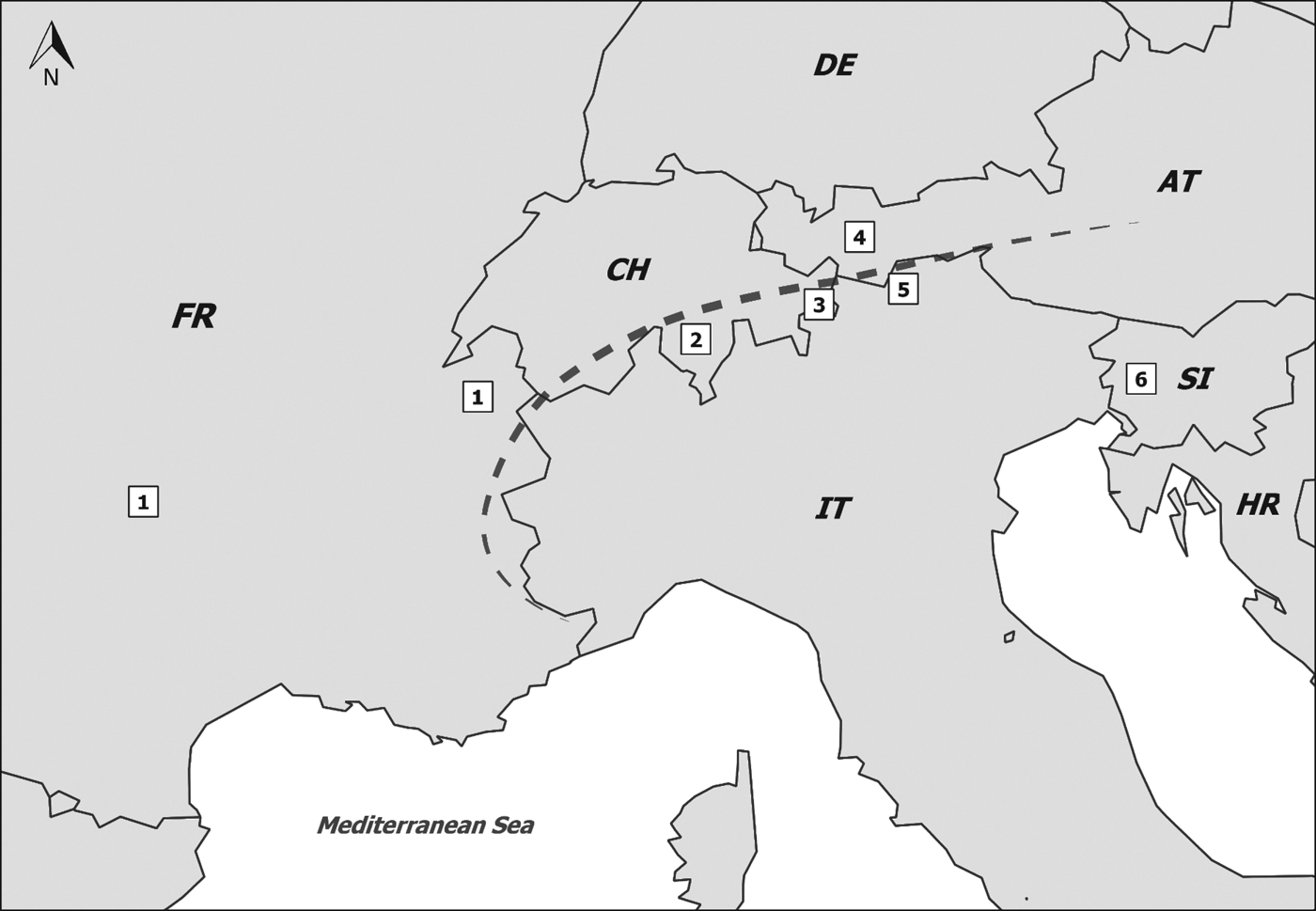
In this study, the southern border of E. multilocularis in Europe is the focus (Fig. 1). The most southern E. multilocularis records in foxes in France are reported in the historically endemic department of Cantal (Deblock et al. Reference Deblock, Pétavy and Gilot1988) and recently further east, in the department of Savoie (Combes et al. Reference Combes, Comte, Raton, Raoul, Boué, Umhang, Favier, Dunoyer, Woronoff and Giraudoux2012). South of the Alps, infected foxes have already been recorded in the cantons of Ticino (Ewald, Reference Ewald1993) and Grisons, Switzerland (Tanner et al. Reference Tanner, Hegglin, Thoma, Brosi and Deplazes2006), and in the very northern part of Italy, in Bolzano and Trento provinces (Manfredi et al. Reference Manfredi, Genchi, Deplazes, Trevisiol and Fraquelli2002; Casulli et al. Reference Casulli, Manfredi, La Rosa, Di Cerbo, Dinkel, Romig, Deplazes, Genchi and Pozio2005). The E. multilocularis endemic areas in northern Italy are adjacent to the Austrian ones, where the parasite seems to be ubiquitously distributed (Duscher et al. Reference Duscher, Pleydell, Prosl and Joachim2006). No records exist further south in the Italian peninsula (Di Cerbo et al. Reference Di Cerbo, Manfredi, Trevisiol, Bregoli, Ferrari, Pirinesi and Bazzoli2008; Magi et al. Reference Magi, Macchioni, Dell'Omodarme, Prati, Calderini, Gabrielli, Iori and Cancrini2009). Towards east and southeast, the parasite is known to be present in Slovenia (Rataj et al. Reference Rataj, Bidovec, Žele and Vengušt2010), Hungary (Sreter et al. Reference Sreter, Szell, Egyed and Varga2003) and in adjacent areas in north-western Romania (Sikó et al. Reference Sikó, Deplazes, Ceica, Tivadar, Bogolin, Popescu and Cozma2011). No foxes were found infected from the north of Croatia (Rajković-Janje et al. Reference Rajković-Janje, Marinculić, Bosnić, Benić, Vinković and Mihaljević2002), but the presence of E. multilocularis metacestodes is described in M. arvalis from the north of Bulgaria (Genov et al. Reference Genov, Svilenov and Polyakova-Krusteva1980).
Distribution of the most southern infections by Echinococcus multilocularis in foxes from the Alps and adjacent regions. AT – Austria; CH – Switzerland; DE – Germany; FR – France; HR – Croatia; IT – Italy; SI – Slovenia. References: 1 – Combes et al. (Reference Combes, Comte, Raton, Raoul, Boué, Umhang, Favier, Dunoyer, Woronoff and Giraudoux2012); 2 – Ewald (Reference Ewald1993); 3 – Tanner et al. (Reference Tanner, Hegglin, Thoma, Brosi and Deplazes2006); 4 – Duscher et al. (Reference Duscher, Pleydell, Prosl and Joachim2006); 5 – Casulli et al. (Reference Casulli, Manfredi, La Rosa, Di Cerbo, Dinkel, Romig, Deplazes, Genchi and Pozio2005); 6 – Rataj et al. (Reference Rataj, Bidovec, Žele and Vengušt2010). The dashed line represents the main Alpine divide.

As mentioned above, abundance and prevalence of E. multilocularis in foxes were shown to have augmented over large areas, e.g. the Netherlands (Takumi et al. Reference Takumi, de Vries, Chu, Mulder, Teunis and van der Giessen2008) or Germany (Berke et al. Reference Berke, Romig and von Keyserlingk2008; Staubach et al. Reference Staubach, Hoffmann, Schmid, Ziller, Tackmann and Conraths2011), respectively. Likewise, a growing incidence is reported for alveolar echinococcosis (AE) in humans. In Switzerland, for example, the incidence of human cases increased 2·5 times between the years 2000–2005 (Schweiger et al. Reference Schweiger, Ammann, Candinas, Clavien, Eckert, Gottstein, Halkic, Muellhaupt, Prinz, Reichen, Tarr, Torgerson and Deplazes2007). A tendency in the increase of AE cases was also documented for Austria (Schneider et al. Reference Schneider, Aspöck and Auer2013) and France (Said-Ali et al. Reference Said-Ali, Grenouillet, Knapp, Bresson-Hadni, Vuitton, Raoul, Richou, Millon and Giraudoux2013). The rising numbers of foxes and the urbanization of the E. multilocularis life cycle in Europe have been pointed out as possible causes for the described patterns (Deplazes et al. Reference Deplazes, Hegglin, Gloor and Romig2004; Fischer et al. Reference Fischer, Reperant, Weber, Hegglin and Deplazes2005; Schweiger et al. Reference Schweiger, Ammann, Candinas, Clavien, Eckert, Gottstein, Halkic, Muellhaupt, Prinz, Reichen, Tarr, Torgerson and Deplazes2007). In Belgium, on the other hand, no emergence of the parasite was detected in foxes during 1996–2008, although the fox population had considerably increased during the same period (Van Gucht et al. Reference Van Gucht, Van Den Berge, Quataert, Verschelde and Le Roux2010). This suggests that the observed trends for E. multilocularis in Europe are heterogeneous and can only partially be explained by changes in the fox population dynamics.
The spatial dynamics of E. multilocularis occurrence and abundance are not well understood and few studies investigated different factors putatively limiting the distribution of this parasite. Mean temperature and humidity, for example, have an impact on egg survival in the environment (Veit et al. Reference Veit, Bilger, Schad, Schäfer, Frank and Lucius1995) and may affect the transmission potential and the infection of intermediate hosts. However, it has to be considered that the role of these hosts depends not only on their infection rates, but also on the fertility of the larval stages and on the extent by which they are predated by definitive hosts. Moreover, the distribution and abundance of intermediate hosts are likewise expected to be key factors for the establishment and maintenance of the life cycle in a given habitat (Giraudoux et al. Reference Giraudoux, Craig, Delattre, Bao, Bartholomot, Harraga, Quéré, Raoul, Wang and Shi2003; Hansen et al. Reference Hansen, Jeltsch, Tackmann, Staubach and Thulke2004; Guislain et al. Reference Guislain, Raoul, Giraudoux, Terrier, Froment, Ferté and Poulle2008; Raoul et al. Reference Raoul, Deplazes, Rieffel, Lambert and Giraudoux2010). The distribution of rodent species is mainly shaped by the availability of suitable habitats and by climatic factors (Giraudoux et al. Reference Giraudoux, Craig, Delattre, Bao, Bartholomot, Harraga, Quéré, Raoul, Wang and Shi2003, Reference Giraudoux, Raoul, Pleydell, Li, Han, Qiu, Xie, Wang, Ito and Craig2013b) as well as by post-glacial range expansion (Braaker and Heckel, Reference Braaker and Heckel2009). Accordingly, a recent study in China demonstrated how key rodent species could be used to describe the distribution ranges of E. multilocularis over large areas (Giraudoux et al. Reference Giraudoux, Raoul, Afonso, Ziadinov, Yang, Li, Li, Quéré, Feng and Wang2013a). However, the distribution of most rodents is rather heterogeneous and rodent community composition can be highly variable over small areas, just like the patchy distribution of E. multilocularis infections in rodents and foxes (Tanner et al. Reference Tanner, Hegglin, Thoma, Brosi and Deplazes2006). In the framework of this study, we investigated the long-term spatial dynamics of E. multilocularis on a small scale in the south of Switzerland and analysed how the observed pattern correlates with the known distribution of autochthonous vole species.
MATERIALS AND METHODS
Study area
This study was conducted in the Canton of Ticino (southern Switzerland) which has a surface area of approximately 2812 km2. Half of the territory is covered by forest, 30% by unproductive areas (i.e. mountains, lakes and rivers), 13% by agricultural areas and 6% by human infrastructures (data: Swiss Federal Statistics Office, www.bfs.admin.ch). There is a predominance of an alpine landscape, with deep valleys and high mountains (altitudes range from 200 to 3400 m).
There are seven Arvicolid species described in Ticino, which are potential intermediate hosts for E. multilocularis: Arvicola amphibius, Chionomys nivalis, M. arvalis, Microtus multiplex, Microtus savii, Microtus subterraneus and Myodes glareolus (Hausser, Reference Hausser1995).
Samples
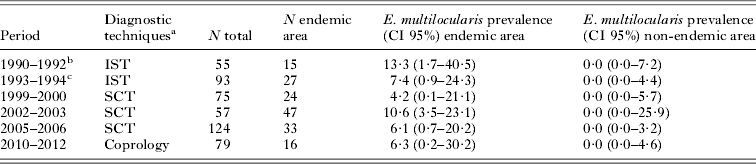
A total of 404 red foxes, obtained from hunters between 1990 and 2006, were analysed. These specimens had been shot in the course of the official hunting seasons and a small percentage (<2%) had been found dead (e.g. road killed). Five time periods were studied: 1990–1992 (Ewald, Reference Ewald1993); 1993–1994 (Alther, Reference Alther1996); 1999–2000; 2002–2003 and 2005–2006 (unpublished results). Sex, age and location were recorded for each animal. Whenever the exact location was not available, the coordinates of the nearest human settlement were used. In order to inactivate taeniid eggs, carcasses were deep-frozen at −80 °C for at least 5 days (Eckert et al. Reference Eckert, Gemmell, Meslin and Pawlowski2001). Helminthological investigations were performed either by the Intestinal Scraping Technique (IST) (Eckert et al. Reference Eckert, Gemmell, Meslin and Pawlowski2001) or by the Sedimentation and Counting Technique (SCT) (Hofer et al. Reference Hofer, Gloor, Muller, Mathis, Hegglin and Deplazes2000) (Table 1).
Echinococcus multilocularis in foxes (n = 404) and fox faecal samples (n = 79) from the Canton Ticino (Switzerland) during 1990–2012
a IST – Intestinal Scraping Technique; SCT – Sedimentation and Counting Technique; Coprology – Sieving and flotation technique and molecular identification.
b Ewald (Reference Ewald1993).
c Alther (Reference Alther1996).
Based on typical morphological characteristics, prevalence rates of some common intestinal helminths were determined: E. multilocularis (for the period 1990–2006), Taenia spp., Mesocestoides spp., hookworms (Uncinaria spp.) and ascarids (Toxocara spp. and Toxascaris leonina) (for the period 1999–2006 only).
During 2010–2012, 79 fox and 23 dog faecal samples were collected in the same study area. Collection was performed between April and November when snow or grass coverage were lowest. Species identification for faecal samples was based on content, morphology, odour and location (Stieger et al. Reference Stieger, Hegglin, Schwarzenbach, Mathis and Deplazes2002). Faecal samples were also frozen at −80 °C for at least 5 days prior to any analysis. Two grams of each sample were screened for taeniid eggs with a sieving-flotation technique (Mathis et al. Reference Mathis, Deplazes and Eckert1996). DNA extraction from positive samples was performed according to Štefanić et al. (Reference Štefanić, Shaikenov, Deplazes, Dinkel, Torgerson and Mathis2004) and a multiplex-PCR for taeniid genus identification was used (Trachsel et al. Reference Trachsel, Deplazes and Mathis2007), with the primer pairs described by the authors. Echinococcus multilocularis positive samples were confirmed by sequencing, after purification with a MinElute PCR purification kit (Qiagen, Hilden, Germany). Sequencing was carried out by Synergene Biotech GmbH, Biotech Centre Zurich, Switzerland (www.synergene-biotech.com) and results compared with GenBank nucleotide database (BLAST; www.blast.ncbi.nlm.nih.gov).
Spatial and statistical analysis
A map with the coordinates of all carcasses and faecal samples was built using the software QuantumGIS version 1.8.0 Lisboa, http://qgis.org/. Official Switzerland borders were obtained from the Swiss Federal Office of Topography (www.swisstopo.admin.ch/; version from 1.1.2013).
The Swiss Biological Records Center (CSCF) (http://lepus.unine.ch/carto/) provides cartographical server information on the known distribution of the Swiss fauna. The distribution maps of the different rodent species, which are provided on the base of a 5×5 km grid, were used for comparisons with the recorded distribution of E. multilocularis in foxes.
The endemic area for E. multilocularis was defined by all grid cells where infections of fox origin were recorded and a buffer zone of 1 cell (5×5 km) around this area therewith accounting for the spatial behaviour of foxes. Fox home-range sizes in different studies on Continental Europe ranged between 0·6–9·3 km2 (Trewhella et al. Reference Trewhella, Harris and McAllister1988; Meia and Weber, Reference Meia and Weber1995). All grid cells outside this area were referred as belonging to a non-endemic area.
As rough indicators of fox predation on rodents, prevalence rates of rodent- and non-rodent-related intestinal helminths were compared between foxes originating from the E. multilocularis endemic and non-endemic areas, using the Chi-square test. Statistical analysis was carried out using SPSS 20.0. Significance value was set as P<0·05.
RESULTS
Between one and five E. multilocularis positive samples were recorded in foxes in every period studied (Table 1). The periodic prevalence rates in the endemic area ranged between 4·2 and 13·3% and the overall rates were 9·5% (IST; 1990–1994) and 7·7% (SCT; 1999–2006). The occurrence of E. multilocularis in fox faecal samples was 6·3% (2010–2012). The presence of E. multilocularis eggs was detected in one out of just four dog faecal samples from the endemic area. For this faecal sample only, the host species was confirmed by a multiplex-PCR (Nonaka et al. Reference Nonaka, Sano, Inoue, Teresa Armua, Fukui, Katakura and Oku2009).
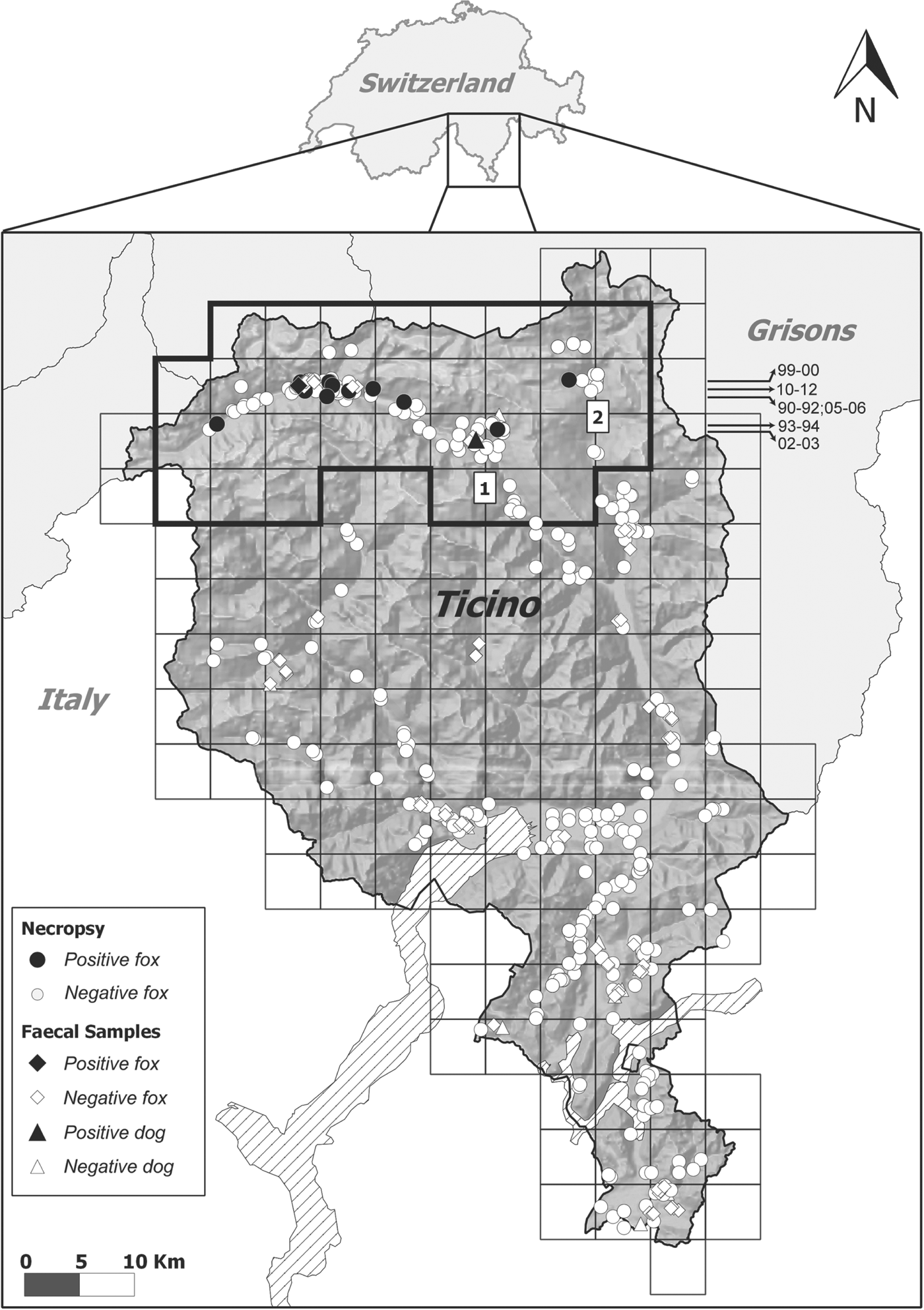
All positive E. multilocularis samples (n = 13) were from an endemic area with approximately 160 km2 in the most northern part of Ticino (Fig. 2), just south of the main Alpine divide. In this area there are two main valleys with north-south orientation that merge further south: Val Leventina in the West and Valle di Blenio in the East (Fig. 2). Most of the positive samples were from Val Leventina and only one from Valle di Blenio. No evident changes in the latitude of the infections were recorded throughout the study periods (Fig. 2). The most southern infected fox was located at latitude 46·49°N (Decimal degrees, WGS84) in Val Leventina. The positive dog sample originated from approximately 2 km southwest from this point.
Echinococcus multilocularis in foxes and dogs from the Canton of Ticino (southern Switzerland) between 1990 and 2012. Grid with 5×5 km cells. The bold gridlines define the endemic area of E. multilocularis. 1 – Val Leventina; 2 – Valle di Blenio. The arrows in the upper right corner depict the latitude of the most southern case in a fox during each studied period.
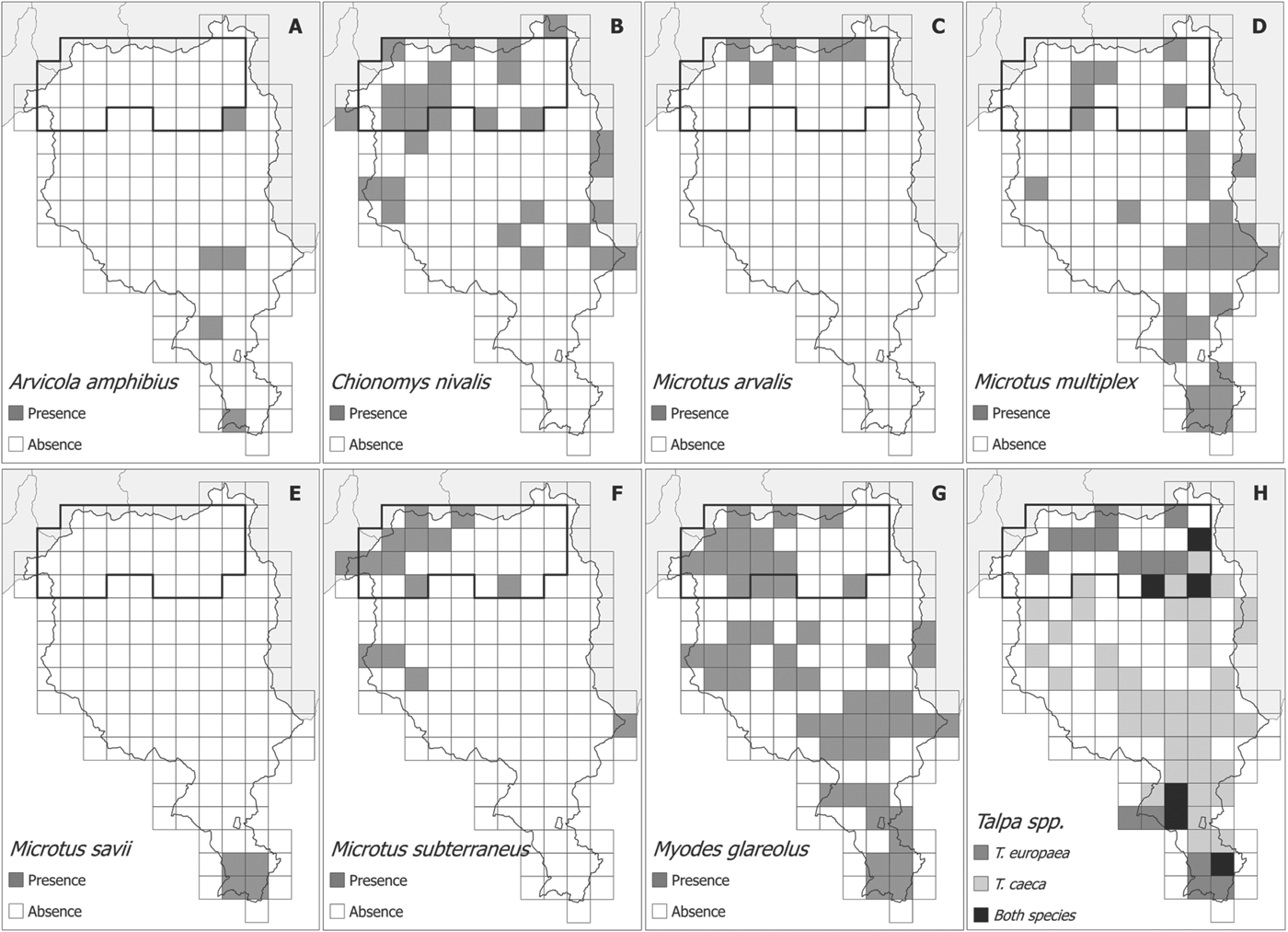
Analysis of rodent communities revealed that M. arvalis is the only species contemporaneously present in the E. multilocularis endemic area and completely absent in the other area (Fig. 3A). Microtus subterraneus was also predominantly recorded in the endemic area, but there are records in two other locations further south (Fig. 3F). The distribution of all other Arvicolids was apparently unrelated to the one of E. multilocularis in foxes, including A. amphibius and M. savii which were present solely in the non-endemic area.
Presence/absence of rodent (A–G) and insectivore (H) species in Ticino (Switzerland). Data obtained from the online cartographical server of the Swiss Biological Records Center (http://lepus.unine.ch/carto/). Grid with 5×5 km cells. Bold gridlines define the endemic area for Echinococcus multilocularis in Ticino (see Fig. 2).
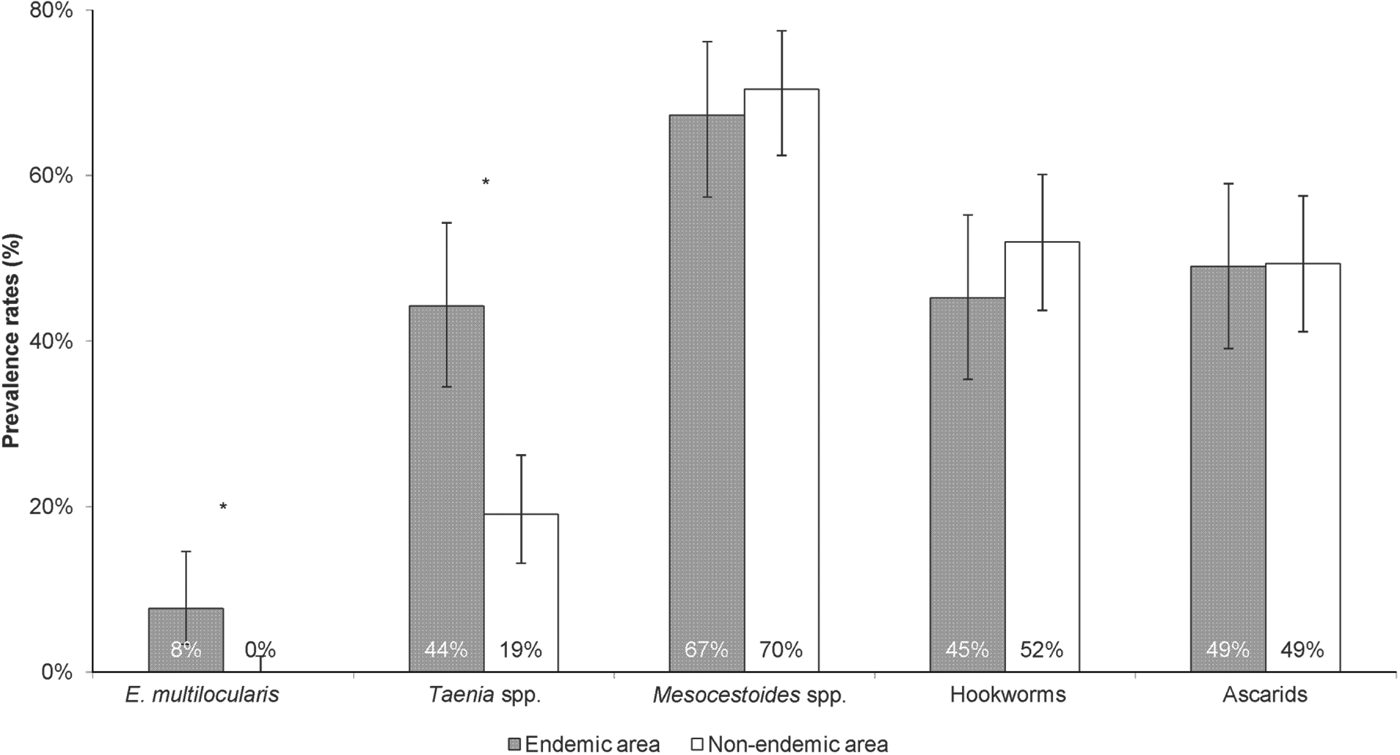
There was a significantly higher prevalence of Taenia species in the E. multilocularis endemic area (Fig. 4). The prevalence rates of Mesocestoides spp., hookworms and ascarids exhibited no differences between the two investigated areas.
Comparison of helminth prevalence rates between foxes from the Echinococcus multilocularis endemic (n = 104) and non-endemic (n = 152) areas in Ticino during 1999–2006. Asterisks: P<0·05 (Chi-square test); error bars: 95% confidence interval.
DISCUSSION
Distribution of E. multilocularis in foxes
Our results give no evidence for a spread of the distribution of E. multilocularis in Ticino over a 20-year period. The infected samples were constantly obtained from a very small geographic area and there were no major changes in their latitude that could suggest a southern spread.
The fact that all 258 foxes investigated from southern areas of Ticino were not infected gives strong evidence that the parasite is absent in this region or only occurs occasionally.
The overall E. multilocularis prevalence in foxes from the endemic area in Ticino is much lower compared with hyper-endemic locations north of the Alps, where prevalence rates higher than 30% have frequently been recorded, e.g. in Switzerland (Brossard et al. Reference Brossard, Andreutti and Siegenthaler2007; Hegglin et al. Reference Hegglin, Bontadina, Contesse, Gloor and Deplazes2007; Reperant et al. Reference Reperant, Hegglin, Fischer, Kohler, Weber and Deplazes2007) or Austria (Duscher et al. Reference Duscher, Pleydell, Prosl and Joachim2006). In fact, the prevalence rate is similar to the ones obtained from other alpine regions, such as the Swiss canton of Grisons (<14·3%) (Tanner et al. Reference Tanner, Hegglin, Thoma, Brosi and Deplazes2006) or the Bolzano and Trento provinces, in northern Italy (<12·9%) (Manfredi et al. Reference Manfredi, Genchi, Deplazes, Trevisiol and Fraquelli2002; Casulli et al. Reference Casulli, Manfredi, La Rosa, Di Cerbo, Dinkel, Romig, Deplazes, Genchi and Pozio2005) (Fig. 1). A north-to-south decreasing gradient of the prevalence rates is evident between the highly endemic areas in northern Switzerland and Austria, and adjacent foci in the South. On these three alpine regions, infected foxes exhibit a patchy distribution coincident with specific valleys. In the Canton of Grisons, infected foxes have been found in the Müstair Valley that is in close connection with an Italian valley in Bolzano, where one of the Italian foci is located (Casulli et al. Reference Casulli, Bart, Knapp, La Rosa, Dusher, Gottstein, Di Cerbo, Manfredi, Genchi, Piarroux and Pozio2009). Since foxes can disperse over large distances (Trewhella et al. Reference Trewhella, Harris and McAllister1988; Meia and Weber, Reference Meia and Weber1995), occasional exchanges of parasites between these two areas are likely.
The first E. multilocularis infections in foxes from Ticino were recorded more than 20 years ago (Ewald, Reference Ewald1993) but no autochthonous human cases have been documented in this region so far.
Autochthonous human AE was reported in two patients from South Tyrol between 1906 and 1922 (Hosemann et al. Reference Hosemann, Schwarz, Lehmann, Posselt and Küttner1928) nearby the location of reported infections in foxes from northern Italy. This may shed some light on the age and dynamics of these different alpine E. multilocularis foci that seem rather stable and not a result of a recent spread.
Rodent species distribution and fox predation on rodents
The analysis of the distribution areas of the vole species in Ticino gives evidence that M. arvalis is likely to act as the most important intermediate host for E. multilocularis in this Canton. Its apparent absence from the non-endemic area may be a limiting factor for the parasite's spread. Other rodent species present in both areas may also act as intermediate hosts. Microtus subterraneus is mostly found in the E. multilocularis endemic area but also in a few locations in the non-endemic area. There is a record of E. multilocularis infection in this species, i.e. one out of 169 necropsied specimens in France (Delattre et al. Reference Delattre, Giraudoux and Quéré1990), but no other extensive studies have been carried out so far. Although M. subterraneus is not a very abundant vole (Hausser, Reference Hausser1995), the number of foxes collected from these locations in the non-endemic area is too small to completely discard its relevance as an intermediate host. Conversely, M. glareolus, which has been described as a potential intermediate host for E. multilocularis (Bonnin et al. Reference Bonnin, Delattre, Artois, Pascal, Aubert and Petavy1986; Stieger et al. Reference Stieger, Hegglin, Schwarzenbach, Mathis and Deplazes2002) has a distribution that is clearly unrelated to E. multilocularis infections in foxes. Maybe due to low densities or because they are not as important in foxes’ diet, the presence of this and of the other rodent species in the non-endemic area seems to be insufficient to maintain the parasite's life cycle. The former species A. terrestris, an important intermediate host for E. multilocularis, has been reclassified into A. scherman and A. amphibius (Wilson and Reeder, Reference Wilson and Reeder2005). Arvicola scherman, absent in Ticino, is abundant in E. multilocularis highly endemic areas. For example, in Zurich, Switzerland, high prevalence rates of infection (up to 40·6–78·5% in some areas) with fertile metacestodes (overall 9·3%) have been documented in this species (Burlet et al. Reference Burlet, Deplazes and Hegglin2011). Interestingly, in our study A. amphibius was located exclusively in the E. multilocularis non-endemic area in Ticino. In contrast to A. scherman, this species reaches regions far outside the known endemic area of E. multilocularis in Europe. It is a semi-aquatic species associated with wetlands, rivers and ponds (Hausser, Reference Hausser1995) and this environment may protect it from fox predation. While A. scherman can be considered an important intermediate host, according to our study, the relevance of A. amphibius for the E. multilocularis life cycle in this region is questionable.
In the Massif Central, France, in an area of roughly 5000 km2, Deblock et al. (Reference Deblock, Pétavy and Gilot1988) defined a border between an endemic and a non-endemic area for E. multilocularis, based on the necropsies of foxes. This endemic area corresponded to locations where infected Arvicola sp. were previously recorded. Unfortunately, the authors did not describe the distribution of the other rodent species which derails possible relationships between the distribution of potential intermediate hosts and the observed pattern for E. multilocularis in foxes.
Another key factor to understand the role of different intermediate hosts in the parasite's life cycle is the fox predation rate. Foxes exhibit a dietary plasticity that is nonetheless related to a preference for certain prey (Macdonald, Reference Macdonald1977; Hegglin et al. Reference Hegglin, Bontadina, Contesse, Gloor and Deplazes2007). In Zurich, Switzerland, although burrow systems of M. arvalis were far less frequently recorded than the ones from A. scherman, the frequency of both species’ remains in fox stomachs was similar (Hegglin et al. Reference Hegglin, Bontadina, Contesse, Gloor and Deplazes2007). In other highly endemic areas for E. multilocularis in France, M. arvalis was the most common prey (Guislain et al. Reference Guislain, Raoul, Giraudoux, Terrier, Froment, Ferté and Poulle2008) and foxes exhibited a predatory preference for it (Raoul et al. Reference Raoul, Deplazes, Rieffel, Lambert and Giraudoux2010). In the Müstair Valley, where no Arvicola species are recorded, E. multilocularis in foxes was likely associated with predation on Microtus species (Tanner et al. Reference Tanner, Hegglin, Thoma, Brosi and Deplazes2006). However, a study in western Switzerland showed that A. scherman can also be the most common prey of foxes (Weber and Aubry, Reference Weber and Aubry2009) and is likely to act as a key species for the parasite's transmission in certain areas. Unlike other less predated Arvicolids, A. scherman and M. arvalis are known agricultural pests. They inhabit meadows and pastures and develop pluriannual population cycles, reaching as many as 1000 and 2500 individuals ha−1, respectively (Hausser, Reference Hausser1995).
The analysis of other helminths’ frequency in foxes may deliver some more information on their diet. Interestingly, Taenia spp. occurred more frequently in foxes from the E. multilocularis endemic area (Fig. 4). Taenia crassiceps and Taenia polyacantha are the most common Taenia species in foxes from Ticino (Ewald, Reference Ewald1993). Like E. multilocularis, both species have a dixenous life cycle, in which rodents are the most important intermediate hosts. Microtus arvalis is considered the most susceptible intermediate host for T. crassiceps (Rietschel, Reference Rietschel1981) and is also an intermediate host for T. polyacantha (Jones and Pybus, Reference Jones, Pybus, Samuel, Pybus and Kocan2001). In the Canton of Thurgau, Switzerland, a study on helminths of rodent species succeeded in finding both T. polyacantha and T. crassiceps in M. arvalis (Schaerer, Reference Schaerer1987). There were significant differences between this species and M. glareolus, in which no infections were found. The higher number of Taenia spp. infections in the E. multilocularis endemic area may be related to the availability of susceptible intermediate hosts, such as M. arvalis, thus reinforcing its relevance in the foxes’ diet and in the E. multilocularis life cycle. In contrast, helminths with life cycles not dependent on microtine species exhibited no spatial segregation.
Limiting factors for the spread of E. multilocularis
Geographic barriers have been impacting the spread and distribution of rodents for a long time (Braaker and Heckel, Reference Braaker and Heckel2009). After the Last Glacial Maximum (LGM), which took place more than 200 000 years ago, animal and plant species were able to recolonize previously frozen regions (Sommer and Nadachowski, Reference Sommer and Nadachowski2006). The current distribution of these species was strongly affected by the outcome of these events. The migration patterns of foxes and intermediate hosts after the LGM and the gradual colonization of different areas may help in the understanding of the current distribution of E. multilocularis and the patchy arrangement of infected foxes in the Alps. In a work by Braaker and Heckel (Reference Braaker and Heckel2009), mitochondrial DNA of different M. arvalis isolates revealed that the post-glaciation migrations of this species might have occurred upwards from Italy through the valleys of the bigger rivers in Switzerland. It is surprising to see that the postulated main routes of migration overlap with the valleys where E. multilocularis was found in Ticino (this paper) and in Grisons (Engadin and Bregaglia valleys) (Tanner et al. Reference Tanner, Hegglin, Thoma, Brosi and Deplazes2006). These findings seem to reinforce the hypothesis of M. arvalis relevance for E. multilocularis in these regions or at least reflect areas where the contact between definitive and intermediate hosts has occurred long enough to allow the establishment of a parasitic life cycle.
Analysis of the distribution of other species can help clarify the impact of geographic barriers. Talpa caeca and Talpa europaea are insectivores that often share the habitat with M. arvalis and A. terrestris (Giraudoux et al. Reference Giraudoux, Craig, Delattre, Bao, Bartholomot, Harraga, Quéré, Raoul, Wang and Shi2003; Delattre et al. Reference Delattre, Clarac, Melis, Pleydell and Giraudoux2006). In Ticino, these two Talpa species have a segregated distribution (Fig. 3H). Maddalena et al. (Reference Maddalena, Maurizio and Moretti2000) documented a clear border in Val Leventina, mostly due to geographic barriers. This border was set around latitude 46·42°N coincident with the border of the endemic area for E. multilocularis obtained in the present study. Since M. arvalis is a grassland rodent, it is reasonable to assume that in Val Leventina the border features for the Talpa species would also be valid for M. arvalis, preventing it from spreading further south. If M. arvalis is the most important intermediate host for E. multilocularis in Ticino, its circumscription to the north of the canton would prevent the parasite from establishing on more southern areas where no key intermediate host is present.
Climatic variables in Ticino, such as temperature and rainfall, are distinct between the very northern mountain valleys and the more temperate lakeside pastures in the south. This north-south gradient in temperature and humidity could act as an adjuvant in balancing the stable epidemiological situation for E. multilocularis. However, as seen in Fig. 1, foxes have been found infected even in regions south from Ticino. This shows that climate is not per se an absolute exclusion factor for the distribution of the parasite in Europe and that other variables, such as the distribution of rodent communities, should be henceforth more frequently considered.
ACKNOWLEDGEMENTS
To Tiziano Maddalena, Simon Capt and Jürg Paul Müller for the valuable comments on the rodents’ distribution in Ticino. Also, to Laura Lurati for collecting part of the faecal samples and to Alexander Mathis for comments on the manuscript. This study represents the dissertation of Diogo Guerra, veterinarian.
FINANCIAL SUPPORT
This work was supported by the Federal Food Safety and Veterinary Office (FSVO) of Switzerland, by the EMIDA-ERA NET framework, and is within the scope of the EMIRO project ‘The significance of rodent communities for the distribution of Echinococcus multilocularis: ecological and experimental investigations’ (grant number 1.12.18 EMIDA EMIRO).