





1. Introduction
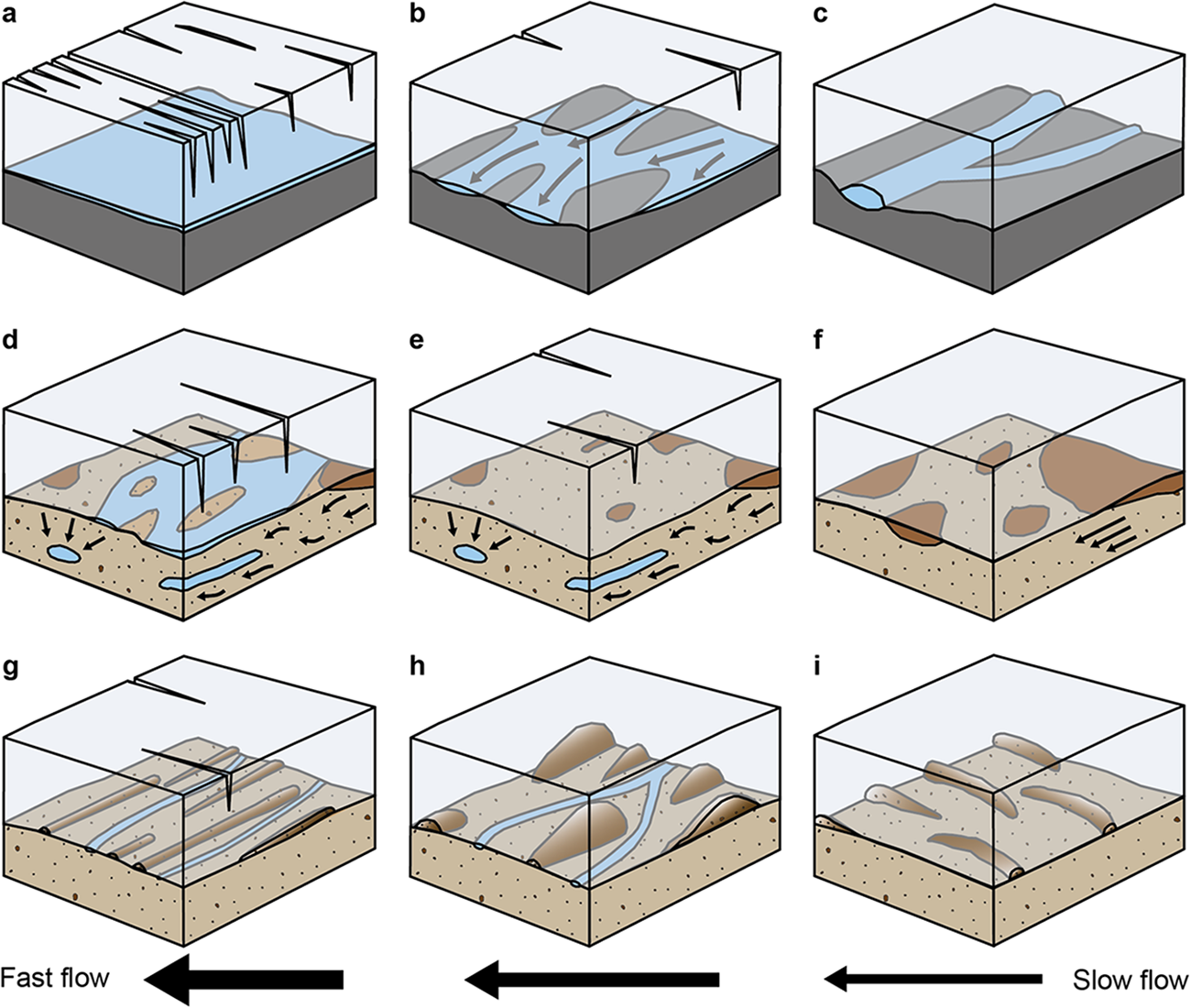
Instability in glacial systems describes the unpredictable behaviour and sometimes erratic changes in ice sheets and glaciers during ice streaming and surging. Interest in fast flow and instability has increased in recent years due to their importance for predicting and estimating glacier and ice sheet response to a changing climate (Bennett, Reference Bennett2003; Kjær and others, Reference Kjær2006; Nuth and others, Reference Nuth2019). The mechanisms behind fast flow and instability are driven by subglacial processes, sliding and basal deformation, making understanding and characterising conditions at the ice–bed interface key to constraining this erratic behaviour (Fig. 1) (Boulton and Hindmarsh, Reference Boulton and Hindmarsh1987; Fischer and Clarke, Reference Fischer and Clarke2001; Kjær and others, Reference Kjær2006).
Transitions between slow and fast ice flow driven by basal deformation and basal sliding due to changes in subglacial hydrology and roughness. (a) Transition between inefficient sheet flow promoting fast ice flow, to (b) a system of more efficient connected channels, to (c) a fully channelised system resulting in slow ice flow. (d) Transition between highly deformable oversaturated till with high pore water pressure promoting fast flow, to (e) a reduction in water pressure and stiffening of till, to (f) an unsaturated stiff till resulting in slow ice flow. (i-h) n ice sheets and ice streams, large macro-scale roughness with large and/or transverse perturbations dominates in interior slow flow regions. (j) Further downstream areas of low macro-scale roughness promote fast flow resulting in the formation of more linear streamlined bedforms.
However, some of these instabilities and fast flow conditions have been difficult to predict with current theory. For example, the instability observed in surging glaciers around the world cannot be explained in a unified way by (i) the hydrological switch model (e.g. Kamb and others, Reference Kamb1985, Kamb, Reference Kamb1987), (ii) the thermal switch model (e.g. Robin, Reference Robin1955; Murray and others, Reference Murray2000; Sevestre and others, Reference Sevestre, Benn, Hulton and Bælum2015) nor (iii) the enthalpy balance model (e.g. Benn and others, Reference Benn, Fowler, Hewitt and Sevestre2019a, Reference Benn, Jones, Luckman, Fürst, Hewitt and Sommer2019b, Reference Benn, Hewitt and Luckman2023), suggesting there are a number of factors at play that are still to be fully considered. A single surge theory becomes increasingly difficult when we are also made to consider friction laws and hydrology of most glacial systems (Benn and others, Reference Benn, Hewitt and Luckman2023). This is particularly the case where soft-bed dynamics could be driving parts of the surge mechanism. In larger ice sheets, ice stream flow is also heterogeneous, showing degrees of instability with flow speeds varying over spatial and temporal scales (Stokes and others, Reference Stokes, Clark, Lian and Tulaczyk2007). Ice stream instability takes the form of ‘switch on’ and ‘switch off’ events, as well as changes to ice stream positioning (Conway and others, Reference Conway, Catania, Raymond, Gades, Scambos and Engelhardt2002; Joughin and others, Reference Joughin, Abdalati and Fahnestock2004; Dowdeswell and others, Reference Dowdeswell, Ottesen and Rise2006; Ó Cofaigh and others, Reference Ó Cofaigh, Evans and Smith2010; Winsborrow and others, Reference Winsborrow, Clark and Stokes2010). There are a number of possible mechanisms for this, from topographic controls (e.g. McIntyre, Reference McIntyre1985) the presence of sticky spots caused by bedrock bumps (e.g. Schoof, Reference Schoof2002; McKenzie and others, Reference McKenzie, Miller, Slawson, MacKie and Wang2023), an absence of till (e.g. Alley, Reference Alley1993; Ashmore and others, Reference Ashmore, Bingham, Hindmarsh, Corr and Joughin2014), well-drained till (e.g. Anandakrishnan and Bentley, Reference Anandakrishnan and Bentley1993; Anandakrishnan and Alley, Reference Anandakrishnan and Alley1994; Boulton and others, Reference Boulton, Dobbie and Zatsepin2001; Ashmore and others, Reference Ashmore, Bingham, Hindmarsh, Corr and Joughin2014) and localised freeze-on (e.g. Anandakrishnan and Alley, Reference Anandakrishnan and Alley1997; Vogel and others, Reference Vogel2005; Stokes and others, Reference Stokes, Clark, Lian and Tulaczyk2007).
However, one factor that has remained difficult to observe and parametrise in our existing theories is the micro- and macro-scale sedimentological properties of the till (Kyrke-Smith and others, Reference Kyrke-Smith, Gudmundsson and Farrell2018; Narloch and others, Reference Narloch, Phillips, Piotrowski and Ćwiek2020). The complex nature of sediment and sediment interactions at a micro-scale means that even in a ‘simple’ homogeneous till model basal deformation and sediment failure could occur through grain boundary sliding, rolling and larger granular flows (Fowler, Reference Fowler2003; Minchew and Meyer, Reference Minchew and Meyer2020). Furthermore, the interface physics of wettability, a recently rapidly developing field of surface physics (e.g. Lafuma and Quéré, Reference Lafuma and Quéré2003; Quéré, Reference Quéré2008; Gao and Yan, Reference Gao and Yan2009; Nosonovsky, Reference Nosonovsky2011; McHale and others, Reference McHale, Ledesma-Aguilar and Wells2020) has rarely been considered in glacial environments. We propose that expanding our considerations of potential mechanisms driving fast glacier flow may help to explain some fast flow, surging and ice streaming observations.
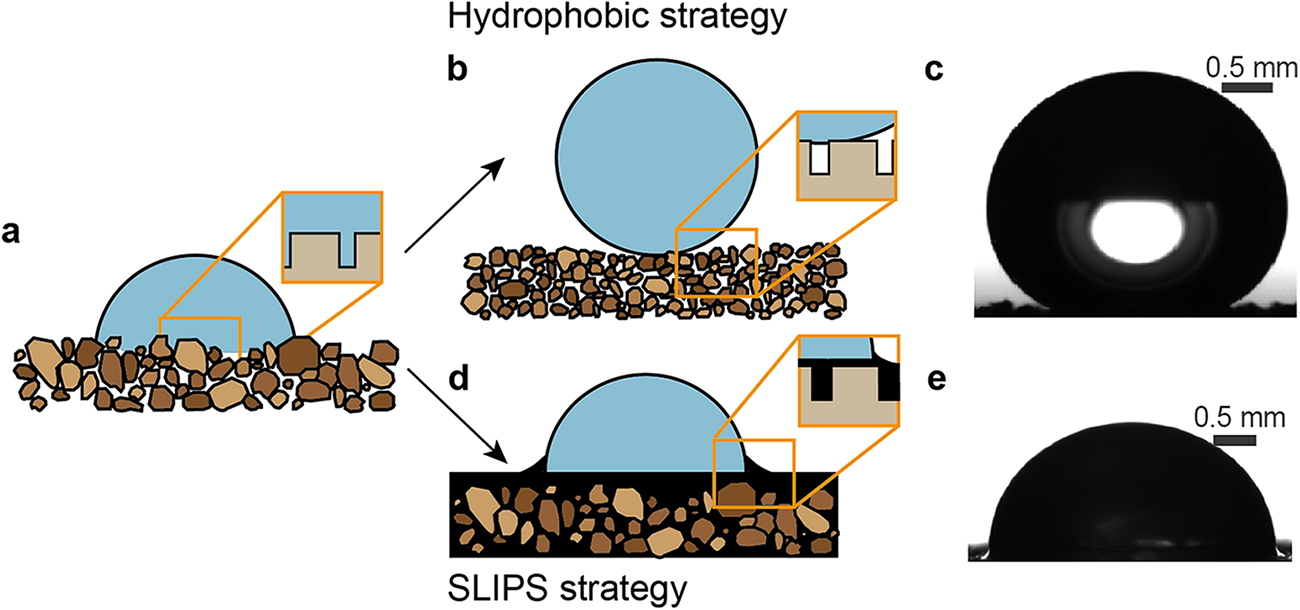
In both materials science and sedimentology, it is widely understood that the interaction of water with a surface or substrate is dependent on two distinct properties, (i) the physical properties (roughness, texture or porosity) and (ii) the wetting properties (the extent of hydrophobicity or hydrophilicity) (Cassie and Baxter, Reference Cassie and Baxter1944; de Gennes, Reference de Gennes1985; Adamson and Gast, Reference Adamson and Gast1997; Quéré, Reference Quéré2008; Shirtcliffe and others, Reference Shirtcliffe, McHale, Atherton and Newton2010). In extreme cases, hydrophobicity in combination with surface roughness or porosity can create super slippery surfaces, such as superhydrophobicity where air acts as a lubricant (Barthlott and Neinhuis, Reference Barthlott and Neinhuis1997; Neinhuis and Barthlott, Reference Neinhuis and Barthlott1997). Alternatively, surface roughness or porosity may be impregnated by a lubricant liquid to create a slippery liquid-infused porous surfaces (SLIPS) (Lafuma and Quéré, Reference Lafuma and Quéré2011; Wong and others, Reference Wong2011). In these cases, extreme water-repellent and water-shedding surfaces can be created (Fig. 2) (McHale and others, Reference McHale, Ledesma-Aguilar and Wells2020).
Hydrophobic slippery liquid-infused porous surfaces (SLIPS) strategies to create slippery surfaces in sediments: (a, b) Hydrophobic strategy initiated by high aspect ratio roughness/texture with hydrophobic solids to reduce liquid–solid contact. (c) Corresponding photograph of a droplet on clay-silt sized particles with a hydrophobic geochemistry. (a–d) SLIPS strategy initiated by the introduction of a lubricant such as oil or biofilm into the surface roughness/texture to convert to liquid–lubricant/solid or liquid–lubricant contact. (e) Corresponding photograph of a droplet on a clay-silt sized particle with a hydrophobic geochemistry and oil impregnation.
Superhydrophobicity in sediments has been proposed by McHale and others (Reference McHale, Newton and Shirtcliffe2005, Reference McHale, Shirtcliffe, Newton, Pyatt and Doerr2007) and Shirtcliffe and others (Reference Shirtcliffe, McHale, Atherton and Newton2010). It has also been physically modelled by McCerery and others (Reference McCerery, Woodward, McHale, Winter, Armstrong and Orme2021), which demonstrated the formation of air plastrons between individual sediment particles supporting water droplets and enhancing water-shedding abilities. It has also been observed that a finer particle size sediment will exhibit more extreme hydrophobicity with the potential for superhydrophobicity and SLIPS on fine-silt size particles (Hamlett and others, Reference Hamlett2011; McCerery and others, Reference McCerery, Woodward, McHale, Winter, Armstrong and Orme2021). Previous works on fluvial and marine sediments containing microbial biofilms have also shown improved abilities to buffer shear stresses compared to biofilm-free sediments as they behave as an elastic membrane (Vignaga and others, Reference Vignaga, Sloan, Luo, Haynes, Phoenix and Sloan2013; Chen and others, Reference Chen2017).
Here, we review the current literature on sediment wettability and super slippery surfaces and we use this knowledge to suggest a series of possible models by which glacial sediment could become super slippery in the context of grain size, geochemistry, oil mobilisation and microbial action. By investigating each of these in turn, and collectively, we propose a novel way to explain observable instability in some glaciers and ice sheets. It is important to note that we do not set out to apply this to all fast-flowing ice, or all glaciers that experience flow instability. We do propose new ways by which till could inherit slipperiness properties and provide theoretical models for the consequences on flow behaviour and suggest this warrants further consideration and field investigation.
2. Mechanisms for super slipperiness in glacial systems
Here we focus on two types of super slippery surfaces that could exist in sediments and glacial tills: superhydrophobicity and SLIPS. Each mechanism uniquely alters the proportion of the solid–liquid interface using air or liquid lubrication to enhance water shedding.
2.1. Sediment grain sizes
A necessary condition for super slipperiness in sediments is an appropriate grain size and shape. Physical modelling by McCerery and others (Reference McCerery, Woodward, McHale, Winter, Armstrong and Orme2021) showed that the ideal grain size to meet the material physics definitions of super slipperiness was clay-silt sized particles, although extreme water repellence was also observed on sand grain sizes (Fig. 2a–c). The smaller particle sizes are able to support super slipperiness through the enhanced roughness structure and the optimally sized gaps between individual particles which reduce the solid–liquid contact. In direct soil systems studies, it has been demonstrated that sand-sized grains are optimal for inducing hydrophobic properties, however this is mainly associated with the supply of the hydrophobic geochemistry and reduced surface area of sand-sized particles as opposed to finer particle sizes being less hydrophobic (e.g. Doerr and others, Reference Doerr, Shakesby and Walsh1996, Reference Doerr, Ritsema, Dekker, Scott and Carter2007; de Jonge and others, Reference De Jonge, Jacobsen and Moldrup1999; McHale and others, Reference McHale, Shirtcliffe, Newton, Pyatt and Doerr2007).
In glacial systems, these grain sizes are provided by glacial erosion of the underlying substrate. The evolution of till through the subglacial system exposes rocks and sediments to repeated abrasion and shearing processes constantly resupplying fines to the ice–bed interface (Hooke and Iverson, Reference Hooke and Iverson1995; Altuhafi and Baudet, Reference Altuhafi and Baudet2011). This constant resupply means there is often freshly eroded material within the grain size range of clay-silt and sand sized particles that can exhibit super slipperiness under the right conditions.
2.2. Inherited hydrophobic geochemistry
One possible mechanism for creating super slipperiness at the glacier bed is through inherited historic processes creating hydrophobic chemistry in sediments prior to glaciation. Hydrophobicity can be induced though chemical coatings on sediments from organic matter (Doerr and others, Reference Doerr, Ritsema, Dekker, Scott and Carter2007; Hallett, Reference Hallett2007; Mao and others, Reference Mao, Nierop, Rietkerk, Sinnighe and Dekker2016) and/or deposition of volatile organic compounds from wildfires (DeBano and Krammes, Reference DeBano and Krammes1966; Doerr and others, Reference Doerr, Shakesby, Blake, Chafer, Humphreys and Wallbrink2006). The presence of organic compounds and their inherent hydrophobic properties also extends into sediments originating from organic-rich sedimentary rocks such as shales and coals which are rich in preserved organic material (Hedges and Keil, Reference Hedges and Keil1995; Cai and others, Reference Cai, Cai, Liu, Wang, Zeng and Wang2023).
The type or style of sediment failure associated with hydrophobicity in soils and sediments is also partly controlled by where in the soil or sediment profile the hydrophobicity occurs. During a rainfall event, where the hydrophobicity is buried beneath a wettable layer, the surface sediment will become oversaturated as water is not able to percolate past the hydrophobic layer (Gabet, Reference Gabet2003; Parise and Cannon, Reference Parise and Cannon2012). This results in discrete mobilisation of the oversaturated material forming a discrete shallow landslide and debris flows (Parise and Cannon, Reference Parise and Cannon2012). Where a hydrophobic layer is present on the surface of the soil, rainwater erosion of the material results in increased rilling and sheet-wash (Parise and Cannon, Reference Parise and Cannon2012). This has the potential to initiate large debris flows from continued sediment entrainment and incorporation into water (Parise and Cannon, Reference Parise and Cannon2012; Wall and others, Reference Wall, Roering and Rengers2020).
Wildfires frequently occur in Arctic shrub tundra and boreal forests (Higuera and others, Reference Higuera, Brubaker, Anderson, Brown, Kennedy and Hu2008; Rocha and others, Reference Rocha2012; Dietze and others, Reference Dietze2020). Furthermore, rapid changes in climate (common in glacial-interglacial transitions), can influence wildfire frequency by affecting (i) the frequency and intensity of precipitation, (ii) changes in spring and summer temperatures and (iii) the amount of biomass available for burning (Marlon and others, Reference Marlon2009). Changes in fire frequency are observed in charcoal records from the most recent interglacial transition (15–10 ka) in North America and show an increase in wildfires during the most abrupt shifts in climate (Marlon and others, Reference Marlon2009). This would have created hydrophobic coatings in sediments at glacial margins during interglacial periods. Hydrophobicity within glacial sediments could therefore occur at the surface during glacier advance or be buried beneath more wettable sediments and re-exposed during glacial erosion. This may explain some of the surging glacier lobes at the margins of former ice sheets such as the Laurentide Ice Sheet and the Barents-Kara Ice Sheet, where the margins were underlain by permafrost sediments, which are likely to have wildfire coatings and some degree of inherited hydrophobicity.
2.3. Oil contamination and mobilisation
The second possible mechanism of slipperiness at the glacier bed is through oil contamination and mobilisation. The hydrocarbons present in oil and gas deposits can create a hydrophobic chemistry and in the fluid form they also create a lubricating layer immiscible to water acting as a SLIPS. Hydrocarbons can enter the environment as one-off events, or through the action of repeated glaciations. Hydrocarbon presence is common in large sedimentary basins, such as the North Sea and Barents Sea with isostatic changes caused by the Eurasian Ice Sheet Complex, resulting in the re-routing of hydrocarbon pathways and natural hydrocarbon spillages (Zieba and Grøver, Reference Zieba and Grøver2016; Fjeldskaar and Amantov, Reference Fjeldskaar and Amantov2018; Løtveit and others, Reference Løtveit, Fjeldskaar and Sydnes2019; Cathles and Fjeldskaar, Reference Cathles and Fjeldskaar2020). Oil may also enter the ice–bed interface through glacial erosion, exposing oils within sedimentary basins. It is thought that one of the most important events leading to the development of surface oil deposits in the Athabasca region of Alberta, Canada, was glacial erosion, and glacial lake drainage which eroded and mobilised oil sands deposits (Paragon Soils and Environmental Consulting, 2006). Previous work has indicated that glacial erosion by the Laurentide Ice Sheet not only exposed oil deposits at the original source but that glacial erosion also mobilised oil sands materials—as they are present in glacial tills south of their original source in northern Alberta (e.g. Andriashek and Pawlowicz, Reference Andriashek and Pawlowicz2002; Paragon Soils and Environmental Consulting, 2006; Andriashek, Reference Andriashek2018; McCerery and others, Reference McCerery, Woodward, Winter, Esegbue, Jones and McHale2023, Reference McCerery, Esegbue, Jones, Winter, McHale and Woodward2024). This suggests that glacially mobilised oil may be widespread, at the ice–bed interface, particularly in areas that have oil deposits close to the surface and/or in regions which have experienced substantial isostatic change and resultant re-working and remobilisation of sediments.
2.4. Microbial action
A third possible mechanism of hydrophobicity at the glacier bed is through the action of certain microbes and their biofilms. Whilst some components of biofilms are hydrophilic, others can also exhibit hydrophobic properties (Rosenberg and others, Reference Rosenberg, Gutnick and Rosenberg1980), and communities can respond to environmental stress by creating hydrophobic compounds such as extracellular polymeric substances (Seaton and others, Reference Seaton2019). In large enough quantities, biofilms can also give rise to bio-clogging in porous surfaces (Lee and others, Reference Lee, Lee, Yun, Koh, Kim, Han and Unno2019). In these cases, the cohesive nature and accumulation of biofilm in pores results in the lowering of the permeability of a surface or sediment (Lee and others, Reference Lee, Lee, Yun, Koh, Kim, Han and Unno2019; Gerbersdorf and others, Reference Gerbersdorf2020). This is particularly true in finer grained sediments where biofilms generate a less erodible, smoother sediment with lower hydraulic roughness (Gerbersdorf and others, Reference Gerbersdorf2020).
The subglacial zone is a low biomass environment (i.e. Skidmore and others, Reference Skidmore, Anderson, Sharp, Foght and Lanoil2005; Kaštovská and others, Reference Kaštovská, Stibal, Šabacká, Černá, Šantrůčková and Elster2007; Boetius and others, Reference Boetius, Anesio, Deming, Mikucki and Rapp2015), and thus such a hydrophobic mechanism may be rare. However, any developed hydrophobicity would impact the slipperiness of the surface, as well as the wettability and roughness properties of the glacier bed, changing the proportion of sliding at the ice–bed interface and the amount of basal deformation occurring in the system.
3. Potential implications of super slipperiness in glacial systems
3.1. Hydrophobic sediment
Previous research on soil–water interactions demonstrates that a reduction in the wettability of a sediment results in a reduction in the total water storage and runoff acceleration (Chau and others, Reference Chau, Biswas, Vujanovic and Si2014; Zheng and others, Reference Zheng, Laurenҫo, Cleall, Chui, Ng and Millis2017; Müller and others, Reference Müller, Mason, Strozzi, Simpson, Komatsu, Kawamoto and Clothier2018). In the glacial environment, this physical process could result in lower till permeability and infiltration, leading to water pooling at the ice–bed interface. Where particle sizes are sufficiently small there is also potential for the formation of superhydrophobicity whereby pockets of air between the sediment particles acts as a lubricating interface. In cases where the till is fully saturated with all solid surfaces completely wetted and air–water–solid three-phase contact lines, superhydrophobicity could not occur. A layer of low wettability sediment will have different implications on glacier flow depending on where in the till profile the hydrophobicity occurs.
Where low wettability till occurs at the ice–bed interface (Fig. 3a–c), water infiltration into the sediment below would be impeded. With consistent delivery of water to the bed and little opportunity for infiltration, an increase in basal water pressure will occur as the water cannot be drained efficiently and ice–bed decoupling, and enhanced glacier sliding will ensue. This model also builds upon the scientific understanding of fast ice flow driven by a thin film of water at the ice–bed interface (e.g. Weertman, Reference Weertman1957, Reference Weertman1964, Reference Weertman1979; Bindschadler, Reference Bindschadler1983; Alley, Reference Alley1989; Piotrowski and Tulaczyk, Reference Piotrowski and Tulaczyk1999), which, as shown here, can occur on soft beds with an appropriate hydrophobic chemistry without the need for a fully saturated or hard glacier bed.
Schematic diagram of the hypothesised hydrophobic and slippery liquid-infused porous surfaces (SLIPS) scenarios at the glacier bed. In the first model of hydrophobicity, (a–c) a hydrophobic sediment layer at the ice–bed interface impedes water infiltration and enhances basal sliding through ice–bed decoupling. The gradual degradation of the hydrophobic layer results in resumed infiltration and a recoupling of the ice and bed. Alternatively, if the hydrophobic sediment layer occurs within the till profile, (d–f) an oversaturated sediment would form at the ice–bed interface. This would result in a thin layer of enhanced basal deformation, before complete degradation of the hydrophobic layer results in resumed infiltration further down the till profile and a reduction in the degree of basal deformation. In a SLIPS system facilitated by oil or biofilms, (g–i) sediment particles can create a water–oil interface or a slippery biofilm interface between the individual sediment particles. Under the pressure of overlying ice the sediment bed would be able to deform, generating a hypermobile slurry through the creation of a SLIPS between the individual grains (figure adapted from McCerery and others, Reference McCerery, Woodward, Winter, Esegbue, Jones and McHale2023).
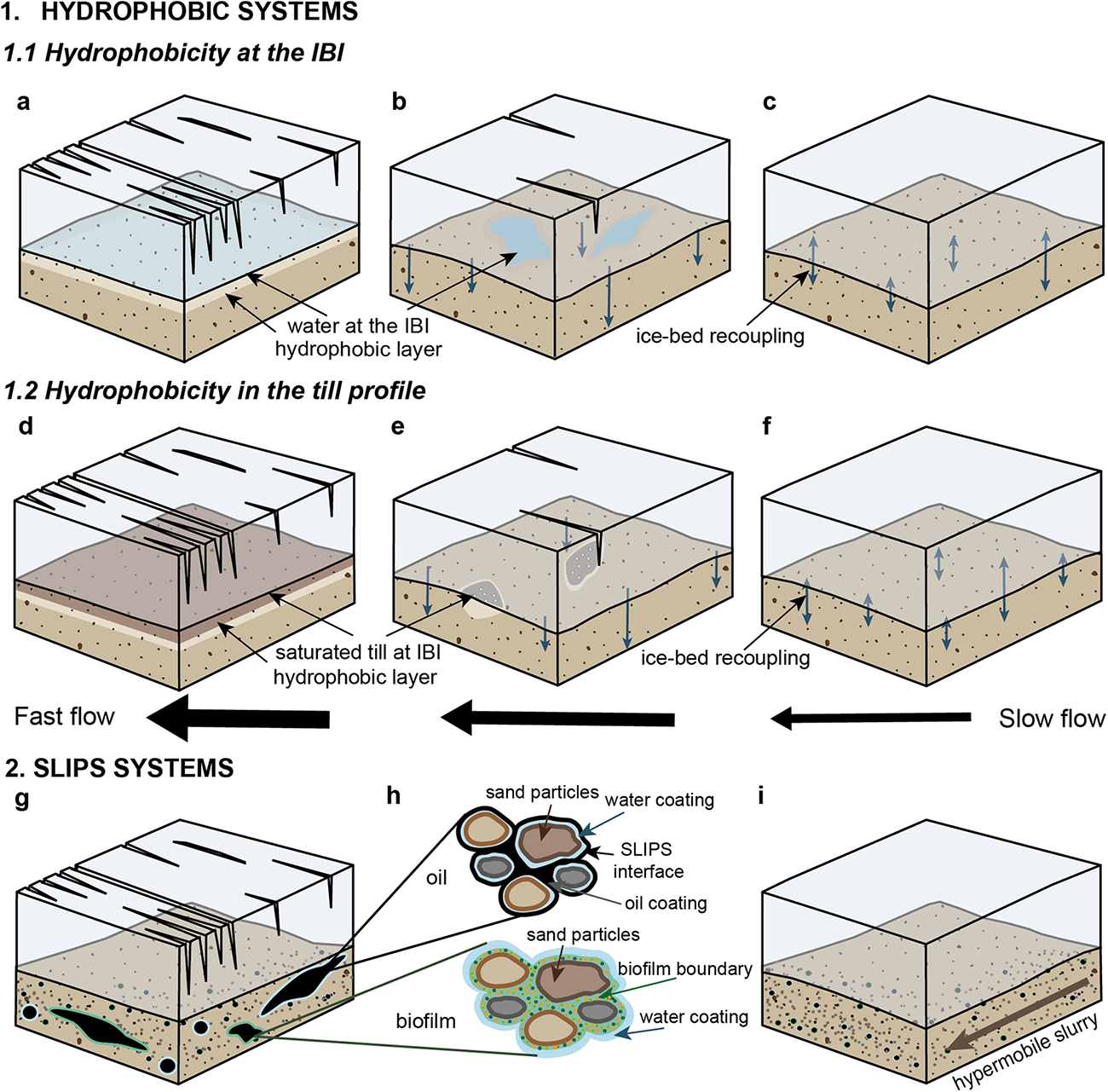
A hydrophobic sediment could also occur within the till profile, buried beneath a more wettable material (as shown in Fig. 3d–f). By preventing infiltration further into the till profile over-saturation of the wettable till at the ice–bed interface would occur. If the till is strongly coupled to the ice, the till will weaken and begin to deform. The hydrophobic sediment would then also create a physical barrier preventing more pervasive deformation, thus concentrating weak till at the ice–bed interface. A not dissimilar mechanism has been suggested as the driving process for surging activity at Bakaninbreen, Svalbard by Murray and others (Reference Murray2000) and Smith and others (Reference Smith, Murray, Davison, Clough, Woodward and Jiskoot2002), where the impermeable layer at the ice–bed interface is permafrost. It is also possible that multiple layers of hydrophobic chemistry exist in a till profile as the result of changes within and between glacial and interglacial cycles. During these cycles multiple layers of buried hydrophobic chemistry could occur, producing zones of weakness and slip between till layers, rather than slip only occurring directly at the ice–bed interface.
3.2. Sediment-SLIPS
Previous work by McCerery and others (Reference McCerery, Woodward, Winter, Esegbue, Jones and McHale2023) first outlined the implications of an oil at the ice–bed interface on glacial flow, from geochemical evidence of glacially mobilised oil sands deposits in Alberta, Canada, using two models of a sediment-SLIPS. In the macro-scale model, an immiscible working fluid and lubricating fluid create a slippery interface, and in the micro-scale model, the liquid-liquid interface occurs between individual sediment grains, which under pressure, would create a hypermobile slurry of sediments, oil, and water. We note that this could also apply to the formation of biofilms creating a quasi-liquid lubricated substrate.
In the macro-scale model, enhanced slip at the ice–bed interface is most analogous to the classic Nepenthes pitcher plant style of SLIPS described by Bauer and Federle (Reference Bauer and Federle2009), Wang and others (Reference Wang, Zhang and Lu2015) and Yong and others (Reference Yong2017). As the bed is infused with a lubricant, sliding may be initiated at lower basal water pressure than is required for ice–bed decoupling. Furthermore, sliding over the lubricated substrate will limit laterally extensive basal deformation. Where the lubricant (be it oil or biofilm) is less viscous (and potentially hardened), it could act as an impermeable seal, impeding drainage. As water is not able to efficiently drain into the till in this instance, it will pool at the ice–bed interface and increase basal water pressure. This would result in more rapid ice–bed decoupling than would be expected for a soft bed.
In the micro-scale SLIPS model (Fig. 3g–i), the hypermobile slurry could induce a style of basal deformation similar to the ideas of icequake-induced till liquefaction. In icequake-induced till liquefaction first proposed by Phillips and others (Reference Phillips, Evans, van der Meer and Lee2018), the sudden delivery of energy to the saturated till causes an increase in intergranular pore water pressure. This results in reduced sediment cohesion; allowing grains to move over one another easily and thus deforming in a transient liquefied state (Phillips and others, Reference Phillips, Evans, van der Meer and Lee2018).
3.3. Spatial and temporal sediment instability
For any of the slipperiness mechanisms we outline above to establish in sediments, a number of conditions must be met in the system (i) the particle sizes of the till must be small enough (fine sand to clay dominated) to support a micro-scale roughness; (ii) he subglacial hydrology must achieve a balance between a steady stream of water (to lubricate the bed) but not too dynamic a water flow as to destroy or remove the lubricating agent, i.e. the biofilm or hydrophobic chemistry; and (iii) the lubricating interface or hydrophobic chemistry/biology must be immiscible to water (for SLIPS) and the subglacial sediment must be preferentially wetted by one of the liquids. Furthermore, as the subglacial zone has been shown to be a low biomass environment (i.e. Skidmore and others, Reference Skidmore, Anderson, Sharp, Foght and Lanoil2005; Kaštovská and others, Reference Kaštovská, Stibal, Šabacká, Černá, Šantrůčková and Elster2007; Boetius and others, Reference Boetius, Anesio, Deming, Mikucki and Rapp2015), it may be unable to grow or sustain a thick biofilm. With these constraints, the slipperiness mechanisms we describe may be both spatially (i.e. where the location of slipperiness may change in a system) and temporally (i.e. erosion of slipperiness properties or reestablishment such as the cyclical growth and destruction of biofilm surfaces) rare. Where all of the necessary conditions are met, these processes could explain the occurrence and spatial heterogeneity of past or present unstable and/or fast flow regimes, particularly in areas where current theories cannot account for observations and records of enhanced flow.
Due to the micro-scale-level nature of slipperiness in sediments, it is likely that multiple factors combine, and that in large glacial systems there will also be other drivers of instability contributing to fast flow. For example, in surging glaciers any single or combination of existing mechanisms could be driving a glacier towards fast or unstable flow and the geochemistry or microbiology of the sediment could then be acting as the either the starting point or final tipping point to achieve fast and unstable conditions. In the case of ice streams, the presence of slippery or super slippery sediments could account for localised slippery spots.
The stability of these super slippery properties is an important consideration if we are to apply these theories to a highly pressurised and dynamic system such as the subglacial environment. Research in materials, soils science and hydrology has shown that during prolonged wetting hydrophobicity is degraded and the material will eventually become wettable, then after drying the hydrophobic state is reinitiated (Quyum and others, Reference Quyum, Achari and Goodman2002; Lourenço and others, Reference Lourenço, Wang and Kamai2015). This suggests that chemical hydrophobicity may be short lived in subglacial systems and could occur unpredictably, particularly where the overburden pressure of the ice could force wetting of the hydrophobic grains. Conversely in the SLIPS model, these surfaces are typically more stable and retain their super slippery properties for longer and over more harsh erosive conditions. This is evident in soil contamination research where water repellence post-oil spill persists for decades (e.g. Roy and McGill, Reference Roy and McGill1998; Roy and others, Reference Roy, McGill and Rawluk1999).
3.4. Till microstructure and morphology
A further consideration is the impact super slipperiness would have on the microstructures of deformed tills. Laboratory experimentation suggests till microstructures are influenced by ice velocity, water and clay content, deposition of carbonates and clay minerology (van der Meer and others, Reference van der Meer, Menzies and Rose2003). It is likely that the geochemistry and/or biophysics of the sediments and the resulting impact on interface physics between particles may influence till microstructures. For example, transient episodes of till dilation caused by changes in pore water pressure and effective pressure, results in shearing micromorphology in the till profile (e.g. Minchew and Meyer, Reference Minchew and Meyer2020; Warburton and others, Reference Warburton, Hewitt and Neufeld2023). The processes that we hypothesise here could induce a similar effect where heterogeneous changes in the geochemical and/or biophysical properties within the till profile, both vertically and horizontally may generate and/or contribute to the existence of the stick-slip phenomena seen in studies by Phillips and others (Reference Phillips, Evans, van der Meer and Lee2018) and Phillips and Piotrowski (Reference Phillips and Piotrowski2023).
The detection of super slipperiness inducing compounds in the Central Alberta Ice Stream in Alberta, Canada, also coincides with evidence of soft bed subglacial deformation (McCerery and others, Reference McCerery, Woodward, Winter, Esegbue, Jones and McHale2023, Reference McCerery, Esegbue, Jones, Winter, McHale and Woodward2024). This suggests the geomorphological impact of such sediment properties may fit our current observations. Thus, there may also be a micromorphological signature or signatures associated with the geochemical and/or biophysical properties of sediments that can be detected in the sediment record. We therefore propose that further investigation into the biophysics, geochemistry and micromorphology of till in places where instability and/or fast flow occurs or has been known to have occurred should be investigated.
4. Conclusions and future challenges
Models of enhanced flow (generated by micro-scale processes occurring at the ice–bed interface) proposed in this paper highlight the importance of considering sediment geochemistry and microbiology in glaciated environments. This paper has presented the potential chemical, biological and physical processes occurring in subglacial sediment that could drive some fast flow and instability in contemporary and palaeo ice sheets and glaciers. We hypothesise that the necessary conditions for slipperiness in the context of interface physics could occur in glacial systems. We do not suggest that these conditions will be extensive, in fact, in most cases the theory of slippery surfaces is not required to explain observed fast flow. We do propose that where appropriate conditions occur, slipperiness will be an important contributor to fast and unstable flow—which may vary spatially (i.e. where the location of slipperiness may change in a system) and temporally (i.e. erosion of slipperiness properties or reestablishment such as the cyclical growth and destruction of biofilm surfaces). This novel approach therefore requires future work to fully understand and predict where slippery surfaces occur in glacial systems.
Acknowledgements
We like to thank the anonymous reviewers who provided helpful and constructive comments. R. McCerery would like to acknowledge Northumbria University at Newcastle for financial support.


 Open access

