1. Introduction
Sound in a cultural, technological and cognitive context mediates one's relationship with place (Blesser Reference Blesser2007). The use of sound to appropriate and aestheticise everyday life, represented in the use of audio players (Bull Reference Bull2004), has shifted individual listening practices. Other mobile devices, such as smartphones, provide the possibility of remote listening through the use of networks. By operating between the public and private sphere, these personal technologies enhance notions of place as a multi-layered charged concept (Coyne Reference Coyne2010).
These technologies are part of what Raymond Ledrut (Reference Ledrut1986: 114–34) calls things. They form part of a wider urban semiotic construct that encompasses buildings, roads and the necessary infrastructures upon which city life is based. Attaching significance to these elements is personal and connected to significant social, cultural and economic conditions, prompting individual meta-languages.
The true issue is not to make beautiful cities or well managed cities, it is to make a work of life. (Ledrut Reference Ledrut1986: 133)
It is this idea of continuous signification that interests us; works that appear in the context of everyday life can function as open scores, that reveal relationships between listening and place. Mobile devices aid in this ‘tuning of place’ – as described by Coyne (Reference Coyne2010) – in which new technologies signal the emergence of new practices in everyday life. This can be exemplified in the movement of an individual through space urged by the need to search for better reception for a mobile phone. This process of negotiation constitutes a symbolic, metaphorical and physical threshold that signifies the transition from one place to another (e.g. a door, a window or the silence observed when entering a library).
The sonic experience in the city displays its own form of thresholds. For example, before starting to read this article, you experienced or negotiated a series of other spaces: perhaps you opened the door to your home and suddenly the soundscape shifted with the presence of car traffic at the end of your street, mixed with other sonic events that are surrounding you.
These thresholds are overlaid due to sound's own physical properties, emphasising the idea of shifting ambiances from one zone to another (Coyne Reference Coyne2010: 180–1). This reinforces the notion of a city without definite boundaries, which is experienced rather than read.
The archetypal city, museum and theatre incorporate their own transitions and thresholds. In these, the relationship between listener/participant and place (Hollerweger, Green and Rebelo 2008), often articulates the experience of listening through framing a participant's engagement in space and time. Nonetheless, the history of contemporary music and sonic art feeds on the breach of any ‘rules’ that aim towards a static relationship between listener and context. Such practices predate and constitute an essential background for context based sonic art (Labelle Reference LaBelle2006).
The notion of context and mediation is essential when addressing previous studies that posit the culture of listening between subject and object. The object (a sound) remains relatively unaffected by the subject (the listener), the interaction between the two being normally described according to intention. The three listening modes proposed by Michel Chion (Reference Chion1994) reflect methods for decoding sound described as reduced (Schaeffer 1967), causal and semantic. The tradition of acoustic ecology criticises the notion of a disembodied approach, as it disconnects the individual from the source of sound – what Schafer calls schizophonia (Reference Schafer1994: 273). Schafer characterises the soundscape as a musical composition in which the listener has an active part, perhaps to the extent that the listener is involved in the composition process.
More recently, the work of Suk-Jun Kim presents an interplay between these different listening modes. This is described as acousmatic reasoning, where concepts such as ‘Body’, ‘Place’, ‘Non-body’ and ‘Non-place’ are essential in understanding the role that imagination plays in completing and establishing relationships within different sound sources, in compositional work (Kim Reference Kim2008). This model has been described by Kim (Reference Kim2010) as an essential element that might link the phenomenon of listening in everyday life with proposed frameworks for electroacoustic music:
The making of a listening framework may propose or at least suggest an answer to the first question: that is, listeners imagine what is missing in order to complete the representation. Humans do this daily when faced with partial perception of events. For example, while I am writing this sentence in my study, I hear a series of loud sounds – beeps, sharp scratching, thumping and cranking – but I cannot see their source; nonetheless, I create, out of past experience, a visual image of a garbage truck just outside my apartment. (2010: 47)
Nonetheless, these ideas do not fully address the conditions exposed by mobile media or the city, as the listening framework shifts from a situation based on intention to one in which the complexity of everyday life permeates the subject–object relationship.
As listening practices develop out of music, sonic art, locative media and other fields, it becomes pertinent to articulate how recent work engages the listener, context and media. This article proposes the notion of evocative listening as a quality of experience present in installation and performance works that deal with aspects of the everyday (see section 4). Evocative listening is framed by spatial context and mediation. Spatial context is articulated in a typology that defines the theatre, museum and the city as spatial archetypes that address thresholds of intention and engagement. These thresholds have implications for how the listener engages with the public act of listening and the notion of place.
2. Listening in the Theatre, Museum and City
2.1. The theatre of listening
The archetypal theatre clearly defines the position of the audience and stage according to the notion of projection. As those on stage embody the role of producers, and those in the audience agree to the role of spectators, the listening contract is articulated as one enters the theatre. The threshold is suggested spatially by the doors to the hall and temporally by the curtain call. This mode of listening is characterised by the emphasis on communicating an experience that is notionally equal to all members of the audience, and therefore treated as an object that can be projected. This paradigm has been crucial in the development of sound projection techniques, instrumental forces (from chamber to orchestral) and architectural acoustics (Rebelo, Green and Hollerweger Reference Rebelo, Green and Hollerweger2008).
Nonetheless, John Cage's 4′33″, clearly shifts the notion of projection away from the stage, questioning the role of spectators as the sound of social interaction and the environment itself begins to emerge throughout the piece.
Recent network music practice (Renaud, Carot and Rebelo Reference Renaud, Carot and Rebelo2007) poses interesting questions in terms of sound projection, embodiment, collaboration and articulation between different sites. Here, the notion of projection is extended across theatres and concert halls, suggesting further articulation of the threshold between the local and the remote in terms of presence or telepresence. The contract articulated by the audience entering a space is questioned by the presence of remote sites, and perhaps remote audiences. Raising questions in relation to a shared sense of the event and space, across geographically displaced performers and audiences.
2.2. The museum of listening
The Museum shares with the theatre the clear threshold condition that identifies entrance and engagement. As one enters through its doors, one agrees to inhabit a curator's world within the safety of the museum walls. The museum of listening is distinct from the theatre as the sense of projection is replaced by the labyrinth of routes that emerge from the overlay of the museum's own architecture, the exhibition layout and one's own intentions. Unlike the theatre, the museum experience is likely to be fragmented, articulated not by the event but by the spatial boundaries that differentiate one collection or gallery from another. In opposition to the theatre, the listener in the museum is mobile. He or she co-defines the spatial and temporal frame: the museum is a building or area with clear spatial boundaries and limited opening hours, but the listener decides when to visit and what to explore within the visit (Rebelo, Green and Hollerweger Reference Rebelo, Green and Hollerweger2008).
Bill Fontana's Harmonic Bridge (Fontana Reference Fontana2006) exposes the nature of those boundaries, by overlapping sonically a representation of one place into another. This representation was made of recordings with accelerometers picking up pedestrians, cyclists and other atmospheric and climate events that occurred on the Millennium Bridge in London. Those recordings were then converted into a sound installation in Tate Modern's Turbine Hall. Salome Reference VoegelinVoegelin describes this piece as a process of inventing a ‘place between both sites’, a place made … up of the time of the motion of the bridge, the time of its recording, the time of my listening’ (2010: 146).
2.3. The city of listening
The city's fragmented, dispersed, multiform and migrational characteristics are advanced by de Certeau as an alternative to the readable and planned city (de Certeau Reference de Certeau1984: 83). To listen in the city is to be immersed in all that is not anticipated by the city planner and his or her ‘visual’ city. The god-like view of the urbanist provides no help in understanding what it is to be in a constant complexity of sound and to be called to articulate a multitude of events. In contrast to the well-defined threshold of the theatre and the museum, the city offers no safe boundaries. The listening contract conveniently articulated by doorways and curtain calls is here replaced by a condition of potentially permanent engagement. As in the museum, the listener is mobile and free to define his or her temporal and spatial frame, but there is still an important difference: the boundaries of the city are not clearly defined. The city typically accommodates a variety of simultaneous experiences and temporal conditions (Rebelo, Green and Hollerweger Reference Rebelo, Green and Hollerweger2008).
3. Evocative Listening
Listening and different spatial archetypes are discussed not as separate entities, but as part of a complex matrix that encompasses everyday life, in the process of signifying personal practices. This interaction, in most cases, shifts rules and social context, creating new situations and revealing new forms of spatial imagination. These transgressive practices are also common in the history of sonic arts, and expose mediation strategies that are criticised, by imposing a particular distinction between subject and object. This distinction will not only reflect on new listening typologies that reflect everyday situations, but also works of sonic art that put focus on the context of what one is listening to, foregrounding the notion of place as multi-layered.
We seek to build the broad history of scientific, phenomenological and compositional analysis of listening by suggesting a framework that resonates with recent contextual-based sound works. This framework primarily addresses the evocative aspects of listening in the everyday, where the process of signification is bound to context and identity. This reflective statement attempts to capture this process:
I am at the airport lounge, sitting near the gate where the boarding process is going to take place. At this moment, I transport some of my feelings into what I perceive about this place. I have just said goodbye to my girlfriend, and this is the last time I am going to be in this city with her. I hear the drone of the air conditioning system with the occasional announcement, and I notice the weird English accent of a female voice. A young couple approaches me and the girl says hello to me. They are very friendly here. They sit by my side and they start to play word games. It is a weird word game. I continue to hear the drone. The boarding desk has a microphone with a switching system. I feel like picking it up and saying something. Disrupt. (Rui Chaves, 26 January 2010, Nantes Airport)
This short passage addresses past, present and future through listening in an everyday context. Through memories and intentions, one is modulating the sound environment and opening oneself to evocative listening. This is not only made of an aesthetic framework or ecological awareness in the classical sense; most importantly, it is made of vocabulary that incorporates a mediated everyday life into significant forms of creative individual practice.
Timothy Morton (Reference Morton2007) describes mediation as the relationship between inside and outside, private and public, me and other, and background and foreground. This process of contextualising otherness attempts to reveal the in-between, the ambiance. According to him this has been a common pursuit for ambient music, sonic art and other forms of environmental practice. He describes these medial statements using concepts such as timbral, aeolian, tone and re-mark (2007: 37–47).
All of these concepts come into play when discussing re-mark – a concept based on Derrida's work (Morton Reference Morton2007: 47–50). This idea brings the illusion of a background collapsing into the foreground. We can think of background as the distant sounds of someone in another room and of Alvin Lucier's work I Am Sitting in a Room (1970), as a prime example of this shift between both elements.
3.1. Evocative listening and technology
Steven Connor in ‘The Modern Auditory I’ (1997: 203–23) reflects on the influence of new auditory technologies, such as phonography, in questioning models that describe experience through visualism. The sonic prompts the subjective experience where source and effect are unclear. The phonograph, telephone and radio, which became ubiquitous between 1875 and 1920, accompanied the rise of modern and postmodern literary, philosophical and psychoanalytic texts. The advent of the telephone brought fascination due to its ‘ability … to convey messages and information as by its faithful preservation of the individuating tones and accidents of speech and even the non-verbal sounds of the body’ (Connor Reference Connor1997: 205). Descriptions of this form of fascination signalled the disintegration of time and space represented by transmission through radio and telephone.
According to Labelle (Reference LaBelle2010: 203–42), the necessary infrastructural development in these technologies as manifest in the construction of huge communication towers (e.g. the Berlin TV tower) changed the notion of spatial urbanism. These electronic macro-structures signalled the utopic desire for freedom, communication and togetherness. Their arrival pointed towards the manifestation of networks and a new spatial imagination. The invisibility present in radio waves resonates with the search for other invisible forms of reading and experiencing the city (Labelle Reference LaBelle2010: 213), thus, for example, resonating with the work of the Situationist International (Debord et al. Reference Debord2006) and its endeavours in psychogeography.
3.2. Mediation, technology and spatial archetypes
Mediation is defined here in terms of sound technologies that inform our response to sound materials, namely, playback/recording and transmission. The superimposition of these spatial and media conditions opens the possibility for sound to affect identity, while questioning the relationship between object and subject in the context of artwork that suggests listening as an active process.
The artworks discussed in this paper reflect sound as an ideal media with which to explore the rituals involved in the familiar and unfamiliar settings of everyday life. In sound lies the potential for elsewhere and the possibility that even for just a few seconds a listener is transported into imagined worlds, in a process made up of memories and moods.
4. Works of everyday life
The following section reflects on common threads that indicate an intention to take into account the listener's identity as a core aspect of the work's experience, reflecting ideas of how listening can operate as shared, accidental, contextual or remote. For example, imagine that you are in the subway, sharing a seat with someone. This person picks up the phone. You do not intend to listen in to the conversation, but you notice a particular tone in his voice – it sounds serious. The content of what is being discussed resonates with your own personal history and identity. There is an invisible bound created in that moment, and you try to picture who is on the other side, remotely causing this reaction.
4.1. Accidental listening
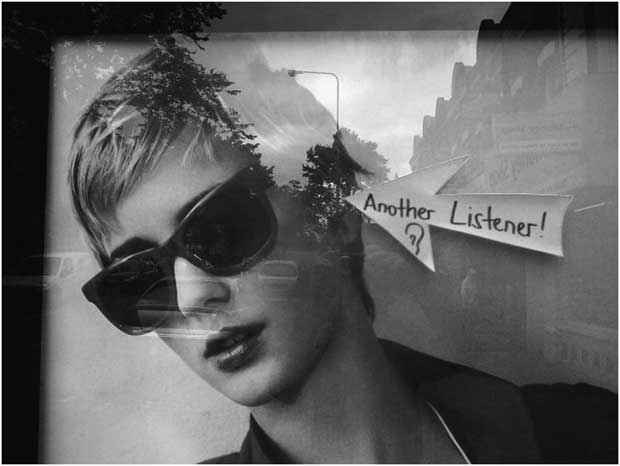
Florian Hollerweger's EaRdverts (Figures 1 and 2) consists of a subliminal public intervention in which members of the public are invited to consider their aural awareness through the annotation of advertising in a city. Hollerweger annotates posters, billboards and ads with large coloured arrows that identify the ear as depicted in contemporary iconography. This work plays on the ambiguity of thresholds characteristic of the city and asks the accidental listener to momentarily engage with the soundscape. The work evokes the notion of aural awareness through the public's reaction to the significance of the ear as annotated in a wide range of visual media. To engage with this work is to reflect on one's own identity as a listener and to re-consider the function of the ear in everyday life.
EaRdverts1. Copyright by Florian Hollerweger.

EaRdverts2. Copyright by Florian Hollerweger.

The notion of accidental listening, which Max Neuhaus’ Times Square relies on, turns a member of the public into an evocative listener even for just a short period of time. In Matt Green's Resounding Rivers (Movie example 1), this process is explored by juxtaposing curated aural superimpositions in everyday space, and the discrete annotation of sites of acoustic interest in a city. This work invites the public to engage in an augmented soundscape without necessarily requiring their attention. Resounding Rivers consists of six sonic interventions in locations around Belfast's city centre chosen for their historical significance in relationship with the Blackstaff, Farset and Lagan rivers which once flowed above ground, through the city. The rivers, two of them now covered for the most part, provide an evocative trajectory through the city in which sound plays a role in evoking the past and its associated soundscapes.
4.2. Contextual listening
Both Resounding Rivers and EaRdverts rely on subliminal additions to the fabric of urban life, with a view to suggest evocative listening through accidental encounter. The works invite the city dweller to an informal engagement with artwork that most members are unfamiliar with.
In contrast to the open and suggestive space of the city lies the art gallery as a space for contextual listening. Two works by the same artists provide an example of the exploration of site-specificity and context which frames the notion of evocative listening. Both of these works explore the uniqueness of the PS gallery in Belfast and its character as a former shop in a Victorian terrace, in the centre of the city. The gallery is unique in how it interacts with the outside world, being closer in character to a shop window than a white-cube gallery. Present Place by Matt Green consists of an aural, visual, social and contextual study of the site. The installation itself presents the visitor with graphic annotations in the form of a frieze in the gallery's wall, describing events taking place in the space prior to the public opening. Visitors are invited to sit on benches facing the window, which overlooks a busy street, while listening to a composition based on recordings made on site. The cinema-like arrangement, with a large visual frontal frame and surround sound, places the listener into a context that deliberately blends the liveness of the moment and the projected sound based on recordings from the past. The installation's configuration and the site itself suggest how the juxtaposition between live, real-world sound and projected, composed sound can induce the notion of evocative listening, as the relationship between the audiovisual and the purely aural are constantly in tension.
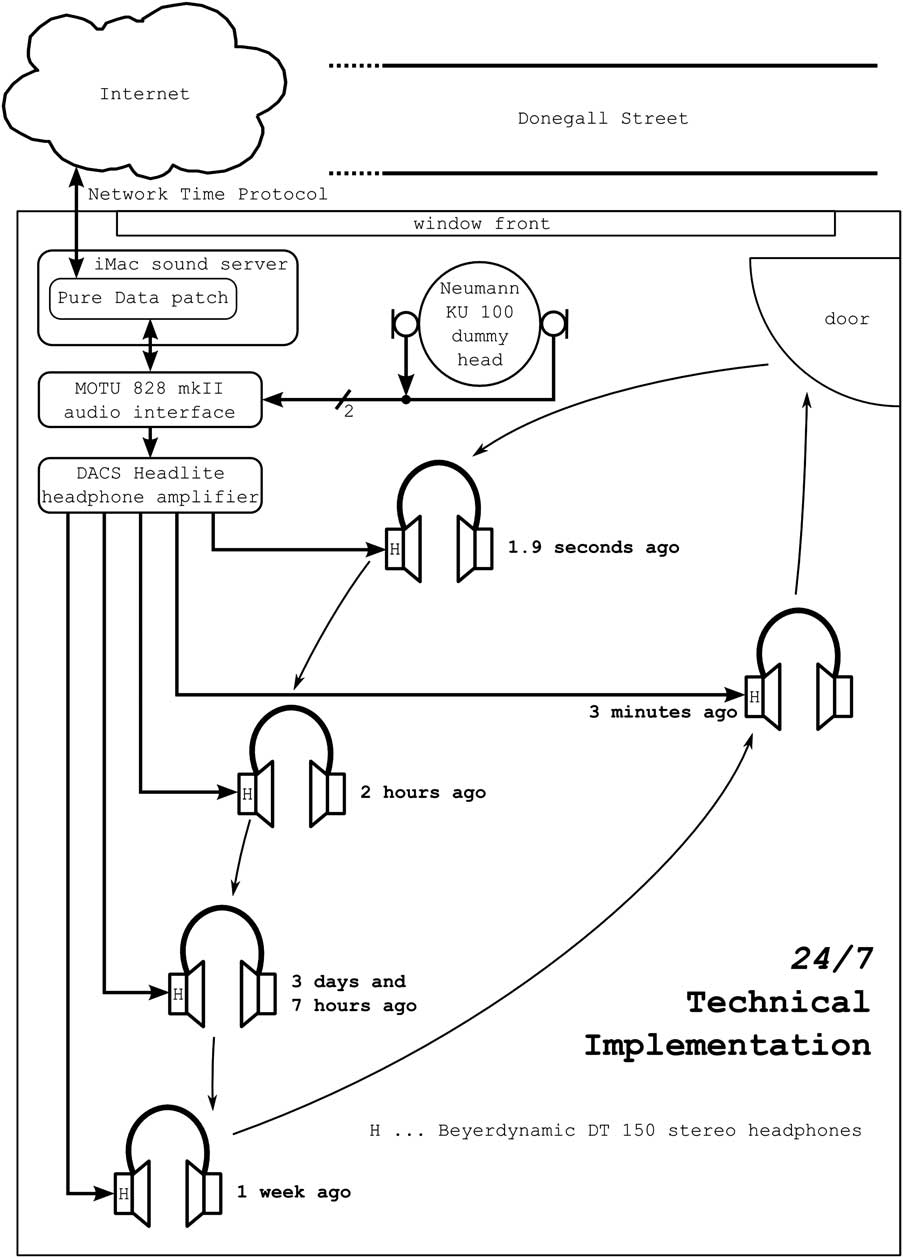
24/7 by Florian Hollerweger explores the same gallery space from the perspective of making time audible. The visitor is invited to listen to different moments in the gallery's aural past (1.9 seconds, 3 minutes, 2 hours, 3 days and 7 hours, 1 week from the present moment; Figure 3). A timeline on the gallery wall represents these different temporal scales and places headphones as listening posts. The work addresses the social sharing of space (with the shorter delays suggesting playful interplay amongst visitors as they hear their actions being played back) and notions of aural history and surveillance. 24/7 turns the gallery space into a specific context for listening by converting the ephemeral nature of sound into discrete historical moments. Visitors are given access to the aural past while at the same time contributing to the aural future of the space. The individual experience provided by headphones is situated in a shared social space that suggests particular listening roles, as the acoustic present is augmented by the various pasts. Both 24/7 and Present Place transform a gallery space into a context for evocative listening, through the juxtaposition of the live/real and past events.
24/7 technical diagram. Copyright by Florian Hollerweger.

4.3. Shared listening
Rui Chaves’ Blackheart (Movie example 2) addresses notions of shared listening by engaging participants in a group soundwalk. The work is a guided tour for a group of people participating in a walk through the hills towards an area that allows for a unique view over the city. Blackheart focuses on changes in scale (viewing and hearing the city from a distance), as well as shifting relationships with a landscape, allowing participants to explore the physical and psychological geography of the site, using sound to cross personal history, myths and narratives. Pre-composed sound materials are diffused through twelve cassette recorder/players with built-in speakers worn by the participants. While each participant primarily experiences the walk through his or her own listening as informed by the sound materials played by his or her own device, there is an inevitable sense of complicity created by the choreography of the guided tour. The sense of sharing comes to the fore as a group of participants embark in the action of listening, in a rather inhospitable environment. Recorded fragments of interviews and storytelling evoke the lives and memories of those that remain out of earshot, in the city.
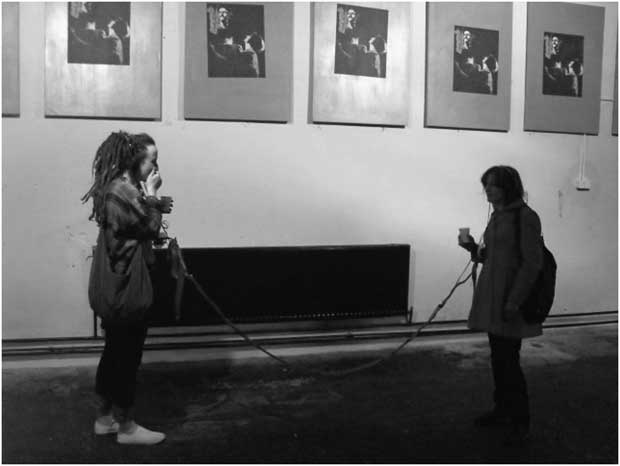
In Florian Hollerweger's Music for Lovers (Reference Hollerweger2010), the notion of shared listening is explored through intimacy, as two participants are invited to share a device that augments their surrounding soundscape. The work consists of a portable sound installation that allows two people to ‘swap ears’, through two pairs of headphones and binaural microphones connected across the two listeners (Figure 4). As one listens to the environment through the ears of another, elements of trust and responsibility frame the engagement with this work. By agreeing to participate, listeners exchange control of their own listening with their partners, which in itself exposes the relationship between one's body and the listening experience. Sharing the intimate act of listening exposes the affective and emotive nature of one's engagement with a sound environment.
Music for Lovers. Copyright by Florian Hollerweger.

4.4. Remote listening
With the increased prominence of network infrastructure, a number of works have begun to explore the qualities of remote listening. As the listening space becomes extended through streaming across various modalities, the listener's imagination is engaged in articulating issues of presence and site. Pedro Rebelo's Netrooms (Sound example 1) uses the network to establish a loop of active listeners who contribute to a developing feedback circuit consisting of microphones and loudspeakers around the world. Netrooms is a participative network piece which invites the public to contribute to an extended feedback loop and delay line across the Internet. The work explores the juxtaposition of multiple spaces as the acoustic, the social and the personal environment become permanently networked. The performance consists of live manipulation of multiple real-time streams from different locations, which receive a common sound source. Netrooms celebrates the private acoustic environment as defined by the space between one audio input (microphone) and output (loudspeaker). The performance of the piece consists of live mixing of a feedback loop with the signals from each stream. This work invites participants and listeners to imagine spaces, other than their own, through subtle clues in the various sound streams.
wewalktogether (Sound example 2) by Rui Chaves is a mobile broadcast piece for three performers in three different cities. Each performer walks and broadcasts through their city, equipped with a mobile device and custom-developed software. This exploration is the result of a series of notes and timed instructions sent to the performers, in order to enable each of them to create a path that explores different soundscapes, but also situations that are enhanced through on-the-spot perception of space. The work focuses on exposing the process of discovery, personal mapping and the idea of transmission, while enabling the listener to engage with each broadcast simultaneously.
5. Conclusion
The fact that the works discussed here range from the non-technological (e.g. EaRdverts) to custom-designed mobile software (e.g. wewalktogether) supports the premise that, although technology plays a role in the understanding of listening, it is not necessarily the predominant element. Rather, the understanding of how a listener engages with the evocative through sound presents a richer framework within which to discuss current work in this field. The ideas developed in this paper are not intended as a generalised theory of listening, but rather as local and specific concepts that will allow us to further develop sonic arts practices with an understanding of the qualities of listening at its core.
Ultimately, an experiential understanding of listening in the context of the city, mobile technologies and the everyday represents not only a useful framework for creative practice in sonic arts, but also a step towards developing an awareness of sound that is intertwined with today's mediated living.