Introduction
In the course of agricultural intensification, farmland biodiversity has declined due to the decrease of semi-natural habitats in agrarian landscapes and the increased application of pesticides and fertilizers, impairing a variety of ecosystem functions and servicesReference Tscharntke, Klein, Kruess, Steffan-Dewenter and Thies1. Different approaches of agri-environmental management have been found to successfully restore biodiversityReference Batary, Andras, Kleijn and Tscharntke2. Plant diversity that provides habitat and food for animals can be established at the border of crop fields by set-aside management, e.g. wildflower strips, or within crop fields. Common weeds and rare arable herbs both profit from non-intensive or organic farming. While rare herbs are sown intentionally to strengthen their populations, weeds will colonize fields reducing crop yieldReference Liebman, Mohler and Staver3. Seed dispersal is essential for the viability and competitiveness of arable plant populationsReference Benvenuti4. Most arable plant species, however, lack obvious adaptations for dispersal and rely on gravity when shedding their seedsReference Benvenuti4, which permits very limited dispersal distances unless seeds are transported by manReference Liebman, Mohler and Staver3. Recent research highlights the importance of so far underappreciated invertebrate taxa, in particular, gastropodsReference Türke, Andreas, Gossner, Kowalski, Lange, Boch, Socher, Müller, Prati, Fischer, Meyhöfer and Weisser5 and earthwormsReference Forey, Barot, Decaens, Langlois, Laossi, Margerie, Scheu and Eisenhauer6 in the dispersal of seeds of herbs. Also in crop fields or adjacent wild flower strips, gastropods were responsible for the removal of a fair proportion of weed or herb seedsReference Fischer, Thies and Tscharntke7, Reference Kollmann and Bassin8. We are conducting experiments within three projects to test the potential of gastropods, and partly also earthworms, to disperse seeds and also to predate on seeds of agricultural weeds and rare arable plants by the ingestion of seeds. In the following, we briefly present the three projects, their aims and first findings.
The Projects
Weeds and rare herbs in an organic rye field (Germany)
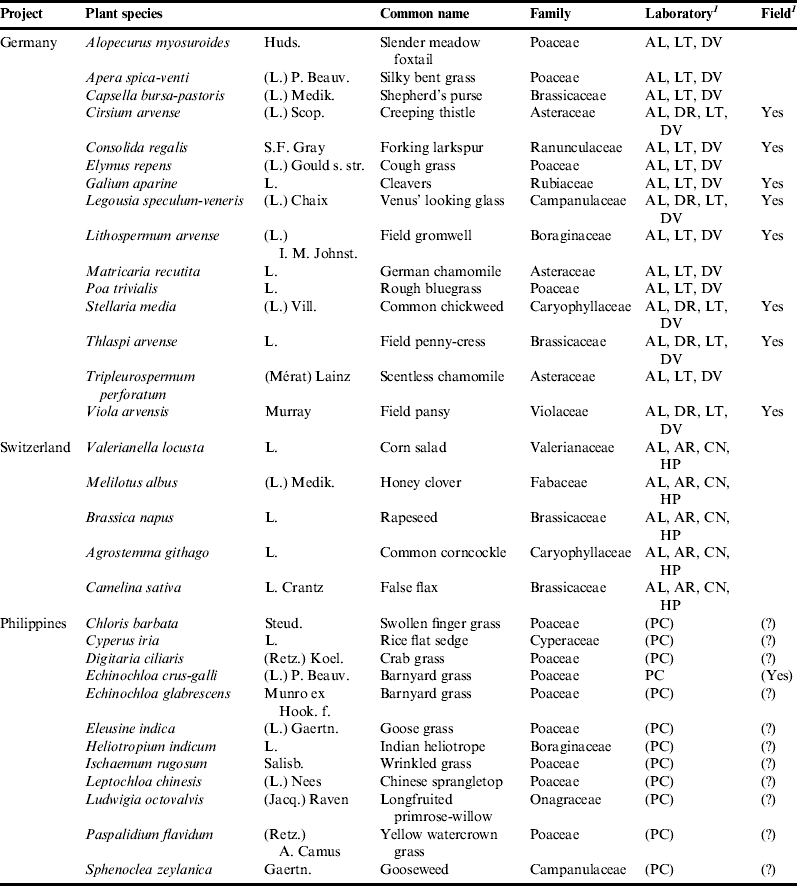
We established an organically managed rye field in Germany to assess the effects of management and animals on the establishment of rare arable wild herbs. A number of weeds are growing naturally in the field. We conducted seed removal experiments with five weeds and three rare herbs (Appendix 1) with one treatment accessible to all animals and one treatment protected against rodents. In addition, we used video cameras to identify all seed-feeding animals. In accompanying laboratory experiments, we offered seeds to two slug and two earthworm species of up to 15 plant species (animal species-dependent), including 12 common weeds and three rare herbs (Appendix 1), followed by germination experiments. Slugs and earthworms readily swallowed seeds of different species and defecated them mostly apparently intact (Fig. 1). Seeds of several species germinated after being defecated. By screening the first videos, we observed rodents, carabids, earthworms and slugs visiting seed depots in the field, supporting the significance of interactions between seeds and the latter two invertebrate groups.
Seeds of field pansy (Viola arvensis) in (A, B) earthworm casts (Lumbricus terrestris) and in (C) slug feces (Arion lusitanicus), and (D) a seed of German chamomile (Matricaria recutita) germinating from slug feces.

Herbs sown in fallow ground (Switzerland)
In a lab experiment, we fed four different gastropod species (Arion lusitanicus, Arion rufus, Cepaea nemoralis and Helix pomatia) with five different herb species often sown in fallow ground in Switzerland (Appendix 1). Consumption and damage of seeds after gut passage were assessed; defecated seeds were collected and put on soil to evaluate germination rates. We found high consumption rates in all mollusc species and for all five plant species. Furthermore, the seeds that had previously been defecated showed high germination rates, similar to those without gut passage. Our results therefore support our hypothesis that molluscs act as efficient and important seed dispersers of a wide range of plant species in agricultural landscapes.
Weeds in irrigated rice fields (Philippines)
Rice farmers in South-East Asia make a great effort to fight weeds. Exotic golden apple snails (Pomacea canaliculata) were introduced to control weeds in rice fields, amongst other thingsReference Joshi and Sebastian9. In most cases, however, the snails were a major pest, consuming rice plantsReference Joshi and Sebastian9. We suggested that this invasive snail might also be spreading weeds in rice fields. Within the LEGATO project on land-use intensity and ecological engineering in irrigated rice (http://www.legato-project.net/), we collected seeds of 12 common weeds in the Philippines (Appendix 1), which currently are being offered to snails in feeding experiments. First observations in the laboratory showed that the snails readily consumed seeds of the troublesome barnyard grass Echinochloa crus-galli and defecated them apparently intact (Fig. 2). We will further conduct seed removal experiments and observations in rice fields in the Philippines.
Seeds of common barnyard grass (Echinochloa crus-galli) (A) eaten by a golden apple snail (Pomacea canaliculata) and (B) collected from its feces.
Outlook
Our complementary experiments in multiple settings will help us to understand whether gastropods and earthworms are important for weed movement and the establishment of sown plants in the agri-environment. Based on our findings, it is possible that invertebrates such as slugs that dwell in planted wild flower strips might affect crop yields negatively if they transport weeds into the fields, even if they do not feed on the crop. Thus, it might be valuable to establish structured habitats at crop margins which do not promote these invertebrates but their predators. In environments where seed dispersal is beneficial, such as in ecological restoration, knowing which seed traits encourage dispersal, and which animals are important in dispersal, would be beneficial. In consideration of our preliminary results, we suggest that future research on weed ecology, dispersal and predation should take these invertebrate groups into account.
Appendix 1
Plant species of which seeds were/will be offered in field seed removal experiments (=Field) or to gastropods and earthworms in laboratory feeding trials (=Laboratory).