Introduction
Depression disorders are the most common psychiatric disorders of adult populations in the Western world. Lifetime prevalence of depressive disorder ranges between 5% and 25%. The disorder is in many cases associated with considerable disability and suffering that is not limited to the affected person alone, but also includes consequences for close persons such as family members and friends. Depression is the leading cause of disability worldwide, and is a major contributor to the global burden of disease. Still many countries, especially in low-income parts of the world, lack mental health policies. Access to prevalence data is, however, critical to the success of mental health programs and necessary in order to formulate working national health policies and in order to assure budget allocation to mental health. For the country of focus in this study, Bangladesh, such information is scarce. A handful of studies (e.g. Chowdhury et al., Reference Chowdhury, Alam and Ali1981) have reported prevalence rates, using different diagnostic instruments and by examining different age groups (e.g. middle-aged, young adults, children, rural, or urban participants). No study has, to our knowledge, yet examined mental health specifically in the elderly segments of the Bangladeshi rural population.
In the present paper, we have no access to proper clinical diagnoses of depression, but rely instead on self-reported symptoms as assessed with SRQ20 (Harpham et al., Reference Harpham2003). Among those, we considered symptoms corresponding to those listed by DSM-IV. Although we will discuss our own data in terms of depressive symptoms or status, we relate in the following to the literature on depression.
There is no consensus about whether higher age causes an increase in prevalence of depression, or whether higher age itself constitutes a risk factor for depression. However, prevalence rates for depression are known to vary across the adult age span, possibly with one peak in middle age and another increase in very old age (Riedel-Heller et al., Reference Riedel-Heller, Busse and Angermeyer2006).
Sex differences, women being more vulnerable to depression, are however well established (e.g. Ferrari et al., Reference Ferrari2013). A study performed in a Bangladeshi village context even reported that women were four times more likely than men to suffer from depressive states (Chowdhury et al., Reference Chowdhury, Alam and Ali1981). The reasons for this gender discrepancy are thought to be a combination of biological and gender-specific roles including greater social acceptance of females being sick. Another source may be the high incidence of domestic violence in Bangladesh and other South Asian countries (e.g. Schuler et al., Reference Schuler, Hashemi, Riley and Akhter1996).
The question of whether the risk for depression associated with female sex varies across age has been examined in previous studies (e.g. Burns et al., Reference Burns, Butterworth, Windsor, Luszcz, Ross and Anstey2012; Reference Burns, Butterworth, Luszcz and Anstey2013) and the results are mixed. Existing findings present an unclear picture that is thought to be related to the often limited sampling of the oldest old. Hence, more studies are warranted.
There are reports indicating that persons with limited literacy are up to three times more likely to suffer from depressive symptoms than more literate persons (Gazmarian et al., Reference Gazmarian, Baker, Parker and Blazer2000), although the mechanisms linking literacy with depression are yet to be established. However, some research indicates a direct causal relation between low literacy and more depressive symptoms (e.g. Francis et al., Reference Francis, Weiss, Senf, Heist and Hargraves2007), an effect that might be mediated by levels of self-efficacy.
Emotional stress resulting from economic constraints may also lead to the development of mental health problems such as depression (e.g. Weich and Lewis, Reference Weich and Lewis1998).
The deterioration of social networks is a risk factor for depression at any age (Rosenquist et al., Reference Rosenquist, Fowler and Christakis2011). Further, the quality of and satisfaction with these relationships determines the direction of health outcomes (e.g. Heaney and Israel, Reference Heaney, Israel, Glanz, Rimer and Viswanath2008). In the current study, we restricted ourselves to examine relationship of the participants with their own children in the network (having children residing in the same bari (a bari is a group of households (HHs) around a central common courtyard) or in the same HH), and quality of this network (satisfaction with the contact with children). Studies conducted on low-income elderly populations in the West (e.g. Zunzunegui et al., Reference Zunzunegui, Béland and Otero2001) indicate that support from children has beneficial effects on psychological well-being of the elderly parents. A major difference between prior research and the current project is, however, that in Western societies, it is less common for older adults to live with their adult children than it is in rural Bangladesh.
A strong body of evidence demonstrates the coexistence of depression in many chronic illnesses (e.g. cardiovascular disease, stroke, cancer, epilepsy) and the presence of depression is reported to considerably worsen medical prognoses (e.g. Taylor et al., Reference Taylor, McQuoid and Krishnan2004). Many studies also suggest that people with chronic disease are at increased risk for depression (see Verhaak et al., Reference Verhaak, Heijmans, Peters and Rijken2005). Alternatively, depression may in some instances act as a risk factor for developing medical disorders, such as is seen in coronary heart disease (Carney and Freedland, Reference Carney and Freedland2003). There is also a possibility that depression shares risk factors with other chronic conditions. In the present study, we aim to examine how medical co-morbidity relates to the distribution of depressive symptoms.
The prevalence of suicidal thoughts among elderly in Western studies range from 0.7% (in the preceding week; Callahan et al., Reference Callahan, Hendrie, Nienaber and Tierney1996) to 15.9% (in the preceding month; Skoog et al., Reference Skoog1996). Although the link between suicidal ideations and suicide is moderated by factors such as religious beliefs, the rates of late-life suicide are higher in Asia than in Western countries (e.g. Yip, Reference Yip1998).
The main objective of the present study is to examine prevalence and associated factors of depressive symptoms and suicidal thoughts in a rural elderly population in Bangladesh. We selected to focus specifically on age, sex differences, that are highly relevant in this patriarchal society, literacy because of the high proportions of illiteracy in this population, and on marital status. We hypothesized also that the oldest women were likely most vulnerable. To achieve this, we used SRQ20 in a population-based sample of elderly participating in the “Poverty and Health in Aging” project (PHA: Kabir et al., Reference Kabir, Ferdous, Cederholm, Khanam, Streatfield and Wahlin2006).
Methods
Data from the participants were collected during August 2003 to January 2004. PHA is a population-based study of elderly persons living in Matlab, a rural area 55-km South East of Dhaka city. The study has been approved by the ethical committees both at the International Centre for Diarrheal Disease Research, Bangladesh (icddr,b) in Dhaka and at Karolinska Institutet in Stockholm. All procedures described are in accordance with APA ethical standards and the Helsinki Declaration of 1975.
Participants
icddr,b has been maintaining a Health and Demographic Surveillance System (HDSS) in Matlab since 1966, which currently covers a population of approximately 220,000 persons across 142 villages. A total number of 850 community-dwelling elderly individuals aged 60 years or more were randomly selected from HDSS of icddr,b. The sampling was performed such that it was representative with respect to age, sex, and literacy. A total of 625 individuals participated in the home interviews. The difference was due to that 63 persons died before the beginning of the study, 38 refused to participate, 11 had migrated, 93 could not be reached, 18 were found to be registered twice in the surveillance database, and two persons were found to be under age (after cross-checking age).
There is homogeneity to some extent in rural Bangladesh, in terms of living conditions, distribution of socioeconomic levels, availability of healthcare facilities etc. (Kabir, Reference Kabir2001). Our results may have implications for rural Bangladesh, but not necessarily so for the urban areas.
Procedure
In brief, data were collected during three occasions. On obtaining informed consent, participants were interviewed by trained interviewers in their homes on the first day. At this occasion, they were also invited to a nearby health center for clinical examinations by physicians and cognitive tests by psychologists, which would take place approximately within a week from the home interview. An elaborated description of the data collection can be found in Kabir et al. (Reference Kabir, Ferdous, Cederholm, Khanam, Streatfield and Wahlin2006). Only data pertaining to the focus of the present paper are described here.
Demographic data
Age and sex of the participants were used for the present purposes. The participants’ chronological age was double checked with questions in relation to biological and historical events, since many people in rural Bangladesh do not know their exact chronological age, and there was no formal birth registration system in earlier days. Determining age in this way in low-income countries is well established (e.g. Allain et al., Reference Allain1997). In addition, current marital status of each participant was included. Divorcees, widows, widowers, and never married persons were grouped as single, and compared to “currently married.” Literacy was defined as ability to read and write Bangla, and each participant was coded as either illiterate or literate.
Economic factors
Economic factors were indexed based on questions regarding “personal income” (coded as no income and some income) and whether the person “received any financial support from anyone” (coded as regular or no regular financial support).
Social network
The information about social networks used for the purposes of the present study was answers to questions about “Number of children living in the same HH” and “Number of children living in the same bari.”
Social support
Level of social support was indicated by asking about how satisfied the participant was about the contact with own children. The answers were coded from 1 (not satisfied) through 4 (fully satisfied).
Medical diagnoses
The medical conditions used for examination of co-morbidity in this study were dementia, lower back pain, arthralgia, arthritis, elevated blood glucose, signs of thyroid hypofunction, symptoms of helminthiasis, hearing impairment, gastrointestinal or upper alimentary tract disorder, impaired vision, hearing impairment, jaundice, lower alimentary tract disorder, obstructive pulmonary symptoms, respiratory tract infection, skin disease, and severe headache. For details, consult Khanam et al. (Reference Khanam, Streatfield, Kabir, Chengxuan, Cornelius and Wahlin2011).
Depressive symptoms
In order to assess depressive symptoms, we used the SRQ20 (Harpham et al., Reference Harpham2003), a screening tool for common mental disorders used in primary healthcare, and a well-tested instrument with high face- and criterion-related validity and high suitability for use by lay workers. It is also endorsed by the World Health Organization. The instrument assumes that the study populations of interest may have low literacy, thus being suitable for our study population where literacy rate is very low (about 36%). The SRQ20 has been used both as a mental health screening tool and as a method to establish prevalence figures for mental ill health at the community level, and it has acceptable levels of reliability and validity in developing countries (WHO, 1994). The interviewers administered the 20 questions that, if necessary, were followed up with clarifications by the interviewer in order to make sure that each participant had understood what was asked. Answers to each question were coded as Yes (1) or No (0). For the present purposes, we first calculated a symptom summary score. Second, we derived a depressive status indicator from the symptom data. This was done applying the DSM-IV depression diagnostic criteria on the SRQ20 scores. In order to receive a depressive status diagnosis, a participant had to report the core symptom “loss of interest” and at least four of the symptoms “loss of appetite,” “sleeping problems,” “problems thinking clearly,” “constantly tired,” “valueless,” “affected decision making,” or “suicidal thoughts.” Suicidal thoughts were assessed by asking the participant whether he or she had thought about suicide during the past two weeks.
Statistical analyses
First, the prevalence of depressive status and suicidal thoughts was calculated for the whole population. Prevalence rate ratios (PRR) and robust 95% confidence intervals (CI), using Poisson regression analyses, were calculated to assess whether participants with a certain characteristic were more likely to be afflicted with depressive status or to report suicidal thoughts than persons without that characteristic. Crude and adjusted models were calculated.
Since not all participants had undergone the medical examination, assessment of morbidities as factors associated with depressive symptoms or suicidal thoughts was based on a subsample (n = 471) that underwent a complete medical examination by physician. This comparison was done after first having replicated the main analyses from the full sample. Stata 12.1SE for Windows was used for all analyses.
Results
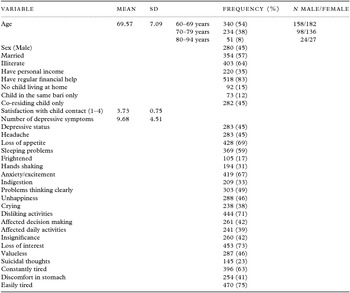
Table 1 displays descriptive data for the sample. Most depressive symptoms were frequently reported. The majority of study participants reported loss of appetite, sleeping problems, anxiety/excitement, disliking activities, loss of interest, that they were constantly tired, or easily tired.
Descriptive statistics for the participants (n = 625)

The overall prevalence of depressive status among the participants was 45% (95% CI 41–49). As a control, we applied the SRQ20, standard cut-off for definition of mental ill health (i.e. >7), and cross-tabulated the resulting data with depressive status. Among those diagnosed with depressive status, 98% also scored as having mental problems. Altogether, 68% of the sample had scores that indicated mental ill health.
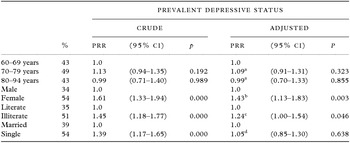
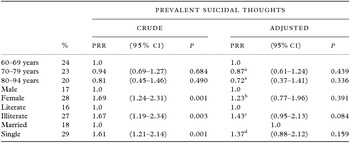
We examined first the association of age, sex, literacy, and marital status with prevalence of depressive symptoms and suicidal thoughts, respectively. Crude and adjusted (adjusted for the three other predictors) results for depressive symptoms and suicidal thoughts are reported in Tables 2 and 3, respectively.
Crude and adjusted prevalence rate ratios between four demographic variables and depressive status

Note. % = percentage of these with depressive status.
PRR = prevalence rate ratios.
aAdjusted for sex, literacy, and marital status.
bAdjusted for age, literacy, and marital status.
cAdjusted for age, sex, and marital status.
dAdjusted for age, sex, and literacy.
Crude and adjusted prevalence rate ratios between four demographic variables and prevalence of suicidal thoughts

Note. % = percentage of these with prevalent suicidal thoughts.
PRR = prevalence rate ratios.
aAdjusted for sex, literacy, and marital status.
bAdjusted for age, literacy, and marital status.
cAdjusted for age, sex, and marital status.
dAdjusted for age, sex, and literacy.
As can be seen in Table 2, female sex, illiteracy, and being single were, when analyzed independently, significant risk factors for prevalent depressive symptoms. Adjusted analyses indicated that being a woman and illiteracy remained significantly associated with depressive symptoms. Illiteracy showed an association with having suicidal thoughts (Table 3), even after adjustment.
As a follow-up, we examined in two separate models (one for depressive status and one for suicidal thoughts), the interaction effects of sex*age group after first accounting for the main effects. These analyses revealed that the PRR for depression in the oldest group of women was 4.2 (CI 1.38–12.90, p = 0.011), which corresponded to a prevalence of 70% in this group. This interaction was significant also with literacy and marital status included in the model (p = 0.013). Among men in this age group, the same figure was 12%. In order to confirm this finding, we conducted an analysis based on age being separated in five-year bands for all but the oldest, i.e. 60–64 years, 65–69 years, 70–74 years, 75–79 years, and 80+ years. The PRR for the oldest group of women was still the only significant interaction (PRR = 3.91, CI 1.45–10.49, p = 0.007). The sex*age group interaction term was however non-significant (p = 0.119) for suicidal thoughts.
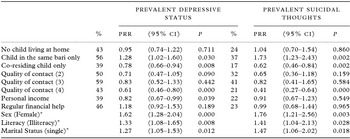
Next, we examined whether the children and income variables predicted depressive status or suicidal thoughts, and second whether they accounted for the associations of the demographic variables with the same outcome variables. In these analyses, we focused on sex, literacy, and marital status that were examined one by one together with the children and income variables. Results revealed, first, that living together with children in the same HH or bari, and reporting the highest quality of children contact were associated with lower PRR of both depressive symptoms and suicidal thoughts. Having an income was also associated with lower PRR of depressive status (see Table 4). Second, associations with sex, literacy, and marital status were still significant after adjusting for the children and economic indicators.
Upper section: Crude associations between child relation and income variables and prevalence of depressive status and suicidal thoughts. Lower section: Associations of sex, literacy, and marital status adjusted for child and income variables

Note. % = percentage of these with depressive status or suicidal thoughts, respectively. * Adjusted for all child relation and income variables.
PRR = prevalence rate ratios.
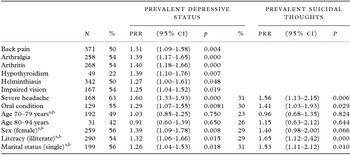
In the next set of analyses, we examined data in the subsample (n = 471) that had undergone the medical examination. First, we replicated the previous regressions in this sample. The results were nearly identical with the results reported in Tables 2 and 3. Examination of the interaction of age with sex showed in line with the full sample that the PRR for depressive status in the oldest group of women was similar to the larger sample (p = 0.024), and the interaction term was also not significant for suicidal thoughts. The results were also nearly identical with that reported in Table 4, but with two exceptions. The lower PRR of suicidal thoughts in people living together with a child in the same HH was now slightly weaker and lost significance (p = 0.162), and the higher PRR for suicidal thoughts associated with being a woman after accounting for the child and economic variables also lost significance (p = 0.082).
The selection of morbidities for the final set of analyses with the subsample was based on whether a diagnosis was associated with any of the two outcomes. In order to determine this, we performed two logistic regressions per morbidity.
Second, the four main predictors (age group, sex, literacy, and marital status) were examined one by one together with the morbidity variables that were significantly associated with the respective outcome. Consequently, the number and type of morbidity variables that were included in the eight separate analyses differed slightly. In these analyses, we also examined age, since age was significantly correlated with several of the significant morbidity indicators. Results revealed that, as compared with the crude PRRs for the subsample (data not shown), female sex was still associated with higher PRR of being a risk factor for depressive status, as was being illiterate, and being single (see Table 5). For suicidal thoughts, female sex was now no longer a significant risk factor, although the change was slight, but illiteracy was still significant as was being single.
Upper section: Crude associations between morbidity and prevalence of depressive status or suicidal thoughts. Lower section: Associations of age, sex, literacy, and marital status adjusted for morbidity

Note. n = number of persons with each morbidity; % = percentage of these with depressive status or suicidal thoughts, respectively.
PRR = prevalence rate ratios.
aIn analyses of depression statistical control for Back pain, arthralgia, arthritis, hypothyroidism, helminthiasis, impaired vision, gastrointestinal or upper alimentary tract disorder, severe headache, and oral condition, bIn analyses of suicidal thoughts statistical control for gastrointestinal or upper alimentary tract disorder, severe headache, and oral condition.
Discussion
This is the first study to report prevalence figures of depressive status of elderly Bangladeshi persons, and it shows that the prevalence rates of depressive status and suicidal thoughts are very high in the 60+ population living in rural Bangladesh. In the context of population-based data, we examined the prevalence of depressive symptoms, based on SRQ20 and by applying DSM-IV criteria. We found the overall prevalence of depressive status to be high, mainly among women, illiterates, single persons, and in particular among the oldest women. In addition, we examined the extent to which social network, economic, and morbidity factors accounted for these group differences. Although these factors predicted both depressive status and suicidal thoughts, the effects did not mediate the effects of sex, literacy, or marital status. In sum, our analyses revealed that co-residing with a child in the same HH or bari and having a high quality of contact with the children were associated with lower PRR of both depressive status and suicidal thoughts. A number of morbidities were associated with higher PRR of depressive status and suicidal thoughts. These associations were however also independent of those related to the main predictors, the sole difference being the probability for women of having suicidal thoughts, which was non-significant after taking medical morbidity into account.
Comparable prevalence figures are found in elderly of similar age and health status in other parts of the world (e.g. Benazzi, Reference Benazzi2000). It is however very important to report these figures from this region, as depression is a life-threatening condition. We consider the generalizability of the results to be good, because it was possible to select randomly a representative sample from the available demographic register.
The prevalence of depression is known to increase in very old age, although it is unclear whether age in itself has any causal impact (Riedel-Heller et al., Reference Riedel-Heller, Busse and Angermeyer2006). It is important to bear in mind that we are dealing with very old persons in this study, given the expected life expectancy at birth is currently only about 69 years, and slightly higher for women. Our analyses showed that there were no systematic variations of age with either depressive symptoms or suicidal thoughts. However, the oldest female participants had an extreme prevalence figure for depressive status (70%), though the CI of the result was very wide and, correspondingly, this group was small (n = 27). Similar to most previous research (Ferrari et al., Reference Ferrari2013), we found women to be more vulnerable to depressive symptoms (54%) than men (34%). We found no explanation for this in our social, economic, or morbidity data. Future research will have to explore the mechanism for sex differences in depression. We also replicated the well-established finding that illiteracy constitutes a greater likelihood for developing depressive symptoms. Marital status, finally, is a robust predictor of health outcomes and depression in many parts of the world (see Scott et al., Reference Scott2009), and elderly in Bangladesh are no exception to this, as demonstrated by the results of our study. Some previous studies indicate that marital status may have a different impact on depression in women than in men, although the results are inconsistent (e.g. Hope et al., Reference Hope, Rodgers and Power1999). As a follow-up, we conducted analyses where sex, marital status, and sex*marital status were used to predict depression. Results showed that the interaction term was not significant (PRR 1.61, CI 0.76–3.40, p = 0.214), which is consistent with studies that show no such sex interaction differences (e.g. Maciejewski et al., Reference Maciejewski, Prigerson and Mazure2001).
We used a set of variables to represent other aspects of the social network (relationship with children) and indicators of the economic situation (own income and economic support received from others). We speculated that this might constitute possible explanations for at least sex differences where, for example, Bangladeshi elderly women are not very likely to have their own income. In short, these potential explanatory variables did not change the main findings. However, similar to studies involving other elderly populations (e.g. Zunzunegui et al., Reference Zunzunegui, Béland and Otero2001), having a child in close proximity (in the same HH or bari) was protective of both depressive status and suicidal thoughts, as was high level of satisfaction with the current child contact. Having a personal income was also protective.
Our finding that morbidity was related to depressive symptoms is a previously well-documented finding (e.g. Verhaak et al., Reference Verhaak, Heijmans, Peters and Rijken2005). However, it is generally thought that there are double causal directions where depression is thought to be a risk factor for the development of some medical conditions (e.g. heart disease: Carney and Freedland, Reference Carney and Freedland2003), whereas the converse might be true for other conditions, i.e. medical disorders may contribute to the pathogenesis of depression (e.g. vascular disease: Krishnan et al., Reference Krishnan2004). Importantly, persons who are depressed may exhibit higher levels of medical co-morbidity that in turn may lead to poorer outcomes for those medical diseases. Speculations about the mechanisms for the varying PRR among the significant morbidities in the results are beyond the scope of the present paper.
The ultimate reporting of SRQ20 is not meant to be broken down into single items, but to be reported as yes–no cases. However, due to the noticeable figures, we decided to look more closely at one of the items. Although suicidal thoughts were the least among all items, still 23% reported having such thoughts during the past two weeks which is alarming considering that in this culture, wherein the majority religion (Islam), God is considered the sole arbiter of life and death. We have to keep in mind that depression is a strong and independent risk factor for suicide among the elderly, and that Western data show that suicide among elderly is reliably more frequent than among younger adults (e.g. Szanto et al., Reference Szanto, Prigerson and Reynolds2001). Some research has even indicated that suicides have a large effect on the mortality figures among women in Bangladesh (Yusuf et al., Reference Yusuf, Akhter, Rahman, Chowdury and Rochat2000). Other research (Mashreky et al., Reference Mashreky, Rahman and Rahman2013) has shown that in Bangladesh, high risk of suicide is, for the rural population, associated with little education, poor economic status, and old age.
A limitation of the current study is that it provides a cross-sectional picture of the situation in rural Bangladesh. Although we were able to report important prevalence figures and how they were distributed across some important basis for classification such as age, sex, literacy, and marital status, we could not examine incidence rates or causal directions of the potential factors. Also, even though the prevalence figures were very high and the division bases were well balanced, the possibility for further specification by means of interaction terms was still limited because of the resulting relatively small numbers.
We also suggest that the interactions examined by us, and the corresponding results, are best viewed as something that should be subjected to future research. The present study was not primarily designed to detect such interactions (i.e. sex*age) and the results therefore need to be interpreted with caution.
Although we know that the SRQ20 has acceptable levels of reliability and validity and is well suited for use in rural Bangladesh, characterized by high levels of illiteracy (WHO, 1994), another potential limitation concerns overestimation of prevalence figures. Epidemiological studies using screening instruments tend to report slightly higher prevalence rates than diagnostic instruments. For example, this has been shown in other Asian studies using the Geriatric Depression Scale (e.g. Liu et al., Reference Liu1997). Forthcoming clinical studies will show the extent to which we may have overestimated the figures for the Bangladeshi older rural population. Of note is that the most prevalent symptoms in the SRQ were not somatic (i.e. “Disliking activities,” “Loss of interest,” and “Easily tired.” This pattern is in accordance with other research (e.g. Scazufca et al., Reference Scazufca, Menezes, Vallada and Araya2009).
A final potential limitation is that 225 of the 850 selected participants were not possible to assess, mainly due to death and unavailability. The extent to which this has affected the prevalence rates, remains unknown.
The extent to which our results may be generalized from rural to urban elderly is not known. In developing countries, it has been suggested that prevalence in adults may be higher in rural communities. However, the few studies that include both urban and elderly samples in their study have often found that there are no observable differences (e.g. Kim et al., Reference Kim, Shin, Yoon and Stewart2002).
In sum, the prevalence of depressive status, based on SRQ20 and applying DSM-IV criteria, was 45% in this population of older persons in rural Bangladesh. This figure was most pronounced among the oldest women (70%), but because of the unbalanced study design, this must be interpreted with caution. The overall prevalence of suicidal thoughts was 23%. Being a woman, illiterate or single were all significant factors for predicting depressive status and suicidal thoughts, and these associations remained after controlling for the social network and economic variables for which co-residing with a child and having a high quality of contact acted as protective of depressive status and suicidal thoughts. It was also found that some morbidities acted as significant factors independently of the four main predictors. This study requires serious consideration because it reports the first prevalence figures for depressive symptoms in the rural elderly Bangladeshi population and contributes substantial information for the mental health scenario in the country and in South Asia. Even if the figures resemble those in some other parts of the world, the findings are still alarming and call for mental health interventions in a large scale.
Conflict of interest
None.
Description of authors’ roles
Å. Wahlin designed the study, was responsible for the statistical design of the study, for carrying out the statistical analyses, and was main responsible author. K. Palmer assisted in the statistical analyses and wrote the paper, O. Sternäng and J. D. Hamadani wrote the paper, and Z. N. Kabir designed the study, supervised the data collection, and wrote the paper.
Acknowledgments
The study was supported by grants from Department for International Development (DFID), UK to icddr,b and from the Swedish Medical research Council & Swedish International Development Agency (Sida) to icddr,b and Karolinska institutet. We would like to thank all the participants and coworkers in the Poverty and Health in Ageing project.