Introduction
Stroke, also known as “cerebrovascular accident,” is a common acute cerebrovascular disease, with high morbidity, recurrence, mortality, and disability, and has become the second leading cause of death and the main cause of disability worldwide (Labovitz, Reference Labovitz2020; Logroscino and Beghi, Reference Logroscino and Beghi2021). With the accelerating process of population aging, the incidence of stroke increases at an annual rate of 8.7%, and its morbidity and disability rate increases with age. At present, it has become the main cause of hospitalization for the elderly over 65 years old (Schafer et al., Reference Schafer, Princk and Kollhorst2019). With the continuous development of China's population aging process, the proportion and incidence of elderly patients with stroke are gradually increasing, and the disability rate of stroke among people over 80 years old is as high as 57.3% (Yu et al., Reference Yu, Zhu and Chen2020). In the process of disease diagnosis, treatment and rehabilitation, most elderly stroke patients not only have to overcome complications such as language disorders and limb hemiplegia, but also suffer from the burden of family, economy, society, and other pressures. Worrying about life and death coupled with the shortage of social support system are more likely to suffer spiritual distress and pain of different degrees of body-mind-society-spirit integrity than young and middle-aged patients, such as anxiety, depression, the self-perceived burden increased, self-efficacy and happiness decreased, and the fear of death (Kim et al., Reference Kim, Cahill and Cheng2015). More importantly, studies have reported that the elderly usually have the need to find the meaning and value of life, hope and strength, forgiveness and other needs, that is, spiritual care needs (Ayik et al., Reference Ayik, Ozden and Kahraman2021).
Spirituality is derived from the Latin word “Spiritus,” which means breathing, courage, strength, energy and soul, and usually endowed with the spirit of life (Lazenby, Reference Lazenby2010). Spiritual care refers to the provision of care measures or activities for individuals according to their culture and beliefs by listening, accompanying or discussing the meaning and value of life with patients according to the assessment results of individual spiritual needs and pains (Ayik et al., Reference Ayik, Ozden and Kahraman2021; Johnson et al., Reference Johnson, Hauser and Emanuel2021). At present, the definition of spiritual care needs has not reached a consensus. The most commonly used definition currently refers to the expectation and needs of each individual to find the meaning, value, and purpose in life, as well as the need to feel the connection between himself and the present, others, God/holiness, faith, and nature (van Nieuw et al., Reference van Nieuw, Schaap-Jonker and Anbeek2021).
Background
The World Health Organization (WHO) called for attention to patients’ spiritual well-being and spiritual care needs in 1998, and added spiritual well-being as one of the components of health (Dhar et al., Reference Dhar, Chaturvedi and Nandan2011). At present, the spiritual care needs of patients with chronic diseases (such as heart failure) have been recognized and affirmed at the policy level (Chang et al., Reference Chang, Kaplan and Geng2020). The Practice Guide for Hospice Care (Trial) (2017) issued by the National Health Commission of the PRC in 2017 stated that hospice care should include providing spiritual care for patients. Several studies have shown that providing spiritual care and meeting patients’ spiritual care needs can relieve pain, improve physical function, promote patients’ spiritual well-being, soothe the negative emotions, and reduce their self-perceived burden, thereby improving treatment effect and care compliance, as well as their life and death quality (Bandeali et al., Reference Bandeali, des Ordons and Sinnarajah2020; Ripamonti et al., Reference Ripamonti, Giuntoli and Gonella2018).
At present, there are many studies on the spiritual care needs of stroke patients abroad. These studies show that stroke patients generally hope that nurses can care about their spiritual care needs and provide corresponding spiritual care (Mohamed et al., Reference Mohamed, Nelson and Wood2015; Moorley et al., Reference Moorley, Cahill and Corcoran2016). Cowey (Reference Cowey2012) rightly put forward that the hospice care of acute stroke patients needs to provide spiritual care for patients. However, the research on spiritual care needs in China started late, with few related research, most of which focus on patients with advanced cancer, heart failure, mental patients, and so on, which are influenced by sociodemographic, disease-related, and psychosocial factors. In contrast, there are few studies on the spiritual care needs of stroke patients, with mainly qualitative studies and few quantitative studies reported. Two qualitative studies in China have found that stroke patients have multi-theme spiritual care needs, such as “sudden physical disability affects spiritual troubles” and “contradictory family and social ties connections” (Jia, Reference Jia2007; Huang and Yang, Reference Huang and Yang2010). By interviewing and evaluating a patient with the first stroke from four aspects, Yang (Reference Yang2012) found that patient's spiritual needs were unsatisfied. At present, there is insufficient attention to the spiritual care needs of elderly stroke patients in China. In addition, the spiritual care education of nurses in China is still in its infancy and has not received adequate attention. Many factors jointly limit the improvement of nurses’ spiritual care perceptions and competence, leading to the mismatch with patients’ spiritual care needs, and in consequence, their spiritual care needs were rarely met (Bar-Sela et al., Reference Bar-Sela, Schultz and Elshamy2019; Liang et al., Reference Liang, Cheng and Chen2016; Eriksson et al., Reference Eriksson, Bergstedt and Melin-Johansson2015).
Objectives
The objectives of this study are (1) to investigate the spiritual care needs and associated influencing factors among elderly inpatients with stroke; (2) to examine the correlations among spiritual care needs, spiritual well-being, self-perceived burden, self-transcendence, and social support; and (3) to provide a theoretical basis for the formulation targeted spiritual care interventions of elderly inpatients with stroke in China.
Methods
Study design and setting
A cross-sectional and quantitative design was employed, and the equator checklist document in this study was issued by Strengthening the Reporting of Observational Studies in Epidemiology (STROBE).
Participants and sample
The convenience sampling was used to recruit elderly inpatients with stroke from three hospitals in China. Respondents met the following criteria, respectively. Inclusion criteria: (1) meeting the diagnostic criteria of stroke in “Diagnostic Points of Major Cerebrovascular Diseases in China (2019)” (Zeng and Pu, Reference Zeng and Pu2019), and is confirmed by CT or MRI; (2) 60 years old and above; (3) able to communicate effectively and complete questionnaires independently or with help; and (4) informed and agreed to participate. Exclusion criteria: (1) cannot cooperate due to other serious organic disease (such as renal failure and malignant tumor) and (2) have participated or participating in similar research.
According to Kendall's (Reference Kendall1975) sample estimation method, five to ten times of the entries were taken as the sample size in this study. There were 12 items in NSTS, 12 items in FACIT-Sp-12, 10 items in SPBS, 15 items in CSTS, and 12 items in PSSS. A total of 61 items need to be analyzed, and considering 5% invalid questionnaires, so the sample size ranges from 321 to 442, and 458 participants were included in this study.
Data collection
Participants were recruited from three hospitals in China from May to November 2021. Firstly, the investigation was conducted with the prior approval of the university and hospital administrators. And verbal and written consent was obtained from the participants who met the inclusion criteria. As the participants answered the questionnaires, the researchers were able to seek answers to any questions concerning the questionnaires. When the patients could not read the questions, the researchers helped the patients through reading the questions. The questionnaires were filled in approximately 15–20 min using a face-to-face interview and paper/pencil. The precaution was taken to protect the privacy of the participants, and only researchers have access to the data. Additionally, researchers recalled questionnaires on the spot, checked whether there was any defect, and made corrections in time. Finally, 458 valid questionnaires were collected.
Instruments
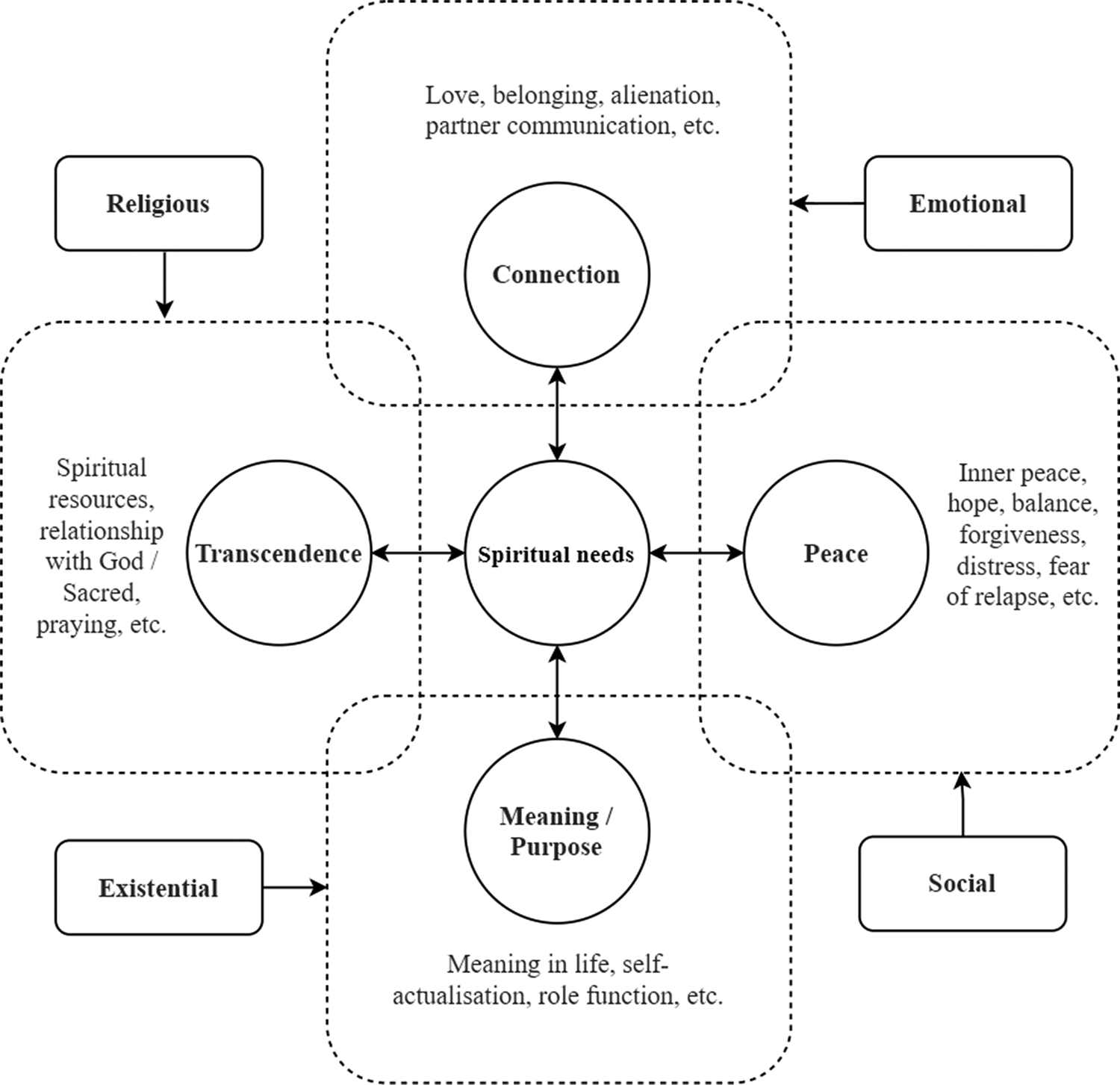
The spiritual needs model of chronic diseases patients established by Büssing et al. (Reference Bussing, Balzat and Heusser2010) was used in this study, which includes four core dimensions: connection, peace, meaning/purpose, and transcendence. These are further attributed to the underlying categories of social, emotional, existential, and religious needs of patients, as shown in Figure 1.
The spiritual needs model of patients with chronic diseases.

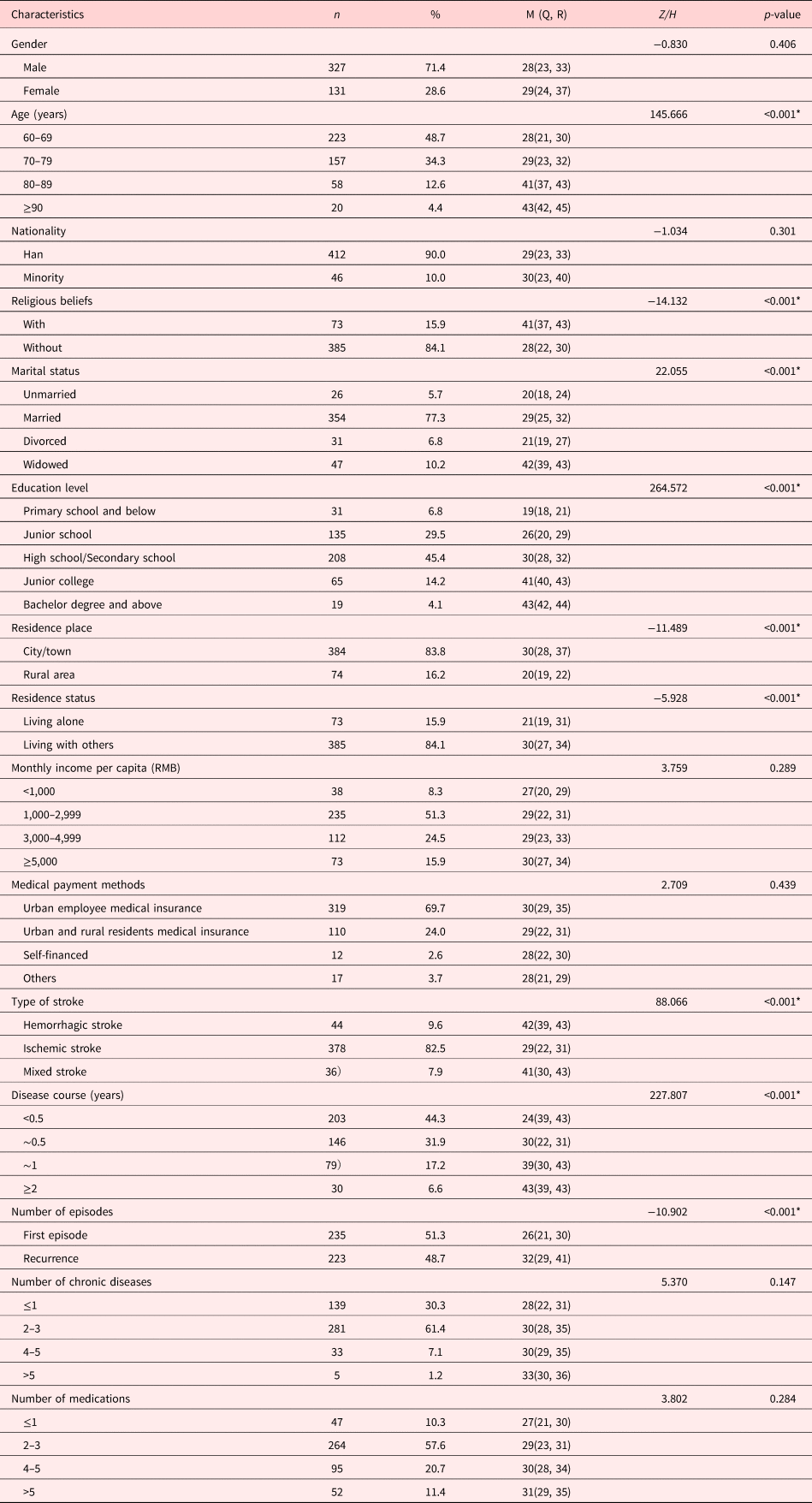
The sociodemographic characteristics questionnaire was developed by the researchers to identify the demographic, individual, and socioeconomic characteristics of the patients in accordance with the literature, including 17 items (such as gender and age), as shown in Table 1.
Sociodemographic characteristics and the scores of NSTS based on sociodemographic differences among elderly inpatients with stroke (n = 458)

* p < 0.01, Z: Mann–Whitney U-test, H: Kruskal–Wallis H test.
The Nurse Spiritual Therapeutics Scale (NSTS; Taylor and Mamier, Reference Taylor and Mamier2005; Xie et al., Reference Xie, Li and Wang2017) was used to assess needs for nurses to provide spiritual care. It consists of 5 dimensions and 12 items, including “sharing self-perception,” “helping thinking,” “creating a good atmosphere,” “exploring spiritual beliefs,” and “helping religious practice.” And the Cronbach's α was reported as 0.792, which calculated in this study was 0.853. The items in the scale, which is a 4-point Likert type, with the 1–4 scores indicating a range from “never” to “strongly.” The total score of NSTS was 12–48, with 12–24 being mild needs, 25–36 being moderate needs, and 37–48 being severe needs, with a higher score indicating higher needs for nurses to provide spiritual care.
The Functional Assessment of Chronic Illness Therapy—Spiritual Well-being (FACIT-Sp-12; Brady et al., Reference Brady, Peterman and Fitchett1999; Liu et al., Reference Liu, Wei and Chen2016) was used to assess spiritual well-being, which is the most effective measuring tool of spiritual well-being of patients with chronic disease. There are 3 dimensions and 12 items in FACIT-Sp-12, including “peace,” “meaning,” and “faith.” And the Cronbach's α was reported as 0.711–0.920, which calculated in this study was 0.913. The items in the scale, which is a 5-point Likert type, are scored between 0 and 4 points (0: not needed at all and 5: strongly needed). The total score of SPBS was 0–48, in which a higher score indicating a better spiritual well-being.
The Self-Perceived Burden Scale (SPBS; Cousineau et al., Reference Cousineau, McDowell and Hotz2003; Wu and Jiang, Reference Wu and Jiang2010) was used to assess self-perceived burden. There are 3 dimensions and 10 items in SPBS, including “physical burden,” “emotional burden,” and “economic burden.” The Cronbach's α was 0.910, which calculated in this study was 0.923. Likert 5 rating method was used, with the 1–5 scores indicating a range from “never” to “always.” The total score of SPBS was 10–50, with a higher score indicating a heavier self-perceived burden.
The Chinese Self-Transcendence Scale (CSTS; Reed, Reference Reed1991; Zhang et al., Reference Zhang, Sun and Zhang2014) was used to assess self-transcendence. A total of 15 items were included and the Cronbach's α was 0.892, which calculated in this study was 0.907. Likert 4 rating method was used, with the 1–4 scores indicating a range from “never” to “extremely.” The total score of CSTS was 15–60, with a higher score indicating a higher self-transcendence.
The Perceived Social Support Scale (PSSS; Zimet et al., Reference Zimet, Powell and Farley1990; Wang et al., Reference Wang, Wang and Hong1999) was used to assess perceived social support. There are 3 dimensions and 12 items in PSSS, including “family support,” “friend support,” and “other support.” The Cronbach's α was reported 0.880, which calculated in this study was 0.917. 7-point Likert was used, with the 1–7 scores indicating a range from “strongly disagree” to “strongly agree.” The total score of PSSS was 12–84, with a higher score indicating higher perceived social support.
Statistical analysis
The raw data were recorded and checked by two researchers using Epidata 3.1 software, and the data were then statistically analyzed by using SPSS 21.0 version program. The normality test, which included skewness, kurtosis, and histograms, was used to examine whether the scores of numerical variables were normally distributed. Descriptive statistics were used to describe sociodemographic characteristics of participants. Mean ± Standard deviation [M (SD)] and [M (Q, R)] were used to describe the measurement data in accordance with normal distribution or non-normal distribution, respectively. Student's t-test, ANOVA, correlation, and non-parametric analyses were performed to assess the relationships among sociodemographics, spiritual care needs, and other variables. Multiple linear regression was conducted to assess whether the variables predicted the spiritual care needs.
Ethical considerations
Ethical approval for conducting this study was obtained from the ethics committees of hospitals. After granting the official permission from hospital managers, the participants were approached by the researchers. A consent form for volunteer participation was completed by the participants. The participants were given the right to decide whether to participate in the study or not. Anonymity was ensured as the questionnaire contained no marks, names, or numbers that could identify participants. The questionnaires were anonymous and confidential, and the data obtained are only used for academic research.
Results
A total of 458 patients were recruited in this study, including 327 males (71.4%) and 131 females (28.6%), with an average age of 71.25 ± 8.51. And 223 (48.7%) aged 60–69, 157 aged 70–79 (34.3%), 58 (12.6%) aged 80–89, and 20 aged ≥90 (4.4%). And other sociodemographic characteristics were shown in Table 1.
The total score of spiritual care needs among the 458 elderly inpatients with stroke was 29.82 ± 7.65, which was moderate. The number of inpatients who were mild, moderate, and severe with the spiritual care needs were 28 (6.1%), 379 (82.7%), and 51 (11.2%), respectively. And among 5 dimensions, the average scores of dimension from high to low created a good atmosphere (2.86 ± 0.65), sharing self-perception (2.48 ± 0.66), helping thinking (2.46 ± 0.68), exploring spiritual beliefs (2.36 ± 0.70), and helping religious practice (1.93 ± 0.74). And the total scores of FACIT-Sp-12, SPBS, CSTS, and PSSS were 35.90 ± 6.57, 35.65 ± 7.33, 35.91 ± 8.64, and 49.57 ± 10.08, respectively.
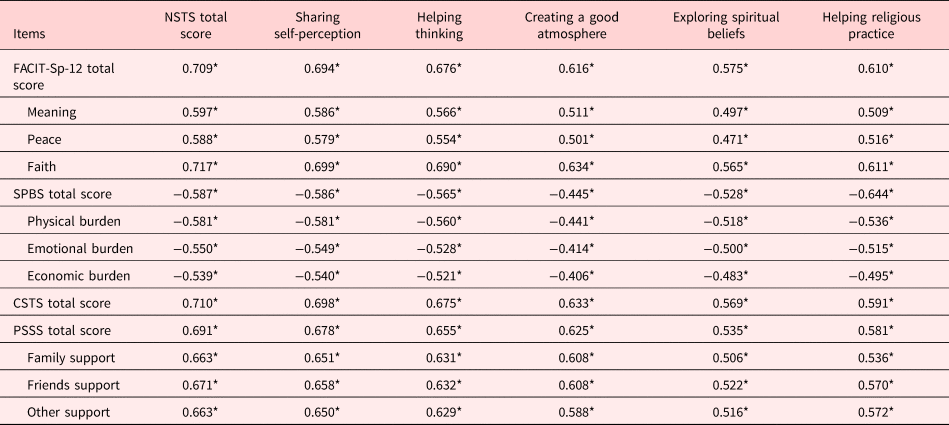
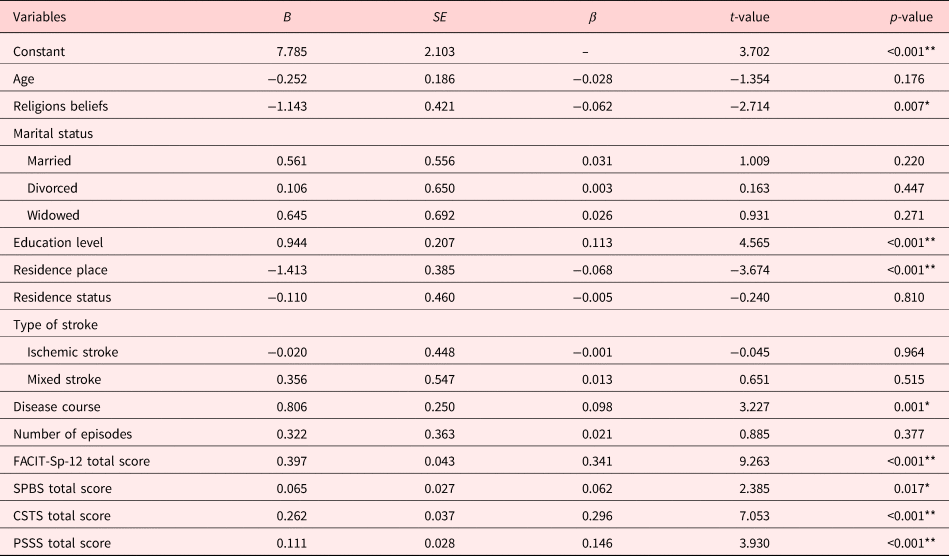
According to the results of single factor analysis, inpatients with different ages, religious beliefs, marital statuses, education levels, residence places, residence statuses, types of stroke, disease courses, and number of episodes had statistical significance in NSTS score difference, as shown in Table 1. Table 2 shows that spiritual care needs were positively correlated with spiritual well-being (r = 0.709, p < 0.01), self-transcendence (r = 0.710, p < 0.01), and social support (r = 0.691, p < 0.01). While they were negatively correlated with self-perceived burden (r = −0.587, p < 0.01), the results of multiple linear regression analysis from Table 3 revealed that religious beliefs, education level, residence place, disease course, spiritual well-being, self-perceived burden, self-transcendence, and social support were the main influencing factors, which could explain 71.3% (R = 0.849, R 2 = 0.721, adjusted R 2 = 0.713, p < 0.01).
The correlations among NSTS, FACIT-Sp-12, SPBS, CSTS, and PSSS in elderly inpatients with stroke (n = 458, r)

* p < 0.01.
A multiple linear regression of spiritual care needs among elderly inpatients with stroke (n = 458)

* p < 0.05.
** p < 0.01, R = 0.849, R 2 = 0.721, adjusted R 2 = 0.713, F = 57.685.
Discussion
In this study, the total score of NSTS among 458 elderly inpatients with stroke was 29.82 ± 7.65, and the average score of entries was 2.49 ± 0.64. The number of inpatients who were mild, moderate, and severe with the spiritual care needs were 28 (6.1%), 379 (82.7%), and 51 (11.2%), respectively. Comparison of domestic normative scores shows that the overall spiritual care needs among elderly inpatients with stroke were prevalent and generally moderate (Xie et al., Reference Xie, Li and Wang2017). The reasons for this may be as follows. Firstly, quality of life of elderly inpatients with stroke is seriously affected by the psychological, economic, and social burdens caused by the pain, stigma, and functional impairment. In addition, spiritual care in China is still in its infancy, there is still a lack of systematic spiritual care education model, and nurses have low awareness of spirituality and spiritual care, resulting in a mismatch between their competence and patients’ needs in spiritual care (Li et al., Reference Li, Wang and Xie2017). Last but not least, most of the elderly stroke inpatients may fail to realize that spiritual care is an “excellent living” care method that can mobilize positive emotions, promote spiritual comfort, and improve the quality of life. The total score of NSTS was lower than several domestic studies on cancer patients, such as breast cancer (Liu et al., Reference Liu, Zeng and Chen2019), gastric cancer (Cai and Wang, Reference Cai and Wang2018), and end-stage lung cancer (Shen and Dong, Reference Shen and Dong2018). The reason for this may be that, compared with the elderly inpatients with stroke, cancer patients have higher spiritual distress and pain, and they hope to overcome and get rid of the pain and hardship, and they are eager to seek help and spiritual comfort from families and friends, and obtain confidence and perseverance to adhere to treatment (Sastra et al., Reference Sastra, Bussing and Chen2021). Of the five dimensions, the highest score was 2.86 ± 0.65 for “creating a good atmosphere,” indicating that inpatients wish the nurses to provide them with a solitary environment, bring some humor, and be exposed to positive things and ideas as well as encouragement from others to enhance their confidence so that they could perceive the meaning of faith, death, life and family, and overcome fear and experience inner peace. The lowest score was only 1.93 ± 0.74 in the dimension of “helping religious practice” which may be due to the fact that 385 (84.1%) of the patients in this study had no religious beliefs, and the non-religious patients were more resistant to religious practices.
The results of this study showed that inpatients with religious beliefs had a higher spiritual care needs than those without religious beliefs (B = −1.143, p < 0.01), which was consistent with the findings of Li et al. (Reference Li, Wang and Xie2017). The reasons may be as follows. Religious beliefs, as an important part of spiritual care needs, is itself an expression of spirituality, which is at the highest level of the conceptual framework of spirituality. Its manifestations mainly include participating in religious activities, reading related books, etc., finding the meaning and value of eternal life, and regaining peace and comfort through continuous transcendence and integration (O'Brien et al., Reference O'Brien, Kinloch and Groves2019). Studies have shown that religious beliefs are related to the mental health of patients, and that patients with religious beliefs are more likely to accept the truth of the disease and believe that prayer is a process of obtaining power from God as a post-traumatic growth experience, which can divert attention from physical symptoms, enhance the resistance to disease, and relieve self-pressure (Shi et al., Reference Shi, Liu and Jiao2012). Therefore, nurses should pay more attention to the religion-related components of spiritual care needs and provide appropriate spiritual care measures.
The results of this study showed that inpatients with higher education level had a higher spiritual care needs than those with lower education level (B = 0.944, p < 0.01), which was similar to the results of Büssing et al. (Reference Bussing, Pilchowska and Surzykiewicz2015) while being contrary to the findings of Li et al. (Reference Li, Wang and Xie2017). The reasons for this may be as follows. Inpatients with higher education level are better at maintaining physical, psychological, and social well-being than those with lower education level. They are more proactive and efficient in learning about illnesses, and they can sensitively detect spiritual troubles and needs. In this process, they are good at using all resources available to carry out positive psychological suggestions and adjustments to maintain the overall spiritual health and spiritual peace. Therefore, nurses should provide inpatients with disease-related knowledge and information as well as psychological support using easy-to-understand methods according to their individual characteristics.
As shown in this study, inpatients living in cities/towns had a higher spiritual care needs than those living in rural areas (B = −1.413, p < 0.01), which was consistent with the results of Wang (Reference Wang2020) and van Nieuw et al. (Reference van Nieuw, Schaap-Jonker and Westerbroek2020). The reasons for this may be that, the overall medical level in cities is higher than rural areas, and inpatients living in cities/towns tend to be more educated, and they are better able to gain a deeper understanding of diseases and significance of spiritual care for disease treatment and mental health. As a contrast, medical resources in rural areas are limited, patients have heavier disease burden, and patients need to consider more to receive good medical services, which are relatively difficult. All these lead to patients easily ignoring the importance of spirituality.
As shown in the current investigation, inpatients with longer disease courses had a higher spiritual care needs than those with shorter disease courses (B = 0.806, p < 0.01), which was consistent with the results of Chan et al. (Reference Chan, Yu and Leung2016). The reasons may be as follows. The shorter the course of disease is, the less patients think about the meaning of life. They will not actively seek spiritual strength and sustenance, resulting in lower spiritual care needs. However, with the treatment progress of the disease, inpatients receive greater impact from physiological, psychological, and role changes due to various sequelae (such as paralysis and slurred speech), and are easier to consider death-related issues and become increasingly fearful of death (Logroscino and Beghi, Reference Logroscino and Beghi2021). They will strive to find their own spiritual strength to actively cope with the disease, thus generating higher spiritual care needs. Therefore, nurses should pay more attention to patients’ psychological and spiritual support, and help them regain spiritual comfort at the end of the disease or even the end of their life.
The results of this study showed a positive correlation between spiritual well-being and spiritual care needs, which means that the higher spiritual well-being is, the higher their spiritual care needs are (r = 0.709, p < 0.01), which was consistent with the research conducted by Zhang (Reference Zhang2018). Research by Liu et al. (Reference Liu, Zeng and Chen2019) and Wang (Reference Wang2020) also showed that spiritual well-being was a predictive indicator of patients’ spiritual care needs. The reasons for this may be as follows. Inpatients with better spiritual well-being can treat their current plight with a peaceful and harmonious mentality, find strength and comfort in their beliefs or spiritual beliefs, have a more thorough understanding of illness and life, and have a more clear picture about the meaning and purpose of life (Büssing et al., Reference Bussing, Pilchowska and Surzykiewicz2015). Inpatients in this category are more willing to tell nurses about their spiritual life, explore the relationships among themselves, nature, life and the spiritual power they believe in, and obtain spiritual support through a variety of ways, which was consistent with Kamijo and Miyamura (Reference Kamijo and Miyamura2020) who reported that patients with higher spiritual well-being attach more importance to the communication and contact with their families, friends, and nurses, and are more likely to agree with the significance of meeting spiritual care needs.
This study also showed that spiritual care needs were negatively correlated with self-perceived burden, that is, the heavier self-perceived burden is, the lower spiritual care needs are (r = −0.587, p < 0.01). Self-perceived burden is the empathic concern that results from an individual's disease and care needs affecting others, resulting in decreased guilt, burden, and self-perception (Ren et al., Reference Ren, Liu and Li2016). The reason for this may be that, the heavier self-perceived burden, the stronger the sense of guilt, and they have physical and psychological problems. In addition, the dysfunction, image change, and limited activities directly caused by stroke lead to a huge psychological gap in patients, and they are more likely to have negative emotions, and unable to face the disease, their families, and the society positively. As a result, their confidence in overcoming disease gradually decreases, blocking harmony at the spirituality level and ultimately making the spiritual care needs significantly lower. Studies have shown that psychological factors can alleviate or aggravate the symptoms of the disease by affecting the mental health of patients, thus affecting the onset, progression, and prognosis of disease, and ultimately determining the quality of life (Liang and Zhang, Reference Liang and Zhang2020). Therefore, nurses should meet inpatients’ spiritual care needs by strengthening communication with them and reducing self-perceived burden through a variety of effective emotional intelligence interventions (such as life review therapy, music therapy, and nostalgia therapy).
The results of this study showed a positive correlation between self-transcendence and spiritual care needs, namely, the higher self-transcendence is, the higher spiritual care needs are (r = 0.710, p < 0.01). Self-transcendence refers to the different ways to improve individual's ability to achieve continuous transcendence in the face of life events, so that self-actualization reaches a higher level, which is inseparably linked to the mind, psychology, and spirit (Bajjani-Gebara et al., Reference Bajjani-Gebara, Hinds and Insel2019). The reasons for this may be as follows. Stroke inpatients with a higher self-transcendence level often deal with problems in different ways. When faced with physical pain and various negative emotions, they can analyze the essential issues, and use all favorable factors (such as interpersonal relationships, and family support) to deal with them positively, so as to enhance self-confidence and self-esteem, and thus achieve spiritual harmony. Therefore, nurses should improve their self-transcendence through a variety of effective psychological intervention measures, improve their understanding of the significance of life fundamentally, so as to meet their own spiritual care needs in the process of achieving self-transcendence.
As shown in this study, spiritual care needs were positively correlated with social support, that is, the higher social support is, the higher spiritual care needs are (r = 0.691, p < 0.01), which was similar to the results of Erichsen and Bussing (Reference Erichsen and Bussing2013). Social support is one of the potential resources for patients to face disease stress, which not only provides buffer and protection for themselves, but also helps them to maintain a good emotional experience (Sharrief et al., Reference Sharrief, Sanchez and Lisabeth2017). The reasons may be as follows. The more social support patients receive, the more they can give vent to all kinds of negative emotions to their caregivers, and are willing to communicate with others about their feelings and ideas. In the process, they feel spiritual support and strength from their caregivers. As a result, the utilization of social support is increased, so that their confidence in treatment is increased. Therefore, nurses should provide inpatients with multi-faceted support (such as patient exchange meetings) in a targeted manner, feel love from caregivers, so as to meet their spiritual care needs.
Strengths and limitations
The study has several limitations. Firstly, the study was conducted using a convenience sampling method, and only 458 elderly inpatients with stroke were selected from three hospitals in China, which may mean that the sample is not being representative enough and the findings are somewhat one-sided and cannot be generalized. In addition, due to the differences and abstractness of “spirituality” cultures between the East and the West, there may be some deviations of results. It is recommended that assessment suitable for Chinese cultural background should be adopted and include more patients in different regions in future research.
Conclusion
This study found that the 458 elderly inpatients with stroke had moderate spiritual care needs, and religious beliefs, education level, residence place, disease course, spiritual well-being, self-perceived burden, self-transcendence, and social support were the main factors affecting spiritual care needs. It is suggested that nurses should strengthen learning of spiritual care knowledge, improve their spiritual care competence, take targeted spiritual care measures according to patients’ individual characteristics and differences, reduce self-perceived burden, and improve spiritual well-being, self-transcendence and social support to meet their spiritual care needs to the maximum and enhance their spiritual peace.
Supplementary material
The supplementary material for this article can be found at https://doi.org/10.1017/S1478951522000426.
Author contributions
Zhangyi Wang contributed to the work design, data collection, data acquisition, data analysis, data interpretation, draft the article, revise important intellectual content of the article, and the final approval of the version to be submitted. Haomei Zhao contributed to the work design, analysis, data acquisition, data interpretation, draft the article, and the final approval of the version to be submitted. Yue Zhu and Siai Zhang contributed to the analysis of the work, data interpretation, draft the article, and the final approval of the version to be submitted. Luwei Xiao and Haiqin Bao contributed to the analysis of the work, data interpretation, draft the article, and the final approval of the version to be submitted. Zhao Wang, Yue Wang and Xuechun Li contributed to the analysis of the work, data interpretation, writing of the article, and final approval of the version to be published. Yajun Zhang and Xiaoli Pang contributed to the data interpretation, revise important intellectual content of the article, and the final approval of the version to be submitted.
Funding
This research was supported by the Tianjin Research Innovation Project for Postgraduate Students (CN) [grant number 2021YJSS171], and the Tianjin University of Traditional Chinese Medicine Research Innovation Project for Postgraduate Students (CN) [grant number YJSKC-20212005].
Conflict of interest
The authors declare that there is no conflict of interest.