Implications
Aggression when pigs are mixed with unfamiliar individuals causes stress. Genetic selection for pigs showing low aggression could reduce stress and improve animal welfare. In a behavioural genetics study on 1663 pigs in one farm, we looked at responses to two challenges: (1) mixing with unfamiliar pigs, which results in aggression and (2) being moved through a weigh crate. These two responses were moderately associated at the genetic level, meaning that genetic selection to reduce aggression could result in pigs that are somewhat less active (and perhaps calmer?) in the weigh crate at weighing.
Introduction
The behavioural responses of farmed livestock to their social and physical environment can affect animal welfare, production and health. Within a population, individuals show differences in behaviour, which are stable across time and situations. This is referred to as animal temperament, personality or behavioural syndromes (Sih et al., Reference Sih, Bell and Johnson2004; Réale et al., Reference Réale, Reader, Sol, McDougall and Dingemanse2007). Examples of temperament traits in livestock include aggressiveness (D’Eath, Reference D’Eath2002), maternal traits (Jarvis et al., Reference Jarvis, D’Eath and Fujita2005), responses to isolation (Boissy et al., Reference Boissy, Fisher, Bouix, Hinch and Le Neindre2005), and responses to humans or handling (Phocas et al., Reference Phocas, Boivin, Sapa, Trillat, Boissy and Le Neindre2006).
Although experiences during development are also important (e.g. D’Eath and Lawrence, Reference D’Eath and Lawrence2004; D’Eath, Reference D’Eath2005), such temperament traits have been shown to be partly under genetic control (Van Oers et al., Reference Van Oers, de Jong, Van Noordwijk, Kempenaers and Drent2005; Réale et al., Reference Réale, Reader, Sol, McDougall and Dingemanse2007). This raises the possibility that genetic selection could be used to alter animal temperament, resulting in animals that are better adapted to the farmed environment. For example in pigs, specific behavioural traits which could be altered by genetic selection include social aggression, tail-biting, savaging of newborn piglets by sows and other aspects of piglet and sow behaviour that contribute to piglet survival (Kanis et al., Reference Kanis, van den Belt, Groen, Schakel and De Greef2004; Roehe et al., Reference Roehe, Shrestha, Mekkawy, Baxter, Knap, Smurthwaite, Jarvis, Lawrence and Edwards2009; Turner et al., Reference Turner, Roehe, D’Eath, Ison, Farish, Jack, Lundeheim, Rydhmer and Lawrence2009). Aggressive behaviours following the mixing of pigs are moderately heritable (h 2 = 0.17 to 0.24, Løvendahl et al., Reference Løvendahl, Damgaard, Nielsen, Thodberg, Su and Rydhmer2005; h 2 = 0.37 to 0.46, Turner et al., Reference Turner, Roehe, Mekkawy, Farnworth, Knap and Lawrence2008; h 2 = 0.31 to 0.43, Turner et al., Reference Turner, Roehe, D’Eath, Ison, Farish, Jack, Lundeheim, Rydhmer and Lawrence2009). An associated indicator trait (skin lesion counts 24 h after mixing) is also heritable (h 2 = 0.22, Turner et al., Reference Turner, White, Brotherstone, Farnworth, Knap, Penny, Mendl and Lawrence2006; h 2 = 0.12 to 0.20, Turner et al., Reference Turner, Roehe, Mekkawy, Farnworth, Knap and Lawrence2008; h 2 = 0.21 to 0.26, Turner et al., Reference Turner, Roehe, D’Eath, Ison, Farish, Jack, Lundeheim, Rydhmer and Lawrence2009) and is genetically correlated with aggressive behaviour (r g = 0.56–0.77, Turner et al., Reference Turner, Roehe, Mekkawy, Farnworth, Knap and Lawrence2008; r g = 0.67–0.79, Turner et al., Reference Turner, Roehe, D’Eath, Ison, Farish, Jack, Lundeheim, Rydhmer and Lawrence2009). This suggests that skin lesions could be used as a proxy measurement, which is the result of aggression, and would be easier to apply in practical animal breeding than observations of behaviour. Aggressive behaviour in pigs has a number of negative impacts on animal welfare including skin injuries, social stress and impaired immune function (D’Eath, Reference D’Eath2002; Turner et al., Reference Turner, White, Brotherstone, Farnworth, Knap, Penny, Mendl and Lawrence2006). A number of these traits also have production impacts affecting growth, carcass gradings and meat quality (Warriss et al., Reference Warriss, Brown, Gade, Santos, Costa, Lambooij and Geers1998; D’Eath, Reference D’Eath2002). Selection to reduce aggressive behaviour in pigs thus appears to be both feasible and desirable.
However, selection for one trait may affect other traits, mainly because single genes may have more than one effect (pleiotropy) and because genes do not segregate randomly in the population (linkage disequilibrium; Falconer and Mackay, Reference Falconer and Mackay1996). The correlation of the breeding values of two traits is known as the genetic correlation (Falconer and Mackay, Reference Falconer and Mackay1996). However, selection against aggressive behaviour may affect other genetically correlated traits, thereby affecting the feasibility and desirability of adding behavioural traits to a breeding programme.
In the present study, we investigated the genetic relationships between aggressive behaviour at mixing and two further behaviour traits of potential practical and ethical importance, in a pedigree herd of 1663 pigs. For example, lower aggressiveness may be genetically correlated with reduced activity of animals in any situation. To investigate this, we observed activity in the home pen (3 weeks after mixing) over 24 h. Conversely, high aggressiveness in pigs may be associated with increased reactivity in other challenging situations (Thodberg et al., Reference Thodberg, Jensen and Herskin1999; Ruis et al., Reference Ruis, te Brake, Van de Burgwal, de Jong, Blokhuis and Koolhaas2000; but see D’Eath and Burn, Reference D’Eath and Burn2002) as found in a number of other species (‘coping styles’ reviewed by Koolhaas et al. (Reference Koolhaas, de Boer, Buwalda and van Reenen2007)). If there is a genetic relationship between these traits, then selection for reduced aggression would lead to reduced responses to other challenges. To investigate this, we scored responses to a practically relevant challenge: handling during weighing, on two occasions 85 days apart. This situation contains a number of different aspects that could affect how pigs respond: presence of human handlers (Hemsworth et al., Reference Hemsworth, Barnett, Treacy and Madgwick1990), novelty, restraint and partial isolation from penmates.
Material and methods
The work described here was carried out at a farm in Ransta, Sweden as part of a larger study on the genetics of behaviour in pigs, aspects of which have been described in detail in Turner et al. (Reference Turner, Roehe, D’Eath, Ison, Farish, Jack, Lundeheim, Rydhmer and Lawrence2009). The work was subjected to an ethical appraisal by the Animal Experiments Committee at the Scottish Agricultural College (SAC), and permission for the study was granted by Sweden’s animal protection authority (Djur Skydds Myndigheten).
Animals and housing
The genetic analyses were carried out on a pedigree population of pigs (n = 1663) from a dam-line nucleus, consisting of 898 Swedish Yorkshire and 765 Swedish Yorkshire × Swedish Landrace, of which 582 were entire males, 222 castrates and 859 were female. Pigs were the progeny of 86 sires and 251 dams, and their full pedigree back to the great-grandparent generation was known.
Pigs were born in open farrowing pens (5.76 m2 with 0.24 m2 creep area) and, after weaning, were housed in these pens until 70.5 ± 4.3 (mean ± s.d.) days of age, when the mean live-weight was 27.7 ± 5.5 kg. At this stage, pigs were transported to a different building and mixed into new groups of 15 (details below) in part-slatted pens (29% slats, 71% shallow sawdust bedding over a solid floor) measuring 4.0 m × 3.2 m (0.85 m2 per pig). Dry pelleted food was provided ad libitum from a single-space feeder. Pigs remained in these pens until after 156.7 ± 5.9 days of age (live-weight 105.0 ± 11.9 kg) when the last measurements were taken. The mean (±s.d.) temperature was 19.4 (±2.9)°C.
The farm employed a batch-farrowing system, and the experiment used 105 to 120 pigs from each of 14 batches, spread over a 14-month period.
Observations of aggressive behaviour at mixing
This part of the study has been described in depth (Turner et al., Reference Turner, Roehe, D’Eath, Ison, Farish, Jack, Lundeheim, Rydhmer and Lawrence2009), but briefly, 109 groups of 15 pigs and two groups of 14 pigs were mixed into new groups (n = 1663). These new groups consisted of entirely purebred (Swedish Yorkshire) or crossbred (Swedish Yorkshire × Swedish Landrace) pigs. Group composition in terms of the number and proportion of pigs from different groups entering a new group can affect the overall level and targets of aggression. Consequently, group composition was kept uniform and balanced: single-sex groups of 15 were composed of three pigs from each of five littermate groups. Since pig size is a predictor of participation and success in aggressive interactions (D’Eath, Reference D’Eath2002), weight variation within a group was minimised.
On the day of mixing, each animal was given an individually distinct spray mark and an injection against mycoplasma, which was routine on this farm. Three pig littermate subgroups were selected from their pen and were kept separately in a trailer for transport. They were then transported for approximately 10 min over a distance of 4 km and mixed into their new groups of 15 on arrival. Then, 24-h time-lapse video recordings of these newly mixed groups were made, and each individual’s aggressive behaviour was subsequently observed for analysis using Noldus Observer software. The total time each pig spent in reciprocal aggression (in the following referred to as ‘fighting’) and in both delivery and receipt of non-reciprocal aggression (in the following referred to as ‘bullying’ and ‘being bullied’) were recorded. Reciprocal aggression (fighting) was defined as aggressive interactions lasting ⩾1 s in which both pigs were seen to be pushing, head knocking and/or biting each other, and non-reciprocal aggression was the same, but delivered by one pig with no retaliation by the opponent. At 24 h after mixing, the pigs were weighed as detailed below.
Scoring of the response to handling at weighing
Pigs were weighed on two occasions: (i) 24 h after mixing on day 71.5 ± 4.3 (in the following referred to as ‘weighing at mixing’), and (ii) at the end of the test period at 156.7 ± 5.9 days of age (in the following referred to as ‘weighing at end of test’). Handling scores were collected at these times from 1620 pigs (29 pigs had died by the second weighing and 14 pigs were excluded due to ill health, primarily due to lameness). On each occasion, one group of pigs at a time were removed from their pen into one half of a corridor area (28.0 m × 1.5 m) with a weight crate, suitable for the weight of pigs studied, placed half way along the corridor and positioned so as to block pig access. In an ad-hoc order, pigs were then, (a) moved into the weigh crate, (b) weighed and (c) allowed to leave the weigh crate to access the other half of the corridor. At these three scoring points, each pig’s behaviour was scored on a 3- or 5-point scale according to the system given in Table 1, where low values indicate difficult-to-handle pigs and high values indicate easy-to-handle pigs. Also, whether or not the pig produced high-pitched ‘squeal’ vocalisations whilst it was in the weight crate was recorded (Marchant et al., Reference Marchant, Whittaker and Broom2001). The order in which pigs were weighed was noted. After weighing, all pigs were returned to their home pen, and another group weighed and scored in a similar way. Scoring of pigs was always performed by the same individual.
Scoring system used for handling during weighing

Observations of inactivity in the home pen
Aggressive behaviour associated with the formation of a new group is most intense during the first few hours after mixing (D’Eath, Reference D’Eath2002) and typically declines to baseline over the next several days. These home pen observations were thus intended to reflect behaviour in a relatively stable social group context rather than during the intense initial aggression associated with group formation. Due to practical constraints, pigs from 81 of the 111 mixed pens (n = 1212) were observed at 18.2 ± 2.9 (mean ± s.d.) days after mixing, when pigs were 88.8 ± 5.2 days of age. Each pig was spray-marked enabling individual identification and then time-lapse video-recorded for 24 h. Once in an hour, instantaneous scan-samples of every pig’s behaviour were made, enabling an estimate of activity levels. Pigs were defined as either being active (standing or sitting) or inactive (lying): active pigs were either standing upright on all four legs (which included standing still, walking or running), or sitting in a dog-like posture on its hind haunches with its front legs straight. Inactive pigs were lying with both front and rear portions of the ventral or lateral skin surface in contact with the ground.
Genetic analysis
The aggressive behavioural traits (fighting, bullying and being bullied) showed skewed distributions with substantial kurtosis as described in more detail in Turner et al. (Reference Turner, Roehe, Mekkawy, Farnworth, Knap and Lawrence2008) and Turner et al. (Reference Turner, Roehe, D’Eath, Ison, Farish, Jack, Lundeheim, Rydhmer and Lawrence2009). To reduce the skewness as well as kurtosis and to approach normality, a log transformation Y = loge (1 + observation) was used for these behavioural traits. All other traits (handling scores and home pen activity) were based on their original scale. To obtain reliable estimates of the genetic parameters, in particular of the genetic correlations, the two lines had to be pooled for the analysis. However, the lines are partly genetically connected because Yorkshire animals were used in the purebred line as well as sire in the crossbred line.
The estimation of genetic and environmental parameters was carried out in three analyses. In the first analysis, handling scores traits at mixing and activity in the home pen, were estimated together with behavioural traits indicating aggressiveness. In the second analysis, genetic and environmental parameters of handling scores at mixing and at end of test were treated as different traits and estimated in a multiple trait model. In the third analysis, handling scores at end of test were analysed with behavioural traits reflecting aggression. The model used for all analysed traits was the same and is described in more detail in the following:

where y includes the vector of observations of the analysed traits. Vector b includes the fixed effects of line (purebred Yorkshire, crossbred Yorkshire x Landrace), sex (males, castrates and females), experimental batch (14 separate mixing days reflecting the batch farrowing policy on the farm) and body weight at mixing as a covariable fitted by using linear regression. For handling scores at the end of test, the latter covariable was based on body weight at end of test. Preliminary analysis showed that the sex effect was only significant for the behavioural trait moving into the crate recorded at end of test (indicating that females are moving faster into the crate). However, the gender effect has been kept in the model for all analysed traits to be sure that this factor did not influence the estimates of genetic parameters. The vectors a, c and e represent the additive genetic effects, common environmental pen effects (into which the animals were mixed) and the environmental residual effects, respectively. X, Z and W are incidence matrices linking the effects with y.
The variance–covariance structure was as follows:
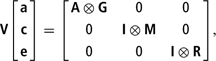
where G represents the (co)variance matrix due to additive genetic effects, M is the (co)variance matrix due to the common environmental pen effects (111 pens) in which the mixing of animals took place and R is the (co)variance matrix due to residual effects. A denotes the additive genetic relationship matrix (2419 animals) and I is the identity matrix.
Genetic and environmental variance components of model (1) were estimated using restricted maximum likelihood (REML) approach as implemented in the programme VCE-5 (Kovac et al., 2003).
In all tables of results, standard errors of each estimated parameter are reported in parentheses. Estimated parameters were tested for significance from zero using P < 0.05. Some traits are estimated more than once in different analyses and in some cases their estimates were slightly different. This is because different combinations of traits result in slightly different sampling variance due to their different covariances. Where two different estimates of a trait are available, we took the most accurate estimate and quote the value with the smallest standard error if the estimate is discussed in the text.
Results
Aggressive behaviour at mixing
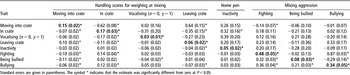
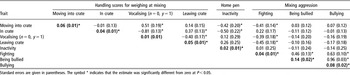
The heritabilities of, and correlations between aggressive traits have been discussed in detail in Turner et al. (Reference Turner, Roehe, D’Eath, Ison, Farish, Jack, Lundeheim, Rydhmer and Lawrence2009). In summary (Tables 2 and 6), both fighting and delivery of bullying were moderate to highly heritable traits, and these two behaviours were strongly associated as indicated by a high positive genetic correlation and a moderate residual correlation. This suggests that the same animals are engaged in fighting and bullying. In contrast, receiving bullying showed a much lower heritability. The pen of mixing had a small but significant effect on aggressive behaviour, and there were strong positive correlations between these pen effects, suggesting that in certain pens, all forms of aggression were increased (Tables 3 and 7).
Heritabilities (on diagonal) as well as genetic (above diagonal) and residual correlations (below diagonal) among different handling score and aggression traits using the handling scores for weighing at mixing

Standard errors are given in parentheses. The symbol * indicates that the estimate was significantly different from zero at P < 0.05.
Phenotypic fractions of the variance due to pen of mixing (diagonal) and their correlations (above diagonal) among different handling score and aggression traits using the handling scores for weighing at mixing

Standard errors are given in parentheses. The symbol * indicates that the estimate was significantly different from zero at P < 0.05.
Scoring of the response to handling at weighing
Pigs were generally quite efficient to handle, with the majority receiving intermediate or high scores, although the scoring was not very diverse. In each case, the most commonly used (modal) score was used for 50% of more of the pigs scored (Figure 1). Vocalisations in the crate were quite rare, occurring on 6.0% of occasions during the first weighing at mixing, and 7.0% during the second weighing at end of test.
Frequency histograms of the pig handling scores recorded during weighing at two time points (first weighing at mixing: light bars; second weighing at end of test: dark bars), for (a) moving into crate (modal score 4 used for 60.2% of pigs at mixing and 51.3% at end of test), (b) in crate (modal score 2 used for 52.9% at mixing and 63.4% at end of test), (c) leaving crate (modal score 3 was used for 73% of pigs at mixing and 91.4% at end of test).

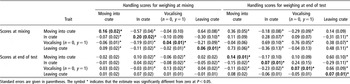
Genetic analysis comparing the corresponding handling score traits from the two weighing events (e.g. moving into the crate in the weighing at mixing and at end of test), generally revealed weak to moderate genetic correlations (Table 4). The exception to this was that vocalisations on the two occasions were highly correlated. Because of the generally weak genetic correlations, the handling scores recorded on the two occasions were treated as separate traits, rather than repeated observations of the same trait. Heritabilities for the handling traits were quite low, although all estimates were significantly different from zero. Residual correlations between different handling scores were very low. At both weighing events, there was a moderately high positive genetic correlation between the scores for moving into the crate and leaving the crate (weighing at mixing: r g = 0.64 ± 0.08; weighing at end of test: r g = 0.60 ± 0.10; Table 4), suggesting that the behavioural response to these two aspects of the situation shared a degree of common genetic influence. Therefore, at the genetic level, pigs that entered the crate with little encouragement also exited with little encouragement. The handling score for moving into the crate showed a negative genetic correlation with the score for behaviour in the crate, indicating that pigs that were difficult to move into the crate were subsequently inactive during weighing. However, this genetic association was only significant for the weighing at mixing (r g = −0.57 ± 0.04; Table 4) but not for the end of test weighing (r g = −0.17 ± 0.10; Table 4). The handling score in the crate showed a negative genetic correlation with the score for behaviour on leaving the crate. This correlation was similar in magnitude for both weighing events (r g = −0.30 ± 0.10; r g = −0.29 ± 0.11; Table 4), indicating that pigs that were inactive during weighing were more likely to need to be pushed in order to leave when the exit gate was opened. Vocalisation in the crate showed the highest genetic correlation between the two weighing events, but generally low genetic correlations with the other handling scores. The exception to this was that pigs which had to be pushed from the crate at the mixing weighing showed a propensity to vocalise (r g = −0.21 ± 0.09), while conversely on the end of test weighing, it was pigs which left the crate of their own accord that showed a propensity to vocalise (r g = 0.66 ± 0.09). All other genetic and residual correlations were low (Table 4).
Heritabilities (on diagonal) as well as genetic (above diagonal) and residual correlations (below diagonal) among different handling scores assessed at mixing and at the end of test weighing

Standard errors are given in parentheses. The symbol * indicates that the estimate was significantly different from zero at P < 0.05.
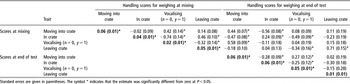
Pen effects were responsible for only a small fraction of the variance for each of the handling score traits, although there were some correlations (Table 5).
Phenotypic fractions of the variance due to pen of mixing (diagonal) and their correlations (above diagonal) among different handling scores assessed at mixing and at the end of test weighing

Standard errors are given in parentheses. The symbol * indicates that the estimate was significantly different from zero at P < 0.05.
Inactivity in the home pen
Inactivity in the home pen (measured by the amount of lying) was distributed symmetrically (Figure 2) and showed a low heritability (h 2 = 0.05 ± 0.01; Table 6).
Heritabilities (on diagonal) as well as genetic (above diagonal) and residual correlations (below diagonal) among different handling score and aggression traits using the handling scores at the end of test weighing

Standard errors are given in parentheses. The symbol * indicates that the estimate was significantly different from zero at P < 0.05.
Frequency histogram of inactivity (frequency of lying) in the home pen 18.2 ± 2.9 (mean ± s.d.) days after mixing.

Genetic correlations between behavioural traits
Mixing aggression and handling scores
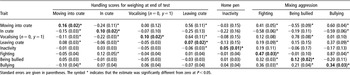
Estimates of genetic correlations between aggression traits and handling scores from the first weighing were not significantly different from zero (Table 2) with one exception: there was a very weak negative genetic correlation between fighting and moving into the crate, suggesting that pigs that fought needed more encouragement to enter the crate. There were a few significant correlations between the pen effects: pigs from pens in which fighting was high were slower to enter and leave the crate, and less likely to vocalise in the crate (Table 3).
There were a number of significant genetic correlations between handling scores from the end of test weighing and aggression traits (Table 6): in contrast to the finding from the weighing at mixing, genetically aggressive pigs (showing high durations of fighting and bullying) showed a genetic propensity to move more quickly into and out of the weigh crate. The receipt of bullying at mixing showed a positive genetic correlation with vocalising whilst in the crate and a negative correlation with movement into the crate during the end of test weighing, indicating that these bullied pigs required greater encouragement to enter the crate. Residual correlations between handling at the end of test weighing and aggression were low and generally non-significant (Table 6, below the diagonal). Pen effects on aggression and handling at the end of test weighing were generally not significantly correlated.
Handling scores and home pen inactivity
The standard error associated with estimates of genetic correlations between inactivity in the home pen and handling scores were large for both the weighing events at mixing and at end of test. Consequently, almost none of these correlations were statistically significant (Tables 2 and 6). The one exception was that there was a significant genetic correlation between inactivity and behaviour in the crate at the mixing weighing: pigs that were inactive in the home pen had higher scores in the crate indicating that they stood still during weighing.
When the pen effects were considered, there were some significant correlations between inactivity and aspects of behaviour during weighing (Tables 3 and 7).
Phenotypic fractions of the variance due to pen of mixing (diagonal) and their correlations (above diagonal) among different handling score and aggression traits using the handling scores at the end of test weighing

Standard errors are given in parentheses. The symbol * indicates that the estimate was significantly different from zero at P < 0.05.
Mixing aggression and home pen inactivity
None of the genetic correlations between inactivity and aggressive behaviour were statistically significant, as all estimates had large standard errors (Tables 2 and 6). There were also no significant correlations between pen effects on inactivity and aggressive behaviour (Tables 3 and 7).
Discussion
Genetics of aggressive behaviour at mixing
As expected based on earlier work in pigs (Løvendahl et al., Reference Løvendahl, Damgaard, Nielsen, Thodberg, Su and Rydhmer2005; Turner et al., Reference Turner, White, Brotherstone, Farnworth, Knap, Penny, Mendl and Lawrence2006; Turner et al., Reference Turner, Roehe, Mekkawy, Farnworth, Knap and Lawrence2008), aggression had a moderate-to-high heritability, comparable to, or higher than that in reports from other species. Being bullied showed a lower heritability, suggesting that being the target of aggression is genetically determined to some degree. There was a high positive genetic correlation between the two offensive aggressive behaviours: fighting and bullying. The pen effect explained a considerable part of the variation in the environmental component of aggression. This may result from the fact that certain combinations of types of animals result in greater aggression in a pen as a whole (D’Eath, Reference D’Eath2002). Aggressive behaviour results from this study are presented and discussed in greater detail in Turner et al. (Reference Turner, Roehe, D’Eath, Ison, Farish, Jack, Lundeheim, Rydhmer and Lawrence2009).
Genetics of behaviour during handling at weighing
Weighing is a complex challenge for the pig, including aspects of novelty, social separation/reinstatement, confinement and the presence of actively interacting humans. Despite this, the different aspects of behaviour during weighing showed low but significant heritabilities (h 2 = 0.03 to 0.17), even though scores were not particularly variable, suggesting that response to handling could be altered by genetic selection. In contrast to the aggressive social behaviours, pen effects on handling were very small. Although there are no comparable studies in pigs, similar levels of heritability for handling scores have been found in beef cattle under similar confined circumstances (behaviour in and on exit from a crush; Burrow, Reference Burrow1997; Kadel et al., Reference Kadel, Johnston, Burrow, Graser and Ferguson2006). Higher heritabilities have been reported for the reaction to humans in a standardised test in a larger space (a handling pen) in both pigs (h 2 = 0.38 ± 0.19, Hemsworth et al., Reference Hemsworth, Barnett, Treacy and Madgwick1990) and beef cattle (h 2 = 0.06 to 0.26, Phocas et al., Reference Phocas, Boivin, Sapa, Trillat, Boissy and Le Neindre2006).
A degree of consistency over time in a response is one aspect that defines animal temperament (Sih et al., Reference Sih, Bell and Johnson2004; Réale et al., Reference Réale, Reader, Sol, McDougall and Dingemanse2007). In the present study there were moderate genetic correlations between corresponding handling scores at the two weighing events 85 days apart, suggesting that there were some common genetic influences on behaviour at these two times. However, the correlations were significantly less than one, suggesting that it was not appropriate to treat the two behavioural responses to weighing as a repeated measurement of a single trait in genetic models. Genetic correlations for repeated measures of behavioural traits have rarely been reported in livestock species (Wolf et al., Reference Wolf, McBride, Lewis, Davies and Haresign2008), although repeatability is often found at the phenotypic level (Ruis et al., Reference Ruis, te Brake, Van de Burgwal, de Jong, Blokhuis and Koolhaas2000; D’Eath, Reference D’Eath2004).
Within each weighing event, the three handling scores and vocalisations reflect different aspects of the pig’s response to the same event and as such correlations between them were expected. At each weighing, moving into and out of the crate was positively genetically correlated, but the genetic correlation between these two and behaviour in the crate was negative. The direction of this relationship was perhaps due to the scoring system used: We took the human handler’s perspective in assigning high scores to ‘good’ handling characteristics: moving quickly in and out of the crate and standing still in the crate. However, the direction of the genetic correlations we found makes better sense from a pig perspective: pigs were either active or inactive, where active pigs moved quickly into and out of the crate and moved around a lot during weighing. This interpretation requires a little caution: score 1 for moving into the crate allows for ‘actively’ stubborn pigs who try to escape, although in practice this occurred rarely (Figure 1a). The fact that the scores for moving in and out of the crate were positively correlated could suggest that the motivation to move away from the human handler was the common factor influencing behaviour. If fear of the crate had been the most important, the expectation might be that pigs that were slow to enter the crate would be quick to leave it.
Although rapid movement in and out of the crate is desirable from a human handler’s perspective, high levels of activity in the crate and on exit may indicate that pigs were more fearful of the weighing situation. In support of this, was the finding that there was a positive genetic correlation between high-pitched ‘squeal’ vocalisations in the crate and a rapid exit from the crate (after the second weighing). In beef cattle, vigorous behaviour in a weigh crate and a subsequent rapid exit are often positively correlated and taken to indicate a flighty, fearful temperament, which is undesirable because of its implications for handler safety (Turner and Lawrence, Reference Turner and Lawrence2007) and its association with poor meat quality (Kadel et al., Reference Kadel, Johnston, Burrow, Graser and Ferguson2006).
Genetics of home pen inactivity
The estimated heritability for inactivity during a 24-h period in the home pen was very low (0.05 ± 0.01), but significantly different from zero. In contrast to the aggressive social behaviours, pen effects on activity were very small.
As far as we are aware, genetic parameters for activity/inactivity over a 24-h period in the home pen have not previously been estimated in pigs. Heritability for activity during a 2-min test in an empty pen (open field) has been estimated at 0.16 (Beilharz and Cox, Reference Beilharz and Cox1967) and at 0.28 ± 0.17 (Hemsworth et al., Reference Hemsworth, Barnett, Treacy and Madgwick1990). However, activity in a 2-min open-field test is unlikely to bear much relation to activity over 24 h in the home pen. As an example, mice selected for high levels of wheel running showed no differences in a 3-min open-field test (Bronikowski et al., Reference Bronikowski, Carter, Swallow, Girard, Rhodes and Garland2001).
Estimated heritabilities for 24-h activity in other species are generally higher than that reported here. Examples include wheel running duration in mice (h 2 = 0.14, Swallow et al., Reference Swallow, Carter and Garland1998), activity levels in hyperactive (attention-deficit hyperactivity disorder, ADHD) children (h 2 = 0.35 to 0.77, depending on the method of assessment, Wood et al., Reference Wood, Rijsdijk, Saudino, Asherson and Kuntsi2008) and sleep durations in adult humans (h 2 = 0.17, Gottlieb et al., Reference Gottlieb, O’Connor and Wilk2007). This may (in part) be due to the relatively crude measure of activity (hourly scan samples) used in the present study.
Genetic correlations between traits
Inactivity in the home pen, which had a low heritability, showed no significant genetic correlation with aggression. This suggests that selection to reduce aggression would not alter the general level of activity. Genetic correlations between handling scores and inactivity were also not significant, with the exception of behaviour whilst restrained in the crate at the first weighing, suggesting that selection on either of these traits would have little effect on the other.
Handling (at the second weighing) was genetically correlated with aggression: (i) aggressive pigs (showing higher durations of fighting and bullying) were more active throughout the weighing event (see discussion above). (ii) Pigs that were the targets of bullying were reluctant to enter the crate and vocalized more in the crate. These results show genetic correlations between the behavioural response in different challenging situations: a social challenge (mixing) and a non-social challenge (handling during weighing). The extent of correlated responses across different situations is a source of much debate and interest in the literature on animal temperament (Sih et al., Reference Sih, Bell and Johnson2004; Koolhaas et al., Reference Koolhaas, de Boer, Buwalda and van Reenen2007; Réale et al., Reference Réale, Reader, Sol, McDougall and Dingemanse2007). In pigs, this question has been particularly controversial, with some authors finding an association between social and non-social challenges (Thodberg et al., Reference Thodberg, Jensen and Herskin1999; Ruis et al., Reference Ruis, te Brake, Van de Burgwal, de Jong, Blokhuis and Koolhaas2000; Bolhuis et al., Reference Bolhuis, Schouten, Schrama and Wiegant2005) and others not (D’Eath and Burn, Reference D’Eath and Burn2002; Janczak et al., Reference Janczak, Pedersen and Bakken2003). However, in contrast to the rodent literature, which makes extensive use of high and low aggression selection lines (Miczek et al., Reference Miczek, Maxson, Fish and Faccidomo2001; Gammie et al., Reference Gammie, Garland and Stevenson2006), this research has typically been conducted at the phenotypic level. The present study is the first to identify genetic associations between the behavioural response to social and non-social challenges in pigs.
The practical implications of this finding is that selection for reduced aggression in pigs might result in some degree of correlated reduction in activity during physical restraint (at least in older animals), but an increase in the labour input required to move animals when isolated from their pen mates. There may also be animal welfare implications: reduced activity during weighing itself could reflect a reduction in the level of fear. In beef cattle, rapid exit from a weigh crate or crush is assumed to reflect greater fear of the situation, and a more nervous, flighty temperament (Turner and Lawrence, Reference Turner and Lawrence2007). If selection for reduced aggression in pigs did result in less fearful animals because of a correlated selection response, this could have a positive effect on animal welfare and also perhaps on meat quality (Kadel et al., Reference Kadel, Johnston, Burrow, Graser and Ferguson2006). We should perhaps be a little cautious though, because pigs that are reluctant to move during weighing might also be experiencing fear. A further study with more detailed behavioural (and perhaps physiological) assessment of pigs during weighing would be needed to investigate this before deciding whether selection for reduced activity during weighing could improve pig welfare.
Conclusions
This study has shown that general activity in the home pen and ease of handling at weighing in pigs are heritable traits. Estimates of heritability were low but significantly different from zero. There were moderate genetic correlations between aggression when unfamiliar pigs were mixed and handling scores at weighing: aggressive pigs required less encouragement during movement to and from a weigh crate, but were more active when restrained in the weigh crate. Genetic associations between behavioural responses to different challenging situations are consistent with the concept of temperament (behavioural syndromes, coping styles or personality). Selection for reduced aggression in pigs is feasible and desirable, but this study shows that other behaviours could show a correlated response to some degree, with possible implications for animal production and welfare.
Acknowledgements
This work was supported by the Scottish Government Rural and Environmental Research and Analysis Directorate. It is part of the Welfare Quality® research project, co-financed by the European Commission, within the 6th Framework Programme, contract No. FOOD-CT-2004-506508. The assistance of Nils Lundeheim and Lotta Rydhmer at SLU Uppsala, Maria Kihlberg at Quality Genetics, and Jan Vallgårda and the staff of Vallrums Lantbruk is gratefully appreciated. Ulla Schmidt, Bjorne Olsson and Elisabeth Merin performed on-farm data collection.