Introduction
With over 7100 known species, the Dolichopodidae represent one of the most speciose dipteran families in the world (Pape et al. Reference Pape, Bickel, Meier, Pape, Bickel and Meier2009). Within this family, Medeterinae account for about 8% of the species diversity. A total of 22 genera are currently assigned to this subfamily. Yang et al. (Reference Yang, Zhu, Wang and Zhang2006; see also Sinclair et al. Reference Sinclair, Brooks and Cumming2008) listed 17 genera, of which Saccopheronta (Becker) is considered a synonym of Medetera Fischer von Waldheim (see Pollet et al. Reference Pollet, Brooks and Cumming2004). Euxiphocerus Parent, on the other hand, was first treated as a member of the Rhaphiinae, but is currently considered closely related to Systenus Loew, which renders it medeterine (Grichanov Reference Grichanov2010). In addition, the following five medeterine genera have been described since 2006: Papallacta Bickel, Pharcoura Bickel, Neomedetera Zhu, Yang and Grootaert, Systenomorphus Grichanov, and Systenoneurus Grichanov. Some of the genera, like the Palaearctic Cyrturella Collin and the Neotropical Microchrysotus Robinson, Microcyrtura Robinson, and Micromedetera Robinson, are minute (1 mm long or less) and are usually termed micro-dolichopodids (Robinson Reference Robinson1975; Bickel Reference Pape, Bickel, Meier, Pape, Bickel and Meier2009; Runyon and Robinson Reference Runyon and Robinson2010). Their systematic position remains largely uncertain. Also, the recently described Nearctic micro-dolichopodid genus Hurleyella Runyon and Robinson may belong to the Medeterinae but is currently considered incertae sedis (Runyon and Robinson Reference Runyon and Robinson2010). Only three genera (Medetera, Systenus, and Thrypticus Gerstäcker) show a worldwide distribution (Yang et al. Reference Yang, Zhu, Wang and Zhang2006; Grichanov and Mostovski Reference Grichanov and Mostovski2009), Medetera being by far the most speciose in this subfamily, with nearly 60% of the species. Over 160 Medetera species, or nearly one-half of the currently known global diversity, are described from the Palaearctic Region, mainly as a result of the remarkable efforts of Negrobov (Negrobov and von Stackelberg Reference Negrobov, von Stackelberg and Lindner1971, Reference Negrobov, von Stackelberg and Lindner1972Reference Negrobov, von Stackelberg and Lindner1974a, Reference Negrobov, von Stackelberg and Lindner1974b; Negrobov Reference Negrobov and Lindner1977). However, Negrobov did not consider intraspecific and (or) geographical variability, unlike Bickel (Reference Bickel1985, see the treatment of M. apicalis (Zetterstedt)) and it is probable that Palaearctic Medetera are oversplit and include a number of rather variable species. Medetera is usually found on tree trunks and other vertical substrates, and larvae of some species are known as predators of bark beetles (Coleoptera: Curculionidae: Scolytinae) (e.g., Fitzgerald and Nagel Reference Fitzgerald and Nagel1972; Nagel and Fitzgerald Reference Nagel and Fitzgerald1975).
In Medetera, unlike many other dolichopodid genera, conspicuous male secondary sexual characters are rare, with the flattened tarsomeres of the fore leg in the M. aberrans Wheeler species group as the most obvious exception (Bickel Reference Bickel1985). The lack of these diagnostic features and the use of characters of ambiguous polarity have often led to uncertainty and confusion about the systematic status of species and genera. Attempts to split off species into new genera (often on the basis of a single character, e.g., two scutellar bristles instead of four in Oligochaetus Mik) have ultimately proved to be invalid. Also, some reverse cases in which species were synonymized on the basis of variability in the shape of hypopygial appendages remain highly questionable (Grichanov Reference Grichanov2002). For these reasons and as a first attempt to test some of the morphological hypotheses proposed by Bickel (Reference Bickel1985, Reference Bickel1986), Negrobov and von Stackelberg (Reference Negrobov, von Stackelberg and Lindner1971, Reference Negrobov, von Stackelberg and Lindner1972Reference Negrobov, von Stackelberg and Lindner1974a, Reference Negrobov, von Stackelberg and Lindner1974b), Negrobov (Reference Negrobov and Lindner1977), and Grichanov (Reference Grichanov2002), molecular markers were used to investigate the phylogenetic structure within Medetera and between Medetera and four other medeterine genera.
Materials and methods
Samples
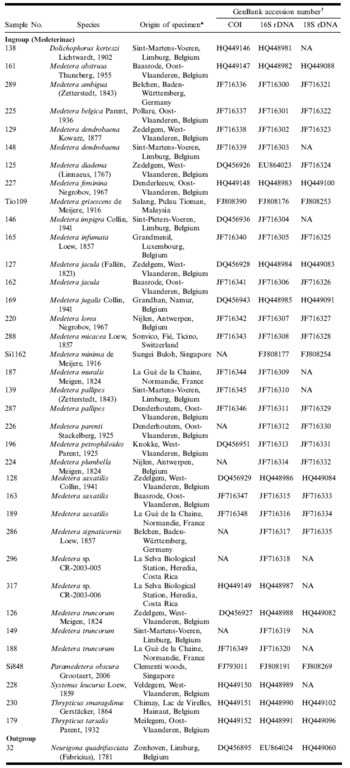
A total of 37 specimens of 30 dolichopodid species were included in the present study, with 29 species (36 specimens) of Medeterinae as ingroup and Neurigona quadrifasciata F. (Neurigoninae) as outgroup. The two subfamilies share a number of characters, such as the convex postcranium (occiput), the flattened prescutellar depression, the lack (or rather secondary loss) of preapical bristles on the hind femur, the large pedunculate hypopygium (Bickel Reference Bickel1985), and an arboreal life history. For these reasons the subfamily Neurigoninae has been used as outgroup in the past as well (Bickel Reference Bickel1985, Reference Bickel1987). Moreover, a likelihood analysis conducted by Lim et al. Reference Lim, Hwang, Kutty, Meier and Grootaert(2010) revealed a sister-clade phylogenetic relationship between the Medeterinae and Neurigoninae, though without statistical support. Twenty-four Medetera species made up part of the present taxon sample, with 20 Palaearctic, 2 Neotropical, and 2 Oriental species (the last species were also used in Lim et al. Reference Lim, Hwang, Kutty, Meier and Grootaert2010), next to Palaearctic Dolichophorus Lichtwardt, Thrypticus, Systenus, and Oriental Paramedetera Grootaert and Meuffels. Taxon sampling was largely based on the availability of fresh specimens, suitable for sequencing. Only 4 of the 15 Medetera species groups sensu Bickel (Reference Bickel1985, Reference Bickel1987) are represented here, but the data set holds species previously placed in Oligochaetus and Saccopheronta, and species synonymized by Grichanov (Reference Grichanov2002). Information on the samples investigated here is given in Table 1. All samples were conserved in 100% ethanol at −20 °C.
Overview of samples and species of Dolichopodidae used in molecular phylogenetic analyses of lineages of Medetera.

* The locality is given for each species, with the province and country where appropriate.
†NA, not available.
DNA extraction, amplification, and sequencing
DNA was extracted using a DNeasy Tissue kit (Qiagen AG, Hombrechtikon, Switzerland) following the manufacturer's instructions (for more details see Bernasconi et al. Reference Bernasconi, Pollet, Varini-Ooijen and Ward2007a, Reference Bernasconi, Pollet and Ward2007b). Standard PCR reactions and subsequent direct sequencing for COI and 16S (including amplification and sequencing primers; Microsynth GmbH, Balgach, Switzerland) were performed following Germann et al. Reference Germann, Pollet, Tanner, Backeljau and Bernasconi(2010). Concerning 18S, the following primers were used for amplification and sequencing: 18S-A1984 (Forward = F) and 18S-S22 (Reverse = R) (both listed in Kubota et al. Reference Kubota, Morii and Miura2005) as well as 18S1.2F, 18Sai (F), 18Sa0.7 (F), and 18S9R (all listed in Whiting Reference Whiting2002). The 18S fragment was amplified using the following procedure: 15 min DNA denaturation at 94 °C, 35 cycles of denaturation at 94 °C for 1 min, annealing at 48–50 °C for 1 min, and elongation at 72 °C for 2 min. The elongation was completed by a further 7-min step at 72 °C.
DNA-sequence analyses
The DNA sequences (COI, 16S, and 18S) were handled and stored with the Lasergene program Editseq (DNAstar Inc., Madison, Wisconsin, United States of America). Alignment of all gene sequences was performed using Megalign (DNAstar Inc.) with default multiple alignment parameters (“gap penalty = 15”; “gap length penalty = 6.66”; “delay divergent sqs(%) = 30”; “DNA transition weight = 0.50”). In the COI alignment, gaps were in multiples of three, thereby maintaining the correct reading frame. Concerning 18S, in a few cases gaps were manually introduced to improve the alignment of the homologous corresponding regions. The alignment of the 16S gene fragment usually proved to be sufficiently satisfactory with the default parameters and did not require particular manual interventions.
Phylogenetic reconstruction was carried out using Bayesian analysis (BAY), performed with MrBayes version 3.1.2 (Ronquist and Huelsenbeck Reference Ronquist and Huelsenbeck2003), and with the maximum-likelihood (ML) method using the RAxML Web-Servers version 7.0.4 (Stamatakis et al. Reference Stamatakis, Hoover and Rougemont2008). Modeltest 3.5 (Posada and Crandall Reference Posada and Crandall1998) enabled us to identify the evolutionary model(s) fitting the data better for both the BAY and the ML analyses. For this purpose, data were partitioned by gene (COI, 16S, and 18S) and the COI gene was further partitioned by codon (first-, second-, and third-codon positions). BAY and ML analyses were allowed to use a mixed model (i.e., a model in which all genes have their unique GTR + I + G model) and, in the case of the ML analysis, 1000 bootstrap pseudoreplicates were applied. Concerning the BAY analysis, the Markov chain Monte Carlo search was run with four chains (one cold and three heated) for 1.5 million generations, with trees being sampled every 100 generations. Independent trials were performed on two different computers and the heating of the chains was adjusted to get the acceptance rates for the swaps between chains to 10%–70% (the “temp” parameter varied from 0.1 to 0.2). To determine the “burn-in”, log-likelihood plots were examined for stationarity (where plotted values reach an asymptote). Stationarity was clearly reached already after fewer than 100000 generations (= 1000 trees) but we discarded the first 3000 trees to ensure that stationarity was completely reached. Higher burn-in did not alter the topology of the final 50% majority rule consensus tree(s). In all analyses, the two independent runs executed in parallel always converged, reaching average standard deviations for the split frequencies of less than 0.05. Preliminary analyses (involving the single genes as well as the combined data set) performed using the maximum-parsimony and neighbour-joining methods were carried out with molecular evolutionary genetics analysis (MEGA version 4.0.2; Tamura et al. Reference Tamura, Dudley, Nei and Kumar2007) and PAUP*4.0b10 (Swofford Reference Swofford2002). All new sequences analysed here have been deposited in GenBank (see Table 1).
Ecological data
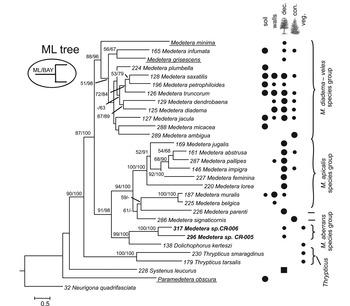
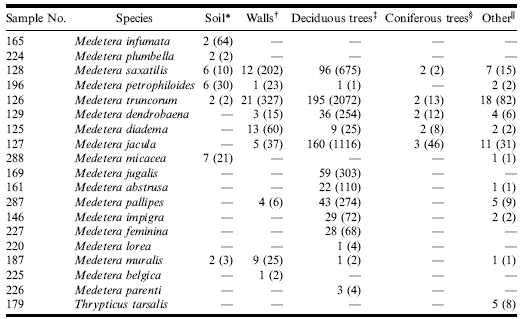
In an attempt to define the ecological affinities of the medeterine species included in the present study, information from the literature, published results (e.g., Pollet and Grootaert Reference Pollet and Grootaert1994, Reference Pollet and Grootaert1996; Maes and Pollet Reference Maes and Pollet1997; Pollet Reference Pollet2000) and unpublished results of surveys, and personal field observations was gathered. By so doing, we focused on the substrate where specimens were observed/collected, rather than the habitat type of the different species. The overall combined outcome of this action is presented in Figure 1. In addition, and as partial support of Figure 1, information on specimens collected only by hand or sweep-net by the senior author during 1984–2004 is summarized in Table 2. These data were retrieved from the ECODOL database (MS Access®) of the senior author (see Pollet Reference Pollet2000), which holds records on nearly half a million dolichopodid specimens collected in several European countries, Belgium in particular. Data from sampling campaigns involving pan and (or) Malaise traps are thus not included in Table 2, as they did not always reveal a clear relationship between the collected Medeterinae and specific substrates.
Phylogenetic relationships derived from the maximum-likelihood (ML) analysis (GTR + G + I, data partitioned by gene type; COI gene further partitioned by codon) based on combined COI, 16S, and 18S sequences, and as established between 30 dolichopodid species obtained using the RAxML Web-Servers, version 7.0.4 (Stamatakis et al. Reference Stamatakis, Hoover and Rougemont2008). Values of bootstrap support from 1000 pseudoreplicates and posterior probabilities over 50% derived from 24002 trees of a Bayesian (BAY) analysis are depicted above the nodes. The scale bar indicates the genetic distance calculated during the application of the tree-generating model. Species names of our own samples are preceded by a unique sample number; Oriental species names are underlined, Neotropical species names are in boldface type. Substrate categories are “soil”, “walls” (vertical surfaces, except for tree trunks), “dec.” (deciduous trees), “con.” (coniferous trees), and “veg.” (herb layer and broad leaves of shrubs or trees (mostly in humid habitats) (●, highest prevalence and abundances; ●, low prevalence and abundances; ■, rot holes / sap runs). See Table 2 for further information.

Distribution of Medeterinae over substrate categories, based on sweep-net and manual collections made between 1984 and 2004 in Europe (mainly Belgium).
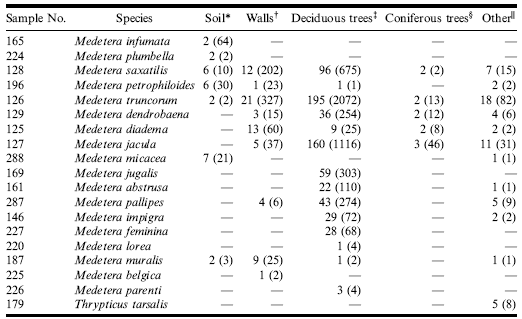
Note: Values are given as the number of samples per species, with the number of collected specimens in parentheses.
*Open, sandy, mostly arid habitats, where specimens were collected from soil, small rocks, or other low, hard substrates.
† All vertical substrates (walls, fences, even indoors) except tree trunks.
‡ Including Acacia Mill. (Fabaceae); Acer L. (Aceraceae); Aesculus L. (Hippocastanaceae); Alnus Mill., Betula L., and Carpinus L. (Betulaceae); Castanea Mill., Fagus L., and Quercus L. (Fagaceae); Fraxinus L. (Oleaceae); Juglans L. (Juglandaceae); Populus L. and Salix L. (Salicaceae); Pyrus L. (Rosaceae); and Sambucus nigra L. (Caprifoliaceae).
§ Including Cupressus L. and Thuja L. (Cupressaceae) and Pinus L. and Pseudotsuga Carrière (Pinaceae).
∥ Specimen collections made with sweep-nets in a wide array of habitats (marshlands, heathlands, shrub vegetation, banks of water bodies, woodlands). The specific substrate of the specimens could not be determined exactly.
Results
Preliminary analyses were based on the single-gene partitions. All results reported in this paper, however, rely on the total molecular evidence resulting from the concatenation of the three genes. The full data set comprises 2288 characters (COI: 825; 16S: 525; 18S: 938) with 607 variable sites (COI: 327; 16S: 211; 18S: 69). These analyses included all 37 specimens (Table 1). As all specimens of each separate species made monospecific clades, one specimen of each species was ultimately selected for incorporation into the final analyses.
Phylogenetic relationships derived from the ML analysis based on combined COI, 16S, and 18S sequences from 30 dolichopodid species are illustrated in Figure 1. Bootstrap support values (ML) and posterior probability values derived from a BAY analysis (24 002 trees, 12 001 trees for each of the two parallel runs) of 50% or higher are marked in this figure. The results achieved by the ML analysis seem to find support in the BAY analysis, however, with variable statistical support.
Paramedetera and Systenus form unsupported (= bootstrap and posterior probability support values below 50%; not marked in Fig. 1) branches beyond the remaining medeterine clades. Thrypticus, in contrast, represents a strongly supported (ML: 90; BAY: 100) sister clade to Medetera + Dolichophorus. Within the latter cluster, two well to strongly supported (ML: 87; BAY: 100) clades can be distinguished. The lower clade is composed of two subclades with a strongly supported relationship (ML: 91; BAY: 98). One small group within the lower clade comprises two Costa Rican species of the M. aberrans species group sensu Bickel (= Saccopheronta Becker, sensu Grichanov), and the Palaearctic Dolichophorus kerteszi Lichtwardt. The second, larger group within the lower clade is made up of two strongly related (ML: 94; BAY: 100) subclades. Apart from M. signaticornis Loew of the M. signaticornis – pinicola Kowarz species group sensu Bickel, and M. parenti von Stackelberg, whose positions are poorly supported, all species of this clade belong to the M. apicalis species group sensu Bickel. As expected from their morphological similarity, M. muralis Meigen and M. belgica Parent form a strongly supported (ML, BAY: 100) species couple. The genetic distance between them is smaller than that between other Medetera species couples but larger than the within-species variation (M. Pollet, C. Germann, and M. Bernasconi, unpublished data).
The upper clade (Fig. 1), on the other hand, is composed entirely of species belonging to the M. diadema L. – veles Loew species group sensu Bickel. It includes the Oriental M. minima de Meijere (considered phylogenetically isolated by Bickel Reference Bickel1987), the tramp species M. grisescens de Meijere of the Old World tropics and Australasia, and 10 Palaearctic species, 2 of which (M. diadema and M. truncorum Meigen) have been introduced into the Nearctic Region. Two species featuring one pair of scutellar bristles (M. micacea Loew and M. plumbella Meigen) and previously placed in Oligochaetus, also belong to this clade but do not show a close relationship to each other. Other internal relationships in this upper clade lack sufficient statistical support.
Discussion
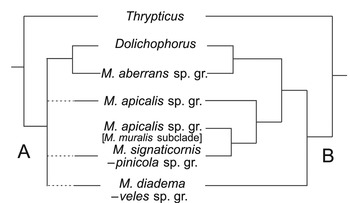
Bickel (Reference Bickel1985, Reference Bickel1987) defined 15 species groups in Nearctic and Oriental/Australasian Medetera, respectively, whereas Negrobov and Stackelberg (Reference Negrobov, von Stackelberg and Lindner1972, Reference Negrobov, von Stackelberg and Lindner1974aReference Negrobov, von Stackelberg and Lindner1974b) split the genus into three subgenera, Asioligochaetus Negrobov, Lorea Negrobov, and Medetera s.s., with the last containing nearly all of the Palaearctic species. However, the latter authors— key to Medetera s.s. was based in part on features of questionable phylogenetic relevance (colour, chaetotaxy) and did not reflect any natural groups. The present investigations largely seem to support the species groups concept of Bickel as well as hypothesized relationships between Medetera and other medeterine genera by the same author (see Fig. 2).
Comparison of simplified phylogenetic trees of Medetera species groups (sp. gr.), Thrypticus, and Dolichophorus. (A) Empirical cladogram based on morphological characters (Bickel Reference Bickel1987). (B) Maximum-likelihood tree (this study).

Paramedetera is the only genus in the present study not treated by Bickel (Reference Bickel1985, Reference Bickel1987), and might even not be medeterine. Its sister-clade relationship with the remaining medeterine genera not only proved to be unsupported here as well as in Lim et al. Reference Lim, Hwang, Kutty, Meier and Grootaert(2010), but C. Germann, M. Pollet, and M. Bernasconi (unpublished data) found this species to be part of a strongly supported hydrophorine lineage composed of Cymatopus Kertesz, Thambemyia Oldroyd, and Thinolestris Grootaert and Meuffels.
Systenus did not form a supported relationship with Thrypticus + Medetera + Dolichophorus either, but proved to be consistently included in a weakly supported medeterine clade (C. Germann, M. Pollet, and M. Bernasconi, unpublished data). Although better taxon sampling is needed to properly test this assumption, we believe that the transfer of Systenus to the Medeterinae by Bickel (Reference Bickel1986), based on a series of morphological traits, is valid.
Initially, Thrypticus was considered to be most closely related to Dolichophorus and part of the Medetera lineage (Bickel Reference Bickel1985). Later, Bickel (Reference Bickel1987) regarded it, together with Corindia Bickel, as sister taxon to Medetera + Dolichophorus, which is in concordance with our results (Fig. 2).
The close relationship between Dolichophorus and species of the M. aberrans (and M. melanesiana Bickel) species group(s) was suggested by Bickel (Reference Bickel1985, Reference Bickel1987), and is confirmed here using different species of Medetera. This renders Medetera paraphyletic (also noted by Bickel Reference Bickel1987), but as this clade seems well incorporated within Medetera, synonymizing Dolichophorus would dilute the generic limits of Medetera. We therefore prefer to maintain the current generic status of Dolichophorus until extended taxon sampling provides more evidence and better resolution.
Two other species groups sensu Bickel, M. apicalis and M. diadema – veles, are clearly represented in our analysis. Even the existence of the subclade of the M. apicalis species group represented here by M. muralis + M. belgica had been predicted on the basis of distally expanded, clublike surstyli and cerci with a cluster of strong ventroapical bristles (Bickel Reference Bickel1985).
The M. diadema – veles species group is characterized by seven synapomorphies, including a stout and massive proboscis and various reductions and fusions of hypopygial appendages (Bickel Reference Bickel1985). Rather unlike the other Medetera species groups included here, species of this clade display a rather high diversity of mesonotal bristle arrangements. These features, however, prove to be of little phylogenetic significance, in contrast to hypopygial characters, and seem to represent a tendency found in many dolichopodid genera (D.J. Bickel, personal communication).
Among applied entomologists, Medetera species are generally known as antagonists of bark beetles. Larval stages of these flies are often found in the subcortical galleries made by scolytines preying on eggs, larvae, pupae, and freshly emerged beetles (Nuorteva Reference Nuorteva1956, Reference Nuorteva1959; Krivosheina Reference Krivosheina1974; Bickel Reference Bickel1985). The vast majority of these species, however, belongs to the M. signaticornis – pinicola species group that are mainly associated with coniferous trees, where bark beetle damage is best documented (see further). These species are even capable of detecting monoterpenic products of the host plants and certain pheromone compounds released by the prey (Švihra Reference Švihra1972; Hulcr et al. Reference Hulcr, Pollet, Ubik and Vrkoc2005). Because this represents only 1 of Bickel's 15 species groups, and the ecology of most of the other groups, when documented, seems to be different (see Bickel Reference Bickel1985, Reference Bickel1987), it is very likely that this life history is not representative of the entire genus, despite the fact that similar larval behaviour and niche have been reported in species of other lineages, such as M. dendrobaena Kowarz (Nicolai Reference Nicolai1995) and M. excellens Frey (Ringdahl Reference Ringdahl1928; MacGowan Reference MacGowan1988).
The presumed typical arboreal way of life is not the general rule in all Medetera species (see Fig. 1), although an association with plants seems to be significant in much of the subfamily except for some of the micro-dolichopodid genera (Robinson Reference Robinson1975). Their habit of resting on vertical surfaces (either tree trunks or other substrates) and their specific posture (with the head facing upwards) seem to be characteristic of most Medetera and Systenus species. The outward leaning of the body, though, is most prominent in the M. diadema – veles species group. Systenus species are known to breed in rot holes and sap runs of deciduous trees and are rarely collected beyond these microhabitats (Wirth Reference Wirth1952; Dyte Reference Dyte1959; Vaillant Reference Vaillant1978). They have been observed in a typical medeterine posture at or near the entrance of rot holes or damaged bark (M. Pollet, unpublished data). Thrypticus is the only dolichopodid genus with stem-mining larvae (Dyte Reference Dyte1993; Bickel and Hernandez Reference Bickel and Hernandez2004; Hernandez Reference Hernandez2008). Species of the M. aberrans species group and Dolichophorus do not seem necessarily bound to tree trunks and are often retrieved from herb vegetation or leaves of broad-leaved shrubs and trees (M. Pollet, unpublished data).
At least two lineages are strictly arboreal: the M. signaticornis – pinicola species group clearly prefers coniferous trees (e.g., species of Pinus L. and Picea A. Dietr. (Pinaceae); see Kowarz 1877; Collin Reference Collin1941; Nuorteva Reference Nuorteva1956, Reference Nuorteva1959; Krivosheina Reference Krivosheina1974; Bickel Reference Bickel1985; MacGowan Reference MacGowan1988), but M. aldrichii Wheeler has occasionally been retrieved from deciduous trees (e.g., species of Alnus Mill. (Betulaceae) and Quercus L. (Fagaceae)) as well (Bickel Reference Bickel1985). The M. apicalis species group mainly occurs on deciduous trees, but representatives have also been found on coniferous trees (Bickel Reference Bickel1985; M. Pollet, unpublished data). In Western Europe, the latter species group seems to be most diverse on smooth-barked species of Populus L. (Salicaceae) (M. Pollet, unpublished data), but data on the larval (feeding) habits are entirely lacking.
Most species of the M. diadema – veles species group show an entirely different or substantially wider niche. Whereas some are encountered in numbers on tree trunks and on dry sandy soils with sparse vegetation in coastal dunes (Pollet and Grootaert Reference Pollet and Grootaert1994, Reference Pollet and Grootaert1996), heathlands, and ruderal areas (Maes and Pollet Reference Maes and Pollet1997; Pollet Reference Pollet2000), others, such as M. micacea and M. plumbella, seem to be exclusively soil-dwelling (Pollet and Grootaert Reference Pollet and Grootaert1996; see also data sheets in Pollet Reference Pollet2000). Larval behaviour and habitats are only documented in the arboreal M. dendrobaena (Nicolai Reference Nicolai1995), and are largely unknown in the remaining, often very abundant species.
The M. diadema – veles species group is the most derived in this genus (Bickel Reference Bickel1985), based on several morphological reductions and fusions in hypopygial structures. This was not confirmed in our study; instead, we found a comparable evolutionary stage of this species group and the M. apicalis species group, possibly because of the lack of more (basal) medeterine lineages in our analysis. Nevertheless, species of the M. diadema – veles species group feature partially to completely fused epandrial lobes and reduced or lost epandrial setae, two characters in a more primitive state in the M. apicalis species group. If Bickel's above-mentioned assumption is correct, and considering the host-plant association in nearly all other Medetera species groups, this would imply that the trend towards a more epigaeic way of life must be considered a secondary return to soil habitats (this is also observed in the unrelated Holarctic M. petulca Wheeler species group; Bickel Reference Bickel1985). This is likely to have an impact on larval habitats and prey, and it is assumed that larvae might live in stems or roots of herbs and shrubs (see the comment on M. veles in Bickel Reference Bickel1985; M. Suvák, personal communication). It is possible that plasticity in the larval stages (in terms of habitat and prey preference) of ancestral species could have facilitated the (partial) shift from the original arboreal to a more diverse and ultimately soil-dwelling behaviour. Hard evidence for this hypothesis is lacking, unfortunately, but field observations and experiments may yield important information on larval habits in this species group.
Acknowledgements
Many thanks are due to Jack Longino, Evergreen College, Olympia, Washington, United States of America, who invited the senior author to participate in the 2003 expedition as part of the Arthropods of La Selva project, phase IV (grant code DEB-0072702; 2000–2005), funded by the National Science Foundation. We are also grateful to the Instituto Nacional de Biodiversidad, Santo Domingo de Heredia, Costa Rica, who allowed the incorporation of Costa Rican biological resources into this study. Jean-Paul Haenni, Muséum d'histoire naturelle de Neuchâtel, Neuchâtel, Switzerland, kindly provided the French abstract. Two anonymous reviewers revised the manuscript and improved its quality in several ways. This work was supported by the Swiss National Science Foundation (Grant 3100A0-115981) to Marco V. Bernasconi. The present paper is part of the Ph.D. research project of Christoph Germann and is a contribution of the Zoological Museum, University of Zurich, Zurich, Switzerland. A very special acknowledgement is extended to the coordinators of the Manual of Nearctic Diptera, J.F. McAlpine, B.V. Peterson, G.E. Shewell, H.J. Teskey, J.R. Vockeroth, and D.M. Wood. With the publication of this monumental work about 30 years ago they provided a true benchmark for dipteran research and inspired an entire new generation of people passionate about flies.