1 Introduction
There is increasing attention in Australia on the specific disadvantage and discrimination faced by accused persons with disabilities in the criminal justice system, in particular Aboriginal and Torres Strait Islander peoples. Specific areas of concern include the indefinite or prolonged detention of people with intellectual, cognitive and psychosocial disabilities who are found unfit to stand trial, as well as the serial incarceration of those cycling in and out of prison on short sentences and detention on remand due to a lack of appropriate support in the community. The human rights implications and social and economic costs of these criminal justice pathways of accused persons with intellectual, cognitive and psychosocial cognitive disabilities are significant, yet governments have been slow to respond (Baldry et al., Reference Baldry2012; Freckelton and Keyzer, Reference Freckelton and Keyzer2017).
In this paper, we report on a cost–benefit analysis of a model of support that sought to build on and contribute to the evidence base to improve policy and practice in this area. Led by an interdisciplinary research team of legal and social sciences scholars, the ‘Unfitness to Plead’ research projectFootnote 1 developed a ‘Disability Justice Support Program’ that embedded disability support workers in community legal services in the Australian jurisdictions of Victoria, New South Wales and the Northern Territory. One major aim of the project was to optimise the participation of accused persons with intellectual, cognitive and psychosocial disabilities in legal proceedings so as to avoid – where possible under current law – a finding of unfitness to stand trial. A second major aim was to query what changes to law would be needed to secure equality before the law in relation to unfitness-to-stand-trial laws in line with the Convention on the Rights of Persons with Disability (CRPD). During the course of the project, disability advocacy organisations advised the researchers that it would be valuable if the evaluation data could also inform a cost–benefit analysis of a case-study from the programme to inform advocacy efforts and policy decision-making. Whilst this analysis is of one specific supported case, it purposely reflects a broad range of alternative pathways and cost–benefit comparisons to provide an indication of the scope of possible outcomes for programme participants and some of the economic implications. A detailed profile of one client supported by the project was developed, and quantitative and qualitative data drawn on to calculate the police, court, justice and custody costs associated with typical pathways for someone with his disability who is charged with a similar offence.
This paper begins by setting out the literature on the prevalence and experience of people with intellectual, cognitive and psychosocial disabilities in criminal justice systems in Australia that informed the support programme. We will refer to this group in shorthand as ‘persons with cognitive disability’.Footnote 2 (Where relevant, we will specify particular disabilities and impairments, such as mental health conditions or psychosocial disability, acquired brain injury, intellectual disability, etc.) The second section details the methodology of the cost–benefit analysis, followed by the legal and economic outcomes of its application to the case-study of ‘David’. The paper concludes with analysis of the findings and implications for the legal system, policy and practice. From a human rights perspective, David's case-study is a complex one, raising questions about whether ‘justice’ was achieved from a disability-rights perspective: on the one hand, the support programme seemed to generate social benefits and a manifest improvement in David's individual circumstances, while, on the other hand, tensions arose between the accused's individual interests, the limits of the law in its current form, justice for the alleged victim and the aspirations of international human rights law to secure equality before the law for persons with disabilities more generally. While acknowledging that complexity, this study found that the pathway enabled by the model of support that sought to optimise the participation and outcomes for the accused person with cognitive disability was also the most cost-effective.
2 People with cognitive disabilities in the criminal justice system
In Australia, as in other comparable jurisdictions, there is evidence that people with cognitive disabilities are overrepresented at all stages of the criminal justice system (Law Council of Australia, 2018; Bower, Reference Bower2018; Parliament of Australia Senate Community Affairs References Committee, 2016; Freckelton, Reference Freckelton2016; Blagg et al., Reference Blagg, Tulich and Bush2015; Baldry et al., Reference Baldry, Dowse and Xu2013; Indig et al., Reference Indig2010; Herrington, Reference Herrington2009; Hayes et al., Reference Hayes2007). Although there are limitations with systematic data collection, a growing body of literature is indicating consistently significantly higher prevalence rates. For example, a 2013 Victorian parliamentary inquiry reported that people with an intellectual disability were ‘anywhere between 40 and 300 percent more likely’ to be jailed than people without an intellectual disability (Victorian Law Reform Commission, 2014, p. 14). The Victorian Department of Justice reported that 42 percent of male prisoners and 33 percent of female prisoners had an acquired brain injury, compared to just 2.2 percent of the general population (Jackson et al., Reference Jackson2011). In New South Wales, a study considered sixty accused adults appearing before four local courts in Sydney, and found that people with intellectual disability or some form of cognitive impairment were overrepresented in the local courts; the proportion of participants who met standardised measures of these disabilities was three to four times the rate in the general population (Vanny, Reference Vanny2009). Factors contributing to the higher rates of contact with the criminal justice system for people with cognitive disabilities include greater difficulty comprehending, communicating and problem-solving, and often being more susceptible to peer influence (Sotiri et al., Reference Sotiri2012). People with cognitive disabilities may be more easily caught in a criminal act or be blamed by co-offenders; be susceptible to being exploited by others as an accomplice; have their intentions misunderstood; express sexuality in a naive or socially unacceptable way; and have other associated disorders that might result in impulsive and unpredictable behaviour (McCausland and Baldry, Reference McCausland and Baldry2017; Law and Justice Foundation, 2009). Many people working in criminal justice agencies have a poor understanding of cognitive impairment (Snoyman, Reference Snoyman2010) and of the specialist supports required by people with cognitive disabilities (Intellectual Disability Rights Service, 2008). As such, many people with cognitive disabilities face serial incarceration, cycling in and out of prison on short sentences and remand due to a lack of appropriate specialist support in the community (McCausland and Baldry, Reference McCausland and Baldry2017; Baldry et al., Reference Baldry2015).
Aboriginal and Torres Strait Islanders are overrepresented in Australian criminal justice systems and are more likely to experience disability compared to non-Indigenous people (Avery, Reference Avery2018; Bower, Reference Bower2018; Australian Bureau of Statistics, 2017a, 2017b; First Peoples Disability Justice Consortium, 2016). Aboriginal and Torres Strait Islanders constitute 27 percent of the prisoner population compared to 3 percent of the general population (Australian Bureau of Statistics, 2017b); 23.9 percent of Aboriginal and Torres Strait Islander people report living with disabilityFootnote 3 compared with 17.5 percent of non-Indigenous people (Australian Bureau of Statistics, 2017a). Eileen Baldry and colleagues conducted a study on Indigenous Australians with mental health conditions and cognitive disabilities in the criminal justice system and identified a severe and widespread lack of appropriate early diagnosis and positive culturally responsive support for Indigenous children and adults with cognitive disabilities (Baldry et al., Reference Baldry2015). This gap has been connected to schools and police viewing certain kinds of behaviours as criminal rather than as related to disability, as well as Indigenous community reluctance to have children assessed using criteria that are perceived as stigmatising (Baldry et al., Reference Baldry2015, p. 12). Indigenous people with cognitive impairment in certain locations may not have any contact with disability services systems prior to the age of eighteen and a lack of diagnosis of their disability impacts on their eligibility for specialist disability programmes, including support to help them understand the criminal justice process and their own rights (Baldry et al., Reference Baldry2015; Sotiri et al., Reference Sotiri2012, pp. 31–32). Many Indigenous people are first diagnosed when they come into contact with the criminal justice system and require appropriate support to enable them to participate in justice processes (Baldry et al., Reference Baldry2015, p. 21).
2.1 Unfitness-to-stand-trial laws: accessible justice or discriminatory barrier?
Of particular and increasing concern in Australia is the number of people with cognitive disabilities, particularly Indigenous people, who are indefinitely detained after being deemed by courts to be unfit to stand trial (First Peoples Disability Justice Consortium, 2016; Gooding et al., Reference Gooding2017; Baldry, Reference Baldry2014; Sotiri et al., Reference Sotiri2012). A highly publicised case was that of Marlon Noble, an Indigenous man with an intellectual disability who was found unfit to plead to alleged sexual assaults in 2001 (Committee on the Rights of Persons with Disabilities, 2016). Had he been found guilty, it is likely he would have served two to three years in prison. Instead, he was imprisoned for over ten years without conviction, despite the alleged victims of his original charge subsequently informing prosecutors that he had never assaulted them (Egan, Reference Egan2011). The UN Committee on the Rights of Persons with Disabilities found that several of Mr Noble's rights had been violated, including his right to equality before the law, access to justice, freedom from deprivation of liberty and freedom from cruel, inhuman and degrading treatment (Committee on the Rights of Persons with Disabilities, 2016, p. 15 [8.4]).
The doctrine of unfitness to plead is typical to common-law jurisdictions. In Australia, the legal test of an accused's ability to participate in the criminal trial process is derived from the 1836 English case of R. v. Pritchard (1836, 7 C & P 303). The ‘Pritchard test’, as it is known, requires that the accused must be
‘of sufficient intellect to comprehend the course of proceedings in the trial so as to make a proper defence, to know that he [or she] may challenge any of you to whom he may object and to comprehend the details of the evidence.’ (R. v. Pritchard (1836) 7 C & P 304)
In Australia, the influential case to have further developed the test is that of R. v. Presser [1958] VR 45. To be fit to plead, the accused must be capable of:
• ‘Understanding the charges;
• Deciding whether to plead guilty or not;
• Exercising the right to challenge jurors;
• Instructing solicitors and counsel;
• Following the course of proceedings; and
• Giving evidence in his or her own defence.’ (R. v. Presser [1958] VR 45, 48, per Smith J.)
Australia has a federal system of government, comprising six states and two self-governing Territories; each has its own Constitution, parliament, government and laws. The ‘Presser test’ has been incorporated into legislation in most state and territory jurisdictions within Australia.Footnote 4
The test is substantially similar across Australian jurisdictions but the outcomes of a finding of unfitness vary considerably within and between jurisdictions (see Gooding et al., Reference Gooding2017). After a finding that an accused is unfit to stand trial, all Australian jurisdictions except Western Australia provide some means of challenging the prosecution's case. In most of these jurisdictions, legislation establishes a special hearing, sometimes called a ‘trial of the facts’, which is a process to test the case against an unfit accused. If the court decides an accused person who has been found unfit should be released, criminal proceedings may be discontinued and the accused released (see e.g. Criminal Law (Mentally Impaired Accused) Act 1996 (WA), s. 24(1); Mental Health Act 2016 (Qld), s. 490). If a court decides that the accused should not be released, there are two possible dispositions: custodial or non-custodial orders. Non-custodial supervision orders are made by courts and impose compulsory conditions, such as: regular reporting to corrections services, complying with compulsory psychiatric interventions and residing in a particular place, such as a group home or semi-secure residential facility. (For example, Mr Noble remains on an indefinite, non-custodial supervision order at the time of writing.) Custodial supervision orders, which are a more common response, involve detention in corrections facilities, such as prisons or forensic facilities. Different states and Territories have different custodial models, most of which provide for indefinite detention on the basis that the person is not there for punishment, but for treatment. There are some exceptions in which fixed terms can be applied (see e.g. Crimes Act 1900 (ACT) (Australia), ss. 301, 305; Mental Health Act 2015 (ACT) (Australia), s. 183). In Western Australia and the Northern Territory, people with cognitive disabilities found unfit to stand trial are generally detained in maximum-security prisons in the absence of adequate disability service and housing options, as was the case with Mr Noble (Gooding et al., Reference Gooding2017).
According to the Australian Law Reform Commission (2014, s. 3.45), one of the justifications for unfitness-to-stand-trial laws is that ‘the integrity of a criminal trial (and, arguably, the criminal law itself) would be prejudiced if the defendant does not have the ability to understand and participate in a meaningful way’. Ostensibly, the process offers a mechanism to test the prosecution and divert individuals to relevant treatment. However, in application, the laws can produce ‘extremely deleterious consequences’ (Freckelton and Selby, Reference Freckelton and Selby2009, p. 770). Unfit accused persons may be detained in prison or forensic facilities or supervised in residential facilities for periods longer than they would have received in a typical sentence; and they may be unable to access the full range of due-process standards found in typical trials (e.g. having an equal standard of proof, being able to raise the full range of defences) (see Gooding et al., Reference Gooding2017). There appears to be a racial dimension to the disadvantage caused by unfitness-to-stand-trial laws in Australia, which could also be surmised from the overrepresentation of Indigenous people in the criminal justice system, and their higher-than-average rates of disability. In one investigation, all nine people on indefinite supervision orders in Western Australia were Indigenous, as were eleven of thirty-three people found unfit to stand trial or ‘unsound of mind’ under the jurisdiction of the Western Australian Mentally Impaired Accused Review Board (Sotiri et al., Reference Sotiri2012).
Several official inquiries have brought attention to the issue of unfitness-to-stand-trial laws, as has the coming into force of the CRPD. The CRPD has raised questions from a human rights perspective as to whether unfitness-to-stand-trial laws can be justified at all. The contention stems from competing accounts of equality and hinges on whether unfitness-to-stand-trial laws should be characterised, in crude terms, as a protectionist measure that can improve access to justice for people with disability by mitigating the unique disadvantage they face in normal trials, or a degraded version of a typical criminal trial and a vestige of disability-based discrimination that violates equality rights. The debate centres on the question: can unfitness-to-plead legislation that creates distinct criminal justice procedures for persons with cognitive disabilities be separate but equal to the mainstream justice system? A detailed overview of this debate is outside the scope of this paper and has been explored elsewhere (see Arstein-Kerslake et al., Reference Arstein-Kerslake2017; Gooding et al., Reference Gooding2017). The Unfitness to Plead Project, which is detailed in the next section, was premised on the view that modified proceedings that only apply to persons with cognitive disabilities most likely do not comply with the CRPD. After all, such laws, in Australia and elsewhere, can result in longer sentences and tend not to ensure the due-process safeguards of typical trials, such as offering the same evidentiary standards and available defences (see Gooding et al., Reference Gooding2017). Regardless, a major gap in research – even in the event that unfitness-to-stand-trial laws are reformed rather than abolished – appears to be in identifying effective accessibility measures, procedural accommodations and so on, to assist accused persons with cognitive disabilities to participate in criminal proceedings. We will return later to debates generated by the CRPD about unfitness-to-stand-trial laws, in our discussion in Section 6.
3 ‘Unfitness to Plead’ research project
The model of support reported on in this paper formed part of an action research project in which accused persons with cognitive disabilities were supported to participate in criminal proceedings (McSherry et al., Reference McSherry2017). The aim was to test the effectiveness of different types of support designed to help an accused person at risk of being deemed unfit to stand trial. Several law-reform initiatives had called for additional support to be provided to accused persons with cognitive disabilities in order to ‘optimise’ their fitness to stand trial so that they can avoid, where possible, a finding that they are unfit to stand trial. The Victorian Law Reform Commission, for example, noted that ‘[t]he importance of support measures in the unfitness-to-plead process was one of the strongest themes to come out of the Commission's review’ (Victorian Law Reform Commission, 2014, p. 89 [3.124]) and that support measures could potentially ‘optimis[e] an accused's fitness where they might otherwise be unfit’ (Victorian Law Reform Commission, 2014, p. 89 [3.124]). However, in practice, according to the Commission, such supports are ‘not necessarily considered, provided or available’ (Victorian Law Reform Commission, 2014, p. 89 [3.125]). The six-month trial of the ‘Disability Justice Support Program’ sought to address this gap.
The trial took place in three jurisdictions in Australia and was located within three community legal services. It had an emphasis on assisting Indigenous people with cognitive disabilities. Two of the services were Aboriginal community-controlled. The disability support workers, based at the community legal centres, offered different types of assistance, including: helping clients to attend meetings, liaising with community support services, providing communication support to individuals in courts, and assisting lawyers, legal services and even courts to engage with the person in a more accessible way. The imperative for the support was based on provisions in the CRPD, particularly the right to equal recognition before the law and the obligations on ‘states parties’ to the Convention to provide persons with disabilities with ‘support to exercise legal capacity’ (Art. 12(3)) and ‘procedural and age-appropriate accommodations’ to access justice on an equal basis with others (Art. 13(1)).Footnote 5
The researchers were cognisant that efforts to improve the ‘participation’ of people with cognitive disabilities in their trial is not a panacea for systemic disadvantage and inequality, but rather presents an opportunity to ensure procedural due process and substantive equality in one significant area of the law that can improve the rights of people with cognitive disabilities and help inform policy decision-making. Detailed qualitative and quantitative data were gathered throughout to inform the evaluation of this model of support, including semi-structured interviews with support workers, lawyers and clients. Research ethics approval for conducting the interviews was granted by the University of Melbourne management and review of human ethics.Footnote 6 Analysis of these data as part of the action research process prompted the research team to undertake a cost–benefit analysis in relation to one specific in-depth case-study. The social sciences researchers who formed part of the team had experience in using case-studies drawn from administrative data to develop economic analyses of appropriate models of support and diversion for people with cognitive disabilities in the criminal justice system (Reeve et al., Reference Reeve2017; McCausland et al., Reference McCausland2013). The cost–benefit analysis reported on here sought to provide a detailed example to complement and underwrite the evidence provided by the broader project, highlighting that there can also be an economic case for enhancing human rights and procedural fairness in our legal systems.
4 Methodology
Cost–benefit analysis is an economic tool used to help to determine whether a programme is a good investment by comparing the costs of providing the programme to the benefits it provides, in monetary terms. As a framework for providing a consistent procedure for evaluating economic decisions in terms of their consequences in public-policy decision-making, it has been used by governments since the nineteenth century for assessing large-scale investment projects, in particular in the US (Drèze and Stern, Reference Drèze, Stern, Auerbach and Feldstein1987). Since the 1970s, the cost–benefit method has been used more broadly in evaluating projects across various sectors receiving public funding (Layard and Glaister, Reference Layard and Glaister1994). Grounded in economics as a discipline, its use in informing policy decision-making has generated significant scholarship over the past three decades, with some critiques more oriented towards analytical issues and others more concerned with problems of practical application (Sen, Reference Sen2000).
To summarise the normative approach to cost–benefit analysis, if the total benefits (or costs avoided) exceed the costs, then a programme or initiative is considered an efficient use of resources. Ideally, all possible costs and benefits into the future are included; however, even when it is not possible to quantify all impacts of a programme, cost–benefit analyses have been increasingly seen by governments to be a valuable tool to help in decision-making (Australian Government Office of Best Practice Regulation, 2016). Used retrospectively, as is done in this study, the known outcome from a programme can be compared with what would have happened in the absence of that programme (Australian Government Department of Finance and Administration, 2006). In this study, the retrospective cost–benefit analysis is undertaken from the perspective of the justice system over twelve months to give an indication of the net fiscal impact of providing Disability Justice Support for one case-study from the pilot programme. There are various pathways through the justice system that the subject of the case-study may have taken in the absence of Disability Justice Support. Given this uncertainty, rather than a single cost–benefit estimate, the results are presented as the costs to the justice system associated with a series of alternative pathways compared to the cost of the actual supported pathway. Whilst there are also likely to be health and other social benefits, it was beyond the scope of the study to estimate these. Therefore, the benefits calculated are conservative to avoid over-claiming benefits and as a realistic model that can inform the specific area of criminal justice policy.
Cost–benefit analysis has had limited application in socio-legal fields, although crime-prevention programmes and interventions are one area of exception to this, with cost–benefit analyses increasing in prevalence and influence over the past two decades, in particular in the US (Welsh and Farrington, Reference Tonry2000; Nagin, Reference Nagin and Tonry2001; Farrington and Koegl, Reference Farrington and Koegl2015; Welsh et al., Reference Welsh, Farrington and Raffan2015; Aos, Reference Aos2015). Such studies have primarily focused on calculating the costs for victims of crime and on ascertaining the cost benefit of a particular programme or intervention as an offset to those costs rather than on estimating the broader costs of apprehension, conviction and punishment. An emerging area of research is the estimation of trajectory costs for different groups in the criminal justice system, in particular for serious and chronic offenders (Cohen et al., Reference Cohen, Piquero and Jennings2010; Piquero et al., Reference Piquero, Jennings and Farrington2013; Day et al., Reference Day2016). Despite increasing data indicating the significant overrepresentation of people with cognitive disabilities in criminal justice systems, there has been limited focus in research internationally on this group's specific pathways into and around the justice system and the associated economic costs.
This cost–benefit analysis builds on and contributes to an emerging body of innovative research in Australia that draws on linked administrative data and multidisciplinary methodologies to estimate the economic costs to government of the overrepresentation of people with mental and cognitive disabilities in the criminal justice system (Reeve et al., Reference Reeve2017; McCausland et al., Reference McCausland2013; Baldry et al., Reference Baldry2012). Its approach is informed by critical disability and critical criminology theory that frames the overrepresentation and poor outcomes of people with cognitive disabilities in criminal justice systems as the result of systemic discrimination and policy failure (Baldry et al., Reference Baldry2015). To appropriately address this disparity and discrimination in turn requires a systemic response that seeks to ensure equality before the law, for which the CRPD offers a normative framework in international human rights law.Footnote 7 At the same time, any systemic response needs to be informed by evidence around the type of supports that are effective in achieving ‘equality before the law’ or ‘access to justice’ in practice as well as the realities of public-policy decision-making (Gooding, Reference Gooding2018). Human rights-based arguments can be made alongside pragmatic arguments about fiscal policy and the comparison of evidence as to the success and shortcomings of a particular approach. Taking both a principled and pragmatic approach, this analysis is grounded in the reality that governments make policy decisions based on a range of factors including their popular mandate, the power vested in the judiciary and the weighing-up of economic arguments in favour of particular policy and programming decisions. This research project seeks to connect these understandings and make a contribution that speaks to both human rights obligations, the existing judicial system in Australia and budget imperatives in the real-life contest over resources.
During the course of the project, disability advocacy organisations who were community partners in the project indicated that it would be valuable if the project could also develop a cost–benefit analysis of a case-study from the programme. Social sciences researchers involved in the project, including an economist, had previously undertaken cost–benefit analyses of providing early intervention and support for people with disability in the criminal justice system by focusing on case-studies of individuals drawn from a linked administrative dataset (Reeve et al., Reference Reeve2017; McCausland et al., Reference McCausland2013; Baldry et al., Reference Baldry2012) and community partners felt such analysis could usefully inform advocacy efforts and policy decision-making in this as an area widely acknowledged as in need of policy reform. While resources available to the research team enabled detailed examination of only one case-study for this project, it builds on and contributes to a methodology and body of research focused on detailed individual case-studies as a robust qualitative approach. The case-study is not intended to be exhaustive, but rather indicative of the kind of benefit such a programme can provide in responding to a policy area marked by systemic discrimination, as well as a means to explore the complexity around the enactment of CRPD and supported decision-making in relation to accused persons with cognitive disability. The case-study selected purposely reflects a broad range of alternative pathways and cost–benefit comparisons to provide an indication of the scope of possible outcomes for programme participants as well as the economic implications for government.
This cost–benefit analysis focuses on a case-study in the Australian jurisdiction of Victoria. The case was selected because it was a case in which a person who was being considered for unfitness to stand trial proceedings could seemingly be assisted to participate in proceedings and avoid the need to be deemed unfit to stand trial. While time and resource constraints limited analysis to a single case-study, a range of alternative pathways and cost–benefit comparisons were developed to provide an indication of the scope of possible outcomes for programme participants. Drawing on a social-science conceptualisation of a case-study as an intensive, holistic description and analysis of a single instance, phenomenon or social unit (Merriam, Reference Merriam1998, p. 27) and an empirical inquiry that investigates a contemporary phenomenon within its real-life context (Yin, Reference Yin2009, p. 13), this study focused on the pathways and experiences of one client of the project. This enabled the focus on the experiences of a real accused person with a cognitive disability – de-identified to ensure privacy – and the quantification and contrasting of his likely outcomes informed by expert advice and drawing on a unique linked administrative dataset. The People with Mental Health Disorders and Cognitive Disability in the Criminal Justice System (MHDCD) Dataset contains administrative information from human service and criminal justice agencies on a cohort of 2,731 persons who have been in prison in the Australian state of New South Wales and whose diagnoses of cognitive disability are known (Baldry et al., Reference Baldry2012; Reference Baldry, Dowse and Xu2013; Reference Baldry2015). Drawing on the MHDCD Dataset enabled the quantification and analysis of unsupported trajectories of individuals with similar demographic and diagnostic backgrounds to the individual supported by the project.
The aim of this component of the research project was to estimate the economic costs of the court and related criminal justice processes of an accused person with a cognitive disability supported by the Disability Justice Support Program and to use this to develop a cost–benefit analysis of the programme. The police, court, justice and custody costs over twelve months for the typical pathway scenarios for a person with cognitive disability charged with an offence were calculated, drawing on available research and legal, community and government sources in that jurisdiction.Footnote 8 The various pathway scenarios involved the outcomes from: a finding of unfitness to stand trial; a guilty plea to avoid a finding of unfitness; and support provided by this programme. Rather than a single estimated net benefit, this approach provides a range of estimates indicating the scope of possible economic outcomes for programme participants.
4.1 Case-study: ‘David’
‘David’ is an Indigenous man with an intellectual disability aged in his early twenties living in a supported residential facility in Victoria run by a government social-services agency. David was charged with indecent assault after allegedly assaulting a female fellow resident. After the charge, the agency removed him from that residence to separate him from contact with the alleged victim and he moved to live with his aunt. David was very socially isolated at his aunt's home, though he expressed a wish to stay there. His aunt herself had significant disability support needs. David was spending time at a local high street where he was allegedly indecently exposing himself. Police and prosecution were aware of this and were concerned that he posed a risk of reoffending. At the time the Disability Justice Support Program became involved, David had presented to the court four times and, each time, the case had been adjourned so that the court could gather sufficient information to respond to David's circumstances.Footnote 9
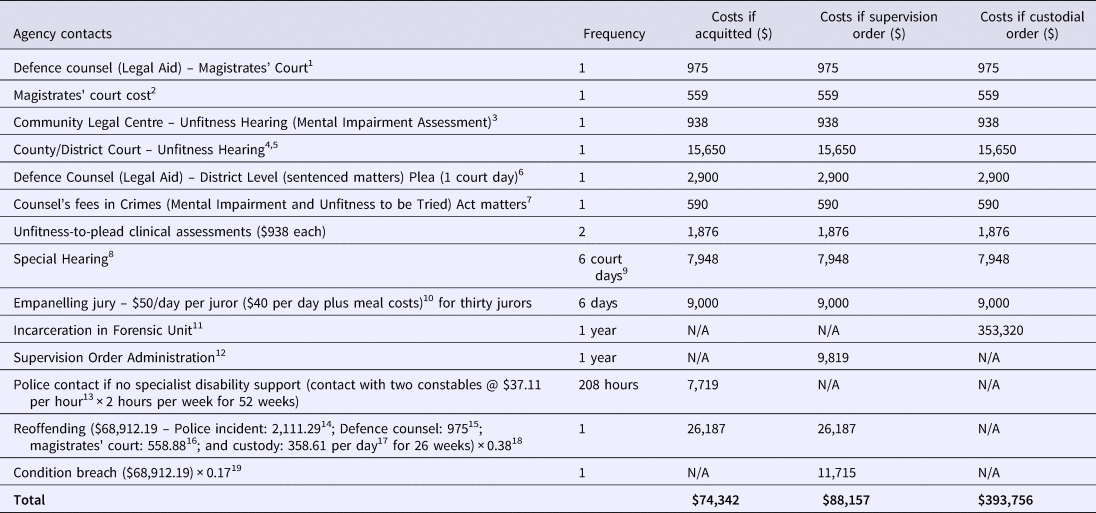
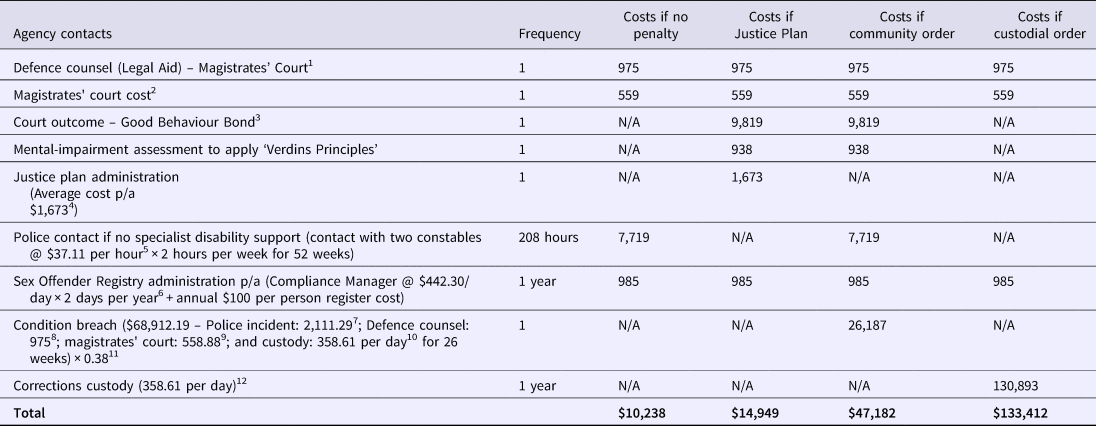
Two options were being considered in David's case that are explored in this analysis: Pathway 1 was pursuing a determination that he was unfit to stand trial and Pathway 2 was entering a guilty plea. After outlining the detail and potential outcomes and drawbacks of these possible pathways, we describe what happened in Pathway 3, once the Disability Justice Support Program worker based in the community legal centre (‘disability support worker’) assisted David. A table of costs associated with each of the three pathways is presented, calculated after consulting with legal practitioners, government and court officials and using available data and relevant research (see Table 1 for Pathway 1, Table 2 for Pathway 2 and Table 3 for Pathway 3).
Criminal justice costs of Pathway 1 – Unfitness-to-plead finding

1 Victoria Legal Aid, 2018, costs payable in criminal-law matters, Table E – Lump sum fees for magistrates’ court stage of an indictable crime (lump sum general preparation fee $600 plus appearance committal mention $375).
2 Magistrates’ court cost for specific offence – Offensive Behaviour in 2015/16 AUD (Productivity Commission, 2017, Table 7A.31 – Magistrates’ courts costs for Victoria ($499) weighted by Bureau of Crime Statistics and Research (BOCSAR) data on number of adjournments relative to average for an offensive behaviour charge with guilty plea and penalty not incarceration (weight = 1.12)).
3 Victoria Legal Aid (2018): payments to lawyers and service providers, disbursements, Table S (evidentiary report).
4 It is important to note that the operation of the CMIA is extremely complex and difficult to fully cost. As the VLRC noted, in order to examine the operation of the CMIA, their investigation needs coverage of ‘multiple jurisdictions and government departments and people from a range of professional and non-professional backgrounds’ (Victorian Law Reform Commission, 2014, p. 2.80).
5 Average District Court cost in 2015/16 AUD (Productivity Commission, 2017, Table 7A.31 – District Court costs for Victoria).
6 Victoria Legal Aid (2018) costs payable in criminal-law matters, Table F – Lump sum fees for County Court and Supreme Court stage of an indictable crime matter (County Court fees for: Counsel – post-committal negotiations $600 plus plea fees: preparation $474, appearance fee (first day) $1,527, sentence $299).
7 Victoria Legal Aid, Handbook, costs payable in criminal-law matters, Table T – Counsel's fees in Crimes (Mental Impairment and Unfitness to be Tried) Act Matters (County Court).
8 Victoria Legal Aid (2018) costs payable in criminal-law matters, Table F – Lump sum fees for County Court and Supreme Court stage of an indictable crime matter (County Court fees for: Special hearing: preparation $158, appearance fee (first day) $2,080, five subsequent days @ $1,142 per day).
9 Days calculated as per advice from the Victorian Aboriginal Legal Service on the mid-point of a range of lengths of special hearings.
10 Estimates used on advice from Victorian court staff regarding the usual number of jury members and average costs per day.
11 Australian Institute of Health and Welfare (2017), Table EXP.6 – Recurrent expenditure (a) ($) per patient day (b) on specialised mental health public hospital services: Forensic Average Cost Victoria 2014/15; $968 per day × 365 days.
12 Productivity Commission of Australia (2017), Table 8A.18 Vic – Recurrent expenditure per community corrections offender per day $26.90 multiplied by 365 days for a twelve-month Good Behaviour Bond.
13 $63,757 per year for thirty-eight hours per week (http://www.policecareer.vic.gov.au/police/about-the-role/salary-and-benefits (accessed 20 May 2019)) plus 15 percent on costs (Australian Bureau of Statistics, 2012: Employee earnings account for 87.3 percent of labour costs, 1/0.873 = 1.15, i.e. 15 percent on cost). 63,757 × 1.15 = $73,320.55 per year = $37.11 per hour.
14 2015–2016 NSW police expenditure of $3,763,368,400 (Productivity Commission, 2017 Table 6A.1 –Net recurrent expenditure + payroll tax + user cost of capital + capital expenditure), 20 percent deducted to account for police work that does not relate directly to crime (Smith et al., Reference Smith2014). The remaining budget ($3,010,694,720) was then divided by the number of recorded criminal incidents in NSW for July 2015 to June 2016 (1,425,996 incidents, data provided by BOCSAR Reference: jh17-15041) to come up with a cost per incident of $2,111.29.
15 Victoria Legal Aid, 2018 costs payable in criminal-law matters, Table E – Lump sum fees for magistrates’ court stage of an indictable crime (lump sum general preparation fee $600 plus appearance committal mention $375).
16 Magistrates’ court cost for specific offence – Offensive Behaviour in 2015/16 AUD (Productivity Commission, 2017, Table 7A.31 – Magistrates’ courts costs for Victoria ($499) weighted by BOCSAR data on number of adjournments relative to average for an offensive behaviour charge with guilty plea and penalty not incarceration (weight = 1.12)).
17 Productivity Commission of Australia (2017) was used to identify recurrent expenditure per prisoner per day $352.38 (Table 8A.18) plus payroll tax $6.23; total payroll tax for prisons (Table 8A.1) divided by 365.25 days per year divided by average daily number of prisoners (Table 8A.4). These were summed to calculate the cost per day as $358.61 per prisoner.
18 The likelihood of reoffending is calculated through analysis of the MHDCD Dataset, which found that, in the twelve months after court finalisations for all males with ID in the MHDCD Dataset convicted of sexual assault and related offences and acquitted, 38 percent reoffended (Baldry et al., Reference Baldry, Dowse and Xu2013).
19 The likelihood of breaching a supervision order is calculated through analysis of the MHDCD Dataset, which found that, in the twelve months after court finalisations for all males with ID in the MHDCD Dataset convicted of sexual assault and related offences and acquitted, 17 percent breached their supervision order (Baldry et al., Reference Baldry, Dowse and Xu2013).
Criminal justice costs for Pathway 2 – Guilty plea to avoid unfitness finding

1 Victoria Legal Aid, 2018, costs payable in criminal-law matters, Table E – Lump sum fees for magistrates’ court stage of an indictable crime (lump sum general preparation fee $600 plus appearance committal mention $375).
2 Magistrates’ court cost for specific offence – Offensive Behaviour in 2015/16 AUD (Productivity Commission, 2017, Table 7A.31 – Magistrates’ courts costs for Victoria ($499) weighted by BOCSAR data on number of adjournments relative to average for an offensive behaviour charge with guilty plea and penalty not incarceration (weight = 1.12)).
3 Productivity Commission, 2017, Table 8A.18 Vic – Recurrent expenditure per community corrections offender per day $26.90 multiplied by 365 days for a twelve-month Good Behaviour Bond sentence.
4 As the Victorian government were unable to provide sufficient detail to estimate unit costs around the development, implementation and monitoring of a Justice Plan, the cost was estimated based on the following: one week over a year of a Disability Justice case manager's time, cost estimated by annual salary (midpoint of range: https://apply.correctionsjobs.vic.gov.au/jobs/DOJ-1289934 (accessed 20 May 2019)) $75,650 plus 15 percent on costs = 87,000 p.a. = $1,673 per week.
5 $63,757 per year for 38 hours per week (http://www.policecareer.vic.gov.au/police/about-the-role/salary-and-benefits (accessed 20 May 2019)) plus 15 percent on costs (Australian Bureau of Statistics, 2012: employee earnings account for 87.3 percent of labour costs, 1/0.873 = 1.15, i.e. 15 percent on cost). 63,757 × 1.15 = $73,320.55 per year = $37.11 per hour.
6 As Victoria police were unable to provide unit costs associated with an individual being included on the Sex Offender Registry, the cost was estimated based on the following: the Compliance Manager is responsible for initial interview and annual reviews with sex offenders on the register and ongoing notification obligations (Victorian Law Reform Commission, 2011, p. 24). This was assumed to amount to at least two days’ work per annum. A recent advertisement for a Compliance Manager is advertising the position at ASP level E1, which is $99,734 per annum plus 15 percent on costs = $115,000 per year. At two days per annum, this equates to $885 per year ($442.30 per day). In addition, a $100 registry cost per registered offender was attributed, amounting to $985 per year per person on the register.
7 2015–2016 NSW police expenditure of $ 3,763,368,400 (Productivity Commission, 2017, Table 6A.1 – Net recurrent expenditure + payroll tax + user cost of capital + capital expenditure), 20 percent deducted to account for police work that does not relate directly to crime (Smith et al., Reference Smith2014). The remaining budget ($3,010,694,720) was then divided by the number of recorded criminal incidents in NSW for July 2015 to June 2016 (1,425,996 incidents, data provided by BOCSAR Reference: jh17-15041) to come up with a cost per incident of $2,111.29.
8 Victoria Legal Aid (2018) costs payable in criminal-law matters, Table E – Lump sum fees for magistrates’ court stage of an indictable crime (lump sum general preparation fee $600 plus appearance committal mention $375).
9 Magistrates’ court cost for specific offence – Offensive Behaviour in 2015/16 AUD (Productivity Commission, 2017, Table 7A.31 – Magistrates’ courts costs for Victoria ($499) weighted by BOCSAR data on number of adjournments relative to average for an offensive behaviour charge with guilty plea and penalty not incarceration (weight = 1.12)).
10 Productivity Commission of Australia (2017) was used to identify recurrent expenditure per prisoner per day $352.38 (Table 8A.18) plus payroll tax $6.23; total payroll tax for prisons (Table 8A.1) divided by 365.25 days per year divided by average daily number of prisoners (Table 8A.4). These were summed to calculate the cost per day as $358.61 per prisoner.
11 The likelihood of reoffending is calculated through analysis of the MHDCD Dataset, which found that, in the twelve months after court finalisations for all males with ID in the MHDCD Dataset convicted of sexual assault and related offences and acquitted, 38 percent reoffended (Baldry et al., Reference Baldry, Dowse and Xu2013).
12 Productivity Commission of Australia (2017) was used to identify recurrent expenditure per prisoner per day $352.38 (Table 8A.18) plus payroll tax $6.23; total payroll tax for prisons (Table 8A.1) divided by 365.25 days per year divided by average daily number of prisoners (Table 8A.4). These were summed to calculate the cost per day as $358.61 per prisoner.
Criminal justice costs of Pathway 3 – Actual outcome with supporter

1 Victoria Legal Aid (2018), costs payable in criminal-law matters, Table E – Lump sum fees for magistrates’ court stage of an indictable crime (lump sum general preparation fee $600 plus appearance committal mention $375).
2 Magistrates’ court cost for specific offence – Offensive Behaviour in 2015/16 AUD (Productivity Commission, 2017, Table 7A.31 – Magistrates’ courts costs for Victoria ($499) weighted by BOCSAR data on number of adjournments relative to average for an offensive behaviour charge with guilty plea and penalty not incarceration (weight = 1.12)).
3 This figure is an estimate of the average cost of a client, depending on their level of complexity, as this approach was deemed to be a better reflection of the diversity of the clients supported than using an average overall cost. Under the pilot, the community legal centre received $30,000 to employ someone for six months 0.6 FTE. Qualitative data gathered indicated that a support person is likely to have approximately ten clients and questionnaire responses indicated that the level of complexity of clients (high, medium, low) affects the contact hours and work involved, and that the distribution of clients for a support worker is approximately (20 percent – high complexity, 40 percent – medium complexity, 40 percent – low complexity). Assuming the costs are normally distributed and that, as indicated by the questionnaires that this particular case-study client fits in the medium complexity bracket and that the distinction between ‘medium’ and ‘high’ complexity in terms of work load is not substantial, the estimated average cost of $3,500 for a six-month period is approximately 0.45 standard deviations above the mean.
5 Findings
5.1 Pathway 1 – Unfitness hearing (see Table 1)
‘The magistrate said: “Well, maybe this matter needs to then go in for a fitness test or a fitness trial so that support can be provided”.’ (Excerpt from interview with defence lawyer, 2016)
The magistrate considered the possibility that David was unfit to stand trial. In response, his community legal centre solicitor initiated a mental-impairment and fitness-to-plead evidentiary assessment. The expert who compiled the report concluded that David would never be fit to stand trial or have insight into his alleged crime. A determination of David's fitness to stand trial could not occur in the magistrate's court under Victorian law and so would need to be elevated to a higher court.Footnote 10 The process could take at least twelve months. It is considered not unusual even for typical trials ‘to occur up to three or more years after the alleged offences were detected or committed’ (Victoria Legal Aid, 2014, p. 29). The Victorian Law Reform Commission note that ‘[i]t can take an average of 14 months for a matter to be finalised in Victoria from date of initiation in a summary court to date of finalisation in a higher court’ (2014, p. 2.39). This figure appears to relate to a typical trial and unfitness-to-stand-trial proceedings under the Crimes (Mental Impairment and Unfitness to Stand Trial) Act 1997 (Vic) (‘CMIA’) are likely to take longer than typical trials.Footnote 11 During this lengthy period of months or even years, David would have been required to remain at his aunt's home or could have been remanded in custody, particularly because there was concern about the likelihood of reoffending without other support in the community. Compared to prisoners without an intellectual disability, research has found that prisoners with an intellectual disability present with more extensive criminal offending histories, illustrating that people with an intellectual disability are overrepresented in the prison system and have higher recidivism rates (Corrections Victoria, 2007). It is not uncommon for accused persons with intellectual disabilities to be remanded in custody, particularly given that there are limited housing options for people with disabilities (Sotiri et al., Reference Sotiri2012).
Under Victorian legislation, the question of unfitness to stand trial is determined by a jury in an investigation presided over by a judge.Footnote 12 In order to get the matter to the higher court – which in this case is the Victorian County Court – a report would be required from the defence counsel and the court would also order a report through forensic services to compare with the report obtained by the defence solicitor. If the psychiatric/psychological assessors both determined that David was unfit to stand trial and the jury agreed, the judge could pursue a ‘special hearing’.Footnote 13 Special hearings are essentially truncated trials designed to ensure that an individual's liberty is not restricted without a proper justification.Footnote 14 In Victoria, most special hearings occur in the County Court, though they can be heard in the Supreme Court (Victorian Law Reform Commission, 2014, p. 2.45). If it was determined that David ‘committed the offence charged or an offence available as an alternative’,Footnote 15 the court would be permitted to elect between a custodial order and a ‘community-based’ supervision order.Footnote 16 In this case, if it was found that he committed the offence charged, it is likely that David would be subject to a non-custodial supervision order. According to the Victorian Law Reform Commission, the majority of people with intellectual disability subject to supervision orders are subject to non-custodial supervision orders (2014, p. 2.71). Supervision would be provided by disability services (through the government social-services agency), who oversee all services to all people with an intellectual disability or cognitive impairment who are subject to a supervision order under the CMIA (Victorian Law Reform Commission, 2014, p. 2.70). In the less likely case that David was given a custodial supervision order, he would be placed in custody in a secure residential facility. Another possibility is acquittal, though this appeared highly unlikely given the circumstances. According to the Victorian Law Reform Commission, ‘[i]t is very rare for the court to release a person unconditionally under the CMIA’ (2014, p. 2.36).Footnote 17
A non-custodial supervision order, a custodial order and an acquittal relating to a finding of unfitness to stand trial are the three alternatives that are costed under Pathway 1 below.
5.1.1 Pathway 1 – Unfitness-to-plead finding
Anticipated outcomes: By being found unfit to stand trial, David avoids conviction. According to the current standards of Australian law (setting aside, momentarily, Australia's obligations under the Convention on the Rights of Persons with Disabilities), David avoids what would be an unfair trial in which he was subjected to proceedings that he seemingly did not understand and which would result in his punishment. A support package could be mandated by the court as part of the community supervision order. Court-ordered supervision may result in more resources being available to David than under typical disability service provision. Notwithstanding potentially disadvantageous outcomes, a general testing of the evidence would have occurred in accordance with a ‘special hearing’.
Potential drawbacks: The process is long and drawn out. This delay can cause stress for David and his family. The alleged victim and her family may also find this delay – and ultimately a lack of conviction – to be confusing and difficult to accept. The likelihood of David reoffending whilst awaiting trial without specialist support is high (Parliament of Victoria Law Reform Committee, 2013; Villamanta Disability Rights Legal Service Inc., 2012; Intellectual Disability Rights Service, 2008). This would increase contact with police and the likelihood of breaching bail conditions during this time, as well as contributing to a perception that David is a serial offender, possibly leading to the magistrate being less likely to give him a community supervision order. There is also no guarantee that the services provided under the non-custodial supervision order would be satisfactory to the magistrate and others involved in the initial trial, meaning that a custodial order is a realistic possibility. A supervision order is essentially indefinite, although a nominal term would be set that ensures the detention is reviewed at a specific time. The point of review would occur at the end of the period that is equivalent to the maximum penalty for the offence.Footnote 18 Indecent assault is an indictable offence that carries a maximum penalty of ten years’ imprisonment,Footnote 19 meaning the nominal term would be set at ten years. Although review mechanisms are in place, the order might last longer than if David was sentenced and convicted. If David breaches the order, which is a distinct possibility given its length and his history, a custodial order may be imposed, which entails an indefinite deprivation of liberty,Footnote 20 though – again – a nominal term would be set, at the end of which a review process would occur.Footnote 21 David's regular police contact may continue if he is acquitted, particularly if the underlying factors contributing to his contact with the criminal justice system are not addressed and there is no specialist disability support in place (Baldry et al., Reference Baldry2015; Villamanta Disability Rights Legal Service Inc., 2012; Intellectual Disability Rights Service, 2008).
5.2 Pathway 2 – Guilty plea (see Table 2)
The magistrate considered a second option before the initial expert report on David's mental impairment and fitness-to-plead evidentiary assessment was returned. David could be potentially supported to enter a guilty plea in the magistrates’ courtFootnote 22 and claim mitigating circumstances due to the nature of his disability. ‘Verdins principles’ could be applied to sentencing (in which the length of the sentence is reduced if offending is linked to disability). David would likely have been placed on a Good Behaviour Bond. Because the expert report concluded that David was unable to provide instruction, David's lawyer did not feel that it was ethical to proceed down this pathway. It is worth outlining the processes and costs associated with a guilty plea, however, because there is a widely acknowledged risk that current unfitness-to-plead laws may create an incentive for even innocent people to plead (or be advised to plead) guilty, in order to avoid the consequences of a finding of unfitness (Australian Law Reform Commission, 2014, p. 7.20). Chief Justice Martin of the Supreme Court of Western Australia, in an extra-judicial comment, observed that:
‘Lawyers do not invoke the legislation, even in cases in which it would be appropriate, because of the concern that their client might end up in detention, in custody, in prison, for a lot longer period than they would if they simply plead guilty to the charge brought before the court.’ (Quoted in Australian Broadcasting Corporation, 2015)
Law-reform initiatives at the Australian Commonwealth, state and territory levels have brought attention to the issue (New South Wales Law Reform Commission, 2013; Australian Law Reform Commission, 2014; Parliament of Victoria Law Reform Committee, 2013; Western Australian Department of the Attorney-General, 2016), including under Victorian law (Victorian Law Reform Commission, 2014). Research specifically focused on Aboriginal people with cognitive disability in the criminal justice system has found that solicitors may advise clients to plead guilty as a means to get their matter resolved quickly and also to avoid a potential finding of unfitness to plead that may lead to worse outcomes (Baldry et al., Reference Baldry2015). This is more common in regional and remote areas where solicitors face particularly heavy caseloads and there is a lack of court diversion or other community-based options for people with intellectual disability (Baldry et al., Reference Baldry2015, p. 151).
If David's defence counsel did enter a guilty plea and the magistrate decided to proceed within the magistrates’ court, he may be eligible for a ‘Justice Plan’ – a form of court diversion for offenders with disabilities. In Victoria, because David has an intellectual disability as defined in the Disability Act 2006 (Vic), he would have access to the Justice Plan regime under section 80 of the Sentencing Act 1991 (Vic). The Sentencing Act 1991 Part 3BA, Division 2 provides that the court may request a plan of available services for offenders with an intellectual disability once they have been found guilty of an offence and the court is considering imposing a corrections order or releasing the offender on adjournment. Electing to have a matter heard summarily in the magistrates’ court in Victoria by way of plea enables the engagement of the Justice Plan regime that effectively requires disability services to provide service provision that he would be eligible for if he were found unfit to stand trial under the CMIA. In drafting the plan, authorised persons must have regard to the objectives and principles specified in Part 2 of the Disability Act 2006 and which are designed to reduce the likelihood of the person committing further offences. It is important to note that a person subject to a Justice Plan does not have to consent to the plan, which can be imposed. Without the specialist disability support provided via a Justice Plan, there is a reasonable likelihood of David having ongoing contact with police and breaching his community order or reoffending within the twelve months and returning to court.Footnote 23
A guilty plea could have led to a custodial order, community-based order with supervision, a Justice Plan or no penalty for DavidFootnote 24 and these alternatives are detailed below.
5.2.1 Pathway 2 – Guilty plea to avoid unfitness finding
Anticipated outcomes: A relatively speedy resolution (notwithstanding that, at the time of the supporter's intervention, David had already had at least four appearances in court, according to his defence lawyer). If he did receive a Justice Plan, he may have had access to supports that he would not be otherwise eligible for outside the criminal justice system.
Potential drawbacks: David would have a conviction against his name and would be placed on a sex-offender registration list. This could increase the likelihood of David receiving more punitive outcomes in the future in relation to similar incidents as well as decreasing his housing and disability service options. If he were placed on a Good Behaviour Bond without a Justice Plan, David would be required to notify Corrections Victoria of any changes in his circumstances but would not be actively monitored, although, without a Justice Plan and the associated specialist support, the likelihood of David breaching his bond and reoffending is high. If David were provided with a Justice Plan, the plan may be imposed without or even against his wishes and preferences. In addition, a Justice Plan could increase the level of surveillance of David by agencies and services that may be required to report potential breaches of the conditions of his plan; research has indicated the various ways in which diversionary programmes that have the stated aim of reducing reoffending can in fact increase the likelihood of people with cognitive disability becoming enmeshed in the criminal justice system (McCausland and Baldry, Reference McCausland and Baldry2017). If David received a custodial order, it is unlikely that he would have any access to appropriate disability support in prison and his cognitive disability would make him extremely vulnerable (Villamanta Disability Rights Legal Service Inc., 2012). The likelihood of David continuing to cycle in and out of custody on short sentences and detention on remand as a result is very high (Baldry et al., Reference Baldry2015).
5.3 Pathway 3 – Disability Justice Support worker intervention (see Table 3)
During the course of David's trial, the Disability Justice Support Program had been initiated. Prior to this, David had appeared in court on four separate occasions, each time resulting in an adjournment. After the fourth appearance, the disability support worker was asked by the defence lawyer (at the same community legal centre) to assist with the case. The disability support worker arranged a meeting between David, his social-services agency case manager, his guardian and defence lawyer.Footnote 25 Their discussion centred on David's current situation, namely the offending behaviour, his unstable housing situation and his social isolation, which potentially exacerbates alleged offending in a local high street. They discussed possible support structures, including relationship support programmes and sex education and the possibility of David moving to a male-only supported residential service. The government social-services agency then provided an updated care plan and the disability support worker co-ordinated communication about this development between relevant parties, including assisting David to make the decision about how to proceed. David's lawyer stated:
‘So a meeting was convened to have a discussion about (a) his current state, and then (b) about what sort of support structures could be set up around this particular client. Addressing things also such as positive sexuality type programs. … [The government social-services agency] then provided a care report or a care plan which we then used, we provided that to prosecution and said: “We know that you're pursuing this prosecution on the basis that you're trying to set up support structure around this particular client. But here is the proposal that we can provide with his guardian and with disability support services,” and they were able to then come back to us and say, “well, in the circumstances we're satisfied that he's no longer at risk of committing further offences so we'll withdraw this matter” – as opposed to going to a fitness trial, because the fitness report that we had for him stated that he was unlikely to ever be fit in the future. In fact, he had no insight whatsoever with respect to his offending.’ (Excerpt from interview with lawyer, 2016)
The disability support worker communicated this process to David. David was quite happy to stay at his aunt's house but the case manager, guardian and defence lawyers were concerned – as was the prosecution – that the lack of support meant he was spending most of his time at the local high street. They were concerned that David would not agree to leave his aunt's place to stay in the new proposed residential facility. However, after the disability support worker explained the options and the risks to David and spoke also to his aunt, David agreed to move to the new male-only supported residence. For the service providers, the new home reportedly provided safer options for social and community engagement for David, which they believed reduced possibilities for any future offending. A relationships and sex education programme was part of the support package. This proposal was offered to the police and prosecution, who were satisfied that the likelihood of David committing offences in the future was greatly reduced. They withdrew the charges. According to the defence lawyer, it was quite unusual for this prosecution team to withdraw a case. In an interview, the lawyer on the case stated the following:
‘It was great to have a support worker … facilitate this, which we could then provide to prosecution saying “there's no point pursuing these charges. Because we're going to a costly and time consuming fitness trial.” I mean ordinarily just for this client in particular we had about four to five appearances and the stress of having those appearances for the client was huge.
‘It was a learning process not only for myself and the practitioners here, but it was a learning process for prosecutors as well. For [the specific prosecutors] … to withdraw the charges based upon the fact that there was appropriate care was ground breaking for us. Because ordinarily police prosecutors would uplift the matters to the County Court and let the [public] prosecutors deal with it. So then they [would] just wipe their hands. But the frustration that the prosecutors in Melbourne were facing is that, I suppose, the reasons for why people were offending weren't being addressed.
‘So that's why they [normally] found the need to have it uplifted [to a higher court] but in this circumstance they withdrew and it was on the basis that he didn't pose any future threat. They use that as a case example for how to pursue matters in the future – that's, I suppose, beneficial not only to the client but to the community.’ (Excerpt from interview with lawyer, 2016)
5.3.1 Pathway 3: Actual result with Disability Justice Support Program
Outcomes: The charge was withdrawn. Targeted and seemingly appropriate support services were put into place, with a relatively timely resolution (though, again, the client had appeared in court at least four times prior to the support worker's intervention). Seemingly, David's quality of life improved, at least according to the support person, lawyer and police prosecution, and assisted in reducing the likelihood of his coming into contact with the criminal justice system in the future.
Potential drawbacks: The outcome may have been dissatisfying and confusing for the alleged victim and possibly her family, although the research team was not able to confirm this. The alleged victim was a fellow resident at the disability residential facility, meaning she is likely to have a cognitive disability. Women with cognitive disabilities are at a significantly increased risk of being victims of sexual violence, including in disability service settings, often with poor system responses and legal outcomes (Dowse et al., Reference Dowse2016).
There is also a risk that the outcome for David was merely de facto supervision (or arguably even de jure detention) in the new group home. It seems reasonable to infer that one of the main reasons the prosecution was withdrawn is because the prosecutors felt David was going to be subject to a degree of supervision and control by other services. Note that David was also under a guardianship order (a point that raises major issues under the CRPD in relation to equal recognition before the law (see Flynn and Arstein-Kerslake, Reference Flynn and Arstein-Kerslake2014)). It was not clear to the researchers the extent to which David could change his mind about his new living arrangements and the level of supervision he received. Seemingly, as the charges were withdrawn, he was free to go and live with his aunt if he so wished – but this was not at all certain. Multiple factors (for better or worse) are likely to influence David's self-determination in making such decisions, including the group home staff and management, the nature of his guardianship arrangement, the pressure exerted on him by family and the range of relationships he has in his life. Perhaps these matters are too broad to consider in a cost–benefit analysis of this nature. However, caution is warranted. Claire Spivakovsky (Reference Spivakovsky, Spivakovsky, Seear and Carter2018) has argued that the disability services sector, and particularly group homes, often involve processes of institutional coercion that are not readily apparent to outside observers. Linda Steele (Reference Steele2018, p. 1) has similarly argued that persons with disability, in being designated as disabled, are subjected to ‘ongoing, persistent and multifarious control’ across multiple sites, from education settings, disability residential facilities, to the criminal justice system. These characterisations may not apply in David's case, but the reality of his circumstances is not at all clear. A more in-depth cost–benefit analysis of David's story, resources permitting, would have included a follow-up on his living circumstances and the range of supported living options available to him.
Another drawback is that the process did not at any stage establish whether offending took place and neither David nor the prosecution got the chance to test the evidence against him. This is a significant point. For some prominent commentators on CRPD-based requirements for unfitness-to-stand-trial laws, the consequence of equal recognition before the law is equal responsibility for crimes (see Minkowitz, Reference Minkowitz2015) – this does not appear to be the position taken by key decision-makers in Pathway 3. Tina Minkowitz (Reference Minkowitz2011, para. 15) has argued that special defences like unfitness to stand trial are an inherently discriminatory concept that ‘deprives individuals of a clear determination of their responsibility’ in contravention of Articles 12 and 14 of the CRPD. Similarly, David was not able to gain a clear determination of responsibility, whether for him or anyone else. For example, in some criminal offences between residents in group homes, services could be seen as partly responsible for not taking steps to prevent harm. Minkowitz (Reference Minkowitz2015, p. 454) has argued that ‘inclusive design’ principles set out in Article 4 of the CRPD should drive the creation of an ‘equality-based framework for legal capacity’ that adopts a ‘unitary conceptual and doctrinal framework that treats all our mental states as a continuum and does not utilise the concept of mental capacity or treat disability as a category giving rise to separate legal rules’. As noted previously, the complexities of what equal recognition before the law under the CRPD requires in relation to unfitness-to-stand-trial laws are outside the scope of this paper and have been explored by researchers in the Unfitness to Plead Project elsewhere (Arstein-Kerslake et al., Reference Arstein-Kerslake2017). Suffice to say that Pathway 3, despite the pragmatic benefits for David, highlights some of the limits – at least from a disability-rights perspective – of what can be achieved under current laws.
6 Discussion
This cost–benefit analysis of the Disability Justice Support Program provides evidence of how a tailored programme intervention at a critical point in legal proceedings can lead to economic savings in police, courts, justice and custody costs in addition to improving the timeliness and quality of outcomes for accused persons with cognitive disabilities. Three likely pathways were detailed based on extensive research and consultation, with multiple alternative outcomes considered and associated criminal justice costs over twelve months in $AUD outlined. In summary:
1 David faces unfitness-to-stand-trial proceedings:
a. Forensic unit: $393,756;
b. Supervision order: $88,157;
c. Acquittal: $74,342.
2 David's solicitor enters a guilty plea to avoid unfitness-to-plead proceedings:
a. Incarceration: $133,412;
b. Community order: $47,182;
c. Community order with Disability Justice Plan: $14,949;
d. Conviction but no penalty: $10,238.
3 With the assistance of the support worker, David's solicitor invites police prosecution to withdraw the charge after creating a support package that is presented to the court as an alternative to prosecution:
a. Charge withdrawn with support: $5,034.
While this case-study focuses specifically on the criminal justice system-related costs for a twelve-month period around court proceedings, there are likely to be broader and longer-term economic and social costs associated with Pathways 1 and 2 that could be offset by the supporter role being embedded in legal services for the longer term. Research in the field indicates that criminal justice costs increase over time as people with cognitive disabilities become entrenched in the criminal justice system and are further disadvantaged, while more cost-effective, holistic, community-based, specialist disability support can counter this and support people with cognitive disabilities to access alternative pathways out of the criminal justice system (McCausland et al., Reference McCausland2013). The figures here indicate modest short-term savings, but point to significant longer-term benefits and the potential for a systemic shift to reinvestment in community-based initiatives and alternatives for people with cognitive disabilities.
This study makes an important empirical and methodological contribution to an area marked by systemic discrimination, policy failure and evidentiary gaps. It seeks to respond to both human rights concerns and the realities of government resource allocation. In doing so, it explores the complexity around the enactment of CRPD and supported decision-making in relation to accused persons with cognitive disability and the potential application of multidisciplinary research to public-policy-making. From a human rights perspective, as noted previously, David's case is complex, highlighting the challenges of harmonising domestic law with international human rights law along the continuum from pragmatic to ideal concerns.
It is important to note that not all improvements to human rights and procedural fairness will create fiscal savings—and vice versa. Economic analyses should not become the most significant factor in determining how best to respond to the problem of people with cognitive disabilities being overrepresented in criminal justice systems. However, our analysis is grounded in the reality that economic arguments inform policy and programming decisions, and this case-study does provide evidence of the ways in which a relatively modest programme can improve outcomes for accused persons with cognitive disabilities and offset the significant costs associated with police time, court proceedings and incarceration. This research project sought to make a contribution that speaks to both human rights obligations (namely ensuring procedural accommodation, support to exercise legal capacity and accessibility for persons with disabilities), as well as the existing judicial system in Australia and budget imperatives in the real-life contest over resources.
7 Conclusion
Although this case-study is set in one jurisdiction in Australia, its analysis has national and international implications for the way the criminal justice system responds to accused persons with cognitive disabilities. Without specialist accessibility support, people with cognitive disabilities may face the relatively rare but highly problematic prospect of indefinite detention after being found unfit to stand trial or the more common likelihood of serial detention, incarceration and community supervision. The evaluation of the Disability Justice Support Program overall found that strategic support to improve the accessibility of criminal proceedings reduced the need for unfitness-to-plead determinants under current law by assisting accused persons to participate in proceedings and exercise their legal capacity (McSherry et al., Reference McSherry2017). David's case raised the challenging likelihood that the outcome in his particular case was not, strictly speaking, a ‘just’ outcome from a disability-rights perspective, even as he experienced several pragmatic benefits. The case highlighted both the limits of the law as it currently stands, as well as challenges for the type of participatory, rights-based research that guided the Disability Justice Support Program. Notwithstanding these challenges, the study provides evidence that resourcing trained disability support workers in legal services could assist in reducing the significant economic costs associated with contact with the criminal justice system for people with cognitive disabilities, in addition to improving the timeliness and quality of their legal outcomes.
Author ORCIDs
Ruth McCausland, 0000-0001-7323-0358