1. Introduction
Progress in development of a calibrated Cambrian timescale has primarily resulted from precise U–Pb dating of volcanic ashes in fossiliferous marine successions in the lower and upper parts of the system. This has led to a progressive stepwise ‘younging’ and a shortening of the estimated boundaries of the Middle Cambrian from 540–523 Ma in the early 1980s to 509–500 Ma by 2003 (Bowring & Schmitz, Reference Bowring, Schmitz, Hanchae and Huskins2003, fig. 1; Peng, Babcock & Cooper, Reference Peng, Babcock, Cooper, Gradstein, Ogg, Schmitz and Ogg2012). An even younger top of the Middle Cambrian of 495 Ma was estimated by Shergold (Reference Shergold1995); although this estimate was not based on precise geochronology, it may indeed prove to be a useful ‘guess’. However, no precisely determined dates with highly resolved biostratigraphic constraints have been determined above the base of the Middle Cambrian and through most of the Upper Cambrian. This means that the duration of the Middle Cambrian, rates of faunal replacements, duration of biostratigraphic zones, the timing of geological events through the Middle Cambrian and the age of the Middle–Upper Cambrian boundary interval can only be estimated. Peng, Babcock & Cooper's (Reference Peng, Babcock, Cooper, Gradstein, Ogg, Schmitz and Ogg2012) review of Cambrian geochronology featured a relatively young age estimate (497 Ma) for the Middle–Upper Cambrian boundary interval based on the number and estimated duration of successive Australian Middle Cambrian trilobite zones. This younger age obviously reflects, in part, international agreement that parts of the traditional Upper Cambrian on several palaeocontinents (e.g. Agnostus pisiformis Zone in Avalonia and Baltica; Cedaria and Crepicephalus zones on the Laurentian shelf) are now referred to the informal Series 3 (the ‘Middle Cambrian’ of this report), with the remaining higher strata of the traditional Upper Cambrian termed the Furongian Series.
This report documents what is only the second known, precise and biostratigraphically bracketed Middle Cambrian U–Pb zircon date and relates it to a potential younger estimated age for the Middle–Upper Cambrian boundary. (‘Lower’/’Early’, ‘Middle’/‘Middle’ and ‘Upper’/‘Late’ Cambrian, herein, are informal subsystems and subperiods that equal the Terreneuvian+Series/Epoch 2, Series/Epoch 3 and Furongian Series/Epoch, respectively (Landing, Reference Landing and Landing2007). Following standard stratigraphic recommendations, the two or three major divisions of a system or period are capitalized (North American Commission on Stratigraphic Nomenclature, 1983; Salvador, Reference Salvador1994)).
2. Middle Cambrian geochronology
A number of Cambrian palaeocontinents had terminal Early–Middle Cambrian igneous activity, but only a few localities are known where datable volcanic rocks can be bracketed with a high degree of precision in a biostratigraphic succession. Schmitz (Reference Schmitz, Gradstein, Ogg, Schmitz and Ogg2012, p. 1074) listed two such dates in the Middle Cambrian (Series 3) from Avalonia (England) and East Gondwana (Antarctica). However, the number of dates with useful but more limited biostratigraphic control includes two additional Tasmanian dates.
This paucity of geochronologic data reflects the fact that there are few known, datable volcanic rocks within fossiliferous Middle Cambrian marine successions. For example, Middle Cambrian volcanic flows and ashes in the North American and British parts of the Avalonia palaeocontinent and on the south Moroccan margin of West Gondwana are primarily basaltic (e.g. Landing, Reference Landing, Nance and Thompson1996; Landing, Geyer & Heldmaier, 2004; Landing, Johnson & Geyer, Reference Landing, Johnson and Geyer2008). As a result, almost all Middle Cambrian samples that we have processed from these regions have not yielded zircons. Although numerous Cambrian dates have been determined by U–Pb zircon analysis in the Variscan terrane(s) of southern Germany and the Barrandian region of the Czech Republic (Geyer et al. Reference Geyer, Elicki, Fatka, Żylinska and McCann2008, table 4.1) (Fig. 1), these come from intrusive rocks, higher-grade metamorphic rocks or boulders reworked into the Ordovician. Thus, these dates cannot be precisely related to Cambrian bio- or chronostratigraphy.
Generalized geological map of Saxothuringian Zone in northeastern Bavaria, southern Germany; small-scale insert map shows modern political boundaries of Germany and adjacent regions with outcrop areas of Cambrian rocks (black), outcrop areas of rocks with supposed Cambrian portions (grey), and subsurface Cambrian (hatched). Small black rectangle outlines map area of Franconian Forest in Figure 2.

2.a. Basal Middle Cambrian age
Avalonian samples have allowed a geochronologic bracketing of the Lower–Middle Cambrian boundary interval. A 207Pb–206Pb and 206Pb–238U zircon date of 510.0±1.0 Ma (isotope dilution thermal ionization mass spectrometry, ID-TIMS) was determined in the upper, but not uppermost, Lower Cambrian Protolenus elegans Faunal Interval in southern New Brunswick, Canada (Bowring & Schmitz, Reference Bowring, Schmitz, Hanchae and Huskins2003, fig. 3; recalculated from 511±1.0 Ma in Landing et al. Reference Landing, Davidek, Westrop, Geyer and Heldmaier1998, Reference Landing, Bowring, Davidek, Rushton, Fortey and Wimbledon2000). Peng, Babcock & Cooper (Reference Peng, Babcock, Cooper, Gradstein, Ogg, Schmitz and Ogg2012, p. 477) assigned the New Brunswick ash to an ‘Ovatoryctocara granulata–‘Protolenus’ howleyi Zone’, reported it as 508.05±2.75 Ma and correlated this ash with the Siberian lowest Middle Cambrian Amgan Zone. However, their discussion must be qualified: neither of the latter two species occur in New Brunswick; O. granulata Chernysheva, Reference Chernysheva and Shvedov1962 is known from a few specimens from a single layer in the Avalonian Lower Cambrian in southeastern Newfoundland (Fletcher, Reference Fletcher2003), and no basis for their recalculation of the age and error of the New Brunswick ash is given.
A weighted mean 206Pb–238U date of 503.14±0.13/0.25/0.59 Ma for five zircon grains (MSWD = 0.74, n = 5) is reported from the lower, but not lowermost, Middle Cambrian Quarry Ridge Grits (traditional Paradoxides groomi Grit) of the Comley area, Shropshire, England (Harvey et al. Reference Harvey, Williams, Condon, Wilby, Siveter, Rushton, Leng and Gabbott2011). This date provides an upper bracket for an estimated 510 Ma base of the traditional Middle Cambrian in Avalonia. As the biostratigraphic base of the Middle Cambrian/Series 3 remains undefined and could lie at the base of an interval with the trilobites Ovatoryctocara granulata or Oryctocephalus indicus (Reed, Reference Reed1910) (e.g. Geyer, Reference Geyer2005), it is possible that a 510 Ma date may prove to be only somewhat older than the base of the Middle Cambrian/Series 3.
2.b. Geochronologic brackets within the Middle Cambrian
A precise radioisotopic date with adequate biostratigraphic control has been determined on only one horizon in the Middle Cambrian prior to this study. This date from Antarctica is one of a number that have been determined on arc volcanic rocks along the Tasmanian and Antarctic margins of East Gondwana. Perkins & Walshe (Reference Perkins and Walshe1993) reported a SHRIMP 206Pb–238U and an 40Ar–39Ar date of 502.6±3.5 Ma that they termed ‘upper Middle Cambrian’ from the Tasmanian Mount Read Volcanics. However, this date is actually a composite based on a number of samples, which have been noted to lack a precisely reported stratigraphic or geographic provenance (Jago & McNeil, Reference Jago and McNeil1997, p. 87).
Indeed, Perkins & Walshe's (Reference Perkins and Walshe1993) report includes samples with quite different dates and with uncertain or questionable biostratigraphic context. Thus, they report a mean date of 494.4±3.5 Ma on the Comstock Tuff (sample 92–101) above Jago et al.'s (Reference Jago, Reid, Quilty, Green and Daily1972; also Shergold, Reference Shergold1995) upper Middle Cambrian Lejopyge laevigata Zone assemblage. There is no overlying biostratigraphic bracket on the dated Comstock Tuff horizon, and this date would seem to lie in the lower Upper Cambrian/Furongian by Peng, Babcock & Cooper's (Reference Peng, Babcock, Cooper, Gradstein, Ogg, Schmitz and Ogg2012) estimate. Alternatively, this latter date may be appropriate to the upper Middle Cambrian and may provide evidence for a Middle–Late Cambrian age even younger than the 495 Ma or 497 Ma estimates of Shergold (Reference Shergold1995) and Peng, Babcock & Cooper (Reference Peng, Babcock, Cooper, Gradstein, Ogg, Schmitz and Ogg2012). Two additional U–Pb zircon dates from the Tyndall Group and Anthony Road andesite (Perkins & Walshe, 1995, sample 91–610 at 502.5±3.8 Ma and sample 90–557 at 502±3.5 Ma) lack biostratigraphic control and should simply be regarded as ‘Middle Cambrian’ (Shergold, Reference Shergold1995).
Another U–Pb SHRIMP date of 503±3.8 Ma reported by Perkins & Walshe (Reference Perkins and Walshe1993, p. 1184, sample 91–278) comes from a debris flow with pumice clasts at the base of the Southwell Group (Jago & McNeil, Reference Jago and McNeil1997, fig. 2). The date is actually a weighted mean of 21 206Pb–238U dates that range from 519±14 Ma to 483±17 Ma. The debris flow lies above a Ptychagnostus punctuosus Zone trilobite assemblage referable to the middle Middle Cambrian (middle Drumian Stage and middle Series 3; e.g. Peng, Babcock & Cooper, Reference Peng, Babcock, Cooper, Gradstein, Ogg, Schmitz and Ogg2012). This calculated 503±3.8 Ma date could represent a population of older zircons from reworked pumice clasts in the debris flow or a sample of zircons from pumice clasts that are significantly younger than the underlying P. punctuosus Zone assemblage.
The calculated age of the lower Southwell Group date is statistically indistinguishable from a biostratigraphically better constrained, 207Pb–206Pb weighted mean zircon date of 505.1±1.3 Ma (ID-TIMS) from volcanic ashes with an interbedded fossiliferous carbonate horizon in west Antarctica (Encarnación, Rowell & Grunow, Reference Encarnación, Rowell and Grunow1999). Two size fractions of zircons from two tuffs, one tuff underlying and a second tuff overlying the trilobite fauna, were dated by Encarnación, Rowell & Grunow (Reference Encarnación, Rowell and Grunow1999). The trilobites are restricted to two East Gondwanan genera that suggest a correlation with the regional Floran and Undillan stages of Australia and with the global Drumian Stage of the traditional middle Middle Cambrian/middle Series 3; e.g. Peng, Babcock & Cooper, Reference Peng, Babcock, Cooper, Gradstein, Ogg, Schmitz and Ogg2012).
The need for biotically bracketed Middle Cambrian dates is clear. The Middle Cambrian succession of the Franconian Forest (or Frankenwald) of southern Germany (Figs 1, 2) has volcanic rocks that form the lower Triebenreuth Formation. These rocks were sampled for U–Pb zircon dating (Fig. 3). The result of this analysis is an additional date in the middle Middle Cambrian that suggests a re-appraisal of the age of the Middle–Upper Cambrian boundary interval.
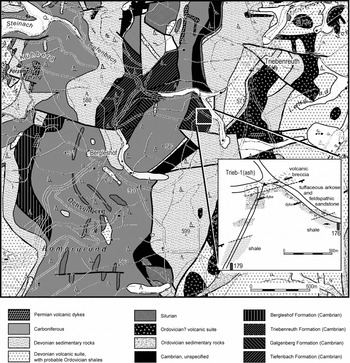
Generalized and simplified geological map of the Cambrian of the Bergleshof–Tiefenbach–Triebenreuth region; inset map shows location of dated ash sample (Trieb-1). The regional geology is comprised of imbricated tectonic slices or olistoliths that form a Schuppenstructur with the greatest outcrop area of Cambrian rocks in the Franconian Forest (modified from Emmert et al. Reference Emmert, Horstig, Weinelt, Berger and Brunnacker1960; Ludwig, Reference Ludwig1969, fig. 2; and W. Trapp, unpub. diploma thesis, Univ. Würzburg, 1965). Large-scale insert map shows forest roads and geological succession at the type locality of the Triebenreuth Formation (modified from Ludwig, Reference Ludwig1969, fig. 9). Fossil locality indicated by trilobite symbol. Elliptical symbols with numbers refer to landmark stones.

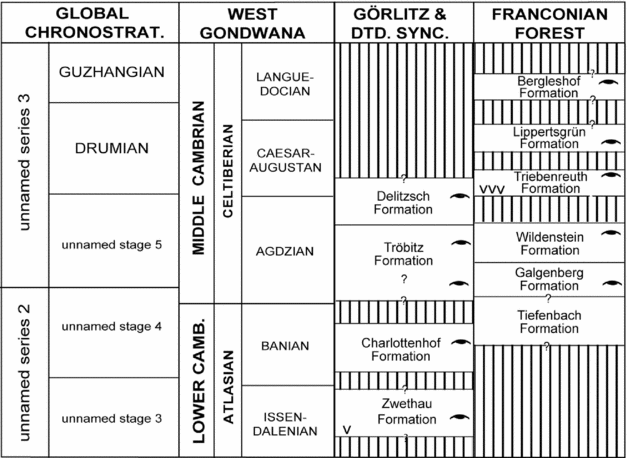
Stratigraphic table of fossiliferous strata in the Saxothuringian Zone in Germany and its correlation into the standard Cambrian of West Gondwana (Geyer & Landing, Reference Geyer and Landing2004). Abbreviations: CHRONOSTRAT. – chronostratigraphy; DTG. SYNC. – Delitzsch–Torgau–Doberlug Syncline.

3. Geological setting
The Franconian Forest lies on the southern margin of the Saxothuringian Zone in northeastern Bavaria, southern Germany (Fig. 1). The Saxothuringian Zone is a West Gondwana-associated terrane or, perhaps better, a marginal West Gondwana succession. The zone is one of the largest inliers of terminal Ediacaran–Middle Palaeozoic rock south of the Rheic Ocean suture. Avalonian successions of the Rhenohercynian Zone lie to the north of the Saxothuringian Zone (e.g. Kröner et al. Reference Kröner, Mansy, Mazur, Aleksandrowski, Hann, Huckriede, Lacquement, Lamarche, Ledru, Pharoah, Zedler, Zeh, Zulauf and McCann2008).
The Ediacaran and Cambrian–Carboniferous successions of the Saxothuringian Zone have been interpreted as giant olistoliths in wildflysch of the Variscan orogen (e.g. Linnemann & Schauer, Reference Linnemann and Schauer1999). However, the poorly exposed Cambrian of the Saxothuringian Zone is a geographically coherent facies succession that does not suggest regional allochthony and transport for most of the zone (e.g. Göthel, Reference Göthel2001), whereas the small Cambrian blocks in the Franconian Forest are obviously related to the presence of the so-called Münchberg Gneissmass, a genetically and chronologically controversially debated block of metamorphic rocks (e.g. Stettner, Reference Stettner1972; Behr, Engel & Franke, Reference Behr, Engel and Franke1980; Gandl, Reference Gandl1998) (Figs 1, 2). The Saxothuringian Zone's basement everywhere is an Ediacaran arc succession deformed and intruded in the Late Ediacaran Cadomian orogeny and then unconformably overlain by shallow-marine Cambrian deposits (e.g. Linnemann et al. Reference Linnemann, d’Lemos, Drost, Jeffries, Gerdes, Romer, Samson, Strachen and McCann2008).
Within the Saxothuringian Zone, outcrops of the lowest Cambrian in the Görlitz syncline, Lusatia (Niederlausitz), northeast of Dresden and in cores in the Delitzsch–Torgau–Doberlug (DTG) syncline to the northwest (Fig. 1) feature restricted marine to open-shelf carbonates with archaeocyathans and trilobites. These northern Saxothuringian sequences are lithologically and biostratigraphically comparable to coeval late Early Cambrian intervals in West Gondwanan Spain and southern Morocco (Elicki, Reference Elicki1994; Geyer & Elicki, Reference Geyer and Elicki1995; compare Geyer & Landing, Reference Geyer, Landing, Geyer and Landing1995, Reference Geyer, Landing, Geyer and Landing2006). A change to shallow-marine siliciclastic deposition takes place in the very late Early Cambrian in the Görlitz syncline. Similarly, dominantly sandstone and mudstone successions constitute the Middle Cambrian of the DTG syncline with fossil assemblages very similar to the West Gondwanan faunas in Morocco (e.g. Geyer & Elicki, Reference Geyer and Elicki1995; Geyer et al. Reference Geyer, Elicki, Fatka, Żylinska and McCann2008). A comparable vertical transition from shelf carbonates to siliciclastic sediments in Morocco and Spain is interpreted to reflect a cooling climate with the southern movement of West Gondwana into higher south latitudes (Theokritoff, Reference Theokritoff1979; Burrett, Long & Stait, Reference Burrett, Long, Stait, McKerrow and Scotese1991; Landing, Reference Landing, Nance and Thompson1996; Álvaro et al. Reference Álvaro, Rouchy, Bechstädt, Boucot, Boyer, Debrenne, Moreno-Eiris, Perejón and Vennin2000; Landing, Westrop & Bowring, Reference Landing, Geyer, Brasier and Bowring2013; Landing et al. Reference Landing, Geyer, Brasier and Bowring2013).
This succession of a carbonate-rich Lower Cambrian and a siliciclastic-dominated Middle Cambrian is suggested in the Franconian–Thuringian Slate Mountains in the Saxothuringian Zone. A borehole in the Berga Anticline, a northeastern extension of the Franconian Forest in this area (Fig. 1), passed through lowest Ordovician (Tremadocian) mudstone and penetrated an unconformably underlying ‘Limestone Member’ with poorly preserved chancellorids and hyoliths assigned to the late Early or lower Middle Cambrian (Blumenstengel, Reference Blumenstengel1980; Elicki, Reference Elicki1997).
Just south of the Berga Anticline, rocks as low as the characteristic Lower Cambrian carbonates of West Gondwana are not exposed in the Franconian Forest (Figs 1, 2). However, the Franconian Forest has a Middle Cambrian succession of siliciclastic-dominated, shallow-water, fossiliferous units of typical West Gondwanan aspect (Fig. 3). This succession has primarily West Gondwanan trilobites in its lower part (Galgenberg and Wildenstein formations) and an increase in the proportion of Baltic genera in its upper part (Bergleshof Formation) (e.g. Geyer et al. Reference Geyer, Elicki, Fatka, Żylinska and McCann2008; Heuse et al. Reference Heuse, Blumenstengel, Elicki, Geyer, Hansch, Maletz, Sarmiento, Weyer, Linnemann and Romer2010). Although the Middle Cambrian formations of the Franconian Forest are fault-bounded, biostratigraphically important trilobites and agnostoid arthropods allow recognition of a relatively complete Middle Cambrian faunal succession. This succession allows a tight biostratigraphic bracketing of zircon-bearing volcanic rocks at the base of the Triebenreuth Formation (Fig. 3).
4. Pyroclastic rocks at the base of the Triebenreuth Formation
The lower Triebenreuth Formation records a phase of explosive, mixed (acidic and basic) volcanism in the middle Middle Cambrian of the Franconian Forest succession (Ludwig, Reference Ludwig1969). Although now poorly exposed, Ludwig (Reference Ludwig1969) reported that the gently SE-dipping Triebenreuth Formation was well exposed in 1963–1965 along forest roads on the NW slope of a low hill called Kleiner Torkel, west of the small village of Triebenreuth (Fig. 2, see large-scale inset map). This section with basal volcaniclastic rocks and higher mudstones is the type locality of the Triebenreuth Formation of Gaertner et al. (Reference Gaertner, Horstig, Stettner and Wurm1968). The volcanic rocks that form the base of the type section of the Triebenreuth Formation (Fig. 2, large-scale inset map) lie in the middle of a Y-intersection of unimproved forest roads. This locality is c. 650 m southwest of Triebenreuth village (coordinates R 446788 H 556032) (Geyer, Reference Geyer, Fatka and Budil2010).
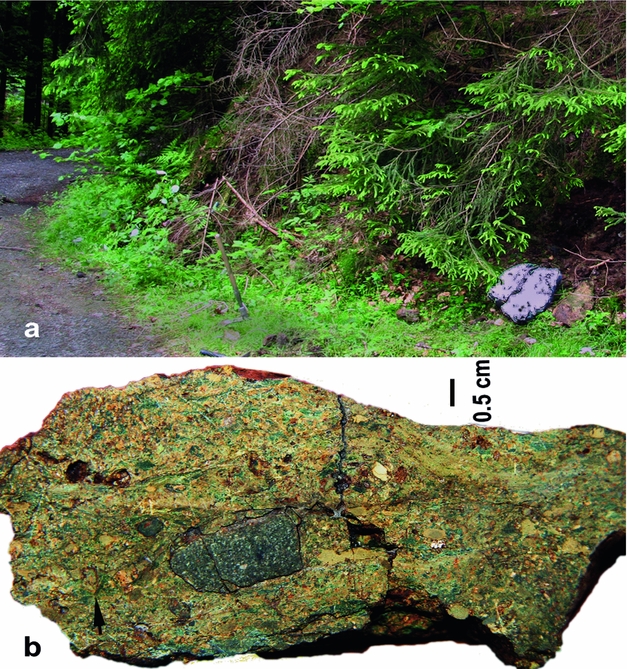
Ludwig (Reference Ludwig1969) reported a c. 60+ m thick type section of the Triebenreuth Formation with three major divisions at the type section (Fig. 2, see inset map). These three divisions were only well exposed in the 1960s as a result of road work, but are now largely overgrown. The three divisions include a lower division that consists of 10+ m of volcanic breccia with felsite porphyry clasts (1–5 cm in size), abundant glass shards and volcanic bombs (up to 10 cm). The volcanic ash collected for this report came from 1.0 m above the base of the formation and, thus, 1.0 m above the base of Ludwig's (Reference Ludwig1969) ‘lower division’ (Fig. 2). Ludwig (Reference Ludwig1969) noted that this lower division had undergone mass movement, but did not provide evidence for this interpretation. The volcanic ash sample (Trieb-1) analysed in this report was collected 1.0 m above the base of the lower division of the Triebenreuth Formation and from the overgrown road-cut at the SE side of the Y-intersection (Figs 2, 4a).
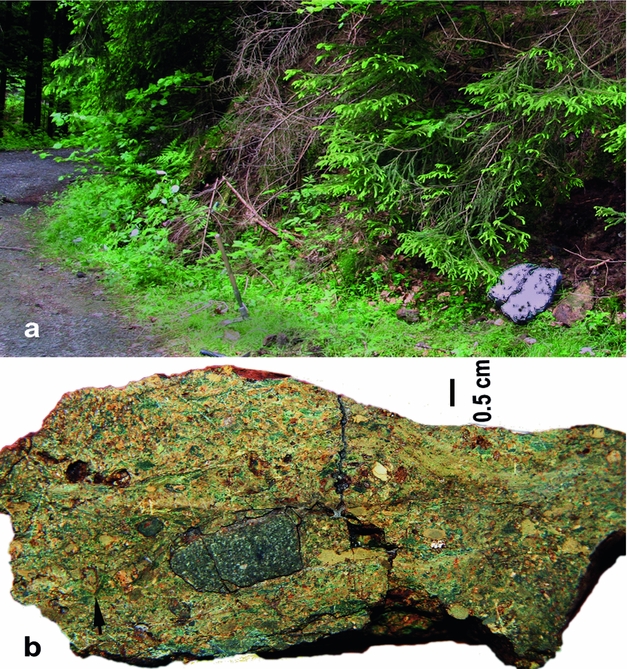
Locality and lithology of sample from Triebenreuth Formation. (a) Heavily overgrown outcrop of the sample Trieb-1 volcanic ash; two white sample bags are 35 cm long. (b) Small slabbed section of Trieb-1 volcanic ash shows laminated fabric with pumice (light yellowish-coloured) and rhyolite (dark grey) clasts; black arrow points to compaction-broken, green glass shard. Sample MMUW 2013-III-001 at the Universität Würzburg.
Higher strata of the Triebenreuth Formation's type section include a middle yellowish tuffaceous arkose (25+ m thick) with quartz porphyry and basaltic tuffs; and an upper (25+ m) light coloured, tuffaceous, siliceous and fossiliferous mudstone. Ludwig (Reference Ludwig1969) described what he called ‘volcanic conglomerates’ within the lower volcanic breccia and middle tuffaceous arkose, and noted the presence of angular to subangular quartz sandstones and quartzites – likely fragments of Ediacaran basement rock – in the volcanic conglomerates. The lower volcanic rocks and middle tuffaceous arkoses of the Triebenreuth Formation have not yielded fossils. The tentatively identified ‘algal colonies’ illustrated in a thin-section from the lower Triebenreuth (Ludwig, Reference Ludwig1969, p. 108, pl. 12, fig. 22) appear to be disordered pyrite framboids (e.g. Love & Amstutz, Reference Love and Amstutz1966).
The lowest part of the Triebenreuth type section includes c. 4.0 m of dominantly yellowish-brown coloured, polymict volcanic tuff that was exposed during the fieldwork for this report in 2010. The breccia is dominated by fine-grained, yellowish-brown, soft pumice-like pebbles with welded grey rhyolite and rare sandy shale and shaly sandstone pebbles. The matrix has abundant, fine- to coarse-grained, euhedral, pink orthoclase sand. Ludwig (Reference Ludwig1969) reported clasts of reworked basalt, diabase, granite and dark chert fragments up to 8.0 cm in diameter, but these clasts were not observed in the fieldwork for this study. Hydrated, frequently angular or disc-shaped, dark green volcanic glass shards are common. These glass shards were fractured with compaction of the volcaniclastic deposit (Fig. 4b, arrow) but commonly show embayed contacts with under- and overlying clasts. The latter contacts suggest that the glass shards were hot and still plastic on deposition.
The lower 4.0 m of the outcrop ranges from ungraded, structureless volcaniclastic conglomerate that suggest plinian fall deposits at the base of the volcanic rocks to finer-grained, stratified pyroclastic rocks with the cross-lamination and imbricate structure known in laminar grain flow (e.g. Sheridan, Reference Sheridan, Chapin and Elston1979; Fig. 4b). This latter fabric at the Trieb-1 sample horizon suggests pyroclastic surge activity (Crowe & Fisher, Reference Crowe and Fisher1973). A lack of fossils or subaqueous sedimentary structures, the fact that the green volcanic glass was still plastic on deposition and the large size of some of the clasts suggest subaerial tuff emplacement relatively close to a volcanic centre. The Triebenreuth Formation volcanic rocks are deeply weathered and porous at the type section, which may indicate calcite-replacement of the matrix of the volcanic rocks.
Yellowish tuffaceous arkoses deposited under wave and current influence are exposed above the lower volcaniclastic conglomerate as patchy low outcrops on the north side of the western forest road. Still higher, and about 40 m above the base of the Triebenreuth Formation, is a short outcrop (Fig. 2, large-scale map, trilobite symbol) of fossiliferous dark green to grey, tuffaceous and siliceous mudstones with minor coarser-grained sandstones and small phosphatic nodules (Geyer, Reference Geyer, Fatka and Budil2010).
5. Relative age of the Triebenreuth Formation
5.a. Biostratigraphic brackets
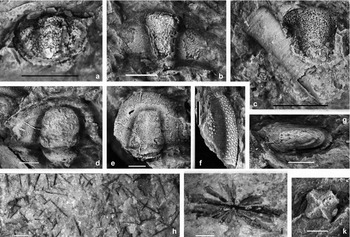
A poorly preserved but relatively diverse, trilobite-dominated assemblage has been collected from a few loose calcareous nodules and calcareous, siliceous shales estimated to lie roughly 40 m above the Triebenreuth volcaniclastic rocks (Ludwig, Reference Ludwig1969) (Fig. 2, trilobite symbol in large-scale map). The nodules include shell hash-rich layers with disarticulated small trilobite sclerites and echinoderm ossicles, brachiopod and mollusc valves, hyolith conchs and other fossil remains. The siliceous shales are occasionally rich in isolated sponge spicules (Fig. 5h). The previously unillustrated trilobite assemblage of eodiscinids, corynexochids and ptychopariids suggests a traditional middle Middle Cambrian (middle Celtiberian Series) correlation of the Triebenreuth Formation (Geyer & Wiefel, Reference Geyer, Wiefel and Deutschlands1997; Geyer et al. Reference Geyer, Elicki, Fatka, Żylinska and McCann2008; Heuse et al. Reference Heuse, Blumenstengel, Elicki, Geyer, Hansch, Maletz, Sarmiento, Weyer, Linnemann and Romer2010).
Fossils from the Triebenreuth Formation. 1 mm scale bars. (a) Undetermined eodiscid, pygidium, largely exfoliated. (b) Milaspidoid corynexochid, incomplete cranidium. (c) Orthothecid hyolith conch and undetermined trilobite hypostome. (d) Incomplete ptychoparioid cranidium. (e) Skrejaspis sp., incomplete cranidium. (f) Solenopleuropsis sp., incomplete librigena. (g) Helcionellid conch, internal mould, dorsal view. (h) Siliceous shale with sponge spicules. (i) Undetermined metazoan fossil, external mould with mineralized remains of the skeletal substance. (k) Isolated echinoderm ossicle.

The Triebenreuth Formation is only known from two localities that are apparently in fault contact with the lowest and highest Middle Cambrian units (Tiefenbach, Galgenberg and Bergleshof formations, respectively) in the Franconian Forest (Fig. 2, inset map). The Triebenreuth's assignment to the middle of the Franconian Forest Middle Cambrian places it as younger than the muddy to weakly calcareous, slightly tuffaceous sandstones of the Galgenberg and Wildenstein formations (Wurm, Reference Wurm1924a ,Reference Wurm b , Reference Wurm1925a ,Reference Wurm b ; Sdzuy, Reference Sdzuy1964; Ludwig. Reference Ludwig1969; Geyer et al. Reference Geyer, Elicki, Fatka, Żylinska and McCann2008), but older than the shales of the Lippertsgrün Formation (Sdzuy, Reference Sdzuy1964, Reference Sdzuy2000; Geyer et al. Reference Geyer, Elicki, Fatka, Żylinska and McCann2008) (Fig. 3).
The Galgenberg Formation is locally very fossiliferous and has a low-diversity, trilobite-dominated, lowest Middle Cambrian (early Celtiberian Epoch) fauna with Ornamentaspis frankenwaldensis (Wurm, Reference Wurm1925a ), Latikingaspis sp., Parasolenopleura spp. and others. The Wildenstein Formation has subtly younger, early Middle Cambrian (early Celtiberian Epoch) agnostoid arthropod- and trilobite-dominated faunas with Condylopyge Hawle & Corda, Reference Hawle and Corda1847; Conocoryphe; Dawsonia Hartt in Dawson (Reference Dawson1868); Kingaspidoides Hupé, Reference Hupé1953; Ornamentaspis Geyer, Reference Geyer1990; and Paradoxides Brongniart, Reference Brongniart, Brongniart and Desmarest1822 sensu lato. Similarly, the Triebenreuth Formation is regarded as older than the middle Middle Cambrian mudstones of the Lippertsgrün Formation, with its distinctive assemblage with Solenopleuropsis Thoral, Reference Thoral1947 (Wurm, Reference Wurm1928; Sdzuy, Reference Sdzuy2000; Heuse et al. Reference Heuse, Blumenstengel, Elicki, Geyer, Hansch, Maletz, Sarmiento, Weyer, Linnemann and Romer2010), and older than the upper Middle Cambrian siltstones and sandstones of the Bergleshof Formation (Horstig, Reference Horstig1954; Sdzuy, Reference Sdzuy1966; Heuse et al. Reference Heuse, Blumenstengel, Elicki, Geyer, Hansch, Maletz, Sarmiento, Weyer, Linnemann and Romer2010).
5.b. Triebenreuth fossils
The poorly preserved, but relatively diverse, trilobite-dominated fossil assemblage from the Triebenreuth type section at Kleiner Torkel was collected during mapping activities in 1964 (Ludwig, Reference Ludwig1969). Later attempts to supplement this collection by excavating the upper part of the Kleiner Torkel section failed, in part due to the deep weathering of the mudstones. Thus, the original fossil samples made in 1964 remain the only available material. An additional locality assigned to the Triebenreuth Formation with fewer fossil remains was found in the late 1960s near Elbersreuth (map sheet Schwarzenbach a. W.). However, this outcrop is equally poor, and the few fossils appear to have been lost (Geyer & Wiefel, Reference Geyer, Wiefel and Deutschlands1997).
The relatively diverse fossil assemblage known from a few calcareous nodules collected in the 1960s from the type section include shell hash-rich layers with disarticulated small trilobite sclerites, echinoderm ossicles, brachiopod and mollusc valves, hyolith conchs and other fossil remains presently being studied by G.G. The trilobites belong to at least six different genera, including Skrejaspis Růžička, Reference Růžička1946 and Solenopleuropsis. As noted above, the previously unillustrated trilobite assemblage suggests a middle Middle Cambrian (middle Celtiberian Series) correlation of the Triebenreuth Formation. The closest similarity of the trilobites is with part of the Jince Formation in the Skryje–Tyřovice Basin of the Barrandian of Bohemia. The siliceous shales are occasionally rich in isolated sponge spicules with simple triaxons scattered on bedding planes (Fig. 5h).
6. U–Pb geochronology
6.a. Analytical procedures for dating sample Trieb-1
High precision U–Pb dating was done on zircons from sample Trieb-1 by chemical abrasion thermal ionization mass spectrometry (CA-TIMS) techniques. Zircons were recovered from a bulk collection of sample Trieb-1 by standard crushing, heavy liquid and magnetic separation techniques. The zircons to be analysed were handpicked under the binocular microscope on the basis of clarity and a well-preserved (i.e. primary) crystal morphology. In order to minimize discordance related to the effects of radioactive decay-induced crystal defects and associated lead-loss, the zircon grains were pre-treated by chemical abrasion (CA), a procedure that involves thermal annealing and chemical leaching (Mattinson, Reference Mattinson2005).
In the CA procedure, the zircons are annealed in a muffle furnace at 900°C for 60 hours. The annealed grains are subsequently loaded into FEP Teflon® microcapsules and leached with concentrated HF at 180°C in high-pressure vessels for 12 hours. The partially dissolved sample is then transferred into Savillex® FEP beakers for rinsing. The leached material is decanted with several millilitres of ultra-pure water and fluxed successively with 4M HNO3 and 6M HCl on a hot plate and/or in an ultrasonic bath. After final rinsing of the annealed/leached zircons with ultra-pure water, they are loaded back into their microcapsules, spiked with a mixed 205Pb–233U–235U tracer solution (Earthtime 535 tracer; www.earth-time.org), and dissolved completely in concentrated HF at 220°C over 48–60 hours.
The dissolved zircon solutions are processed through anion exchange resin columns to separate U and Pb. The samples are then loaded in a silica gel-phosphoric acid mixture onto degassed, zone-refined Re filaments. Analyses are completed by thermal ionization mass spectrometry (TIMS), using a peak-hopping routine with a Daly detector (ion counter).
Data acquisition and reduction utilizes the software packages Tripoli and U–Pb Redux (Bowring, McLean & Bowring, Reference Bowring, McLean and Bowring2011; McLean, Bowring & Bowring, Reference McLean, Bowring and Bowring2011). A split of the zircons recovered from the sample that were not used for CA-TIMS analysis was reposited with the Bayerisches Landesamt für Umwelt in Hof, Germany.
6.b. U–Pb geochronology
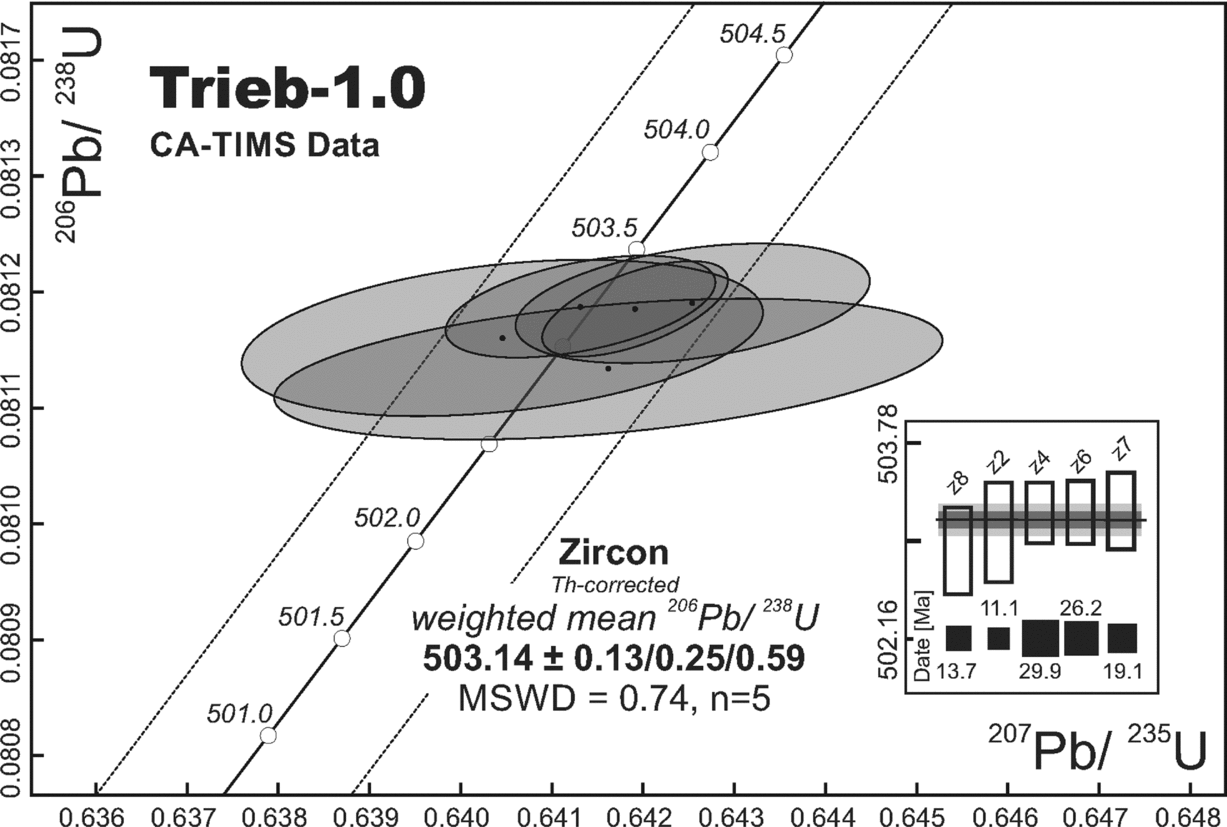
A sample (Trieb-1) from near the base of the Triebenreuth Formation yielded abundant well-preserved (euhedral) zircons of which seven were analysed (z 2–8) (Table 1). Of these, two zircons (z 3 and z 5) are clearly distinctly older (Table 1) and are interpreted to have been reworked during eruption and/or deposition.
U–Pb zircon isotopic data by conventional isotopic dilution mass spectrometric methods

Pb blank isotopic composition: 206Pb/204Pb = 18.42±0.35; 207Pb/204Pb = 15.36±0.23; 208Pb/204Pb = 37.46±0.74
(a) Th contents calculated from radiogenic 208Pb and the 207Pb–206Pb date of the sample, assuming concordance between U–Th and Pb systems. (b) Total mass of common Pb. (c) Ratio of radiogenic Pb (including 208Pb) to common Pb. (d) Measured ratio corrected for fractionation and tracer contribution only. (e) Measured ratios corrected for fractionation, tracer, blank, common Pb is lab blank, U blank = 0.1 pg; Mass fractionation correction of 0.25%/amu±0.04%/amu (atomic mass unit) was applied to single-collector Daly measurements. (f) Corrected for initial Th/U disequilibrium using radiogenic208Pb and Th/U [magma] = 2.8. (g) Isotopic dates calculated using the decay constants λ238 = 1.55125E−10 yr−1, λ235 = 9.8485E−10 yr−1 (Jaffey et al. Reference Jaffey, Flynn, Glendein, Bentley and Essling1971), and for 238U/235U = 137.818±0.045 (Hiess et al. Reference Hiess, Concon, McLean and Noble2012).
corr. coef. = correlation coefficient
The remaining five zircons are used to calculate a weighted mean 206Pb–238U date of 503.14±0.13/0.25/0.59 Ma (Fig. 6). We report errors in the form of X/Y/Z where X is internal errors, Y includes tracer calibration and Z includes decay constant errors. Y would be used if comparing U–Pb data from two different labs with different tracers or between ID-TIMS and SHRIMP analyses. Similarly, one would use Z if comparing U–Pb to Ar–Ar or Re–Os or to any other radioactive decay series.
Concordia diagram and weighted 206Pb–238U average ages (analyses by ID-TIMS techniques) for five unreworked grains from sample Trieb-1 from the Triebenreuth Formation, southern Franconian Forest, Bavaria, Germany.

7. Regional and interregional correlation
A mudstone interval that represents the highest known part of the Triebenreuth Formation is truncated by a fault at its top. Samples from this mudstone interval include a relatively diverse fossil assemblage, which is presently being studied by G.G. Despite the surprising diversity, the preservation of the fossils rarely allows an identification to the species level, and the majority of the known fossils appear not to be taxonomically established yet. Nevertheless, the trilobites include sclerites that can be readily assigned to Skrejaspis and Solenopleuropsis (Fig. 5e, f). Along with other faunal elements, these trilobites suggests a middle Middle Cambrian (middle Celtiberian Series and lower Languedocian Stage) correlation of this part of the Triebenreuth Formation, and, thus, reference to the global Drumian Stage (Fig. 3). Solenopleuropsis is an index fossil for the Languedocian Stage and indicates a minimum age of the upper Triebenreuth Formation, although other trilobites would rather suggest a slightly older age. This disparity in apparent biostratigraphic correlation is explained herein as a result of a fairly monofacial siliciclastic mudstone development of Solenopleuropsis-bearing strata in the so-called ‘Mediterranean fossil subprovince’. It should be emphasized that Solenopleuropsis is a typical ‘Mediterranean’ trilobite, whereas other faunal elements suggest a similarity with those known from part of the Jince Formation in the Skryje–Tyřovice Basin of the Barrandian of the Bohemian region of the Czech Republic. Whether the known fossils record a typical assemblage for this part of the succession or are just a preservational and collection artefact remains an open question because no fossils have ever been discovered from the arenites or at any other horizon in the mudstones of the Triebenreuth Formation.
8. Discussion
A weighted mean 206Pb–238U date of 503.14±0.13 Ma from a volcanic tuff low in the type section of the Triebenreuth Formation is the first biostratigraphically bracketed Middle Cambrian date from sedimentary rocks of the Saxothuringian Zone and, thus, from the margin of West Gondwana. The date is more precise than but overlaps a Middle Cambrian date with less biostratigraphic resolution from the Middle Cambrian of Antarctica (Encarnación, Rowell & Grunow, Reference Encarnación, Rowell and Grunow1999) and a more problematical date from possibly reworked zircons from a volcaniclastic debris flow from the Southwell Group of Tasmania (Perkins & Walshe, Reference Perkins and Walshe1993). A 503.14±0.13 Ma middle Middle Cambrian date from the Triebenreuth Formation complements a c. 509 Ma age on the Lower–Middle Cambrian boundary based on Avalonian ashes from New Brunswick and England (Isachsen et al. Reference Isachsen, Bowring, Landing and Samson1994; Landing et al. Reference Landing, Davidek, Westrop, Geyer and Heldmaier1998; Harvey et al. Reference Harvey, Williams, Condon, Wilby, Siveter, Rushton, Leng and Gabbott2011).
A precise and biostratigraphically bracketed younger date in the Cambrian is known no lower than a late Late Cambrian date of 488.71±2.87 Ma in the lowest subzone of the Peltura scarabaeoides Zone of Wales (Davidek et al. Reference Davidek, Landing, Bowring, Westrop, Rushton, Fortey and Adrain1998; Landing et al. Reference Landing, Bowring, Davidek, Rushton, Fortey and Wimbledon2000; recalculated as 488.71±1.17 Ma by Schmitz, Reference Schmitz, Gradstein, Ogg, Schmitz and Ogg2012). What is obviously left unresolved in Cambrian geochronology by the new 503.14±0.13 Ma date from Germany is a precise date on the traditional base of the Upper Cambrian (e.g. Agnostus pisiformis Zone in Avalonia and Baltica; Cedaria Zone in Laurentia; and in East Gondwana about the base of the South China Linguagnostus reconditus Zone and Australian Acmarhachis quasivespa Zone) or the younger base of the Furongian Series (the informal Upper Cambrian Subsystem used herein).
Peng, Babcock & Cooper (Reference Peng, Babcock, Cooper, Gradstein, Ogg, Schmitz and Ogg2012) estimated a 499 Ma date on the base of the traditional Upper Cambrian, which is essentially the 500 Ma estimate of Bowring & Schmitz (Reference Bowring, Schmitz, Hanchae and Huskins2003) and others, and estimated 496 or 497 Ma dates on the base of the Furongian Series. Peng, Babcock & Cooper (Reference Peng, Babcock, Cooper, Gradstein, Ogg, Schmitz and Ogg2012) preferred the 497 Ma estimate. This 497 Ma estimate was based on two assumptions: that the base of the Australian regional Undillan Stage was at c. 503 Ma (based on Perkins & Walshe's (Reference Perkins and Walshe1993) date from the Southwell Group, which is questioned in Section 2.b of this report) and that the Furongian Series base lies six Australian trilobite zones, with an average 500 ka duration, above the base of the Undillan Stage.
A ‘middle Middle Cambrian’ correlation of the Triebenreuth Formation volcanic rocks does not equate to a precise geochronologic age, and does not constrain either the age of the base of the traditional Upper Cambrian or the base of the Furongian Series. Similarly, no quantitative evidence really allows an estimated average of c. 500 ka for the duration of Australian upper Middle Cambrian trilobite zones.
A c. 503 Ma date on the Triebenreuth volcanic rocks is approximately 6–7 Ma younger than the base of the traditional Avalonian Middle Cambrian, and could be used to speculate that an estimated 500 Ma date on the base of the traditional Upper Cambrian (e.g. Bowring & Schmitz, Reference Bowring, Schmitz, Hanchae and Huskins2003) and a 497 Ma estimate for a date on the base of the Furongian (Peng, Babcock & Cooper, Reference Peng, Babcock, Cooper, Gradstein, Ogg, Schmitz and Ogg2012) may be about correct. Schmitz (Reference Schmitz, Gradstein, Ogg, Schmitz and Ogg2012, p. 1074) re-evaluated Davidek et al.'s (Reference Davidek, Landing, Bowring, Westrop, Rushton, Fortey and Adrain1998) upper Upper Cambrian zircon date (weighted mean of 207Pb–206Pb, 206Pb–238U, 207Pb–235U) of 491±1 Ma as 488.71±1.17 Ma (207Pb–206Pb). Schmitz (Reference Schmitz, Gradstein, Ogg, Schmitz and Ogg2012) also recalculated Landing et al.'s (Reference Landing, Bowring, Davidek, Rushton, Fortey and Wimbledon2000) terminal Upper Cambrian zircon date (weighted mean of 207Pb–206Pb, 206Pb–238U, 207Pb–235U) of 489±0.6 Ma as 486.78±0.53 Ma (207Pb–206Pb). The recalculations in Schmitz (Reference Schmitz, Gradstein, Ogg, Schmitz and Ogg2012) reflect new estimates of the isotopic composition of uranium (Hiess et al. Reference Hiess, Concon, McLean and Noble2012).
Schmitz's (Reference Schmitz, Gradstein, Ogg, Schmitz and Ogg2012) recalculated Upper Cambrian dates from the upper Upper and terminal Cambrian of the Avalonian palaeocontinent are somewhat younger than the original reports of Davidek et al. (Reference Davidek, Landing, Bowring, Westrop, Rushton, Fortey and Adrain1998) and Landing et al. (Reference Landing, Bowring, Davidek, Rushton, Fortey and Wimbledon2000). In addition, they are in accord with the successive (older and younger) biostratigraphic horizons these zircon-bearing ashes occur in, as well as an estimate of a c. 10 Ma-long Upper Cambrian. Estimates on the age of the Cambrian–Ordovician boundary by Cooper & Sadler (Reference Cooper, Sadler, Gradstein, Ogg and Smith2004; 488.3±1.7 Ma) and Sadler, Cooper & Melchin (Reference Sadler, Cooper and Melchin2009; 490.9±0.1 Ma) are relatively close to the un-recalculated systemic boundary date in Landing et al. (Reference Landing, Bowring, Davidek, Rushton, Fortey and Wimbledon2000).
These re-evaluations of the Avalonian ‘legacy’ zircon dates on the uppermost Cambrian further suggest that Pigage et al.'s (Reference Pigage, Crowley, Pyle, Abbott, Roots and Schmitz2012) western Laurentian (Canadian Yukon) Lower Ordovician zircon date and its implications for the duration of the traditional Late Cambrian may itself need to be re-evaluated. Pigage et al. (Reference Pigage, Crowley, Pyle, Abbott, Roots and Schmitz2012) reported a 206Pb–238U weighted mean date of 491.04±0.13 Ma for zircons from a tuff in the upper lower Tremadocian Rossodus manitouensis Zone. They then used this date and an estimate on the durations of lowest Ordovician conodont zones to propose a date of > 493.3 Ma on the Cambrian–Ordovician boundary. Pigage et al.'s (Reference Pigage, Crowley, Pyle, Abbott, Roots and Schmitz2012) Lower Ordovician date is surprising for its great age and for its consequent implication that the traditional Late Cambrian spanned a relatively short period of time (< 7 Ma) if its base is placed at c. 500 Ma.
Pigage et al. (Reference Pigage, Crowley, Pyle, Abbott, Roots and Schmitz2012, p. 737) suggested that this discrepancy in the zircon-based age of the Cambrian–Ordovician boundary based on Avalonian and Laurentian samples might be due to two causes. The first is a lack of biostratigraphic resolution between lowest Ordovician Laurentian conodont and graptolite zones. However, this biostratigraphic ‘nonresolution’ does not exist, because Fortey, Landing & Skevington (Reference Fortey, Landing, Skevington, Bassett and Dean1982), Landing, Barnes & Stevens (Reference Landing, Barnes and Stevens1986) and Landing (Reference Landing1993) have detailed lowest Ordovician (Tremadocian Series) conodont–graptolite correlations from Laurentian continental slope deposits. The second reason for the seeming discrepancy in age of the Cambrian–Ordovician boundary between Avalonia and Laurentian suggested by Pigage et al. (Reference Pigage, Crowley, Pyle, Abbott, Roots and Schmitz2012) is due to a recycling of zircons in the ‘legacy’ Avalonian samples. However, this explanation is not appropriate as the latter phenomenon would obviously have given older, not younger, ages for the Avalonian samples.
Schmitz's (Reference Schmitz, Gradstein, Ogg, Schmitz and Ogg2012) re-evaluation of the ‘legacy’ Avalonian zircon dates and the fact that the two dates are consistent with derivation from lower and highest parts of the Avalonian Cambrian suggest an alternative explanation of the seemingly ‘old’ euhedral zircons from the Yukon tuff. Pigage et al. (Reference Pigage, Crowley, Pyle, Abbott, Roots and Schmitz2012, p. 736) noted that four older (c. 492 Ma) zircons from the Yukon tuff may indicate that antecrysts formed during earlier activity at the volcanic centre and were later erupted and deposited in the tuff sampled by Pigage et al. (Reference Pigage, Crowley, Pyle, Abbott, Roots and Schmitz2012). Indeed, all of the zircons from the Yukon tuff may have this explanation, and the Pigage et al. (Reference Pigage, Crowley, Pyle, Abbott, Roots and Schmitz2012) report may not be relevant to refining the age the Cambrian–Ordovician boundary. With approximately 10 Ma assigned to the lowest Ordovician Tremadocian Series (i.e. c. 488–478 Ma in Cooper & Sadler, Reference Cooper, Sadler, Gradstein, Ogg and Smith2004) and a 483±1 Ma date from the upper Tremadocian, an ‘old’ 491.04±0.13 Ma zircon date on the upper lower Tremadocian (Rossodus manitouensis Zone) of the Yukon seems to reflect zircon reworking. However, ultimate resolution of this problem will require re-dating of many rocks dated before widespread use of EARTHTIME protocols, including the use of precise calibrated tracers.
If a c. 488 Ma date for the end of the Cambrian is appropriate, Perkins & Walshe's (Reference Perkins and Walshe1993) mean 206Pb–238U date of 494.4±3.5 Ma on the Comstock Tuff (their sample 92–101) may actually be an important key to the ages of the bases of the traditional Upper Cambrian and Furongian Series and the durations of the latter intervals. As noted above (Section 2.b), the detailed provenance of this ash is unclear. As this c. 494 Ma ash occurs above Jago et al.'s (Reference Jago, Reid, Quilty, Green and Daily1972; also Shergold, Reference Shergold1995) upper Middle Cambrian Lejopyge laevigata Zone assemblage, it may actually provide a lower bracket for the age of the traditional Upper Cambrian/Furongian Series. If so, the traditional Upper Cambrian/Furongian with a c. 6 Ma duration would constitute the shortest series-level division of the Cambrian. With its base at c. 509 Ma, the Middle Cambrian/Series 3 would bracket a longer c. 15 Ma-long interval. Finally, over half of Cambrian time would be encompassed by the generally subtrilobitic Terreneuvian Series and the commonly trilobite-bearing Lenaldanian/Series 2 (Landing et al. Reference Landing, Davidek, Westrop, Geyer and Heldmaier1998, Reference Landing, Geyer, Brasier and Bowring2013).
Acknowledgements
Much of E.L.'s work was done under National Science Foundation grant support while at the New York State Museum. G.G.'s work was supported by research grant GE 549/21–1 of the Deutsche Forschungsgemeinschaft (DFG). The Bayerisches Landesamt für Umwelt, Abteilung 10, is gratefully acknowledged for financial support used for processing and dating of sample Trieb-1. A. Gubanov and M. Hofmann provided helpful reviews.