Introduction
Alzheimer's disease (AD) is the main cause of dementia and one of the most burdensome conditions in later life. The number of persons with AD will increase markedly in the next few decades as older persons constitute an increasing proportion of the population. Behavioral and psychological symptoms of dementia (BPSD), including agitation, depression, apathy, delusions, hallucinations and sleep impairment, have adverse consequences for persons with dementia and their caregivers (Aguera-Ortiz et al., Reference Aguera-Ortiz, Frank-Garcia, Gil, Moreno and fiveE Study2010). Comprehensive assessment and analysis of predisposing factors and situational triggers are essential in the evaluation and treatment of BPSD (Lyketsos et al., Reference Lyketsos2006). Though the evidence on the effectiveness of non-pharmacological interventions is limited (Livingston et al., Reference Livingston, Johnston, Katona, Paton and Lyketsos2005), the use of antipsychotics is recommended only for psychosis and agitation in the treatment of BPSD (APA Work Group on Alzheimer's Disease and Other Dementias, 2007; Bishara et al., Reference Bishara, Taylor, Howard and Abdel-Tawab2009; National Institute for Health and Clinical Excellence, 2010).
Persons with AD may be particularly susceptible to antipsychotic-related adverse drug events (ADEs), including extrapyramidal symptoms, confusion, falls, fractures, and adverse metabolic and cerebrovascular events (Ganjavi et al., Reference Ganjavi2007; Pouwels et al., Reference Pouwels, van Staa, Egberts, Leufkens, Cooper and de Vries2009; Zheng et al., Reference Zheng2009). ADEs are responsible for increased morbidity, institutionalization and distress among caregivers (Kennedy et al., Reference Kennedy2009). Increased mortality among users of both first-generation antipsychotics (FGAs) and second-generation antipsychotics (SGAs) have been demonstrated in several studies, which led the US Food and Drug Administration to issue black box warnings in 2005 and 2008 (Wang et al., Reference Wang2005, Kales et al., Reference Kales2007, Gill et al., Reference Gill2007).The long-term risk of death in persons with AD who continue versus discontinue taking antipsychotic medication is increased (Ballard et al., Reference Ballard2009). Withdrawal of antipsychotics did not impair the functional and cognitive status of persons with AD in the DART-AD study conducted in the UK (Ballard et al., Reference Ballard2008), which may indicate that the benefits of these drugs is limited among persons with AD.
In earlier Finnish studies of community-dwelling older persons, Linjakumpu et al. (Reference Linjakumpu, Hartikainen, Klaukka, Koponen, Kivelä and Isoaho2002) showed that 3.0% of persons aged over 65 years were using antipsychotics in the late 1990s. According to Hartikainen et al. (Reference Hartikainen, Rahkonen, Kautiainen and Sulkava2003), 30.0% of community-dwelling persons with dementia and 5.0% of those without dementia used antipsychotics in eastern Finland. In a recent study, Desplenter et al. (Reference Desplenter, Caenen, Meelberghs, Hartikainen, Sulkava and Bell2011) reported that the adjusted prevalence of antipsychotic use remained stable from 1998 to 2004. In another study, Alanen et al. (Reference Alanen2008) showed that compared to several other European countries, the use of antipsychotics was higher among community-dwelling persons in Finland. To our knowledge, no nationwide study has been carried out on use of antipsychotics in community-dwelling persons with and without AD. The Finnish healthcare registers provide a near unique opportunity to study and monitor drug use on a national level. Our aim was to investigate the national pattern of antipsychotic use among community-dwelling persons with and without AD.
Methods
Data sources
This nationwide register-based study was based on data obtained from the Finnish National Prescription Register and Special Reimbursement Register maintained by the Social Insurance Institution of Finland (SII). The Prescription Register contains records of prescription drugs purchased by all 5.3 million Finnish residents living in non-institutional settings. Also recorded are the prescriptions written by hospital physicians but dispensed in the community setting for use by patients when discharged from hospitals. The Prescription Register did not include records of drugs that were used in hospitals. Each resident is assigned a unique identification number that is used to track prescription drug purchases. In 2005 the SII did not reimburse the cost of non-prescription drugs or drugs that cost less than €10 (US$13) and, therefore, records of these purchases do not appear in the Register. Information contained in the Register includes the dispensing date of each prescription, the number of dispensed packages and the number of dispensed tablets. Each person's birth date, sex, and residential area are also included. In addition, each prescriber's specialty and workplace (hospital, primary care or private care sector) are recorded. The Special Reimbursement Register contains records of persons who are eligible to receive reimbursement due to being diagnosed with definite diseases, for example AD, diabetes, hypertension or psychosis. The Prescription and Special Reimbursement Registers have been previously used to study drug utilization among persons with and without AD (Bell et al., Reference Bell, Laitinen, Lavikainen, Lönnroos, Uosukainen and Hartikainen2011).
Definition of AD and comorbidities
Data on morbidity were obtained from the Special Reimbursement Register. To be included in the Special Reimbursement Register, a person's disease or condition must meet explicit predefined criteria, and written documentary evidence must be provided to the SII by that person's physician. Diagnoses extracted for each person included AD, cardiovascular diseases (heart failure, hypertension, coronary artery disease, and arrhythmias), diabetes, glaucoma, chronic asthma or chronic obstructive pulmonary disease, psychosis, hypothyreosis, rheumatoid arthritis and other connective tissue diseases and cancer.
For a diagnosis of AD to be verified and recorded in the Special Reimbursement Register that person's physician must provide a medical statement to the SII. The medical statement must state that the person has (i) symptoms consistent with mild or moderate AD, (ii) experienced a decrease in social capacity over a period of at least 3 months, (iii) received a CT or MRI scan, (iv) had possible alternative diagnoses excluded, and (v) received confirmation of the diagnosis by a registered neurologist or geriatrician. Each medical statement is then assessed by the SII to ensure the AD symptoms are consistent with the 4th edition of the Diagnostic and Statistical Manual of Mental Disorders (DSM-IV) and NINCDS-ADRDA criteria (American Psychiatric Association, 1994). The Finnish Current Care guidelines recommend that all persons with AD should be prescribed anti-dementia drugs (Working Group set by the Finnish Medical Society Duodecim et al., 2010). Having mild or moderate AD is an initial SII requirement for reimbursement of anti-dementia drugs. Entitlement for the reimbursement is not withdrawn when a person later develops severe AD. This means our study sample included persons with mild, moderate, and severe AD. In addition our sample of persons with AD included persons with mixed dementias of the AD/vascular or AD/Lewy body type. We were not able to exclude the possibility that the comparison group included some persons with dementia due to causes other than AD.
Study population
The SII extracted from the Special Reimbursement Register records for all community-dwelling persons with a verified diagnosis of AD in Finland on 31 December 2005 (n = 28,093). Of the AD diagnoses, 53% were verified in 2004 and 2005, and the earliest diagnoses were from 1999 (n = 703, 2.5%).
For each person with AD the SII extracted data for a comparison person individually matched in terms of age (+/− one year), sex and region of residence. Four of the 28,093 comparison persons had purchased one or more anti-dementia drugs in 2005 despite not having a verified diagnosis of AD, and these four persons with their pairs were excluded from the analyses. The SII encrypted the data enabling identification of individuals before the dataset was provided to the research team.
Classification of drugs
Records for all drugs purchased by persons with AD and comparisons in 2005 were extracted from the Finnish National Prescription Register. All drugs were categorized according to the Anatomical Therapeutic Chemical (ATC) classification system recommended by the World Health Organization (WHO Collaborating Centre for Drug Statistics Methodology, 2010). For the purpose of this study, antipsychotics (N05A) were categorized as FGAs, for example, melperone (N05AD03), perphenazine (N05AB03) and haloperidol (N05AD01), and SGAs, for example, olanzapine (N05AH03), quetiapine (N05AH04) and risperidone (N05AX08). Anxiolytics (N05B) and hypnotics and sedatives (N05C) were categorized as sedatives. Antidepressants were defined as those drugs included under codes N06A and N06CA of the ATC classification system. Anti-dementia drugs included cholinesterase inhibitors (ChEIs, N06DA) and memantine (N06DX01).
Statistical analysis
All analyses were performed using annual prevalence data. The annual prevalence was defined as the number of persons with and without AD that were dispensed a particular antipsychotic drug during the 2005 calendar year. Conditional logistic regression analysis was used to calculate odds ratios (ORs) and 95% confidence intervals (CIs) for use of antipsychotic drugs. Chi square tests or t-tests were used to determine the differences between the users and non-users of antipsychotic drugs among the persons with AD. All analyses were performed using SAS (version 9.1; SAS Institute Inc., Cary, NC, USA).
Ethical considerations
The study protocol was approved by the SII. In accordance with Finnish law, the study was deemed exempt from requiring ethics committee approval because only de-identified data were used and study participants were not contacted.
Results
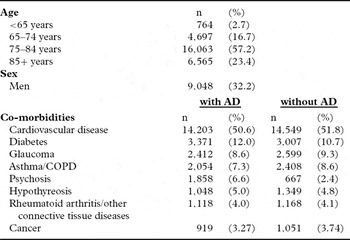
The study population consisted of 28,089 matched pairs of community-dwelling persons with and without AD. The proportion of women was 67.8% (Table 1). The age of the participants ranged from 42 to 101 years, and the mean age was 80.0 (SD 6.8) years; 78.4 (SD 7.0) for men and 80.3 (SD 6.7) for women. The majority of persons (n = 22,628, 80.6%) were aged 75 years and older.
Characteristics of pairs of persons with and without Alzheimer's disease (AD) (n = 28,089 in both groups)

Half of the persons in the AD (50.6%) and non-AD (51.8%) groups had cardiovascular disease. The history of psychosis was more often detected among the persons with AD (6.6% vs. 2.4%). The prevalence of diabetes was higher and prevalence of glaucoma, asthma/COPD and cancer were lower in the AD compared to the non-AD group.
Among all persons with and without AD, there were 24,091 reimbursed prescriptions for antipsychotic drugs dispensed in 2005. Of these prescriptions, 79.7% were written by general practitioners, 5.9% by neurologists, 5.6% by geriatricians and 3.9% by psychiatrists. Most of the antipsychotic prescriptions, 67.8% in the AD and 62.9% in the non-AD group, were written in primary care.
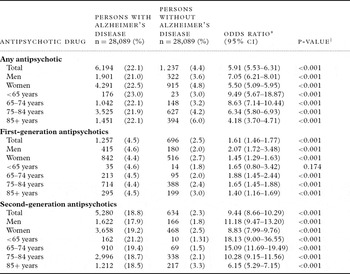
The prevalence of antipsychotic drug use was 22.0% (n = 6192) among the persons with AD and 4.4% (n = 1237) among persons without AD (Table 2). Women used antipsychotic drugs more frequently than men. The annual prevalence of antipsychotic use was 22.5% for the women with AD and 4.8% for the women without AD. The corresponding percentages among men with and without AD were 21.0% and 3.6%. In the AD group, on average, a fifth (22.1% to 23.0%) of the persons in every age group used antipsychotics. In the non-AD group, the prevalence of antipsychotic use was two times higher in the oldest than in the youngest age group (6.0% vs. 3.0%).
Use of antipsychotic drugs among community-dwelling persons with and without Alzheimer's disease in 2005

* Adjusted for major psychiatric disorders.
† Wald χ2 test, df 1.
In the whole study sample, SGAs were more commonly used than the FGAs (number of users: 5,914 vs. 1,953). In the AD group, 85.2% of the antipsychotic users had purchased SGAs. In the non-AD group, the corresponding proportion was 51.3%. The use of SGAs decreased with increasing age in the AD group but increased in the non-AD group.
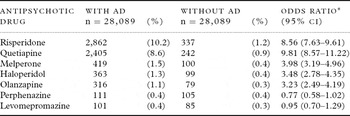
Nineteen different antipsychotic drugs were in use in the AD group and 18 in the non-AD group. Risperidone and quetiapine were the most frequently used antipsychotics in both groups (Table 3). Among the users of antipsychotics, risperidone was used by 46.2% of persons with AD and 27.2% of persons without AD, and quetiapine was used by 38.8% and 19.6%, respectively. Of the FGAs melperone was most often used. Among the users of antipsychotics, melperone was used by 6.8% of persons with AD and 8.1% of persons without AD. Haloperidol was the second most often used FGA, and the corresponding user percentages were 5.9% for the AD group and 8.0% for the non-AD group.
Most frequently used antipsychotics among community-dwelling persons with and without Alzheimer's disease (AD)

* Adjusted for major psychiatric disorders.
With regard to the use of psychotropic drugs (antipsychotics, sedatives, antidepressants), antipsychotics alone were used by 7.9% (n = 2226) of persons with AD and 1.6 % (n = 438) of persons without AD. Use of both antipsychotics and sedatives was recorded in 6.1% (n = 1705) of persons with AD and 1.2% (n = 324) persons without AD. Antipsychotics and antidepressants were use by 3.4 % (n = 951) of persons with AD and 0.5% (n = 142) of the comparison persons. Purchases in all these three psychotropic classes were recorded in 4.5% (n = 1260) of the persons with AD and 1.1% (n = 301) of the comparison persons.
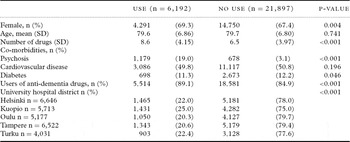
Anti-dementia drugs were used by 86% (n = 24,100) of the persons with AD. Of the users, 71% (n = 17,154) used ChEIs, 14% memantine (n = 3,323) and 15% (n = 3,623) used both a ChEI and memantine. Antipsychotic users with AD had a higher prevalence of anti-dementia drug use than the non-users of antipsychotics (p < 0.001) (Table 4). In addition, the antipsychotic users with AD were more likely to be females (p = 0.004), used a higher total number of drugs (p < 0.001) and had a higher prevalence of diabetes (p = 0.046) and psychosis (p < 0.001) than the non-antipsychotic users with AD. Finland is divided into five university hospital districts, in which the prevalence of antipsychotic use among persons with AD varied from 20% to 25% (p < 0.001).
Characteristics of community-dwelling persons with Alzheimer's disease by use of antipsychotic drugs

Discussion
To our knowledge this is the first nationwide study of antipsychotic drug use among community-dwelling persons with AD. We found a high rate of antipsychotic drug use concentrated on SGAs, risperidone and quetiapine especially. The annual prevalence of antipsychotic use was six times higher among persons with AD compared to persons without AD. Most of the antipsychotics were prescribed in primary care. Persons with AD not using anti-dementia drugs were less likely to use antipsychotics compared to AD persons taking anti-dementia drugs.
One in five people with AD received one or more reimbursed antipsychotics in 2005; this prevalence was lower than in an earlier Finnish study of community-dwelling persons aged 75 years and older in which the point prevalence of antipsychotic use was 27% among persons with AD (Hartikainen et al., Reference Hartikainen, Rahkonen, Kautiainen and Sulkava2003). In contrast to that study, our study was nationwide, used annual prevalence data and was specific to persons with and without AD. The annual prevalence of antipsychotic use among persons with AD in the present study was higher than the point prevalence in other European countries (Czech Republic, Denmark, Germany, Iceland, Italy, Netherlands, Norway and UK) (Alanen et al., Reference Alanen2008). In these countries, the average antipsychotic user proportions were 13.4% for cognitively impaired persons receiving home care services and 17.0% for those with a diagnosis of dementia.
In the comparison group the prevalence of use of antipsychotics was 4.4 %. This is in accordance with findings of earlier Finnish studies conducted in community-based settings (Hartikainen et al., Reference Hartikainen, Rahkonen, Kautiainen and Sulkava2003; Linjakumpu et al., Reference Linjakumpu, Hartikainen, Klaukka, Koponen, Kivelä and Isoaho2002). Thus the prevalence of antipsychotic use has not decreased despite the debate about high rates of antipsychotic use that was prompted by these earlier studies.
Persons with AD were six times more likely to be prescribed an antipsychotic drug than persons without AD, which is a higher ratio than that observed in several other European countries (Alanen et al., Reference Alanen2008). Antipsychotics are indicated only for psychosis and aggression in persons with dementia, long-term use should be avoided, and safety, in terms of ADEs, should be monitored closely (Alexopoulos et al., Reference Alexopoulos, Streim, Carpenter and Docherty2004). With regard to the efficacy of antipsychotics, it has been shown that the withdrawal of antipsychotics was not associated with any significant increase in behavioral and psychological symptoms in patients with dementia (Ballard et al., Reference Ballard2009).
We identified that only 15.4% of all antipsychotic prescriptions were written by neurologists, geriatricians or psychiatrists. Although the diagnosis of AD has to be made by a neurologist or geriatrician in Finland, persons with AD are mostly followed and treated by general practitioners in primary care. Our results may indicate that continuing education about new findings concerning care of patients with AD is especially needed in the primary care sector.
Risperidone is the only antipsychotic indicated for treatment of neuropsychiatric symptoms in dementia in Finland. According to this it was the most often used antipsychotic in the present study. Schneider et al. (Reference Schneider2006) showed that risperidone had the lowest rate of discontinuations because of intolerability in persons with AD. Quetiapine, which was the second most commonly used antipsychotic in the present study, may be associated with adverse metabolic changes (Zheng et al., Reference Zheng2009). Though SGAs are associated with fewer side-effects, extrapyramidal symptoms in particular, than the FGAs (Brown et al., Reference Brown, Markowitz, Moore and Parker1999), these benefits may be lost with increasing doses (van Iersel et al., Reference van Iersel, Zuidema, Koopmans, Verhey and Olde Rikkert2005).
Anti-dementia drugs were prescribed to 86% of persons with a verified diagnosis of AD, a finding that reflects the frequent and increasing use of anti-dementia drugs in Finland since 2000 (Ålander et al., Reference Ålander, Lönnroos, Hartikainen and Klaukka2006). The use of anti-dementia drugs was not associated with a lower prevalence of antipsychotic drug use. The reason for this may be that the effects of anti-dementia drugs appear slowly. If a patient has severe neuropsychological symptoms, antipsychotics may offer faster relief. Conversely, this may also reflect inadequate treatment monitoring and continuation of antipsychotic drugs without proper indication (Hartikainen et al., Reference Hartikainen, Rahkonen, Kautiainen and Sulkava2003). If neither anti-dementia drugs nor antipsychotics were used, it may also reflect the patients’ and physicians’ attitudes toward drug use in general.
Strengths and limitations
An important strength of our study was that we investigated the use of antipsychotic drugs among all community-dwelling persons with a verified diagnosis of AD in Finland. The diagnosis of AD can be considered accurate due to the diagnostic criteria required to be fulfilled to obtain reimbursement for anti-dementia drugs. Finnish Current Care Guidelines recommend that all persons with AD be started on anti-dementia drugs unless there is a specific contraindication (Working Group set by the Finnish Medical Society Duodecim et al., 2010). Due to the high cost of anti-dementia drugs they are rarely used without reimbursement in Finland. Thus almost all use of anti-dementia drugs was captured in the Prescription Register. In addition, there is a high level of concordance between antipsychotic drug utilization data obtained from the Register and patient self-reported use (Haukka et al., Reference Haukka, Suvisaari, Tuulio-Henriksson and Lonnqvist2007). We used annual prevalence data, because it has been shown to have the better sensitivity than data from shorter periods (Rikala et al., Reference Rikala, Hartikainen, Sulkava and Korhonen2010).
This study also had methodological limitations. The Prescription Register included all prescription drugs reimbursed in community-based settings in Finland but non-prescription drugs and drugs dispensed to persons in hospitals were not included in the SII registers. According to Finnish national sales statistics from 2005, 18% of anti-dementia drugs and 17% of antipsychotic drugs were used in hospitals or other institutions (National Agency for Medicines and Social Insurance Institution of Finland, 2006). Furthermore, we did not determine the duration of drug use, nor whether specific psychotropic drugs were taken concurrently at specific times throughout the year, or whether the pattern of psychotropic drug use changed over the course of AD. The US FDA's black box warning was issued in 2005 and the use of antipsychotics in the USA has since declined (Kales et al., Reference Kales2011). In contrast, national sales statistics in Finland reveal that the overall use of antipsychotics among all age groups increased from 17.4 DDDs/1000 inhabitants/day in 2005 to 20.7 DDDs/1000 inhabitants/day in 2010 (National Agency for Medicines and Social Insurance Institution of Finland, 2006; Finnish Medicines Agency, 2011). Future studies may seek to explore the evolution of antipsychotic use among persons with and without AD since the publication of research data and safety warnings that highlight the increased risk of death among antipsychotic users with dementia. Future studies may also seek to explore the indications for antipsychotic use in the non-AD group. As in other register-based studies, our analyses were based on drug purchases, and it was not possible to determine if the drugs reimbursed by the SII were actually taken by the study participants.
In conclusion, this was the first nationwide study on antipsychotic use among community-dwelling persons with and without AD. One fifth of persons with AD used antipsychotics, mainly SGAs. The annual prevalence of antipsychotic use was six times higher among persons with AD compared to persons without AD. The use of anti-dementia drugs was not associated with lower use of antipsychotic drugs. In Finland, AD is mainly diagnosed by neurologists or geriatricians. However, antipsychotics are mostly prescribed by primary care physicians. This may indicate that continuing education about care of patients with AD is especially needed in the primary care sector.
Conflict of interest
None.
Description of authors' roles
M-L. Laitinen and S. Hartikainen were responsible for the conception and design of the study. M-L. Laitinen and P. Lavikainen conducted the statistical analyses. All authors were involved in analysis and interpretation of the data. M-L. Laitinen and J.S. Bell drafted the first version of the paper. All authors were involved in critically revising the paper for important intellectual content, and all authors read and approved the final version submitted for publication.
Acknowledgments
The authors thank the Social Insurance Institution of Finland for providing the de-identified data that were analyzed in this study.