[I]
A friend said the other day that all the places we used to think of as “Asian friendly”—San Francisco, Seattle, Los Angeles, New York, Vancouver—are now turning into hot spots of anti-Asian hatred and violence. Her comment depressed me, not for its immediate but for its deeper truth about the Asian American mindset even during unexceptional times: that Asians in this country have always carried that consciousness and concern about what is a safe space for them. “Will we be safe there?” was the first question my mother asked some forty-plus years ago when my parents first decided to immigrate to America.
Being disliked for being Asian in America is not exceptional. It is the result and expression of over three hundred years of cultural and legal discrimination directed first against “the Chinese” and then more broadly people from the so-called Asia Triangle. African Americans have long understood that danger and denigration await them at every corner and haunt every exchange with strangers. And although Asians in America have been systematically characterized as an “exceptional” minority group—“white adjacent,” a model minority, economically advantaged, seemingly overwhelming in numbers in certain sectors while perpetually foreign, which is also to say, hardly minor or American at all—their history in America, their very American history, is an integral and erased part of the logic and teleology of American settler colonialism and its fantasies of racial purity.
Recently, hard-right House Republicans forming a so-called America First Caucus, which one document described as championing “Anglo-Saxon political traditions,” warned that mass immigration was putting the “unique identity” of the United States at risk (“America First”). I wonder if individuals like Marjorie Taylor Greene or Matt Gaetz know who the Anglo-Saxons really were or what “Anglo-Saxon political traditions” meant or whether they have studied their own racial-ethnic origins. Historians have long noted what a polyglot, transatlantic, and transpacific world the New World was from the get-go. According to the brilliant Peter Linebaugh and Marcus Redike, when an unprecedented expansion of trade and colonization in the early seventeenth century launched the first global economy, a vast, diverse, and landless workforce was born, and the roles of the dispossessed and the “immigrant” became foundational to the making of the modern world.
Long before the American Revolution, the Declaration of the Rights of Man, and the retroactive whitewashing of American exceptionalism, a crew of sailors, slaves, pirates, laborers, market women, and indentured servants had ideas about freedom and equality that laid the foundation beneath the dreams of liberty and revolt. Workers who lit the fires of revolution were not only the Puritans but also those who crossed national, ethnic, and racial boundaries, as they circulated around the Atlantic world on trade ships and slave ships, from England to Virginia, from Africa to Barbados, and from China to the Americas. “America” has always been—has never not been—a motley crew.
The “big lie” is not about the legitimacy of the 2020 presidential election. The big lie is the belief in the racial purity of American origins and the myth of white, exceptional supremacy that gave ideological cover to the long life of western settler colonialism. That imagined history was created and has been preserved through violent, systemic erasures, aided by the painstaking craft of race making—from how certain immigrants became white (Roediger; Rogin, Blackface) to how others became “Oriental” (Ngai)—and its accompanying expurgations.
The American pre–Civil War economy was largely founded on slave labor. After emancipation, the fractured country was reunited under the prospect of a burgeoning modern American economy jump-started by the completion of the Transcontinental Railroad, a feat made possible by a workforce that was ninety percent Chinese and one hundred percent erased from official American history.
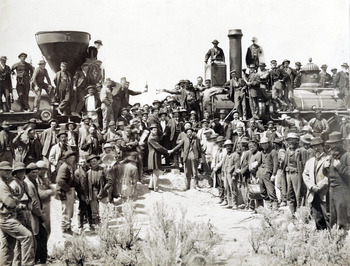
The famous photograph memorializing the celebration of the completion of the Transcontinental Railroad at Promontory Summit, Utah, in May 1869 was entitled “East Meets West” (fig. 1). The title, of course, refers to the meeting of both coasts, making America the first nation to have unlimited access to both the Atlantic and the Pacific oceans. But it is also a rather ironic name for those who know the critical yet invisible roles that Chinese workers played in this achievement. Scan the image: not a single Asian face to be found in this historic memory, even though Chinese workers completed two-thirds of the most difficult stretches of this project, and thousands lost their lives to it.
Photograph commemorating the completion of the First Transcontinental Railroad on 10 May 1869.

Meanwhile, United States citizenship was busy consolidating itself through a series of legal racial exclusions. The Chinese Exclusion Act of 1882 and the legal wrestling over what constitutes “Asians” preceding and following it (from the Page Act to Ozawa v. United States and Thind v. United States) spell out clearly how the making of white American exceptionalism relied on the violent erasure of an other that it both needs to make use of and yet denies as integral to its formation.
The price of this delicate and particularly American suspension—of keeping the racial other close enough to be utilitarian but not too close, incorporated but not assimilated, consumed but not digested—is what I have called American racial melancholia (Cheng). If we think about it, systems of colonialism, internment, segregation—all of which America has availed itself of—operate not by fully expelling the racial other but by securing without recognizing the other within existing institutions. This is what makes the American racial ecology—and democracy—so specific and so volatile: an elaborate structure built on the heterogeneity and losses that it disavows.
So when the news of the eruption of anti-Asian hate crime first reached me at the end of 2020, I was heartbroken but not surprised. This storm has been simmering under the surface for hundreds of years, and it has erupted many times before.
What is happening to Asian Americans today on the streets of San Francisco, Seattle, New York, and other cities across the country echoes the violent efforts to “expel the Chinese” in the nineteenth century and the demonization of the Asian throughout the twentieth century (in World War II as well as other American wars fought in Asia), just as what happened in Atlanta—the March 2021 fatal shooting of eight people, including six Asian and Asian American women, in three Asian-owned businesses—is part of a long history of the erotization and denigration of Asian women (as desirable, plunderable, but also despicable and disposable) that is as old as the birth of Western imperial ambition itself.
Asian Americans have known, experienced, and worried about this antagonism for a long time. We have been habituated to its mild quotidian forms (“Where are you people from?”) and anticipated its more explicit expressions. It takes very little for the scale to tip from one to the other. For we remain tethered to the specter of the yellow peril throughout the centuries: it attaches itself to us again and again during times of national crisis (think of World War II and the American internment of Japanese Americans), of economic downturn (think of the demonization of Asian Tigers and the cases of Vincent Chin and Wen Ho Lee in the 1980s), and, of course, during a time of disease (the “China Virus” simply naming the conflation of Asia and contagion). It undergirds the exoticization of Asian women (the lotus blossom who is also the dragon lady), as well as the faint praise behind the phrase model minority (hardworking but deeply unlikable and always quietly threatful).
Lately I've started to keep count compulsively: a global pandemic, especially deadly for the physically weak and the economically vulnerable; rapid climate changes that flooded half of the nation while engulfing the other half in flames; an insurgence at our nation's capital by a mob carrying the Confederate flag (just think about what that was saying); the senseless killing of black men and women on an almost daily basis; the shameless, murderous attacks on innocent Asian American elderly people, women, and children; a humanitarian crisis erupting at the borders; mass shooting becoming a regular occurrence … and, all the while and perhaps most egregiously, a large part of the nation in willful denial of any of these catastrophes.
To deny what is happening all around us is, paradoxically, also to acknowledge silently that hatred and violence have become the tolerable conditions of our lives. America has spent decades disavowing its founding paradox of freedom and unfreedom—what Michael Rogin called the Janus-faced origins of the United States Constitution (“Two Declarations”)—and has now come to a bald-faced acceptance of violent hatred as its unexceptional condition.
I spent decades teaching my students (what now seem lofty) ideas about ethical responsibility, the limits of identity politics, the easy and fragile morality touted by the righteous on both sides of the political aisle, democracy's complicity with colonialism and other racist institutions. But these days I feel like I need to step way back and talk about the basics: compassion, empathy, being human.
[II]
How is it that in the face of so much natural disaster some people see fit to instigate willful hatred and violence? Do we really have to face our own mortality, touch death or feel its touch on us and our own, before we can have sympathy for others? Some have been poisoned by so much illusory fear (fear of imagined changes) that they project and practice murderous hate in order to throw off the mantle of disaster unto others, while others live under real threats every day, struggling to stand up under the relentless weight of helplessness.
These lines from Yeats keep circling in my mind lately: “The best lack all conviction, while the worst / Are full of passionate intensity.”
I once heard a young man ask a friend, a poet who writes about the beauty and grief of human wishes, whether he (the young man himself) ought to be suffering for his art. And my friend replied, very gently, “You do not have to worry about that. Life will take care of that for you.”
When the phone call that turned my world upside down came on a blissfully quiet Saturday, I did not at first understand what was being said to me. The doctor never used the C word; she spoke carefully of an unusually large tumor on my right ovary and how I needed to find a surgeon ASAP. She recommended somewhere called Fox Chase. I looked it up, and the full name read Fox Chase Cancer Center.
Part of me was disbelieving. I have no family history, and hadn't I always done the right things, exercised, eaten clean?
Part of me thought, well, there it is, my malignant body.
I have always been, at least as an adult, a vigilant person, someone who is always on the lookout for the unforeseen, for the things that could go wrong. This preparedness is what made me the go-to person for problem solving at work and a good mother of small children. This is also what made me unbearable for loved ones who have had to suffer my worst-case scenarios. It is really a kind of superstition, the idea (in truth, the talismanic hope) that if you anticipate it enough, the bad won't come your way, something like the idea that if you carry an umbrella, it won't rain.
It is hard to accept that good and bad things happen to people regardless of whether they anticipate it or not, whether they deserve it or not. This is hard to accept because it means that we have no control over the vagaries of fortune. And for a Taiwanese immigrant who grew up in the American South, if I don't have striving—and the promised results of that concerted labor—then what do I have?
Cancer and chemo turned out to be lessons in letting go. The moment the diagnosis was given, my life and body became questions already answered, given over to the medical machinery. I went from a purposeful person multitasking the thousands of little decisions and demands of motherhood, of professional and quotidian life, to a unitary statistic following protocols so honed in and so universal that the doctor opened up a chart to show me where I fell and the combination of specific chemicals required to save and erase me.
There was almost a relief in such clarity.
I could be content on a quiet weekend morning, rehearsing my list of things to do while my family slept peacefully around me, when a call out of the blue changed everything. I could be walking down the street, absorbed in my own random thoughts, when two young men, the age of my students, walked past on either side of me, suddenly body slammed into me, their hands grabbing my jacket and yanking it hard off my shoulders, then walked on casually. (If such malice can hardly be called real violence, then why was my heart pounding in my chest?)
It always takes a minute or two to register, to transit from the me that is me to the me that is an object in the world.
I am prey to many ugly feelings, but what I hate most is fear. I dread that heated tightening radiating through my veins, filling up my stomach and chest, a repeated explosion without relief. Fear that I will have to say goodbye to loved ones sooner than expected. Fear that I may have to lose more body parts, or that I will have to go through chemo again. Fear that even as my immune functions start to recover, I now have to worry about taking the subway alone in Manhattan. Fear that I could wrap myself up in American civility and education, and yet I will always remain raw and naked.
[III]
When my daughter was an infant, I would stand by the crib at night and watch her sleep that deep sleep of angels, her cheeks warm and slightly moist. I would be overwhelmed by such intense love and fear that tears would come. Do other women cry over their happily sleeping babies? Why, for me, does fear follow love?
When the Atlanta incident happened, I thought of those nights when I cried by the crib. And I knew that part of the fear wrapped around my love for my daughter has always been about what it means to be a woman in this world, and what it means to be a woman of color in this country we call our own.
The Atlanta shooter explained that he had a sexual addiction so he wanted to eliminate the sources of his temptation. Eight people—six of them Asian American women—lost their lives (and their families) to this one man's desire. The police said the man suffered from a sexual condition and was “having a bad day.” Does one man's life really count that much more?
Most of the public don't remember the names of the women who died because they didn't have easy, Americanized names. But when you read about them, they are familiar. They were middle-aged wives or single mothers with kids or elderly parents; they were juggling tuition, childcare, and late shifts; they were people aspiring to better lives; and all were workers in a service industry already at risk in a time of pandemics. Extraordinary precarity was the unexceptional condition of their daily lives.
[IV]
Upon hearing about my diagnosis, a friend who's a physician recommended that I not look up ovarian cancer on Google. I, of course, already had. And he was right to have warned me away. “Ovarian cancer is the most deadly gynecologic cancer, with approximately 45% of patients surviving only 5 years. The death rate from ovarian cancer has changed very little in the past 40 years” (“Knowing”).
In five years, my daughter will graduate from college and my son will be in college. I have to adjust my ambitions. I used to dream about seeing my kids with their own children. Now I hope I get to attend my daughter's graduation. It would be something to make it to my son's.
There are people I know and care about who are living with the knowledge of their certain death, and they are navigating this wait with more strength than I can imagine. But I am stuck in a gamble. I pinball between calculations: the AC marker, the 50/50 chance that might have been improved by surgery to 70/30, and by chemo to 80/20, depending on who's giving the information. My life turns on a number. I don't know whether it is better to live with the full reminder that I could die in the next few years or to move forward the way normal people do, not thinking you will live forever but without a sense of limit. Which will allow me to have the most faith in the moment and its endurance?
I keep thinking about Olaudah Equiano, who thought the clock and the portrait in the white man's house were watching him and about to tell on him. (And, of course, in a sense, they were, being symbols of surveillance and control.) Or of Ralph Ellison's invisible man, who, on an accidental street collision, beat the white man down before the latter could strike. A messy web of sight and insight: one could accuse Equiano or the invisible man of paranoia, and they might have been paranoid, but at the same time they would have been blind or stupid not to suspect that a racist confrontation awaited them.
Cancer and racism: diseases at the most cellular level, killing the biological body and the body politic. Both render the distinction between paranoia and perspicacity impossible. There are scripts that we follow, and there are scripts that follow us.