The basic concept of inertia, considered by many as the hallmark of classical science, is summarized in Newton's first law of motion: “Every body perseveres in its state of being at rest or of moving uniformly straight forward, except insofar as it is compelled to change its state by forces impressed” (Newton Reference Newton, Cohen and Whitman1999, 416). However, the post-Newtonian concept of inertia – according to which the “state of being at rest or of moving uniformly straight forward” described by Newton entails a totally forceless motion – is somewhat alien to Newton himself, who has also claimed that “Inherent force of matter (materiae vis insita) is the power of resisting by which every body, so far as it is able, perseveres in its state either of resting or of moving uniformly straight forward” (ibid., 404; emphasis mine). This rather well known tension between Newton's original concept and its modern common interpretation is of course nothing compared to the dire difficulties that the concept of inertia (even during or before Newton's time) presented to Aristotle's philosophy of motion; and in this paper I shall examine how a rather obscure Aristotelian philosopher – almost anonymous today (though not in his own era), usually mentioned (if mentioned at all) as basically a traditional (though relatively open-minded) neo-scholastic thinker – coped with a humbler version of inertia, which I shall be defining as “limited inertia.” Within a very short time after the first explicit publication of the concept of (exclusively) linear inertia in the history of science by Descartes,Footnote 1 this philosopher, the Jesuit Honoré Fabri (1608–1688), tried to incorporate his own notion of linear inertia into his impetus-based physics, with quite interesting results, as I intend to show here.
Father Honoré Fabri was a high-ranking official in the Roman Inquisition and also a prolific mathematician and natural philosopher, a senior representative of Jesuit science in the vigorous decades between Galileo's death (1642) and Newton's Principia (1687). Fabri – a prominent participant in the “Republic of letters” of the mid-seventeenth century who was engaged in an active long-term correspondence with figures like Leibniz, Mersenne, Huygens, and Gassendi – is known today mainly thanks to his deep involvement in what Paolo Galluzzi defined as the “new Galilean Affair,” the “lively discussions on Galileo's laws of motion after the Pisan's death” (Galluzzi Reference Galluzzi and Renn2001, 239). Fabri formulated, in his Tractatus physicus de motu locali (1646), an alternative to Galileo's law of fall, based on a discrete conception of time, while attacking Galileo's continuous analysis which had led to Galileo's (experimentally confirmed) famous “law of odd numbers,” which claimed that the spaces a falling body traverses in consecutive time units behave like the series 1,3,5,7. . .Footnote 2
The issue of Fabri's attitude towards Galileo's law of fall is an important matter by itself, but this is not my focus in this paper. My concern here is with the “notion of inertia,” and it is time to explain exactly what I mean by it. First, it is important to note that “inertia” is a terrible concept from a historiographic point of view: the word was actually coined by Kepler to mean simply a tendency of bodies to stay at rest, or to reach a state of rest (Bertoloni Meli Reference Bertoloni Meli and Applebaum2000, 326–328), and was used according to the first of these two meanings occasionally by Descartes (Des Chene Reference Des Chene1996, 307) and even by Fabri himself.Footnote 3 “Inertia” is therefore quite an awful anachronism, but it is so convenient and prevailing that I intend to use it nevertheless, though not without reservation. Secondly, even confining ourselves to its post-Newtonian meaning, the concept of inertia is far more complicated than it would seem from first sight. This notion, as it is expressed in Newton's first law, could be regarded merely a “less important aspect of inertia” than his second law (Graneau Reference Graneau and Neal2006, 28); it is also clear that the (classical) concept of inertia cannot be fully expressed and understood without Newton's third law and his concept of force (Gabbey Reference Gabbey and Gaukroger1980, 287–288). Therefore I shall define as “limited inertia” a principal devoid of any anachronistic (eventually “Newtonian”) implication: “An object once moved in a certain direction, and henceforth affected by no other factor, will continue ad infinitum in its motion along that very direction with uniform velocity.” This limited notion of inertia, which is fairly simple despite the complexity of the issue of inertia in general, amounts more or less to what Aristotle has deemed an “absurd” in book 4 of his Physics.Footnote 4 As we shall see, even this humble idea – joined with the inseparable notion of the possibility of motion in the void – will have quite significant consequences concerning Fabri's attitude towards Aristotle's basic conception of motion.
David Lukens has dedicated a whole Ph.D. dissertation to Fabri's Mechanics, entitled “An Aristotelian Response to Galileo: Honoré Fabri, S.J. (1608–1688) on the Causal Analysis of Motion.” Referring to the issue of inertia in Fabri's thought, Lukens pronounces a decisive judgment: he claims that according to Fabri an impetus, i.e. an “impressed force,” applied to an object – say, by the hand of a thrower – “cannot endure ‘on its own’ because whatever comes into being is not from itself and needs a cause to conserve it,” and therefore inertia is not possible according to Fabri. Lukens concludes that “this is a key difference between impetus and inertia. The greatest weakness of Fabri's system lies in his refusal to grant (as Galileo did) conservation rules as simple facts confirmed by experience” (Lukens Reference Lukens1979, 140, 140 n. 48). Stillman Drake, Lukens' advisor, explicitly identifies Fabri's theory of impetus with Jean Buridan's, and claims that this concept is by no means close to the idea of inertia, insisting that impetus “is a kind of force (impressed force), and forces are not normally permanent in the modern sense of the word” whereas “Aristotle identified force with violence, and held that nothing violent can long endure” (Drake Reference Drake1975b, 33, 33 n. 3).
There seems to be a deep consensus among historians around the assertion that in Fabri's mechanical thought there is no place for the idea of inertia, whether limited or not. The position held by Lukens and Drake has been already expressed by A. Boehm, who sharply distinguishes between what he regards as Fabri's Aristotelian conception of motion – according to which any kind of motion requires a continuing action of a mover – and Galileo's theory, which recognized (or led to the recognition) that motion can persist by itself without requiring a cause. Boehm contrasts Fabri's adherence to impetus with Galileo, who (according to Boehm) could gradually abandon the theory of impetus and proceed “towards the theory of inertia” (Boehm Reference Boehm1965, 346–347). Annelise Maier takes a similar view. Maier, who has strongly (and convincingly) objected to Pierre Duhem's attempt to portray Buridan's impetus theory as a “true anticipation” of inertia (Maier Reference Maier and Sargent1982, 77), asserts that Fabri resorts to Buridan's impetus in order to attack the new physics of Descartes. She relies on apologetic letters written by Fabri to his fellow Jesuit Ignatius Gaston Pardies in 1673, in which he is eager to refute persistent accusations that his theory is similar to that of Descartes. Fabri indeed distances himself in the first letter from Descartes' opinions concerning motion, and claims that he himself objects, e.g., to the two following Cartesian assertions: 1. “It is opposed to the laws of nature that an object once moved would come to rest.” 2. “All movement by its own nature is straight” (Maier Reference Maier1951, 312–313).Footnote 5 Maurice Clavelin, paraphrasing Maier's account, remarks that “the impetus theory in the form Buridan had given it was so much of a piece with traditional mechanics that the seventeenth-century Jesuit Honoratius Fabri used it, in the name of the School, to refute Descartes' physics” (Clavelin Reference Clavelin and Pomerans1974, 102, n. 116).
In this paper I intend to show that the consensus around Fabri's attitude towards inertia, as well as the prevalent simplistic identification of Buridan's views with Fabri's, are incorrect and based on an incomplete or inaccurate reading of Fabri's texts. Maier, for instance, saw in Fabri's letters the anxious plea of a frightened old Jesuit, fearing an imminent expulsion from the order because of an alleged affinity between him and Descartes (a dangerous association, especially following Descartes' post-mortem condemnation in 1663). She apparently did not consult his earlier (and much more important) writings from the 1640s – the writing of a young talented college professor, enthusiastic to integrate the exciting achievements of Descartes, Galileo, and others within the old structure, i.e. the writings that had raised the abovementioned accusations in the first place. In this paper I shall not make a case for this general claim. I shall concentrate here on the concept of inertia: my aim here is to show that although Fabri – unlike Descartes before him and Newton after him – did not regard (limited) inertia as a law of nature, his outright rejection of the Cartesian “inertial” statement in his apologetic letter to Pardies (the first one from the two quoted above) can hardly be considered as an exact (or even honest) account of his mechanics. Furthermore, Fabri's rejection of the second statement will be shown as no less than a lie (if we consider only terrestrial physics). It will be shown that not only did Fabri take great pains to carefully construct his concept of impetus in order to allow for “limited inertia”; and not only did he explicitly describe what we would now call “inertial motions” within “thought experiments” which were possible by the guarantee of God; but he also explicitly and in some detail attacked Aristotle (and all his followers) who resisted motion in the void and “inertial motion” and relied heavily on arguments which he took (also explicitly) from none other than Galileo himself – allegedly (according to most historians, if not almost all of them) Fabri's extreme opponent. Furthermore, like Descartes and Newton, and contrary to Galileo, Beeckman, and Gassendi, Fabri adopted an exclusively linear version of (limited) inertia and emphasized the inherent linearity of impetus and (consequently) motion.
A thorough contextual assessment of Fabri's concept of inertia, which must take into account the inertial notions of Kepler, Benedetti, Descartes, Beeckman, Galileo, and Gassendi (at least), is beyond the scope of this paper. Therefore I shall focus on describing Fabri's concepts of impetus and “limited inertia” and some ways that he used (or perhaps failed to use) the latter. I shall also point out some substantial differences – pertaining to inertia and closely related issues – that exist between Fabri's mechanical thought and standard scholastic theory of impetus, exemplified by Jean Buridan.Footnote 6 But before presenting Fabri's concept of impetus, I would like to remind the reader of some important essentials of Buridan's formulation of the same idea, and explain why I do not accept Lukens' assertion, essentially shared – as I have just shown – by other eminent historians, that the two are “hardly distinguishable” (Lukens Reference Lukens1979, 161 n. 48).
Buridan's notion of impetus
This is not the place, of course, to elaborate on the huge subject of the evolution of the idea of impetus since Jean Buridan introduced it in the fourteenth century, or since John Philoponus suggested – as early as the sixth century – a kind of “force” inherent in a projectile which moves it along after it has left the throwing agent. Suffice it to say that this inherent “force” was used especially by Arab philosophers in the centuries following Philoponus to explain two sorts of motion which the Aristotelian tradition had failed (or not really bothered) to explain; the latter was adept in handling constrained and highly frictional motions, but had little success in explaining “low resistance” motions, or motions in which the standard Aristotelian distinction between “mover” and “moved” was not so clear, like the movement of projectiles and falling bodies. Buridan was the first to use the name “impetus” for defining the inherent “force” moving the projectile or falling body, and here are some quotations from his Questions on the Physics (translated by Marshall Clagett) describing his concept:
In the projectile there is impressed something which is the motive force (virtus motiva) of that projectile. . . . It ought to be said that the motor in moving a moving body impresses (imprimit) in it a certain impetus (impetus) or a certain motive force (vis motiva) of the moving body, [which impetus acts] in the direction toward which the mover was moving the moving body, either up or down, or laterally, or circularly. . . . The impetus is a thing of permanent nature (res naturae permanentis), distinct from the local motion in which the projectile is moved . . . and it is probable that that impetus is a quality naturally present and predisposed for moving a body in which it is impressed, just as it is said that a quality impressed in iron by a magnet moves the iron to the magnet. And it is also probable that just as that quality (the impetus) is impressed in the moving body along with motion by the motor; so with the motion it is remitted, corrupted, or impeded by resistance or a contrary motion. (Clagett Reference Clagett1959, 534, 537)Footnote 7
Even from these few remarks three main points concerning Buridan's notion of impetus are quite clear:
1. The ontological status of impetus is quite vague; it is defined firstly as a “motive force,” then as a “quality,” and in the last sentence it is in some way associated with motion itself (“with the motion it is remitted” etc.).
2. The impetus can be directed “either up or down, or laterally, or circularly.”
3. Impetus is a “permanent” quality, i.e. inherently enduring in time and in scholastic jargon, also not “successive” (meaning that the impetus exists in the subject at any given moment and does not disappear and reappear successively) (Adams Reference Adams1987, 804).
As we shall see, there is a great difference between Buridan and Fabri concerning the first two central aspects of impetus, as well as in relation to the critical issue of the possibility of motion without resistance, i.e. motion in the void. However, as far as the third aspect is concerned, Fabri will indeed be shown to follow in his medieval predecessor's footsteps, though elaborating and implementing this point to a degree Buridan could never have imagined, assisted by ideas to be formulated only long after Buridan's death.
Fabri's notion of impetus
In Fabri's theory of motion, impetus is not only a means to explain occurrences in which the standard Aristotelian theory of motion – which always demanded a concrete physical contact between “mover” and “moved” – failed to work; Fabri allocates a far more important role to his own concept of impetus, as is clear from the bombastic opening paragraph of his main work on local motion, Tractatus physicus de motu locali (1646):
We begin this treatise on local motion with the impetus itself, on the knowledge of which certainly all this issue depends; for since impetus is the immediate cause of motion, as we shall prove at length below; and since a thing cannot be known as a reasoned fact (propter quid)Footnote 8 unless its cause is known; there cannot be any doubt but that a discussion about the impetus should come first, so that afterwards the properties of motion itself will be proved by its cause; indeed I would dare say that not only motion itself but also the whole of physics depends on the knowledge of impetus alone. (Fabri Reference Fabri1646, 1)Footnote 9
Fabri, unlike his fourteenth-century predecessor, is very careful in defining the concept of impetus itself, and the connection between that concept and the concept of motion in particular. In the first definition of the Tractatus Fabri gives us a simple definition of “local motion”:
Definition I: local motion is the transition of a mobile from one place to another in a continual fluxus. (Ibid.)Footnote 10
Fabri's definition of impetus, however, is a bit more complicated:
Definition III: impetus is a quality exacting (exigens) motion, i.e. the fluxus of place, of its subject; or [the quality] which is the proximate cause of the motion of that mobile in which it is, i.e. in that way in which it can be a cause of motion. (Ibid., 2)Footnote 11
The first sentence basically describes impetus as a quality causing motion in the subject in which it inheres, and in that sense it is very similar to Buridan's definition. However, Fabri uses the verb exigere (i.e. to “exact” or “compel”), and it remains to be seen what he means by this choice; furthermore, the second sentence communicates the important idea that impetus can be a cause of motion only in a limited way – which will be shortly explained by Fabri. The significance of these two points, which amount to the same issue – the question of the adequate relationship between the concepts “impetus” and “motion” – and the connection to the concept of (limited) inertia will be apparent soon.
Having defined the notion of impetus Fabri compares himself to a geometrician who defines a circle without committing himself to its actual existence; he claims that later, with the help of theorems, he will prove the existence of impetus (ibid.). But before attempting to prove the existence of impetus, Fabri takes great pains to establish the adequate causal relation between impetus – “a quality exacting motion” – and the motion “exacted” by it. The first theorem states that motion is “something really distinct from the mobile,” basing itself on the difference – contradiction, actually – between “moving” and “not moving” (ibid., 12).Footnote 12 Fabri needs to establish motion as an object separate from the moving object, otherwise he would be forced to retreat to Ockham's ontology of motion, which refused to accept motion as an “objective” entity and treated it as a merely “convenient” way of describing a body and the consecutive places it occupies (Adams Reference Adams1987, 819–822). Such an attitude would of course immediately render the whole notion of impetus totally useless, and clearly this is not what Fabri is after. However, what is more interesting is that Fabri also refuses to adopt the other extreme position, namely the “realist” assumption that motion is a “full-fledged” entity by itself: theorem 2 claims that motion is not “produced” (producitur), and “it is not an immediate effect of an efficient cause.” The reason Fabri gives for this statement is that only a real entity – an “ens” – can be “produced,” while local motion has to signify simultaneously the place already left and the place just acquired (Fabri Reference Fabri1646, 12–13),Footnote 13 and therefore it is not eligible for the title “pure ens,” and thus cannot be said to be “properly produced”:
You will say:Footnote 14 motion is an entity, not [existing] by means of itself; therefore [existing] by means of another; therefore motion is produced. I answer that motion is not an independent entity, but is a mutation of an entity (mutatio entis), a mutation which is some composition of an entity and a non-entity; which certainly cannot be said properly speaking to be something produced, rather it is a resultant, like a relation. . . . And there is no reason for some people to be so surprised that I say this; since it is certain that secondary formal effects of principle qualities are such, that they are not produced at all; rather, they as it were result by an exigence, e.g., the effect of heat in its subject is the expansion of that subject, which actually is not produced, as is well-known. (Ibid., 13)Footnote 15
Fabri refers, therefore, to motion as a “resultant,” an object which is not a “pure ens” and therefore is not really “produced.” But what does he mean by the expression “secondary formal effects”? In Theorem 3, which declares that motion “exists by means of something else distinct belonging to some type of a cause,” Fabri adds that motion “is the purpose, or secondary formal effect, which the impetus exacts” (ibid., 13–14).Footnote 16 This is then the causal connection Fabri chooses to define between impetus and motion: the impetus, a physical quality which inheres in a subject, causes motion as a “secondary formal effect.”
In his Metaphysica demonstrativa, sive scientia rationum universalium (1648), Fabri clarifies his somewhat obscure terminology. In the fifth book, dedicated to the accident (“De accidente”), he explains that there are two kinds of accidents: modal accidents (i.e. modes) and non-modal accidents, which are sometimes referred to by scholastic philosophers as “absolute accidents” (see Siegfried Reference Siegfried and Knight2007). The main difference between them, explains Fabri, is that non-modal accidents can be kept miraculously outside their subject (as in the case of the “Eucharistic” accidents), while modal accidents cannot be kept outside it, not even by a miracle (Fabri Reference Fabri1648, 163). Another important difference between them is that modal accidents have only a “primary formal effect” (i.e. their mere presence in their subject) whereas non-modal accidents have, in addition to a “primary formal effect,” also a “secondary formal effect” – that is, an influence over and above their mere inherence in their subject (ibid., 169).
It turns out that there are only two non-modal accidents: heat, which causes, beyond its “primary formal effect” (i.e. an object being hot), also a “secondary formal effect” – expansion; and impetus, which in addition to its own “primary formal effect” (i.e. an object which has impetus) has also a secondary effect – motion. All the rest of the accidents (for instance color, humidity, opacity, duration, hardness etc.) are modal: a red color inhering in a subject causes it to be red, and nothing more. The non-modal qualities play a significant role in Fabri's natural philosophy: without them, for instance, all the phenomena pertaining to the forming and disintegration of mixtures would have been impossible (ibid., 175). Moreover, Fabri uses these two non-modal accidents to formulate a kind of synthesis between the novel atomistic approach, which tried to reduce all phenomena to neutral (i.e. devoid of any quality or “accident”) matter and pure motions,Footnote 17 and standard scholastic philosophy: in 1671, in a letter to Leibniz, Fabri briefly summarizes his work from the 1640s and explains that he accepted there the existence of only six “corporeal things”: the four standard elements, “and two principles of two sensible mutations, of place and of extension; for nature needs both for various outcomes, indeed all nature is in motion” – while the “principle of change of place” is impetus, and the “principle of change of extension” is heat (Leibniz Reference Leibniz and Gerhardt1961, vol. IV, 242–243).Footnote 18 A similar “synthetic” (or eclectic) mode of thought is apparent in Fabri's chemical theory, which as Dennis Des Chene has shown, managed to be “corpuscularian” (assuming minima naturalia of the abovementioned four elements) without violating essential Aristotelian principles like hylomorphism and homeomerism (Des Chene Reference Des Chene, Lüthy, Newman and Murdoch2001).
But our main subject here is Fabri's synthesis of mechanics, so we should now return to his analysis of impetus: impetus is a quality, while motion – not a full-fledged entity by itself, but nevertheless something distinct from the moving body – is its secondary formal effect. It is only reasonable to conclude that impetus is actually a formal cause of motion. Fabri indeed explains, in theorem 4: “That immediate cause of motion, which is not efficient, can only be exacting (exigens), which is reduced to a formal [cause], which exacts its secondary formal effect, i.e. its intrinsic purpose. This is how heat exacts expansion, or disintegration, [and] impetus [exacts] motion; since it is not an efficient cause by theorem 2, but nevertheless it is a cause by theorem 3” (Fabri Reference Fabri1646, 14).Footnote 19
Fabri has now solved the problem he had raised in his definition of impetus: the specific nature of the causal connection between impetus and motion. The implication of this carefully articulated causality is incredibly simple and also (to my mind) very important: it guarantees the conservation of impetus in the absence of contradictory agents. This can be seen in theorem 5, which states that “The entity or substance of the mobile is not its immediate cause of motion.” In it Fabri connects a cause which “acts” and “produces” something with the notion of getting “exhausted,” which he contrasts with a cause “exacting” something:
A motive force of a projectile really acts, because it is also exhausted; therefore it produces something, not directly motion, which cannot be produced properly speaking, according to theorem 2. Furthermore, motion has only an “exacting” immediate cause, but a motive force does not exact; because . . . it would not be exhausted by exacting. (Ibid.)Footnote 20
In theorem 6, which purports to prove the existence of impetus,Footnote 21 Fabri repeats the important connection between “acting,” “producing,” and “being exhausted”:
Theorem 6: impetus exists. The substance of the mobile is not the immediate cause of motion, by theorem 5, therefore something else; therefore the impetus. For what is distinct from the mobile's substance and exacts motion is impetus, by Def. III . . . The motive force is active, because it is exhausted; who will deny that? Therefore it produces something; not motion, which is properly speaking not produced, according to theorem 2; therefore [the motive force produces] something else; I call it “impetus.” (Ibid., 15)Footnote 22
The impetus, therefore, while creating (exacting!) motion does not at all “exhaust” itself, and so can be conserved in the absence of obstacles and impediments (like air resistance or friction). The idea which is merely mentioned in Buridan's text, without explanation or elaboration, receives in Fabri's analysis a philosophical justification. What seems at first to be scholastic obscure terminology (“secondary formal effect”) turns out to have quite a clear and simple significance: as a formal cause the impetus is not “exhausted” by the mere act of compelling motion in the object in which it inheres. The importance of this characterization of impetus is clear in light of Alexandre Koyré's harsh criticism against the idea of impetus, which he deemed “muddled” (Koyré Reference Koyré and Mepham1978, 21–22). Describing what he saw as the transformation of the notion of impetus from a “cause” (in the thought of the young Galileo) to an “effect” (in Galileo's mature work) Koyré writes:
We must emphasize the fundamental importance of the fact that Galileo gave up the idea of impetus, the internal cause of the body's motion. He does, of course, keep the word, but with a completely different meaning: instead of being the cause of motion impetus becomes its effect. The idea of impetus as cause of motion purely and simply vanishes. This hybrid, confused and obscure idea has no equivalent in his thought . . . Already at Pisa, investigating the special, abstract cases of motion, i.e., the “simple” cases (circular motion “around the center”; horizontal motion, i.e., motion which is at the limit between the accelerated motion of fall and decelerated upwards motion), Galileo had learned that, in such cases, contrary to the basic intentions of impetus theory, motion seemed to be able to last for ever. . . . He saw clearly that impetus, if it is defined as the cause of motion, must be used up as it generates the motion. (Ibid., 75)
It could be argued that the notion of conservation of impetus can already be found in Buridan's claim that it is a “permanent” quality. Indeed, Buridan has claimed that “The impetus would last indefinitely (in infinitum) if it were not diminished by a contrary resistance or by an inclination to a contrary motion” (Clagett Reference Clagett1959, 525). But conservation of impetus is not enough to guarantee what we would call the idea of linear inertia (even a “limited” one); as we shall soon see, Aristotle's dynamics has set up a pretty tough obstacle to the notion of inertia (especially rectilinear and sublunary), an obstacle which had to be overcome before translating the conservation of impetus to linear conservation of motion. Buridan, for his part, did claim that the impetus which had been imparted to the heavenly bodies in the moment of creation has been preserved since that time and has been moving them along their circular trajectories; but he stopped short of implementing this idea to sublunary objects, or any linear movements. Clagett says about Buridan:
One might suppose from his arguments that, were there no resistance, not only would the impetus last indefinitely (as he states) but also that the movement maintained by the impetus would be both finiteFootnote 23 and uniform. However, such a conclusion would be difficult to fit in the Aristotelian framework, which Buridan generally accepted. (Ibid., 539)
Most historians – with Duhem as an obvious exception – agree on this point, and stress the strength of the Aristotelian tradition's position against inertial motion. Maurice Clavelin, for example, discussing the law of preservation of motion claims that “the ideal state presumed by the law (the absence of external resistance to motion) would be impossible (not solely unreal) in the entire tradition of scholastic physics, in which motion would always require the existence of resistance” (Baldini Reference Baldini and Mahlmann-Bauer2004, 135).Footnote 24
Fabri's opinion on the “Aristotelian Framework”
Before checking how (or whether) Fabri implemented in his Tractatus the idea of conservation of impetus – which he, as we saw, worked hard to justify philosophically – let us examine his attitude regarding the obstacle which Aristotelian (and scholastic) dynamics raises against motion without resistance in general, and against inertial motion in particular. Fortunately such examination is possible, because Fabri dedicated quite a long theorem to this very subject.
The theorem, designated “propositio 35,” appears in an appendix to the Metaphysica, called “De vacuo” (a rather interesting text that has not received the attention it deserves). Already in book 8, “De loco,” Fabri has established the possibility of the existence of void: Aristotle's definition of place – “the innermost motionless boundary of what contains” (Physics, IV, 212a20, in Aristotle Reference Aristotle, Hardie and Gaye1930) – is not enough, explains Fabri, and a more general concept of space (ubicatio) is required, because God (or an angel) clearly does not exist in an Aristotelian place, and because “God can destroy all the air in this room, sparing everything else . . . and yet I exist in the middle of the room, and I am not in an Aristotelian place, because there is no surface of a body surrounding me, therefore I would exist, and not be in an Aristotelian place” (Fabri Reference Fabri1648, 315).Footnote 25
Actually, the main purpose of this appendix is to refute the claim that the famous “Torricellian Experiment” has produced a vacuum. Indeed, Fabri argued that a void cannot be created artificially (ibid., 558), and that there was no proof that the space inside the glass tube between the level of mercury and the tube's upper edge was devoid of any matter; moreover, he explained the experiment using the old concept of “horror vacui” (ibid., 570–580). In Pietro Redondi's words, “to our modern eyes, his refutation reveals a total incomprehension of the subject of atmospheric pressure” (Redondi Reference Redondi1987, 294), and this might explain why historians have neglected this text. However, this appendix does contain issues that are less “expected” from a Jesuit scientist, like the decisive remark that the whole universe is immersed in an infinite void, or “imaginary space” (Fabri Reference Fabri1648, 569), and – even more so – like Fabri's opinion concerning motion in the void.
Already in book 8, after claiming that God can remove all the air from a room, Fabri adds that God would have afterwards no problem moving a man or a stone within that void he created (ibid., 316). This suggestion itself is not surprising, since the possibility of motion in the void – notwithstanding Aristotle's known position against it – was raised by quite a few medieval philosophers, including Thomas Aquinas himself (Grant Reference Grant1964, 267–272). However, in proposition 35, which analyzes motion in the void, we can easily discern (despite the strange beginning) a new tone, quite alien to medieval dynamics:
In a total void, an angel could move, indeed an animal; because nothing would impede a power of a motive force, determined along such a line: hence were a man to be conserved by God in that total void, he could move in any direction, almost in the way in which fish swim in water; hence since there would not be any resisting gravitation, nor any medium, he would henceforth conserve the impetus impressed on him . . . Hence the medium would be most suitable to motion, obviously since it would in no way resist the mobile; hence motion could be impressed on another mobile, e.g., on a stone; its motion, once impressed, would henceforth always endure, [because] there would be nothing by which it could be destroyed: hence a stone, after being thrown, would move in infinitum with constant motion. (Fabri Reference Fabri1648, 563)Footnote 26
Fabri's claim that the void would be “aptissimum ad motum” is of great importance, as we could have already inferred from Clavelin's opinion cited above. Anneliese Maier adds that “in the absence of all resistance . . . according to scholastic theory, no motion in the strict sense would occur. Instead there would be a mutatio, that is, an instantaneous change of position, rather than a successive process that takes place over time” (Maier Reference Maier and Sargent1982, 95–96). As we saw in Theorem 2 (see p. 8 above), Fabri himself identifies motus with mutatio. But the important point, of course, is Fabri's formulation of the (limited) principle of inertia: A stone in a void “once impressed . . . would move infinitely with constant motion” and (as is implied by the beginning of the paragraph) along a straight line.Footnote 27
Now Fabri describes a “thought experiment” in which God destroys everything except the stone, and explains the nature of the resulting inertial motion:
Indeed if God were to destroy everything except the stone, then this stone would immediately move because of the innate impetus which is in it (propter impetum innatum, qui ipsi inest),Footnote 28 namely with constant motion; for natural acceleration belongs only to heavy things which go towards the center; indeed that innate impetus would be in vain;Footnote 29 therefore it would have to be destroyed;Footnote 30 therefore thisFootnote 31 would only occur on the assumption that the innate impetus is not destroyed; yet if, while the stone moves upwards with decelerated violent motion, everything else were to be destroyed, it would then never stop, but would move with constant motion, namely retaining the same level of velocity which it had at that very instant in which the rest of the world was destroyed. (Fabri Reference Fabri1648, 563–564)Footnote 32
What does Fabri mean by claiming that the stone, following the destruction of the rest of the universe, will move “because of the innate impetus which is in it (qui ipsi inest)”? Contrary to what might be understood, Fabri does not mean that a stone at rest in the moment of the universe's destruction would spontaneously begin to move. This interpretation is ruled out by the previous proposition (34), which claims that “if there were a total vacuum, a stone placed in it would not move through a natural motion from the inside; for whither would it move? Why would one direction be preferred over another? There would be no center of the world to which it could tend” (ibid., 563).Footnote 33 Hence in proposition 35 the stone is not moved by any “natural” internal motion: as Fabri explains again (in the passage quoted above), the innate impetus involved in such motion would be in vain and therefore destroyed. So how would a stone already moving before the universe's destruction continue to move afterwards? Fabri's example – the upward moving stone – supplies the answer (apparently the meaning of the “innate impetus qui ipsi inest,” i.e., that which is not destroyed): “retaining the same level of velocity which it had at that very instant in which the rest of the world was destroyed.”Footnote 34 Interestingly, Fabri does not claim here that the impetus is conserved (though this would be his justification for the resulting uniform motion), but directly refers to the inevitable conservation of uniform velocity, thus somewhat dimming (or perhaps concealing) the difference between his concept of limited inertia, which ultimately relies on an unfailing impetus, and Descartes' modern view, according to which uniform motion, as a mere “state,” does not need a “reason” in any case, therefore nor its preservation.
No less interesting than Fabri's “inertial statements” is his presentation of possible objections to motion in the void (and of course his answers to them), outlined in the remainder of proposition 35. Immediately following the “thought experiment” involving the stone and the vanishing universe, Fabri says:
You will say that the stone in that void would move instantly; because if the mobile moves faster, since it encounters a smaller resistance in a medium, it seems that it moves faster in the same proportion by which the aforementioned resistance is diminished; but a void designates an infinite decrease of resistance; therefore an infinite increase of velocity. (Fabri Reference Fabri1648, 564)Footnote 35
This objection is directly taken (like the rest of the objections) from book 4 of Aristotle's Physics, which outlines the Philosopher's adamant objection to the possibility of motion in the void, and consequently to the acceptability of the concept of void itself. It is no more than a reiteration of Aristotle's position:
Now the medium causes a difference because it impedes the moving thing . . . especially a medium that is not easily divided, i.e., a medium that is somewhat dense. A, then, will move through B in time C, and through D, which is thinner, in time E (if the length of B is equal to D), in proportion to the density of the hindering body. For let B be water and D air; then by so much as air is thinner and more incorporeal than water, A will move through D faster than through B. Let the speed have the same ratio to the speed, then, that air has to water. Then if air is twice as thin, the body will traverse B in twice the time that it does D, and the time C will be twice the time E. And always, by so much as the medium is more easily divided, the faster will be the movement. Now there is no ratio in which the void is exceeded by body, as there is no ratio of 0 to a number . . . Similarly the void can bear no ratio to the full, and therefore neither can movement through the one to movement through the other, but if a thing moves through the thickest medium in such and such a time, it moves through the void with a speed beyond any ratio. (Physics, IV, 215a28–215b23, in Aristotle Reference Aristotle, Hardie and Gaye1930)
This “movement in an instant” argument – based on the widely accepted proportion v ∝ W/R (where v = velocity; W = weight; R = resistance of the medium) – is only one of several consequences Aristotle describes as directly resulting from the idea of motion in the void; their absurdity, claims Aristotle, is proof that this idea is itself totally ridiculous. Fabri knows very well the source of this argument, and this is what he thinks about it:
This argument is a mere paralogism, which led several [thinkers], even Aristotle himself, to an error, despite the fact that some [philosophers] try to justify the same Aristotle . . . I say that the proposed argument is of no value, nor is that [alleged] proportion of velocity to the resistance of the medium, as Galileo has excellently demonstrated. (Fabri Reference Fabri1648, 564)Footnote 36
This is an unusually brave attack on Aristotle for a Jesuit, who is supposed to abide by Loyola's famous dictum to follow Thomas Aquinas in theology and Aristotle in philosophy, on quite an important issue; and most interestingly, Fabri recruits none other than Galileo himself – supposedly the “Great Enemy” of the Aristotelians in general, and the Jesuits in particular, at least following Galileo's trial – as an ally in this direct assault against the Stagirite. Fabri continues to explain why the proportion v ∝ W/R suggested by Aristotle is unacceptable:
OtherwiseFootnote 37 (as he [Galileo] himself says) the same body, which moves through the medium of air, must also move through the medium of water, because there exists a proportion between the density, or resistance of air, and the density, or resistance of water; therefore, for example, a piece of wood would have to move through water, and through air, in the same proportion by which water is denser than air; i.e. motion[=velocity]-through-air to motion-through-water should be as resistance-of-water to resistance-of-airFootnote 38 – and this is absolutely false; since from this it would follow, that the piece of wood moves in some sort of motion through the medium of water, and yet it cannot sink in water. (Ibid.)Footnote 39
Now Fabri delineates his preferred proportion, taken from Galileo's Discorsi, which is (anachronistically) reconstructed as (vo − v)/vo = ρm/ρb:Footnote 40
Besides, if the body were twice as dense as the medium, then the medium subtracts half of the heaviness from the movable, therefore it would move through that medium with half the motion [i.e., velocity] which it would have had in the void;Footnote 41 therefore there would be no instantaneous motion in the void; if the movable were four times denser than the medium, then [the medium] subtracts a quarter of its heaviness; therefore [it subtracts] a quarter of the motion [=velocity]; therefore if the motion [=velocity] in the void were four [units], in the latter medium it will move [as fast] as three [units];Footnote 42 in the first medium, [as fast] as two [units];Footnote 43 therefore the motions [i.e., velocities] are in the ratio of 3/2 [between each other], even though the media are in the ratio 1/2. (Ibid.)Footnote 44
Galileo's proportion resembles a less sophisticated version developed by Avempace (Ibn Baja), which is itself an improvement of the still simpler “formula” v ∝ W – R suggested already by John Philoponus. According to Ernst Moody, a similar relation (allowing in any case motion in the void) was rather popular in the thirteenth century, but fell out of grace by the following century, and was abandoned by the “Mertonians” and “Parisians” – Buridan being of course one of their most important and famous representatives (Grant Reference Grant1974, 257–258, 345; Moody Reference Moody1951, 184–193, 396, 402).
Fabri raises another important objection, based also on Aristotle: “Because in a void everything would move with equal velocity, while diverse heaviness and shape seem to cause only the velocity's inequality” (Fabri Reference Fabri1648, 564).Footnote 45
Here is Fabri's reply:
I say: firstly, that two bodies with different heaviness and the same shape and material are carried equally, as we proved in the second book of the Tractatus physici; secondly, as far as motion in a void is concerned, there is nothing relevant in what can be sought by the diverse ratio of media. (Ibid.)Footnote 46
Fabri indeed claimed in the Tractatus (incorrectly, according to modern physics) that things similar in shape and material but different in size fall exactly the same in every given medium (Fabri Reference Fabri1646, 128–129). As for two bodies falling in a void, there is in any case no difference of media, therefore no reason to assume a different rate of fall. Actually, Fabri already supplied a basis for this assertion in the first book of the Tractatus. Axiom 13 states that “The extension of a cause does not strengthen an effect inwards (ad intra)”; for example, “any part of a bigger fire does not have a more intense heat than any part of a smaller fire.” Fabri concludes, concerning falling bodies: “I say the same about the heaviness of lead, etc.; and a pound of lead connected to another does not have a different heaviness than the heaviness that it has being separated.” Fabri adds, however, that as far as influence outwards (ad extra) is concerned, extension helps very much: “Thus a bigger fire diffuses its heat farther away; a heavier body falling inflicts a greater blow” (ibid., 10–11).Footnote 47
Fabri uses then the distinction between influencing ad intra and ad extra to prove the famous Galilean and anti-Aristotelian dictum claiming that all bodies (in the void) fall exactly the same. Fabri thus turns against the entire scholastic tradition, which was consistent in trying to refute this “paradox” (Grant Reference Grant1964, 287): he completely “neutralizes” weight as a determining factor concerning free fall and clears the way for a kinematical (discrete) mathematical analysis. Another important Galilean principle that is wholeheartedly adopted by Fabri – again, pace historians who failed to notice Fabri's progression beyond scholastic philosophy – is the total abandonment of Aristotle's “absolute levity” in favor of an Archimedian style “relative levity,” though Fabri fully develops this notion (while again quite harshly criticizing Aristotle) not in his 1640s writings but in a later book (Fabri Reference Fabri1669, 238–308).Footnote 48
The next objection Fabri raises against motion in the void is the most interesting in the context of this paper. Fabri says simply: “A stone once thrown would move indefinitely” (Fabri Reference Fabri1648, 564).Footnote 49 Fabri of course is only reiterating Aristotle's argument – another one of the “paradoxes” allegedly resulting from motion in the void:
Further, no one could say why a thing once set in motion [in the void] should stop anywhere; for why should it stop here rather than here? So that a thing will either be at rest or must be moved ad infinitum, unless something more powerful gets in its way. (Physics, IV, 8, 215a19, in Aristotle Reference Aristotle, Hardie and Gaye1930)
Here Aristotle directly refers to what amounts more or less to “limited” inertia as a “paradox.” Aristotle, who does not even bother to explain why this notion is so ridiculous, must deem it a paradox since any resistless motion is impossible (as we saw, Aristotle's proportion v ∝ F/R entails infinite velocity under zero resistance) and inexplicable (we also know that Aristotle actually uses the medium to explain projectile motion). Moreover, and even more importantly, according to Aristotle violent motion can never be eternal. While discussing in the first book of On the Heavens the natural circular motion of the heavens, he says (in book 1) that if this movement were said to be violent, it would be “strange, in fact quite absurd, that being unnatural it should yet be the only continuous and eternal motion, seeing that in the rest of nature what is unnatural is the quickest to fall into decay.” In the second book he remarks that this “natural motion is circular. Otherwise the motion would not be eternal, for nothing contrary to nature is eternal. The unnatural is subsequent to the natural, being an aberration from the natural in the field of becoming” (On the Heavens, I, 269b5–269b8, and II, 286a19–286a22, in Aristotle Reference Aristotle and Guthrie1953). And finally, straight motion – whether natural or violent – can never be, by definition, ad infinitum: it must have both a terminus a quo and a terminus ad quem (Physics, VIII, 265a14- 265b1, in Aristotle Reference Aristotle, Hardie and Gaye1930).Footnote 50
Edward Grant examined some major medieval philosophers who claimed, contrary to Aristotle, that motion in the void is possible,Footnote 51 and discovered that while they treated the first three Aristotelian objections (“paradoxes”) described here, they all avoided the fourth one, the “inertial paradox.” “Why,” asks Grant, “was this argument not also repudiated, or at least discussed by those who insisted that motion in the void was not absurd?” He suggests as a possible answer that according to scholastic cosmology the universe is in any case limited, so this argument was not considered relevant or interesting. We have seen that according to Fabri the universe is immersed in an infinite void, so evidently as far as he is concerned this argument is pertinent and meaningful. Grant further estimates (very reasonably) that had this argument been discussed by the scholastics, “it seems almost certain that Aristotle's consequence would have been denied, for, otherwise, every violent motion in the void would have been of an inertial character” (Grant Reference Grant1964, 288–289). It seems that this “anti-inertial” climate lasted until Fabri's time (or at least very close to it): in the influential commentary to the Physics by the Jesuit Collegium Conimbricenses, this “inertial consequence” is recognized as a necessary result of assuming that the impetus is conserved and that motion in the void is possible (and even “easy”), but casually dismissed as “an absurd” because “no motion can begin” in the first place within such a void (Conimbricenses 1594, 54).Footnote 52 Fabri's “thought experiment,” in which a void is created only after motion has already begun, renders this evasion useless. Fabri, deeply influenced by Galileo and Descartes, chose not to ignore this consequence (like his distant scholastic predecessors), nor to avoid it (like his Jesuit immediate forerunners, and probably many of his colleagues); he simply accepted it (like the third “paradox”) as a part of his physical thought. His response in the Metaphysica to the fourth objection is short and decisive: “I concede, of my own accord, that in a total void a stone once moved, would move indefinitely, unless it is restrained extrinsically” (Fabri Reference Fabri1648, 564).Footnote 53
Now let's return to Fabri's concept of impetus. Theorem 12 in the first book of the Tractatus reiterates Buridan's contention about the “permanence” of impetus: “Impetus is a permanent quality. Because a projected stone even after being separated moves for some time . . . therefore its cause, i.e. the impetus, endures; therefore it is a permanent quality” (Fabri Reference Fabri1646, 18).Footnote 54
Having firmly established the persistence of impetus over time (in the absence of forces opposing it), Fabri can present the following important theorem, which clearly formulates his principle of conservation of motion, i.e. (limited) inertia:
Theorem 147: the impetus is conserved for as long as nothing exacts its destruction; because it is destroyed only according to the exigence of something . . . certainly it will not be destroyed for as long as there is nothing which exacts its destruction; therefore for that long it is conserved. (Ibid., 68–69)Footnote 55
Fabri's exclusively Linear Inertia
Proposition 35 from the Metaphysica begins by claiming that in a void “nothing would impede a power of a motive force, determined along such a line,” implying a linear conservation of impetus and motion. Fabri's analysis of horizontal projectiles (to be discussed later) starts by assuming that in the absence of gravity such a projectile “would obviously move along a straight line with constant motion” (see p. 25 below), leaving no doubt that Fabri had in mind linear (limited) inertia, and not anything like “circular inertia” which Copernicus, Galileo, and others attributed to terrestrial bodies.Footnote 56
In book 12 of the Metaphysica Fabri remarks that “since motion follows from impetus, it is determined along one line only, whether it is simple, or mixed, and that determination was extensively dealt with in the first book of the Tractatus physicus” (Fabri Reference Fabri1648, 495–496).Footnote 57 Indeed in the Tractatus we can clearly observe that the origin of Fabri's “linear” attitude is the very nature of impetus itself: like Benedetti before him Fabri explicitly rejects any impetus which is not rectilinear (Clagett Reference Clagett1959, 663–664).Footnote 58 Theorem 45 claims that “the impetus does not act at once along a circle, rather only along the line of its motion”; later Fabri points out:
You will observe . . . that the impetus, in each of its two causal roles,Footnote 59 is under one line only; i.e. it exacts motion through a single line; because there cannot be motion through many [lines] at once; otherwise the same mobile would be in many places at once. (Fabri Reference Fabri1646, 32–33)Footnote 60
Later in the first book of the Tractatus Fabri says:
Theorem 112: an impetus must be determined along a certain line of motion; it is proved, because there cannot be an impetus, unless it exacts motion . . . and it can exact motion only along a certain line, which is clear; but this means that the impetus is determined along a certain line of motion; besides, if it is not determined along a certain line; therefore it is undetermined and indifferent by axiom 1. But it cannot stay indifferent; for why would it prefer motion along one line, rather than another? Therefore it must be determined. (Ibid., 60–61)Footnote 61
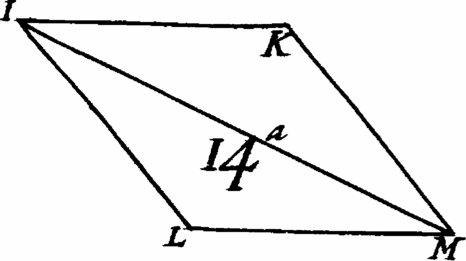
An impetus therefore has to be determined, i.e. aligned along a specific line, and again we can easily discern here a deep Cartesian influence (Damerow et al. Reference Damerow, Freudenthal, McLaughlin and Renn1992, 77). Fabri's conception of determinatio enables him to treat the concept of impetus as if it were a vector: “You will observe first of all,” says Fabri, “that this determination is nothing other than this very impetus adapted, or conjoined, to such a line” (Fabri Reference Fabri1646, 61).Footnote 62 Later (in theorems 136–142) Fabri develops a sort of a “vector analysis” to explain how various pairs of “determined” impetuses at varying angles to each other are to be added and to estimate the resultant traversed space. For instance (see fig. 1), “if the lines of the double impetus form a more acute angle, the traversed space will be longer; let there be lines IK and IL, while the mobile is situated in I; no doubt the new line will be IM” (ibid., 67).Footnote 63
“Vector analysis” of impetuses.
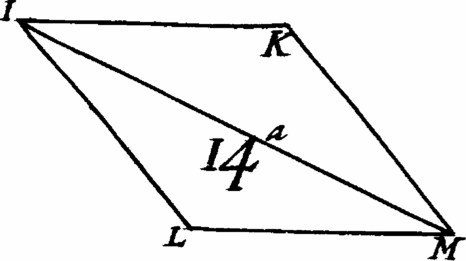
Fabri's view, allowing only linear (i.e. “determined”) impetus, leads him to outline quite an advanced approach to circular motion, including the important recognition that an object tied to a turning rope which then breaks will proceed along a straight line: “Circular motion in sublunary things emerges from an impeded straight line; because the impetus is determined only along a straight line: hence any circular motion exists merely by accident, such as the end of a pendulum or a sling which is restrained; if it is released, a straight motion follows” (ibid., “Synopsis amplior,” “de motu circulari,” par. 1).Footnote 64 This important idea, which in Galileo's thought – and even more so, in Gassendi's – is muddled with “circular inertia” (Palmerino Reference Palmerino, Palmerino and Thijssen2004, 151–152), does exist – explicitly and univocally – in Fabri's analysis (and also in Descartes'), and it is indeed a far cry from Buridan's claim that impetus can be directed “either up or down, or laterally, or circularly.”
In the seventh book of the Tractatus, dealing with circular motions (“De motu circulari”), Fabri emphasizes that “at least in sublunar things,” circular motion would not exist unless “a determination of impetus along a straight line was impeded,” thus rejecting Aristotle's basic conviction that “circular motion is primary to all others, because it is simpler and more complete” (Gabbey Reference Gabbey, Garber and Ayers1998, 661). Hence, continues Fabri, “a circular motion arises from a straight one impeded in single points,” and therefore in each instant it is “determined along a new line.” Fabri concludes that “there are as many determinations corresponding to single instants as there are tangents in a circle” and that at each point the circular motion is “determined towards a new tangent” (Fabri Reference Fabri1646, 273–274).Footnote 65 As for non-circular curved motion, Fabri identifies it with a “mix” between straight and circular motions, and asserts that a curved line is nothing but a line composed of “almost infinite sides of a polygon” (ibid., 364, 154).Footnote 66 We may therefore ascribe to Fabri a sort of reduction of all motion to basic linear motions, a reduction which is physically justified by his assertion that in a given mobile several motions cannot exist at once, and that any “mixed motion” arises from the interaction between the impetuses within it, which as we saw are always “linear” (ibid., 185).Footnote 67
Fabri's concept of inherently linear impetus seems to be closely connected to his assertion – contrary to traditional Euclidean geometry – that lines are described by the “fluxus or motion of a point” (ibid., 35):Footnote 68 for according to Fabri, circles (or curves) are “created” by a line “impeded” along the tangents, i.e. they may be said to result from a point creating a line while directing itself along “momentary” tangents to the trajectory. Fabri indeed connects (though not very clearly, it must be admitted) between the notion of fluxus, which as stated above he regards as a sort of “process” by which local motion is created,Footnote 69 and the direction of motion: “a line of motion,” he says, “does not differ from motion itself in a continuous course, or a kind of sliding fluxus” (ibid., 61).Footnote 70 E. A. Fellman, who has thoroughly investigated Fabri's mathematical thought – in particular, his method of infinitesimals appearing in his Synopsis geometrica (1669) – asserts that Fabri considered his “method's novel feature to be the ‘fluent generation’ of geometrical objects, the fluxus representing time.” Fellman even ventures to conclude that “this rather dynamical concept of the generation of the continuum by the fluxus of an indivisible leads qualitatively to the calculus of fluxions of the Newtonian type” (Fellman Reference Fellmann, Harman and Shapiro2002, 97). Paul Mancosu emphasizes “the connection between the widespread use of motion in mathematics during the seventeenth century and the emergence and flourishing of the mechanistic viewpoint” and lists Fabri among the “mathematicians who had appealed to the concept of motion in their geometrical investigations” (Mancosu Reference Mancosu1996, 95). In any case, Fabri's notion of fluxus, as well as what seems to be (as Mancosu also implies) an important link between Fabri's mathematical and physical thought should be further studied and clarified.
It is important to stress though that Fabri limited this inherent “linearity” of motion to terrestrial, i.e. sublunary physics. We have just seen that in the beginning of “De motu circulari” Fabri remarks that he refers to sublunary motions “at least,” thus casting a doubt concerning heavenly motions; however, soon afterwards he explicitly rejects heavenly linear tendencies and sticks to traditional circular non-terrestrial motions (Fabri Reference Fabri1646, 273).Footnote 71
Implementation of linear inertia in the Tractatus
It might be wondered whether Fabri's notion of linear inertia is just a theoretical concept, relevant only to counterfactual conditions that could be achieved only by God's direct intervention, or whether he also takes it into consideration in everyday physics. I shall briefly explore here only two places (there are more in the Tractatus)Footnote 72 in which Fabri does indeed convey his belief in linear conservation of motion, though his subsequent treatment would not necessarily be what the modern reader might expect. These two areas are exactly the subjects in which the idea of impetus had been introduced in the first place: projectile motion and falling bodies.
I. Projectile motion: Fabri calls the motion of a body thrown horizontallyFootnote 73 a “mixed motion” (motus mixtus), composed of a natural acceleration downwards (free fall) and a horizontal violent motion. The natural impetus of the body participates, or concurs (concurrit), explains Fabri, in that motion, otherwise it would move along a straight line (ibid., 162). Fabri is more explicit in the next theorem:
Theorem 38: if natural impetus were not concurring with this [mixed] motion, the projectile would obviously move along a horizontal straight line with constant motion. (ibid.)Footnote 74
The reader should not be surprised to find here explicitly what I have defined as “limited inertia,” stated as an “obvious” fact. However, one of Drake's arguments against ascribing the notion of inertia to Fabri (and Buridan) is significant, being relevant to Fabri's theory of projectiles. Drake explains that according to the Jesuit “contrary inclinations fight within the same body, and since the inclination downward due to heaviness is never diminished, it eventually wins out over an initial impressed impetus, however strong” (Drake Reference Drake1974, 63). Drake's claim that according to Fabri natural motion downwards “eventually wins out” over the horizontal violent motion is misleading, because it implies a vertical fall in the end of the trajectory (it will soon be shown that Fabri's solution includes no such vertical motion). However, Drake's assertion that in Fabri's analysis “contrary inclinations” always “fight” with each other is accurate and important: it correctly implies Fabri's rejection of superposition between orthogonal inclinations. Fabri indeed objects to “Galileo's followers” who think (correctly, according to classical physics) that the violent impetus in this mixed motion is destroyed only by the medium's resistance, and proposes instead a mechanism by which violent impetus is destroyed by any natural impetus which does not have the same direction (Fabri Reference Fabri1646, 160).Footnote 75
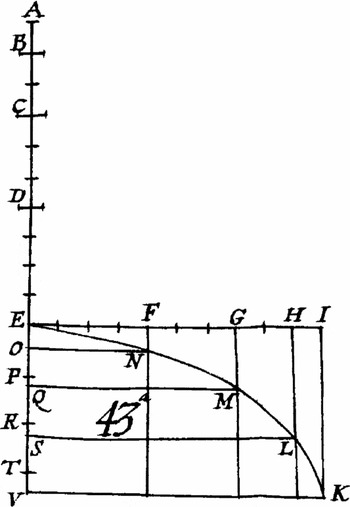
As Lukens explains, Fabri “knows that the combination of uniform horizontal motion and vertical accelerated motion produces a parabolic path, and he credits Galileo with the discovery. But he rejects this analysis as not applicable to real motions because it does not fit his hypothesis that violent motion is slower at the end” (Lukens Reference Lukens1979, 231–232). Fabri indeed formulates an “hypothesis” – a term which according to Fabri denotes not what we would call a “hypothetic conjecture,” but a qualitative statement, based on sense data, whose veracity is not to be doubted (see Dear Reference Dear1995, 139, and also Lukens Reference Lukens1979, 116–118) – which claims that a horizontal projectile loses its “hitting force” as the trajectory advances.Footnote 76 Fabri claims that this assumption, hypothesis 3 in book 4 of the Tractatus, is evident from experiments, and considering the substantial deceleration a projectile (especially a fast one) experiences because of air resistance, this assertion is not all that unreasonable (though of course it is ultimately incorrect, since Fabri assumes here motion in void, and fails to realize the considerable effect of air resistance in such cases). In any case, this “hypothesis” – apparently popular among contemporary theorists of projectile motion – surely also represents a remnant of Aristotle's general dictum that violent motion must gradually die out.Footnote 77 Hypothesis 3 leads Fabri to concoct a mechanism by which the motion downwards (and therefore the overall motion) is “slowed down” by the end of the trajectory: Fabri claims that while the violent impetus is continuously destroyed by the natural impetus (Fabri Reference Fabri1646, 160),Footnote 78 the natural impetus itself – i.e. the acceleration downwards – behaves not like perpendicular fall, but rather like the acceleration on an inclined plane (ibid., 161).Footnote 79 Fabri uses this (also totally incorrect, needless to say) device to subsequently state that the violent impetus is “decelerated in a higher proportion than the one by which the natural [impetus] is accelerated,” and thus make sure that hypothesis 3 is not violated (ibid., 162).Footnote 80 Fabri's ultimate solution for the problem of a horizontal projectile, after rejecting the parabola (which is constructed, according to Galileo and Classical physics, by a superposition of a horizontal constant velocity and a continuous acceleration downwards) is a different curve (see fig. 2), constructed according to these two key premises:
1. The horizontal velocity continually decreases (HI < GH < FG < EF).
2. The acceleration downwards is not constant, but continually increases, though at a smaller rate than the decrease of the violent motion: it is very small close to the beginning (represented by the small distance addition PQ, corresponding to the relatively moderate slope of angle ENO) and only by the end of the motion does it reach its highest value (represented here by TV), i.e. the constant value it would have had if the fall had been vertical (ibid., 162–163).
Trajectory of a horizontal projectile.


Fabri's explanation of horizontal projectiles – only briefly outlined here – clearly manifests Aristotelian constraints on his physical thought. If Drake and Lukens had claimed that as a consequence we cannot ascribe to Fabri a classical notion of inertia, then they would have had a case. However, we have seen that this point has no bearing on Fabri's conception concerning an ideal world, devoid of gravity (and resistance), in which only the initial “pushing” force of the projectile's thrower is relevant; i.e. the idea I have defined as “limited inertia.”
Fabri's horizontal projection analysis, involving a totally continuous (though incorrect) curve, should be regarded – contrary to Drake's abovementioned claim – as an improvement on the general traditional opinion, which endorsed a linear component of the trajectory, either in the beginning of the motion or in its end (assuming that gravity totally “wins out” over the original violent impetus and moves the stone vertically down).Footnote 81 However, it must be admitted that Fabri's rejection of superposition represents a step back with respect to Galileo's theory, and indicates that Fabri's notion of inertia – being inherently unidimensional – is indeed far from “classical.”
II. Falling bodies: in order to understand Fabri's attitude concerning falling bodies, Drake's and Lukens' contention that Fabri's position here is close to Buridan's, or even somehow “implicit” in it, must be refuted. Here is the core of Buridan's theory of fall:
From these [reasons] it follows that one must imagine that a heavy body not only acquires motion unto itself from its principal mover, i.e., its gravity, but that it also acquires unto itself a certain impetus with that motion. This impetus has the power of moving the heavy body in conjunction with the permanent natural gravity. And because that impetus is acquired in common with motion, hence the swifter the motion is, the greater and stronger the impetus is. So, therefore, from the beginning the heavy body is moved by its natural gravity only; hence it is moved slowly. Afterwards it is moved by that same gravity and by the impetus acquired at the same time; consequently it moves more swiftly. And because the movement becomes swifter, therefore the impetus also becomes greater and stronger, and thus the heavy body is moved by its natural gravity and by that greater impetus simultaneously, and so it will again be moved faster; and thus it will always and continually be accelerated to the end. And just as the impetus is acquired in common with motion, so it is decreased or becomes deficient in common with the decrease and deficiency of the motion. (Clagett Reference Clagett1959, 560–561)Footnote 82
I believe that four crucial points (expressed or at least hinted in this paragraph) reveal the huge difference between these two thinkers, separated by three centuries: 1. Buridan's analysis, like his basic description of the concept of impetus (see pp. 5–6 above) involves an incoherent distinction between impetus and velocity which probably justifies Koyré's characterization of impetus as “muddled” and amounts to a circular explanation (an increased impetus entails an increased velocity, which in turn causes a “greater and stronger” impetus, etc.). Fabri is careful not to expose himself to a similar accusation: theorem 16 of book 2 (of the Tractatus) concludes that “natural motion downwards accelerates,” and seems to explicitly avoid such confusion. Fabri explains that the mere fact of natural acceleration is known to us as a “hypothesis,” i.e. by the senses (see p. 26 above), and thus it is merely “supposed quod sit,” while by explaining this phenomenon causally – i.e. using impetus – this hypothesis “can be converted into a theorem,” thus achieving a demonstration “of the reasoned fact” (propter quid; see note 8 above). The impetus simply increases, and because it is the cause of motion, so does the velocity. If we recall Aristotle's famous example in the Posterior Analytics, we might say that the fact of acceleration represents the statement “the planets do not twinkle,” and the increase of impetus represents the statement “the planets are near the earth”: if we rely on the first statement (known only by the senses) to prove the second one, we obtain only a demonstration “of the fact,” but if we rely instead on the second statement to prove the first we achieve a scientific causal explanation – a demonstration “of the reasoned fact.” Fabri remarks that “there is no ground for anyone to judge that I am committing here a circular argument, [as if] I proved above that the impetus increases because motion increases, but now I prove that motion increases because the impetus increases.” He repeats now the essence of his theory, explained by him previously: the impetus accumulates not because of the increased velocity but rather because of a “necessary cause” continually acting,Footnote 83 while natural acceleration is known only by the senses (and thus – like the statement “the planets do not twinkle” – cannot serve as a basis for a scientific causal demonstration). The important point is that impetus is the real cause of motion, never the other way around. Fabri is entitled then to conclude that “therefore no [vicious] cycle is committed” (Fabri Reference Fabri1646, 84).Footnote 84
2. One of Galileo's most important contributions to the study of motion in general, and free fall in particular, was the clear cut (and un-Aristotelian) recognition that frictionless motion (like falling in the void) is some kind of an “ideal” motion, while actual motion is only an approximation of it. Such a view might be described as somehow “implicit” among those who allowed for motion in a void, but it is alien to those (like Buridan and his fellow “Terminists,” the early protagonists of the idea of impetus) who could not acknowledge the possibility of motion devoid of all resistance. Fabri has explicitly adopted Galileo's view, and in theorem 71 of book 2 – after introducing his proposed “discrete” law of fall (which claims that the distances passed in consecutive equal units of time behave like the “natural number” series, i.e. like 1,2,3,4 . . .) – explains that “if the heavy body were to descend in a vacuum, the above-mentioned proportions would be preserved very accurately; i.e. because there is no impediment; but indeed if any impediment intervenes, no doubt they are not preserved accurately” (ibid., 115).Footnote 85
In this context, Buridan's “muddled” line of thought can also be discerned in his claim that the reason “why I project a stone farther than a feather” is “that the reception of all forms and natural dispositions is in matter and by reason of matter. Hence by the amount more there is of matter, by that amount can the body receive more of that impetus and more intensely” (Clagett Reference Clagett1959, 535). Fabri has explicitly objected to this view (which again contradicts the modern conception of “ideal” resistance-free motion) by rejecting, in the first book of the Tractatus, “the argument of those who say that a body is capable of having a higher velocity because it has more parts of matter under the same quantity [i.e. a higher density]” and claiming that a large weight does not assist motion impressed from outside but rather inhibits it (Fabri Reference Fabri1646, 40),Footnote 86 thus revealing the understanding that a feather reaches less far due to much greater air resistance and not because of its small mass. Fabri also remarks that a “bigger bulk” is “more suitable to impress motion, and less suitable to receive” it, while the opposite is true for a “smaller bulk” (Fabri Reference Fabri1646, 34).Footnote 87
3. A coherent mathematical discrete theory of fall, like Fabri's – which amounts to an endless series of interrupted inertial motions, each one slightly faster than the preceding one – can be developed only under the assumption that between two “impetus additions” the impetus is conserved (i.e. when the motion is “ideal” and devoid of all friction). In Buridan's analysis there is of course no such assumption (nor can there be, as I have explained), and therefore – to my mind – a mathematical discrete analysis cannot be in any way “implicit” in his view. Fabri is well aware of the importance of this “inertial assumption” to his discrete theory, and in theorem 13 of book 2 he says that “the impetus produced in the second instant in a free medium is conserved in the third, and [the one] produced in the third [instant] is conserved in the fourth, and so on . . . for I suppose a free medium; therefore it does not destroy the impetus . . . therefore there is nothing that exacts the destruction of this impetus; therefore it is not destroyed” (ibid., 82).Footnote 88
A. G. Molland also objects to Drake's contention that Buridan's theory of free fall entails discontinuity of time. Molland asserts that Buridan “was firmly with Aristotle in asserting the continuity of time,” and concludes that Fabri's “discrete approach arose not from his being an impetus theorist but from his being of the Seventeenth century” (Molland Reference Molland1982, 48). I agree with Molland, and I suspect that Fabri's discrete analysis of free fall might have been inspired by Isaac Beeckman's theory, which in any case rejected the concept of impetus altogether.Footnote 89 Carla Rita Palmerino further strengthens Molland's interpretation by pointing to the important fact that “in Fabri's account, the discreetness of acceleration is presented not as a consequence of the nature of the impetus, but rather as a consequence of the nature of time” (Palmerino Reference Palmerino and Mordechai2003, 194; Palmerino's emphasis).Footnote 90 Thus the attempt to link Fabri's discrete approach with Buridan's old theory of impetus seems indeed dubious.
4. A necessary condition for developing a correct theory of fall is of course recognizing the linear proportion between velocity and time (v ∝ t), instead of velocity and space (v ∝ s). Fabri adopted the necessary proportion v ∝ t, and even reproached Galileo for failing to prove it before assuming it, while in his own discrete impetus theory this proportion is an immediate consequence (Fabri Reference Fabri1646, 85).Footnote 91 Perhaps this is the place to mention that although Fabri develops a discrete theory of free fall, based on the proportion v ∝ t as well as on the assumption that within an instant the velocity remains constant (therefore it would be more accurate to describe Fabri's proportion as vi ∝ ti, while i denotes the ordinal number of any instant), he takes great pains to show that if the instants taken are small enough then his discrete treatment and Galileo's continuous analysis become identical: ultimately Fabri urges his own students to use Galileo's mathematically convenient ratios rather than his own (mathematically cumbersome) theory.Footnote 92 Buridan, as is well known, endorses both v ∝ t and v ∝ s (Clagett Reference Clagett1959, 563). His failure to appreciate the difference between these proportions is not surprising, in light of his general “qualitative” (or “muddled”) conception of impetus and velocity, as opposed to Fabri's rather rigorous mathematical analysis.
Conclusion
At the beginning of this paper I referred to the “dire difficulties” faced by Aristotle's philosophy of motion in light of the (full-fledged) concept of inertia. But in the case of Fabri and his notion of inertia, apparently the “difficulty” is after all not so dire.
Notwithstanding his “advanced” ideas concerning the counterfactual status of completely unhindered motion, Fabri's analysis regarding the actual world (in which the medium does offer an impediment, and in which violent impetus is almost alwaysFootnote 93 diminished) includes outdated teleological arguments and the assertion of an “uninertial” hypothesis taken from sense data.Footnote 94 Hence Fabri's physical outlook might seem, at first sight, as still “scholastic.” Fabri – while accepting the principle of limited inertia as a necessary “limit case” – did not consider it as a law of nature:Footnote 95 his methodological and conceptual starting point is understandably Aristotelian, or scholastic, and Fabri is apparently trying to preserve it while assimilating the new content described in this paper.
However, at a deeper level this new (Galilean and Cartesian) content seems to have transformed the theoretical structure according to which Fabri had been raised and educated. We have seen that Fabri's adoption of (limited) exclusively linear inertia is closely connected to other important and revolutionary notions, like the reduction of (terrestrial) curvilinear motion to underlying linear “determinations” and the abandonment of “absolute weight” as a factor determining free fall (like inertial motion, it is one of the “paradoxes” enumerated by Aristotle to deny the possibility of motion through a void). If we add to all these notions Fabri's total abolishment of “absolute levity,” the blatant attacks against Aristotle concerning these key issues (especially in the context of motion in the void), the obvious influence of his advanced mathematical ideas on his “mechanistic” physical way of thought, and the overall differences between Fabri's views and Buridan's – I think we can no longer define Fabri's theory of motion as “Aristotelian,” or even “scholastic”; it seems to me evident that Fabri belongs to the “preclassical” category no less than Galileo, Descartes and the rest of the leading scientists of the early seventeenth century. Lukens, who entitled his dissertation on Fabri “An Aristotelian Response to Galileo,” might as well have chosen a title like “A Galilean response to Aristotle,” or “A Cartesian response to Buridan.” Perhaps therefore Fabri's inertial conception should be seen as some kind of “Trojan Horse” – allowing for some (probably false) coexistence with the old scholastic framework, while nevertheless loosening the philosophical fabric of the old system and thus maybe “predicting,” or facilitating, its demise.
Edward Grant, referring to Fabri's contemporary, the English Jesuit Thomas Compton-Carleton who “proclaimed the existence of an infinite, three dimensional space, which he identified with God's infinite immensity,” claims that “by linking God's infinite immensity with infinite space, Compton-Carleton preceded by at least 15 years the quite similar conception of Henry More and Isaac Newton” (Grant Reference Grant and Mordechai2003, 146). Fabri – who slightly preceded even Compton-Carleton – seems to be the first to publish a theory of motion that combines such a belief in an infinite void (though existing outside the universe; see p. 13 above) and exclusively linear inertia (which would necessarily occur in such a void).Footnote 96
It is important then to reevaluate Fabri's place within the history of physics, and especially to reject once and for all not only the contention that he “belongs” to the Middle Ages, but also the general assessment concerning the Jesuits according to which “even after 1640 they constantly repeated the traditional analyses of motion: the majority accepted impetus, but they considered it as a self-consuming entity which cannot bring forth motion of indefinite or infinite duration, even in a vacuum in the total absence of external forces” (Baldini Reference Baldini and Mahlmann-Bauer2004, 106).Footnote 97 However, in light of Fabri's theory of horizontal projectiles (especially the rejection of superposition), his overall “inertial thinking” must be deemed inferior to that of Galileo and Descartes. Fabri excelled in creating a fascinating synthesis between old and new physics – exemplified, e.g., in his insistence on impetus as a formal cause, rather then an efficient cause, of motion – and thus was able to transmit Galilean and Cartesian ideas to his Jesuit students. But incorporating linear conservation of motion – certainly not his own discovery – has not led him, as far as I can tell, to any original insight essential to the development of classical mechanics. As Julian Barbour has remarked, “the really important thing about the discovery of the law of inertia was not so much the finding of the law itself as the demonstration of what could be done with it” (Barbour Reference Barbour1989, 433; Barbour's emphasis).
I would like to make one last point: I still have not directly referred to Lukens' assertion that in Fabri's theory, impetus “cannot endure ‘on its own’,” and therefore inertia is not possible (see p. 3 above). As we have seen, notwithstanding Lukens' argument Fabri did assume the conservation of impetus (and motion) in the absence of external forces. He has even made it perfectly clear that he attributes the cause of this conservation to none other than that factor which originally allowed for motion in the void: namely, God.Footnote 98 Thus we see once more the affinity between the views of the two Frenchmen, at least from an “inertial” point of view.Footnote 99 Fabri did not stress this point (it is not systematically analyzed, only “casually” raised) probably because he did not wish to emphasize the proximity between his attitude and Descartes' on the issue of the conservation of linear inertia. But perhaps such proximity could not have remained unnoticed: as late as 1706 – 19 years after Newton's Principia, 18 years after Fabri's death, and 56 years after Descartes' death – we can discern, among the twenty-four “prohibited propositions” formulated by the Fifteenth General Congregation of the Jesuit order, Fabri's and Descartes' (respectively) justifications of inertia, most appropriately lying side by side:
6. Modes or accidents, once produced in a subject, have no further need of any cause whatever to conserve them by positive action; rather, they should last until they have been destroyed by the positive action of some external force.Footnote 100
7. To believe that matter has lost some of the quantity of motion first impressed upon it by God, would be necessarily to suppose a changeable and inconstant God. (Healy Reference Healy1956, 29, 313)Footnote 101