


1. INTRODUCTION
Hohlraum plays a key role in indirect drive inertial fusion (Haan et al., Reference Haan, Pollaine, Lindl, Suter, Berger, Powers, Alley, Amendt, Futterman, Levedahl, Rosen, Rowley, Sacks, Shestakov, Strobel, Tabak, Weber and Zimmerman1995, Reference Haan, Lindl, Callahan, Clark, Salmonson, Hammel, Atherton, Cook, Edwards, Glenzer, Hamza, Hatchett, Herrmann, Hinkel, Ho, Huang, Jones, Kline, Kyrala, Landen, Macgowan, Marinak, Meyerhofer, Milovich, Moreno, Moses, Munro, Nikroo, Olson, Peterson, Pollaine, Ralph, Robey, Spears, Springer, Thomas, Town, Vesey, Weber, Wilkens and Wilson2011; Atzeni & Meyer-ter-Vehn, Reference Atzeni and Meyer-ter-Vehn2004; Lindl et al., Reference Lindl, Amendt, Berger, Glendinning, Glenzer, Haan, Kauffman, Landen and Suter2004), which converts incident laser beam into X-rays to uniformly drive a capsule placed inside the hohlraum to ignite. Because many factors that greatly influence the ignition are strongly related to the hohlraum geometry, such as the coupling efficiency from hohlraum to capsule, the X-ray emission, capsule radiation uniformity, and laser plasma interactions, so the design of hohlraum is very important (Callahan, Reference Callahan, Amendt, Dewald, Haan, Hinkel, Izurni, Jones, Landen, Lindl, Pollaine, Suter, Tabak and Turner2006, Reference Callahan, Hinkel, Berger, Divol, Dixit, Edwards, Haan, Jones, Lindl, Meezan, Michel, Pollaine, Suter and Town2008; Li, Reference Li, Lan, Meng, He, Lai and Feng2010; Lan, Reference Lan, Gu, Ren, Li, Wu, Huo, Lai and He2010; Rosen, Reference Rosen, Scott, Hinkel, Williams, Callahan, Town, Divol, Michel, Kruer, Suter, London, Harte and Zimmerman2011). The traditional hohlraum is a cylinder (hereafter called “cylinraum”), now being used for the national ignition campaign (Haan et al., Reference Haan, Lindl, Callahan, Clark, Salmonson, Hammel, Atherton, Cook, Edwards, Glenzer, Hamza, Hatchett, Herrmann, Hinkel, Ho, Huang, Jones, Kline, Kyrala, Landen, Macgowan, Marinak, Meyerhofer, Milovich, Moreno, Moses, Munro, Nikroo, Olson, Peterson, Pollaine, Ralph, Robey, Spears, Springer, Thomas, Town, Vesey, Weber, Wilkens and Wilson2011). However, in order to have a more efficient hohlraum, researchers have also been making efforts in exploiting hohlraums with different shapes. Elliptical hohlraum (hereafter called “ellipraum”) was first proposed in 1991 (Caruso, Reference Caruso and Strangio1991), but until recent years, it began to arouse much interests worldwide. Up to now, there are many simulation design and experiments on rugby-like or ellipraums for the OMEGA and the LMJ laser facilities (Amendt, Reference Amendt, Cerjan, Hamza, Hinkel, Milovich and Robey2007, 2008; Vandenboomgaerde, Reference Vandenboomgaerde, Bastian, Casner, Galmiche, Jadaud, Laffite, Liberatore, Malinie and Philippe2007; Casner, Reference Casner, Galmiche, Huser, Jadaud, Liberatore and Vandenboomgaerde2009; Robey, Reference Robey, Amendt, Park, Town, Milovich, Döppner, Hinkel, Wallace, Sorce, Strozzi, Phillippe, Casner, Caillaud, Landoas, Liberatore, Monteil, Séguin, Rosenberg, Li, Petrasso, Glebov, Stoeckl, Nikroo and Giraldez2010; Philippe, Reference Philippe, Casner, Caillaud, Landoas, Monteil, Liberatore, Park, Amendt, Robey and Sorce2010). These shapes of hohlraum have the possible advantages over cylinraum in enhancing X-ray drive and reducing mode coupling for symmetry control, and this has already been demonstrated (Vandenboomgaerde, Reference Vandenboomgaerde, Bastian, Casner, Galmiche, Jadaud, Laffite, Liberatore, Malinie and Philippe2007; Robey, Reference Robey, Amendt, Park, Town, Milovich, Döppner, Hinkel, Wallace, Sorce, Strozzi, Phillippe, Casner, Caillaud, Landoas, Liberatore, Monteil, Séguin, Rosenberg, Li, Petrasso, Glebov, Stoeckl, Nikroo and Giraldez2010). Presently, the main strategy to design a rugby-like or ellipraum was given by Amendt et al. (Reference Amendt, Cerjan, Hinkel, Milovich, Park and Robey2008).
In this work, we will present our initial study and design on ignition ellipraum by using the extended plasma-filling model with criterions of plasma-filling and laser deposition (Lan, Reference Lan, Gu, Ren, Li, Wu, Huo, Lai and He2010), and give an initial design of ellipraum size and pertinent laser power to produce a typical 300 eV ignition radiation (Callahan, Reference Callahan, Hinkel, Berger, Divol, Dixit, Edwards, Haan, Jones, Lindl, Meezan, Michel, Pollaine, Suter and Town2008). In addition, we will compare the mode coupling efficiencies in ellipraum and cylinraum. For a hohlraum with given shape, there are three ratios to describe the hohlraum geometry, which are the ratio of hohraum semi length-to-radius, the radius ratio of hohlraum-to-capsule, and the radius ratio of laser entrance hole (LEH) to capsule, respectively, denoted as ξH, ξC, and ξL hereafter. Usually, the capsule radius is given by the implosion design and the LEH sizes is decided by the laser beam conditions, so only ξH and ξC are left to design. Here, we want to make clear that there are two points in our design strategy different from that of Amendt et al. (Reference Amendt, Cerjan, Hinkel, Milovich, Park and Robey2008). First, Amendt et al. (Reference Amendt, Cerjan, Hinkel, Milovich, Park and Robey2008) keep the same ξC of rugby-like hohlraum as that of the compared cylinraum, then used the calculus of variations to assess the minimal surface area for a given enclosed hohlraum volume in order to decide the detail hohlraum shape; while in our design, we directly used ellipraum, which schematic is show in Figure 1. Second, Amendt et al. (Reference Amendt, Cerjan, Hinkel, Milovich, Park and Robey2008) adjust ξH (and laser cone pointings) of the rugby-like hohlraum with chosen shape to achieve optimal implosion core symmetry; while in our design, we obtain ξC from the extended plasma-filling model with criterions to meet the requirements of plasma-filling and laser deposition at different ξH, and ξH will be decided by a two-dimensional (2D) simulation. Because the optimal ξH is relevant to the tolerable LEH size and the laser beam arrangement, so a detail 2D simulation is needed to optimize the ellipraum size together with the laser pointing position, and the relative beam powers after balancing all factors. We will present our 2D simulation in a forthcoming paper, and will only focus on the initial design in this work. As a result, ξC of ellipraum from our design is higher than that of the rugby-like hohlraum designed by Amendt et al. (Reference Amendt, Cerjan, Hinkel, Milovich, Park and Robey2008), and also the coupling from hohlraum to capsule in our ellipraum is lower than their rugby. Notice that the intents are different in the two designs. Amendt et al. (Reference Amendt, Cerjan, Hinkel, Milovich, Park and Robey2008) intend to drive high yield with low-convergence capsules, so they design a rugby-like hohlraum with a smaller volume and a smaller ξC to get a higher coupling efficiency from hohlraum to capsule than our design, and they did successfully obtain a very high X-ray enhancement and very high neutron yield with the rugby-like hohlraum compared with the cylinraum, while they also observed a significantly high simulated Brillouin scattering backscatter that affect the implosion symmetry (Robey, Reference Robey, Amendt, Park, Town, Milovich, Döppner, Hinkel, Wallace, Sorce, Strozzi, Phillippe, Casner, Caillaud, Landoas, Liberatore, Monteil, Séguin, Rosenberg, Li, Petrasso, Glebov, Stoeckl, Nikroo and Giraldez2010). Our intent in this work is to design an ellipraum for ignition. Hence, in addition to the enhancement of X-ray radiation, the plasma-filling is an important issue to concern in our work.
(Color online) Geometry for ellipraum and capsule. Here, O is the center, P is point on capsule and P∗ is a point on ellipraum surface.

This work is arranged as follows. In Section 2, we will apply the extended plasma-filling mode in ellipraum and give criterions of plasma-filling and laser deposition. In Section 3, we will present our method to give an initial design of hohlraum size and pertinent laser power to produce a required radiation inside the hohlraum, and then give an initial design of ellipraum to produce a 300 eV ignition radiation. In Section 4, we will compare the mode coupling efficiencies in ellipraum with that in cylinraum. Finally, we summarize in Section 5.
2. EXTENDED PLAMAS-FILLING MODEL FOR ELLIPRAUM
In our previous work (Lan et al., Reference Lan, Gu, Ren, Li, Wu, Huo, Lai and He2010), we extended the plasma-filling model (Dewald et al., Reference Dewald, Suter, Landen, Holder, Schein, Lee, Campbell, Weber, Pellinen, Schneider, Celeste, McDonald, Foster, Niemann, Mackinnon, Glenzer, Young, Haynam, Shaw, Turner, Froula, Kauffman, Thomas, Atherton, Bonanno, Dixit, Eder, Holtmeier, Kalantar, Koniges, Macgowan, Manes, Munro, Murray, Parham, Piston, Van Wonterghem, Wallace, Wegner, Whitman, Hammel and Moses2005; McDonald et al., Reference McDonald, Suter, Landen, Foster, Celeste, Holder, Dewald, Schneider, Hinkel, Kauffman, Atherton, Bonanno, Dixit, Eder, Haynam, Kalantar, Koniges, Lee, Macgowan, Manes, Munro, Murray, Shaw, Stevenson, Parham, Van Wonterghem, Wallace, Wegner, Whitman, Young, Hammel and Moses2006; Schneider et al., Reference Schneider, Hinkel, Landen, Froula, Heeter, Langdon, May, McDonald, Ross, Singh, Suter, Widmann and Young2006) to a case when a cylinraum is driven by a shaped laser pulse with high contrast (>1) between different steps, which is a typical drive for ignition goal. In the extended model, we assume that the differences of radiation temperature T r between steps are large and calculate the ablated mass of the wall in each step independently. The ablation in each step increases the wall albedo and contributes to the sum of the ablated mass, and therefore eventually influences the plasma-filling time in hohlraum. In this part, we apply this extended plasma-filling model to an ellipraum.
For an ellipraum considered in our study, it rotates along its major axis and the LEH are opened at both ends of ellipraum along the major axis, in order to keep the radiation uniformity of capsule inside. The schematic of an ellipraum is shown in Figure 1. We use a to denote the major axis of an ellipraum, b is the minor axis, R L is the radius of LEH, and γL is the angle of LEH to the rotating axis z. Defining 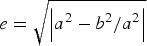 and
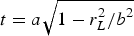 , then we have
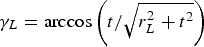 . Thus, the wall area A W and volume V H can be, respectively, expressed as:


We use A L to denote the area of LEH and A C to denote the area of capsule. Under the jth step of a laser pulse, the geometrical factor f j of hohlraum with a capsule inside is (Sigel et al., Reference Sigel, Pakula, Sakabe and Tsakiris1988):

Here, αC,j is the albedo of capsule and  is an effective albedo of the wall under the jth step. Thus, the hohlraum power balance (Lindl, 1995) under the jth step pulse

can be written as:

Here, P j is laser power at the jth step, and σ is the Stefan-Boltzmann constant. Usually, the wall albedo at time τ under a radiation temperature of T r can be expressed as (Lindl, 1995):

where H, γ, and β are fitting parameters. Therefore, we can express T r,j as (Lindl, 1995):

Here, the coefficients D, E, and F can be obtained by taking Eq. (5) into Eq. (4), and they are related to the laser power at every step.
Summing the radiation ablated mass under all laser pulse steps; we get the material density inside hohlraum (Schneider et al., Reference Schneider, Hinkel, Landen, Froula, Heeter, Langdon, May, McDonald, Ross, Singh, Suter, Widmann and Young2006):

Here, m j is the area mass ablated in the jth step of radiation, A abl is an effective ablated wall area. Considering the hydrodynamic losses and coronal radiative losses from LEH, we take A abl = A W − A LEH, here A LEH is the area of LEH. Then, the ion density n i is:

Here, n i is in units of the critical density, A is the atomic number of wall material, λL (in μm) is the wavelength of driven laser, A abl is in cm2, V H is in cm3, and m j is in g/cm2.
Furthermore, as in the plasma-filling model (Schneider, 2006), considering the power balance of the laser hot channel and the pressure balance between the laser channel and surrounding plasmas, we can finally obtain the average electron density n e in laser hot channel at filling time (Lan et al., Reference Lan, Gu, Ren, Li, Wu, Huo, Lai and He2010).
Because n e depends on laser pulse, wall material, and hohlraum size, so the plasma-filling model can be used in the initial design of a hohlraum target. More than that, the plasma-filling model can be actually applied to the initial design of an ignition hohlraum, although the latter usually uses low-Z gases fill to suppress hohlraum high-Z plasma expansion, while the former normally refers to the vacuum hohlraums filled with high-Z plasmas due to laser heating. The reason is that, from our 2D simulations, the low-Z gases fill does play an important role in suppressing hohlraum high-Z plasma expansion and helping to improve the radiation uniformity on capsule during the pre-pulses of driving laser, but its role can be almost neglected when very hot and massive hohlraum high-Z plasmas is ablated during the main pulse. In other words, the hohlraum filling during the main pulse of laser heating is also mainly caused by the high-Z wall plasmas for an ignition target. Therefore, an initial design of ignition hohlraum can be obtained from the plasma-filling model.
Certainly, criterion is needed to design a suitable hohlraum for ignition besides the requirement on hohlraum geometrical factors from capsule radiation uniformity. As known (Schneider et al., Reference Schneider, Hinkel, Landen, Froula, Heeter, Langdon, May, McDonald, Ross, Singh, Suter, Widmann and Young2006), when the plasma filling becomes serious, the laser absorption region shifts far from the hohlraum wall and the hydrodynamic loss and the thin coronal radiative loss from LEH increase rapidly. Usually, n e = 0.1 is used as a threshold that prevents the laser from propagating into the hohlraum due to absorption. On the other hand, the laser is required to deposit near the wall surface for an ignition target in order to get X-ray emission near hohlraum wall. Therefore, we define two semi-empirical criterions for ignition hohlraum. One criterion is n e = 0.1, and another one is n IB= 1. Here, n IB can be defined either as  or
 , in which λ IB is the inverse bremsstrahlung absorption length (Dawson et al., Reference Dawson, Kaw and Green1969) and δ is an effective incident angle of laser to hohlraum axis. According to our experience, we usually take δ = 50° for ignition design. Under different criterion, it may give a different size of hohlraum. We choose the largest hohlraum as our initial design after considering all the criterions. Hereafter, the extended plasma-filling model with criterions is shortened as EPFC.
3. INITIAL DESIGN OF ELLIPRAUM UNDER 300 EV IGNITION RADIATION
The above EPFC, together with one-dimensional (1D) simulation, can be used to give an initial design of hohlraum size and pertinent laser power to produce a required radiation inside the hohlraum. In this part, we first present our initial design method, and then use it to design an ellipraum and pertinent laser power to produce a 300 eV radiation pulse for a given capsule.
As discussed in Section 1, R C is given by implosion design, ξL is usually decided by the laser beam conditions, and ξH will be chosen by 2D simulation after taking the laser beam conditions into consideration. Hence, what we need to give from the initial design is ξC at different ξH. In addition, we need some iteration in the initial design so as to get P j, the laser power at the jth step. Our initial design method has five steps:
(1) As the first step, we have to assume a primary value of ξC at a given ξH, such as taking the values from traditional cylinraum in which the radiation uniformity has already been taken into consideration. Because R C is given, we therefore have the primary values of a, b, R L.
(2) Then we have the time-dependent wall albedo and capsule albedo under the required radiation pulse from 1D simulation.
(3) After that, we obtain the primary profile of laser power by putting the albedo of wall, the albedo of capsule, and the primary ellipraum size into the hohlraum power balance. Thus, all coefficients needed in Eqs. (5) and (6) can be obtained.
(4) Furthermore, we obtain the first design of ellipraum size by using EPFC.
(5) If the first size is smaller than the primary size, then we take the primary size and the primary laser power as the initial design result. Otherwise, we modify the laser power profile by putting the first size into the power balance and recalculate all coefficients, and then we obtain the second size from EPFC. We iterate this process until the profile of laser power is convergent. Finally, the convergent laser power and relevant hohlraum size are the initial design result.
As an example, now we give an initial design of ellipraum and pertinent laser power to produce the 300 eV radiation pulse in the 2010 ignition target design on the NIF (Callahan et al., Reference Callahan, Hinkel, Berger, Divol, Dixit, Edwards, Haan, Jones, Lindl, Meezan, Michel, Pollaine, Suter and Town2008). This radiation pulse has four steps, as shown in Figure 2. The coupling efficiency from laser to X-ray is taken as 75%. To compare with the design given in Callahan et al. (Reference Callahan, Hinkel, Berger, Divol, Dixit, Edwards, Haan, Jones, Lindl, Meezan, Michel, Pollaine, Suter and Town2008), we also take R c= 1 mm and ξL = 1.27. About ξH, usually it is taken from 1.7 to 1.81 for inertial fusion study (Lindl, 1995; Cavailler, Reference Cavailler2005; Callahan, Reference Callahan, Hinkel, Berger, Divol, Dixit, Edwards, Haan, Jones, Lindl, Meezan, Michel, Pollaine, Suter and Town2008; Haan, 2011). Here, we take ξH = a/b as 1.4, 1.6, 1.8, and 2 for ellipraum. In addition, we also consider one model for cylinraum of ξH = 0.5L/R = 1.81, same as in Collahan (2008), just for comparison.
(Color online) Albedo (blue line) of U wall from RDMG code under 300 eV radiation pulse (black line) given in Collahan (2008).

First, we calculate the albedo of U under the 300 eV radiation pulse by using our 1D multi-groups radiation transfer code, radiation hydrodynamic code of multi-groups (RDMG) (Feng et al., Reference Feng, Lai and Xu1999), as shown in Figure 2. Then, following the initial design method given above, we finally obtain the contour lines of T r = 300 eV, n e = 0.1, and n IB = 1 in the plane of laser energy E L and hohlraum semi-length at a given ξH for ellipraum or cylinraum. The contour line of T r = 300 eV may have different intersections with contour lines of n e = 0.1 and n IB = 1, resulting in two sizes of hohlraum and two laser energies. We take the larger size with higher laser energy as our initial design. As shown in Figure 3, are initial design results for the five kinds of hohlraums.
(Color online) Initial design of laser energy and hohlraum size to produce a 300 eV ignition radiation in ellipraums of ξH=1.4 (violet), 1.6 (red), 1.8 (blue), and 2.0 (green) and in a cylinraum of ξH = 1.81 (black).

For cylinraum, our initial design gives a result of 9.1 mm length with 0.93 MJ laser energy, which is close to the design given in Callahan et al. (Reference Callahan, Hinkel, Berger, Divol, Dixit, Edwards, Haan, Jones, Lindl, Meezan, Michel, Pollaine, Suter and Town2008).
For ellipraum, the intersections give: (1) a = 4 mm and E L = 0.8 MJ at ξH = 1.4; (2) a = 4.48 mm and E L = 0.83 MJ at ξH = 1.6; (3) a = 4.95 mm and E L = 0.85 MJ at ξH = 1.8; and (4) a = 5.4 mm and E L = 0.88 MJ at a/b = 2. Notice that the laser energy required for the four ellipraums is obviously smaller as compared with the cylinraum. From a, ξH, and R c, we can obtain ξC: (1) ξC = 2.86 at ξH = 1.4; (2) ξC = 2.8 at ξH = 1.6; (3) ξC = 2.75 at ξH = 1.8, and (4) ξC = 2.7 at ξH = 2. As a result, the initial design gives a lower E L and a larger ξC at a shorter ξH, which certainly benefits to save laser energy and improve capsule radiation uniformity.
From Eq. (7), the filling density inside hohlraum is related to the ratio of wall area to hohlraum volume. Table 1 lists the area and volume ratios of ellipraum-to-cylinraum for above models, which helps us to understand the advantage of ellipraum in saving laser energy while meeting the plasma-filling requirement at the same time. From Table 1, both ellipraum volume and area are smaller as compared with the cylinraum, but the ellipraum area is much smaller. It is easy to understand when a sphere is associated. As a result, either  or
 are smaller than 1, but very near to 1 to meet the criterions. They do not exactly equal to 1 because the coefficients in Eq. (6) are also related to the wall area.
Volume and area ratios of ellipraum-to-cylinraum. Here, the compared cylinraum is at ξH = 1.81 and ξC = 2.54. The values of ξH and ξC given in the table are for ellipraum. Here, the subcripts “ellip” and “cylin” refer respectively to ellipraum and cylinraum. In addition, A abl is also listed for comparison.

In Figure 4, we give the pertinent laser power to produce the 300 eV radiation pulse in the ellipraum of a/b = 1.6 and b/R c = 2.8. The result for the cylinraum is also presented for comparison. As shown, the required peak power is 300 TW for the ellipraum, which is about 10% lower than what required for the cylinraum.
(Color online) Laser powers to produce the 300 eV ignition radiation in an ellipraum of ξH = 1.6 and in a cylinraum of ξH = 1.81.

4. THE COUPLING BETWEEN DIFFERENT MODES IN AN ELLIPRAUM
As we know, it is a key requirement in ignition research to control capsule implosion symmetry (Lindl, 2004; Haan, 2011). For Legendre asymmetry modes, P 2 and P 4 are main issues in hohlraums of ξC < 4. Normally, P 4 is controlled by laser ring separation and P 2 is controlled with the inner/outer cone ratio (Lindl, 2004). However, there is coupling between modes for capsule in non-spherical hohlraums (Suter, Reference Suter1985; Lindl, 2004), because different points on the capsule see different solid angles of the hohlraum wall and therefore have different smoothing factors. It means that P 2 and all higher even modes appear at the capsule even if only a pure P 2 is applied to the hohlraum. Nevertheless, the coupling between modes is relevant to hohlraum shape and it is somewhat easier to control in a hohlraum with weaker coupling. In this part, we compare the coupling between modes in an ellipraum with that in a cylinraum.
As in Caruso and Strangio (Reference Caruso and Strangio1991), we consider a capsule that is illuminated by the radiation emitted from an optically thin plasma layer at the ellipraum surface. The geometry of ellipraum and capsule is shown in Figure 1, and the geometry relevant for the definition of position between point P on capsule and point P∗ on ellipraum surface is shown in Figure 5. We use I(P∗) to denote the emitted power density from P∗, then the total power density flux F at P is:

Both ellipraum and radiation source distribution are cylindrical symmetry in our consideration. Then I(P *) can be represented in terms of Legendre polynomials P n with argument of cos γ, where γ is the angle of OP∗ with the symmetry axis, as in Figure 1:

On the other hand, the radiation on capsule can also be represented in terms of P n but with argument of cos θ0:

Here, we call a m (P n) as the coupling coefficient between the modes m and n when a pure P n (c n = 1) is applied to the hohlraum.
Geometry relevant for the definition of the position between point P on capsule and point P∗ on ellipraum surface. Here,  is in the direction of OP, both
 and
 are tangential directions, and
 is defined to point into paper.

In Figures 6 and 7, it gives a 4 (P 2) and a 2 (P 4) for cylinraum in the plane of ξH and ξC. In Figures 8 and 9, it gives a 4 (P 2) and a 2 (P 4) for ellipraum in the plane of ξH and ξC. Usually, the cylinraum designed for ignition study has ratio values of about ξH = 1.6–1.8 and ξC = 2.5. Here we choose the ellipraum of ξH = 1.6 and ξC = 2.8 for comparison. Then, as shown, a 4 (P 2) = −0.03 and a 2 (P 4) = −0.07 for the cylinraum, while a 4 (P 2) ≈ −0.015 and a 2 (P 4) ≈ −0.035 for the ellipraum. Hence, the mode coupling in the ellipraum is about half of that in the cylinraum. In fact, the mode coupling is weaker in a more sphere-like hohlraum, which benefits to control the different modes separately.
Contour lines of (P 4) on capsule when (P 2) is applied to cylinraum, in the plane of ξH and ξC.

Contour lines of (P 2) on capsule when (P 4) is applied to cylinraum, in the plane of ξH and ξC.

Contour lines of (P 4) on capsule when (P 2) is applied to ellipraum, in the plane of ξH and ξC.

Contour lines of (P 2) on capsule when (P 4) is applied to ellipraum, in the plane of ξH and ξC.

5. SUMMARY
We have applied EPFC to give an initial design on ignition elliptical hohlraum and pertinent laser pulse to generate a required radiation pulse. We have also compared the mode coupling between ellipraum and cylinraum. As a result, in an ellipraum with a smaller ξH, the value of ξC should be larger in order to satisfy the criterions of plasma-filling, meanwhile the required laser energy and peak power are lower and also the coupling between different modes is weaker. In addition, a large ξC has the benefit in capsule radiation uniformity. To produce a 300 eV radiation pulse inside hohlraum to ignite a capsule of 1 mm radius, an ellipraum of ξH = 1.6 and ξC = 2.8 is superior to a cylinraum of ξH = 1.81 and ξC = 2.54 in saving more than 10% laser energy and reducing 50% coupling between different modes, here the radius of laser entrance hole is taken as 1.27 mm.
However, the optimal ξH and ξC for ellipraum are also relevant to the tolerable R L and the laser beam arrangement. The transfer distance of laser beam inside the ellipraum of ξH = 1.6 and ξC = 2.8 is shorter than inside the cylinraum of ξH = 1.81 and ξC = 2.54 when laser incident angle is larger than 50°, but longer when the angle is smaller than 50°. Therefore, a detail 2D simulation is needed to determine the optimum ellipraum size, the pointing position and the relative beam powers after balancing all factors.
ACKNOWLEDGMENTS
The authors wish to acknowledge the beneficial discussions with Prof. Min Yu and Prof. Yongkun Ding.



