- GR
cheese made from grazing goats' raw milk
- GP
cheese made from grazing goats' pasteurized milk
- IR
cheese made from indoor goats' raw milk
- IP
cheese made from indoor goats' pasteurized milk
- Trolox
6-hydroxy-2, 5, 7, 8-tetramethylchroman-2-carboxylic acid
- tBHQ
Ter-butylhydroquinone
- DPPH+
(1, 1-diphenyl-2-picrylhydrazyl)
- ABTS+
ABTS [2, 2-azinobis-(3-ethylbenzothiazoline-6-sulphonic acid)]
Goats adapt well to environmental conditions in arid lands, being able to obtain an adequate diet, even when forage is scarce and they can feed over rough and otherwise inaccessible terrain. Mexican rangeland is dominated by different vegetation species, which usually contain metabolites with certain benefits for human health, including alkaloids, glycosides, fatty acids, terpenes, phenols, saponins, tannins, and flavonoids (Galina et al. Reference Galina, Osnaya, Cuchillo and Haenlein2007; Ruiz-Terán et al. Reference Ruiz-Terán, Medrano-Martínez and Navarro-Ocaña2008; Cuchillo et al. Reference Cuchillo, Puga, Galina and Pérez-Gil2009a). All pasture plants change their chemical and nutritive composition seasonally, which gives cheeses made from milk of grazing animals different nutritive properties and flavours during year round seasons, being a significant source of bioactive compounds (Sanz Sampelayo et al. Reference Sanz Sampelayo, Chilliard, Schmidely and Boza2007), metabolites that are thought to be an important part of both human and animal diets (Galina et al. Reference Galina, Osnaya, Cuchillo and Haenlein2007; Ruiz-Terán et al. Reference Ruiz-Terán, Medrano-Martínez and Navarro-Ocaña2008). Although many questions remain concerning milk functional compounds, it is well known that some compounds found in foods can diminish DNA changes that lead to the reduction of lipid and protein damage, mainly caused by the presence of free radicals. Recent research has demonstrated that fatty acids, hydroxycinnamic acids and flavonoids play a synergic antioxidant role, that by different mechanisms protect cells, against free radical damage (Halliwell, Reference Halliwell1996). Milk and by-products provide a wide range of these compounds with potentially functional properties which are transferred from the animal diet (O'connell & Fox, Reference O'Connell and Fox2001; Cuchillo et al. Reference Cuchillo, Puga, Wrage and Pérez-Gíl2009b; Puga et al. Reference Puga, Cuchillo and Pérez-Gil2009a, Reference Puga, Galina, Bonilla, Cuchillo, Montaño, Castillo, Villareal and Pérez-Gilb). However, a tenuous relationship has been found between forage intakes and antioxidant compounds in goat milk, particularly in flavonoids like rutin and quercetin (De Feo et al. Reference De Feo, Quaranta, Fedele, Claps, Rubino and Pizza2006). Middleton et al. (Reference Middleton, Kandaswami and Theoharides2000) reported that quercetin is the best antioxidant of the flavonoids, five times more powerful than vitamins A and C. Likewise, the pro-oxidant activities of milk have been attributed to both the thermal degradation of naturally occurring antioxidants, and the formation of novel oxidative species in the early stages the Maillard reaction (Calligaris et al. Reference Calligaris, Manzocco, Anese and Nicoli2004). Thus, the significance of the animal diet and the metabolic pathways followed by the bioactive compounds, their final concentration in milk and dairy products and their benefits to human nutrition are important research topics. The objectives of this study were: (1) to evaluate the effects of two feed systems on cheese antioxidant activity, (2) to demonstrate in goat cheeses the presence of bioactive polyphenolic compounds and (3) to evaluate these parameters in cheese made from raw versus pasteurized goats' milk.
Material and Methods
Experimental animals
The study was conducted in Querétaro, México (latitude: 20° 35', longitude: 100° 18'), with a climate described as dry semiarid with isolated rains in the winter, and a total of 460 mm average precipitation per year. Two groups (A and B) each with 20 French Alpine goats (body weight 50±5 kg) were studied. All animals were milked once daily at 7:00 h and had been in milk for between 70 and 80 d. Group A animals grazed 8 hours/d on 14 ha shruby rangeland after milking, with overnight confinement. The rangeland where group A grazed is characterized by the following forbs: Aristida adscensionis, Bouteloua curtipendula, B. repens, Chloris virgata, Leptochloa dubia, Lippia queretarensis, Pennisetum ciliare, Rhynchelytrum roseum, Urochloa fasciculata. Leguminous trees: Acacia farnesiana, Acacia schaffneri, Mimosa biuncifera, Prosopis laevigata and Cactus: Opuntia affasiacantha, O. amyctaea, O. hytiacantha, O. imbricata, O. robusta, O. streptacantha and O. tomentosa (Cuchillo et al. Reference Cuchillo, Puga, Galina and Pérez-Gil2009a; Puga et al. Reference Puga, Galina, Bonilla, Cuchillo, Montaño, Castillo, Villareal and Pérez-Gil2009b). Group B was kept in full indoor confinement during the study; fed 1·5 kg Lucerne hay and 1 kg concentrate (18% of crude protein and 2·5 Mcal/kg).
Cheese manufacture
Thirty kg goats' milk were collected from each group; 15 kg from each group were curded from raw milk, and the rest (15 kg) were pasteurized (63°C for 30 min and cooled to 40°C) before cheese production. Therefore 4 kinds of cheese were made from grazing goats' raw milk (GR), from grazing goats' pasteurized milk (GP), from indoor goats' raw milk (IR), and from indoor goats' pasteurized milk (IP). Curd was prepared by adding a mix of 100 ml whey lactic bacteria (Lactobacillus brevis; Lb. helveticus; Lb. plantarum; Lb. delbrueckii and Leuconostoc lactis) saved from the previous day and 1 ml of a commercial rennet starter (Cuamex, Querétaro, Mexico). The milk was set at the same temperature to coagulate for 24 h. After which, curd was scooped into cheese cloths for 72 h; hand salted (14 g NaCl), and a moulded for 24 h. Five parallel cheeses per treatment were kept frozen at −80°C; before chemical analyses, the samples were thawed at 4°C.
Solvent extraction of cheese sample
The cheese sample (20 g) was extracted twice with 150 ml hexane, then homogenized and stirred with sodium sulphate anhydrous, and the solvent evaporated; a Rotovapor at 30°C and 150 rpm (Büchi R-205, Labortechnik AG, Switzerland) was used to concentrate the sample. A third extraction was carried out with methanol, then dehydrated, evaporated, and concentrated by the same procedure. The methanol extracts were frozen at −80°C, lyophilized and stored at 4°C for later analysis (Labconco Freezone 6, Labconco Corp., Kansas City, MO, USA).
Total phenol determination in the cheese extracts
Total phenolic content in cheese alcoholic extracts was determined by the Folin-Ciocalteu colorimetric method described by Taga et al. (Reference Taga, Miller and Pratt1984). The concentration was calculated using gallic acid as standard (Sigma-Aldrich), and the results were expressed as mg gallic acid equivalents (GAE) per kg extract.
Quantitative determination of bioactive polyphenolic compounds by HPLC
Twenty microlitres of extracted cheese samples were analysed by HPLC to measure the presence of flavonoids and hydroxycinnamic acids according to Carnachan & Harris (Reference Carnachan and Harris2000). HPLC 1525 Binary Pump (Waters Milford, USA) and Symmetry C18 (5 μm steel 3·9 mm×150 mm; Waters Milford, USA) column was employed. Methanol: water (30:70), and 0·16 m-acetic acid at pH 2·4, was used as a carrier at a flow rate of 1 ml/min. Oven temperature was at 45°C. Each standard (5 μg): catequine (2·21 mg/ml), quercetin (1·25 mg/ml), caffeic (0·032 mg/ml), chlorogenic (0·033 mg/ml) and ferulic acid (0·0031 mg/ml) were dissolved into methanol. A calibration curve was employed by each standard using three dilutions (1:1; 1:3 and 1:5). Identification of the peaks was by retention times of individual standard flavonoids and hydroxycinnamic acids, using a Brezze version 6.30 Waters Software. Concentration was expressed as mg/kg sample. All analytical reagents and standards were from the Sigma-Aldrich, Steinheim, Germany.
Qualitative evaluation of the free-radical scavenging and bioactive polyphenols TLC
Qualitative assays were performed as follows: a solvent system consisting of chloroform-methanol-water (3·5:1·3:0·2) was used to develop silica gel TLC plates (10 cm×20 cm; Fluka, Steinheim, Germany). Extract of samples (20 mg) were prepared in 1 ml methanol and 10 μl aliquots were applied to the plate. The chromatograms were developed at room temperature, air-dried and the spots were detected as follows:
a) Qualitative free radical scavenging activity was performed by dissolving 2 mg DPPH+ in 100 ml methanol. Assays were carried out according to the methodology of Sharma et al. (Reference Sharma, Bhat and Singh1998).
b) The mixture was detected with ceric sulphate (Ce (SO4)2) reagents. This was prepared by dissolving 12 g ceric sulphate, 22·5 g sulphuric acid in 350 g of cut ice (Sherman & Fried, Reference Sherman and Fried2003).
c) Flavonoids and hydroxycinnamic acids detection were according to Sharma et al. (Reference Sharma, Bhat and Singh1998). Using a UV light chamber 220v (Edmund optics Inc. Barrington, HJ, USA).
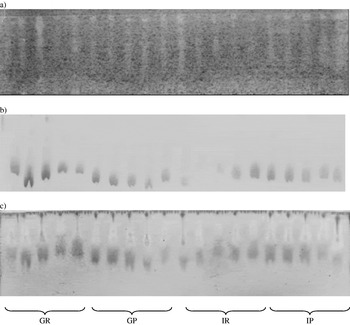
Effect of feeding system on qualitative evaluation of the free-radical scavenging and bioactive polyphenols by TLC of four kinds of goats' milk cheese extracts developed by DPPH+radicalt (a), Ceric sulphate (b) and vanillin-sulphuric acid (c). GR=cheese made from grazing goat's raw milk, GP=cheese made from grazing goat's pasteurized milk, IR=cheese made from indoor goat's raw milk, IP=cheese made from indoor goat's pasteurized milk.

Quantitative evaluation of the free-radical scavenging and antioxidant activity DPPH+ free radical scavenging activity assays
Determination of scavenging stable DPPH+ free radicals was a very fast method to evaluate the antioxidant activity of the extracts, by measurement of the decrease in the absorbance of DPPH at 517 nm. The method used was described by Hatano et al. (Reference Hatano, Kagawa, Yasuhara and Okuda1988) with some modifications. Into 4·5 ml methanol were added 0·5 ml of the DPPH+ solution (about 0·5 g l−1) and 0·1 ml of cheese alcoholic extract. Standards such as trolox; caffeic acid; tBHQ and catechin were used as a reference index to determine radical scavenging capacity of the samples. The activity of each standard was calculated as:

where At 0 is the start absorbance at time zero and At end is the final absorbance after 60 min. Five parallel cheeses per treatment were analysed by triplicate.
Radical scavenging activity by ABTS+
Radical scavenging activity by ABTS (2, 2'-azino-bis [3-ethylbenzthiazoline-6-sulphonic acid]) radical cation was made according with Kuskoski et al. (Reference Kuskoski, Asuero, Troncoso, Mancini-Filho and Fett2005) and Turkmen et al. (Reference Turkmen, Sari and Velioglu2006). Standards as Trolox, tBHQ, caffeic acid and quercetin were used as an index reference data. All determinations were carried out three times for the 20 samples (five parallel cheeses per treatment). The percentage inhibition of absorbance at 730 nm was calculated according to the equation of Re et al. (Reference Re, Pellegrini, Proteggente, Pannala, Yang and Rice-Evans1999).
Determination of antioxidant activity by liposome oxidation method
Liposome preparation and lipid stress unilamellar small liposome were prepared as described by Tsuda et al. (Reference Tsuda, Sugaya, Yong Zhen, Katoh, Tanaka, Kawazura, Sugaya, Kusai and Kohno1994). Briefly, 10 g soybean phosphatidylcholine was dissolved in methanol (10 ml). Methanol was then evaporated to obtain a fine lipid layer. These lipids were resuspended in 10 ml phosphate buffer saline (137 mm-NaCL, 10 mm-phosphate, 2·7 mm-KCL, pH 7·4) by vortex agitation, to a final lipid concentration of 1 mg/ml, and treated with an ultrasound Branson 8210 (Branson Ultrasonic Corporation, CT, USA) for 10 min. Then solutions containing 2 mg lecithin/ml, 25 mm-FeCl3, 25 mm-H2O2, 25 m-ascorbic acid and alcoholic cheese extracts (0·5 mg/ml) were prepared following the method of Siddhuraju et al. (Reference Siddhuraju, Mohan and Becker2002). The mixture was incubated for 2 h at 37°C by the thiobarbituric acid (TBA) method. The absorbance of the sample was read at 532 nm (Spectronic GENESYS 5 and 2 UV-Vis, Thermo Fisher Scientific, Inc, USA) against a blank which contained all reagents except lecithin. Five parallel cheeses per treatment were analysed in triplicate.
Statistical analysis
The statistical model fixed effects with interaction and variance analysis in a 2×2 factorial arrangement, with two feeding treatments (A and B) and two milk processes (raw and pasteurized). Results are reported as means±standard deviation. Differences between the groups were assessed by the Tukey's test. Data were analysed by General Lineal Model using SAS program (version 8.2, Cary, NC, USA). We considered the differences between the means to be significant if P<0·05.
Results and Discussion
Total phenol in the cheese extracts
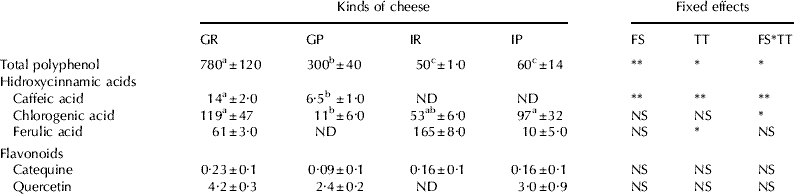
The present study, indicated that polyphenol content were affected by animal feeding (P<0·0001) and heat treatment of milk (P<0·0008). The total polyphenol content was higher (P<0·05) in GR in relation to GP, IR and IP cheese (Table 1). Pasteurization negatively influenced total polyphenol concentration, due to the possibility of denaturation of phenol content and amino acid catabolism (De Feo et al. Reference De Feo, Quaranta, Fedele, Claps, Rubino and Pizza2006), and the higher values in GR and GP are related to the higher consumption of polyphenols during grazing (O'connell & Fox, Reference O'Connell and Fox2001).
Bioactive polyphenolic compounds in cheese extracts
Hydroxycinnamic acids in this assay exhibit a detectable antioxidant activity, caffeic acid contents only appeared in GR and GP cheeses; this was probably due to a diet rich in phenolic compounds coming from the vegetation grazed by goats. However in IR and IP cheeses this compound was not detected, possibly because this hydroxycinnamic acid is sensitive to the pasteurization (Table 2). Besides, ferulic acid was altered by the pasteurization treatment (P<0·05), where IR cheese showed higher concentration of ferulic acid, possibly because the concentrate grain consumed by stall goats contained corn, a cereal rich in these hydroxycinnamic acids. Chlorogenic acid concentrations were altered by the animal feeding system and the pasteurization treatment; unclear effects are due to possibly not only the detrimental thermal effect but also the production de novo antioxidants metabolites product of Maillard reaction (Calligaris et al. Reference Calligaris, Manzocco, Anese and Nicoli2004). On the other hand, catechin showed a lower average concentration, probably because milk based products represent a very complex matrix; where strong catechin-protein interactions may occur and interfere directly with accumulated catechin determination by significantly reducing the analytical recovery (Siebert et al. Reference Siebert, Troukhanova and Lynn1996). Research of Ferruzzi & Green (Reference Ferruzzi and Green2006), suggests the application of short-time pepsin treatment in an enzymatic assisted extraction, to release the catechins in beverages combined with milk which contain active ingredients as tea catechins, increases the recovery of total catechins and their isomers from 20 to 50%. Otherwise, De Feo et al. reported values of quercetin in milk of 0·012 g l−1 (De Feo et al. Reference De Feo, Quaranta, Fedele, Claps, Rubino and Pizza2006). Cheese processing in the current investigation could alter the quercetin and other flavonoids solubility leading to some losses, because they can react in lipid and aqueous phases; acting as radical scavengers and metal ion binders (Zulueta et al. Reference Zulueta, Maurizi, Frígola, Esteve, Coli and Burini2009).
Effect of feeding system on the concentration of total polyphenol content and bioactive polyphenolic compounds in four kinds of soft goats' milk cheese extracts (mg/kg)
Values are means±sd for n=5

GR=cheese made from grazing goats' raw milk, GP=cheese made from grazing goats' pasteurized milk, IR=cheese made from indoor goats' raw milk, IP=cheese made from indoor goats' pasteurized milk. a,b,c means with different letters indicate differences (P<0·05) between columns. FS: Feeding system. TT: Thermal treatment. FS*TT: Interaction between feeding system and thermal treatment.
* P<0·05, **P<0·0001. NS=No statistically significance. ND=Not detected.
Qualitative evaluation of the free-radical scavenging and bioactive polyphenols by TLC
Thin layer chromatography demonstrated that GR and GP cheeses had the maximum antioxidant activity and concentration of phenolic compounds (Fig. 1). This chemical group was exposed by specific developers, their concentration increased in cheeses made with raw milk under grazing management. Sharma et al. (Reference Sharma, Bhat and Singh1998) showed that this activity can be related to the presence of gallic acid, catechin, epicatechin, cinnamic acid, p-coumaric acid and ferulic acid. These results seen to be similar to those reported by Ahmad & Beg (Reference Ahmad and Beg2001), who evaluated 45 medicinal plants by TLC, finding that this activity was associated with these metabolites. The chromatograms developed with Vanilline-H2SO4, displayed colours belonging to catequine and quercetin compounds; flavonoids with high antioxidant dynamism, largely present in GR and GP cheeses; even though, these were also found in cheeses from indoor management.
Free-radical scavenging and quantitative antioxidant activity
DPPH free radical scavenging activity
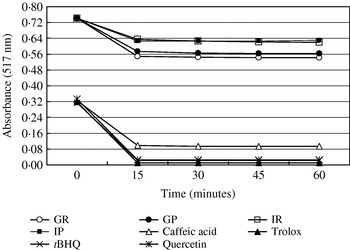
Free radical scavenging activity is important due to the protection against damage caused by free radicals in food and in living systems. DPPH method has been successfully tested measuring the total antioxidative capacity of milk (Smet et al. Reference Smet, Raes, De Block, Herman, Dewettinck and Coudijzer2008). Lower values of these activities in cheese, are possibly due to the metabolism of ruminants in certain compounds with antioxidant activity (O'connell & Fox, Reference O'Connell and Fox2001). During the kinetics of the quantitative antioxidant activity with DPPH, GR established at 15 min the highest antioxidant activity. On the other hand, GP was the second best cheese with an absorbance of 0·574 nm at 15 min, and a final value at 60 min of 0·563 nm (Fig. 2). These differences are due to pasteurized milk containing higher serum proteins and less albumin, when a denaturation due to heat stress occurs as has been demonstrated by Zulueta et al. (Reference Zulueta, Maurizi, Frígola, Esteve, Coli and Burini2009) who tested commercial milks in Italy to evaluate the total antioxidant activity.
Kinetic of DPPH+ free-radical scavenging in 4 kinds of soft goats' milk cheese extracts. GR=cheese made from grazing goats' raw milk, GP=cheese made from grazing goats' pasteurized milk, IR=cheese made from indoor goats' raw milk, IP=cheese made from indoor goats' pasteurized milk. Trolox=6-hydroxy-2, 5, 7, 8-tetramethylchroman-2-carboxylic acid. tBHQ=Ter-butylhydroquinone.

Radical scavenging activity by ABTS
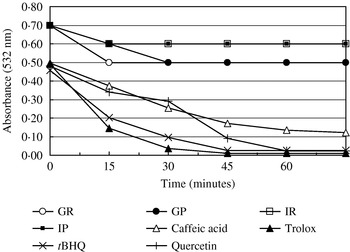
In the analysis of the kinetic of free radicals scavenging by ABTS, GR cheeses showed at 15 min the highest free radical scavenging (Fig. 3). This result could be due to the fact that pasteurization process can influence the formation of compounds that have antioxidant capacity during the Maillard reaction (Calligaris et al. Reference Calligaris, Manzocco, Anese and Nicoli2004). Chen et al. (Reference Chen, Lindmark-Månsson, Gorton and Åkesson2003) evaluated the antioxidant capacity of bovine milk using the ABTS+ radical, and found a significant antioxidant capacity, in agreement with the current report. Likewise, Wegrzyn et al. (Reference Wegrzyn, Farr, Hunter, Au, Wohlers, Skinner, Stanley and Sun-Waterhouse2008) evaluated the effects of fortifying apple polyphenol extract into milk drinks. The oxidation and loss of antioxidant capacity of apple polyphenols limited the work when the flavonoid content is high; demonstrating that the use of 200 mg apple polyphenol per 100 ml milk, permitted a physical stability and antioxidant capacity of the beverage in relation to control milk (zero mg apple polyphenols/100 ml) during storage and thermal processing.
Kinetic of ABTS+ free-radical scavenging in 4 kinds of soft goats' milk cheese extracts. For abbreviations see Fig. 2.

Antioxidant activity on liposome oxidation
In this cell model, the deleterious effect of pasteurization and the effects of animal feeding seem not to influence the radical scavenging. The synergism between antioxidant compounds as well as the production of de novo antioxidant metabolite products can explain this effect (Calligaris et al. Reference Calligaris, Manzocco, Anese and Nicoli2004; Smet et al. Reference Smet, Raes, De Block, Herman, Dewettinck and Coudijzer2008). Also, the content of natural potentially antioxidant aminoacids like tyrosine, tryptophan, histidine, lisine and methionine can influence the final antioxidant capacity (Zulueta et al. Reference Zulueta, Maurizi, Frígola, Esteve, Coli and Burini2009). According to this study, Cervato et al. (Reference Cervato, Cazzola and Cestaro1999) evaluated casein fractions antioxidant capacity in liposomal models. All caseins fractions were able to inhibit peroxidation by modifying the Fe2+/Fe3+ equilibrium and thus inhibit lipid peroxidation of milk matrix. Though, liposome model did not follow the same patterns as DPPH+ and ABTS+ antioxidant essays, complementarity of the results demonstrate the capability of cheese extracts to inhibit free radical damage.
Effect of feeding system on the free-radical scavenging of four kinds of goats' milk cheese extracts (%)
Values are means±sd for n=5

GR=cheese made from grazing goats' raw milk, GP=cheese made from grazing goats' pasteurized milk, IR=cheese made from indoor goats' raw milk, IP=cheese made from indoor goats' pasteurized milk. Trolox=6-hydroxy-2, 5, 7, 8-tetramethylchroman-2-carboxylic acid. tBHQ=Tert-butylhydroquinone, DPPH+=(1, 1-diphenyl-2-picrylhydrazyl), ABTS+=ABTS [2, 2-azinobis-(3-ethylbenzothiazoline-6-sulphonic acid)]. FS: Feeding system. TT: Thermal treatment. FS*TT: Interaction between feeding system and thermal treatment.
* P<0·05, **P<0·0001. NS=No statistically significance.
Present results showed that soft goats' cheese antioxidant activity can be modified by the animals feeding system. Grazing management represents a better option than indoor feeding to produce a healthy profile of bioactive compounds; providing an increase of total polyphenol, hydroxycinnamic acids and flavonoid concentrations. Pasteurization did have a significant effect on these metabolites, and diminished total polyphenol concentration. More research is needed to elucidate the potential of soft goats' cheese as a functional food.
Mario Cuchillo Hilario thanks the Consejo Nacional de Ciencia y Tecnología (CONACYT) for his Master grant.