People communicate differently today than they did a decade ago. Communication is not necessarily less textual, but it is certainly more visual and interactive. Similarly to how the printing press delinked written expression from the Catholic Church, new tools and technologies have freed audiovisual expression from the hands of film and television studios, allowing individuals the opportunity to create and broadcast high-quality video content on a small budget. Footnote 1 These tools—which include compact and affordable high-definition (HD) video cameras, user-friendly video editing software, and websites like YouTube and Netflix—are transforming how people everywhere document, publish, and consume knowledge. Footnote 2 These changing modes of communication are even beginning to permeate academia. A growing number of scholars and students in the natural sciences, social sciences, and humanities are exploring how new digital video technologies can be used to create “audiovisual publications” that stretch the boundaries of traditional scholarly work. Footnote 3 Some institutions are even getting in on the act. Perhaps signaling a coming trend in “mixed-media publication,” the Graduate School of Arts and Science at Harvard University recently created an interdisciplinary program called Critical Media Practice, which allows Ph.D. candidates in any discipline—including political science—to integrate digital video and other digital media into their dissertations. Footnote 4
As knowledge production becomes increasingly oriented to digital/visual modes of expression, scholars will need new approaches for conducting and publishing research. The purpose of this essay is to advance a systematic approach to audiovisual scholarship that is consistent with the standards and practices of positive social science. I call this approach—which is both a new way of publishing social science research and a new way of making nonfiction films—analytic filmmaking. I argue that when filming and editing are guided by rigorous social scientific standards, digital video can be a compelling medium for illustrating causal processes, communicating theory-driven explanations, and presenting new empirical findings. By using audiovisual data to present scholarly findings, I argue that we develop a more accurate and complete body of scholarly knowledge and offer policymakers and the public a uniquely effective way to glean insights from and engage with scholarly research.
I became interested in audiovisual scholarship in 2007–2008 while writing a dissertation on the political economy of international migration. Footnote 5 Originally, my goal was to use a video camera to collect qualitative data while directing a sample survey in Mexico. Over time, I refined my filming methods and ultimately shot 32 hours of interview and observational footage. The footage was fascinating and revealed insights that text and survey data could not. Upon returning from the field, I became convinced that creating a “video companion” to my dissertation would be the most effective way to present my qualitative data. Unable to find good models of “political science on film,” I developed my own methods and approaches through trial and error. I worked not as a documentary filmmaker trained in the art of visual storytelling, but as a social scientist interested in using new tools and technologies to advance theoretical claims and empirical findings. The end result of that long, iterative process is a 55-minute “analytic film” called The Other Side of Immigration. Footnote 6
The Other Side of Immigration—henceforth, TOSOI—has allowed my Ph.D. research to cross disciplinary and professional lines in ways that would not have been possible had I only produced a text-based dissertation. I have presented TOSOI and discussed related findings from my dissertation at more than 100 universities, conferences, community events, and government institutions. Many of these events include forums that, as a political scientist, I never expected to attend, such as public health conferences, education policy conferences, mental health forums, law conferences, agricultural policy forums, medical schools, churches, cultural institutions, high schools, public libraries, and dozens of interdisciplinary university events. TOSOI has furthermore brought my research to thousands of viewers through online distribution networks like Netflix, iTunes, and Amazon Instant Video. TOSOI is a serious work that many audiences appreciate for the unique way it presents information. Shortly after its release TOSOI was named “most original presentation of a current political issue” at an event sponsored by the Bipartisan Policy Center (a think tank founded by four former Senate Majority Leaders). In 2011, TOSOI became one of fifteen films added to the American Library Association’s List of Notable Videos for its “significant contribution to the world of video recordings.” Footnote 7
This article systematizes the approach that informed the production of TOSOI. The first section of this article provides a general definition of analytic filmmaking, distinguishes analytic filmmaking from documentary filmmaking, and outlines a set of core concepts and techniques. The second section draws on examples from TOSOI to show how one can apply the analytic filmmaking approach in practice. Here I situate TOSOI within a larger research program that includes written scholarship to explain how analytic film and textual work are complements that together contribute to a more complete and accurate understanding of the social and political worlds. The third section discusses some extra-scholarly advantages of analytic film and explains why audiovisual scholarship is able to transcend some of the barriers that keep scholarly knowledge from leaving our subfields and why broader dissemination is to the advantage of both scholars and the public. I conclude with some thoughts about how scholars who are interested in analytic filmmaking can receive proper training and how incentives can be created within the academy to encourage good digital/visual scholarship in general.
Analytic Filmmaking: An Overview
An analytic film is an audiovisual work that uses theory and empirical evidence to systematically explain social and political outcomes. Footnote 8 Analytic filmmaking is the application of the standards, rigor, and objectivity of social science to audiovisual media to communicate and disseminate original social science research. Analytic films are scholarly publications that advance new hypotheses and new empirical findings, not works that merely report on or synthesize existing studies through narration or interviews with scholars and other experts. Footnote 9 Analytic filmmaking begins by posing research questions and outlining possible explanations. Various arguments, explanations, and theoretical claims, including new hypotheses, form the backbone of the narrative. Video data—i.e., footage from interviews, observations, and experiments—are arranged around that theoretical structure in order to create a coherent audiovisual narrative. The ultimate goal of any analytic film should be to make nomothetic statements based on empirical evidence and to complement inferences made in written work by illustrating how, in reality, human behavior follows hypothesized logics. Analytic films are a particularly vivid way of illustrating causal processes and are best suited to research that involves human subjects and where individual or group preferences, opinions, or behavior are causally important. They may be viewed independently of or in combination with written scholarship and may range in length from a few minutes to many hours long, depending on the needs of the researcher.
Analytic filmmaking is not documentary filmmaking by another name. Documentary filmmakers typically adhere to a set of practices and norms that are incompatible with positive social science. Footnote 10 Above all, most documentary filmmakers are trained and identify themselves as storytellers. Their stories tend to follow and describe the actions of “characters”—the real-life individuals or groups (which may include the filmmaker or journalist) whose lives, struggles, journey, or achievements create the kind of conflict, action, or suspense that drive the plots of their films. The search for “engaging characters” and “narrative tension”—two key ingredients to a successful documentary, according to one authority Footnote 11 —explains why so many documentaries feature eccentrics and outliers. It also explains why many documentaries blur the line between fiction and nonfiction without alerting the viewer, using staged or semi-scripted scenes to develop more dramatic, romantic, or emotional narratives. Footnote 12 Finally, through their characters’ stories, many documentaries aim to “say something” about politics or society. These statements, however, tend to be normative arguments based on opinion, emotion, or unique (and often extraordinary) experiences.
Analytic filmmaking is thus different from documentary filmmaking in that (1) it emphasizes the general over the particular; (2) it engages in original theoretical inquiry and nomothetic explanation over descriptive storytelling and character development; (3) it is categorically nonfictional and privileges accuracy above all else; and (4) it advances positive arguments based on theory and evidence rather than normative arguments based on opinion, emotion, and dramatization.
The remainder of this section introduces three core concepts of analytic filmmaking: video data, theoretical pillars, and strategic reiteration. The subsequent section provides examples from TOSOI to demonstrate how social scientists can put these concepts to use to create analytic films in practice. Just as every scholar has a different approach to written expression, every scholar will have a different approach to creating audiovisual scholarship. The objective here, however, is to systematize some essential aspects of analytic filmmaking in order to establish a set of guidelines and standards for using digital video tools to conduct and disseminate social science research. Footnote 13
Video Data
Although usually thought of as entertainment, video is fundamentally a medium for capturing and storing information. Instead of confining human behavior, statements, and opinions to numerical codes (as one might with a survey) or relatively thin text-based descriptions (as one might when making field notes), video uses audio and moving images to create dynamic records of whatever we point our camera at. Video has the unique ability to simultaneously capture and store various kinds of aural and visual information, much of which cannot be stored nearly as effectively, exhaustively, or simultaneously as text, numbers, or audio, Footnote 14 including contextual and environmental factors, body language, facial expressions, group dynamics, behaviors, actions, and tone of voice. It can furthermore capture important attributes of a person, event, or situation, such as credibility, authority, mood, intention, sincerity, and authenticity. A single video clip may therefore hold many bits of information, some of which one may have never anticipated. Footnote 15
This “video data” is the central component of any analytic film. Collecting it should be systematic and guided by theory. Before beginning to collect video data, scholars should pose research questions, outline existing explanations, and develop new hypotheses. These questions, explanations, and hypotheses, along with a priori substantive knowledge, should inform choices regarding who is interviewed or what is observed. In some cases, researchers may collect video data through random sampling. However, since the goal of analytic filmmaking is to illustrate causal processes rather than test hypotheses, useful samples may be nonrandom. Footnote 16 Whatever the sampling strategy, it is essential that researchers use their scholarly judgment and academic training to collect video data from credible sources (i.e., not necessarily the best “characters” or most entertaining personalities) which present the most accurate (i.e., not dramatized or sensationalized) representation of the populations, events, or phenomena they study. Later in this piece I will discuss techniques for minimizing the kinds of biases that can threaten the validity and reliability of video data.
Theoretical Pillars
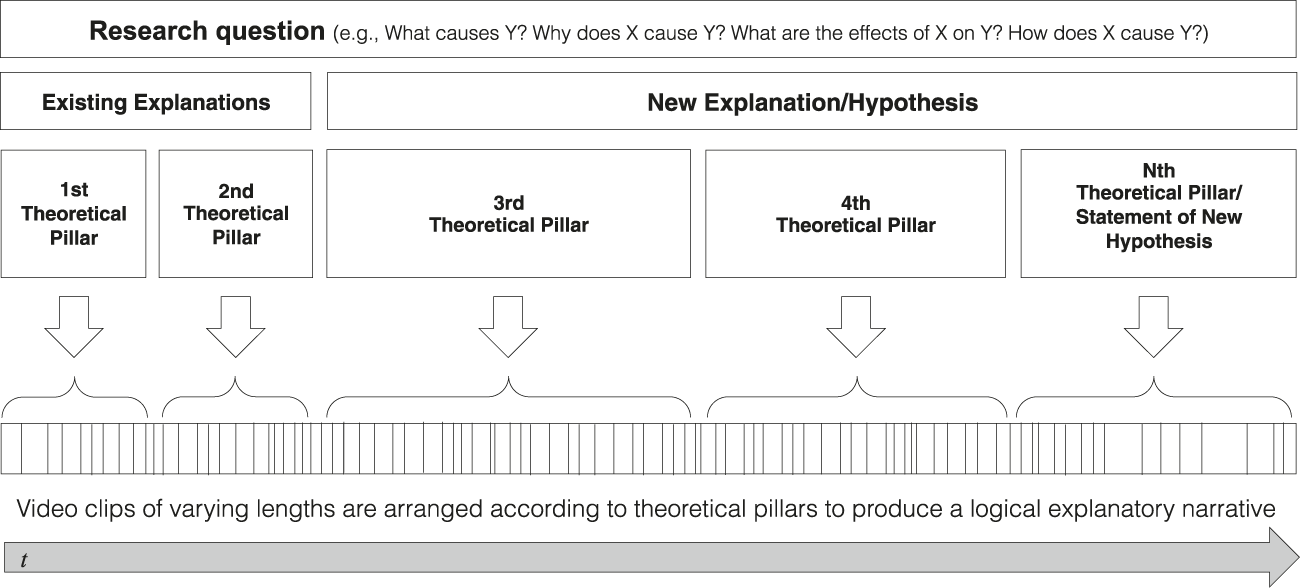
With the help of nonlinear video editing software like Adobe Premiere, Avid, and Final Cut Pro, video data can be analyzed, parceled, and edited into a self-sustaining audiovisual narrative. Instead of telling a story about a particular person, group, time period, or event, the narrative in an analytic film should advance a series of theory-driven explanations about social or political outcomes. To do the kind of explaining that is expected of social science research, one should establish and edit video clips according to theoretical pillars. Theoretical pillars are organizational subsections that structure the explanatory trajectory and theoretical logic of analytic films. They guide argumentation and the presentation of theoretical explanations, and thus organize how video clips are presented to the viewer. As a narrative device, they are analogous to the plot points and scenes that structure most other films. Without theoretical pillars, one is left with little more than an unstructured and unfocused collection of statements and observations.
Figure 1 presents a schematic overview of the process of editing an analytic film. The first step is to pose a research question that will occupy a major section of the analytic film, or possibly the entire analytic film. A number of possible existing and new explanations inevitably flow from the research question. Theoretical pillars are the schools of thought, theories, new hypotheses, and logical steps that advance those explanations. Before the video editing process begins, one should have a strong sense of what theoretical pillars might be used to structure the narrative. Video data should then be grouped according to those theoretical categories. Video data that do not fit in preordained theoretical categories may find a home in substantive/empirical categories or new theoretical categories, the creation of which may cause one to rethink the original theoretical outline. After video data has been organized along theoretical and substantive lines, one should select and arrange video clips that best convey particular arguments and explanations. The next task is to use video editing software to fuse and interweave distinct pieces of video data together so that clips of varying lengths come together to produce a logical explanatory narrative that sheds light on the causal processes that underlie some social or political outcome. Footnote 17
Overview of the process of structuring and editing an analytic film

Strategic Reiteration
A key objective of analytic filmmaking is to offer general explanations rather than describe particular cases. On one hand, generalization is pursued by organizing video clips according to theoretical pillars rather than according to the story of any particular individual, group, or event. Even still, theoretical propositions are conveyed through statements made by individual respondents or through observations of specific events, places, or points in time. To overcome the particularity that is inherent to any single video clip and give the viewer confidence that one’s video data are expressing generalizable concepts, arguments, and explanations, I recommend a technique called strategic reiteration. Strategic reiteration means editing two or more different video clips so that they are presented simultaneously or in close succession to generalize and infer beyond any particular example, statement, or piece of evidence.
Strategic reiteration can mean at least three things in practice. First, one could engage in strategic reiteration by showing observational footage that reveals a process or demonstrates a point that is being described by a respondent. The observational footage, presumably filmed at a different place and time but presented to the viewer simultaneously, suggests to the viewer that the respondent’s statement generalizes beyond his or her immediate experience. Second, one may present video clips that make nearly identical statements but which come from respondents who differ on certain demographic variables, such as profession, race, age, location, or socio-economic status. This can signal to the viewer that a particular belief or understanding spans different populations or subpopulations. Finally, one may present the stories or experiences of many different kinds of respondents in a way that highlights a unifying theme or underlying process. This approach shows that although the details of any respondent’s experience may be unique, they are linked by some more general variable of interest. In the next section, I use examples from my work to demonstrate how, in practice, one can use these and other techniques to create analytic films.
Analytic Filmmaking in Practice
To make the process of creating an analytic film less abstract, I use examples from The Other Side of Immigration (TOSOI) to illustrate how, in practice, one collects good video data, edits according to theoretical pillars, and generalizes through strategic reiteration. In this section, I also explain the relationship between TOSOI and my written scholarship to indicate how video and text complement and interact with one another. Together, these forms of expression help us accumulate different kinds of knowledge and contribute to the creation of a more accurate and complete body of scholarly knowledge. Finally, in case the key differences between analytic filmmaking and documentary filmmaking remain unclear, I briefly compare TOSOI’s narrative approach to narrative approaches taken in a handful of documentary films on the same topic.
Project Background
TOSOI was filmed as part of dissertation fieldwork I completed in Mexico between January and April of 2008. Although embedded within the same study that informed my dissertation, TOSOI is not the “film adaptation” of my dissertation. Rather, they are distinct works that complement one another, overlapping in some respects, but more importantly, revealing things about their common topic that the other cannot. My dissertation explores the political determinants and political effects of migrants’ remittances in developing economies. Footnote 18 Two key arguments are at the center of this study. To put them succinctly, I first argue that fiscal austerity in developing countries prompts citizens abroad to send more money to family and friends in the homeland, filling what could be thought of as a “social insurance vacuum” left when developing states curtail or eliminate subsidies and social welfare programs. Second, I argue that because remittances are cash injections that insulate poor households from market vicissitudes, remittance recipients have fewer economic grievances and are thus less likely to punish politicians for an otherwise ill-managed economy. To test these arguments, I collected survey data from 767 randomly selected Mexican households.
In an effort to develop stronger causal theories and illustrate causal mechanisms, I collected qualitative data during the period that my research team collected survey data. Through in-depth interviews and observations in high-emigration areas, I was interested in gaining a more general understanding of the political, economic, and social processes that cause people to emigrate and in turn how emigration and remittances impact the communities and households migrants leave behind. As part of my qualitative fieldwork, I collected 32 hours of video footage using a small HD camcorder. Most of this footage consists of interviews with a broad range of people in the communities where my research team collected survey data—e.g., smallholder famers, return migrants, residents with family members in the United States, and local politicians, candidates, and community leaders of all political parties—and with policymakers and bureaucrats in the state capital. Interviewees were selected purposively in an effort to extract reliable information about the intersection of emigration, politics, and economics in the locales where I conducted fieldwork. Other footage was observational: e.g., the look of the homes that return migrants had built with money earned abroad, propaganda from a recent political campaign, and mothers lining up to participate in a conditional cash transfer program.
Selection Bias, Response Bias, and Nonresponse Bias
Biased data are a threat to good inference. Footnote 19 While collecting video data, I was attentive to three types of bias in particular: selection bias, response bias, and nonresponse bias. These three biases are certainly not unique to video data, but may manifest themselves in ways that are unfamiliar to scholars who have never collected video data.
First, selection bias becomes an issue if one succumbs to the natural impulse of recording only when “something interesting” is happening or when something interesting is being said. This impulse is problematic because the most interesting moments, people, and statements may in fact be outliers that tell us little about the true processes we are interested in understanding. To collect data that is representative of the population or phenomenon being studied, it is critical to record often and to allow one’s camera to roll uninterrupted for long periods of time. Uninterrupted recording is now possible due to the decreasing cost of storing digital video footage on hard drives and the fact that most video cameras are now equipped with high capacity internal hard drives and/or record to high capacity removable data cards. My camcorder, for example, recorded footage to a 60-gigabyte internal hard drive that could store seven hours of HD footage at a time. I furthermore used a three-hour battery and traveled with a power cord and two backup batteries. In addition to reducing selection bias, capturing large amounts of video data is advantageous because it creates more observations for one to analyze later, whether those analyses inform written scholarship, audiovisual scholarship, or both.
Next, anytime we collect human subjects data, we must take steps to mitigate nonresponse bias and response bias. Nonresponse bias occurs if respondents systematically refuse to participate in a study. Response bias occurs if respondents systematically misrepresent their opinions or provide inaccurate information (often for reasons of social desirability) in the presence of an observer. Footnote 20 Video cameras may exacerbate these biases. For example, people may refuse to participate, or clam up if they do participate, due to camera-shyness (nonresponse bias). Others may feel compelled to perform, exaggerate, or withhold information in order to put forward a favorable image for the camera (response bias).
I attempted to mitigate these biases by minimizing the camera’s role in the interaction. First, I predicted that a crew and professional film equipment would intimidate or distract many respondents. Those who are intimidated might refuse to participate or act withdrawn during the interview; those who are distracted by a crew, big camera, or bright lights may feel compelled to perform or feel unable to speak naturally. To make the on-camera interview less daunting and to minimize these distractions, I worked alone and used an inconspicuous setup that consisted of only a small consumer-grade camcorder on a simple tripod. I refrained from using a lighting kit, and I did not attach lapel microphones to interviewees. These decisions had adverse effects on production quality: many of my shots were out of focus and poorly lit, and most of my audio contained hiss and background noise. I think, however, these decisions made the interview feel less formal and made it easier for respondents to ignore the camera. Finally, to make on-camera interviews feel more like natural conversations between two people, I did not formally “start” and “end” interviews with countdowns or signals. Rather, I began recording prior to entering the conversation and generally left the camera rolling on a tripod the entire interview.
Nonresponse bias was ultimately not a problem: only one out of 37 people I approached for interviews refused to go on-camera. I performed two tests to check for response bias. First, on a handful of occasions, I conducted off-camera pre-interviews and returned later with the camera. I noticed little if any difference in the disposition of interviewees or the kind of information they provided between the off-camera pre-interview and the on-camera interview. In general, people seemed to ignore the camera after only a couple minutes—something observed by other visual social scientists. Footnote 21 I also checked my video data against my survey data and my own understanding of the topic when possible. I did not find evidence that the camera was causing respondents to provide inaccurate information. Using the camera to collect observational data did not appear problematic either—because I was using a small, consumer-grade camera, I was routinely ignored, probably taken for a tourist. Footnote 22
Are cameras too disruptive to collect good data? In some instances they may be, especially in places where recording is prohibited. At the same time it may be more possible than ever to collect good data with a video camera. Video recording—whether it is people shooting video on their cellphones in public or security cameras watching overhead—is now so ubiquitous that people “take decreasing notice of the technology.” Footnote 23 My argument is not that researchers should ignore or wish away the potential disruptions that video cameras may cause while gathering data, but that there are ways to minimize and check for biases that video cameras may induce. Footnote 24
Communicating Arguments and Evidence
Using Final Cut Pro software, I edited my video data into a 55-minute narrative that addresses the following research questions: (1) What causes international migration? [2:50–15:12] (2) Under what circumstances do people choose “exit” (emigration) over “voice” (political participation and protest)? [16:27–27:18] (3) What are the implications of migrants’ remittances for political and economic life in migrant-sending communities? [27:45–32:33] and (4) How do mass emigration and U.S. immigration policy affect migration patterns and social dynamics in rural Mexico? [32:34–47:00]. The fifth section concludes the film by offering some policy recommendations, just as a book or article might [47:00–52:03]. In each of these sections, a series of explanations is provided, followed by a central argument or explanation. (Throughout this discussion, bracketed numbers reference time points in the film.)
To illustrate how I used video data to advance an original social scientific audiovisual narrative, consider the theoretical logic behind the first key section of TOSOI [2:50–15:12]. This section of the film is made up of about 80 video clips that were edited together to present explanations and evidence to a single research question: What causes international migration? My objective here was to offer explanations that go beyond the clichés we hear in public debates—e.g., “people migrate in search of a better life”—and present a set of systematic explanations based on existing theories and a new hypothesis that grew out of my research. I was also interested in going beyond the most common economic explanations to show how changes in economic policy—not just exogenous economic shocks or economic conditions—trigger mass emigration. To advance these explanations, I established three theoretical pillars.
Economic theories of international migration constitute the first theoretical pillar [2:50–6:10] and are conveyed through observational footage and statements made by residents of high-emigration Mexican towns. One resident, a return migrant, argues in favor of Stark and Taylor’s theory of relative deprivation Footnote 25 when he states: “You create big expectations when you see family members and neighbors come back from the U.S. [with] their nice clothes, their new cars, their new trucks. You think it’s easy to go up there (the United States) and in a short time have the same.” As he speaks, images of well-dressed people walking through poor communities and driving pickup trucks help generalize the point [3:35–3:51]. The simultaneous presentation of the respondent’s statement and accompanying observations is one of many examples of strategic reiteration. Other factors that explain emigration include wage differentials between sending and receiving economies and the availability of employment opportunities in receiving economies (commonly known as “pull factors”), Footnote 26 expressed through statements and observational footage that compare a rosy picture of working in the United States with the difficulty of finding decent paying work in rural Mexico.
After exploring economic theories of international migration, the film shifts gears and begins to offer a new “political economy explanation.” Specifically, this section of the film argues that in combination, an open trade policy and low social spending cause emigration. The second theoretical pillar initiates this argument at the 6:49-mark with discussion of the distributional effects of international trade.
Although good for growth in the aggregate, the transition from a closed to open trade policy exposes once-protected industries and producers to new competition and the vagaries of the invisible hand, creating new economic losers. Statements from Mexican policymakers and smallholder farmers convey this logic. For example, the mayor of one small town explains how the pork industry once thrived in his community and employed a significant percentage of residents, a point strategically reiterated in the next clip by a peasant farmer [6:49–7:21]. A farmer from another town discusses how he and his neighbors once grew corn for subsistence and cultivated beans to sell at market [7:24–7:57]. A farmer from yet another community explains how there was once great demand for the strawberries he grows on his land. Each respondent then explains that his pork, corn, beans, and strawberries were priced out of the market after Mexico opened its economy to agricultural imports. Various interviewees point out that abandoning their land and emigrating was the most rational course for small farmers who suddenly found themselves unable to compete in a market dominated by cheaper foreign goods [8:13–10:53].
The decision to include four different examples here—pork, corn, beans, and strawberries—is another example of strategic reiteration. In this instance, my objective was to make general statements about the distributional effects of trade in Mexico. If pork had been the only example, the argument would have been that small pork farmers were the losers of Mexico’s trade policy. This is certainly true, but by focusing on examples that fall into four different agricultural categories—livestock, vegetables, grains, and fruits—my aim was to convey the message that with only a few exceptions, small farmers were the losers of Mexico’s trade policy [10:54–11:47].
To this point, it sounds like an open trade policy and exposure to new foreign competition cause emigration. The third theoretical pillar [11:49–15:12] adds a new layer to the explanation by focusing on the role of government spending. Rodrik and others have argued that the kind of external risk that small Mexican farmers were exposed to creates new demand for social insurance—a demand that many governments have responded to by increasing spending on subsidies and social welfare programs that insulate workers from market vicissitudes. Footnote 27 The positive relationship between trade openness and government spending—often referred to as the “compensation hypothesis”—has found strong empirical support in studies of developed countries. The relationship, however, does not hold up so reliably in samples of developing countries. Some developing states, in fact, reduced their social insurance commitments at the same time that they were opening their economies. Footnote 28 The film illustrates the Mexican state’s waning commitment to small-scale agriculture through statements about the unbearably high costs of unsubsidized farm inputs [9:32–9:40] and low levels of spending on subsidies [12:02–12:30]. One farmer—a return migrant—says, “We don’t have any government support. We’re forgotten by the political system” [13:41–13:53]. The idea that small farmers are not supported is strategically reiterated by clips that show the antiquated technologies many continue to use: horses to plow fields [12:24–12:32], machetes to cut grass [13:23–13:30], and small tractors that look many decades old [13:30–13:44].
The combination of open economy policies and weak safety nets may leave certain groups—in this case, small farmers—completely unable to compete. Some political scientists predict that the losers of state retrenchment and trade competition organize and punish politicians for adverse economic change. Footnote 29 Others argue that market losers “swallow the bitter pill” and wait for better times. Footnote 30 This subsection of TOSOI makes a different argument: some market losers cope with fiscal austerity by emigrating. As one respondent points out, he has no choice but to find a way to recuperate losses if what he invests in growing his crops exceeds his income from selling them. In the absence of a robust social safety net, the burden falls to him to self-insure. He points out that the most effective way to do this is to work in the United States and save and send money home [14:20–14:53]. Footnote 31
Reminding us of Albert Hirschman’s seminal framework, Footnote 32 the next major section of TOSOI explores why emigration (“exit”) might be viewed as a more effective way to deal with economic adversity than expressing one’s economic grievances through formal political channels (“voice”) [16:27–27:18]. In short, with the narrative again supported by a set of theoretical pillars, this part of the film explains how low levels of political knowledge [16:27–19:58], clientelism [19:59–21:27], and the widespread perception that the government is corrupt [21:27–23:20] erode marginalized citizens’ faith in political institutions [23:20–25:00]. Lack of faith in political institutions and the need to self-insure leads to a “culture of emigration” in marginalized towns. Those who stay behind can often turn to family members abroad to help them meet their economic needs. As a result, remittance recipients have fewer economic grievances than they otherwise would, making them less compelled to punish politicians for a bad economy [26:25–26:41]. Structured logical explanations are advanced in the remaining sections of the film.
The Complementary Nature of Analytic Film and Written Scholarship
Analytic filmmaking and written scholarship are complements. First, through the analytic filmmaking process, scholars create a vivid record of their fieldwork. Footnote 33 The opportunity to watch and re-watch an audiovisual record of one’s fieldwork through the video editing process allows scholars to see evidence they overlooked the first time around due to cognitive biases, Footnote 34 cognitive limits, Footnote 35 and failures to pick up on subtleties in language, customs, and behavior that were not immediately familiar. “Re-experiencing” one’s fieldwork in this way can improve written scholarship by contributing to the development of more accurate interpretations, better hypotheses and theory, and new ideas about how to specify empirical models and operationalize concepts. Footnote 36
Together, analytic films and written scholarship contribute to a more accurate and complete body of knowledge because either medium is able to achieve things that the other cannot. A central achievement of analytic filmmaking, for instance, is that it is able to illustrate causal processes far more vividly than text. Written scholarship, on the other hand, is better equipped to advance general models and quantitative analysis is better equipped to test those models. The first major section of TOSOI [2:50–15:12], for example, lays out the causal mechanisms behind the claim that market losers who are unable to count on government support self-insure by emigrating and sending money home. A testable implication of this causal process is that, all else equal, remittances sent to a developing economy or poor household should increase when government spending decreases. In my dissertation, tests of time-series data and survey data provide support for the hypothesized negative relationship between government spending and remittance flows. Footnote 37 Moreover, at the 26:22-mark, a respondent argues that people in his community have little interest in holding their politicians accountable because so many are able to count on family members abroad to satisfy their economic needs. A testable implication (which I disaggregate into multiple hypotheses) is that remittance recipients will use political channels to express economic grievances less than neighbors who do not receive remittances. Again, I find robust support for this hypothesis in analyses of survey data I collected while filming TOSOI. Footnote 38
The critical point is that all of the above are useful ways to advance explanations based on a systematic theoretical logic and scientific evidence. To treat them as “competitors” is, I think, to create a false choice, similar to the false choice that once existed between quantitative and qualitative approaches. Together text-based scholarship and analytic film have the potential to reveal more things about human behavior and social reality than either could reveal on their own.
Contrasting Analytic Film and Documentary Film
Notice that the objective of TOSOI was not to describe life in a Mexican village, recount the history of Mexican migration to the United States, report on a new immigration policy initiative, or convey a dramatic three-act narrative about how a particular person or group overcame some economic or interpersonal hardship—all characteristic approaches of documentary filmmaking. Instead, the goal was to offer more general explanations that connected bits of micro-level evidence from my interviews and observations in an attempt to shed light on macro-level trends about why people migrate and how migration affects political, social, and economic dynamics in sending communities.
To further understand this distinction, compare TOSOI’s theory-driven approach to the character-driven approach taken in any number of other documentary films about emigration. Mark Becker’s acclaimed documentary Romántico, for instance, tells the story of a musician named Carmelo who struggles to make a living in his hometown of Salvatierra, Mexico after returning from a stint working in San Francisco, California. Footnote 39 Alex Rivera’s PBS film The Sixth Section tells the story of a group of Mexicans immigrants in New York who pool their money to build a baseball field, purchase an ambulance, and build a well in their hometown of Boqueron, Mexico. Footnote 40 Juan Carlos Rulfo and Carlos Hagerman’s award-winning documentary Los Que Se Quedan (English title: Those Who Remain) provides a window into the daily routines of a handful of people living in rural Mexico to tell a story that builds to the dramatic separation of one family and reunion of another. Footnote 41 All of these films make mention of some of the causes and effects of international migration. In contrast to TOSOI, however, their primary objectives are to tell their characters’ stories, not systematically unpack causal processes or present new evidence from an original social scientific study.
Engaging Broad Audiences and Promoting New Collaboration
Analytic filmmaking is a uniquely effective way to communicate scholarly findings to researchers in other disciplines, people working in other professions, students, and the general public. As I have seen in my experiences presenting and discussing TOSOI, there is no shortage of intelligent people who are hungry for credible, well-researched information. The problem is that most of these people do not have the time or training to obtain that information from text-based scholarship. Video is useful in this regard: Not only do films typically take less time to watch than books take to read, but they require less prior knowledge of a specialized language than text. When engaging with text, readers who are unfamiliar with a certain vocabulary or who confront a poorly elucidated concept may quickly become lost and give up. One can present sophisticated concepts through video, on the other hand, and though viewers may be unfamiliar with the language behind those concepts, they may still be able to extract salient information by way of the visual and aural context. Footnote 42
Another advantage of video is that it can be consumed simultaneously in a group setting. Everyone reads at a different pace, and reads better in some environments than others. Hundreds of people, on the other hand, can watch a video in the same space and at the same time. The opportunity for people of different backgrounds, professions, and education levels to consume sophisticated information simultaneously and obtain some level of basic understanding across the group can greatly facilitate discussion and learning at forums that bring together diverse stakeholders for a limited amount of time, as is often the case at conferences, community events, government institutions, and interdisciplinary and university-wide programs.
Analytic film is thus capable of transcending some of the barriers that keep scholarly knowledge confined to a single field or subfield. Transcending these barriers is particularly important at present as market pressures erode journalistic standards and eliminate opportunities for in-depth reporting, making it increasingly unclear what on the internet is created to inform and promote critical thinking and what was created to sell advertisements. Even at esteemed media outlets, whether or not there is an engaging story to tell plays a central role in determining whether or not a particular topic will be reported on. Scholars, of course, are not beholden to the market pressures that journalists and filmmakers are and therefore have an important role to play in providing credible, well-researched information to the public.
But it is not only the public that gains when we use new digital tools to make scholarly research more accessible. Scholars gain as well. In fact, a 2013 report from the American Academy of Arts and Sciences puts better communication with the public at the center of its recommendations for addressing the funding crisis that threatens the humanities and social sciences. It argues that the burden is now on scholars themselves “to make the case for the public value of their work much more effectively than they have in recent years”—to drum up funding and support by engaging with a broader audience. “Renewed funding may arise altogether,” the report argues, “with renewed effort to remind Americans of the meaning and value of the humanities and social sciences” and “is unlikely to come without it.” Footnote 43 This message is consistent with the guidelines of the National Science Foundation (NSF), whose “broader impacts” criterion requires that grantees do socially relevant research and work to improve the public’s scientific literacy by disseminating results broadly. Footnote 44 Among other recommendations, the NSF encourages scholars to “publish in diverse media” and present “research and education results in formats useful to policy-makers, members of Congress, industry, and broad audiences.” Footnote 45 My experiences presenting TOSOI have persuaded me that analytic films are a particularly effective “format” for presenting sophisticated information to audiences outside our fields or subfields, for reminding the public of the value of social science research, and for having real influence on how policymakers and other members of the public think about important social and political issues. This does not mean “dumbing-down” our work, but instead communicating findings through a medium with which more non-specialists are willing to engage and are better prepared to glean insights from.
In addition to communicating knowledge across disciplines and professions, analytic filmmaking has the potential to promote new kinds of collaboration within universities—another NSF priority. First, students who lack advanced quantitative skills—whether because they are naturally more right-brained or because racism, poverty, gender inequality, disability, or geographic disparities prevented them from receiving decent math and science instruction earlier in life—gain new opportunities for mentorship when invited to collaborate with faculty on the production of analytic films. Second, the technical and communicative requirements of learning to work with video may compel more social scientists to build bridges with colleagues in the arts and humanities for feedback and consultation. The universal language of visual media may likewise encourage scholars from the social sciences, the humanities, and the natural sciences to find new areas of common ground, leading to new collaboration on topics that do not fit neatly into a single academic discipline, such as sustainability, inequality, and human mobility. Finally, digital video has the potential to bring together scholars with different methodological strengths to collaborate on projects that employ many different kinds of data, including audiovisual data, quantitative data, and text-based data.
Conclusion
The current pace of technological change is astonishing. Over the past decade, and especially within the past five years, new and powerful digital video technologies have transformed how people record, produce, and exchange information. In this article, I have argued that these digital tools present interesting opportunities for social scientists, opening the door to new ways of collecting data and publishing our research. Here, I have proposed a specific brand of digital and visual scholarship called analytic filmmaking, which I define as the application of the standards and principles of social science to the filming and editing of digital video data. When well executed, analytic films communicate general theoretical explanations and present new empirical evidence. They achieve these goals through the systematic collection of video data, the establishment of theoretical pillars that convey a logical narrative that offers general explanations of social and political outcomes, and a generalizing technique called strategic reiteration. I contrasted the analytic filmmaking approach with the descriptive storytelling and reporting that is characteristic of documentary filmmaking.
Analytic films complement written scholarship by vividly illustrating causal processes. They are furthermore a uniquely effective way to disseminate social science research beyond our subfields—to communicate scholarly findings to broader audiences, including scholars in other fields and non-specialists who work in any number of professions, such as public policy, public health, education, law, and others. This is an important advantage: Social scientists do research on matters of great importance that people in other fields and professions are interested in learning more about. But because those people do not read our journals or know how to make sense of our theories and empirical work, they remain oblivious to that body of knowledge. Analytic filmmaking helps to resolve this disconnect between scholars and the public by communicating research in a universal audiovisual language that non-specialists are better able to comprehend. The benefits of broad dissemination include a better-informed public and a public that is more engaged with and thus more willing to support scholarly research. Publishing scholarship in more accessible formats could also mean greater influence over policy and public thinking.
Scholars will need the proper training and incentives if they are to take advantage of new digital and visual tools. The technical skillset one needs to start making analytic films is easily taught in classrooms. Introductory media production courses are offered on just about every campus. Faculty and students who are interested in working with digital video would do well to sit in on one or read a basic introduction to nonfiction filmmaking. Footnote 46 But learning basic cinematography and video editing techniques is only the beginning. As with writing and quantitative analysis, the creative aspects of analyzing video data and employing it to create a social scientific narrative are more difficult to teach. These skills develop only through time, practice, and learning from failure. Scholars must engage in an iterative process of finding what works until best practices develop and paradigms emerge. More universities should establish interdisciplinary programs like Harvard’s Critical Media Practice to encourage this kind of training and experimentation.
Political and social scientists will not experiment with analytic filmmaking or any other approach to digital/visual publication without the promise that good work will be rewarded. In the early stages, the individual departments and universities that are willing to embrace digital/visual scholarship must decide for themselves what constitutes valuable scholarly contributions for purposes of hiring and promotion. Eventually, systems for presenting and reviewing analytic films and other forms of digital and visual scholarship will develop, similar to those that exist for written scholarship. Conferences are one forum where political and social scientists should present visual work and receive feedback. Ultimately, there should be peer-reviewed journals that publish visual scholarship on the internet. Even conventional text-based journals could expand their mission to include video research, just as many newspapers now integrate video alongside or within text-based articles that appear online. Finally, there should be dedicated distributors of long-form analytic films. Just as university presses provide incentives to produce written works not supported by a mass market, these academic distributors would provide the necessary incentives for scholars to produce a brand of in-depth audiovisual publication that is not typically produced by filmmakers and journalists.
Scholars should not ignore the remarkable communication breakthroughs of the past decade. How the world disseminates and consumes information is changing. New digital video technologies provide incredible opportunities for capturing and publishing knowledge. Social scientists should begin to debate how we can best take advantage of these tools to produce and publish research that advances understanding of politics, society, and human behavior while remaining true to the practices, standards, and principles of positive social science.