Patients with tetralogy of Fallot with pulmonary atresia and diminished pulmonary arteries are at risk for poor outcomes after complete intra-cardiac repair consisting of the ventricular septal defect closure and reconstruction of the right ventricular outflow tract. Reference Soquet, Liava’a and Eastaugh1,Reference Marshall, Love and Lang2 Many surgeries have been carried out to grow the diminutive pulmonary arteries Reference Soquet, Liava’a and Eastaugh1–Reference Gerellia, van Steenberghea and Murtuzaa6 ; however, we are sometimes disappointed by the insufficient growth of the pulmonary arteries after multiple surgeries. We have to sometimes give up the complete intra-cardiac repair. For these patients we have carried out palliative intra-cardiac repair consisting of closure of the ventricular septal defect using a fenestrated patch and reconstruction of the right ventricular outflow tract since 2004.
However, there are few reports of the long-term results of the palliative intra-cardiac repair. We reviewed our results.
Patients and methods
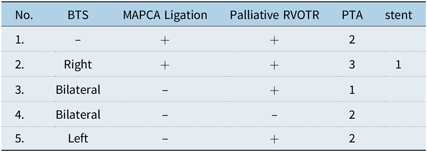
Since 1996, 202 patients have undergone intra-cardiac repair for tetralogy of Fallot in our department. Out of all, five patients (2.5%) have undergone palliative intra-cardiac repair using a fenestrated patch. Diagnosis was tetralogy of Fallot with pulmonary atresia in 4 and tetralogy of Fallot in 1. Operative age was 1–2 years (mean, 1.8 ± 0.3 years), and body weight was 7.5–9.8 kg (8.8 ± 0.9 kg). Previous interventions were Blalock–Taussig shunt in 4 (bilaterally in 3 and unilaterally in 1), palliative reconstruction of the right ventricular outflow tract in 4, and ligation of the major aortopulmonary collateral arteries in 2 (Table 1). Pulmonary artery index of all five patients with diminutive pulmonary arteries was 51.2 ± 22.2 (18–76) mm2/m2 at the first angiography after the birth and was significantly increased to 78.2 ± 27.0 (55–123) mm2/m2 by several surgical interventions prior to the palliative intra-cardiac repair. But pulmonary artery index was still quite small.
Surgical and catheter interventions prior to the palliative intra-cardiac repair.

BTS = Blalock–Taussig shunt; MAPCA = major aortopulmonary collateral arteries; PTA = percutaneous transluminal angioplasty; RVOTR = reconstruction of the right ventricular outflow tract; stent = stent implantation
At operation, the ventricular septal defect was closed via right atriotomy or right ventriculotomy using a fenestrated patch under cardiac arrest. The size of the fenestration was 6 mm in diameter in three patients and 4 mm in 1. The last patient (Patient 1) had a 5-mm-diameter fenestration at first. However, the fenestration was enlarged to 6 mm in diameter at last because of supra-systemic pressure of the right ventricle after weaning from the cardiopulmonary bypass. The right ventricular outflow tract was reconstructed with trans-annular patch (n = 4) or extra-cardiac conduit (n = 1). Follow-up period ranged from 5.2 to 11.2 years (9.8 ± 2.6 years).
Pulmonary artery index, arterial oxygen saturation, systolic pressure of the pulmonary artery, and a systolic pressure ratio of the right/left ventricle were evaluated by cardiac catheterisation before the repair, 6 months after the repair, and at the long term (8.5 ± 0.3 years) after the palliative intra-cardiac repair.
To compare parametric data, Wilcoxon test or Analysis of Variance was used.
Results
There were no operative and late deaths after the palliative intra-cardiac repair.
Fenestration of the patch in all patients was widely open with a right-to-left shunting just after the palliative intra-cardiac repair and before their discharge, but spontaneously closed on its own without any interventions from 1 to 4 years (2.7 ± 2.1 years) after the palliative intra-cardiac repair in four patients except Patient 1. The fenestration of Patient 1 became smaller to 2 mm in diameter 10 years after the palliative intra-cardiac repair, but is still open with a small left-to-right shunt.
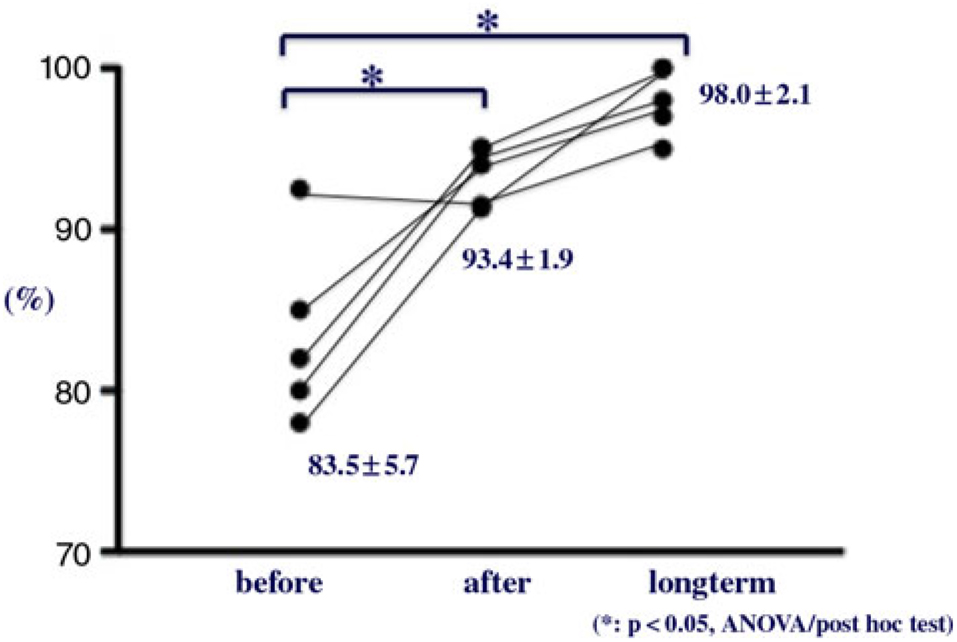
Systemic arterial oxygen saturation was 83.5 ± 5.7% before the palliative intra-cardiac repair; however, systemic arterial oxygen saturation was remarkably increased to 93.4 ± 1.9% after the repair, and to 98.0 ± 2.1% at the long term. Systemic arterial oxygen saturation significantly increased from before the palliative intra-cardiac repair to after the repair, and to at the long term (p < 0.05) (Fig 1).
Changes of systemic arterial oxygen saturation before and after the palliative intra-cardiac repair for tetralogy of Fallot showing significant and dramatic increase of the saturation after the repair and at the long term (p < 0.05).

Pulmonary artery index was 78.2 ± 27.0 mm2/m2 before the palliative intra-cardiac repair, 123 ± 32.3 mm2/m2 after the repair, and 133 ± 25.8 mm2/m2 at the long term. Pulmonary artery index was still quite small but was significantly increased from before the palliative intra-cardiac repair to after the repair, and to at the long term (p < 0.05).
Systolic pressure of the pulmonary arteries was 73.3 ± 27.1 mmHg before the palliative intra-cardiac repair, 84.0 ± 10.3 mmHg after the repair, and 58.4 ± 8.6 mmHg at the long term. Systolic pressure of the pulmonary arteries was significantly decreased at the long term (p < 0.05).
Systolic pressure ratio of the right and the left ventricle was 0.91 ± 0.11 after the palliative intra-cardiac repair and was significantly decreased to 0.76 ± 0.12 at the long term (p < 0.05).
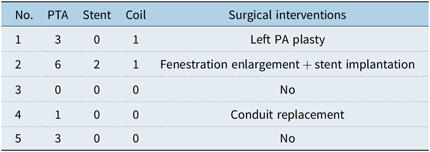
After the palliative intra-cardiac repair, catheter interventions were often needed (Table 2). Percutaneous transluminal angioplasty was carried out 2.6 times for focal stenosis of the peripheral pulmonary arteries in all except Patient 3, coil embolism of major aortopulmonary collateral arteries was carried out in two patients, and stent implantation was 2 times in Patient 2.
Surgical and catheter interventions after the palliative intra-cardiac repair.

PA = pulmonary artery; PTA = percutaneous transluminal angioplasty; stent = stent implantation; coil = coil embolisation
Surgical intervention was carried out in three patients after the palliative intra-cardiac repair. Patient 1 with post-operative percutaneous transluminal angioplasty 3 times underwent patch arterioplasty of the left pulmonary artery 9 years after the repair. A systolic pressure ratio of the right/left ventricle was decreased from 0.9 to 0.6. Now small fenestration was still open with a systemic pulmonary blood flow ratio of 1.2. Patient 2 had supra-systemic pressure of the right ventricle due to a closing fenestration and a progressive stenosis of the left pulmonary artery. Surgical enlargement of the fenestration and stent implantation were emergently carried out 8 months after the palliative intra-cardiac repair. A systolic pressure ratio of the right/left ventricle was decreased from 0.9 to 0.8. Then fenestration was spontaneously closed with a stable condition 2 years after the palliative intra-cardiac repair. Patient 4 with an extra-cardiac conduit repair had a stable post-operative course, but the conduit gradually became stenotic and was replaced with an 18-mm-diameter conduit. A systolic pressure ratio of the right/left ventricle was easily decreased to 0.5.
All patients are doing well with Ross classification class I. No patients put on oxygen. Mean nTerminal of pro-brain natriuretic peptide level is 187 ± 73 (113–273) pg/ml.
Discussion
In patients with tetralogy of Fallot with pulmonary atresia and the diminished pulmonary arteries, various surgeries are carried out to promote growth of the pulmonary arteries. Reference Soquet, Liava’a and Eastaugh1–Reference Gerellia, van Steenberghea and Murtuzaa6 However, due to insufficient growth of the pulmonary arteries, we have to sometimes give up to complete intra-cardiac repair. Reference Soquet, Liava’a and Eastaugh1,Reference Marshall, Love and Lang2 We have carried out palliative intra-cardiac repair using a fenestrated patch for these patients with insufficient growth of the pulmonary arteries; however, there are few reports of the late results of the repair.
Cyanosis is reported to induce synthesis and secretion of atrial natriuretic peptide and reduce systemic cardiac index and systemic oxygen transport, Reference Hopkins and Hall7 leading to impairment of quality of life, exercise limit, and exercise capacity. Reference Saliba, Butera and Bonnet8,Reference Areias, Pinto and Vieira9 Systemic arterial oxygen saturation at rest predicts exercise capacity in these patients. Reference Müller, Hess and Hager10 Patients with the small pulmonary arteries, which might be contraindication to complete repair of tetralogy of Fallot, often suffer from cyanosis when they grow up. To increase systemic arterial oxygen saturation without ventricular volume overload should be remarkedly advantageous for cyanotic patients. The ventricular volume is reduced by division of Blalock–Taussig shunts, and a right-to-left shunt across the both ventricles is restricted by a small fenestration after the palliative intra-cardiac repair. Systemic arterial oxygen saturation dramatically improved after the palliative intra-cardiac repair in all patients and improved again after fenestration closure. Our all five patients are doing well with systemic arterial oxygen saturation of > 95% and are Ross classification class I. The elevation of systemic arterial oxygen saturation without ventricular volume overload would be the most advantageous point after the palliative intra-cardiac repair.
We used 6 mm in diameter fenestration for most of the patients. A bit restrictive fenestration, which restricts right-to-left shunt flow across the fenestration with increasing SpO2, would be needed for these patients with poor growth of pulmonary artery. A large fenestration such as 8 mm in diameter or more for these 8–9 kg infants would not restrict shunt flow across the fenestration. To the contrary, a small fenestration such as 3 mm in diameter or less would much restrict right-to-left shunt with supra-systemic right ventricle pressure. And small fenestration might close early after surgery. We decided 6 mm in diameter fenestration is a basic rule for infants weighing 8–9 kg, and the size was successfully used in four patients. And 5 mm in diameter fenestration was used for a smallest patient weighing 7.5 kg. A bit restrictive fenestration would be needed for this palliative intra-cardiac repair of tetralogy of Fallot with diminutive pulmonary arteries.
Another important concern would be an occurrence of supra-systemic pressure of the right ventricle and failure of the right ventricle after the palliative intra-cardiac repair. Supra-systemic pressure of the right ventricle might occur by closing fenestration or progressive stenosis of the pulmonary arteries after the palliative intra-cardiac repair. Marshall et al reported that 7 patients of all 27 went on to death or failure of the right ventricle. Reference Marshall, Love and Lang2 In our series, Patient 2 with the smallest pulmonary artery index had supra-systemic pressure of the right ventricle 8 months after the palliative intra-cardiac repair and needed emergent surgery. However, echocardiography showed gradual elevation of pressure of the right ventricle with slowly closing fenestration after the palliative intra-cardiac repair. Simple fenestration of the patch might slowly close, comparing with one-way fenestrated patch. Other four patients have an acceptable haemodynamics without supra-systemic pressure of the right ventricle even after spontaneous fenestration closure. Their pre-operative pulmonary artery index ranged from 55 to 120 mm2/m2. Small pulmonary artery index might be a risk of supra-systemic pressure of the right ventricle after the palliative intra-cardiac repair. It is unknown whether the palliative intra-cardiac repair is appropriate to patients with smaller pulmonary artery index than our patients. Close observation by echocardiography would be needed after the palliative intra-cardiac repair.
When growth of the pulmonary arteries is obtained with decrease of the pulmonary vascular resistance after the palliative intra-cardiac repair, patients might suffer from excessive pulmonary blood flow across the fenestration. Reference Marshall, Love and Lang2 Marshall et al reported that 4% of all palliative intra-cardiac repair had an excessive pulmonary blood flow after the palliative intra-cardiac repair. No patients suffered from an excessive pulmonary blood flow after the palliative intra-cardiac repair in our series as well. Massive growth of the pulmonary arteries might have a major difficulty in these patients with extremely small pre-operative pulmonary artery index.
Our data showed increase in pulmonary artery index and decrease in systolic pressure of the pulmonary arteries after the palliative intra-cardiac repair. Blood flow supplied from the right ventricle might grow the pulmonary arteries. But there was no significant difference in pulmonary artery index between after the repair and at the long term. Systolic pressure of the pulmonary arteries significantly decreased at the long term. Pulmonary vascular resistance would be gradually decreased after the palliative intra-cardiac repair and repeated catheter interventions.
Learn et al reported that multiple interventions are essential for this entity. Reference Learn, Phillips and Chisolm11 Catheter interventions were carried out 11 times for our five patients with focal pulmonary stenosis before the palliative intra-cardiac repair, and over 20 times after the palliative intra-cardiac repair. Surgical interventions for focal pulmonary stenosis were also carried out in two patients after the palliative intra-cardiac repair. These procedures were needed to decrease pressure of the right ventricle. Catheter interventions for focal and multiple stenoses of the pulmonary arteries would be essential for this entity as well as surgical angioplasty of the pulmonary arteries.
In summary, palliative intra-cardiac repair with a fenestrated patch had good late results and improved quality of life, suggesting that the palliative intra-cardiac repair might be a choice in patients with tetralogy of Fallot associated with insufficient growth of the pulmonary arteries.
Author ORCIDs
Yoichi Kawahira 0000-0003-1228-1519
Acknowledgements
None.
Financial Support
This research received no specific grant from any funding agency, commercial or not-for-profit sectors.
Conflict of Interest
None.