


In 1998, Mikuláš Dzurinda, a 43-year-old politician, was elected as the Prime Minister of Slovakia after the September parliamentary election. Corruption was a key factor in the Slovak people deciding to elect Dzurinda and his party. Corruption was the principal reason the EU did not agree with the membership of Slovakia in the EU (European Commission, 1997). Due to the high level of corruption during the tenure of former Prime Minister Vladimír Mečiar, Slovak citizens wanted to bring a reform-oriented government (Pawelke, Reference Pawelke2012), and Slovakia subsequently became a member of the EU under Dzurinda’s leadership. Similarly, Einars Repše, a 40-year-old politician, became the Prime Minister of Latvia after the 2002 parliamentary election. Anti-corruption reform was a major issue in this election (Deloy, Reference Deloy2002), and Repše, a young leader of the New Era Party (Jaunais laiks), was known for his charisma and honesty (BBC News, 2002). During the election campaign, Repše promised to combat corruption and put an end to tax evasion. His party won the most legislative seats in the 2002 parliamentary election, thereby allowing him to lead the coalition government. The 2006 Ecuadorian presidential election also highlighted the correlation between the demands for anti-corruption reforms and the election of young political leaders. Rafael Correa was elected at the age of 43, after three former Presidents had been ousted due to corruption and poor economic policy.
These examples suggest that young leaders can emerge when voters demand anti-corruption reforms. More broadly, recent scholarship has paid increasing attention to the selection of elected political leaders. Studies have examined how political, social, and economic factors influence the background of elected politicians, including gender and education (Besley and Reynal-Querol, Reference Besley and Reynal-Querol2011; O’Brien, Reference O’Brien2015; Armstrong et al., Reference Armstrong, Barnes, O’Brien and Taylor-Robinson2022). Recent work has also examined age as an important dimension of political representation and candidate evaluation (Webster and Pierce, Reference Webster and Pierce2019; Buchmeier and Vogt, Reference Buchmeier and Vogt2024; McClean and Ono, Reference McClean and Ono2024; Stockemer and Sundström, Reference Stockemer and Sundström2025). However, less is known about whether corruption makes younger leaders more electorally attractive. We address this question by examining whether corruption increases voters’ demand for younger leaders who may be perceived as less tied to entrenched political networks.
Age plays a significant role in shaping public perception of politicians. Older politicians may be perceived as less energetic than their younger counterparts. In the 2008 US presidential election, Barack Obama’s campaign effectively employed the ‘old politics’ rhetoric, by drawing attention to John McCain’s age. This strategy was effective, considering that more than half of Americans believed that being old was an undesirable characteristic for a president (Carroll, Reference Carroll2007). Voters who viewed McCain as too old were more likely to support Obama (Kenski and Jamieson, Reference Kenski and Jamieson2010). Younger politicians may also be perceived as more likely to pursue policy reforms that appeal to voters who desire change. Emmanuel Macron, the youngest French President, was elected in the 2017 French presidential election based on his proposals for extensive economic reforms that promised to revitalize the stagnant French economy and break with the country’s old political and economic systems.
In this study, we argue that in environments with widespread corruption, younger leaders are more likely to be elected than older ones. Corruption often spurs voters to demand transformational leadership, which can shake up the status quo and institute anti-corruption measures. In such circumstances, voters tend to favour leaders who are energetic and willing to take risks, traits which are typically associated with youthfulness (Lehman, Reference Lehman1953; Glenn, Reference Glenn1974; Spisak et al., Reference Spisak, Grabo, Arvey and van Vugt2014).
To test our argument, we first explore cross-country data on heads of government in democratic countries between 2001 and 2020 and find a general pattern: higher levels of corruption are associated with the election of younger leaders. Additionally, using Afrobarometer survey data from 15 countries between 2019 and 2020, we examine the individual-level relationship between perceived corruption and support for institutional rules that favour younger presidential candidates. The results suggest that, in the presence of high corruption, citizens are more likely to support maximum age limits for presidential candidates. Together with the cross-country evidence, this finding suggests that corruption is associated not only with the election of younger leaders at the macro level but also with public support for rules that make younger candidates more electorally viable.
This study makes two contributions to the existing literature: First, it expands the growing body of research on leadership selection and youth representation by examining the circumstances in which young leaders become electorally attractive. While age plays a key role in shaping voters’ decision-making heuristics (Webster and Pierce, Reference Webster and Pierce2019; McClean and Ono, Reference McClean and Ono2024), leaders’ ages have not received sufficient attention in prior studies of political leaders. Existing studies on youth representation have mainly documented the underrepresentation of young people in elected office and examined the institutional and party-level factors that shape their access to political careers (Joshi, Reference Joshi2013; Stockemer and Sundström, Reference Stockemer and Sundström2018; Kurz and Ettensperger, Reference Kurz and Ettensperger2024). Building on recent work showing that young candidates are not always disadvantaged in electoral competition (Belschner, Reference Belschner2023), our study asks when youth becomes an electorally valuable leader characteristic. Second, the study adds to the literature on political corruption by showing how corruption influences voters’ preferences for particular leader characteristics. We provide cross-national evidence that corruption is associated with the election of younger political leaders, and individual-level evidence that citizens who perceive corruption as more widespread are more likely to support institutional rules that favour younger candidates. By doing so, this study shifts attention from the supply of candidates to the demand-side conditions under which voters become more favourable toward younger leaders.
1. Consequences of corruption
Corruption is defined as ‘the misuse of public office for private gain’ (Sandholtz and Koetzle, Reference Sandholtz and Koetzle2000: 32). Typically, corrupt politicians use their public positions to achieve private gains for themselves, their groups, and parties.
Corruption generally has a negative impact on both politics and the economy. Politically, corruption undermines democratic legitimacy and erodes citizens’ trust in democratic institutions (Anderson and Tverdova, Reference Anderson and Tverdova2003; Donovan and Karp, Reference Donovan and Karp2017). When corruption undermines the rule of law and legal procedures are not applied equally across individuals in society, citizens lose trust in democratic governance. Economically, corruption undermines the foundation of economic development by reducing private companies’ incentives to invest in technological innovation, leading to lower economic growth (Mauro, Reference Mauro1995). It also impedes human capital development because corrupt bureaucrats have little incentive to allocate government resources to education, as it is difficult to collect bribes from the education sector (Mauro, Reference Mauro1998). Therefore, the education sector tends to be underfunded in societies prone to corruption.
Existing studies have examined the impact of political corruption on voting behaviour and electoral outcomes. Some studies (e.g., Peters and Welch, Reference Peters and Welch1980) find that corruption leads to electoral losses for incumbent candidates, because voters hold politicians accountable for corruption. However, others suggest that corruption may not necessarily harm the electoral fortunes of corrupt incumbents if voters have strong ties to political parties (Ecker et al., Reference Ecker, Glinitzer and Meyer2016) or when opposition parties are ideologically distant from voters (Elia and Schwindt-Bayer, Reference Elia and Schwindt-Bayer2022). Additionally, voters’ ability to punish corrupt politicians is affected by the availability of information on corrupt practices (Ferraz and Finan, Reference Ferraz and Finan2008) and the existence of viable electoral alternatives (Klašnja et al., Reference Klašnja, Tucker and Deegan-Krause2016; Agerberg, Reference Agerberg2020). Even in highly corrupt countries, voters may tolerate corruption when politicians deliver good policy performance. In contrast, voters react negatively to corruption, regardless of policy performance, in countries with low corruption (Klašnja and Tucker, Reference Klašnja and Tucker2013).
Despite extensive research on the consequences of corruption, its effects on voters’ preferences for particular types of political leaders have not been extensively explored. In other words, previous studies have not provided satisfactory answers to questions about the types of leaders that voters prefer when corruption is prevalent. This study attempts to overcome this limitation by exploring how corruption affects voters’ demand for young leaders, who are perceived as being relatively free from corruption-prone environments and as possessing the energy to implement anti-corruption reforms. Previous studies have suggested that high levels of corruption can lead voters to support alternative types of political candidates such as political outsiders (Carreras, Reference Carreras2012) and female leaders (O’Brien, Reference O’Brien2015). Building on these studies, we argue that young leaders can also be attractive alternatives to voters in this context, as they can be perceived as less likely to be part of entrenched corruption networks, and may have the energy to bring about substantive political reforms and fight corruption.
2. Corruption and young leaders
Voters often use heuristics to infer candidates’ likely policies and competencies (Popkin, Reference Popkin1991; Lupia, Reference Lupia1994). They use a candidate’s partisanship (Sniderman et al., Reference Sniderman, Brody and Tetlock1991), gender (Aguilar et al., Reference Aguilar, Cunow and Desposato2015), class identity (Carnes and Lupu, Reference Carnes and Lupu2016), and even facial appearance (Todorov et al., Reference Todorov, Mandisodza, Goren and Hall2005) to evaluate their competence. Similarly, we argue that a politician’s age can shape voters’ preference heuristics. Age is frequently used by voters as a shortcut to evaluate candidates and derive information about their characteristics, especially in low-information environments (Webster and Pierce, Reference Webster and Pierce2019). Older politicians are often viewed as more experienced, while younger ones are perceived as more energetic and more closely associated with change (Caprara et al., Reference Caprara, Vecchione, Barbaranelli and Fraley2007; Spisak et al., Reference Spisak, Grabo, Arvey and van Vugt2014). Relatedly, a growing literature has examined age as an important dimension of political representation, including youth underrepresentation, age affinity in voting, demographic ageing, and voter evaluations of candidates’ age (Buchmeier and Vogt, Reference Buchmeier and Vogt2024; McClean and Ono, Reference McClean and Ono2024; Stockemer and Sundström, Reference Stockemer and Sundström2025). Although much of this literature focuses on youth representation and access to elected office, our study examines when and why age becomes politically meaningful in voters’ evaluations of national leaders. Building on recent work showing that younger candidates are not always disadvantaged in electoral competition (Belschner, Reference Belschner2023), we ask whether corruption makes youthfulness an electorally valuable signal of political renewal and anti-corruption reform.
At the macro-level, corruption can create political conditions under which younger leaders become electorally attractive. In societies where corruption is rampant, corrupt behaviour is often embedded in informal political networks and can be considered as an optimal strategy for political actors to attain private gains (Mishra, Reference Mishra2006). Such networks may lead voters to view existing political elites as part of the corrupt status quo. As corruption becomes more salient, voters may therefore become more willing to support leaders who appear distant from entrenched political arrangements and capable of breaking with this status quo.
This expectation draws on related research in gender and corruption. Studies show that women may become politically valuable in corrupt contexts because they are often perceived as less embedded in male-dominated political networks and can signal anti-corruption commitment (Bjarnegård, Reference Bjarnegård2013; Carroll and Dittmar, Reference Carroll, Dittmar, Dahlerup and Leyenaar2013; Armstrong et al., Reference Armstrong, Barnes, O’Brien and Taylor-Robinson2022). Building on this logic, we argue that younger politicians may be similarly viewed as less tied to entrenched political arrangements because of their shorter political careers and limited access to established elite networks. Youthfulness may therefore become electorally valuable when corruption is widespread because it can signal distance from the existing political order and a greater willingness to pursue reform.
At the micro-level, this argument rests on how voters interpret the age of political leaders. Youthfulness may serve as a heuristic for political renewal and anti-corruption reform since voters may view young politicians as less likely to have access to corruption networks, which are typically dominated by older politicians (Krook and Nugent, Reference Krook and Nugent2018). For instance, McClean and Ono (Reference McClean and Ono2024) show that voters perceive younger candidates as less experienced but more likely to focus on anti-corruption and other future-oriented policy issues. When corruption is salient, these perceptions may make younger candidates more attractive to voters seeking political change. In such contexts, voters may prefer younger candidates over older ones since younger leaders are often perceived as more energetic and creative, and thus more likely to challenge the status quo and enact meaningful change.
The case of Rafael Correa illustrates this logic. At the age of 43, Correa ran for the 2006 Ecuadorian presidential election after the forceful ousting of three former Presidents due to the mass protests against poor economic policy performance and corruption. During his campaign, Correa portrayed himself as a leader of the political revolution, fighting corrupt politicians, and described his principal opponent, Álvaro Noboa, as an exploitative oligarch. His image as a young reformist contributed to his decisive victory in the election in a context of widespread dissatisfaction with the existing political order (Conaghan and de la Torre, Reference Conaghan and de la Torre2008).
Taken together, this discussion suggests that corruption can increase voters’ willingness to support younger leaders. At the macro-level, corruption generates dissatisfaction with established political elites and creates demand for political renewal. At the micro-level, voters may use candidate age as a heuristic for evaluating whether politicians are tied to entrenched corrupt networks or capable of pursuing anti-corruption reform. Since younger leaders are more likely to be perceived as less tied to existing political arrangements and more associated with change than stability, youthfulness may become electorally valuable in democratic contexts characterized by high levels of corruption. We therefore propose the following hypotheses:
H1. In democratic countries, higher levels of corruption are associated with younger leaders coming to power.
H2. Citizens who perceive corruption as more widespread are more likely to support institutional rules that favour younger candidates.
3. Macro-level analysis: corruption and leaders’ age
3.1. Data and model
Utilizing a panel of 110 democracies between 2001 and 2020, we conduct a country-level analysis to investigate whether higher corruption is associated with younger leaders coming to power and staying in office. We restrict our analysis to democratic countries, as it is difficult for citizens to hold political leaders accountable for corruption in autocracies due to the absence of free and fair elections. We define democracy using the updated Boix et al. (Reference Boix, Miller and Rosato2013) measure. The countries included in the sample are listed in Table A1.
The dependent variable is the age of the chief executive (Leader’s Age). We obtain leaders’ birth-year information from the Archigos dataset (Goemans et al., Reference Goemans, Gleditsch and Chiozza2009). Because Archigos ends in 2015, we extend the coverage using the WhoGov dataset (Nyrup and Bramwell, Reference Nyrup and Bramwell2020), which identifies leaders under the same definition. We code the chief executive as the effective head of government – the president in presidential systems, the prime minister in parliamentary systems, and, in semi-presidential systems, whichever office wields predominant executive power (e.g., the president in France, where the presidency is comparatively strong, but the prime minister in Portugal, where it is comparatively weak). For each year, we identify the leader in office on December 31; because WhoGov records incumbents as of July, we realign it to this year-end benchmark to obtain a consistent annual snapshot. We then compute each leader’s age in every country-year; the average leader is 57.2 years old.
The independent variable is the level of corruption (Corruption). Because corrupt acts are largely unobservable, actual corruption is difficult to measure directly, and cross-national data on reported or experienced corruption are unavailable. We therefore choose the second-best option to measure corruption – the Corruption Perceptions Index (CPI) collected by Transparency International. This measure captures expert and business assessments of public-sector corruption on a 0–100 scale. We reverse the scale so that higher values denote more corruption.
We measure corruption as a three-year average. First, it is theoretically more appropriate to assume that the public’s perception and information about corruption are formed through accumulation over an extended period, rather than being driven by short-term events within a single year. Additionally, perception-based measures such as Transparency International’s CPI, which is used in this study, rely on the subjective evaluations of experts. Consequently, they are susceptible to short-term noise and sharp fluctuations caused by idiosyncratic events in a given year. By using a three-year average, we smooth out these temporary fluctuations and more accurately capture the structural corruption trend of a country.
We include several control variables that may affect the selection of young leaders. First, we include GDP per capita. Because wealthier countries offer greater private sector opportunities (Besley and Reynal-Querol, Reference Besley and Reynal-Querol2011), public service becomes less attractive to young talent, decreasing the likelihood of young leaders emerging. Second, we include the GDP growth rate (GDP Growth). Citizens would elect young leaders to demand economic reform if the incumbent leader does not exhibit good economic performance. Third, we include the proportion of the population aged 65 and above (The Elderly). A higher proportion of the elderly deters young candidates from being elected. These controls were obtained from the World Bank.
We also control several political factors. First, we control presidentialism from Nyrup and Bramwell (Reference Nyrup and Bramwell2020). Compared to parliamentary systems, presidential democracies allow for the election of inexperienced, personalistic leaders. Moreover, stronger executive control over the cabinet and lower legislative accountability (Linz, Reference Linz1990) create structural conditions that may foster presidential corruption. Second, we add the age of the governing party. This variable may confound the relationship between a leader’s age and corruption, as young leaders are more likely to join newer parties expected to initiate anti-corruption reforms. Lastly, we include mean district magnitude to control for the overall supply of young political talent. By lowering legislative entry barriers for youth (Stockemer and Sundström, Reference Stockemer and Sundström2018), larger district magnitudes naturally expand the candidate pool from which chief executives are typically drawn. We obtained both the age of the governing party and mean district magnitude from the Database of Political Institutions (DPI; Cruz et al., Reference Cruz, Keefer, Scartascini and Simpser2023).
Our macro-level analysis uses time-series cross-sectional (TSCS) data. TSCS data have issues with contemporaneous correlations, heteroskedasticity, and unit heterogeneity, which would violate certain assumptions of ordinary least squares estimation. Thus, we use Prais-Winsten regressions to correct first-order autocorrelation within panels, and panel-corrected standard errors to account for heteroskedasticity. We added country- and year-fixed effects to control unobserved country- and year-specific characteristics that are related to the likelihood of young leaders being elected and staying in power. Considering Nickell’s bias (Reference Nickell1981), we do not include the lagged dependent variable (LDV), because including the LDV and fixed effects in the same model can create an endogeneity problem between the LDV and the fixed effects.
3.2. Empirical results
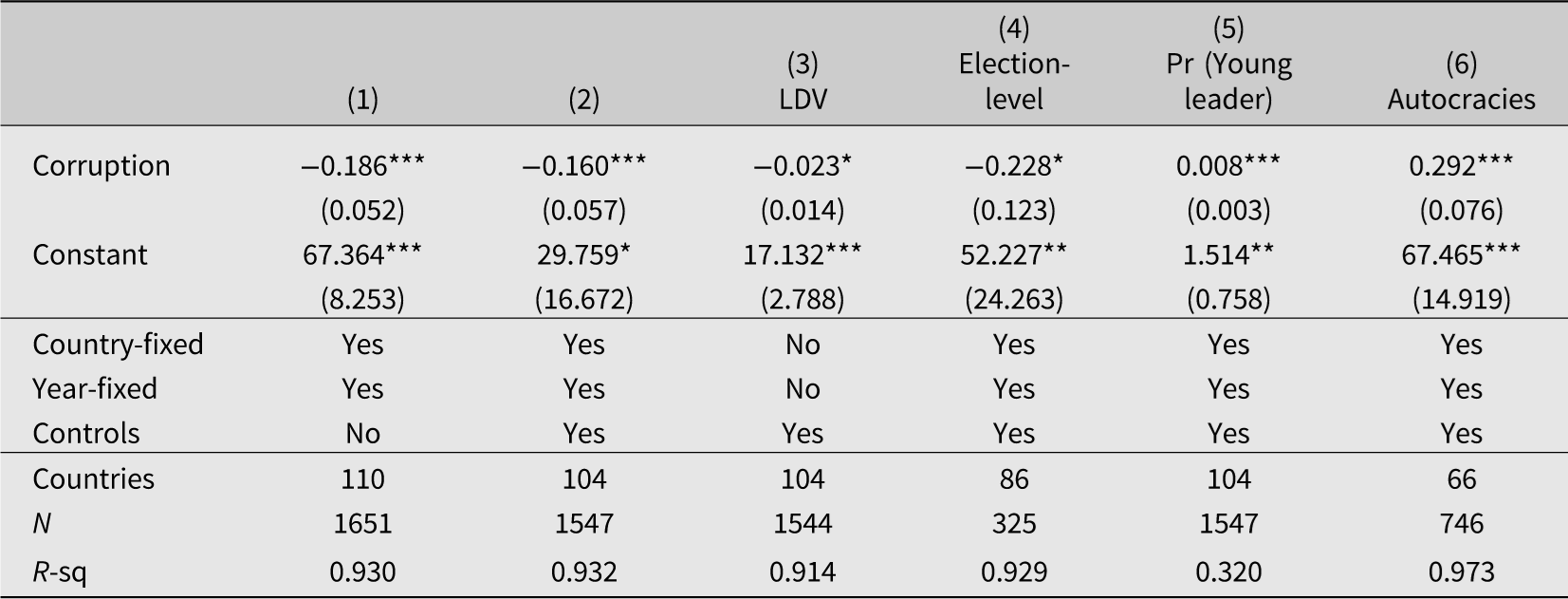
Table 1 reports the relationship between corruption and the age of political leaders. Models 1 and 2 present the core specification, without and with controls, respectively.
Corruption and leader’s age

Table 1. Long description
The table presents the relationship between corruption and the age of political leaders. It includes six columns and six rows of data. Column headers are (1), (2), (3) LDV, (4) Election-level, (5) Pr (Young leader), and (6) Autocracies. Row labels are Corruption, Constant, Country-fixed, Year-fixed, Controls, Countries, N, and R-sq. Row 1: Corruption, -0.186***, -0.160***, -0.023*, -0.228*, 0.008***, 0.292***. Row 2: Constant, 67.364***, 29.759*, 17.132***, 52.227**, 1.514**, 67.465***. Row 3: Country-fixed, Yes, Yes, No, Yes, Yes, Yes. Row 4: Year-fixed, Yes, Yes, No, Yes, Yes, Yes. Row 5: Controls, No, Yes, Yes, Yes, Yes, Yes. Row 6: Countries, 110, 104, 104, 86, 104, 66. Row 7: N, 1651, 1547, 1544, 325, 1547, 746. Row 8: R-sq, 0.930, 0.932, 0.914, 0.929, 0.320, 0.973.
Note: All models are estimated with the Prais-Winsten regression; panel-corrected standard errors are presented in parentheses. The complete results are presented in Table A2. *p < 0.1, **p < 0.05, ***p < 0.01.
The coefficient estimate of corruption is significant and negative across both models. As hypothesized, in democracies, higher prior corruption is related to the election of younger leaders. Specifically, the empirical results in Model 2 indicate that a one-unit increase in corruption corresponds to a reduction of 0.16 years in the age of the leader subsequently in office; moving from the 10th to the 90th percentile of corruption corresponds to a predicted difference of roughly 9.5 years. This finding implies that voters in democracies replace the incumbent leader with a younger one to demand accountability for corruption and implement anti-corruption policies. We further estimate the models in Table A3 using an alternative measure of democracy – V-Dem’s electoral democracy index (Coppedge et al., Reference Coppedge, Gerring, Knutsen, Lindberg, Teorell, Altman, Angiolillo, Bernhard, Cornell, Fish, Fox, Gastaldi, Gjerløw, Glynn, Good God, Hicken, Kinzelbach, Krusell, Marquardt, McMann, Mechkova, Medzihorsky, Neundorf, Paxton, Pemstein, Pernes, von Römer, Seim, Sigman, Skaaning, Staton, Sundström, Tannenberg, Tzelgov, Wang, Wig, Wilson and Ziblatt2026) – and find that the results continue to support our argument. Following the recommendation of Angrist and Pischke (Reference Angrist and Pischke2009), we also estimate Model 3 with LDV but without fixed effects. The result continues to support our argument.
The framing above implies that corruption is linked not only to who governs but also to who comes to power. To directly capture whether prior corruption is related to younger leaders’ rise to power, Model 4 restricts the analysis to elections that determine the chief executive and uses the incoming leader’s age at accession as the dependent variable.Footnote 1 Here, a one-unit increase in prior corruption is associated with a 0.23-year decrease in the incoming leader’s age, indicating that voters tend to select younger leaders. Because a continuous age measure may not speak directly to the probability that a young leader is elected, Model 5 replaces the outcome with a binary indicator for whether the leader in office is young (aged 50 or below) and estimates a linear probability model. A one-unit increase in prior corruption corresponds to an increase in the probability of a young leader holding office. A one-standard-deviation increase in prior corruption (SD ≈ 21.3) corresponds to a roughly 17-percentage-point increase in the probability that a young leader holds office – a substantively large shift. Finally, Model 6 estimates the same specification among autocracies, where the sign reverses: under autocracy, higher prior corruption is followed by older leaders. Because autocracies lack the competitive elections through which citizens could express discontent over corruption and elect younger leaders, this reversal is consistent with an electoral mechanism and supports restricting our analysis to democracies.
3.3. Robustness checks
We ran additional models to check the robustness of the main findings. First, to show that our findings do not rely on a particular time window, Models 1–4 in Table A4 use one-, two-, four-, and five-year averages of the corruption measures. The coefficient for corruption is negative and significant across all windows (top of Figure 1). Second, Models 1–3 in Table A5 serve as a falsification test using future corruption (t + 1, t + 2, and t + 3). Since a leader’s age cannot be affected by future corruption, a significant coefficient would suggest that our findings reflect spurious correlation rather than a temporally ordered relationship. However, the coefficients for future corruption are not significant (bottom of Figure 1), indicating that only prior corruption is correlated with leader age.
Models using alternative lagged time windows and future corruption.
Note: Point estimates with 95% confidence intervals from Models in Tables A4 and A5. The top panel uses cumulative (lagged) corruption averaged over one to five years; the bottom panel uses future corruption (t + 1 to t + 3) as a placebo.

Third, an astute reader may worry that our results reflect a preference for less experienced leaders rather than younger ones – that is, that age merely proxies for experience. We address this in two steps (Table A6 and Figure 2). In Model 1, we add the logged number of leaders’ years in politics from Baturo and Elkink (Reference Baturo and Elkink2022) directly to the main model; prior corruption continues to predict younger leaders even after controlling for experience. To separate the two attributes, we residualize each on the other: Experience-adjusted Age (Model 2) is the portion of leader age not explained by experience, and Age-adjusted Experience (Model 3) is the portion of experience not explained by age. Prior corruption is significantly associated with experience-adjusted age but not with age-adjusted experience (Figure 2). The corruption signal thus operates through age rather than experience: under higher corruption, it is younger leaders per se – not merely less experienced ones – who come to power.
Disentangling age and political experience.
Note: Point estimates of the coefficient on corruption (three-year average) with 95% confidence intervals from the models in Table A6. The dependent variable is leader age, the component of age orthogonal to experience (Experience-adjusted Age), and the component of experience orthogonal to age (Age-adjusted Experience), respectively.

Fourth, we re-estimate our main models while excluding countries that disproportionately elect young leaders – those whose average leader age falls below the 1st, 5th, and 10th percentiles – to ensure that these cases do not drive our findings (Table A7). The results remain robust. We also re-estimate our models while excluding populist governing parties (Lührmann et al., Reference Lührmann, Düpont, Higashijima, Kavasoglu, Marquardt, Bernhard, Döring, Hicken, Laebens, Lindberg, Medzihorsky, Neundorf, Reuter, Ruth-Lovell, Weghorst, Wiesehomeier, Wright, Alizada, Bederke, Gastaldi, Grahn, Hindle, Ilchenko, von Römer, Wilson, Pemstein and Seim2020) (Table A8). Because populist parties employ anti-establishment rhetoric (Mudde, Reference Mudde2004) that aligns with the radical reforms favoured in highly corrupt countries, and because populist leaders tend to be younger than those in traditional parties, our findings could partly reflect corruption driving the rise of populists. However, the coefficient on corruption remains negative and significant across all models, indicating that the link between corruption and younger leaders does not simply reflect the rise of populist parties. Lastly, strong incumbent performance may weaken voters’ demand for anti-corruption reform and thus reduce the likelihood of younger leaders rising to power, since voters may not hold well-performing politicians accountable for corruption (Klašnja and Tucker, Reference Klašnja and Tucker2013). To test this, we add an interaction between GDP Growth and Corruption (Table A9). The coefficient on corruption remains negative and significant, but the interaction term is not significant, indicating that good economic performance does not diminish the association between corruption and leader age.
4. Micro-level evidence: perceptions of corruption and introduction of an age limit for presidential candidates
4.1. Data and model
We conducted an additional micro-level analysis using the Afrobarometer survey data from 15 African democracies between 2019 and 2020.Footnote 2 We use the updated version of Boix et al. (Reference Boix, Miller and Rosato2013) democracy measure to define democratic countries in Africa. We explored how citizens’ perceived corruption shapes their preferences for young leaders through their support for introducing a maximum age limit for presidential candidates. This allowed us to investigate whether voters who perceive corruption as widespread prefer younger political leaders who may be perceived as more reformist and less tainted by corruption.
African countries are ideal testing grounds for our hypothesis because of the prevalence of corruption in African politics. African leaders are known to have considerable discretion over public resources and engage in corrupt behaviour for their personal gain (Bratton and van de Walle, Reference Bratton and van de Walle1997). Although anti-corruption agencies were introduced in the 1990s and the 2000s, corrupt African leaders intervened in these measures, thus reducing their effectiveness (Anders, Reference Anders2019). Transparency International (2021) reported that Sub-Saharan Africa is the lowest-performing region in terms of corruption, with 58% of respondents reporting increased corruption in their countries in the past year. Approximately 25% of African citizens have paid bribes to access public services (Transparency International, 2021), with the poor being particularly vulnerable to corrupt behaviour. Corruption in Africa has had a negative impact on the fight against poverty (Hope, Reference Hope, Hope and Chikulo2000).
The dependent variable is citizens’ support for the introduction of the maximum age limit for top executives (Support for Maximum Age Limit). Because the Afrobarometer does not directly ask whether respondents prefer younger leaders, we use support for an age limit as a behavioural proxy: a maximum age limit is an institutional rule that mechanically advantages younger candidates by restricting older ones, so supporting it may show a preference for rules favouring younger leaders. The Afrobarometer Round 8 survey data contain questions about citizens’ preferences for introducing maximum age limits for presidents and prime ministers in presidential and parliamentary systems, respectively. The variable is coded 1 for support and 0 for no support, and we expect the likelihood of support to increase as perceived corruption rises.
The independent variable is the respondents’ perception of the level of corruption (Perceptions of Corruption). We use answers to the question of how much the level of corruption in the country has increased or decreased on a scale of 1 to 5 (1 = increased a lot, 5 = decreased a lot). For ease of interpretation, we reversed the scale of this variable; a higher value indicated a more negative perception of corruption.
We include six individual-level controls. We control for gender (Female), since in many male-dominated African contexts women may more readily support reform-oriented younger leaders, and for urban residence, as urban Africans tend to be more oriented toward individual liberties than communal solidarity (Bratton and Mattes, Reference Bratton and Mattes2001). We control for respondents’ Age, since voters tend to prefer candidates closer to their own age (Webster and Pierce, Reference Webster and Pierce2019). We include Education (the Afrobarometer’s aggregate measure, 1 = no formal schooling to 4 = tertiary or above) and Wealth, an asset-based indicator widely used where income data are unavailable (Houle, Reference Houle2015): the count of six assets owned (radio, television, motor vehicle, computer, bank account, and mobile phone), from 0 to 6. Finally, we control for respondents’ perceptions of national economic conditions, since negative assessments may heighten demand for reform. In addition, following our country-level analysis, we include the macro-level controls GDP per Capita, GDP Growth, and the Elderly. We also add a country-level measure of corruption – Transparency International’s CPI (TI CPI) – and reverse the scale so that higher values indicate more corruption; including this control allows us to distinguish the individual-level association between perceived corruption and support for an age limit from cross-national differences in countries’ macro-level corruption.
We test our hypothesis using multilevel logit models, which are appropriate because our data have a two-level hierarchical structure: individual survey respondents (level 1) are nested within their countries (level 2). We allow varying intercepts because respondents in the same country share common unobservable characteristics at the national level – such as age-related cultural norms or a legacy of long-serving elderly leaders – that shape the baseline likelihood of supporting an age limit. We also allow varying slopes, meaning that the strength of the relationship between perceived corruption and support for an age limit differs across countries: where competitive elections make responsibility for corruption clear and where viable younger alternatives can enter politics, perceived corruption should more readily translate into support for institutional change. This approach lets us account for the within-country correlation among responses as well as cross-national differences in how corruption perceptions relate to the dependent variable.
4.2. Empirical results
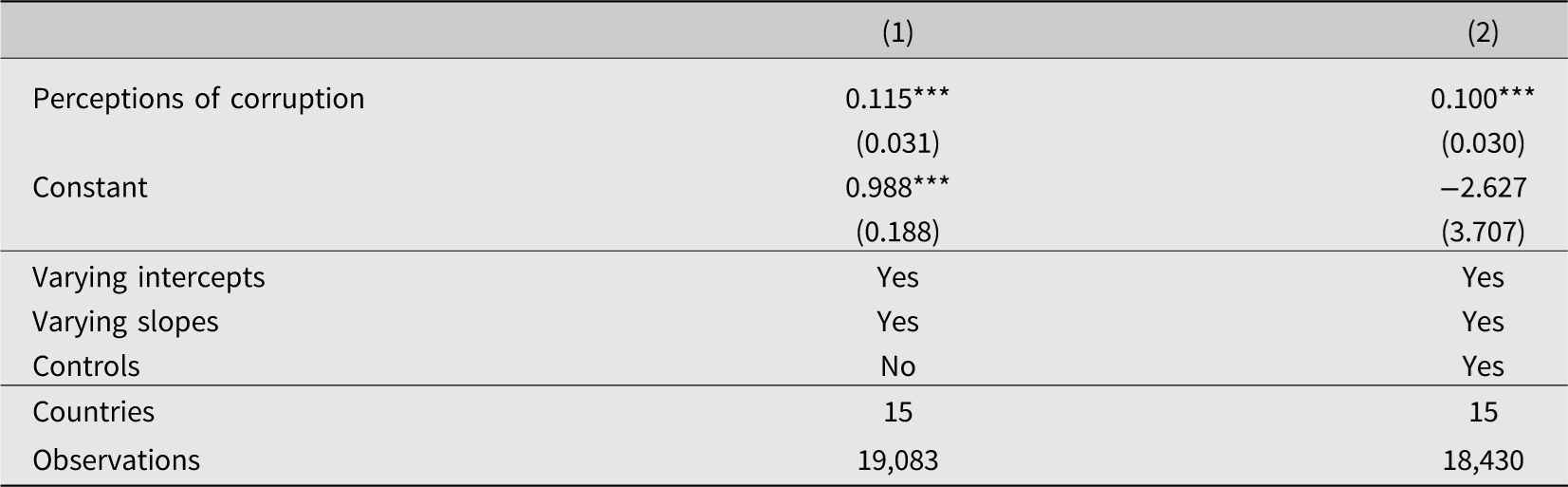
The empirical findings in Table 2 support our second hypothesis that more negative perceptions of corruption increase voters’ demands for young leaders, as reflected in their support for introducing a maximum age limit for presidential candidates. Model 1 is estimated with the main independent variable only, whereas Model 2 includes both the independent variable and controls.
Perceptions of corruption and support for the maximum age limit for presidential candidates

Table 2. Long description
A table with two columns and eight rows. The columns are labeled (1) and (2). The rows are labeled Perceptions of corruption, Constant, Varying intercepts, Varying slopes, Controls, Countries, and Observations. Row 1: Perceptions of corruption, 0.115***, (0.031), 0.100***, (0.030). Row 2: Constant, 0.988***, (0.188), -2.627, (3.707). Row 3: Varying intercepts, Yes, Yes. Row 4: Varying slopes, Yes, Yes. Row 5: Controls, No, Yes. Row 6: Countries, 15, 15. Row 7: Observations, 19,083, 18,430.
Note: All models are estimated with multilevel logit models. Standard errors are shown in parentheses. The complete results are presented in Table A11. ***p < 0.01.
The empirical results reveal that citizens’ perceptions of corruption are significantly associated with the dependent variable across all the models. Specifically, respondents who perceived an increase in corruption are more likely to support the introduction of a maximum age limit for top executives (Models 1 and 2). Given that the average maximum age limit suggested by respondents is 66 years, approximately 26.7% of incumbent leaders in our sample would be ineligible to run in the next election if such a limit were implemented.
Figure 3 depicts predicted support for the maximum age limit and illustrates these findings, with the coefficient estimate from Model 2 in Table 2. We observe that citizens with the most favorable assessment of the corruption trend (decreased a lot) have a predicted 0.75 probability of supporting the maximum age limit. In contrast, those with the worst perception of corruption (increased a lot) have a 0.81 probability of supporting this limit.Footnote 3 Maximum age limits are typically constitutional, and amending an entrenched provision often requires overwhelming approval – in Ghana, at least 75% of those voting (Constitution of Ghana, Art. 290(4)). Given that support already hovers around this 75% threshold, a 5-percentage-point increase in support for such a ceiling is far from trivial and could prove decisive for passage.
Effect of perception of corruption on preferences for young presidential candidates.
Note: Predicted probabilities from Model 2 in Table 2.

Among the controls, education and wealth correlate positively with support for an age limit, consistent with these groups being more open to institutional reform, whereas favourable economic perceptions correlate negatively – mirroring our argument that dissatisfaction fuels demand for reform-oriented leaders. The country-level corruption index (TI CPI) shows the expected sign but is not significant – unsurprising for a second-level predictor estimated across only 15 countries, where statistical power is limited.
4.3. Robustness checks
We run additional models to check the robustness of the main empirical findings. First, we estimate models in Table A12 to probe the source of the relationship found in the main analysis by disaggregating perceived corruption by target. Specifically, we include respondents’ perceptions of corruption regarding the presidential office (Model 1), members of parliament (Model 2), traditional leaders (Model 3), and religious leaders (Model 4), coded on a scale from 0 (None) to 3 (All of them). Perceived corruption among elected officials – the president (Model 1) and parliament (Model 2) – is positively and significantly associated with support for a maximum age limit, whereas perceived corruption among traditional and religious leaders (Models 3 and 4) is not. This pattern refines our interpretation: the demand for an age limit responds specifically to corruption among officials whom voters can hold accountable and replace through elections, rather than among non-elected authorities. The effect thus operates through political accountability rather than diffuse dissatisfaction with corruption in society as a whole.
In some African democracies, respondents may fear punishment for sharing sensitive views, leading them to understate negative perceptions of corruption or support for a maximum age limit – signals that could be read as dissatisfaction with the incumbent. To address this, we add an interaction between perceived corruption and Gov’t Sponsor, coded 1 if the respondent perceives the survey as government-commissioned and 0 otherwise (Table A13). Perceived corruption shows its expected sign, and the interaction is not significant, indicating that perceived government sponsorship does not alter the relationship between corruption and support for an age limit.Footnote 4
5. Conclusion
Our study found empirical evidence that corruption is associated with the election of younger leaders and with greater public support for institutional rules that favour younger candidates. Higher levels of corruption are associated with the election of younger leaders, who are perceived as more likely to introduce extensive reforms and be less corrupt than their older counterparts. Moreover, citizens with more negative perceptions of corruption tend to support the introduction of maximum age limits for presidential candidates.
This study fills a gap in the literature on leadership selection and youth representation by highlighting the conditions under which young leaders become electorally attractive. Existing studies on youth representation have examined how institutional and party-level factors shape young people’s access to elected office, while research on political behaviour has shown that voters use age as a heuristic when evaluating candidates (Webster and Pierce, Reference Webster and Pierce2019; McClean and Ono, Reference McClean and Ono2024). However, less is known about the political conditions under which voters come to prefer younger leaders. By highlighting how the level of corruption is associated with the preference for young leaders, our study offers important insights into the relationship between political issues and leaders’ traits.
This study also contributes to the literature on corruption by revealing how corruption shapes voters’ consideration of specific leader-level characteristics in their electoral decision-making. While existing studies have revealed that high levels of corruption can lead voters to support populist parties or political outsiders (Carreras, Reference Carreras2012; Hanley and Sikk, Reference Hanley and Sikk2016; Foresta, Reference Foresta2020), they have not sufficiently explored whether corruption also increases voters’ demand for younger leaders. Our research emphasizes that it is necessary to study, in greater detail, the manner in which corruption levels are associated with voters’ preferences for certain leader characteristics.
While our findings provide evidence consistent with the argument that corruption can increase electoral demand for younger leaders, future research could more directly test the perception-based mechanism by examining whether voters in high-corruption contexts view younger candidates as less embedded in corrupt political networks and more credible agents of anti-corruption reform. A closer analysis of candidate selection and voter choice among the available candidates is also needed. Younger leaders may reach office through several routes. Young politicians may found new parties and win office under their banner. Established parties may respond to demands for renewal and nominate younger candidates. Voters may simply choose the younger contender among those on offer. Our macro-level analysis captures the aggregate association between corruption and leader age, but it cannot adjudicate among these channels. Future work should therefore examine the role of each channel – party entry, nomination strategy, and vote choice – in bringing younger leaders to office.
Supplementary material
The supplementary material for this article can be found at https://doi.org/10.1017/S1468109926100425.
Data availability statement
Replication data and analytical code for this study are publicly accessible through the Harvard Dataverse at https://doi.org/10.7910/DVN/7JVLKN.
Acknowledgements
The authors thank the editor and anonymous reviewers for their constructive comments and suggestions. This work was supported by Hankuk University of Foreign Studies Research Fund. This work was also supported by the Ministry of Education of the Republic of Korea and the National Research Foundation of Korea (NRF-2025S1A6B5A01003729).
Competing interests
The authors declare no competing interests.




 Open access

