Introduction
Rice blast is among the most damaging diseases affecting global rice crops, and the identification and selective breeding of blast resistant rice strains are cost-effective approaches to controlling its spread (Pan et al., Reference Pan, Wang, Ikehashi and Tanisaka1996). However, the genetic diversity among improved rice varieties that have been grown in China has been decreasing since the 1950s (Wei et al., Reference Wei, Tang, Jiang, Yu, Qiu and Yan2003; Qi et al., Reference Qi, Zhang, Zhang, Wang, Sun, Liao, Wei, Qiu, Tang, Zao, Wang and Li2006). Even resistant varieties tend to lose their rice blast resistance over time owing to the mutation of Magnaporthe grisea (Zhou et al., Reference Zhou, Wang, Jiang, Lei and Lin2003). Therefore, efforts must be taken to broaden the genetic diversity of these varieties.
Landraces are farmer-developed, genetically heterogeneous plant varieties with historical origins, and distinct identity and a lack of formal crop improvement (Villa et al., Reference Villa, Maxted, Scholten and Ford-Lloyd2005; Casanas et al., Reference Casanas, Simo, Casals and Prohens2017). Much of the genetic diversity present within improved varieties can be found in landraces (Tang and Knapp, Reference Tang and Knapp2003; Warburton et al., Reference Warburton, Reif, Frisch, Bohn, Bedoya, Xia, Crossa, Franco, Hoisington and Pixley2008). Landraces are available as an approach to local adaptation for breeding purposes (Corrado and Rao, Reference Corrado and Rao2017). Several new cultivars have been developed using landraces (Garcia et al., Reference Garcia, Grau, Aranzazu, Rubio, Valero and Ruiz2011; Ferreira et al., Reference Ferreira, Campa, Perez, Rodriguez and Giraldez2012; Deng et al., Reference Deng, Wang, Xu, Yuan, Feng, Yu, Wang and Wei2015) and a variety of resistance genes have also been isolated therefrom (Mickelbart et al., Reference Mickelbart, Hasegawa and Bailey-Serres2015). To retain the broad genetic variation of landraces and to support their adaptation to changing environmental conditions, many on-farm conservation projects have been implemented globally to support sustained cultivation of these varieties (Bellon et al., Reference Bellon, Gotor and Caracciolo2015).
The Pita, Pikh, Pib, Pi9 and Pi5 resistance (R) genes enable carriers to resist most known Magnaporthe grisea strains including those prevalent within China (Wang et al., Reference Wang, Yano, Yamanouchi, Iwamoto, Monna, Hayasaka, Katayose and Sasaki1999; Liu et al., Reference Liu, Lu, Zeng and Wang2002; Li et al., Reference Li, Li, Chen, Lei and Ling2005; Lee et al., Reference Lee, Song, Seo, Kim, Ko, Cao, Suh, Yi, Roh, Lee, An, Hahn, Wang, Ronald and Jeon2009; Shi et al., Reference Shi, Lei, Chen, Xu, Wang and Wan2009). Pita resistance status is dictated by the base (G/T) at site 2752 in this gene (Bryan et al., Reference Bryan, Wu, Farrall, Jia, Hershey, McAdams, Faulk, Donaldson, Tarchini and Valent2000) and as such sequencing of the gene fragments including this site has been successful as a means of identifying resistant germplasm resources (Ma et al., Reference Ma, Yang, Sun, Wang and Xu2016, Reference Ma, Sun, Yang, Li and Xu2020; Sun et al., Reference Sun, Ma, Yang, Li and Xu2018). Similar sequence comparisons between blast resistant and susceptible strains have led to the identification of functional molecular markers of the Pib, Pikh, Pi9 and Pi5 resistance genes (Fjellstrom et al., Reference Fjellstrom, Conaway-Bormans, McClung, Marchetti, Shank and Park2004; Shi et al., Reference Shi, Lei, Chen, Xu, Wang and Wan2009; Gao et al., Reference Gao, Gao, Yan, Zhou, Zhou, Zhan and Deng2010; Ramkumar et al., Reference Ramkumar, Srinivasarao, Mohan, Sudarshan, Sivaranjani, Gopalakrishna, Neeraja, Balachandran, Sundaram, Prasad, Rani, Prasad, Viraktamath and Madhav2011; Tian et al., Reference Tian, Chen, Chen, Zhou, Wang, Wang and Chen2016) and these markers are commonly used when analysing germplasm resources (Wang et al., Reference Wang, Zhou, Wang, Su, Feng, Chen, Feng, Yang, Chen and Zhu2017a, Reference Wang, Zang, Chen, Wang, Wang, Wang, Fu, Yang, Bai and Yinb; Ma et al., Reference Ma, Sun, Yang, Li, Chen, Jiao, Tan, Ruan and Xu2018; Sun et al., Reference Sun, Ma, Yang, Li and Xu2018; Zhu et al., Reference Zhu, Fang, Shen, Chen, Jiang and Wang2020).
As many farmers in Laos and Myanmar still conduct rice farming using traditional methods, a number of landraces remain in these countries. However, there have not been any systematic attempts to identify and evaluate these landraces for their blast resistance genotypes. As such, in the present study, we detected the presence of the Pib, Pikh, Pi9, Pi5 and Pita resistance genes in rice landraces from Myanmar and Laos. The results are intended to provide a basis for the further study and breeding of these and related landraces.
Materials and methods
Materials
In total, we evaluated 80 rice landraces in the present study, including 40 each from Laos and Myanmar. Samples were obtained through exchanges between these nations and China, and were conserved in the Institute of Biotechnology and Genetic Resources, Yunnan Academy of Agricultural Sciences. For molecular marker experiments, four monogenic rice lines individually carrying the Pib, Pi9, Pikh and Pi5 genes were utilized as resistant controls. For sequencing experiments, the Japanese Nipponbare cultivar served as a sequencing control, whereas the resistant Tetep cultivar was used as a resistant control.
DNA extraction
A DNA extraction kit (Tiangen Biochemical Technology Co. Ltd.) was used to extract genomic DNA from the leaves of all plants.
Polymerase chain reaction (PCR) amplification and Pita sequencing
Conserved sequences in the second coding region of the Pita gene were employed to design the sequencing primers used in this analysis (Yang et al., Reference Yang, Ma, Sun and Xu2018). Primers were synthesized by Kunming Shuoqing Bio. Co. Ltd and had the following sequences: Forward (Pita-F) – GACATGCTGACAAGGTTCGC; Reverse - (Pita-R) AGGGCCAACATTCTAGGGTT.
Thermocycler settings during PCR amplification were: 95°C for 3 min; 30 cycles of 95°C for 30 s, 55°C for 30 s and 72°C for 70 s; 72°C for 5 min; hold at 4°C. Each PCR reaction was conducted using a mixture containing 10 μl of 2 × Mu Taq DNA Polymerase, 1 μl each of forward and reverse primers (5 μM each), 10 ng of template DNA and ddH2O added to a final volume of 20 μl. After amplification, PCR products were separated via 2% agarose gel electrophoresis and were then sequenced by Kunming Shuoqing Bio. Co. Ltd.
All samples were tested in duplicate. To confirm sequencing reliability, obtained Nipponbare sequences were compared with the Pita sequence (GenBank Accession No. AF207842) retrieved from the NCBI GenBank (http://www.ncbi.nlm.nih.gov). The Biolign software was used for sequence comparisons.
Pib, Pikh, Pi9 and Pi5 gene detection using functional molecular markers
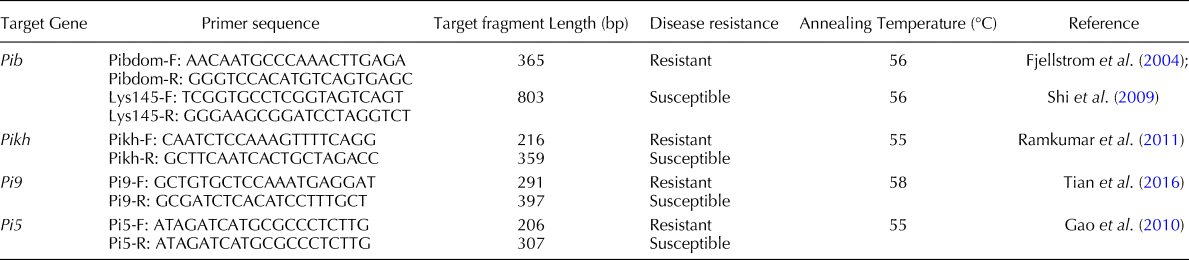
The primers used for functional molecular marker-based resistance gene detection were synthesized by Kunming Shuoqing Bio. Co. Ltd and are compiled in Table 1. All PCR reactions were conducted as in the above sequencing experiments and amplified PCR products were separated and assessed via 2.0% agarose gel electrophoresis.
Sequences of primers for target genes and expected fragment lengths

Results
Pita gene fragment sequencing
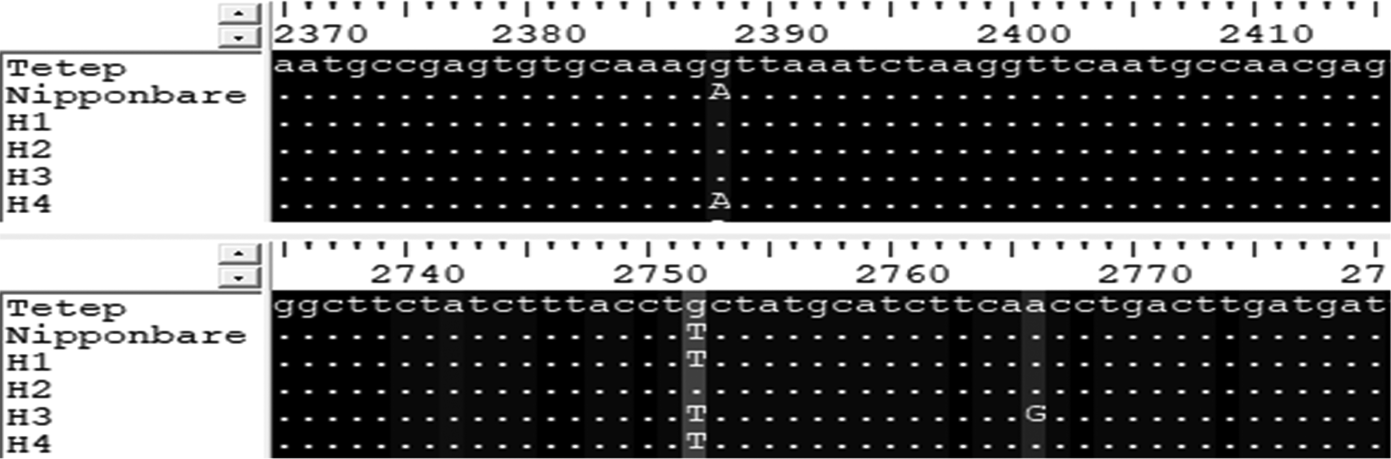
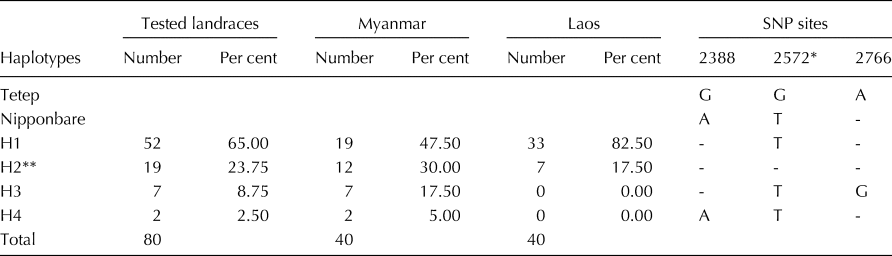
Among the 609 bases in the Pita gene that were sequenced in this study, which included the known functional site of interest (2752), three total mutation sites were detected in these 80 landraces (2,388, 2,752 and 2766). Based on these three mutations, we were able to classify these landraces into four haplotypes (H1-H4) (Fig. 1). The H1 and H2 haplotypes were dominant and accounted for 65.00% and 23.75% of all analysed landraces, respectively. While all four haplotypes were detected among landraces from Myanmar, only the H1 and H2 haplotypes were detected among landraces from Laos (Table 2).
Mutation sites and haplotypes of the gene Pita.

Haplotypes of the gene Pita and geographical distribution

Note: ‘-’ The same base as Tetep. *The functional sites. **The haplotype of a resistant gene.
The Pita resistance gene can be identified based upon the base (G/T) at functional site 2752 in this sequenced region (Bryan et al., Reference Bryan, Wu, Farrall, Jia, Hershey, McAdams, Faulk, Donaldson, Tarchini and Valent2000). Of the four sequencing haplotypes identified in this study, the resistance-associated G base was only carried by plants of the H2 haplotype. In total, 23.75% of analysed landraces (19/80), as well as the Tetep control variety, were classified as belonging to the H2 haplotype, whereas the Nipponbare variety was of the H4 haplotype.
Functional molecular marker-based analysis of the Pib, Pikh, Pi9 and Pi5 resistance genes
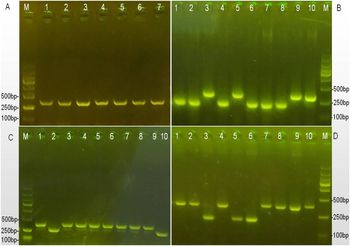
We additionally analysed these 80 landraces for the presence of the Pib, Pikh, Pi9 and Pi5 resistance genes based upon the molecular weight of products amplified using specially designed primers (Pibdom-F /Pibdom-R, Pikh-F/Pikh-R, Pi9-F/Pi9-R and Pi5-F/Pi5-R) (Fig. 2).
Detection of some rice landraces by the primers Pibdom-F/Pibdom-R, Pikh-F/Pikh-R, Pi9-F/Pi9-R and Pi5-F/Pi5-R. Note: M: the molecular weight marker DL2000 plus; (+) carrying a resistant gene, (−) carrying a susceptible gene. (A) Detection of some rice landraces by the primers Pibdom-F/Pibdom-R. 1: Pib monogenic rice line (+); 2: MayinNi (+); 3: A771 (+); 4: Wa16 (+); 5: LWIR17 (+); 6: LWIR22 (+); 7: LWIR28 (+). (B) Detection of some rice landraces by the primers Pikh-F/Pikh-R. 1: Pikh monogenic rice line (+); 2: A771 (+); 3: Lone Thwe (−); 4: Mang3 (+); 5: Kauk Kyi (−); 6: Maodao 11 (+); 7: Maodao 14 (+); 8: Nanyuan Y6 (+); 9: Nali 5 (−); 10: Lay Lan (−). (C) Detection of some rice landraces s by the primers Pi9-F/Pi9-R. 1: Kauk Shay (−); 2: Pi9 monogenic rice line (+); 3: Khauk Kant (−); 4: Ta Yay Gyi (−); 5: Yoe Da Yar Shay (−); 6: Pauk War (−); 7: LWIR41 (−); 8: LWIR4 (−); 9: LWIR31 (−); 10: Yoe Da Yar Shay (+). (D) Detection of some rice landraces by the primers Pi5-F/Pi5-R. 1: Kauk Kyi (−); 2: Kyun Put Gyi (−); 3: Kuyar Galay (+); 4: Kaohai (−); 5: Wa 3 (+); 6: Pi5 monogenic rice line (+); 7: Mandao 17 (−); 8: LWIR28 (−); 9: LWIR31 (−); 10: LWIR2 (−).

The Pibdom-F/Pibdom-R primers were designed to only amplify DNA from rice varietals carrying the resistance gene. Consistent with this design, the monogenic Pib rice line yielded an amplified product between 250 bp and 500 bp in size using these primers, in line with the expected fragment size associated with this resistant functional molecular marker. Landraces carrying the Pib gene yielded identically sized fragments (Fig. 2(A)).
The Pikh-F/Pikh-R primers yielded two different band sizes. The monogenic Pikh rice line and landraces carrying this Pikh resistance gene produced fragments between 100 and 250 bp in size upon PCR amplification (samples 1, 2, 4, 6, 7, 8 in Fig. 2(B)), whereas susceptible varieties (pikh) yielded bands between 250 and 500 bp in size (samples 3, 5, 9, 10 in Fig. 2(B)).
PCR products amplified using the Pi9-F/Pi9-R primers similarly yielded two different band types. The monogenic Pi9 line and those landraces carrying the Pi9 resistance gene yielded bands ~250 bp in size (samples 2, 10 in Fig. 2(C)), whereas landraces carrying the susceptibility gene (pi9) yielded bands between 250 and 500 bp in size (samples 2, 3, 4, 5, 6, 7, 8, 9 in Fig. 2(C)).
The Pi5-F/Pi5-R primers also yielded two band sizes following PCR amplification. The monogenic Pi5 rice line and landraces carrying the Pi5 resistance gene yielded bands between 100 and 250 bp in size (samples 3, 5, 6 in Fig. 2(D)), whereas landraces carrying the susceptibility gene (pi5) yielded bands between 250 and 500 bp in size (samples 1, 2, 4, 7, 8, 9, 10 in Fig. 2(D)).
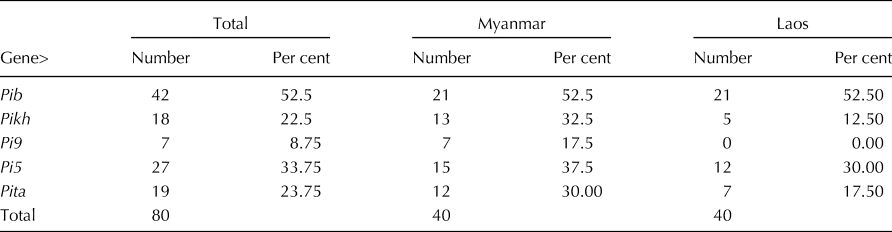
Based upon these analyses, we were able to evaluate the relative frequencies of the Pib, Pikh, Pi9, Pi5 and Pita resistance genes in these landraces (Table 3), which were present in 52.50, 22.50, 8.75, 33.75 and 23.75% of all analysed landraces, respectively. These findings thus suggest that the Pib and Pi5 resistance genes were relatively common, whereas the Pi9 resistance gene was rare among tested landraces.
Gene frequencies and geographical distribution

Geographical distribution of resistance genes in Myanmar and Laos
The Pib, Pikh, Pi9, Pi5 and Pita resistance genes were carried by 52.50, 32.50, 17.50, 37.50 and 30.00% of rice landraces obtained from Myanmar, respectively, whereas they were carried by 52.50, 12.50, 0.00, 30.00 and 17.50% of landraces obtained from Laos, respectively, with Pi9 only being detected in samples from Myanmar. Based upon these results, there are clear differences in the relative prevalence of the Pikh, Pi9 and Pita resistance genes between these two countries.
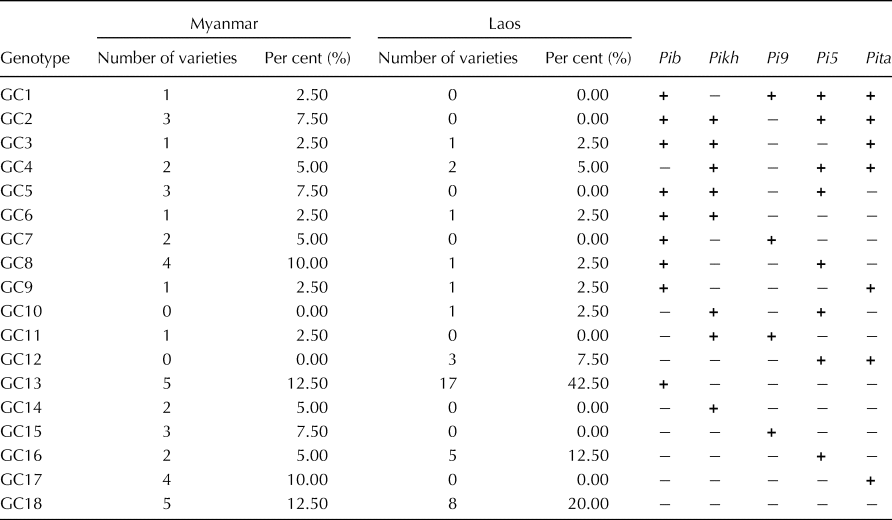
We were able to cluster analysed landraces into 18 genotypes based upon the presence or absence of the Pib, Pikh, Pi9, Pi5 and Pita resistance genes (Table 4). Of these, 16 genotypes were evident among landraces from Myanmar, with relative frequencies of 2.50–12.50%, while 10 were evident among landraces from Laos with relative frequencies of 2.50–42.50%. The GC13 genotype was detected far more frequently in Laos than in Myanmar, while the GC12 and GC10 genotypes were only detected in samples from Laos. In contrast, the GC1, GC2, GC5, GC7, GC11, GC14, GC15 and GC17 genotypes were only detected among landraces from Myanmar. While the GC3, GC4, GC6, GC8, GC9, GC13, GC16 and GC18 genotypes were detected in both countries, the frequencies varied between these countries.
Genotypes and geographical distribution

‘+’ carrying a resistant gene, ‘−’ carrying a susceptibility gene.
No landraces carrying all five resistance genes of interest were identified in the present study. The majority (75%) of landraces identified in Laos carried no resistance genes or just one resistance gene (GC13, GC16, GC18), with the remaining landraces carrying two or three resistance genes (GC3, GC4, GC6, GC8, GC9, GC10, GC12). In Myanmar, four landraces were found to carry four resistance genes (GC1 and GC2), while six landraces carried three resistance genes (GC3, GC4, GC5) and nine landraces carried two resistance genes (GC6, GC7, GC8, GC9, GC11).
In conclusion, these findings suggest that rice landraces from Myanmar exhibit greater rice blast resistance gene diversity than do landraces from Laos.
Discussion
Pib, Pikh, Pi5 and Pita are key rice blast resistance genes and have frequently been employed for the breeding of improved rice varieties in China (Sun et al., Reference Sun, Ma, Yang, Li and Xu2018; Ma et al., Reference Ma, Sun, Yang, Li and Xu2020). Herein, we studied the prevalence of rice blast resistance genes in rice landraces from Laos and Myanmar. We found that the Pib and Pi5 genes were frequently detected in these regions and that there were clear differences in the distribution of resistance gene patterns between these two nations. Some rice varieties from Myanmar have previously been found to carry genes that render them highly resistant to drought (Du et al., Reference Du, Dong, Tang, Xu, Zhang, Yang, Zhang, A and Dai2012), suggesting that the resistant landraces from Myanmar identified in the present study may be of great value to China, although further field confirmation of these results remains necessary. Overall, our data provide a foundation for conservation programs and the selective breeding of improved blast-resistant rice varieties in China.
Pi9 is an exogenous gene that has been transferred to cultivated rice (Oryza sativa) from tetraploid wild rice (Oryza minuta) (Amante-Bordeos et al., Reference Amante-Bordeos, Sitch, Nelson, Dalmacio, Oliva, Aswidinnoor and Leung1992). While rare among Chinese landraces (Ma et al., Reference Ma, Sun, Yang, Li, Chen, Jiao, Tan, Ruan and Xu2018; Sun et al., Reference Sun, Ma, Yang, Li and Xu2018), Pi9 has been commonly used in the breeding of improved rice varieties and is found in 21.35% of such varieties in China (Sun et al., Reference Sun, Ma, Yang, Li and Xu2018). We detected the Pi9 resistance gene in 17.50% of landraces from Myanmar, whereas it was largely absent among landraces from Laos, suggesting that a subset of landraces from Myanmar may have been improved by local farmers. The agronomic traits of these improved varieties are more likely to be consistent with modern breeding requirements, suggesting that landraces carrying this Pi9 resistance gene are likely to be more valuable for rice breeding efforts.
A total of 18 nucleotide variations, 46 haplotypes and 28 protein variants have been detected through analyses of the 609 bases composing the functional Pita fragment among landraces from Yunnan China bordering Myanmar and Laos (Ma et al., Reference Ma, Yang, Sun, Wang and Xu2016). Herein, we detected far fewer Pita haplotypes among landraces from Myanmar and Laos than among landraces from Yunnan and all haplotypes detected in these two countries were among the dominant haplotypes from Yunnan. The Pita resistance gene is also present in the wild rice variety Oryza ruffipogon that grows in southern Yunnan (Zhao et al., Reference Zhao, Jiang, Liu, Chen, Yu and Cheng2014). In summary, these findings suggest that southern Yunnan may be one of the origins of the Pita gene.
Acknowledgements
We thank Professor Li Jinbin at Institute of Agricultural Environment and Resources, Yunnan Academy of Agricultural Sciences for providing the monogenic rice lines and cultivar Tetep. This work was supported by the China National Natural Sciences Foundation (31860369) and National Key R&D Program Projects (No. 2016YFD0100101).