Bipolar disorder (BD) is a severe, chronic mental illness that is highly familial and heritable (Diler, Birmaher & Miklowitz, Reference Diler, Birmaher, Miklowitz, J Miklowitz and Cicchetti2010; Wilcutt & McQueen, Reference Wilcutt, McQueen, Miklowitz and Cicchetti2010). Among offspring of parents diagnosed with BD (O-BD), about 10% develop BD (Craddock & Jones, Reference Craddock and Jones2001). Furthermore, demonstrating the principal of multifinality (Cicchetti & Rogosch, Reference Cicchetti and Rogosch1996), a broad range of other severely impairing developmental outcomes are also characteristic of O-BD (Chang, Steiner, & Ketter, Reference Chang, Steiner and Ketter2003; DelBello & Geller, Reference DelBello and Geller2001), even in O-BD who have not developed BD. For example, it is now well established that across childhood, adolescence, and early adulthood, O-BD are at increased risk of developing any mental disorder, particularly mood disorders, with unipolar depression (UNI; i.e., major depressive disorder, dysthymic disorder, or depressive disorder not otherwise specified) more common than BD (Lapalme, Hodgins, & LaRoche, Reference Lapalme, Hodgins and LaRoche1997; Reichart et al., Reference Reichart, Wals, Hillegers, Ormel, Nolen and Verhulst2004). Externalizing problems and attention-deficit/hyperactivity disorder are also commonly observed in O-BD (e.g., Birmaher et al., Reference Birmaher, Axelson, Goldstein, Monk, Kalas and Obreja2010). Although diverse, one set of problems that are observed in O-BD can be construed as unified within the category of disturbances in reality testing (Klimes-Dougan et al., Reference Klimes-Dougan, Long, Lee, Ronsaville, Gold and Martinez2010).
Prior research examining cognitive and behavioral patterns broadly representing disturbances in reality testing have commonly relied on the empirically derived scales as a means of assessment, most commonly the Thought Problems Scale of the Child Behavior Checklist (CBCL), Youth Self-Report (YSR), and Young Adult Self-Report (YASR; Achenbach, Reference Achenbach1991, Reference Achenbach1997). Thought problem symptoms are distributed across the population. When high levels of symptoms aggregate together in individuals, these indexes characterize atypical behaviors and disturbances in reality testing, such as hallucinations, delusions, and/or significant disturbances in cognition (e.g., loosening of associations, tangential thought patterns, or magical thinking). These disturbances in reality testing, in addition to obsessions and other behavioral oddities, result in thought problems surfacing across numerous disorders, many of which have core disturbances in reality testing. These problems include psychotic disorders (Kasius, Ferdinand, van den Berg, & Velhulst, Reference Kasius, Ferdinand, van den Berg and Verhulst1997), BD (Carlson & Kelly, Reference Carlson and Kelly1998), obsessive–compulsive disorder (OCD; Ivarsson, Melin, & Wallin, Reference Ivarsson, Melin and Wallin2008), dissociative disorders (Macfie, Cicchetti, & Toth, Reference Macfie, Cicchetti and Toth2001), attention-deficit/hyperactivity disorder (Karatekin, White, & Bingham, Reference Karatekin, White and Bingham2010), and pervasive developmental disorders (Bolte, Dickhut, & Proustka, Reference Bolte, Dickhut and Poustka1999).
Thought problems are heritable, are associated with severe impairment, portend a worsening course of illness, and increase morbidity (Abdellaoui et al., Reference Abdellaoui, de Moor, Geels, van Beek, Willemsen and Boomsma2012; Dunayevich & Keck, Reference Dunayevich and Keck2000; Goldberg, Reference Goldberg, Miklowitz and Cicchetti2010; Volkmar, Becker, King, & McGlashan, Reference Volkmar, Becker, King, McGlashan, Cicchetti and Cohen1995). Social and cognitive development in childhood and adolescence increasingly requires youths to more accurately understand logical relations and rules for interacting with the world around them by generating and testing hypotheses about stimuli in the environment against their established knowledge. Impairments in reality testing likely undermine the validity of previously formed conclusions, which are necessary for successful negotiation of the social world. Aberrant reality testing, in its most severe forms, produces faulty associations and is likely to result in social exclusion, decreased reinforcement and increased punishment from the environment, and adverse developmental outcomes (Goldberg, Reference Goldberg, Miklowitz and Cicchetti2010). Thought problems may cause impairment owing to challenges in “traversing stage-salient developmental tasks, developing appropriate object relations, and effectively negotiating developmental transitions” (Goldberg, Reference Goldberg, Miklowitz and Cicchetti2010, p. 194). Thought problem symptoms are therefore likely to disrupt the path of normative development in childhood and adolescence.
Several cross-sectional studies have begun to examine evidence of disturbances in reality testing as evidenced by elevations of the CBCL Thought Problems Scale in O-BD. Dienes, Chang, Blasey, Adleman, and Steiner (Reference Dienes, Chang, Blasey, Adleman and Steiner2002) reported that O-BD with a diagnosis of BD had more symptoms of thought problems than did children with no diagnoses. Furthermore, Giles, DelBello, Stanford, and Strakowski (Reference Giles, DelBello, Stanford and Strakowski2007) compared thought problem symptoms in O-BD diagnosed with BD, O-BD not diagnosed with BD (but at risk for BD), and healthy controls. They found that O-BD diagnosed with BD scored significantly higher on the Thought Problems Scale than did O-BD without BD and healthy children. However, there is also some evidence to suggest that even O-BD without BD have increased thought problems and other symptoms of psychopathology compared to children of healthy parents. That is, Diler et al. (Reference Diler, Birmaher, Axelson, Obreja, Monk and Hickey2011) reported that O-BD without BD had increased levels of internalizing and aggression symptoms and total problems on the CBCL compared to offspring of well parents. Although Reichart et al. (Reference Reichart, Wals, Hillegers, Ormel, Nolen and Verhulst2004) failed to find group differences on the mother's report of the CBCL, they found that O-BD without BD reported higher levels of thought problem symptoms on the YSR compared to children in the general population. Similarly, Petresco et al. (Reference Petresco, Gutt, Krelling, Lotufo Neto, Rohd and Moreno2009) reported higher levels of parent-reported thought problems in O-BD. In contrast to Reichart et al. (2009), they found elevated symptoms of thought problems based on mother's report of thought problems (CBCL) in O-BD compared to offspring of mothers that were well or had other psychiatric disorders but no significant group differences in children's self-reports of thought problems (YSR). Together these results provide preliminary support for an increased risk of thought problems in O-BD. They also suggest that measuring thought problems using multi-informant data may be important. One hypothesis is that thought problems early in development represent a prodrome that precedes varied forms of distal psychopathology, such as BD, schizophrenia, or OCD. However, more research is needed on the trajectories of children at risk who have yet to fully develop psychiatric disorders. The current study addressed these issues.
Over a decade ago, DelBello and Geller (Reference DelBello and Geller2001) drew attention to the importance of prospective longitudinal designs with repeated assessments across childhood and adolescence in O-BD. Efforts are now needed to better understand thought problems within the developmental context. Existing longitudinal studies have focused on the critically important questions regarding prediction for BD and functional outcomes in O-BD (e.g., Duffy et al., Reference Duffy, Alda, Kutcher, Cavazzoni, Robertson and Grof2002; Meyer et al., Reference Meyer, Carlson, Wiggs, Martinez, Ronsaville and Klimes-Dougan2004; Wals et al., Reference Wals, Reichart, Hillegers, Nolen, Van Os and Ormel2006) but have yet to rigorously examine thought problems longitudinally. Developmental homogeneity of the sample has rarely been a priority, with cross-sectional and longitudinal studies in this field often covering a very broadly defined age range (e.g., for some studies drawing conclusions from small samples spanning ages 8 to 25 years). Past work did not adequately account for the fact that normative developmental tasks would be expected to vary substantially at different ages and developmental periods (e.g., Masten, Burt, & Coatsworth, Reference Masten, Burt, Coatsworth, Ciccheti and Cohen2006). In addition, although past research typically limited the comparison groups to offspring of healthy parents, efforts to differentiate developmental risk trajectories were enhanced by considering differences between both healthy and other high-risk groups.
The present study provided the opportunity to address these issues by repeatedly assessing the presence of thought problems in O-BD across a wide period of development. The goal here is to expand on a recent study in which Klimes-Dougan et al. (Reference Klimes-Dougan, Long, Lee, Ronsaville, Gold and Martinez2010) used growth curve models to evaluate patterns of continuity and cascades of problems in O-BD. Those results suggested some evidence of developmental discontinuity (e.g., more within individual variability) of thought problems in O-BD. The findings indicated that self-regulatory problems tend to cascade into thought problems by adolescence in O-BD. By contrast, offspring of unipolar mothers (O-UNI) displayed early self-regulatory problems cascading into internalizing problems. However, this previous study failed to consider individual progression of more cumulative patterns of thought problems across development.
The purpose of the current study was to extend our understanding of the emergence and course of thought problems across development and of how these developmental trajectories might manifest differently depending on the type of family risk. Adopting a developmental psychopathology framework (e.g., Cicchetti, Reference Cicchetti, J Miklowitz and Cicchetti2010), we addressed developmentally relevant questions within the context of meaningful comparison groups by evaluating thought problems in O-BD, O-UNI, and offspring of well parents (O-WELL). This approach holds promise for significantly enhancing our understanding of typical and atypical development. One aim of the current study was to extend our group's previous findings by examining the course of thought problems. To do so, we utilized a series of hazard models to index “survival,” reflected in remaining free of thought problems. A second aim of this study adopted a within-individual approach. We evaluated thought problems as they accumulated over development to determine if “persistence” differed from O-BD, O-UNI, and O-WELL. Persistence was defined as the proportion of assessments that evidenced a specified level of thought problem symptoms. A third aim of this study was to test whether early patterns of thought problems would predict young adult negative outcomes. Specifically, we explored if these estimates of survival and persistence of mother-reported thought problems in childhood and adolescence would predict several key young adult outcomes including clinician-reported assessment of severity and functioning, as well as self-reported problems (e.g., self-reported internalizing, externalizing symptoms, and thought problems). A primary advance of the current study is that we expand the scope of developmental questions assessed in previous studies by evaluating thought problems at multiple time periods in two different offspring risk groups as well as a control group. Furthermore, unlike previous research with this sample (Klimes-Dougan et al., Reference Klimes-Dougan, Long, Lee, Ronsaville, Gold and Martinez2010), the current study considers a larger number of participants (younger and older sibling cohorts) and a longer assessment window by including assessments from childhood through young adulthood.
Method
Sample and procedures
The 98 families participating in this study were part of a longitudinal investigation of O-BD, O-UNI, and O-WELL mothers, with an older and a younger sibling participant from most families. Two offspring were included from almost all the participating families (with the exception of 4 families that only had one child). The families were seen at five periods during offsprings’ development from early childhood through young adulthood. The first four assessments at Time 1 to Time 4 (T1–T4) were approximately 3 years apart, and a subgroup continued to participate through the final assessment at Time 5 (T5), approximately 17 years after they had initially been recruited into the study. There were 192 total offspring who were the focus of this study, comprising 48 O-BD, 84 O-UNI, and 60 O-WELL. Participants were 45% males. Ninety-four percent of the offspring were living with their biological parents at the initial assessment (70% of the offspring continued to live with both their biological parents through T4). The participants were 86% Caucasian, 11% Black, 2% Asian-Pacific Islander, and 1% Latino. The average ages of child participants were 4.45 (SD = 2.05) at T1, 7.37 (SD = 2.09) at T2, 11.10 (SD = 2.26) at T3, 15.79 (SD = 2.65) at T4, and 22.18 (SD = 2.57) at T5. At the initial assessment, families were predominantly middle class to upper middle class; the average Hollingshead socioeconomic status (SES; Hollingshead, Reference Hollingshead1975) score was 51.08 (SD = 14.84). Most parents were college educated (75% of the mothers). With the exception of lower SES for the O-UNI as compared to the O-BD and O-WELL, the maternal groups did not significantly differ on major demographic variables (e.g., age or sex).
During these five visits (T1–T5), comprehensive assessments were conducted to ascertain parents’ and children's psychiatric status, children's psychosocial and neurobiological functioning, and families’ functioning (for a more complete study description, see Klimes-Dougan et al., Reference Klimes-Dougan, Long, Lee, Ronsaville, Gold and Martinez2010; and Radke-Yarrow, Martinez, Mayfield, & Ronsaville, Reference Radke-Yarrow, Martinez, Mayfield and Ronsaville1998).
Attrition
This study recruited O-BD, O-UNI, and O-WELL in early childhood. The careful tracking of participants and regularly scheduled visits between T1 and T4 resulted in minimal attrition, but the attrition was higher between the T4 and T5 visits (when the assessment window was considerably longer and many offspring had grown up and moved away). Of the families meeting the initial criteria for participating in the longitudinal study (N = 126), 114 families were considered eligible for this study at the T3 assessments when mothers were rediagnosed (e.g., families whose mother retained a diagnosis of minor depression were initially included in the recruitment efforts but ruled out as eligible for participation after T3). Of these, 98 (86%) families continued to participate in this study up through T3, 96 (84%) continued to participate up through T4, and 69% continued to participate through T5. By T5, there was limited evidence of selective attrition for diagnostic or demographic variables. Selective attrition was noted at least at a trend level (p < .10) for lower SES families, for O-WELL, and for male offspring.
Measures
Parental diagnoses and functioning
At recruitment (T1), mothers were administered the Schedule for Affective Disorders and Schizophrenia: Lifetime Version (Spitzer & Endicott, Reference Spitzer and Endicott1977). The interviews were conducted by a psychiatric nurse trained by a staff member of the New York Psychiatric Institute, and the interrater reliability (clinicians’ agreement in ratings) for maternal diagnosis was excellent (κ = 1.00). Mothers were eligible if they met the Research Diagnostic Criteria (Spitzer, Robins, & Endicott, Reference Spitzer, Robins and Endicott1978) for BD (I or II), major depressive disorder, or were without past or current psychiatric disorders. If the mother was eligible, the Schedule for Affective Disorders and Schizophrenia interview was also administered to the father. Spouses of the depressed mothers were either without psychiatric disorder or suffered from depression, anxiety, or a substance use disorder. For the well families, both parents needed to be without current or past psychiatric disorders. Six years into the study (T3), mothers were rediagnosed using the Structured Clinical Interview for DSM-III-R (Spitzer, Williams, Gibbon, & First, Reference Spitzer, Williams, Gibbon and First1992) and the Interval Schedule for Affective Disorders and Schizophrenia. The diagnosis used in this study used adjusted “lifetime” diagnosis based on information from both assessment points. Of this sample, 26 mothers were diagnosed with BD (N = 14 with bipolar I, including one mother with bipolar II disorder whose husband developed bipolar I disorder at the T3 assessment; N = 12 with bipolar II), 42 were diagnosed with major depressive disorder, and 30 did not have a lifetime diagnosis.
Thought problems in child and adolescent offspring (T1–T4)
Mothers completed the CBCL (Achenbach, Reference Achenbach1991) about both their younger and older cohort children to assess a range of child functioning at T1, T2, T3, and T4. For the current study, estimates of cognitions and behaviors associated with disturbances in reality testing were assessed using the CBCL Thought Problems Scale. This scale contains seven items involving hallucinations (“Hears sounds or voices that aren't there” and “Sees things that aren't there”), strange ideas and behaviors (“Strange behavior,” “Strange ideas,” and “Stares blankly”) and obsessive–compulsive symptoms (“Can't get his/her mind off certain thoughts, obsessions” and “Repeats acts over and over”). The Thought Problems Scale is an empirically derived scale with strong statistical relations between the items on this scale, as reported in factor analyses (Achenbach, Reference Achenbach1991, Reference Achenbach1997). Internal consistency and test–retest reliability for the Thought Problems Scale (r = .74 over a 2-week interval) have been documented (Verhulst, van der Ende, & Koot, Reference Verhulst, van der Ende and Koot1996). Recent progress in the last decade has also been made in understanding the utility of this scale in assessing a single underlying construct across sex and age as well growing support for the heritability of thought problems (e.g., Abdellaoui et al., Reference Abdellaoui, Bartels, Hudziak, Rizzu, van Beijsterveldt and Broomsma2008, Reference Abdellaoui, de Moor, Geels, van Beek, Willemsen and Boomsma2012; Bartels, van de Aa, van Beijsterveldt, Middledorp, & Boomsma, Reference Bartels, van de Aa, van Beijsterveldt, Middledorp and Boomsma2011).
In this study we used a series of analyses to consider less restrictive, moderately restrictive, and more restrictive dichotomous definitions of thought problems. Abdellaoui et al. (Reference Abdellaoui, Bartels, Hudziak, Rizzu, van Beijsterveldt and Broomsma2008) provided justification for categorizing data based on the distribution of these rarely endorsed behaviors. They noted that categorizing the observations was recommended because thought problems were not normally distributed (as can be explained by the fact that in thought problems data a majority of the subjects display few or no symptoms), and logarithmic and square root transformations were often not enough to correct for this nonnormality. In addition to the advantages from a measurement perspective, the approach to categorizing thought problems data into meaningful cut points may be clinically advantageous. This approach has been useful in assessing developmental trajectories of other rare incident behaviors (e.g., Klimes-Dougan et al., Reference Klimes-Dougan, Free, Ronsaville, Stilwell, Welsh and Radke-Yarrow1999; van Os, Linscott, Myin-Germeys, Delespaul, & Krabbendam, Reference van Os, Linscott, Myin-Germeys, Delespaul and Krabbendam2009). Finally, requirement for the analytical approaches used to address the questions posed in this study (e.g., survival analysis) required dichotomized data.
The approach adopted for this study was to provide clinically useful methods of dichotomizing the thought problems data into any, subclinical, and clinical levels of thought problems. Ideally, we would have narrowed our scope to focus on more deviant behaviors (e.g., only examining thought problems endorsed at subclinical or clinical levels). However, given the low incidence of the behaviors and limited power to detect group differences, applications of broader inclusion criteria appeared justified. The most inclusive category used in this study was any thought problems (also including those who would meet the criteria for subclinical and clinical levels of thought problems). The moderately inclusive category was subclinical thought problems (also including those who would meet for clinical level for thought problems). The most restrictive category assessed here was clinical thought problems. Accordingly, the cutoffs used to assess any thought problem symptoms included the evidence of at least one item endorsed (with a raw score of 1 or more and a T score of 51 or higher), subclinical levels with a raw score of 2 or more and T score of 62 or higher, or clinical levels with a raw score of 4 or more and a T score of 70 or higher.
Thresholds for the persistence of thought problems symptoms were considered in this study based on the criteria outlined above. Persistence of thought problems was based on the proportion of assessments in which individuals exhibited thought problems out of the total number of possible assessments from childhood though adolescence (T1, T2, T3, and T4). Specifically, the persistence of any thought problems was defined as the proportion of assessments with any thought problems. The persistence of subclinical thought problems was defined as the proportion of assessments with subclinical thought problems. The persistence of clinical thought problems was defined as the proportion of assessments with clinical thought problems.
Young adult outcomes (T5)
Offspring psychopathology was based on the well-validated YASR (Achenbach, Reference Achenbach1997). The young adult outcomes assessed were based on the Total Problems Scale and the internalizing, externalizing, and thought problems subscales. The Total Behavior Problems Scale of the YASR is a sum of 110 self-reported emotional and behavior problems and includes the following subscales: anxious/depressed, somatic complaints, withdrawn, delinquent behavior, aggressive behavior, attention problems, social problems, and thought problems. The internalizing problems broadband scale is based on items endorsed from the anxious/depressed, somatic complaints, and the withdrawn subscales. The externalizing problems broadband scale is based on items endorsed from the delinquent behavior and aggressive behavior subscales. Considerable scale validation evidence is available for the broadband scores (Achenbach, Reference Achenbach1991, Reference Achenbach1997). The Thought Problems Scale of the YASR contains six thought problem items that largely parallel the seven items of the CBCL Thought Problems Scale; previous psychometric studies have documented significant predictive links for the YASR thought problems subscale for CBCL subscales in follow-up samples of adolescents (e.g., Ferdinand & Velhurst, Reference Ferdinand and Verhulst1995). The T scores are reported for these three scales.
The Global Assessment of Functioning (GAF; Endicott, Spitzer, Fleiss, & Cohen, Reference Endicott, Spitzer, Fleiss and Cohen1976) rating, which comprises Axis V of DSM-IV, was also used as an additional young adult outcome at T5. The GAF was derived when clinicians originally completed the diagnostic interview with young adults. It summarizes participants’ symptom severity and overall psychosocial functioning by assigning a number 1–100 (using 10-point intervals as guidelines; high scores represent low symptom severity and good functioning). The interrater reliability was found to be excellent (interclass correlation coefficient = 0.84) for clinicians’ ratings of the GAF score.
Data Analytic Plan
Survival analysis
A series of Cox hazard mixed effects models were used to examine if maternal groups had different average time to onset of thought problems and if the time to onset differed for offspring in the maternal groups (Klein & Moeschberger, Reference Klein and Moeschberger2003). We first assessed whether our models met the assumptions of proportional hazards (Grambsch & Therneau, Reference Grambsch and Therneau1994). Because SES differed by mother's diagnosis, all models included SES as a covariate. Three different hazard models were used to examine age of onset of (a) any thought problems, (b) subclinical thought problems, and (c) clinical thought problems. A primary goal was to examine whether mother's diagnosis could account for differences in time to onset. O-BD was defined as the baseline group, and differences in hazards between this group and the remaining groups were examined. In order to account for familial correlation in the development of thought problems for siblings, we fit a random effect for family. The inclusion of the random effect allows families to have different hazard rates. This series of analyses were performed in the statistical package R (R Development Core Team, 2010) using the coxme package (Therneau, Reference Therneau2009).
Persistence analysis
To examine differences in the rate of persistence of thought problems, we used generalized linear mixed effects models (Fitzmaurice, Laird, & Ware, Reference Fitzmaurice, Laird and Ware2004). We included a random intercept for each family to account for familial correlation in growth. As noted previously, persistence was the proportion of assessments in which a specified level of thought problem symptoms were manifested. We examined the persistence of thought problems over T1, T2, T3, and T4 and calculated the rate of persistence for any thought problems and subclinical thought problems. The rates were too low to use this analytic technique for examining clinical thought problems. Again, we explored to what extent the differences in mothers’ diagnosis could explain variation in the rate of persistence over time while controlling for SES. O-BD was used as the baseline group, and we compared differences in persistence over time between O-BD and O-WELL, and between O-BD and O-UNI. To control for age differences, we initially included T4 age as an explanatory variable. However, there were no significant differences associated with age, and age was dropped from all the models.
Predicting young adult outcomes
We conducted a series of analyses to explore the extent to which differences in survival for any, subclinical, and clinical thought problems could explain the development of psychopathology at T5. We also conducted analyses examining differences in persistence rates of thought problems that could explain the development of psychopathologies at T5. We fit generalized linear mixed effects models and included a random intercept for each family to account for familial correlation. To explore whether mother-rated thought problem survival curves explained the development of T5 psychopathologies above and beyond what could be attributed to mother's diagnosis and SES, we compared two models: (1a) hazard rates for any, subclinical, and clinical thought problems; mothers’ diagnoses; and SES; and (2a) just mothers’ diagnoses and SES. Similarly, to explore whether the persistence of any or subclinical thought problems could explain variability beyond mothers’ diagnoses and SES, we compared two models: (1b) persistence rates for any or subclinical thought problems; mothers’ diagnoses; and SES; and (2b) models with just mothers’ diagnoses and SES. Again, to control for age differences, we included an age at T4 explanatory variable. However, there were no significant differences associated with age, so age was dropped from all the models. The improvement in model fit was examined using a likelihood ratio test. The persistence rate analyses and the T5 analyses were performed in R using the lme4 package (Bates & Maechler, Reference Bates and Maechler2010). In order to account for multiple comparisons we used Bonferroni adjustment and tested against a level of α = 0.01. We also reported our findings at an unadjusted level (α = 0.05).
Results
Survival analysis
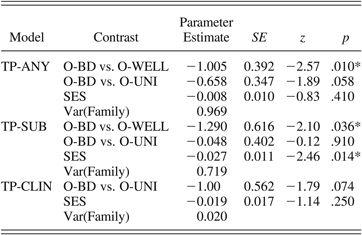
Table 1 shows the results from the survival analysis. Negative values for the parameter estimates (and z values) indicated a reduction in hazard (or reduction in odds of onset) from O-BD to O-WELL and from O-BD to O-UNI, holding the other variables constant. SES was only significant for the analyses pertaining to subclinical thought problems (p = .014). Further, while holding mothers’ diagnoses constant, the hazard of developing subclinical thought problems decreased by 3% for a one-unit increase in SES.
Survival analysis differences for thought problems in offspring of bipolar disorder, unipolar disorder, and well mothers

Note: O-BD, Offspring of bipolar, which is the baseline group; O-UNI, offspring of unipolar; O-WELL, offspring of well; TP-ANY, presence of any thought problems; TP-SUB, presence of subclinical thought problems; TP-CLIN, presence of clinical thought problems; SES, socioeconomic status. These models refer to the outcome variables: TP-ANY, TP-SUB, and TP-CLIN (presence of clinical levels of thought problem symptoms). Var(Family), the variance associated with inclusion of a random intercept for siblings. Negative and significant parameter estimates supports a higher hazard associated with O-BD. Hazard ratios may be calculated by exponentiating the absolute value of the parameter estimate. This value will then represent the increase in hazard moving to O-BD. The contrast for TP-CLIN combined O-UNI and O-WELL because of empty cells.
*p < .05.
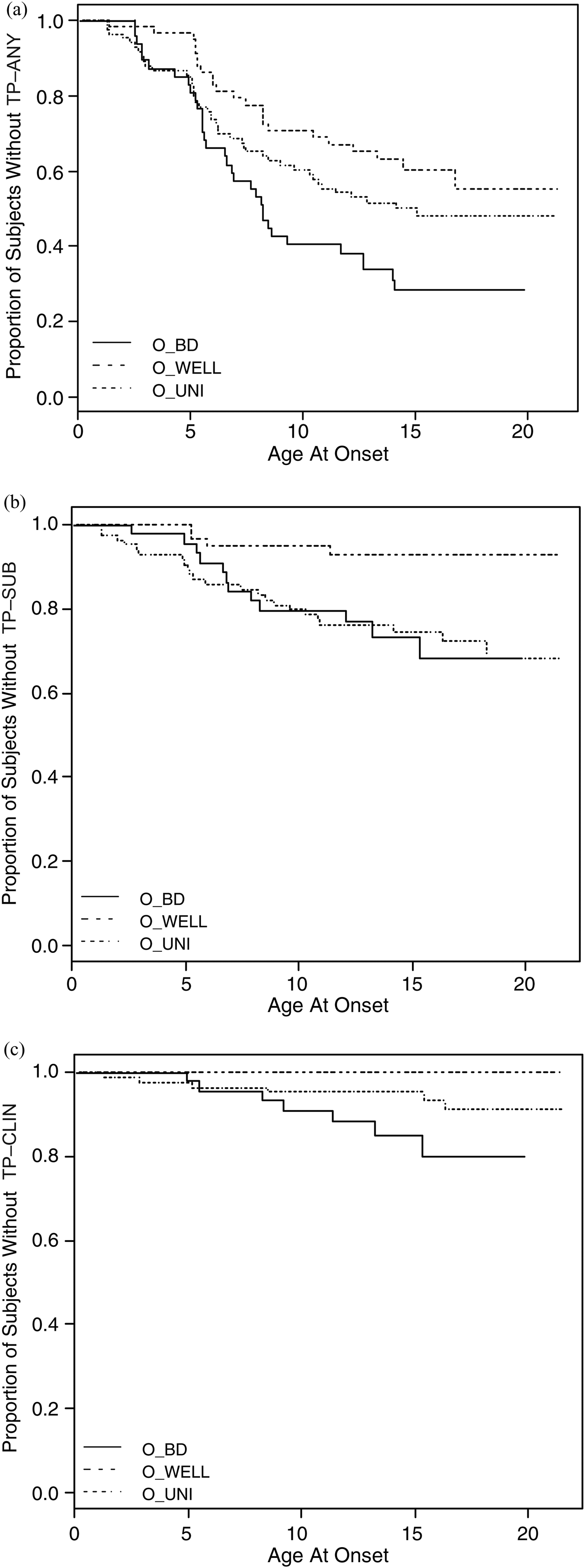
Survival analyses showed that the hazard of developing any thought problems for O-BD was about 2.73 times greater than that of O-WELL (p = .010). The hazard of developing any thought problems for O-BD was 1.93 times greater than that of O-UNI (p = .058). Kaplan–Meier survival curves showed that O-BD and O-WELL diverged most notably in early childhood (Figure 1a) for any thought problems.
Kaplan–Meier survival curves of the time to onset of any (TP-ANY), subclinical (TP-SUB), or clinical (TP-CLIN) thought problems for bipolar (O-BD), unipolar (O-UNI), and well (O-WELL) offspring from Time 1 through Time 4 assessments.
The hazard of developing subclinical thought problems was 3.63 times greater for O-BD than for O-WELL (p = .036). The Kaplan–Meier survival curves showed divergence around middle childhood (Figure 1b). Contrary to predictions, for subclinical thought problems, the O-BD and the O-UNI survival curves failed to show any differences (p = .910).
Statistical estimation of clinical levels of thought problems was a challenge because no one in the control group developed symptoms to meet clinical criteria. Consequently, we compared just O-BD and O-UNI. We found a trend for a difference in the hazard rates for clinical levels of thought problems. That is, the hazard of developing subclinical thought problems was 2.72 times greater for O-BD than for O-UNI (p = .074). This pattern of findings partially supported the Kaplan–Meier survival curves, which showed that the maternal risk groups diverged in early adolescence, with possible differences between O-BD and O-UNI as well as differences between O-BD and O-WELL (although O-UNI and O-WELL are combined here so the findings are speculative with regard to individual maternal group differences).
In summary, the primary results indicated consistent group differences in developmental trajectories of thought problems between O-BD and O-WELL. The differences between O-BD and O-UNI were less systematic. That is, there were no significant differences between O-BD and O-UNI, but there were a number of trends showing O-BD with a higher occurrence of thought problems than O-UNI.
Persistence analysis
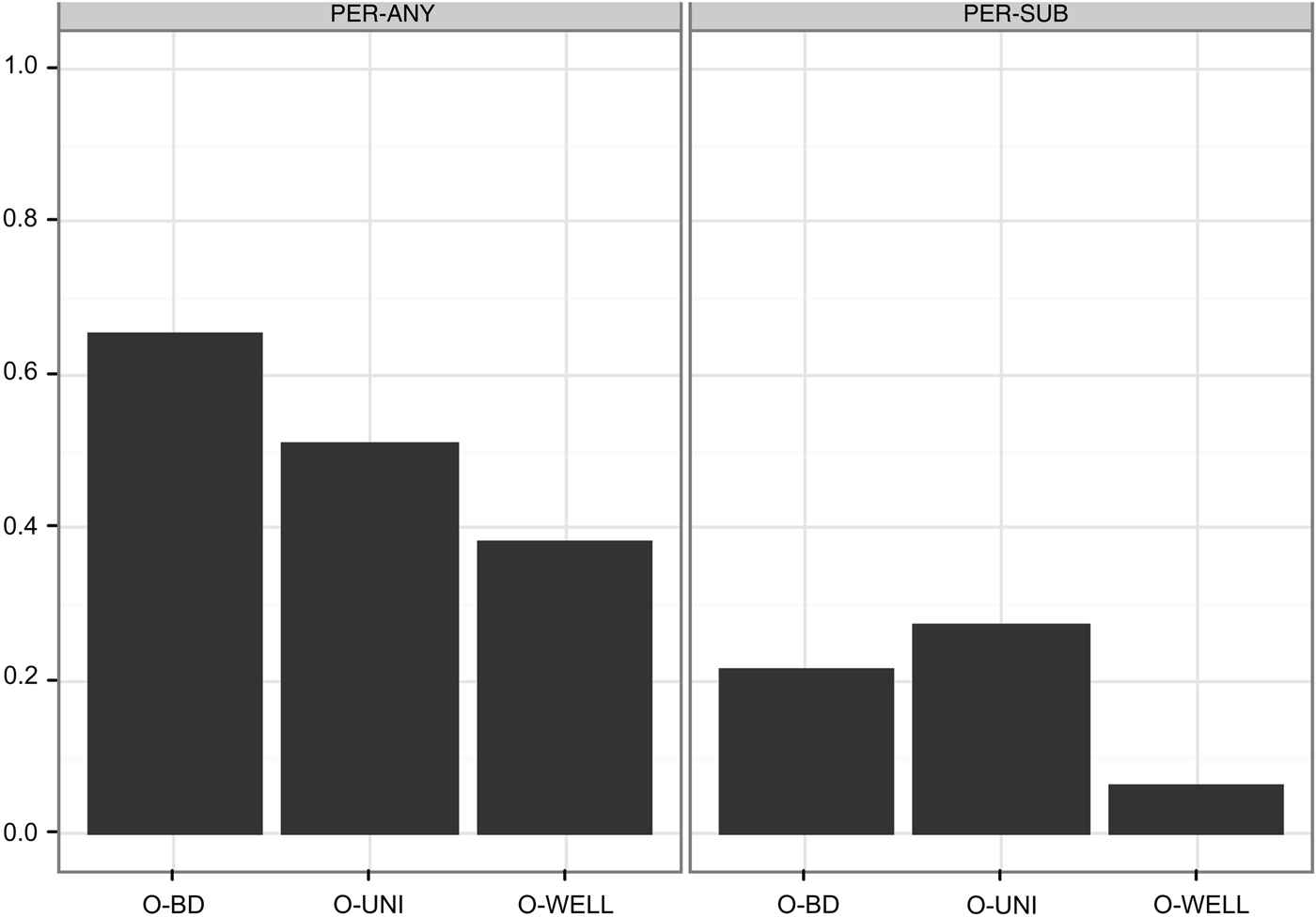
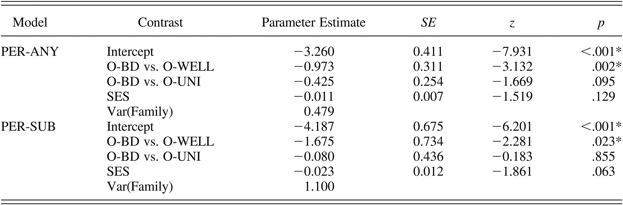
Table 2 and Figure 2 show the results from the persistence analysis. The results had a similar pattern to those seen in the survival analysis. There was no statistically significant difference associated with SES for persistence of any thought problems or Sublinical thought problems.
The proportion of subjects by mother's diagnosis showing persistence of thought problems. O-BD, offspring of bipolar mothers; O-UNI, offspring of unipolar mothers; O-WELL, offspring of well mothers; PER-ANY, persistence (evidence at multiple assessment points) of any thought problems; PER-SUB, persistence of subclinical levels of thought problems, including Time 1 through Time 4 assessments.
Parameter estimates differences for the persistence of thought problems in offspring of bipolar disorder, unipolar disorder, and well mothers
Note: Model refers to the outcome variable predicted by the persistence of any thought problems (PER-ANY) or at the level of persistence of subclinical thought problems (PER-SUB). O-BD, offspring of bipolar; O-WELL, offspring of well; O-UNI, offspring of unipolar; SES, socioeconomic status; Var(Family), the variance associated with inclusion of a random intercept for siblings.
*p < .05.
The results revealed lower persistence for O-WELL, as indicated by negative values for parameter estimates (and z values). In contrast, more moderate levels of persistence were found for O-BD and O-UNI. The rate of persistence for any thought problems was 2.65 times higher for O-BD than for O-WELL (p = .002). There were no statistically significant differences between O-BD and O-UNI for the persistence of any thought problems. Figure 2 reveals that O-BD exhibited slightly higher rates of the persistence of any thought problems than O-UNI.
The rate of persistence for subclinical thought problems was 5.34 times higher for O-BD than for O-WELL (p = .023). There were no statistically significant differences between O-BD and O-UNI for the persistence of subclinical thought problems. Figure 2 reveals that O-BD exhibited slightly lower rates of the persistence of subclinical thought problems than did O-UNI. Persistence of clinical thought problems could not be investigated using this analytic technique because of low occurrence.
Predicting young adult outcomes
A series of analyses were conducted in an effort to determine if (a) children who developed thought problems over the first four assessments “failed to survive” or (b) if the rate of persistence of thought problems over the first four assessment predicted young adult outcomes. Analyses were conducted with each of the three classifications of mother-reported any, subclinical, and clinical thought problems. Several key dimensional outcomes were considered including total behavior problems, internalizing problems, externalizing problems, GAF, and thought problems in adulthood. These indexes of young adult outcome were based on self-report measures with the exception of the GAF score, which was based on a clinician's rating. These scales were moderately correlated. That is, the correlation (all significant at p < .01) between thought problems and internalizing problems was r = .453, between thought problems and externalizing problems was r = .451, and between internalizing problems and externalizing problems was r = .643 (total behavior problems were highly correlated with these scales, particularly internalizing problems and externalizing problems, because the items that comprised these scales were overlapping).
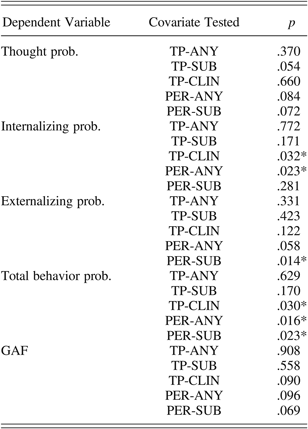
Table 3 shows the results predicting the young adult outcomes. To our knowledge, previous studies have not examined the predictive strengths of thought problems across development to young adult outcomes. As such, some of our analyses were exploratory, and we believed that this might be useful for examining relationships for future research. The results of this analysis failed to find any significant predictors of young adult outcomes when using Bonferroni corrections for multiple comparisons. However, using the more lenient criteria (α = 0.05), a number of significant associations were found. Given the largely exploratory nature of this analysis and the lack of significance at the a priori determined corrected level, the results below should be interpreted with caution.
Thought problems and persistence of thought problems during childhood and adolescence predicting a range of young adult outcomes
Note: TP-ANY, presence of any thought problems; TP-SUB, presence of subclinical thought problems; TP-CLIN, presence of clinical thought problems; PER-ANY, persistence of any thought problems; PER-SUB, persistence of subclinical thought problems; GAF, Global Assessment of Functioning, scale; prob., problem. The first column refers to the dependent variable (DV) of each general linear mixed model regression. Each row in the table refers to the model being examined. Five models were examined for each DV. They were compared against a base model that had the DV regressed onto mother's diagnosis and socioeconomic status (SES) only. Column 2 refers to the survival or persistence covariate that was added to the base model. Column 3 refers to the p value from the likelihood ratio test comparing the model with the survival or persistence covariate added to the model with just mother's diagnosis and SES as control variables.
*p < .05 refers to significant group differences when not accounting for multiple comparisons.
As indexed by disparate rates of survival, mothers’ reports of clinical thought problems during childhood and adolescence significantly predicted internalizing and total problems in young adulthood (and GAF at a trend level). However, more inclusive indexes (any and subclinical) generally failed to predict the five outcome variables assessed. A potentially notable exception was that there was a trend for mother-reported subclinical thought problems to predict self-reported thought problems at the outcome.
When thought problems were identified over multiple assessments (persistence), this index appeared to more robustly predict a number of young adult outcomes. Persistence of any thought problems in childhood and adolescence significantly predicted internalizing problems and total behavior problems in young adulthood, and trends for predicting thought problems, externalizing problems, and GAF scores at young adulthood. Similarly, persistence of subclinical thought problems in childhood and adolescence significantly predicted externalizing problems and total behavior problems in young adulthood, and trends for predicting thought problems and GAF scores at young adulthood.
Discussion
The purpose of our study was to characterize and compare the emergence and persistence of thought problems in O-BD in comparison to O-UNI and O-WELL. Previously our group described thought problem growth curves and patterns of discontinuity up through adolescence with a more limited subsample (Klimes-Dougan et al., Reference Klimes-Dougan, Long, Lee, Ronsaville, Gold and Martinez2010). The results presented here consider additional questions of central relevance for understanding the deviations from typical development in high-risk children and explore if thought problems predicted maladaptive outcomes in young adulthood. The results of this study indicate that offspring of mothers with affective disorders exhibit atypical thoughts and behaviors at a time in development when significant refinements in abstract reasoning, reality testing, social cognition, and executive functioning abilities are taking place in typically developing children. The main findings of this study indicate that disturbances in reality testing across development, as characterized by the Thought Problems Scale of the CBCL, are evident in O-BD. Consistent with past research (Abdellaoui et al., Reference Abdellaoui, Bartels, Hudziak, Rizzu, van Beijsterveldt and Broomsma2008), thought problems were rarely endorsed. Thought problems were documented the most in O-BD, in moderate numbers in O-UNI, and the fewest were in O-WELL. Significant differences were generally evident in the O-BD and O-WELL comparisons. We also examined the value of using survival estimates as well as measuring the persistence of thought problems as predictors of young adult outcomes. The approaches used here of applying multiple methods of dichotomizing thought problems and repeated assessments for characterizing the persistence of thought problems across development are well suited for assessing low incidence problems and identifying diverging developmental trajectories. In addition, we used mixed models to account for family effects, allowing us to include the data from both siblings within each participating family.
These results provide unique insight into the developmental timing of thought problems and the enduring nature of these problems. Specifically, survival analyses revealed that O-BD were more likely to exhibit thought problems than were O-WELL. Depending on the severity of thought problems examined, our results indicate that O-BD diverged from the trajectory of typically developing peers in childhood for any thought problems or subclinical thought problems and in adolescence for clinical thought problems (Figure 1). Encountering transient problems in reality testing may be normal, particularly at low levels of intensity (e.g., any thought problems). Approximately 75% to 90% of developmental psychotic experiences are transitory and disappear over time (van Os et al., Reference van Os, Linscott, Myin-Germeys, Delespaul and Krabbendam2009). Although cross-sectional studies show that disturbed reality testing (thought problems) remain stable across development (Bartels et al., Reference Bartels, van de Aa, van Beijsterveldt, Middledorp and Boomsma2011; Bongers, Koot, van der Ende, & Verhulst, Reference Bongers, Koot, van der Ende and Verhulst2003), longitudinal studies have found that thought problems and other psychotic symptoms rise during adolescence (Tick, van der Ende, Verhulst, Reference Tick, van der Ende and Verhulst2008; van Os et al., Reference van Os, Linscott, Myin-Germeys, Delespaul and Krabbendam2009). For example, a recent study documented isolated incidents of magical thinking in 43% of adolescents (Fonseca-Pedrero et al., Reference Fonseca-Pedrero, Santarén-Rosell, Lemos-Giráldez, Paino, Sierra-Baigrie and Muñiz2011). Collectively, this work suggests that close attention needs to be paid to the potentially maladaptive functioning of adolescents who are at risk for developing affective disorders.
Inclusion of the O-UNI group allowed for a potentially richer understanding of the processes associated with being born to and raised by a parent with O-BD. However, the implications for the possible O-BD and O-UNI differences remain elusive. One possibility is that disturbances in reality testing are more broadly represented in children born to and raised by parents with bipolar or unipolar depression. With few exceptions, O-BD and O-UNI were comparable or differed at only a trend level. Perhaps critical mechanisms for the transmission across generations, such as the ones proposed by Goodman and Gotlib (Reference Goodman and Gotlib2002), are similar for O-BD and O-UNI. In addition to the evidence of common heritability factors in unipolar and bipolar depression (e.g., McGuffin et al., Reference McGuffin, Rijsdijk, Andrew, Sham, Katz and Cardno2003), it is likely that parenting practices and stressful environments are associated with problems exhibited in O-BD (Hillegers et al., Reference Hillegers, Burger, Wals, Reichart, Verhulst and Nolen2004; Meyer et al., Reference Meyer, Carlson, Wiggs, Martinez, Ronsaville and Klimes-Dougan2004; Miklowitz, Reference Miklowitz2011), much as they would be exhibited by O-UNI. Mothers diagnosed with BD often have extended periods of depression in addition to their manic periods and may experience common challenges to attending to the needs of their children. One might assume O-BD are exposed to greater levels of stress than O-UNI, from the added challenges of weathering both parental manic and depressive episodes. Although research conducted by Adrian and Hammen (Reference Adrian and Hammen1993) supported the conclusion that O-UNI were exposed to greater levels of chronic stress than children of mothers with BD, children of mothers with chronic medical illnesses, and children of mothers without any mental or chronic medical illness.
An alternative possibility is that the O-BD and O-UNI group differences were meaningful (but perhaps restricted in some analyses owing to limited power). Despite the evidence that group differences were more consistently detected between O-BD and O-WELL than they were between O-BD and O-UNI, there were also some marginal indications that these problems were more evident in O-BD than in O-UNI. A trend is noted for the differences in the hazard model for any thought problems. In addition, if clinical thought problems were defined as occurring in more than at least one assessment, it occurred in seven (14.58%) of O-BD, six (7.14%) of O-UNI, and never (0%) for O-WELL, yielding a O-BD and O-UNI difference of χ2 = 17.12, p < .0001 (using a method that should be considered with caution given that it could not adequately address nonindependence of the sample). These findings differ from research investigating other indices of maladjustment that has more commonly documented impairments in O-UNI up through adolescence (Klimes-Dougan et al., Reference Klimes-Dougan, Free, Ronsaville, Stilwell, Welsh and Radke-Yarrow1999; Radke-Yarrow & Klimes-Dougan, Reference Radke-Yarrow, Klimes-Dougan, Luthar, Burack, Cicchetti and Weisz1997). Rather, our study provides tentative evidence that the developmental trends noted for thought problems fail to reflect a more general maladjustment trend and may represent a specific type of risk more highly associated with BD.
Even if we conclude that thought problems are more highly represented in one or both of the high-risk samples, some ambiguity persists as to the meaning of this finding. One possibility is that elevated thought problems are indicative of psychotic processes. Some researchers propose possible overlaps as well as common risk factors between schizophrenia and BD (Djurovic et al., Reference Djurovic, Gustafsson, Mattingsdal, Athanasiu, Bjella and Tesli2010; Laursen, Agerbo, & Pedersen, Reference Laursen, Agerbo and Pedersen2009; Murray et al., 2004). Building on genetic linkage studies (perhaps particularly bipolar I disorder; Kelsoe, Reference Kelsoe2003), BD is thought to share certain susceptibility genes with schizoaffective disorder and schizophrenia, and may therefore fall within the spectrum of psychotic disorders. This recent line of thinking calls into question issues of the historical dichotomies proposed by Kraeplin (Reference Kraepelin1906) and may begin to explain why heightened levels of thought problems tend to be exhibited more frequently in O-BD than in O-UNI. Based on this conceptualization of a psychotic continuum, we would also expect that thought problems would be more highly represented in offspring of parents with bipolar I disorder rather than bipolar II disorder. Follow-up analyses reveal that the difference between the O-BD and O-WELL groups are primarily accounted for by the youths who are born to and raised by a parent with bipolar I disorder. That is, significant differences in hazard rates were noted for offspring of bipolar I disorder when compared to O-WELL for any (p = .025), subclinical (p = .028), or clinical (p = .011) thought problems as well as analyses considering the persistence of any (p = .002) or subclinical (p = .014) thought problems. Together these results may provide some tentative evidence in support of a spectrum of psychotic disorders.
Some have suggested that the Thought Problems Scale of the CBCL and YASR might be best described as “schizo-obsessive” symptoms (Abdellaoui et al., Reference Abdellaoui, de Moor, Geels, van Beek, Willemsen and Boomsma2012). Although specific items on the CBCL reflect evidence of delusions or hallucinations (“I hear sounds of voices that other people think aren't there” or “I see things that other people think aren't there”), these items were very rarely endorsed (6.1%) in this largely at-risk sample, and there were no notable differences across maternal risk groups for these specific items. The two most frequently endorsed items in this sample on the CBCL Thought Problems Scale (42.9% of the sample endorsed “can't get his/her mind off certain thoughts, obsessions” and 14.3% of the sample endorsed “repeats acts over and over”) may or may not represent problems associated with psychosis (Ivarsson & Larsson, Reference Ivarsson and Larsson2008). Furthermore, there is tentative evidence that these two items appear elevated in the at-risk maternal groups (56.3% of O-BD, 45.2% of O-UNI, and 31.7% of O-WELL). Continued efforts are needed to enhance understanding of thought problems.
Work that is designed to test the predictive value of thought problems has become a priority in the field (Abdellaoui et al., Reference Abdellaoui, de Moor, Geels, van Beek, Willemsen and Boomsma2012). It is logical to assume that a failure to successfully negotiate early developmental tasks would lead to increasing divergence from normative outcomes and more grossly aberrant development across a range of areas (e.g., cognitive, interpersonal, and self-regulatory abilities; Masten et al., Reference Masten, Burt, Coatsworth, Ciccheti and Cohen2006). Although it is possible that some features of the CBCL Thought Problems Scale represent originality, divergent thinking, or creativity (Abdellaoui et al., Reference Abdellaoui, Bartels, Hudziak, Rizzu, van Beijsterveldt and Broomsma2008), our analyses were directed to testing the possibility that thought problems in childhood and adolescence predict various indexes of problem behavior in young adulthood. The assessment of any thought problems may have represented an excessively liberal inclusion standard to predict young adult outcomes. Instead, mother's reports of subclinical and clinical thought problems during childhood and adolescence significantly predicted global self-reported indices of psychopathology (internalizing problems, externalizing problems, and total problems) in young adulthood. Similarly, trends were also found for the prediction of the clinician-rated problems that accounted for severity and impairment (GAF). Although the results of this study are preliminary and require corroborating evidence from other samples, the tentative conclusions of this study indicate that severe or persistent thought problems in childhood and adolescence predict continued problems in young adulthood.
It is possible that severe or persistent thought problems represent a prodrome for other psychiatric conditions. There is evidence that 76% of variability in thought problems is attributable to heritable sources (Abdellaoui et al., Reference Abdellaoui, Bartels, Hudziak, Rizzu, van Beijsterveldt and Broomsma2008), but more research is needed to establish a clear link between thought problems earlier in development and thought problems in young adulthood. Our results showed preliminary evidence (trends only) of such a link. Cumulative occurrence (hazard analysis) of thought problems in childhood through adolescence tended to predict young adult thought problems. Particularly noteworthy are our findings regarding the persistence of thought problems. Normally developing adolescents rarely reported experiencing multiple episodes in which reality testing was disturbed (Fonseca-Pedrero et al., Reference Fonseca-Pedrero, Santarén-Rosell, Lemos-Giráldez, Paino, Sierra-Baigrie and Muñiz2011; van Os et al., Reference van Os, Linscott, Myin-Germeys, Delespaul and Krabbendam2009). However, as van Os et al. (Reference van Os, Linscott, Myin-Germeys, Delespaul and Krabbendam2009) note, impairment occurs primarily when these transitory developmental expressions of psychosis persist. Although this link was only a trend in our findings, it is important to note that shared respondent variance did not account for this finding in that the rater during childhood/adolescence was the mother, whereas self-reports were used to evaluate the presence of thought problems in young adulthood. It will also be worthwhile for future research to evaluate if thought problems predict problems with reality testing for Axis I disorders such as OCD, BD, and schizophrenia and Axis II disorders such as Cluster A personality disorders. Due to the limited number of offspring in our sample who developed these disorders in young adulthood (OCD, N = 5; BD, N = 9; schizophrenia, N = 1), these questions were not fully examined here. Preliminary evidence, however, suggests that the cumulative occurrence of clinical thought problems across development predicted BD in young adulthood at a trend level (p = .105; Klimes-Dougan et al., Reference Klimes-Dougan, Desjardins, James, Narayan, Long and Cullen2011). In summary, the results of this study contribute critical information about how early thought problems portend maladaptive functioning in young adulthood. Continued clarification of the predictive utility of these problems will be essential to advancing the field.
Limitations
Despite the numerous advantages of our prospective, longitudinal design (that had low attrition, particularly from T1 to T4), this study possesses important limitations. More subtle comparisons between the two high-risk groups were likely underpowered. Insufficient power also limited the number of controls that could be reasonably added to the developmental and prediction models. Some might wonder if these risk trajectories might be identical for any problem that would be assessed. However, if we look across studies, we find some evidence that thought problems do not follow an identical risk profile to other types of problems. That is, the divergent developmental trajectories of thought problems were more evident in O-BD, but other research on internalizing problems and suicide risk have suggested that prior to adulthood O-UNI are most likely to exhibit problems (Klimes-Dougan et al., Reference Klimes-Dougan, Free, Ronsaville, Stilwell, Welsh and Radke-Yarrow1999; Radke-Yarrow & Klimes-Dougan, Reference Radke-Yarrow, Klimes-Dougan, Goodman and Gotlib2002). Perhaps more notable, small samples and multiple comparisons likely substantially limited the predictions of young adult outcomes. Ideally, we would have considered if different patterns of prediction emerged for the maternal risk groups assessed. In addition, it would have been useful to control for internalizing and externalizing problems when predicting outcomes, as well as other variables such as substance abuse that are commonly represented in this risk group (e.g., Duffy, Alda, Hajek, Sherry, & Grof, Reference Duffy, Alda, Hajek, Sherry and Grof2010). It is possible that if the sample was larger or if offspring were followed longer into adulthood, the link between early thought problems and later development of a psychotic or affective disorder might have emerged. Furthermore, given that thought problems are particularly evident in low SES participants and males (e.g., Abdellaoui et al., Reference Abdellaoui, Bartels, Hudziak, Rizzu, van Beijsterveldt and Broomsma2008; Raadal, Milgrom, Cauce, & Mancl, Reference Raadal, Milgrom, Cauce and Mancl1994), the selective attrition in this sample by T5 may have minimized group differences.
This study had some other methodological limitations. The results of this study are based heavily on Achenbach's (Reference Achenbach1991, Reference Achenbach1997) methods of assessment. The CBCL and the YASR are widely used in both research and clinical settings. The broadband scales have good psychometric properties, which allow for assessment of both normative and clinical samples across a wide developmental span. In contrast, the narrow-band scales (Thought Problems Scale of the CBCL) have received significantly less attention in the literature. Nevertheless, recent advances include demonstrating heritability of thought problems as well as providing added evidence of reliability and validity (e.g., Bartels et al., Reference Bartels, van de Aa, van Beijsterveldt, Middledorp and Boomsma2011). Additional methodological issues pertain to the source of information. From childhood through adolescence, we relied on one available source of thought problems (maternal report on the child). However, thought problems may not always be observable by others. Although parent mood has been found by some to minimally impact accurate characterization of internalizing problems in their children (Hughes & Gullone, Reference Hughes and Gullone2010), others have identified reporting biases in depressed mothers (e.g., Richters & Pellegrini, Reference Richters and Pellegrini1989). These biases may differ for mothers with unipolar and bipolar depression (Klimes-Dougan, Reference Klimes-Dougan1998). Future efforts would be well advised to consider multiple sources of information when assessing thought problems to greatly enrich the understanding of developmental trajectories of thought problems.
Conclusion
In conclusion, thought problems are an important and promising area of continued research in children at risk for developing affective disorders. Thought problems are highly heritable, likely to disrupt progression through important developmental periods, and associated with poor outcomes. The results of this study provide evidence for elevated thought problems in offspring of mothers with affective disorders and tentative evidence that thought problems are more highly represented in O-BD than in O-UNI. This latter point represents an important question for future research with larger samples. Moreover, maternal ratings of thought problems in childhood and adolescence predicted self-reported ratings of problems (including aspects of thought problems) in young adulthood. In a cumulative sense, the use of psychometrically sound instruments at multiple levels of analysis and across several developmentally important periods allows for a greater understanding of the developmental psychopathology, including development and persistence of thought problems in offspring of parents with mood disorders. This work extends efforts to identify developmental trajectories associated with maladaptation in at-risk children, thus providing critical information that could be used to optimize resources for prevention and early intervention efforts in offspring of parents with mood disorders.