Introduction
Delirium is a complex neuropsychiatric syndrome with considerable heterogeneity in clinical presentation. It affects approximately 20% of hospitalized patients (Ryan et al., Reference Ryan2013) where two thirds of cases are misdiagnosed or undetected and many cases fail to be recognized until symptoms are have been present for days or weeks leading to a delay in initiating effective treatment (O'Hanlon et al., Reference O'Hanlon2014). Importantly, delirium is independently linked with reduced subsequent cognitive and functional status, longer length of hospital stay, increased institutionalization, and increased mortality rates (Witlox et al., Reference Witlox, Eurelings, de Jonghe, Kalisvaart, Eikelenboom and van Gool2010, Martins and Fernandes, 2012) making more consistent and timely detection a key healthcare target.
Delirium detection is predicated upon reliable and efficient identification of cognitive impairment with an emphasis upon disturbed attention (Meagher et al., Reference Meagher2014). A wide variety of bedside cognitive tests are available yet their utility and accuracy in identifying the cognitive difficulties of delirious patients in everyday clinical practice is unclear (Woodford and George, 2007). Previous studies have suggested that tests of attention, vigilance, and visuospatial abilities can assist in distinguishing between neurocognitive disorders (Brown et al., Reference Brown, Fordyce, Zaghdani, Starr and MacLullich2011; Leonard et al., Reference Leonard2016). There is a need for specifically designed tools to more fully assess cognitive function across the spectrum of cognitive performance (Silverberg et al., Reference Silverberg2011).
Full syndromal delirium (FSD) is frequently preceded by subsyndromal delirium (SSD), a prodromal period during which early detection and treatment may prevent transition into full syndromal illness (Hakim et al., Reference Hakim, Othman and Naoum2012). SSD is considered as subthreshold to FSD based on the severity, number, and type of symptoms experienced (Meagher et al., Reference Meagher2014; Sepulveda et al., Reference Sepulveda2016). Inattention and disorganized thinking are the most significant clinical features distinguishing FSD from SSD (Meagher et al., Reference Meagher, Adamis, Trzepacz and Leonard2012). The prevalence of SSD in elderly medical inpatients is estimated to be between 30% and 50% (Zuliani et al., Reference Zuliani2013). Administration of risperidone to elderly patients who experienced SSD after on-pump cardiac surgery was associated with a significantly lower incidence of delirium (Hakim et al., Reference Hakim, Othman and Naoum2012). Early identification of patients with SSD may thus enable clinicians to target interventions to prevent transition to FSD, improve monitoring, and develop interventions to improve long-term outcomes (Fong et al., Reference Fong, Tulebraev and Inouye2009).
In addition, the heterogeneous nature of delirium includes distinct clinical (motor) subtypes, including hyperactive, hypoactive, and mixed presentations, the latter applied to those patients with elements of both increased and decreased motor activity within a short timeframe (Meagher, Reference Meagher2009). The prevalence of subtypes varies across studies and clinical settings ranging from 15% to 79% for hypoactive subtype, 6–46% for hyperactive subtype, and 11–55% for the mixed subtype (Meagher, Reference Meagher2009). Greater awareness of the motor activity alterations in delirium can assist in the timely detection of FSD episodes where observable motor changes are almost invariably present (Marquis et al., Reference Marquis, Ouimet, Riker, Cossette and Skrobik2007; Meagher et al., Reference Meagher2007) and offer the potential for earlier detection of emergent delirium whereby many patients experience either restlessness or reduced activity along with a sense of not feeling their normal self for 24–72 h prior to emergence of FSD (Duppils and Wikblad, Reference Duppils and Wikblad2004; Levkoff et al., Reference Levkoff1994).
In this study we:
1. Examine performance on nine common bedside tests of cognition in patients with varying neurocognitive diagnoses including groups with FSD, SSD, and no delirium (ND),
2. Explore which tests best discriminate between different syndromal states in delirium, and
3. Compare performance across motor subtypes.
Methods
Subjects and design
We conducted a cross-sectional study of neuropsychiatric symptoms and cognitive performance in referrals to a consultation liaison psychiatry service. This report details a secondary analysis of data from a previously published report (Leonard et al., Reference Leonard2016). Consecutive cases with altered mental state were identified on daily rounds by the medical team and referred for assessment and diagnosis by the research team.
Assessments were conducted by raters (ML, FA, HO'C, OW, DM) specifically trained in the use of the tests included herein (see later) and to further enhance inter-rater reliability, ratings associated with any uncertainty were discussed and agreed by consensus between raters.
Delirium was diagnosed according to a cut-off score of ≥15 on the severity scale of the DRS-R98 and/or presence of DSM IV criteria based upon a full clinical assessment. Dementia was defined as a clear history of documented DSM-IV dementia (based on all available information at the time of assessment including clinical case notes and collateral history from family and/or carers) or a short Informant Questionnaire on Cognitive Decline in the elderly (IQCODE) score of ≥3.5.
Each subject was assessed using a battery of cognitive tests (see later). For each test performance, standardized scale with a score of 0 was used to denote those who were unable to engage with testing at a level that indicated any meaningful correct response or positively rateable engagement with the test. Standard cut-off performances were used to apply a binary (pass/fail) for each test where a fail corresponded with evidence of clinically significant impairment.
Informed consent
The procedures and rationale for the study were explained to all patients but because many patients had cognitive impairment at entry into the study it was presumed that many might not be capable of giving informed written consent. Because of the non-invasive nature of the study, University Hospital Limerick Regional Ethics Committee approved an approach to establishing consent by virtue of augmenting patient assent with proxy consent from next of kin (where possible) or a responsible caregiver for all participants in accordance with the Helsinki Guidelines for Medical research involving human subjects (World Medical Association, 2004).
Assessments
Demographic data and medication at the time of the assessment were recorded. All available information from medical records and collateral history was used. Nursing staff were interviewed to assist rating of symptoms over the previous 24 h.
The Delirium Rating Scale Revised-98 (DRS-R98) is designed for broad phenomenological assessment of delirium. It is a 16-item scale with 13 severity and 3 diagnostic items with high inter-rater reliability, sensitivity, and specificity for detecting delirium in mixed neuropsychiatric and other hospital populations. Each item is rated 0 (absent/normal) to 3 (severe impairment) with descriptions anchoring each severity level. Severity scale scores range from 0 to 39 with higher scores indicating more severe delirium. Delirium typically involves scores above 15 points (Severity scale) or 18 points (Total scale) in populations with high frequency of comorbid dementia.
The Informant Questionnaire on Cognitive Decline in the Elderly-Short Form (IQCODE-SF) is a validated screening tool for detecting cognitive impairment. It includes 16 items that rate cognitive change over time, each of which are rated by an informant on a 5 point likert scale. The short-IQCODE takes approximately 10 min to administer. The total score divided by the number of questions provides a mean item score where ratings ≥3.5 are considered indicative of longstanding cognitive difficulties and dementia.
Cognitive testing
WORLD backwards
The WORLD backwards test was applied according to the format of the MMSE. Each participant was asked to spell WORLD backwards. A point was awarded for each letter correctly identified and the total number of points was recorded. Patients who self-corrected their own mistakes without prompting when spelling WORLD backwards were given the point for each letter they were able to correct. Additionally, if a patient was unable to recite a particular letter, they were told that letter in order for them to make an accurate attempt at the next letter to follow. Failure to correctly recite all five letters is considered to equate with clinically significant inattention (and thus a failed test).
Months backward test (MBT)
In this test, the participant was asked to recite the months of the year in reverse order starting from December. Test duration was a maximum of 90 sec at which point the subjects best performance was noted. Scoring was according to that proposed by Meagher et al. (Reference Meagher2014) – with patients rated as: unable to engage (0), able to engage but unable to reach July without more than one error (1), able to reach July with less than two errors (2), able to reach January without error (3). In subjects over age 60 years, failure to reach July without more than one error of omission equates with clinically significant inattention (and thus a failed test).
Spatial span forwards (SSF)
This was conducted according to the description in the Cognitive Test for Delirium (CTD). The SSF is a visual form of the digit span forwards. The subject is asked to copy the examiner in touching squares on a card (A5 size with 8 × 1 cm red squares). Each square represents a number and the test on each occasion requires that the squares corresponding to the digit span code are tapped at one second intervals. Two trials are conducted and the best performance is used. Failure to correctly complete a sequence of 5 or more numbers is considered to equate with clinically significant inattention (and thus a failed test).
Spatial span backwards (SSB)
Similarly, the SSB uses squares (blue) that are repeated in reverse order to that indicated by the assessor. Two trials are conducted and the best performance is used. Failure to correctly complete a sequence of three or more numbers is considered to equate with clinically significant inattention (and thus a failed test). This was also conducted according to the description in the CTD.
Vigilance A test
The vigilance “A” test was also derived from the CTD scale. A list of 29 letters with the letter “A” included on 11 occasions was presented to the patient and they were asked to indicate each time the letter “A” was mentioned. Scores are calculated by subtracting commissions from correct responses (scored double) and rated as unable to engage with the test (0), score 1–9 (1), score 10–18 (2), score 19–26 (3), score >27 (4). For the purposes of a binary (pass/fail) cut-off, we used failure to score >27 to equate with significantly impaired vigilant (or sustained) attention.
Vigilance B test
This is similar to the vigilance A test except that there are two required letters (“C” and “E”). Scores are calculated by subtracting commissions from correct responses (scored double) and rated as unable to engage with the test (0), score 1–9 (1), score 10–18 (2), score 19–26 (3), score >27 (4).For the purposes of a binary (pass/fail) cut-off, we used failure to score ≥19 to equate with significantly impaired vigilant (or sustained) attention.
Global assessment of visuospatial abilities
Visuospatial ability was rated according to a four-point scale based upon DRS-R98 item 13 using both patient and collateral sources regarding ability to perceive differences in shape and distance as well as practical abilities, such as navigating the ward environment and response to specific probes of describing how to get somewhere (e.g. bathroom), recognizing shapes (‘what shape is the window?’) and differences in distances (which is closer, the window or the hallway?). Patients were rated as: no evidence of impairment (3), mild impairment as evidenced by minor difficulty with probes and/or navigating surroundings (2), moderate impairment in terms of responses to probes and/or reported need for redirection to keep from getting lost in the environment or trouble locating familiar objects in immediate environment (1), and severe impairment evidenced by inability correctly respond to any probes and navigate environment (0). In keeping with DRS-R98 guidance, a score of <2 suggests pathological impairment of visuospatial abilities.
Intersecting pentagons test (IPT)
This geometric copying test is derived from the original Bender Gestalt test. The subject is presented with a copy of two intersecting pentagons drawn at angles to one another producing a diamond shape where they overlap. The subject is requested to copy the design on the blank half of the page. For scoring, we applied the six-point hierarchical scoring scale where 6 represents a perfect reproduction and 1 represents the poorest effort. A score of <4 is considered to reflect a failed performance.
Clock drawing test (CDT)
The CDT examines visuospatial abilities, as well as receptive language, numerical knowledge, working memory, and executive functions. It is widely used in geriatric practice as a cognitive scan. In this study, subjects were provided with a pre-drawn circle onto which the participant was requested to place all the numbers and the large and small hands on the clock face to show the time “ten past eleven.” We used the scoring method of Sunderland et al. rating performance from 0 to 10 according to spatial representation of the numbers and hands of the clock. A score of <6 equates with a failed performance.
Statistical analysis
Statistical analysis was conducted using SPSS-22. Demographic and rating scale data are expressed as means plus standard deviation. Continuous variables (e.g. age, total DRS-R98, total number of medications and SIQ codes) were compared by using independent t tests with one way ANOVA used for post hoc comparisons. Non-normal data (e.g. cognitive test scores) were compared with Wilcoxon signed ranks and Mann–Whitney U tests for between group comparisons.
Results
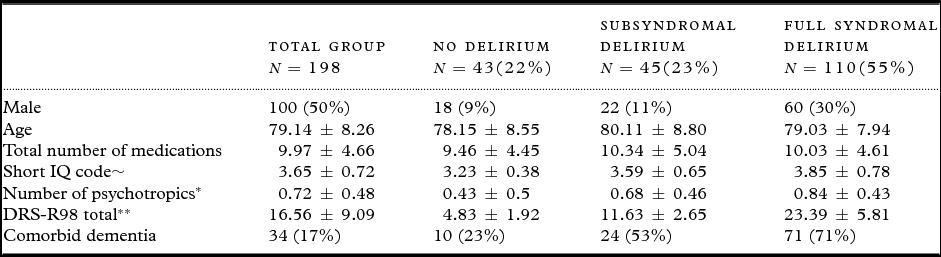
A total of 198 patients were assessed (mean age 79.14 ± 8.3, 100 (51% male). The frequencies of diagnoses were FSD (n = 110), SSD (n = 45), and ND (n = 43). Demographic, medication and clinical data for the total group and delirium syndromal groups are shown in Table 1 along with mean scores for the DRS-R98, IQCODE, total number of medications and number of psychotropic medications prescribed. Delirium status was not associated with differences in terms of gender distribution, age, and overall medication use. However, dementia burden (IQ-CODE scores) increased with greater delirium status. Both the FSD and SSD groups had higher DRS-R98 scores than those in the ND group. The mean short IQCODE scores distinguished the FSD and SSD groups with both scoring in excess of the suggested cut-off score for dementia. The range and distribution for the FSD group was 2.0 (mean 3.42, SD 0.56) while for the SSD group range was 2.0 (mean 3.67, SD 0.74).
Demographic and medication data for the three neurocognitive groups

~FSD > ND at p < 0.001, SSD > ND at 0.05.
*FSD> ND at p < 0.001, SSD > ND at p < 0.001.
**FSD > SSD > ND at p < 0.001.
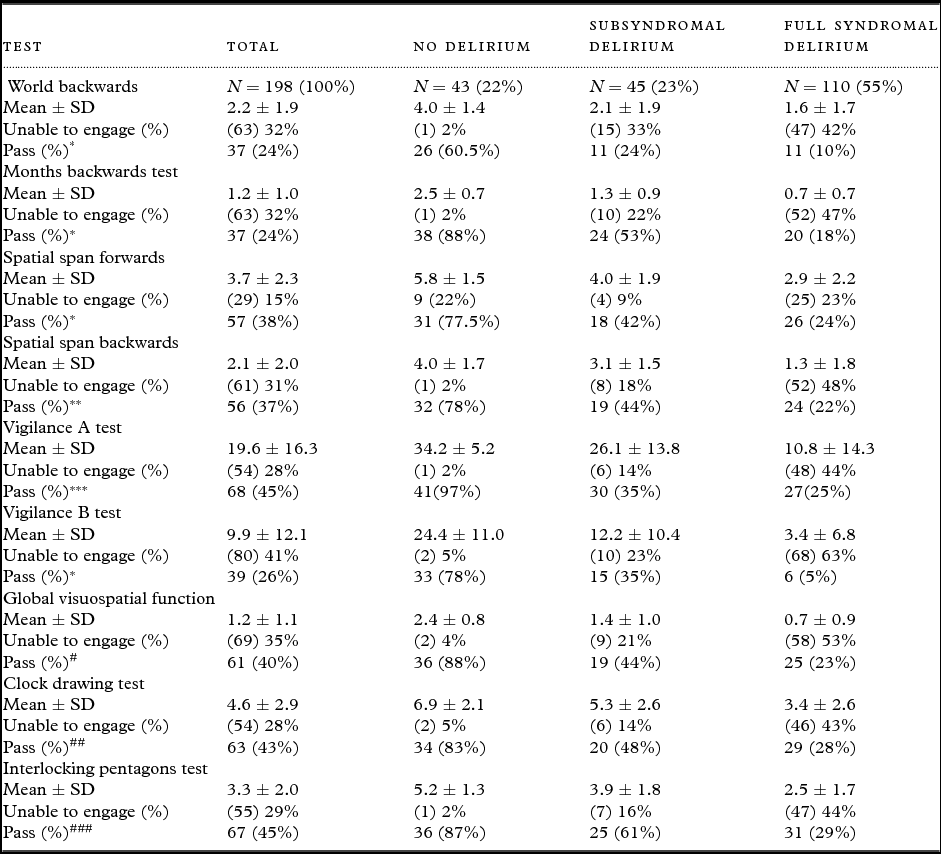
Table 2 shows performance on the nine cognitive tests. The ability to meaningfully engage with each of the tests varied from 85% for the Spatial Span Forwards test to 59% for the Vigilance B test. The frequency of non-engagement was particularly evident in the FSD group with regard to all tests, ranging from 68% for the Vigilance B test to 23% for the Spatial Span Forwards test.
Cognitive test scores for neurocognitive groups and total group (mean ± SD, % engagement, and pass/fail frequency)

A comparison of median test scores using Mann Whitney U tests for nine cognitive bedside tests among neurocognitive groups: % pass rate compared with Chi Squared scores.
FSD and SSD > ND at p < 0.001 for World backwards test.
FSD > SSD > ND at p < 0.001 for MBT, vigilance B test, GVSP, CDT, IPT.
FSD and SSD > ND at p < 0.05 for DSF, FSD and SSD > ND at p < 0.001, FSD > SSD at p < 0.01 for DSB.
FSD > SSD and ND at p < 0.001, SSD > ND at p < 0.05 for Vig A.
FSD and SSD > ND at p < 0.001, SSD > ND at p < 0.05 for IPT. Using the pass/fail cut-off scores:
* FSD > SSD > ND at p < 0.001 for world backwards test, MBT, SSF, and Vig B test.
** FSD > ND at p < 0.001, FSD > SSD at p < 0.01, SSD > ND at p < 0.01 for SSB.
*** FSD > ND at p < 0.001, SSD > ND at p < 0.01 for Vig A test.
# FSD and SSD > ND at p < 0.001, FSD > SSD at p < 0.05 for GVSP.
## FSD > ND at p < 0.001, FSD and SSD > ND at p < 0.05 for CDT.
In terms of performance scores, applying a correction of p < 0.01 for multiple comparisons, the ND group had significantly higher median scores than the FSD group for all tests. The ND group was distinguished from subsyndromal group for MBT, Vigilance B, global VSP, CDT, and IPT. The SSD group was distinguished from the FSD group by performance on the Vigilance A, SSB, and SSF.
Using dichotomous pass/fail cut-off scores, the ND group pass rate was greater than those with SSD for MBT, World backwards test, SSF, Vigilance B (all at p < 0.001). The ND group pass rate was greater than the FSD group for all tests (at p < 0.001). The SSD group pass rate was greater than the FSD group for global VSP (at p < 0.001).
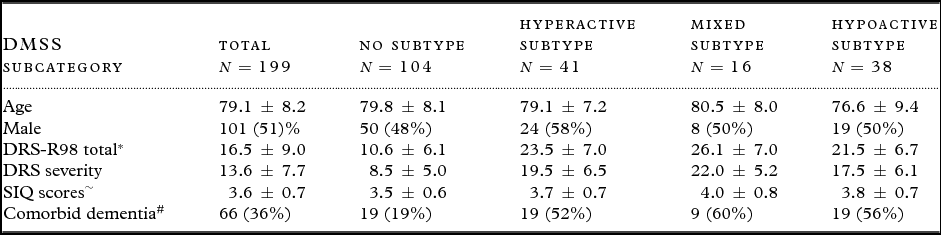
The comparison of test performance among motor subtypes in patients with delirium found that the no subtype group had less severe delirium as evidenced by the significantly lower DRS and DRS-R98 severity scale scores (Tables 3 and 4). However the magnitude of the difference is much greater than that accounted for by the lower motor activity scores (items 5 and 6 of the DRS-R98) but extends to include the range of DRS-R98 items and suggests that the no subtype reflects a milder delirium or perhaps SSD. DRS-R98 scores were highest in the mixed subtype. The frequency of comorbid dementia was similar across the motor subtypes and present in 52% in the hyperactive subtype, 60% in the mixed subtype, and 56% in the hypoactive subtype.
DRS-R98 severity scores for patients with delirium according to clinical subtype as per the delirium motor subtype scale

*All groups > No subtype at p < 0.001.
~All groups > no subtype at p < 0.001.
#All groups > no subtype at p < 0.001.
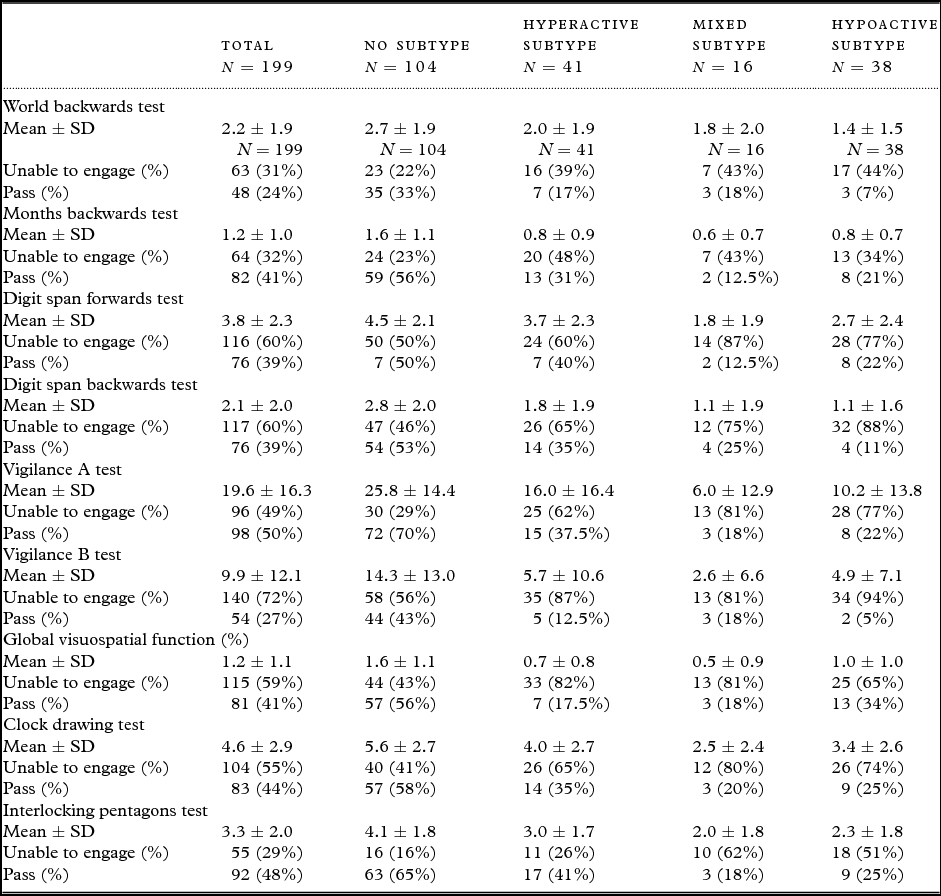
Cognitive test scores for total group and motor subtype groups (mean ± SD, % engagement, and pass/fail frequency

A comparison of test scores among motor subtypes.
Hypoactive subtype > no subtype at p < 0.001 for World backwards test.
Hyperactive and hypoactive subtypes > no subtype at p < 0.001, Mixed subtype > no subtype at p < 0.05 for MBT.
Mixed and hypoactive subtypes > no subtype at p < 0.001, Hyperactive subtype > mixed subtype at p < 0.05 for DSF.
Hyperactive > no subtype at p < 0.05, Hypoactive subtype > no subtype at p < 0.001 for DSB.
Mixed and hypoactive subtypes > no subtype at p < 0.001, Hyperactive > no subtype at p < 0.05 for Vig A test.
Hyperactive and hypoactive subtypes > no subtype at p < 0.001, mixed subtype > no subtype at p < 0.05 for Vig B.
Hyperactive and mixed subtype > no subtype at p <0.001, Hypoactive > no subtype at p < 0.05 for GVSP.
Mixed subtype and hypoactive subtypes > no subtype at p <0.001, Hyperactive subtype > no subtype at p < 0.05 for CDT.
Hyperactive subtype > no subtype at p < 0.01, mixed and hypoactive subtypes > no subtype at p < 0.001 for IPT.
The no subtype group scored better than the other motor subtypes on the majority of tests, but especially in comparison with the hypoactive subtype apart from the GVSP test where the principal differences were between the no subtype and the hyperactive and mixed subtypes. Otherwise, there were no significant differences noted in performance between hyperactive, mixed, and hypoactive subtypes (Table 4).
Discussion
As our population ages, the detection and early diagnosis of cognitive impairment and neurocognitive disorders is increasingly important. Early identification can lead to better outcomes for both patients and caregivers and allow for a reduction in psychological, physical, social, and financial burden. Our findings highlight how existing cognitive screening tests have only modest coverage of elderly hospitalized patient populations with similarly modest accuracy for identifying delirium diagnoses. There is thus a need to develop more delirium-oriented and efficient tests that are quick, easy to administer, lend themselves for use in a variety of settings and that serve to detect specific profiles of impairment.
The DSM-5 criteria for delirium require impaired ability to sustain, focus, or shift attention in patients diagnosed with delirium (American Psychiatric Association, 1994). Vigilance equates with the ability to sustain attention to a task and is often referred to as vigilant attention. Our findings emphasize how the detection of delirium, including different intensities of syndromal status, can be enhanced by emphasizing attention, vigilance, and visuospatial functioning as key cognitive functions for testing.
We compared performance on nine bedside tests of cognition in elderly medical inpatients with varied neurocognitive presentations, including a SSD group. Participants were carefully diagnosed using a full neuropsychiatric assessment that included well-validated instruments. We found that patients with SSD could be distinguished from ND in respect of performance on a variety of cognitive tests of attention, vigilance, and visuospatial functioning with the MBT, Vigilance B, global VSP, CDT, and IPT the most distinguishing. In addition, many tests also distinguished SSD from FSD, especially the Vigilance A, SSB, and SSF. These findings suggest that these different bedside tests of cognition should be applied differently depending on their preferred or primary purpose with the ability to distinguish SSD from those without delirium of particular clinical relevance as it may allow for the earlier identification of emerging (subsyndromal) delirium. This is especially important given that studies have linked a delayed diagnosis of delirium to poor outcomes, including elevated mortality rates (Kakuma et al., Reference Kakuma2003; Gonzalez et al., Reference González2009) while other work has shown that the administration of risperidone to elderly patients who experienced SSD after cardiac surgery was associated with a significantly lower incidence of transition into FSD (Hakim et al., Reference Hakim, Othman and Naoum2012).
One of the most clinically relevant findings of our study relates to the percentage of those tested who were unable to engage with testing which may be secondary to the patient being too drowsy or too agitated to undergo cognitive testing. This was found to equate to one third in both the SSD and FSD groups for most tests with best coverage noted for the Spatial Span Forward test and worst coverage for the Vigilance B test. Of note, the cognitive tests used in this study were largely developed as elements of test batteries designed to assess cognition in subjects with dementia or those at a higher level of cognitive abilities than hospitalized elderly and are thus not ideally suited to assessing those with severe neurocognitive disorders such as delirium. This highlights the need to develop cognitive tests which are more specific for delirium and that allow for detailed assessment of severity and facilitate monitoring of progress over time in varying neurocognitive groups including those with delirium of a varying severity.
The comparison of test performance among motor subtypes indicated higher scores on all tests for the no subtype group. In keeping with this finding, the no subtype group had less severe delirium compared to the other groups as concluded from the lower DRS-R98 severity scale scores. It was notable that performance on these tests, including the percentage of subtypes who were unable to meaningfully engage, was similar across hypoactive and hyperactive subtypes. However, the reasons underpinning such impaired performance are likely to differ with distractability especially relevant to hyperactive patients and reduced arousal and somnolence relevant to hypoactive patients – although this was not formally examined in our study.
The findings of this study highlight how the detection of delirium can be improved through the development of simple cognitive bedside tests which emphasize impaired attention, vigilance, and visuospatial ability as key elements within the cognitive domain while allowing for a level of complexity that engages those patients with gross cognitive impairment. Clear guidance is necessary to allow for the rating of those patients who engage minimally with testing. The European Delirium Association (EDA) and the American Delirium Society (ADS) guidance on the interpretation of DSM-5 proposes that inability to engage with testing should be equated with severe inattention (European Delirium Association, 2014).
In addition, abnormal level of arousal is a strong indicator of delirium and is strongly associated with inattention as measured using the Richmond Agitation Sedation Scale (RASS) and the Observational Scale of Level of Arousal (OSLA) (Tieges et al., Reference Tieges, McGrath, Hall and MacLullich2013). It is thus prudent to combine cognitive bedside tests with a systematic recording of the patient's level of arousal to facilitate rating of cognitive status in a more complete range of patients, but tests that embrace lower functioning subjects are also required to allow for precise grading of severity of impairments and monitoring of performance over time.
Conclusions
Simple bedside tests of attention, vigilance, and visuospatial ability are useful in distinguishing different syndromal intensities of delirium, including subsyndromal illness from ND. Many hospitalized elderly patients cannot engage meaningfully with existing cognitive tests such that novel approaches to testing are needed in order to facilitate more complete coverage of this important population. The findings of our study highlight that cognitive bedside tests can clearly distinguish those with SSD from those without delirium namely MBT, Vig A, global VSP, CDT, and IPT. The tests which best distinguish those with SSD from those with FSD are Vig A, SSB, and SSF. As such, an important conclusion of the work is that bedside cognitive tests have considerable capacity to enhance the recognition and diagnosis of delirium, however, the choice of test is impacted upon by the main target of the assessment. The MBT, Vig B, global VSP, CDT, and IPT can allow for greater consistency in the detection of delirium spectrum illness.
Study limitations
We studied consecutive referrals to a consultation liaison psychiatry service for assessment of neuropsychiatric symptoms and cognitive performance. We included a range of bedside tests but this was not exhaustive. We did not measure the reasons for patient's non-engagement with testing but these are likely to differ across motor subtypes. Specificity also was not included in the study.
Conflict of interest
The authors have no conflict of interest to report.
Description of authors’ roles
CD was responsible for analyzing the data and writing the paper.
DM was responsible for formulating the research question, carrying out the study, and analysis of the data.
ML, CPD, OW, FA, CE, MO'C, and DA were responsible for carrying out the study.
HO'C and WC were responsible for designing and carrying out the study.