INTRODUCTION
Recent evidence has established a strong association between palliative care and clinical outcomes among patients with advanced lung cancer—including quality of life, mood, satisfaction with treatment, understanding of the prognostic, healthcare service use, cost of care, and survival (Zimmermann et al., Reference Zimmermann, Swami and Krzyzanowska2014; Bakitas et al., Reference Bakitas, Lyons and Hegel2009; Temel et al., Reference Temel, Greer and Muzikansky2010). However, previous studies by our team and others suggest that lung cancer patients have limited access to palliative care, and, as a result, patients often receive such care only when the disease is at an advanced stage (Osta et al., Reference Osta, Palmer and Paraskevopoulos2008; Hui et al., Reference Hui, Elsayem and de la Cruz2010; Reville et al., Reference Reville, Miller and Toner2010). In order to improve access to palliative care in the context of a setting with limited resources, our institution recently implemented a pilot project of an embedded outpatient palliative care program (a rapid-access supportive care clinic [RASCC]) by establishing a criterion to adjust to the existing resources (Hui et al., Reference Hui, Elsayem and de la Cruz2010) so that all eligible patients could be seen on the same day. With the consensus of thoracic medical oncologists, the decision was made to set up a specific criterion for referral—that is, the advanced non-small-cell lung cancer (NSCLC) patients could be referred to the RASCC whenever they presented with severe symptoms, distress, and/or had a prognosis of ≤6 months as estimated by a thoracic medical oncologist.
As there is a limited number of pragmatic studies that evaluate the impact of the criteria for referral to outpatient palliative care, we aimed in the present study to (1) compare patient characteristics and overall survival of advanced NSCLC patients referred to the RASCC and advanced NSCLC patients not referred to the RASCC; (2) compare patients who were referred to the RASCC early after diagnosis or registration with those who were referred late; and (3) compare patients who were referred to the RASCC by thoracic oncologists with high rates of RASCC referrals and patients who were referred to the RASCC by thoracic oncologists with low referral rates. We anticipated that our results would provide preliminary data that could foster development of criteria for finding the optimum time at which to integrate palliative and oncology care in settings with limited resources.
METHODS
This research was approved by the institutional review board of the University of Texas MD Anderson Cancer Center.
Rapid-Access Supportive Care Clinic (RASCC)
The RASCC was embedded in the thoracic medical oncology clinic at The University of Texas MD Anderson Cancer Center. Patients could be referred to the RASCC by their thoracic medical oncologists at the same time they were visiting the center for other reasons, and they were seen the same day by a board-certified palliative medicine specialist and provided access to the palliative care team as needed. An eligibility criterion was established so as to adjust to the existing resources (Hui et al., Reference Hui, Elsayem and de la Cruz2010) so that all eligible patients could be seen on the same day. This criterion was established based on a consensus among thoracic medical oncologists that the advanced NSCLC lung patients could be accessing the RASCC whenever they were experiencing severe symptoms, distress, and/or had a prognosis of ≤6 months as estimated by a thoracic medical oncologist.
Study Sample
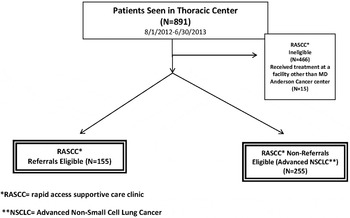
For this retrospective study, we selected the electronic medical records of all patients with advanced NSCLC treated by thoracic oncologists at the Thoracic Center at The University of Texas MD Anderson Cancer Center during the pilot period of the RASCC: August 1, 2012–June 30, 2013. Patients who had been initially seen by the palliative care team as outpatients before August of 2012 or as inpatients were excluded. We also excluded non-referrals who received further treatment outside MD Anderson. Figure 1 shows the details of the patients included in our study: RASCC referrals (n = 155) and RASCC non-referrals (n = 255).
Patient screening and inclusion.

Referred patients were divided into two subgroups so as to understand the timing of RASCC access relative to advanced cancer diagnosis: those who were referred to the RASCC within 12 weeks of diagnosis of advanced cancer (early referrals) and those referred to the RASCC more than 12 weeks after diagnosis (late referrals). We also classified referred patients based on rates of referrals to the RASCC for the thoracic oncologists who referred them so as to better understand referral patterns. High-referring thoracic oncologists (HROs) were defined as those who referred at least 30% of their NSCLC patients to the RASCC, and low-referring thoracic oncologists (LROs) were defined as those who referred less than 30% of their NSCLC patients to the RASCC.
Patient Characteristics
Patient characteristics included age, sex, race, family cancer history, smoking history, illicit drug and alcohol use, and performance status. Illicit drug use was assessed based on patients' responses to this question: “Have you ever used any recreational [street] drugs?” Reports of current or past use were coded as “yes” for the analysis. A referred patient's history of alcohol use was screened with the CAGE questionnaire (Ewing, Reference Ewing1984). Patients who responded “yes” to two or more of the four questions were considered to have a history of alcoholism. Performance status was evaluated with the Zubrod Performance Scale, which ranges from 0 (patient has full normal activity) to 4 (patient is completely disabled by illness) (Zubrod, Reference Zubrod1960). Except for the CAGE questionnaire data, which were collected at the time of initial supportive care consultation at the RASCC, the above data were all derived from study patients' self-reported information collected during the initial consultation with a thoracic oncologist at MD Anderson.
Comorbidities
The comorbidities analyzed for our study were 14 common chronic diseases: chronic obstructive pulmonary disease, hypertension, coronary artery disease, congestive heart failure, chronic kidney disease, diabetes mellitus, seizures, dementia, psychiatric disorders, hyperthyroidism, hypothyroidism, other cancers, deep vein thrombosis, and hepatic cirrhosis. We examined the differences in rates for each of the listed comorbidities in the referred and non-referred groups.
Cancer-Related Symptoms
The severity of common patient-reported cancer-related symptoms was extracted from medical records at the time of referral to the RASCC (RASCC patients) or to the thoracic oncology clinic (non-RASCC patients). These symptoms were assessed as part of routine care using a 0–10 Likert-type scale (0 = no symptoms and 10 = worst symptom imaginable). The symptoms included pain, fatigue, nausea, depression, anxiety, drowsiness, shortness of breath, lack of appetite, and sleep disturbance. A symptom distress score was calculated by adding a composite of the pain, fatigue, nausea, depression, anxiety, drowsiness, shortness of breath, lack of appetite, and sleep disturbance scores.
Overall Survival
Overall survival (OS) was defined as the time between the date of diagnosis of advanced cancer and the date of death or last contact. OS durations were compared between referred and non-referred patients, between early and late referrals, and between HRO and LRO patients to assess the relationship between access to the RASCC and overall survival.
Statistical Analyses
Descriptive statistics (medians, frequencies, and percentages) were utilized to summarize age, sex, race, family history of cancer, smoking, alcohol use, illicit drug use, performance status, and cancer-related symptoms for different subgroups. The chi-square test and Fisher's exact test were employed to compare categorical variables between two groups, and the Wilcoxon rank-sum test was utilized to compare continuous variables between the two groups. Overall survival was estimated using the Kaplan–Meier method, and survival curves were compared using the log-rank test. Values of p < 0.05 were considered statistically significant. All analyses were performed using IBM SPSS software (v. 22, Armonk, NY).
RESULTS
During the RASCC pilot period of August 1, 2012–June 30, 2013, a total of 410 patients registered at the Thoracic Center with advanced-stage NSCLC. Of those 410 patients, 155 (37.8%) were referred to the RASCC (Figure 1). Among these 155 patients, 114 (73.55%) were early referrals and 81 (52.26%) were referred by high-referring oncologists.
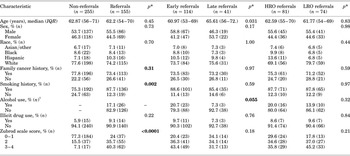
Table 1 shows a comparison of patient characteristics between groups. Referred patients differed significantly from non-referred patients in having poorer performance status and a higher proportion of individuals with a history of smoking. Early referrals were significantly younger and more likely to have a history of alcoholism than late referrals. No significant differences in patient characteristics were found between HRO and LRO patients. Referred and non-referred patients did not significantly differ in terms of comorbidities. We also found no significant difference between HRO and LRO patients with respect to early referral rates (p = 0.46).
Patient characteristics

HRO and LRO = high- and low-referring thoracic oncologists; IQR = interquartile range.
* Chi-square or Mann–Whitney U test.
† CAGE questionnaire (Ewing, Reference Ewing1984).
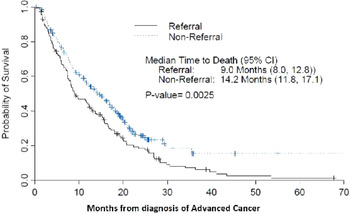
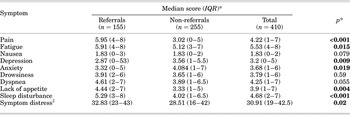
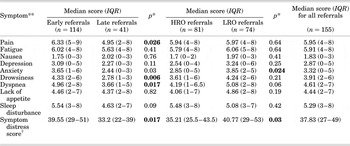
Tables 2 and 3 show between-group comparisons of symptoms. Referred patients had significantly higher scores for pain, fatigue, lack of appetite, sleep disturbance, and symptom distress and significantly lower scores for anxiety and depression than non-referred patients (Table 2). Early referrals had significantly higher scores for pain, anxiety, drowsiness, dyspnea, financial distress, and symptom distress than late referrals. LRO patients had significantly higher scores for anxiety, dyspnea, feelings of well-being, spiritual pain, and symptom distress than HRO patients (Table 3). Referred patients had significantly shorter median OS from the diagnosis of advanced cancer than non-referred patients (9 vs. 14.2 months, p = 0.0025; Figure 2).
Overall survival analysis of RASCC referrals and non-referrals.

Symptom severity in referred and non-referred patients†

IQR = interquartile range.
* 0 = no symptoms, 10 = worst imaginable severity.
† Mann–Whitney U test for comparison of referrals with non-referrals.
‡ Sum of scores for pain, fatigue, nausea, depression, anxiety, drowsiness, dyspnea, and lack of appetite.
Comparison of symptom severity between early and late referrals and between HRO and LRO referrals

HRO and LRO = high- and low-referring thoracic oncologists; IQR = interquartile range.
* Mann–Whitney U test.
** 0–10 scale (0 = no symptom, 10 = worst imaginable severity).
† Sum of scores for pain, fatigue, nausea, depression, anxiety, drowsiness, dyspnea, lack of appetite, and sleep disturbance.
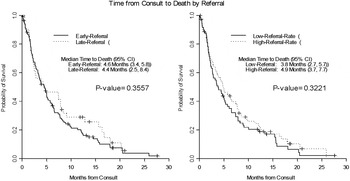
The time interval from RASCC consult to death (OS) did not differ significantly between early and late referrals (4.6 vs. 4.4 months; p = 0.35), nor between HRO and LRO patients (3.8 vs. 4.9 months, p = 0.32; Figure 3).
Overall survival analysis of early and late RASCC referrals, and referrals by thoracic oncologists with high and low rates of referral to the RASCC.

DISCUSSION
Only 37% of the participants in our study were able to access the RASCC due to the state of available resources and with a threshold set at 6 months or less. Based on our results, we would suggest that the referral threshold matters. Referrals at a later stage and with worse symptoms can impact outcomes due to referral bias. Since the referral was ≤6 months, the expectation would be that survival would not be different whether the referral was early or late. However, based on our results, it seems that the motivating factor for earlier referral is higher symptom distress. Future studies should explore strategies where increased resources (structures and processes) are available and it is possible to see patients earlier on in the course of their disease. The other option would be to implement immediate access to palliative care by training the oncologist to provide primary palliative care and then determine when it would be appropriate to provide early access. To address the resource and time crunch, such strategies as sequential implementation of various components with palliative interventions that obtain the highest yield early on could be considered.
Our study found that patients with advanced NSCLC who were referred to the RASCC had higher symptom scores, worse performance status, and shorter overall survival than patients who were not referred to the RASCC. These findings are novel because they are based on real clinical practice (Zimmermann et al., Reference Zimmermann, Swami and Krzyzanowska2014; Bakitas et al., Reference Bakitas, Lyons and Hegel2009; Temel et al., Reference Temel, Greer and Muzikansky2010; Bauman & Temel, Reference Bauman and Temel2014). These data suggest that patients in outpatient settings referred to palliative care are likely to survive for a shorter time and present with more severe physical and emotional distress as compared to patients not referred to palliative care. Previous randomized controlled trials have found that patients randomized to early palliative care had improved symptom control and better quality of life as well as improved survival as compared to patients who were not referred. Our findings suggest that referred bias in clinical practice will result in patients referred to outpatient palliative care having more severe symptoms and worse overall survival, and also that symptom distress will be worse for early referrals. This information will be useful for clinical cancer programs, as there might be a false perception of the failure of palliative care programs if outcomes among referred versus non-referred patients are compared in regular clinical practice.
The findings of the present study suggest that medical oncologists do not use information such as age, gender, or race in deciding a referral to palliative care, and that they are able to identify a subgroup of patients with more severe distress and worse prognosis for referral to the RASCC. Unfortunately, there were patients with significant physical and emotional distress among the non-referred patients. Implementation of regular assessment and monitoring of patient-reported outcomes might help better identify those patients who are in severe distress, and this might allow earlier referral for those patients.
Referred patients had higher scores for pain, fatigue, lack of appetite, and sleep disturbance and lower depression and anxiety scores. These data suggest that referral to the RASCC was more likely based on physical rather than psychological symptoms, possibly due to the fact that physical symptoms are likely to interfere with functional status (and thereby affect treatment decisions) and may be more readily detected by oncologists (Wentlandt et al., Reference Wentlandt, Krzyzanowska and Swami2012).
Early referrals reported more severe pain, anxiety, drowsiness, dyspnea, financial distress, and symptom distress than late referrals. Early referrals also tended to be younger and were more likely to have a history of alcoholism (which is associated with a high symptom burden). These findings suggest that both level of symptom expression and complexity of care required influenced oncologists' decisions on when to refer patients to the RASCC (Garyali et al., Reference Garyali, Palmer and Yennurajalingam2006; Fadul et al., Reference Fadul, Elsayem and Palmer2009; Yennurajalingam et al., Reference Yennurajalingam, Urbauer and Casper2011; Reyes-Gibby et al., Reference Reyes-Gibby, Anderson and Shete2012; Wentlandt et al., Reference Wentlandt, Krzyzanowska and Swami2012; Schenker et al., Reference Schenker, Crowley-Matoka and Dohan2014).
Our findings suggest that thoracic oncologists with high rates of referrals to the RASCC have become more familiar with the process of collaboration in care and refer patients who are generally at a significantly lower level of distress as compared to patients referred by thoracic oncologists with low rates of referrals (LROs) to the RASCC, suggesting that LROs need a much higher threshold of patient distress to decide for a palliative care referral.
More research is needed to determine the criteria for optimal timing of referring patients to palliative care. While patients with low symptom burden should ideally also benefit from early referral to palliative care, the findings from previous studies by our team suggest that adherence to follow-up palliative care is low among such patients, possibly because the patients perceive the value of palliative care to be low (Yennurajalingam et al., Reference Yennurajalingam, Urbauer and Casper2011; Kang et al., Reference Kang, Kwon and Hui2013).
Several aspects of this study may limit the generalizability of our results. Data collection was done retrospectively. All patients included in the study were from the MD Anderson Cancer Center, which has a comprehensive palliative care service (for both inpatients and outpatients). The oncologists at MD Anderson were trained on the importance of early integration of palliative care with standard oncology care and were provided same-day access for their patients to either outpatient or inpatient palliative care. We also had changed the name of the service to “supportive care” to moderate the negative perceptions associated with the term “palliative care.” These unique aspects of the palliative care provided at MD Anderson may have resulted in a higher rate of referrals to palliative care for patients with advanced NSCLC than would be observed in other settings. In addition, the extent to which our findings are applicable to patients with other cancers is unclear.
The findings of our research can be employed to guide further investigation of various measures for improving access to palliative care and the timing of palliative care referral in healthcare centers, with the objectives of increasing early identification of palliative care needs, improving symptom management, and reducing psychosocial distress in patients with advanced NSCLC as well as in patients with other cancers or life-limiting illnesses (Bruera & Yennurajalingam, Reference Bruera and Yennurajalingam2012; Glare et al., Reference Glare, Plakovic and Schloms2013; Bauman & Temel, Reference Bauman and Temel2014). For instance, in determining whether and when to refer cancer patients to palliative care, oncologists could consider such factors as multiple hospitalizations and disease progression after first-line therapy, in addition to the physical symptoms of cancer (Weissman & Meier, Reference Weissman and Meier2010; Glare et al., Reference Glare, Plakovic and Schloms2013). Further studies are needed to evaluate whether patients with better performance status and less symptom burden will benefit the most.
CONCLUSIONS
We have found that patients who were referred to the RASCC presented with a higher patient-reported symptom distress score and worse survival outcomes. Further studies are required to evaluate the optimal criteria for timely integration of palliative and oncology care.
ACKNOWLEDGMENTS
Preparation of the manuscript was supported in part by the American Cancer Society (RSG-11-170-01-PCSM [to S.Y.]).
CONFLICTS OF INTEREST
The authors hereby state that they have no conflicts of interest to declare.