Introduction
Aboriginal and Torres Strait Islander (hereafter Aboriginal) Australians, the socially and linguistically diverse Indigenous peoples of Australia, comprise 3% of the Australian population. The health status of Aboriginal Australians lags substantially behind that of other Australians, as reflected in the 10-year gap in life expectancy and the 2.8-fold higher burden of (all-cause) disease (Vos, Barker, Begg, Stanley, & Lopez, Reference Vos, Barker, Begg, Stanley and Lopez2009). These disparities extend to most health conditions, including stroke and TBI, conditions that both impact significantly on communication.
When compared to non-Aboriginal Australians, the incidence rate of stroke for Aboriginal Australians has been found to be 2.6 times higher for men and 3.0 for women (Australian Institute of Health and Welfare, 2008; Katzenellenbogen, Vos, Somerford, Begg, Semmens, & Codde, Reference Katzenellenbogen, Vos, Somerford, Begg, Semmens and Codde2010); these figures may in fact be underestimates (Thrift, Cadilhac, & Eades, Reference Thrift, Cadilhac and Eades2011). Kilkenny, Harris, Ritchie, Price and Cadilhac (Reference Kilkenny, Harris, Ritchie, Price and Cadilhac2013) found that Aboriginal stroke patients aged 18–64 years had a threefold greater chance of dying or being dependent at discharge compared to non-Aboriginal patients. Aboriginal people are also known to experience stroke at a younger age than their non-Aboriginal counterparts (Australian Institute of Health and Welfare, 2004; Katzenellenbogen et al., Reference Katzenellenbogen, Vos, Somerford, Begg, Semmens and Codde2010), with Katzenellenbogen et al. reporting that more than 60% of Aboriginal non-fatal stroke burden occurred in the 25–54 year age-group compared to 24% in the non-Aboriginal group.
In terms of TBI, studies suggest the overall rate of head injury due to assault in Aboriginal populations is up to 21 times higher than that among the non-Aboriginal population (Jamieson, Harrison, & Berry, Reference Jamieson, Harrison and Berry2008), while the Epidemiology of Injury in Western Australia report (Department of Health of Western Australia, 2011) concludes that Aboriginal people are much more likely than their non-Aboriginal counterparts to experience all the types of injuries which potentially result in brain damage, including falls, motor vehicle accidents, drowning, poisoning, assault, and alcohol-related injuries.
Thirty percent of people who experience a first ischaemic stroke become “aphasic” or language disabled (Engelter et al., Reference Engelter, Gostynski, Papa, Frei, Born, Ajdacic-Gross and Lyrer2006), while the incidence of a broader “cognitive-communication disorder” associated with TBI is estimated to be around 15 per 100,000 population per annum (Tate, McDonald, & Lulham, Reference Tate, McDonald and Lulham1998). ACD results in greater difficulties and further decrement in quality of life for both the persons involved and their family compared to those without this condition (Kauhanen et al., Reference Kauhanen, Korpelainen, Hiltunen, Maata, Mononen, Brusin and Myllylä2006; Landau & Hissett, Reference Landau and Hissett2008). Individuals are known to suffer from increased anxiety, depression, loss of identity, and have ongoing challenges related to social isolation, lack of employment prospects, lack of ability to engage in everyday activities, and significant family disruption (Cruice, Worrall, & Hickson, Reference Cruice, Worrall and Hickson2011; Hilari & Byng, Reference Hilari and Byng2009; Hilari, Reference Hilari2011; Temkin, Corrigan, Dikmen, & Machamer, Reference Temkin, Corrigan, Dikmen and Machamer2009). The impact of an ACD upon an Aboriginal person may cause particular deterioration in the sense of identity as communication is central to engagement and connectedness to family, community, and Aboriginal culture and history. Additionally the leadership of Elders, who rely on communication abilities to listen, provide advice, and act as role models is important for the health of families and communities (Australian Health Ministers Advisory Council, 2011). The Aboriginal and Torres Strait Islander Health Performance Framework 2010 Report (Australian Health Ministers Advisory Council, 2011) also states that “injuries can cause long-term disadvantage for Aboriginal and Torres Strait Islander peoples including: loss of cultural knowledge and wisdom, and the chance of a full life; the burden on caregivers for people with disabilities; decreased workplace productivity; and continuation of the cycle of grief among families, friends and communities” (p. 18). Although not all injuries will lead to an ACD, injuries that do result in an ACD have a detrimental impact.
Aboriginal Australians’ experiences of ACD are likely to be different from non-Aboriginal Australians’ in terms of access to health services, manifestations of the disorder, the construction of the problem and ultimately, as a result of these cultural differences, engagement with treatment modalities (Armstrong et al., Reference Armstrong, Hersh, Hayward and Fraser2015). Previous work related to cardiac rehabilitation, cancer, and management of chronic disease in general has documented challenging issues for Aboriginal people related to areas such as communication, cultural security and cultural beliefs (Cass et al., Reference Cass, Lowell, Christie, Snelling, Flack, Marrnganyin and Brown2002; Liaw et al., Reference Liaw, Lau, Pyett, Furler, Burchill, Rowley and Kelaher2011; Lowell et al., Reference Lowell, Maypilama, Yikaniwuy, Rrapa, Williams and Dunn2012; Shahid, Finn, Bessarab, & Thompson, Reference Shahid, Finn, Bessarab and Thompson2011). As such, there is substantial support for an investigation of the diagnosis, assessment and use of communication rehabilitation services by Aboriginal people experiencing an ACD.
Under-Identification of ACD
Communication disorders are “silent” disorders. They are less identifiable than physical disabilities, and their identification is likely to be more difficult in people from groups that are different from the dominant culture. In the Australian context, this is relevant particularly if the person's first language is not English. Currently, there are no standardised tests which are culturally and linguistically appropriate for health workers to use as screening tools to identify Aboriginal people with ACD. Consequently, an individual with an ACD may not be diagnosed with a communication disorder immediately after the stroke/TBI or in the longer term. This potential under-identification in Aboriginal patients is likely to result in under-referral to appropriate services. Under-identification is also found in related health areas due to the lack of available appropriate screening or assessment tools, particularly in other cognitive domains (Dingwall & Cairney, Reference Dingwall and Cairney2010).
Rehabilitation Services
Given the above, and the importance of communication for individual, family, and community functioning, it is significant that few Aboriginal Australians receive ongoing communication rehabilitation services and there is virtually no published research in the area. Exceptions include recent articles by our research team (Armstrong, Hersh, Hayward, Fraser, & Brown, Reference Armstrong, Hersh, Hayward, Fraser and Brown2012; Armstrong et al., Reference Armstrong, Hersh, Hayward and Fraser2015; Hersh, Armstrong, & Bourke, Reference Hersh, Armstrong and Bourke2015a; Hersh, Armstrong, Panak, & Coombes, Reference Hersh, Armstrong, Panak and Coombes2015b) and another reference to one case scenario involving a Yolngu man with global aphasia who spoke limited English and experienced great difficulties in hospital in terms of management and discharge (Faux et al., Reference Faux, Ahmat, Bailey, Kesper, Crotty, Pollack and Olver2009). A similar situation exists in terms of Indigenous peoples internationally. Few cases have been documented, with the first insights into the Maori experience of aphasia published only recently (McLellan, McCann, & Worrall, Reference McLellan, McCann and Worrall2011; McLellan, McCann, Worrall, & Harwood, Reference McLellan, McCann, Worrall and Harwood2014). Our pilot study (Armstrong et al., Reference Armstrong, Hersh, Hayward, Fraser and Brown2012; Armstrong et al., Reference Armstrong, Hersh, Hayward and Fraser2015), interviewing 13 Aboriginal people and their families, found little awareness of communication problems or relevant services following stroke in an urban Aboriginal community, with none of the 13 people reporting ongoing speech therapy after leaving hospital. Reports of predominantly non-Aboriginal speech pathologists’ concerns and difficulties in bridging the cultural and linguistic gaps with their Aboriginal clients (Hersh et al., Reference Hersh, Armstrong and Bourke2015a, Reference Hersh, Armstrong, Panak and Coombes2015b) mirror those of other health professionals dealing with patients facing a range of different conditions and disorders (National Stroke Foundation, 2004; Shahid & Thompson, Reference Shahid and Thompson2009; Shahid, Bessarab, Howat, & Thompson, Reference Shahid, Bessarab, Howat and Thompson2009; Shahid et al., Reference Shahid, Finn, Bessarab and Thompson2011; Taylor et al., Reference Taylor, Thompson, Smith, Dimer, Ali and Wood2009). However, when communication is the focus of a service, treatment must involve functional and relevant language, and incorporate culturally appropriate practices in order to be effective. Communication is not just the vehicle of ensuring compliance with a medically based intervention; in this case, communication constitutes the issue, the intervention and the service.
The project described in this paper is directly aligned with the National Partnership Agreement on Closing the Gap in Aboriginal Health Outcomes (Council of Australian Governments, 2008) and aims to provide evidence of the impact of ACD and an overview of assessment and current communication rehabilitation services, in the context of Aboriginal Western Australians. Its specific aims are the following:
-
1. To investigate, using current administrative data, the extent and impact of ACD in urban and rural Western Australian Aboriginal populations following stroke or TBI.
-
2. To develop and validate a culturally appropriate communication disorder assessment tool for screening by health professionals who work with Aboriginal people after stroke and TBI.
-
3. To explore the experiences of Aboriginal people with ACD and their families, and describe the current status of communication rehabilitation services for Aboriginal people.
-
4. To develop potential alternative service delivery models that are accessible and culturally appropriate.
This paper describes the protocol for the study, outlining both the important cultural framework underpinning the work, an overview of the participants and locations involved, as well as the mixed methods used to address each of these aims.
Methods/Design
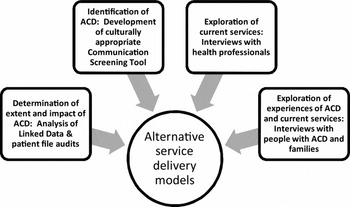
A mixed methodology is being utilised, consisting of several components related to the above mentioned aims (see Figure 1). These include an analysis of linked routine hospital admission data and retrospective file audits, development and pilot testing of a screening tool, interviews and focus groups with people with ACD and their families, as well as health professionals, and drafting of alternative service delivery models. All components will be focused on metropolitan Perth and on five selected regional centres across Western Australia.
Aims and methods of the study.

Aboriginal Framework for the Research
A number of considerations were taken into account in the formation and approach of this study, consistent with an Aboriginal research framework (Laycock, Walker, Harrison, & Brands, Reference Laycock, Walker, Harrison and Brands2011; Purdy, Dudgeon, & Walker, Reference Purdy, Dudgeon and Walker2010) incorporating principles of cultural security (Coffin, Reference Coffin2007) and in line with the National Health & Medical Research Council (NH&MRC) Guidelines for Ethical Conduct in Aboriginal and Torres Strait Islander Health Research (2003). These include the principles of two-way learning and consultation which form an ongoing part of the cultural safety and security of the project in terms of collaboration, employment of Aboriginal research assistants, and recruitment and treatment of Aboriginal participants. The project was conceived through extensive consultation with Aboriginal people throughout Western Australia. The project team includes three Aboriginal researchers, one of whom is the director of an Aboriginal Medical Service (AMS), one who is jointly employed by the AMS and the University of Western Australia, and one researcher who is head of the Indigenous Education and Research Centre at Edith Cowan University. All provide significant input to policies and programs on a wide range of issues at community, state and national levels. The team also received in-principle support from AMS across the state as well as other agencies that provide services to significant numbers of Aboriginal people, for example, Aboriginal teams in Public Health units.
An Aboriginal Reference Group has been established, consisting of members recruited from both the urban and regional areas involved in the study. Aboriginal health professionals, community elders, and other potential stakeholders involved in broad Aboriginal community services form part of this group. The Reference Group guides the project and provides advice to the researchers regarding participant recruitment, development of the interview process, relevant human and practical resources (e.g., interpreters), organisation of community feedback from the project, and general cultural and ethical issues involved. Importantly, they also provide input into translational aspects of the study. The group meets 3–4 times/year, with individual contact between the research team and group members arranged as needed.
In line with the two-way, consultative learning framework, interviews with individuals and focus groups will inform project recommendations and the development of a communication screening tool. Workshops will be held to feed results back to participants, to provide information on communication difficulties to both families and health workers, and to train health workers in the use of the communication screening tool. These activities are to reinforce the reciprocal nature of the study and abide by the negotiated capacity building needs of the communities involved.
Aboriginal research assistants from each of the different regions involved are employed to assist with recruitment in their local area, to undertake interviews and to act as community liaison officers. This is to ensure a level of cultural safety and security for interviewees, and to provide cultural insights into the interview experience.
As the project is focused on communication issues, specific care is being taken to ensure that different languages are taken into account in the project implementation, for example the use of interpreters being used where the language of the person with suspected communication disorder is not the language of the person administering the screening tool. Translation of the screening tool will occur from English into one Aboriginal language in an area where that language is still commonly used in the community. Language centres in different regions are being consulted to both advise on appropriate interpreting services, and to assist in the screening tool translation. Culturally appropriate and “aphasia friendly” consent forms are being used to ensure comprehension and informed consent of potential participants, using language consistent with Aboriginal English and phrasing recommended by the Australian Institute for Aboriginal and Torres Strait Islander Studies for the pilot study conducted in 2010 (Armstrong et al., Reference Armstrong, Hersh, Hayward, Fraser and Brown2012, Reference Armstrong, Hersh, Hayward and Fraser2015).
As noted above, a cultural security framework (Coffin, Reference Coffin2007) will underpin all activities associated with the project.
Participating Sites
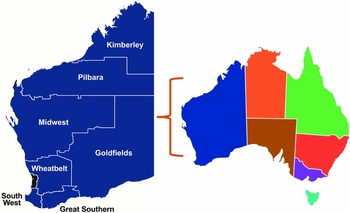
Research sites were chosen to provide a broad cross-section of geographical and cultural areas across Western Australia in which issues may vary considerably. Thus, data collection is being undertaken at four metropolitan hospitals, five regional hospitals and in surrounding communities. One metropolitan-based (Perth) and four regional primary healthcare services for Aboriginal people have agreed to be research sites. The hospital and primary health care sites are located in six different geographical regions within the state – the Kimberley, Pilbara, Goldfields, Great Southern, Midwest, and the South West regions (see Figure 2).
A map of the state of Western Australia, with major regions highlighted, in relation to the whole of Australia. [Image of state regions reproduced with the permission of the Western Australian Country Health Service.]

Analysis of Linked Routine Hospital Admission Data and Retrospective File Audit
Linked routine hospital admission data will be analysed to obtain a quantitative overview of the frequency of ACD recorded in administrative data among patients who were admitted to Western Australian hospitals 2002–2011 with a diagnosis of stroke or TBI. This will provide a minimum estimate of the proportion of ACD in Western Australian hospital patients who have had a stroke or TBI, by Aboriginality, age, region as well as by the five rural and four metropolitan hospitals selected for detailed study.
The Western Australian Data Linkage System (WADLS) (Holman, Bass, Rouse, & Hobbs, Reference Holman, Bass, Rouse and Hobbs1999), a comprehensive system linking population-based administrative health data from several statutory data sets through probabilistic matching, will enable linking of mortality and hospital admission data for this study. This allows a person-based analysis, with differentiation of first-ever events from recurrences, admission histories and estimates of hospital service utilisation (Brameld, Holman, Thomas, & Bass, Reference Brameld, Holman, Thomas and Bass1999; Holman et al., Reference Holman, Bass, Rouse and Hobbs1999). Thus, all admissions with a diagnosis of stroke or TBI to Western Australian hospitals 2002–2011 will be extracted from the Western Australian Hospital Morbidity Data. Codes in all diagnostic positions will be reviewed, with the index admission being the first in the study period and flagged as either a new or existing case. This will provide the total number of cases admitted in the time period. From this group, cases surviving the admission and with any communication disorder or a relevant procedure coded in any admission during the time period will be identified and analysed by Aboriginal status, type of communication disorder, region, age-group, sex and Stroke/TBI. Co-morbidities will be described for patients with and without communication disorders in terms of the Charlson co-morbidity index (Quan et al., Reference Quan, Sundararajan, Halfon, Fong, Burnand, Luthi and Ghali2005) and specific conditions like diabetes, chronic renal disease, alcohol-related admissions and other injuries/trauma using a 5-year look-back period, gleaned from hospital records. A similar analysis will be completed for each of the selected hospitals. Types of discharge will be reviewed to identify patterns of transfers between hospitals as well as discharges against medical advice.
In addition to the linked data, speech pathology and medical files from a sub-set of Aboriginal speech pathology clients (up to seven stroke and seven TBI cases within each rural hospital and 10 stroke and 10 TBI cases within each metropolitan hospital) are being examined. The file audits will potentially constitute a rich source of descriptive data of the Aboriginal person with ACD's experience whilst in hospital, and complement information obtained from both the Linked Data and the qualitative interviews. A relational database is used into which details on therapy services and follow-up procedures received are entered. This includes a variety of parameters including number of sessions offered and subsequently attended, types of therapy provided, involvement of family, Aboriginal Liaison Officers, and interpreters, and ongoing referrals. To explore reasons why some patients identified with ACD were not seen by a speech pathologist, a random sample of medical files of Aboriginal stroke and TBI patients with admissions which include codes for communication disorder is also being examined (seven in each rural hospital and 10 in each metropolitan hospital). A maximum of 225 files will be examined. The information provided by the record audit will provide insight into assessments, difficulties and referrals offered to Aboriginal patients in urban and rural settings.
The electronic patient information record system (such as Communicare) used by the Aboriginal Primary Health Care Services in the study regions is also being accessed where approval from the governing Board of the health service has been granted. Data over the same period will be obtained providing information on the number of people seen at the Centre per year with a diagnosis of stroke or TBI, and with associated speech codes where noted. At least five files from each centre will then be examined in order to ascertain whether any communication disorder had been identified, and whether there had been any speech pathology involvement with the person (including referral or assessment) or any other services offered related to the communication disorder.
Development of Communication Disorder Screening Tool
A culturally tailored communication screening tool is being developed and validated for use with Aboriginal people. The tool is being designed to be used by a variety of healthcare workers for identifying possible ACD and focuses on motor speech problems, language difficulties and cognitively based communication impairments. It consists of a number of skill-based sub-tests involving the person's ability to name pictures (vocabulary) and construct coherent utterances. Ratings of the person's functional abilities on everyday communication tasks will be made by a close family member as well as by the person him/herself. A manual is being developed to support test usage and training workshops.
The development of the screening tool, the index test, is following the approach used for the development of the Kimberley Indigenous Cognitive Assessment (KICA) (LoGiudice et al., Reference LoGiudice, Smith, Lautenschlager, Almeida, Atkinson and Flicker2006), with the content based upon existing aphasia/cognitive linguistic screening tests and functional assessments (e.g., the Frenchay Aphasia Screening Test (Enderby & Crow, Reference Enderby and Crow1996), and the Communicative Effectiveness Index (Lomas et al., Reference Lomas, Pickard, Bester, Elbard, Finlayson and Zoghaib1989)). The instructions, format and wording of existing tools have been reviewed, initially by key Aboriginal informants recruited from Population Health units, public hospitals, AMS, language centres, the broader Aboriginal community across the different regional areas, and the study Reference Group. The informants have been asked to consider the relevance and acceptability of assessment content, pictures and available response scales as well as provide suggestions for re-wording, formatting and the inclusion of additional items. Close review of individual items in the existing tools has occurred, with items that were considered unclear, inappropriate or irrelevant by more than one participant discussed in order to be rephrased or discarded. In order that vocabulary/questions are translatable into different languages, the test will be translated into at least one Aboriginal language (Nyangumarta, spoken widely in the Pilbara region of Western Australia, with an extensive orthography), and then back-translated to English to make sure that the original and translated versions are equivalent.
A minimum of 30 Aboriginal patients admitted to the four metropolitan hospitals and local Aboriginal aged care facilities in Perth with stroke or TBI diagnosis (with and without communication disorders) will be tested on the communication screening tool. Interpreters will be involved and trained as necessary. In addition, 20 people using a regional health service and/or AMS with a history of stroke and/or TBI will undergo testing in one of the regional sites. Aboriginal Health Workers and other Aboriginal health professionals trained in the administration of the tool will perform the screenings and will be blind to the communication status of the patient prior to testing. The screenings will be observed by a qualified speech pathologist familiar with the tool in order to ensure accuracy of administration. All administrations will be audio or videotaped dependent on participant consent. A checklist/observation will be used to monitor issues that are raised in relation to test administration, including the ease with which the Aboriginal Health Worker administered the test. Collation of the results of these observations will inform judgements regarding the practicality of the test and the success of the original training.
All patients screened with the tool will also be independently assessed by a speech pathologist experienced in working with Aboriginal people. This therapist will be blind to the results from the screening tool assessment, but will have access to medical notes, to the family where possible and will be accompanied by an Aboriginal health worker and an interpreter as required. The assessment will consist of an informal conversation, naming and comprehension tasks, and self and family report. The results of the assessment by the speech pathologist will be reviewed independently by a second speech pathologist who will also have the medical history and results of the screening tool assessment. Concordant diagnoses will be accepted. In the case of discordant opinions, a third speech pathologist will complete an assessment to resolve the uncertainty and reach a consensus diagnosis. The experienced speech pathologists’ diagnosis will be used as the “reference test or gold standard” to determine the validity of the screening test, and sensitivity and specificity of the tool assessed. Inter-rater reliability when administered by Aboriginal health workers will be investigated through a sub-set of 15 patients being assessed by two Aboriginal health workers trained in the administration of the tool independently conducting examinations using the screening tool.
Participants will be told that the study will not provide them any direct treatment. However, all participants will be offered information regarding ACD, an information booklet about stroke developed by Queensland Health for Aboriginal and Torres Strait Islander people, entitled “Journey After Stroke”, and they will also be offered information regarding the closest rehabilitation services.
Interviews and Focus Groups
Interviews and focus groups will be conducted with people with ACD and their families, as well as a variety of healthcare workers. The process for each group of participants is outlined below.
Participants with ACD
Five Aboriginal people with ACD at least three months poststroke or TBI and their family members from each of the six different areas will be interviewed (n = 30). Because this is novel research, and therefore exploratory, our sampling matrix will be flexible with respect to demographic factors such as age and gender and will ensure a sample of people from different geographical and cultural areas. As the previous pilot study examined metropolitan residents only, this study includes more rural participants in order to add a rural and different language group and acculturation perspective to our existing understanding. Referral to the study and invitations to participate will occur through Speech Pathologists, Aboriginal Health Workers, General Practitioners, community members and through the networks of the Aboriginal Reference group. A local Aboriginal person is employed within each area to facilitate this process.
Data collection from participants with ACD
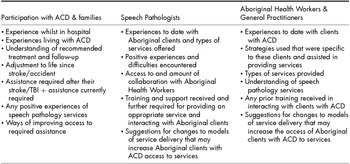
Interviews with participants will take place in the person with ACD's home, aged care facility, primary healthcare setting or at the place most convenient for them and their family member. The individuals and their family members will be asked about issues outlined in Table 1. The interviewer will be an Aboriginal Australian with experience of clinical settings who has undertaken at least 12 hours training (provided as part of the project) covering ACD, in-depth interviewing (incorporating notions of yarning as a research tool (Bessarab & Ng’andu, Reference Bessarab and Ng’andu2010)), facilitating group interviews, and the way(s) in which interviewing can be adapted to the needs of those with communication disability (Dalemans, Wade, van den Heuve, & de Wit, Reference Dalemans, Wade, van den Heuve and de Wit2009; Luck & Rose, Reference Luck and Rose2007). Family members may be present and interviewed either together with, or just after the participants with ACD, or may choose to be interviewed separately. A male and a female interviewer will be available for the interviews as appropriate, to maintain cultural security (Coffin, Reference Coffin2007). Interpreters will also be provided as needed. Should there be a need for added support or counselling, a speech pathologist with experience working with people with ACD will also be available to the interviewer to advise and assist the process as necessary or make referrals to additional services if requested.
Interview Topics

Participants: health professionals
Eighteen Speech Pathologists (eight metropolitan and 10 regional – two from each hospital), 20 Aboriginal Health Workers (10 metropolitan – eight from hospitals and two from AMS/Primary Health Care services, and 10 regional – two from each area) and 20 General Practitioners will be recruited for the study. Participants in the regional areas will be recruited through the local hospital, the local AMS, and General Practitioner networks.
Data collection from health professionals
Interviews with the Speech Pathologists, Aboriginal Health Workers and General Practitioners from each site will occur separately for each group, and at their place of work or convenient location. Where it is possible to organise participants to gather in one site, for example, speech pathologists who work in a specific hospital, the interviews will be conducted as focus groups, as these can yield different information and may assist in gauging a collective response. While both interviews and focus groups can yield rich information, focus groups are an efficient use of time, tap professional group and community attitudes, and are useful in the exploration of health care delivery issues (Davidson, Halcomb, & Gholizadeh, Reference Davidson, Halcomb, Gholizadeh and Liamputtong2010). However, we recognise that in some sites this may not be practical, or that some people would prefer to be interviewed separately, necessitating individual interviews. Issues to be discussed with the health professionals are also outlined in Table 1. Information regarding the demographics and experience (such as time since graduation, time spent in current position and location) of the health professionals will be obtained.
Data analysis
The interviews will be videotaped or audiotaped with consent and transcribed. The accuracy of the transcriptions will be supplemented by observations made by the interviewer at the time of the interview regarding non-verbal behaviours used during each interview (e.g., gestures, facial expressions, body language). People with ACD often supplement verbal expression with non-verbal communication. The transcribed data will be entered into NVivo10, a qualitative software package designed to assist analysing large amounts of text-based data, and coded according to qualitative thematic analysis (Braun & Clarke, Reference Braun and Clarke2006; Taylor & Bogdan, Reference Taylor, Bogdan, Hayden and Avery1994). Responses will be classified according to emerging themes in order to develop a set of initial categories (Taylor & Bogdan, Reference Taylor, Bogdan, Hayden and Avery1994). Further analysis will then refine the categories and the relationships between them in order to develop an understanding of the different perspectives, key themes and core categories. Following the analysis, the resulting themes will be discussed with participants where possible in order to confirm that their meanings were understood and that interpretation is accurate. Member checking is particularly important in a communication disorders study and will help promote a sense of community ownership over the findings. An Aboriginal “lens” to the analysis will be ensured through the involvement of the Aboriginal researchers, Aboriginal Reference Group members, and the Aboriginal Research Assistants in ongoing discussion of themes extracted from the data.
Service Delivery Models
From the interview and focus group data, taken against the background of a review of existing national services (in consultation with the Services for Australian Rural and Remote Allied Health (SARRAH), the National Stroke Foundation, and the Australian Council of Health Standards), a variety of service delivery models will be developed by the research team in conjunction with the Reference Group. These will include aspects related to both identification of ACD and its treatment and potentially could include the following as well as completely novel solutions that emerge:
-
• community based rehabilitation (Gauld, Smith, & Kendall, Reference Gauld, Smith and Kendall2011; Helander, Reference Helander2007);
-
• use of non-health services such as community yarning groups;
-
• use of therapy assistants;
-
• working with families to facilitate conversations; and
-
• education and training for Aboriginal Health Workers, general practitioners and other community workers regarding ACD, how to administer the screening tool, monitoring of therapy programs, advising families and other community members and supporting the person with ACD.
The data gathered will inform potential models in terms of feasibility, cultural appropriateness, and collect preliminary information on potential outcomes and costs. The models will be presented to participants for comments and any necessary refinements made. These prototype models will form the basis of future service development trials.
Ethics Approval
Ethics approval for the project was granted by the Western Australian Aboriginal Health Ethics Committee, the Human Research Ethics Committees of Edith Cowan University, the University of Western Australia, the Western Australian Department of Health, and the Southern Metropolitan Health Service, the Western Australian Country Health Service Research Ethics Committee, and the Kimberley Aboriginal Health Planning Forum Kimberley Research Sub-Committee. In addition, approval was obtained from four Boards of Aboriginal community controlled medical services, and one Western Australian Country Health Service controlled Aboriginal health centre.
Discussion
Apart from our pilot study, this is the first study to investigate Australian Aboriginal peoples’ experience of communication disorders acquired as a result of stroke or TBI. Indeed, it is one of the first explorations into Indigenous peoples’ experiences in this regard. With a dearth of data available surrounding how communication disorders are viewed by Indigenous peoples, how they are currently managed by the person themselves and their family/community, and how they are identified by health professionals in the context of complex co-morbidities and linguistic difference, service planning has been seriously constrained globally and in many areas is non-existent. To date, studies have focused on incidence of stroke and associated morbidity and mortality data, but little attention has been paid to functional outcomes or service delivery models that are culturally safe and accessible. There are no data surrounding ACD after TBI in Indigenous populations generally. Our study therefore has international significance in terms of its approach to understanding and improving ACD in an Indigenous population.
The assessment of ACD relies upon its detection by health professionals around the time of the acute event, which is a time of great stress for affected individuals and their families. Many non-Aboriginal health professionals are not familiar or comfortable with the communication styles of Aboriginal people particularly surrounding cross-cultural pragmatic differences, Aboriginal English, and individuals whose first language is not English (Cass et al., Reference Cass, Lowell, Christie, Snelling, Flack, Marrnganyin and Brown2002; Durey, Thompson, & Wood, Reference Durey, Thompson and Wood2012). Additional barriers occur when a person has an ACD. Even if a communication disorder is noted at the time of the acute event, it may not be assessed given other medical and social priorities. The condition and its effects on the person and family may still be evolving in the early stages, and follow up assessment and support may not be arranged and even if arranged may not occur for a variety of reasons. The low numbers of speech pathologists employed in most rural and particularly remote areas (Speech Pathology Australia, 2014; Zabiela, Williams, & Leitao, Reference Zabiela, Williams and Leitao2007), and the fact that they often cover a wide geographic area, means that workload considerations may also impact upon diagnosis and assessment. To date, there has been little to encourage the screening and assessment of speech disorders by non-speech pathology providers. Hence, the development of a screening tool with which to assess communication disorders among Aboriginal people will be particularly important for improving identification of problems and referral for further assessment and appropriate treatment.
Exploration of hospital data to identify the extent of ACD as reflected in hospital codes will provide the first quantitative information on the extent of both diagnosis of ACD in Aboriginal populations and treatments offered. In addition, qualitative investigation of medical files will shed light on processes and events involved within the relevant medical services, with documented individual journeys providing evidence beyond the current anecdotal recounts. Interviews with both the people with ACD and their families, and with health professionals, will provide further perspectives on current services and experiences and indeed provide the necessary triangulated perspective recommended for gaining an accurate picture of a particular situation or set of circumstances (Liamputtong, Reference Liamputtong2009).
This study provides the first opportunity to explore what happens to Aboriginal people with ACD after stroke and brain injury. Documenting the burden and impact of ACD within a culturally secure framework is a prerequisite to developing better ways to address the problems faced by Aboriginal people with ACD and their families. As communication is fundamental to effective social functioning, translation of the findings to improve the lives of Aboriginal people with ACD is paramount. The insights gained in this study into the extent of ACD and challenges for Aboriginal people and service providers in accessing speech pathology services will inform policy and speech pathology practice. Through peer-reviewed publications, presentations, workshops, training of the health workforce and media coverage of our findings and the screening tool, there is an increased likelihood that Aboriginal people with ACD will be diagnosed and referred for professional support. Increasing community awareness of the nature of ACD, how they differ from mental health problems, and how they are dealt with across a variety of geographical, social and medical contexts will also provide both communities and health services with a shared understanding of the impact of ACD and potentially different ways of managing ACD. In this way the research aims to assist patients to improve their communication, providing an important way in which to improve quality of life and functioning within the family and community context.
Declaration of Interest
The authors report no conflict of interest.
Acknowledgements
The study is funded by National Health and Medical Research Council Project Grant #1046228.