Fiscal crises across the globe have moved questions about the causes of sovereign debt default to the forefront of both theoretical and practical economic importance. Although there exists a well-developed body of research on the economic causes and consequences of default, work considering default as a strategic choice by political actors is still largely undeveloped.Footnote 1 Nowhere is this more obvious than in nondemocracies facing fiscal crisis: although more than half of all default cases in the past fifty years have occurred in autocracies, essentially all political theories of debt default focus solely on the democratic setting.Footnote 2 This lack of emphasis on autocratic politics is understandable if the causes of default are strictly economic. However, the survival incentives of political leaders vary substantially between democracies and autocracies, and a better understanding of the types of domestic pressures faced by governments can help clarify why some regimes are more likely to renege on their international financial obligations.
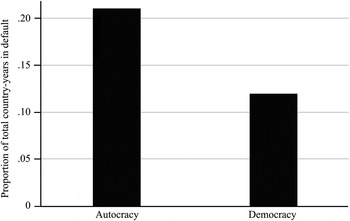
According to data from Reinhart and Rogoff,Footnote 3 more than half of all default cases have occurred in nondemocracies. In a sample of seventy countries representing more than 90 percent of world gross domestic product (GDP) from 1960 to 2009, democracies have spent a total of 235 years in default, whereas autocracies have been in default for a total of 258 years. Figure 1 shows that the same relationship holds when one looks at the proportion of country-years spent in default. Autocratic default appears, if anything, more prevalent than democratic default, and yet our understanding of its underlying causes is limited at best.Footnote 4 If recent events are any guide, considerations by office-minded politicians are critical to default decisions, and understanding the specific ways that institutions shape political survival dynamics is of central importance to this work.
Proportion of country-years spent in default, by regime type

This article develops and tests a novel theory of sovereign debt default in autocracies, where leaders are motivated by fear of urban restlessness in the face of rising food costs. Although in “normal times” autocrats often respond to urban pressure by providing food cheaply to consumers, during times of fiscal crisis such food provision programs may prove too costly to continue. Thus, autocrats may be forced to choose between reducing food subsidies to remain faithful on debt repayment, or defaulting on obligations to international lenders to appease urban citizens threatening revolt in the face of rising food prices.
Yet survival incentives differ across political regimes. If autocratic leaders are constrained by “stones” thrown by rioting citizens, democratic leaders are constrained by “paper stones” cast by voters—political survival for democratic politicians revolves around votes, not protests. Inherent in these different survival incentives is the potential for locational biases: if it is easier to mobilize citizens for protest in densely populated areas, one should expect that autocracies with large cities should favor urban consumers.Footnote 5 However, especially in developing democracies with large rural voting populations, democratic incumbents may place greater weight on rural than urban interests. Given these core differences in survival dynamics across regime type, especially as they relate to urban-rural biases, I restrict my primary attention to discussion of autocratic debt default, and subsequently demonstrate that the dynamics I identify operate in the opposite direction in democracies.Footnote 6
The article tests two main hypotheses: that greater reliance on food imports and higher rates of urbanization should each be linked with sovereign default in autocracies.Footnote 7 Using panel data on forty-three nondemocracies from 1960–2009, I demonstrate strong and robust empirical evidence that autocracies facing urban pressure for cheap imported food are more likely to default on their sovereign debt: an increase in food imports as a proportion of GDP by two standard deviations raises the likelihood of default by 21 percentage points, whereas a similar change in urbanization increases the likelihood of default by 67 percentage points.Footnote 8 In addition, in support of my claim that these political dynamics vary across regimes, I find that the effect of urbanization on debt default in democratic countries is statistically significant and of opposite sign to that in autocracies—although food imports prove a robust predictor of autocratic default, they do not appear to play any significant role in explaining default in democracies. To address concerns about the potential endogeneity of food import costs to unobserved regime attributes, I also use world food commodity prices to instrument for the cost of food imports, finding substantively similar effects on the likelihood of autocratic default. Finally, I provide qualitative evidence for the proposed mechanisms through illustrative historical examples in Zambia and Peru.
This article is the first work, to the best of my knowledge, to develop explicitly a theory of politically driven debt default in autocracies. Autocracies have defaulted on their international borrowing obligations at least as often as democracies have, and a theory that explains the political dynamics of default for this half of all observed cases promises greater leverage in understanding one of the most important fiscal dilemmas of our time. In addition, the article provides the first evidence of the effects of urbanization and food imports on sovereign default. Prior empirical work has not examined these effects; indeed, no link between these factors and debt default has been theorized previously.Footnote 9 This article suggests robust empirical support for two key factors influencing autocratic default that have previously remained completely under the radar of extant analysis.
Finally, the strength of empirical support for the urbanization and food imports findings reconfirms the importance of urban-rural struggles in explaining autocratic political dynamics. By developing a theory that considers the role of urbanization as more than just a by-product of economic growth, this article contributes to a line of work detailing urban biases in autocratic policy-making, and adds credence to claims that urban-rural conflict plays a significant role in shaping autocratic survival more broadly. By highlighting specific mechanisms of political survival that vary under different institutional settings, the article also provides conceptual clarity for widely varying empirical outcomes across democracies and autocracies in the political determinants of sovereign default.
Urban Bias, Food Imports, and Autocratic Sovereign Default
I assume that autocrats are fundamentally self-interested: nondemocratic elites will attempt to maximize their chances of remaining in power by minimizing threats to their rule. In particular, I follow the literature on urban bias in arguing that, in many developing autocracies, a prominent potential threat to continued autocratic rule comes from the concentration of citizens in densely populated urban capitals.Footnote 10 This threat arises from the relative collective action benefits enjoyed by people in urban areas vis-à-vis their rural compatriots: if citizen unrest is the primary potential restraint on autocratic exploitation, and if mass mobilization is easier in cities than rural areas, one should expect to find that autocracies demonstrate an urban bias in their policy-making.Footnote 11 For example, if rural farmers need to walk several miles just to reach their nearest neighbor, whereas urban citizens live and work within a few feet of a host of potential fellow protesters, this suggests that the relative threat of civil opposition to a regime should be much greater in urban areas and so autocrats should favor urban consumers.Footnote 12
Urban bias often results in significant food subsidies for urban consumers. Food typically forms a central part of an urban worker's consumption bundle, and a historical legacy of large-scale “bread riots” has made modern autocrats wary of high food prices. These mandated low prices for food usually come at the expense of rural agricultural producers; in many developing autocracies, governments control the marketing of domestic agricultural production, and often abuse their monopsonist marketing power to force rural farmers to sell their products at submarket prices.Footnote 13 In those countries where domestic agricultural production is sufficient to satisfy urban demand, such cheap food policies need not necessarily impose a significant fiscal burden on the state. That is, if the government is able to purchase food at submarket prices from domestic farmers and then resell these crops to urban consumers, this policy clearly involves a redistributive transfer from rural to urban citizens, but need not result in large fiscal losses for the state.
However, in those countries where domestic food production fails to meet urban demand, many autocrats also rely on foreign imports of food that are then sold on domestic markets at heavily subsidized prices. As the following historical cases make clear, many developing autocracies not only monopolize marketing of domestic agricultural production but also claim sole rights to import basic food commodities.Footnote 14 If the government purchases foreign food commodities at a higher international price, and then resells them to domestic consumers at a lower price, the difference between these prices represents a direct fiscal loss to the state. Subsidizing imported food can thus become costly, and many urban-biased autocracies generate substantial budget deficits in their quest to survive.
Although such a strategy may be feasible so long as external borrowing is available to cover the losses governments incur, once faced with fiscal crisis, autocrats may be forced to choose between reestablishing fiscal balance by removing food subsidies, or instead defaulting on their international obligations to continue to provide cheap food to a restive urban citizenry. Threatened with loss of access to international lending, the ultimate trade-off for autocrats fearful of urban revolt may be between the long-term economic consequences of default as opposed to short-term threat of removal from office when increased food prices trigger riots or more general regime opposition.Footnote 15
When faced with insufficient fiscal resources, governments might also respond either by raising taxes or decreasing expenditures in other areas. Yet the literature on economic crises in developing countries has often emphasized a general inability to increase government tax extraction, especially in those countries with already weak bureaucratic capacity, and so I focus particularly on the importance of lending in these times of crisis as a means to plug gaps in normal government revenue. In addition, conditional loan programs often require governments to reduce expenditure on a number of fronts, such as on military investments or public works. If reducing spending on these other policies is unlikely to trigger mass unrest, autocrats should be more willing to make these cuts first. Indeed, as the historical cases make clear, it is striking the degree to which nondemocratic governments are unwilling to forgo food subsidies even when they are successful in cutting funding for a host of other programs.Footnote 16
Several works emphasize that high food prices often lead to urban unrest. As Walton and Seddon noted, from the midsixteenth to the midnineteenth century, “riot was the most common form of popular protest and uprisings related to food were the most common form of riot.”Footnote 17 The removal of food subsidies was a consistent trigger of urban revolt during the 1970s and 1980s, and a number of studies show the same holds true today.Footnote 18 Following increased volatility in world commodity markets, this suggests that, without a policy of price intervention, swings in international food commodity prices should serve as a trigger for protest as sharp rises in world food prices are passed on to domestic consumers. In recent work, Hendrix and Haggard find that although there is a general linkage between international food price spikes and urban unrest in all countries, disaggregation of their sample suggests that this effect exists primarily in the democratic subsample of countries—in autocracies, the link between international food price shocks and unrest is greatly reduced.Footnote 19 Further investigation demonstrates that this arises precisely because food policy in nondemocracies is more likely to favor urban consumers. The authors show that the presence of cheap food policies in many autocracies insulates urban citizens from the vagaries of international food markets, thereby severing the link between commodity shocks and protest. Yet for countries heavily reliant on imports of food to satisfy domestic demand, this is done at great fiscal cost. If a primary threat to autocratic survival comes from urban unrest, and if such unrest is significantly more likely to occur when the price of food dramatically increases, I expect that autocrats facing fiscal crisis will be particularly unwilling to undo costly food policies, increasing the likelihood of sovereign default when threatened by rampaging urban citizens hungry for change.
This trade-off is especially apparent when one considers that the International Monetary Fund (IMF) and World Bank were deeply opposed to government interference in food markets for the majority of time under consideration in this study, and often included measures intended to curb such practices in conditional loans to developing countries.Footnote 20 Many IMF austerity programs from the 1960s to the late 1990s required at least three key adjustments: eliminating government price interference; devaluing overvalued currencies; and reducing deficit spending.Footnote 21 Although these adjustments were designed to restore macroeconomic stability, each also posed a serious threat to regimes reliant on the provision of cheap food to a poor populace to maintain social order. Most obviously, eliminating price interference mandated a direct end to food subsidies. However, even in cases where governments could keep such subsidies, devaluing the national currency would increase the relative costs of food imports, making subsidized food imports more difficult to afford. Finally, because food subsidies were a significant source of budget imbalance in many autocracies, deficit reduction created additional pressures on cheap food. Together, these conditions created significant risks for autocrats who viewed the prospect of austerity with great trepidation in anticipation of mass revolt.Footnote 22 This made default, even with its associated economic costs, more appealing to many autocratic rulers.
Urban-Rural Biases in Democracy
It may seem reasonable to assume that democratic rulers would wish to provide their citizens with access to cheap food; indeed, a central premise in Sen's work is that democratic rulers should seek to avoid famines because of electoral losses that would ensue, whereas autocrats need not fear being removed from power when food shortages occur.Footnote 23 Yet previous work suggests that, contrary to the urban bias that often arises in autocracies, many democracies exhibit a rural bias in their policymaking, especially in agricultural policy. For example, Varshney documents the rise of rural biases in Indian politics to the point of making farmer support a “third-rail” in India;Footnote 24 Bates and Block find that the presence of competitive elections removes antiagricultural biases in African countries;Footnote 25 and Davis highlights the disproportionate power accorded to rural political actors in developed democracies such as the United States, the European Union, and Japan.Footnote 26 Why should there be such a marked difference in urban and rural biases across political regimes?
At a basic level, the argument for urban bias in autocracies is premised on an assumption that the primary source of citizen influence in nondemocracies is their capacity to threaten autocratic survival by mobilizing mass protests. Yet the survival incentives of political leaders in democracies are quite different. Although a democratically elected incumbent is unlikely to favor antigovernment protests, the institution of electoral turnover means that survival in office in democratic countries is premised upon electoral success.Footnote 27 Thus, increased urban capacity to mobilize for protest may carry less political weight in democracies than it does in autocracies. In fact, as I detail more completely in ongoing research,Footnote 28 if rural voters enjoy certain electoral mobilizational advantages, then incumbents considering reelection may instead be biased toward rural rather than urban interests.Footnote 29 Especially in cases where rural actors prove a critical component of electoral calculus, I do not expect to find that fear of the urban consumer should be a dominant driving force in democratic policy-making, contrary to my expectations for the average developing autocracy.
Testable Implications
My theory linking cheap food policies to pressures for autocratic default provides two primary testable hypotheses. Given the collective action advantages of urban areas in facilitating mass mobilization, I first expect that more urban autocracies should be less willing to make structural adjustments necessary for reform in the face of fiscal crisis, especially when enacting such policies can lead to riots or rebellion. This suggests, all else equal, the following hypothesis:
H1
Autocracies that are more urbanized will be more likely to default on their sovereign debt because of urban collective mobilization advantages.
Although autocrats may be unwilling to remove urban-biased policies generally, my theory suggests that cheap food policies will be particularly fiscally burdensome for those autocracies that are heavily reliant on imports of food to satisfy domestic demand because these countries are forced to buy food at higher international prices and then resell it at reduced prices to domestic consumers. Thus, I also expect, all else equal, this hypothesis:
H2
Autocracies that import more food will be more likely to default on their sovereign debt because of the heavy fiscal burden of cheap food policies for such regimes.
Empirics
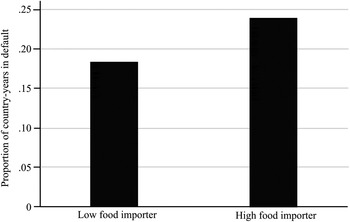
Before testing these hypotheses more rigorously, I call the reader's attention to Figure 2, which shows that, at a coarse-grained level, it does appear that autocrats more reliant on imported food are more likely to default on their debt.
Proportion of autocratic country-years spent in default, by food imports

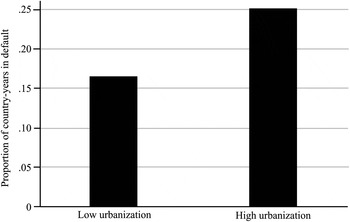
As Figure 2 shows, after dividing the sample into “low” and “high” food importers (those below or above the autocratic sample median of approximately 2.8 percent of GDP), I find that autocracies with above-average food import costs have spent nearly 38 percent more years in default than those with below-average food imports. Additionally, as Figure 3 shows, more urbanized autocracies (those above the autocratic sample median of 41.8 percent urbanization) have spent nearly 55 percent more years in default compared with those with below-average levels of urbanization.
Proportion of autocratic country-years spent in default, by urbanization

Of course, as in any bivariate comparison, there may be a host of other factors driving these relationships; in what follows, I show that this pattern holds up under more complicated statistical investigation.
Data and Estimation
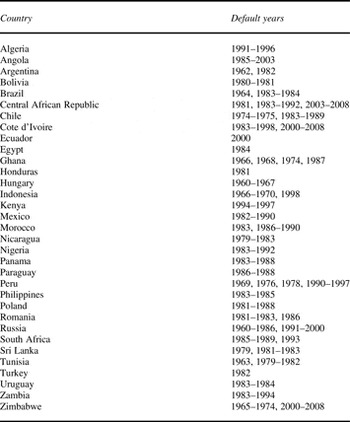
My outcome of interest comes from the historical data set on economic crises collected by Reinhart and Rogoff;Footnote 30 in particular, for my dependent variable I use Reinhart and Rogoff's measure of default to external creditors. As they explain, a “sovereign default is defined as the failure of a government to meet a principal or interest payment on the due date (or within the specified grace period). These episodes include instances in which rescheduled debt is ultimately extinguished in terms less favorable than the original obligation.”Footnote 31 Thus, my primary outcome default takes a value of 1 for any country-year that Reinhart and Rogoff code as in default, and 0 otherwise. Lacking earlier availability of other important covariates, I make use of default data beginning in 1960 and continuing up until 2009. Of the seventy countries covered by Reinhart and Rogoff, given my theoretical interest in explaining nondemocratic default, I restrict the sample to only those country-years that are classified as autocratic, reducing the sample to forty-three countries.Footnote 32 Table 1 lists all nondemocratic country-years that are coded as in default for this period.
Autocratic sovereign defaults, 1960–2009

Source: Reinhart and Rogoff Reference Reinhart and Rogoff2009.
The literature on sovereign default has converged on a limited set of important macroeconomic factors considered significant predictors of debt default.Footnote 33 Most obviously, a country's level of existing debt has been repeatedly associated with default crises because countries without large debt burdens are unlikely to face serious trouble in servicing debt or correcting fiscal imbalances. I therefore include in all specifications a measure of debt-to-gdp, drawn from Reinhart and Rogoff.Footnote 34 It is standard to include a measure of gdp per capita, which I draw from the World Bank's World Development Indicators (WDI) and which, following normal practice, enters logged into each specification. Work by Kraay and Nehru on predicting default instances in the developing world highlights the importance of “shocks” in triggering debt crises. In their paper, they take change in gdp as capturing economic shocks generally, and I follow this approach as well.Footnote 35 The dangers posed to a country's financial security by macroeconomic instability, as proxied by inflation rates, is emphasized in a recent summary of the literature,Footnote 36 so to address this concern I include a measure capturing whether a country is facing an inflation crisis.Footnote 37 Finally, much work on debt default controls for the effect of economic openess on a country's debt levels, so I include as well a standard measure of trade as the sum of a country's exports and imports over GDP.Footnote 38 Because these five macroeconomic factors (debt/gdp, per capita gdp, change in gdp, inflation, and trade) have been consistently associated with external sovereign debt default, I use these five factors as a baseline economic model in predicting years in default.Footnote 39
To test my hypotheses regarding pressures that hungry urban consumers put on autocrats fearful of revolt, I include both a measure of urbanization, which measures the percentage of the total population in a country that lives in an urban area,Footnote 40 as well as a measure of the value of food imports into a given country, scaled by GDP. To construct this measure of food imports, I make use of data reporting “food imports as a proportion of merchandise imports,” which come from the United Nations Statistics Division's Comtrade database. These are then combined with data on “Total Merchandise Imports” for each country, taken from the World Trade Organization (WTO), to generate a (current US) dollar amount of food imports into each country in a given year. However, because food imports should be scaled by country size, I take this measure of total food imports and divide it by GDP, producing a measure of food imports over gdp. Given the hypotheses from the theory I developed, I expect both urbanization rates and food imports to be positively associated with external debt default in autocracies.
My baseline empirical model is of the following form:
 $$\eqalign{defaul{t_{it}} = {\beta _1}foo{d_{it - 1}} + {\beta _2}urba{n_{it - 1}} + \gamma {X_{it - 1}} + {\mu _i} + {\theta _t} + {\varepsilon_{it}},}$$
where β 1 and β 2 are my two main effects of interest to be estimated, X it−1 is a vector of the five macroeconomic controls introduced above (debt/gdp, per capita gdp, change in gdp, inflation, and trade), γ is a vector of coefficients to be estimated on each of these macroeconomic factors, μ i and θ t are country and year fixed effects, and ε it is the error term, with standard errors clustered at the country level to account for within-country correlations including serial autocorrelation in the data. Given my hypotheses, I expect both more food imports and higher levels of urbanization to make autocracies more likely to default (β 1 > 0 and β 2 > 0). I present results estimating this equation as a probit model, and show in the online appendix that the results are not substantively changed when instead it is estimated using OLS, fixed-effects or conditional logit, or random-effects probit.Footnote 41
Results
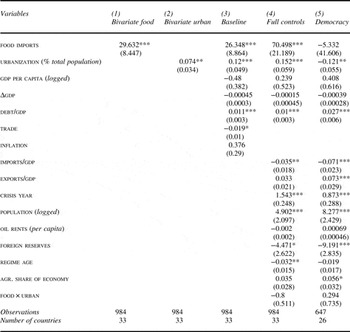
Before moving to results from my full model, I briefly demonstrate support for my hypotheses linking food imports and urbanization with autocratic default at the bivariate level: column (1) of Table 2 reports results from a bivariate regression of default on food imports, whereas column (2) reports the regression of default on urbanization rates.Footnote 42 Without the inclusion of any controls, both food imports and urbanization rates are positively and statistically significantly related to years of sovereign debt default in autocracies.
Food imports, urbanization, and autocratic debt default, 1960–2009

Notes: Table reports estimates of probit regressions of default on food imports over gdp and urbanization, as well as several controls for nondemocracies (in columns 1 to 4) and democracies (column 5) from 1960–2009. The table reports multiple imputation estimates of the probit coefficients for each variable and robust standard errors, clustered at the country level, in parentheses. Country and year fixed effects were included in each regression but are suppressed for presentation. *p < .1; **p < .05; ***p < .01.
Of course, these results do not account for the major economic factors that have been previously identified as important predictors of debt default; column (3) reports results from full estimation of equation (1). Several of these macroeconomic factors are statistically significant predictors of years in default, and all are in the expected direction: autocracies with greater debt, smaller economies, facing economic downturns, and that trade less are more likely to be in default on their sovereign debt. However, even accounting for standard macroeconomic explanations of default offered by the literature, urbanization and food imports are both positively and significantly related to years of sovereign debt default in autocracies.
To the best of my knowledge, this is the first time that the effect of urbanization on the likelihood of default has been tested. This suggests that, although the addition of urbanization and food imports does not invalidate earlier findings from the literature, it does point to potential gains in explanatory power from considering explicitly the influence of self-interested political actors on sovereign debt default. Insofar as urbanization is often considered a proxy for development, one might argue that the effect I have identified is unrelated to the political logic I theorize. Yet this intuition does not seem to comport well with the actual findings. If my measure of urbanization is merely capturing economic development (ignoring for the moment that I am already controlling for both level of GDP per capita as well as change in GDP), then this would suggest that autocracies that are more developed are more likely to default on their debt, contradicting standard economic accounts.
Robustness Checks
Of course, one might speculate that the effects of urbanization and food imports on the likelihood of default in autocracies may be spurious for a host of reasons, such as bias from the omission of important covariates. For example, countries with larger populations are also more likely to have higher rates of urbanization, as well as potentially higher demand for imported food. If the size of a country is correlated with, for example, greater likelihood of social divides that impede a government's ability to resolve economic crises, then any relationship between urbanization, food imports, and default may simply suffer from omitted variable bias. Alternately, it may be that the effect of urbanization I have identified captures that, for the period under consideration, many developing countries relied on agricultural exports to generate foreign currency. If true, a positive correlation between urbanization and default may have nothing to do with urban pressure, but may be instead a function of less agriculturally based developing economies facing more difficulties in adjusting to international shocks. In addition, there is a tendency for countries to become more urbanized over time, which may be correlated with the age of a regime; perhaps the relationship between urbanization and default I have found arises only in older, more brittle regimes. To help control for these concerns, I introduce measures of (logged) population Footnote 43 as well as the agricultural share of the economy in a given countryFootnote 44 and regime age.Footnote 45
Other work on economic crises has suggested that such events tend to be clustered as “twin” or even “triplet” crises, such as when a crashing currency dramatically increases the costs of servicing foreign-denominated debt, or when the failure of a domestic banking sector leads government to assume massive private debts, thereby endangering the health of sovereign bonds.Footnote 46 Although I have controlled for crisis in a somewhat blunt form by including information on changes in GDP, one may worry that this measure does not adequately capture the full spectrum of potential economic crises a country may face. If greater food imports result during domestic crises that also make sovereign default more likely, any relationship between food imports and default may be driven by some underlying omitted economic issue. To address this concern, I have constructed an additional measure of whether a country is facing any parallel form of economic crisis in a given year; this measure takes a value of 1 if Reinhart and Rogoff code the country as also suffering from any of the following forms of economic crisis: banking, inflation, domestic debt, or currency. Although I refer the inquisitive reader to definitions of each type of crisis in Reinhart and Rogoff for more detail, in essence my measure of crisis year is intended to capture other parallel crises that may also drive countries to default on their external debt.Footnote 47
Finally, in many developing countries, one serious strain on government solvency can come from sparse foreign reserves. Because sovereign debt is often denominated in foreign currency, the lack of abundant foreign reserves may make debt repayment more difficult, potentially triggering sovereign default. Countries that have higher imports are, all else equal, more likely to suffer from a trade imbalance, and so an observed correlation between food imports and default may simply be a result of a country importing more in general, not food imports in particular. Alternately, countries that are heavy oil producers may enjoy an advantage in generating foreign currency because of oil revenues, and if such countries either import more food or are more urbanized (such as if there is a concentration of urbanization around oil-producing regions), not controlling for oil resources may lead to spurious results.Footnote 48
To address these issues, I add three additional controls to my regression analysis. First, I include directly a measure of a country's foreign reserves, scaled by GDP, which is drawn from the WDI; if food imports primarily affect default by consuming a large share of foreign currency, the inclusion of this control should remove any independent effect of food imports. Second, although I have followed convention in the literature so far by controlling simply for “trade” as imports plus exports over GDP, I also disaggregate this trade measure explicitly using data from the WDI on imports and exports; again, if the effect of food imports on sovereign default is nothing more than spurious correlation driven by increased imports putting greater pressure on government finances, controlling directly for total imports should do away with any effect of food imports in particular. Finally, to address concerns that some countries may be more likely to have additional foreign reserves arising from sales of natural resources such as oil, I include a measure of oil rents per capita.Footnote 49
Column (4) of Table 2 reports results including all of these potentially omitted variables to my baseline model. Autocracies with larger populations appear to be somewhat more likely to default. In addition, as should be expected, countries facing some other form of economic distress are substantially more likely to default on their sovereign debt, and the coefficient on crisis year is highly statistically significant. However, even after accounting for other parallel economic crises and population size, neither the substantive size nor the statistical significance of the effects of food imports and urbanization change appreciably. Nor are these effects of trivial substantive importance. In the case of food imports, holding all other covariates at sample means, an increase in food import costs from 1.1 percent of GDP to 5.3 percentFootnote 50 increases the likelihood of autocratic default by 21 percentage points, whereas a similar increase in urbanization rates from 28 percent to 61.5 percent raises the likelihood that an autocracy will default by 67 percentage points. For the sake of comparison, consider that moving from a country with virtually no debt to one with a debt-to-GDP ratio of 116 percent would increase the likelihood of default by 24 percentage points.
Concerns regarding the effect of agricultural share of the economy or oil resources, however, do not seem to be borne out by the data. Not only does the inclusion of these factors not change appreciably the size or significance of the effect of food imports and urbanization, these controls also appear not to be correlated with default at any conventional level of statistical significance.Footnote 51 Thus, at least following this initial set of robustness checks against spurious correlation, there does appear to exist a robust relationship between both urbanization rates and food imports with autocratic sovereign default.
However, because of institutional differences in the survival incentives of incumbent politicians, I do not expect to find that urban bias should help explain sovereign default in democracies. Indeed, if anything I expect that rural electoral biases in democracies should better help explain cases in which they default. To assess this claim, column (5) performs an identical regression to that in column (4), except that I restrict analysis to the democratic subsample of countries. In accordance with my theoretical expectations, I find that although food import costs are strongly associated with default in autocracies, they appear to have no effect on the likelihood of democratic default. As further evidence that the effect of urbanization I identified earlier does indeed capture a political dynamic, I find that urban population rates are significantly negatively associated with default in democracies. Differences across regime types in the survival incentives of incumbent politicians create radically different expectations for factors likely to influence default; in a companion paper I provide a much more detailed account of how rural electoral biases in democracies make such countries more likely to renege on their international borrowing agreements.Footnote 52
Sensitivity Analysis and Placebo Tests
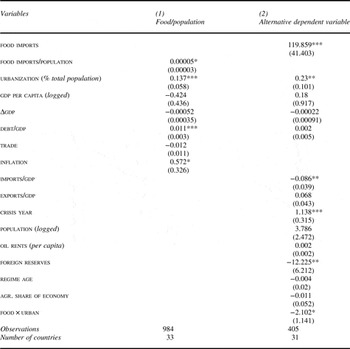
Beyond those tests detailed here, I conducted a number of other sensitivity checks on the relationship of food imports and urbanization with sovereign debt default. Although I have demonstrated continued support for a positive impact of food import costs on autocratic default, my primary measure is constructed as a ratio of food import costs over GDP, and so it is possible that the effects I identify are driven more by changes to the denominator than changes in the numerator. In such a case, a decrease in GDP without any change in food imports would nonetheless lead to a higher food-imports-to-GDP ratio, but any correlation between higher values of this ratio and instances of debt default would be driven only by an underlying parallel economic crisis, not by years in which food import costs were actually higher. I therefore present in column (1) of Table 3 results from an identical regression to my main specification, except that I scale food import costs by population size rather than by GDP. Food imports and urbanization rates remain positively and significantly related to autocratic default, alleviating concerns that the effect I have identified is primarily driven by the scaling of my food imports measure.
Sensitivity analysis

Notes: Column (1) reports estimates of probit regression of default on food imports over population and urbanization for nondemocracies from 1960–2009. Column (2) reports estimates from a probit regression of default instances on food imports over gdp and urbanization, as well as many controls, for the same sample. The table reports multiple imputation estimates of regression coefficients for each variable and robust standard errors, clustered at the country level, in parentheses. Country and year fixed effects were included in each regression but are suppressed for presentation. *p < .1; **p < .05; ***p < .01.
Another concern might be that because being in default in one year increases the likelihood of being in default in subsequent years, the assumption of independence of observations is unlikely to hold; perhaps my choice of dependent variable has led to estimates biased in favor of my hypotheses. My theory, in its most general form, deals with the difficulties of reforming politically salient policies when doing so may lead to removal from office. As such, it should apply equally well to understanding why countries remain in default (default year) as well as why they engage in default in the first place (default instance). An alternative specification to considering a country-year coded as in default, as I have earlier, would instead consider only new instances of default, dropping subsequent years where a country remains in default as these cases may suffer from serial dependence.Footnote 53 However, as column (2) of Table 3 demonstrates, the positive and significant effects of food imports and urbanization on autocratic debt default remain even when considering this different conceptualization of the dependent variable.
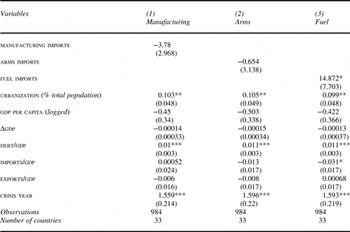
Finally, although I have already controlled explicitly for imports into a country in a given year, it may be that my measure of food imports is still primarily a proxy for increased imports generally, which drives up the current account imbalance or consumes precious foreign exchange. To test whether this is true, I constructed three additional measures of particular imports into a country in a given year: manufacturing imports, arms imports, and fuel imports.Footnote 54 Although prices on manufacturing and arms imports are unlikely to drive urban revolt in the same way as increased food prices, many accounts of unrest in developing countries note that fuel costs are often nearly as important as food costs in the daily budgets of poor people. Rapid spikes in fuel costs, such as when subsidies are removed during times of fiscal crisis, may also lead to urban unrest and therefore increased probability of sovereign debt default in autocracies. In support of these claims, as columns (1) and (2) of Table 4 show, manufacturing and arms imports appear unrelated to instances of autocratic default. However, in accordance with the expectations of my theory, fuel imports are positively associated with instances of autocratic debt default, and are statistically significant at the 10 percent level.
Effect of other import types on autocratic default

Table reports estimates of probit regressions of default on either manufacturing imports over gdp (column 1), arms imports over gdp (column 2), or fuel imports over gdp (column 3), as well as several controls for autocracies from 1960–2009. The table reports multiple imputation estimates of the probit coefficients for each variable and robust standard errors, clustered at the country level, in parentheses. Country and year fixed effects were included in each regression but are not reported. *p < .1; **p < .05; ***p < .01.
Instrumental Variables Approach
Although the results demonstrate that urbanization and food imports are strongly correlated with debt default in nondemocracies, my measure of food import costs might suffer from some other form of endogeneity for which I have failed to introduce an appropriate control. Assuming that changes in the world price of food do not influence default decisions other than through an effect on the costs of imported food, the use of a two-stage instrumental approach should address worries that the results I present are driven by an endogenous regressor.
To instrument for the cost of food imports into a given country in a given year, I use data from the World Bank's GEM Commodities data set on world food commodity prices.Footnote 55 I first used FAO data on the top twenty-five agricultural imports for all seventy countries in the original Reinhart and Rogoff sample to identify five commodities that were commonly part of import baskets of many countries: wheat, rice, chicken, soybean oil, and sugar.Footnote 56 Because changes in world commodity prices should influence food import costs only in those countries that actually import the commodity in question, I then generated year-lagged dummies for each commodity that take a value of 1 if a given country imported a particular food commodity, and 0 otherwise.Footnote 57 The final instruments are constructed by interacting these commodity importer dummies with world prices for each of the five commodities in a particular year.
Instrument Validity
For the instruments to be exogenous, the key assumption is that no country has sufficient “market power” to affect world prices appreciably. Although this assumption might arguably be more problematic in the case of major exporters who produce a preponderance of world supply of a given good, this concern is less likely to hold in the case of food import markets—food demand is broadly distributed across the globe such that no one importing country can intentionally alter world prices via changed demand behavior. Alternately, one might wonder whether the commodity importer dummies I have constructed could be a function of recent price movements, which would violate the assumption of exogeneity. However, although food demand may change over longer periods of time, it tends to be highly inelastic in the short term, and so is unlikely to suffer from this problem.Footnote 58
For the instruments to be valid, world food prices must also have a significant impact on the cost of food imports. Planting new crops and waiting for them to grow takes time, and so food production is slow to respond to price signals in the international market. Additionally, in the short run the composition and quantity of food demand is quite inelastic; it should therefore not be surprising that changes to world food prices affect the cost of imported food. To verify this, I test directly the strength of the first-stage instruments.
Finally, for IV estimation to be valid, the proposed instruments must satisfy the exclusion restriction: the excluded instruments must affect the dependent variable only through an impact on the endogenous regressor. Although it is impossible to prove whether the exclusion restriction holds in a given case, it is difficult to imagine a way that world food prices would affect an autocrat's decision to default other than by affecting the cost of food brought into the country, thereby making it more difficult for autocrats to afford to provide food cheaply to their citizens. Lacking any obvious account linking world food prices to debt default outside the posited cost of food channel, the use of exogenously determined world food prices should serve as a valid instrument for a potentially endogenous measure of food imports to a given country in a given year. This instrumental strategy would not correct for problems of endogeneity in urbanization; I have unfortunately been unable to come up with an exogenous source of variation in urbanization rates that would feasibly satisfy the exclusion restriction. However, in the absence of my theory, previous accounts would expect a negative relationship between urbanization and default.
IV Results
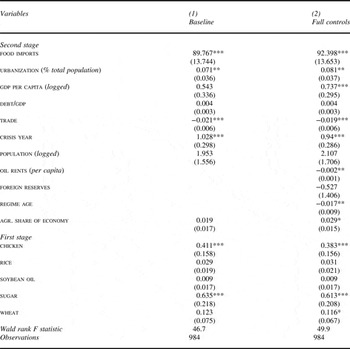
Column (1) of Table 5 reports the results of my two-stage estimation of the probability of sovereign debt default, instrumenting for the costliness of food imports through the use of several world food commodity prices.Footnote 59 The main results for the standard macroeconomic controls are not much changed from the noninstrumental estimation: it is still true that those countries with less trade and those facing parallel economic crises are more likely to default on their debt. In continued support of my theory, the effect of urbanization on default is still positive and statistically significant.
Instrumental variables estimation

Notes: The top section of the table reports estimates from two-stage regression of default, instrumenting for food imports over gdp through the use of several food commodity prices in the first stage, on urbanization and several controls, for autocracies from 1960–2009. The bottom section of the table reports coefficient estimates for the excluded instruments in the first stage, as well as the Kleibergern-Paap Wald rank F statistic from a test of joint insignificance for these instruments. The table reports multiple imputation estimates of the regression coefficients for each variable and robust standard errors, clustered at the country level, in parentheses. Country and year fixed effects were included in each regression but are not reported. *p < .1; **p < .05; ***p < .01.
Most importantly, instrumenting for food imports with world food prices demonstrates that food imports are still robustly associated with increased likelihood of autocratic default. This finding is replicated in column (2), which reports results including my full set of controls. Again, both food imports and urbanization levels remain significant predictors of autocratic default; additionally, the Wald rank F statistic from the test of joint insignificance of my excluded instruments suggests that the first stage does not suffer from a weak instruments problem. Using exogenous variation in world food commodity prices to deal with the potential endogeneity of food imports, I reconfirm a powerful effect of both urbanization and food imports on the probability that nondemocracies default on their sovereign debt.
After subjecting my main results on the positive association between food imports, urbanization, and autocratic debt default to a number of robustness checks, including controlling for omitted variables, different estimating models, reestimation using differently specified independent and dependent variables, placebo tests on separate types of imported commodities, and use of instrumental variables for food imports, I find continued support for my hypotheses that, in nondemocratic countries, more costly food imports and higher levels of urbanization are robust predictors of sovereign debt default.
Illustrative Cases
A common critique of this vein of empirical work is that demonstration of a statistical association between factors is not equivalent to providing proof that the association arises as a result of postulated mechanisms.Footnote 60 To demonstrate that the fear of urban unrest caused by rising food prices does affect default decisions by autocratic elites, I turn now to two historical accounts of debt default in Zambia and Peru. Both were selected as “best fit” cases for illustrating the mechanism: each had defaulted while under autocratic rule following a period of extended urbanization. In addition, particularities of each case helped to disentangle the mechanisms I identify from other competing explanations for default.
To investigate whether the role of food imports and urban pressure were significant determinants of the decision to default by autocrats in these cases, I read through every available document in the IMF archives for these countries for the years before and after particular instances of sovereign default, and supplemented these primary sources with the secondary literature on the subject.Footnote 61 The combination of internal IMF documents and previous historical accounts helps identify that concerns over the fiscal ramifications of cheap food policies for urban dwellers were of central importance at the time, and to demonstrate the extreme reluctance of autocratic rulers to remove these policies for fear of the political backlash that would ensue.
Peru
Although many of the most famous cases of debt default occurred in Latin America during the early 1980s, attempts to explain these default instances often run up against the problem of disentangling domestic political and economic factors from issues of “contagion” from abroad. In this regard, early debt troubles in Peru (1975–78) are ideal insofar as they occur before the broader wave of Latin American defaults and are therefore much less likely to be driven simply by changed international conditions following large defaults by neighbors in the region. In addition, several scholarly accounts of the “austerity protests” that swept through the developing world note that the first major instance of such mass mobilization against economic correction took place in Peru in 1976, which makes Peru an excellent case for investigating the relationship between urbanization, protest, and default.Footnote 62
Urban bias under military rule
Peru underwent a massive demographic shift over the course of the middle of the twentieth century: although under 25 percent of the population lived in urban areas in 1940, by 1981 this had risen to well above half (56.2 percent), adding 8.1 million urban dwellers.Footnote 63 This change was marked by a concentration of the population in the capital city, Lima. Given that my theory depends on the credibility of urban revolt threatening autocratic regime stability, the presence of a large and densely packed urban group of citizens near the seat of government power makes this threat much more tangible.Footnote 64
Despite this growing concentration of urban dwellers, under democratic rule through the late 1960s, there did not exist any nationwide system of food price controls—the only major interference in food markets came from a favorable producer price paid by the government to domestic rice farmers for their crop.Footnote 65 Following a period of political instability in the electoral system, in late 1968 the military intervened in politics, declaring a twelve-year hiatus in elections. In strong support of the claim that autocrats are particularly sensitive to the food needs of the urban poor, within nine months of coming to power, the newly autocratic government of Peru established a national system of controlled prices for basic food commodities. In particular, the government created a centralized agency for domestic agricultural production (EPSA) that had sole control over the purchase, marketing, and pricing of several important agricultural commodities, as well as monopoly rights on food imports.
At the same time, as the IMF noted, “the authorities announced their desire to stimulate domestic food production by extending the program of farm support prices from rice to encompass wheat, pulses, and milk.”Footnote 66 These policies ostensibly aimed to give equal benefits to rural farmers as to urban dwellers. However, despite the lip service paid to protecting rural interests, it quickly became clear that “these [agricultural support] prices … have not been used actively and it would appear that the aim of controlling the rate of price increases in the urban centers continues to dominate the Government's price policy.”Footnote 67 Although the military government at the time expressed nominal interest in protecting domestic farmers, in practice agricultural policy was directed entirely toward reducing urban food prices. In fact, the only major change the government made to agricultural support prices during this period was to decrease the price paid by state agencies for rice, which had been kept at relatively high levels under the previous democratic regime.Footnote 68 The Peruvian military intervention thus provides a rare opportunity for insight into the ways that urban-rural priorities can vary widely according to institutions of political survival—within the same year, but under different regimes, food price policy went from one that favored rural rice producers with supramarket prices to one that paid these same farmers low prices for their goods while also subsidizing nationally the import of food items sold to urban consumers.Footnote 69
It should not be surprising, therefore, that by the mid-1970s, Peru had become heavily dependent on the import of foreign-produced food to meet the demands of a growing urban population. In part, this shift toward food imports was caused by stagnant agricultural production, largely a result of insufficient producer prices and poor government support of rural supply networks.Footnote 70 In 1973, lackluster agricultural performance was compounded by flooding and blight in several crops, which forced the government to rely even more heavily on imports of food. When combined with heavy subsidies required to keep domestic oil prices low in the face of the first oil crisis in late 1973, the state of Peruvian finances began quickly to deteriorate. In a summary of the determinants of this fiscal imbalance, the IMF noted that “this turnabout [from saving to borrowing] reflected in part the acceleration of major investments by the public enterprises but was due to an even greater extent to the heavy financial obligations incurred by the State Petroleum Corporation (PETROPERU) and the Agricultural Marketing Agency (EPSA) in order to subsidize prices of petroleum and foodstuffs on the domestic market.”Footnote 71 In the following year, “there was again a deterioration in [the financial position] of the rest of the public sector linked … to the continued acceleration of public sector outlays and to the policy of maintaining large subsidies for basic foodstuffs and petroleum products.”Footnote 72 Although the oil crisis was certainly outside the control of the Peruvian authorities, the IMF was quite explicit that the government's response to the crisis was politically motivated, noting that “pricing policy for petroleum products has been determined largely by the authorities' concern for the cost of living in urban centers.”Footnote 73 Thus, by the beginning of 1975, it was clear that Peru was facing a serious fiscal crisis, one that the IMF attributed explicitly to policies intended to subsidize the cost of living for urban consumers.
Response to fiscal crisis
Between 1974 and 1975 the operating expenditures of Peruvian state enterprises rose from 8 to 14 percent of GDP, largely because of “consumption subsidies preventing a contraction in demand for imported foodstuffs and crude petroleum.”Footnote 74 In response to this crisis, the authorities initially embarked on a limited program of price increases for state-marketed goods, including increases of food prices by as much as 25 percent.Footnote 75 Further adjustments were made as part of a new austerity package in January 1976, including additional attempts to reduce food subsidies. In an environment of growing inflationary pressure, these rapid increases in the costs of basic consumption goods “led to widespread demonstrations and a wave of strikes.”Footnote 76
In response to these mass protests, the Peruvian government on several occasions resorted to unscheduled wage bonuses for public and private workers alike; according to a memo sent to the IMF from the Peruvian authorities, this was done with the explicit intention of compensating these urban workers “for corrective price increases.”Footnote 77 By giving with one hand what the other took away, this price adjustment policy had only limited impact on the government's financial woes. Dissatisfaction with this reversal was expressed explicitly by several executive directors of the IMF in minutes of an executive board meeting in June 1976, with one noting that although “the authorities had tried to reverse unsatisfactory trends … it was clear, the benefits of the stabilization policies had been offset by accompanying increases in wages and public expenditure.”Footnote 78
After losing access to external banking in 1976, the government was forced again to return to the IMF in 1977 to seek further loans. Under pressure from the IMF to “cut all subsidies,”Footnote 79 the government attempted yet another round of austerity. However, these efforts to rein in imbalances “by increasing food and petrol prices … provoked major riots in a number of provincial cities [and] with the first general strike in twenty years, in July 1977, the stabilization policy appeared to dissolve into incoherence, price increases were rescinded, negotiations with the Fund were broken off and the Central Bank team resigned.”Footnote 80 A memorandum from the Peruvian authorities to the IMF in October 1977 explains that, “despite cost increases, we have kept prices of basic foodstuffs frozen since midyear in an attempt to stabilize living costs for lower income workers, but we realize this policy is not sustainable in the medium run.”Footnote 81 Finally, in a last-ditch effort to prevent default, the Peruvian government reached a temporary agreement with the IMF in November 1977. However, within weeks of signing the agreement Peru was already in violation of the borrowing limits imposed by the program, which was rapidly annulled. Despite some efforts on the part of Peruvian authorities to reduce the fiscal burden of consumer subsidies, by mid-1978 the IMF argued that Peru “was running the risk of having to default on its external debt obligations.”Footnote 82 These worries were to prove prophetic—only a month after this report was circulated, executive directors were already noting that “arrears had accumulated [on Peruvian debt], and commitments on letters of credit had not been honored.”Footnote 83 After proving itself unable to successfully resolve the fiscal burden arising from urban subsidization when faced with massive public protests, the Peruvian government stopped paying back its creditors, moving it into default. The case of default in Peru in 1978 offers strong evidence that urban-biased autocracies, when faced with fiscal crisis, may indeed prefer to default on their sovereign debt rather than undo costly policies designed to keep food cheap for urban consumers.
Zambia
Zambia is another excellent case for investigating the role of urban bias in autocratic policy-making. By 1986, urbanization had reached 48 percent, making Zambia one of the most urbanized countries in sub-Saharan Africa. In response, food policy had become a major political issue for the autocratic UNIP regime, which ruled from the time of independence until the 1990s. The Zambian economy was largely focused around a few key commodities, with its agricultural market heavily centered on consumption of maize. The relative simplicity of the Zambian economy helps identify the ramifications of policies for particular commodities on broader Zambian macroeconomic stability.
Urban bias under Kaunda
Accounts of Zambian food policy make clear that urban bias took a number of particular forms. First, the government exercised monopsonist marketing power for rural agricultural goods through the National Agricultural Marketing Board (NAMBOARD); Lombard and Tweedie record that “usually these boards have a monopoly, at least on the line-of-rail, and competition with the board can be and often is illegal. The Government uses the boards as an important means to manipulate production and consumption through price fixing and subsidies.”Footnote 84 Zambian food policy included price subsidies on maize—the staple food of urban Zambian consumers—as well as on a number of other basic food commodities such as bread and cooking oil.Footnote 85
Beyond its powers to control marketing and pricing for agricultural goods, NAMBOARD enjoyed monopsonist importation rights for most key food commodities, including maize, vegetables, fruit, and milk.Footnote 86 Thus, the government provided cheap urban food both from rural domestic production (which was secured at reduced prices via monopsonist marketing) as well as from imports of food that were resold at a rate below the current world price. Over time these subsidized food imports, particularly on maize, constituted an increasingly large part of Zambian fiscal imbalance. IMF concern over the financial burden of these policies was made clear as early as 1976, when a report on the Zambian economy noted that with “the increase in import prices [for food] subsidies increased by K 10 million in 1974 and by K 35 million in 1975 … The failure to increase gradually consumer prices, as reflected by the increase in subsidy payments, has aggravated the overall budget position.”Footnote 87
Compounded by falling prices for its primary export commodity (copper), these balance-of-payments problems led Zambia to repeatedly promise reduction or removal of distortionary agricultural price policies; IMF reports from 1977, 1979, 1981, 1983, 1984, and 1985 all cite food subsidies as a large and increasing source of budgetary imbalance.Footnote 88 Yet despite being continually identified by the IMF as a significant source of fiscal trouble, nearly ten years later the director of the IMF still highlighted the main fiscal objectives for Zambia in 1986 as “improved expenditure control, as well as restraint on the growth of personal emoluments, containment of budgetary subsidies (particularly on maize and fertilizer), and control of current transfers to parastatals.”Footnote 89 By the beginning of 1986, Zambia was deep in the throes of a fiscal crisis that was attributable in no small part to its policy of subsidizing imported food for urban consumers.Footnote 90
Response to fiscal crisis
In response to a growing awareness that the financial burdens of cheap food policies were unsustainable, in December 1986 the Zambian government tried to restore its fiscal health by doing away with several subsidies. Callaghy recounts the effect of removing the maize subsidy, “which had become a significant fiscal drain … Serious rioting broke out in the Copperbelt in which fifteen people died. The outbursts in Lusaka itself were less serious, but still frightening. Badly shaken by the riots, President [Kenneth] Kaunda immediately reversed the maize price increase and nationalized all the large private maize mills.”Footnote 91 The Zambian regime was thus caught between demands for austerity to remain current on its debt payments, and angry urban citizens willing to take to the streets to protest rapidly rising food prices.
Statements by the Zambian representative to the IMF in January 1987 make explicitly clear the role that unrest played in affecting government reversal in food price policy, arguing that “the civil disturbances that had occurred in late 1986, including some loss of life, had created new political realities that could not be ignored.” In specifying what those new realities entailed, the representative read a letter sent to the IMF from the Zambian Minister of Finance, which noted that with “regard to the government budget, the major expenditure slippage will be in respect of the maize meal subsidy. I am confident that we will find appropriate ways of substantially offsetting or financing the additional subsidy.”Footnote 92 Although this may not seem particularly shocking to a reader unfamiliar with the case, the blatant statement that the maize subsidy would not be reduced further, and that means for financing it would have to be found, constitutes an incredible about-face in the language of these negotiations from the previous fifteen years. Indeed, in every internal account I could find up to this point, the authorities expressed their regret at the distortions caused by food subsidies and always implied that subsidy reduction was an important policy priority for the near future. In simply stating that the subsidy would no longer be on the table for adjustment, the Zambian authorities presented an entirely different political orientation motivated explicitly in response to the largest outpouring of mass unrest since Independence. In reply, the director of the IMF expressed that “it was most regrettable that without the benefit of offsetting savings as yet, the maize subsidy—which accounted for a significant part of the fiscal deficit—had to be reinstated fully.”Footnote 93
With elections scheduled for 1988, Kaunda may have been particularly sensitive to the potential for urban unrest to threaten his rule.Footnote 94 In fact, Callaghy argues that “Zambian officials believed that the elections were crucial to the legitimacy, and thus the stability, of the single-party state [and that] a severe embarrassment in the elections might foster divisive and centrifugal political and social tendencies.”Footnote 95 The Zambian government at the time viewed food price riots explicitly in terms of their potentially destabilizing impact, and facing such pressure, Kaunda chose to call off reforms intended to improve budgetary balances and continue debt servicing. After doing so, access to international financial resources was essentially stopped, and “finally, on May Day 1987, President Kaunda announced that Zambia was suspending its IMF reform effort, abolishing the auction, freezing prices, reintroducing price controls, resurrecting the import licensing system of allocating foreign exchange, and limiting debt service to well under 10 percent of foreign exchange earnings.”Footnote 96 When faced with the threat of regime instability driven by urban riots against rising food prices caused by economic adjustment, the Zambian government chose instead to renege on its international borrowing agreements, and defaulted on its sovereign debt.
Conclusion
What explains sovereign debt default in autocracies? The theory I develop in this study suggests that autocratic elites are unlikely to undergo the painful austerity needed to restore fiscal balance when such measures threaten the provision of cheap food to densely concentrated urban actors. Because importation of foreign-produced food sold at a loss to urban markets represents a significant drain on government resources, those autocracies that face urban unrest following food price increases are likely to worry about their tenure in office. When given the choice between long-run borrowing costs and short-run survival costs, self-interested autocrats may prefer to default, rather than enforce economic correction.
I demonstrate robust empirical support for the main implications of my argument: using several different estimation techniques and controlling for a host of alternative explanations, I find that urbanization and food imports are both consistently associated with years of default in autocracies. These results are reconfirmed when, to allay concerns of potential endogeneity, I instrument for food imports using exogenous variation in world food commodity prices, and continue to find a robust relationship between food imports, urbanization, and autocratic sovereign debt default.
These findings are important for at least three main reasons. They are derived from the first theory of debt default that focuses explicitly on the survival concerns of autocratic leaders. In focusing on the political economy of autocracies facing fiscal crisis, this study also introduces two factors to be considered in empirical analysis of sovereign debt default that have previously been completely ignored: food import costs and levels of urbanization, both of which are shown to be strongly robust correlates of years in default in autocracies, even after controlling for a battery of standard macroeconomic predictors. Finally, these results reconfirm that urban-rural divides are an important component of political struggles. Given a broader international trend toward economic adjustment in the face of binding fiscal constraints, this topic is sure to prove of interest to scholars and practitioners alike for the foreseeable future.
Supplementary Material
Supplementary material for this article is available at http://thedata.harvard.edu/dvn/dv/ and http://dx.doi.org/10.1017/S0020818315000363.