INTRODUCTION
The aim of this paper is twofold: 1) an updated and detailed catalogue of all known chariot kraters to date (available as online Supplementary Material in searchable Excel format) together with a discussion of chariot kraters as a specific type of vessel; and 2) an analysis of what the scenes of horses and chariots on the kraters reveal about horse–human relations in the Late Bronze Age. This builds on important earlier work, especially that of Joost Crouwel and Mary Littauer (Littauer and Crouwel Reference Littauer and Crouwel1979; Reference Littauer, Crouwel and Raulwing2002; Crouwel Reference Crouwel1981). However, our paper takes a distinctively different approach in which the emphasis is on the dynamics of the human–animal relationship and is thus informed by more recent scholarly interest in the complexity and mutual agency of the interactions between humans and other animals. The chariot kraters are therefore used as a case study to illustrate and evaluate the kinds of information that can be gained about how humans and animals had an impact on each other's worlds through a detailed analysis of the iconographic elements.
The fast, light two-wheeled chariot became widespread in the Near East and Egypt in the Late Bronze Age, and also makes its appearance in Cyprus and the Aegean at this time. Horses and chariots were associated with royalty, speed and warfare. The appearance and impact of the chariot, along with the enduring evocative nature of horses, have made this a popular scholarly topic. In this paper, the focus is less on the social impact of the chariot and more on understanding the relationship between human and horse by a close examination of how they are represented in the visual arts, complemented by faunal and Linear B material. The starting point is a specific type of Mycenaean ceramic vessel commonly referred to as a chariot krater, which bears a fairly standardised pictorial scene showing a chariot pulled by horses.
We will first examine the type of vessel, its chronological and geographical distribution, and the contexts in which it has been discovered. A detailed review of the elements of the chariot scene follows, looking in particular at features that are relevant for how horses were perceived and formed an active part of human society. We conclude with a discussion of the interpretation of the iconography of chariot kraters and the horse–human relationship, drawing in supporting evidence from other arts, faunal data and the Linear B tablets.
MYCENAEAN CHARIOT KRATERS
Kraters of various types appear in the Aegean during the Late Bronze Age. They seem to have Minoan antecedents (Morris Reference Morris1989, 51–62; Crouwel and Morris Reference Crouwel and Morris2015). Kraters are some of the largest fine-ware vessels in the ceramic repertoire of the Aegean at this time (about 35–50cm high, with some even larger examples), and the broad space on the shoulder and upper body is particularly suitable for pictorial scenes. The first pictorial scenes appear sometime in Late Helladic (LH) IIIA1 or IIIA2 early (Morris Reference Morris1989, 38–43), while the motif of the horses and chariot probably begins in LH IIIA2 early and continues into LH IIIC (Fig. 1).Footnote 1 A range of other motifs also appear on the kraters: these include human figures engaged in other activities, animals such as birds and cattle, as well as plants and abstract shapes (see examples in Vermeule and Karageorghis Reference Vermeule and Karageorghis1982), but chariot scenes seem to be the most popular, at least in the case of the amphoroid kraters. Kraters and other pictorial Aegean pottery have been the subject of a number of specialised studies.Footnote 2 These studies provide an invaluable background for the present discussion, although it is important to note that our catalogue of 381 entries more than doubles the number of examples recorded by Crouwel (Reference Crouwel1981).
Chronological distribution of chariot kraters, by sub-periods (total of 381).

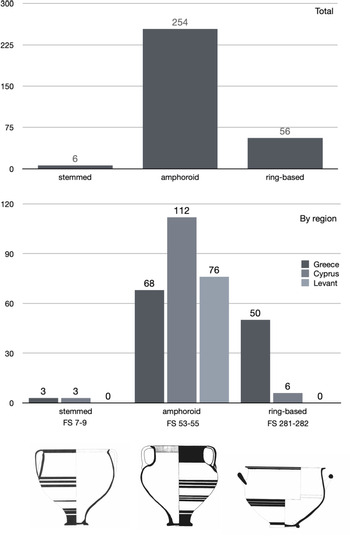
There are three main types of krater on which the chariot scene occurs (Fig. 2). Based on the typology of shapes created by Furumark (Reference Furumark1941) and further developed by Mountjoy (Reference Mountjoy1986; Reference Mountjoy1999), these are (abbreviated FS after Furumark Shape):
1. The stemmed (or open) krater, with three sub-types, FS 7–9. The shape has a broad opening with easy access and vertical strap handles; it has no neck and a stemmed base. This is an early shape, and the few examples with chariot scenes belong to the LH IIIA2 early period.
2. The amphoroid krater, with three sub-types, FS 53–55.Footnote 3 This type of krater is characterised by a neck that is significantly narrower than the broadest part of the body, which restricts access to the interior and creates a taller, more imposing vessel. The neck becomes taller over the lifespan of the form, and the vertical strap handles extend from the rim to the upper shoulder. It is by far the most commonly used shape for chariot scenes, and is found in LH IIIA2–B.
3. The ring-based (or loop-handled) krater, with four sub-types FS 281–284. Like the open krater, this type also has a very broad opening and no neck, but as the name implies it has horizontal loop handles rather than vertical strap handles. It occurs in LH IIIB–C.
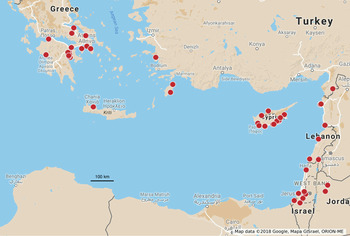
Each krater type is chronologically limited, which is also to some extent reflected in the motifs on the vessels themselves, as we will discuss later. Kraters with chariot motifs were produced in the Aegean, but a large number were exported as part of the extensive eastern Mediterranean network that is now well known (Fig. 3). Early scholars drew this strongly eastern distribution into a narrative of Mycenaean Greek settlement on Cyprus, suggesting that such vases were produced there by Mycenaean settlers and were thus projecting a Hellenised ethnic identity onto the island during the Late Bronze Age. In one of the earliest catalogue descriptions of a chariot krater, Myres (Reference Myres1914, 48), for example, suggested that the pictorial material ‘has many minor peculiarities which mark it as a local Cypriote school’. Extensive ceramic analyses indicate a quite different picture of production and exchange, showing that all the chariot kraters discovered so far were produced in Greece.Footnote 4 Chemical analysis further supports this conclusion, although it is still possible that some are from outside the main centres (Mommsen and Maran Reference Mommsen and Maran2000–1). In the local Cypriot ceramic tradition of White Painted Wheelmade Ware, some of which closely imitates or appropriates Aegean pottery, a shape similar to the ring-based krater was in fact produced. These could bear elaborate pictorial scenes (see e.g. Fischer and Bürge Reference Fischer and Bürge2014, 81–2, figs 27–9), but it is interesting that the horse and chariot motif was not one of those ‘borrowed’ from the Aegean repertoire, despite its evident popularity.
Krater sub-shapes and their distribution.

Map of sites with chariot kraters.

The geographical distribution of chariot kraters demonstrates this popularity in Cyprus. The number of examples from Cyprus almost rival those found in mainland Greece (Fig. 4). This strongly suggests that many vessels were produced with the explicit purpose of export, in other words for directional trade, in particular to Cyprus and to a lesser extent to the Levant. It is here interesting to note that this may have been the case from the very beginning, as all of the earliest examples, dated to LH IIIA2 early, come from outside Greece, with 22 from Cyprus and two from the Levant (Fig. 1). Looking more closely at the geographical distribution, we can note that the majority of vessels cluster at a very limited number of sites in each region during the LH IIIA2–B period: they are recorded in quantity at Berbati in the Argolid, which chimes with the scientific evidence for production centres; at Enkomi and to a lesser extent Maroni and Hala Sultan Tekke in Cyprus; and at Ugarit and possibly Atchana-Alalakh in the Levant (Fig. 5). Although other clusters could still be discovered, this distribution represents deliberate selection. For example, chariot kraters are rarely found at contemporary mainland palaces despite clear evidence for the importance of the horse and chariot, as expressed through key media such as frescoes and glyptic. In Cyprus, they are conspicuously few or even completely absent from important sites like Kition and Alassa (the latter having only a very negligible amount of imported Aegean pottery at all; see most recently Jacobs Reference Jacobs and Hadjisavvas2017, 404). This suggests that the image of the horse had a particular resonance at certain centres, and perhaps hints at more direct links between these sites and their place of production in Greece.
Regional distribution of chariot kraters.

Sites with large numbers of chariot kraters.

As the scientific evidence noted above indicates, the kraters found in Cyprus and the Levant were most likely produced in the Argolid. The site of Berbati is a good candidate for an important production centre. It is the only site so far discovered with a concentration of chariot krater fragments completely unrivalled in Greece in LH IIIA2–B. Many of these fragments come from what has been identified as a potter's quarter (Åkerström Reference Åkerström1987; Schallin Reference Schallin, Gillis, Risberg and Sjöberg1997). The high numbers of chariot krater vessels and fragments at Berbati, Enkomi and Ugarit (with significant gaps in numbers from other sites in each region) are indicative of strong lines of exchange between these three sites. In LH IIIB–C, the chariot kraters all but disappear as exports, and the ring-based chariot krater characteristic of LH IIIB2–C is rare outside Greece itself, suggesting that it – unlike its amphoroid krater predecessor – was produced with local use in mind. They have not yet been identified in the Levant, and six have so far been found in Cyprus (Fig. 2). In Greece, Mycenae and Tiryns take over as the main centres of production, where the ring-based type of krater becomes the dominant shape.Footnote 5
Examination of the contexts in which the kraters are found reveals significant divergence between Cyprus and the Aegean (Fig. 6). In the Aegean, the majority of krater fragments originate from settlement or workshop/dump contexts, with only 10 found in mortuary contexts. This scenario is reversed for Cyprus, where most come from mortuary contexts, and a much lower number have been found in settlements.Footnote 6 The quantity coming from mortuary contexts should probably be even higher, as many of the vessels now in museum collections and of unknown provenance are complete (13 of 40 without exact provenance are complete or nearly complete). This implies that in Cyprus the kraters were valued and used differently than in the Aegean, and that they had a certain association with mortuary rituals – perhaps as part of the funerary display and activities related to the identity of the deceased and as a status symbol.
Distribution of contexts with chariot kraters, by region.

THE ELEMENTS OF THE CHARIOT SCENE
Moving on to look at the actual iconography of the chariot scenes, we can see that it is fairly standardised in overall design and structure. Mycenaean chariot kraters are by far the most popular medium for depicting horses and chariots in the Late Bronze Age, both in Cyprus and in Greece. The chariot scenes follow set patterns that almost suggest the use of a template. The standardisation is particularly evident in LH IIIA2 late–LH IIIB1 and on the amphoroid krater. However, a closer look at each vessel reveals a wealth of variation in design choices and stylistic features, and in fact no kraters have yet been found that are exactly the same.Footnote 7
In ‘reading’ ancient iconography, it is important to remember that we are not dealing with photographic snapshots of reality, but images embedded in cultural and ideological contexts, along with artistic convention (and freedom). The standardisation is a testament to this, and it is, for example, only through a diachronic study of the horse motif that we can recognise the presence of two horses indicated by two eyes (rather than one rather wonky horse) in later kraters. However, even though these images do not necessarily depict reality or specific events, they do refer to concepts that were present and meaningful, and that can therefore be used to reconstruct horse–human relations. Thus, the marking of specific harness elements, as for example reins, terret or blinkers, only make sense if the reference could be understood (and hence, known) at least conceptually, if not in its precise function, by both the ancient producer and consumer/viewer.
The main or primary motif consists of the chariot pulled by two horses, usually driven by two charioteers and moving from left to right. This is repeated on both sides of the krater with minor variations, and in the earliest examples, sometimes twice on each side. Beside these main elements, various walking or standing human figures frequently appear, as does a selection of other animals. Secondary motifs are placed around and between the main elements, most commonly flowers, quirks, parallel lines and chevrons, circles/sea anemones, sacral ivy and palms. These secondary or subsidiary motifs, often referred to as ‘filling ornaments’, are particularly important for the dating of pictorial pottery, both because they offer correlations with the wider world of Mycenaean ceramics and because the stylistic fluidity of pictorial designs can make them remarkably difficult to date (Morris Reference Morris, Rystedt and Wells2006). There is a tendency for the subsidiary motifs to decrease over time, and the LH IIIB–C ring-based kraters rarely have filler motifs. The topic of horses and chariots in Bronze Age Greece has been expertly discussed in detail by Joost Crouwel (Reference Crouwel1981), who includes a detailed analysis of the structural elements of the chariots. What follows owes a great debt to this work, and the types of chariots and terminology largely correspond to that used and presented by Crouwel.
The chariot
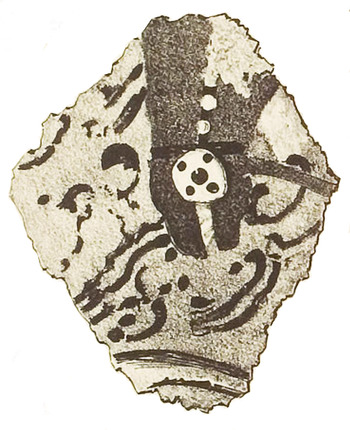
The chariot depicted on all amphoroid kraters is the so-called ‘dual chariot’ (when preserved). Its name is due to the two parts of the chariot box itself. The box is divided into a front and a rear part, separated by one or two vertical lines. The front part is typically square, but it is occasionally shown with a rounded back. The rear part is rounded; it is usually referred to as the wing. It is possible that the rear part of the box did not have a floor, and that the wings functioned as mudguards (Crouwel Reference Crouwel1981, 67). Wings sometimes have a different pattern than the front part, emphasising the separate units (A42, A84, A207). The frame of the chariot box was made of wood, and the sides covered in some other material. Most often, the box is decorated with a dotted pattern, but occasionally the pattern suggests a cow hide (A3, A6, A10, A21, A102; Figs 7 and 8) or a wicker structure (Spyropoulos Reference Spyropoulos, Brecoulaki, Davis and Stocker2015, 361, fig. 8); the Linear B chariot tablets mention a red or crimson colour (Ventris and Chadwick Reference Ventris and Chadwick1973, 366–7), which tallies well with the frescoes from Tiryns (Athens NM 5885-alpha; Fig. 9). The box and other parts of the chariot may have been decorated with fine materials and inlays of ivory, silver, gold and semi-precious stones; such are mentioned in the Linear B tablets as well as the Amarna Letters (Moran Reference Moran1992, EA 16, 22).
A6: Fragments of amphoroid krater from Enkomi (drawn by L. Recht).

A21: Amphoroid krater from Cyprus, probably Maroni. Metropolitan Museum 74.51.964.

Part of wall painting from Tiryns, ‘Boar Hunt Fresco’ (drawn by L. Recht).

The chariots of the Late Bronze Age Aegean were the fast, light two-wheeled type with spoked wooden wheels. On the chariot kraters, the wheels nearly always have four spokes, which Crouwel (Reference Crouwel1981, 35) identifies as characteristically Aegean, but there are a couple of examples of six-spoked, or more, wheels (A22, A60, possibly A214 with eight spokes; Fig. 10). These are rare and may be inspired by Egyptian and Near Eastern images. The chariot box would sit on top of the fixed axle that ran between the two wheels. This is rendered correctly on some kraters (mostly in the early period), but the box is more often shown as simply perched or resting on top of the wheels. The Aegean chariots sometimes have a small pointy projection behind the box, just below the wings. This is referred to as the ‘spur’. The function of this feature is still uncertain, but Crouwel (Reference Crouwel1981, 65) has plausibly suggested it may be the floor frame projecting slightly from its position below the chariot box.
A22: Stemmed chariot krater from Pyla-Verghi. After Morris Reference Morris1989, fig. 40 (redrawn by L. Recht).

Another type of chariot appears only on late ring-based kraters and in the glyptic material.Footnote 8 This is a type more akin to Egyptian and Near Eastern forms. It is called a rail chariot because it has an open rail where the charioteer stands at the front with the support of the rail (A325, A338, A342, A352, A364, A377, A379, A380; Figs 11, 12 and 13) and was probably made with a wooden or metal frame. It also seems to have been used mainly with four-spoked wheels and the frame most likely sitting on top of the axle, although always depicted over the wheels. Krater depictions of the rail chariot are confined to a few LH IIIB–C ring-based kraters (total of 9–12, compared to 158–73 of the dual type). It is notable that images with this kind of chariot seem to represent a concept different from the dual chariot and are related to a different set of activities that may involve hunting and/or military-related transport.
A325: Fragments of ring-based krater from Tiryns. After Schliemann Reference Schliemann1886, pls XV, XVIIb, XXIa–b.

A352: Fragments of ring-based krater from Mycenae (drawn (a) by L. Recht and (b) after Furtwängler and Loeschke Reference Furtwängler and Loeschke1886, pl. XLI, no. 427).

A380. Fragments of ring-based krater from Tiryns (drawn by L. Recht after Immerwahr Reference Immerwahr1990, pl. 90).

Charioteers
Most commonly, there are two occupants in the chariot, almost certainly standing rather than sitting. The front most charioteer is always the one holding the reins and is thus more likely to be shown with simplified hands. Although they are depicted one behind the other, they probably stood next to each other. This positioning can be seen most clearly on the chariot scenes on the short sides of the Ayia Triadha sarcophagus (Paribeni Reference Paribeni1908, pl. III; Long Reference Long1974; Burke Reference Burke2005, figs 3–4). Only in a few cases is there a single occupant in the chariot (e.g. A15, A83, A124, A134; Fig. 14), and this appears to be more common in the ring-based kraters (A319, A338, A355, A363, A369); three or four occupants occur occasionally (e.g. A61, A65, A236, A287, A335; Fig. 15). On the amphoroid kraters, the charioteers typically wear dotted one-piece robes, although the dots are sometimes replaced with other simple designs in the LH IIIB examples (e.g. A255; Fig. 16). Standing or walking figures in the dotted robes also accompany the charioteers, and these afford us a view of a long robe, often with banding on the lower half (A123; Fig. 17) or around the hem (A6; Fig. 7). Given that there is no suggestion that the charioteers are wearing shorter tunics, we might, cautiously, extrapolate that similar long garments are intended. The garments may have been made from textile or some kind of animal skin but given the simple rendering – in contrast to frescoes, for example, where colour and design offer a richer sense of materials – it is difficult to say more. The best parallels for the robes are perhaps fragments of a fresco from the West House at Mycenae, depicting a figure in a similar dotted garment carrying a pole (Tournavitou Reference Tournavitou, Brecoulaki, Davis and Stocker2015, 162, fig. 12), a large piece of yellow textile with red dots which is worn over the usual clothes of a woman on a fresco from Xeste 3 in Akrotiri, the figures wearing long one-piece robes on the so-called Flotilla wall painting from the West House, Thera (Vlachopoulos Reference Vlachopoulos, Brecoulaki, Davis and Stocker2015, 50–1, fig. 10, 59, fig. 14c), and a robed male figure carrying a flat item on a fresco from Pylos (Jones Reference Jones2015, 150, fig. 4:185). Only in the later part of LH IIIB and LH IIIC do we start to see examples of charioteers wearing armour and holding objects other than the reins (A352, A365, A379, A380; Figs 12 and 13).
A15: Fragments of amphoroid krater from Cyprus, perhaps Kourion (drawn by L. Recht).

A65: Amphoroid krater from Enkomi. British Museum 1897,0401.1113.

A255: Amphoroid krater from Cyprus (drawn by L. Recht).

A123: One side of amphoroid krater from Ialysos, Rhodes. After Maiuri Reference Maiuri1923–4, fig. 150 (redrawn by L. Recht).

Another potentially significant variable in the representation of the chariot occupants on the kraters is hairstyle and headgear. The same style is generally used for the two charioteers, which suggests that it is not based on personal or individualised identity but rather refers to their function or social role. There are variations in hair length. A small number of figures are shown with fillets or diadems (e.g. A22; Fig. 10), and a few others wear helmets or other headgear. A broader examination of all the human figures within chariot scenes clearly points to a preoccupation with status; this is signalled through differentiation of dress, hairstyles and accessories. Taking a fragmentary chariot krater from Enkomi Tomb 67 (A6; Fig. 7) as an example, there are two figures walking behind the chariot: the one immediately behind it wears the dotted robe similar to the charioteers, and is equipped with a sheathed sword; behind him walks a silhouette figure (the other main figure type in the scenes, as discussed further below), holding up an object which some scholars interpret as a parasol, or perhaps a weapon of some kind. The pattern repeats on other chariot kraters: only robed figures have swords (A123; Fig. 17), while the silhouette figures carry a variety of other objects such as sticks and spears, or they simply process with the chariot. Although, strictly speaking, it lies outside the scope of the current study, an exceptionally large krater from Enkomi depicting a ship scene neatly captures this interest in status, showing us hierarchy in action: status here is marked by dress, accessories, hair length, and also, more unusually, scale, with the large armed and robed figures on the deck, and the silhouette sailors depicted below – in the cut away bowels of the ship – at smaller scale (Vermeule and Karageorghis Reference Vermeule and Karageorghis1982, cat. no. V.38; Wachsmann Reference Wachsmann2009, 141, with fig. 7:28).
It is beyond doubt that both men and women are depicted as charioteers in Aegean art, but it is not possible to say for certain whether one was more common than the other. Clear images of female charioteers occur on frescoes (Athens NM 5885-alpha; Fig. 9) and on the Ayia Triadha sarcophagus (Immerwahr Reference Immerwahr1990, pls 52–3). Steel (Reference Steel, Rystedt and Wells2006) has drawn attention to the probable gender bias at work in ‘reading’ pictorial vase painting, demonstrating that women are more visible than previously supposed in this ceramic medium. Female charioteers can be confidently identified on one more recently discovered early krater where gender is marked by dotted breasts against a plain upper body, with a glimpse of a striped skirt below (A13), a clothing style which is paralleled by the framed female figures on an early open krater from Kourion-Bamboula (A16). Although female gender indicators are elsewhere less obvious, we should be careful not to default to the assumption that the charioteers are all male. We may suggest that the unusual wavy striped robes and ‘diadem’ hairstyle on A22 (Fig. 10) signify females, a suggestion that finds some support in the similar striped robes of the charioteers on the Kalavasos ‘Shrine krater’ (A28), where the overall scene, with a female figure within a shrine, has an overt ritual context. As noted by Steel (Reference Steel2020, 10–12), similar parallel wavy lines represent clothing on the small Mycenaean female figurines of Tau, Phi and Psi types. Elsewhere, differentiation of hairstyles between figures within a scene could allude to gender (A24; Fig. 18), with the longer hair signalling females both within and outside the chariot, but equally other dimensions of identity or status may be intended. Male charioteers can be identified on a number of frescoes based on their red skin colour and short robe/armour (Crouwel Reference Crouwel1981, cat. nos W35, W70–W74; Spyropoulos Reference Spyropoulos, Brecoulaki, Davis and Stocker2015, 361, fig. 8; Tournavitou and Brecoulaki Reference Tournavitou, Brecoulaki, Brecoulaki, Davis and Stocker2015, 221, fig. 4); if armour and helmets are assumed to only have been worn by men, the charioteers on A352, A366, A377, A379, and A380 (Figs 12 and 13) would also be male. In the vast majority of cases, the gender of the charioteers is not clear. In contrast to the horses, this is unlikely to be because gender was not significant, but rather because we are not yet able to decipher markers of gender and status in the painted pottery. Possible examples of the long robe worn by both male and female charioteers appear on the frescoes (Athens NM 5885-alpha; Fig. 9). On a fresco from Mycenae, a large female figure wears a similar robe and holds out a sword in front of her (Immerwahr Reference Immerwahr1990, pl. 60), dismissing any notion that such weapons purely belong in a male domain.
A24: Amphoroid krater from Ugarit. After Furtwängler and Loeschke Reference Furtwängler and Loeschke1886, fig. 16.

Horses
The chariot is pulled by two horses.Footnote 9 The accuracy of anatomical detail varies, giving the impression that some painters had not seen horses first-hand, while others were more familiar with them. The horses of the Late Bronze Age were small – ponies by today's standards. Although the iconography cannot always be relied upon for relative scale, it suggests that the withers of the horses reached just above hip height; this roughly corresponds to heights estimated based on extant caballine skeletons found in Greece.Footnote 10 In contrast to the charioteers, the horses are shown side by side, which sometimes results in them merging almost completely. Usually, two heads, two full tails and four front legs are shown, but the hind legs may merge into two instead of four. Especially later on, the front legs and heads also merge, with examples where it looks like a single head with an awkward perspective of two eyes – for the modern viewer something more at home in a Picasso image – but they are in fact two heads (A243, A249, A337, A347, A359, A361; Fig. 19). The horses are shown as slender, with necks and heads held high – the neck is almost vertical and the heads close to the same angle, requiring a strong bend at the jawline. Over time, the body is shown as increasingly elongated. Often great care is taken to outline the fetlocks, hooves and shape of the rump and hind legs. The horses hold their tails at a medium height, away from their body.
A347: Fragment of ring-based krater from Tiryns. After Schliemann Reference Schliemann1886, pl. XIV.

With a few possible exceptions, the horses are painted monochrome in the LH IIIA2–B1 period, while patterns and added white decoration become common in LH IIIB and LH IIIC. When decorated, the lines sometimes follow the anatomy of the horses, differentiating between head, neck, shoulders/front, torso, rump and/or legs (A325, A347; Figs 11 and 19). But in most cases, the patterns indicate coat colour. A range of colours was known: white,Footnote 11 chestnut, piebald and possibly bay and black horses are depicted in teams of two on the frescoes, often mixed (Fig. 9; Crouwel Reference Crouwel1981, W catalogue of wall paintings; Tournavitou Reference Tournavitou, Brecoulaki, Davis and Stocker2015, 144, 162, fig. 13). A mixed team may also be intended on a krater from Tiryns (A380; Fig. 13), where the tail of the horse on the left is a light colour, in contrast to the dark of the horse on the right. Monochrome coats are difficult to classify on the kraters where the colour range of the designs is limited to the palette of the ceramic medium, that is, ranging from orange, red, brown to black, depending on firing conditions. The unpainted inner thigh of the hind legs, typical of many kraters, may suggest the mix of a white and chestnut team but could also be a reference to the fact that the hair is often a lighter colour on this part of the horse. Piebald is more easily detectable on a number of examples (A324, A338, A361, A377, A379; Fig. 20). Interestingly, these tend to belong to LH IIIB and later, which suggests that either piebalds were a new addition in that period or that this colour was not considered significant previously. Given its very distinctive character, the former seems more likely. Other patterns using added white or small spots could indicate an attempt to show leopard coats (speckled) or a specific monochrome colour (A65, A325, A351; Figs 11 and 15). Markings are also difficult to identify on the kraters, but a few wall paintings reveal that such hints at individuality were in fact noticed. Frescoes from Mycenae show horses with high stocking on the hind legs (Athens NM 5885-alpha; Fig. 9).
A324: Fragment of ring-based krater from Mycenae. After Furtwängler and Loeschke Reference Furtwängler and Loeschke1886, pl. XLI:429ab.

The horses were groomed to look their best. We see this especially in the treatment of the mane, which was styled into tufts. The mane would be divided into chunks of hair, each of which was held together by a small band near the neck. On the kraters, the large tufts are clearly visible and projecting upwards from the neck of the horse. The band holding them together is occasionally shown on the kraters, sometimes through added white paint (A21, A15, A328; Figs 8, 14 and 21), but is clearer on the frescoes (Crouwel Reference Crouwel1981, cat. nos W58, W68–W69). In a few instances, another style in the form of a shorter, spikier mane seems to have been preferred (A80, A123, A212, A377; Fig. 17), or indeed a combination of the two (A237, A302, A328, A341; Fig. 21). The illustrations of the combination suggest that the lower part of the mane was cut short (perhaps to accommodate the harness). This may actually have been the norm, since the tufts are nearly always shown as on the upper half of the horse's neck, but the short lower part may simply have been left out in most instances. The forelock is not often depicted, but when it is, it seems not to have been tied in a tuft but left loose (A39, A123, A253, A324, A351, A377; Figs 17 and 20). Less frequently depicted is the treatment of the tail, but in a few examples we can note that it was also subject to styling and decoration. The top of the tail may have been braided (A379); elaborately braided tails are, for example, shown on an ivory box found at Enkomi (British Museum 1897,0401.996). A few frescoes and kraters depict what appears to be a tail guard, but these are more likely decorative elements placed around the top of the tail (Athens NM 5885-alpha, A174, A376; Fig. 9).
A328. Sherd from ring-based krater from Tiryns (drawn by L. Recht after Slenczka Reference Slenczka1974, pl. 5:1f).

One of the ways to gauge the mood of a horse is by the positioning of its ears, head and neck.Footnote 12 Unfortunately, the ancient painters were not very concerned with this aspect. Since there is very little variety in the way the necks and heads are rendered, this may have more to do with artistic tradition than with a reflection of actual gestures. Not much attention was paid to the ears either, and at times these are completely obscured by the neck band. However, they are in most cases present, and in just a few instances we can see details that reveal close observation of equine behaviour. Ears pointing forward, suggesting eagerness on behalf of the horses, are shown on a number of kraters (A15, A20, A80, A108, A325, A328, A341, A349, A361; Figs 11, 14, 21 and 22). Backwards pointing ears indicate discomfort or annoyance; they are more rarely depicted (A123, A241, A321, A377; Fig. 17). Equally rare are examples of one ear pointing forward and the other backwards (A21, A124, A239; Fig. 8), an indication of the animal paying attention to something (e.g. instructions from its rider or driver). The latter, in particular, is a very characteristic equine gesture that must have been seen to be presented in this way. The high neck, while a standard feature of horses, may be interpreted as indicating breed, but could also be a feature of the harness system, where the necks of the horses are deliberately kept quite high in order to prevent the yoke from slipping out over their heads (supported also by the strap around the belly, acting as a breaking element).
A20: Amphoroid krater from Cyprus. British Museum 1911,0428.1.

On ten of the kraters, the horses are clearly marked with male genitals (A17, A22, A64, A65, A73, A109, A239, A253, A351, A370; Figs 10 and 15). The remaining kraters do not depict genitals on the horses at all, but this does not necessarily mean that they represent mares; they may also be gender-neutral illustrations. A similar scenario applies to depictions in wall paintings and seal impressions. It is thus not possible to argue for a preference of stallions or mares for chariot teams based on iconography alone.Footnote 13
There may be other ways to mark the sex of the horses. In the Linear B tablets, different ideograms based on variations in the lines along the neck are thought to represent horse, mare and stallion (Ventris and Chadwick Reference Ventris and Chadwick1973, 210–11; cf. Vandenabeele and Olivier Reference Vandenabeele and Olivier1979, 63–75). The neutral ‘horse’ ideogram has three lines along the neck, quite neatly corresponding to the majority of kraters, where the mane is divided into three tufts at the upper part of the neck (two, four or more tufts also appear, but more rarely). The ideogram for stallion has one upper tuft and one or two lines passing over the neckline below this. This could correspond to the examples where the mane is divided into tufts on the upper part of the neck and there are spiky hairs at the bottom. However, this does not correspond with the instances where the male genitals are shown, which have a range of mane styles, including three tufts (A64, A253). The ideogram for mare has one tuft, and a roughly parallel line running along the interior of the main neckline. In two examples, this may be what is intended on the kraters, where we see an ‘extra’ line along the neck, deliberately not filled in with paint (A147, A217; Fig. 23). The similarity is striking, but without further examples and clear differentiation from the harness, not yet conclusive.Footnote 14
A147. Sherd from amphoroid krater from Ugarit. After Schaeffer Reference Schaeffer1939, fig. 93 (redrawn by L. Recht).

With few exceptions, the horses on the kraters either stand or walk, which means that a slow pace was a significant part of the scene. The walk is not entirely correctly depicted, because the legs tend to be painted in parallel positions, and the front legs are often completely stiff. The walk of a horse is in fact a four-beat gait where at least one hoof always touches the ground. There are attempts to show a more dynamic walk, e.g. A20 and A288 (Fig. 22), where both hind and front legs are separated and not parallel. A5 from Enkomi shows bent front legs, even if the joint is placed a bit too high. Depictions of horses trotting are extremely rare in Aegean art. There are only two unambiguous examples, which are found on a carnelian seal stone from Vapheio (CMS I, no. 229) and on seal impressions from Ayia Triadha and Sklavokambos (CMS II.6, no. 19; Fig. 24). On this, the trot is clear as the characteristic V-shape is created by the left front and hind legs, and the reverse with the right front and hind legs; the legs also appear to be off the ground. Trot is probably also the gait on a gold signet ring (CMS V, Sup. 3, no. 244), a carnelian sealstone (CMS VII, no. 87) and the krater A80 from Hala Sultan Tekke. The gallop appears on seals, a couple of frescoes, the ivory box from Enkomi, and a few kraters. It is either the typical ‘flying gallop’ known from Aegean iconography, or the kind typical of Near Eastern and Egyptian iconography, where the front part of the horse is slightly raised as if launching. Both are incorrect in terms of how horses actually move but seem to be down to artistic convention since the exact same stance started in the third millennium bc and continued well into at least the first millennium bc (the canter/gallop is a three/four-beat gait where the two front and hind legs are never in sync). The gallop shown on the kraters is rather awkward (A24, A108, A353; Fig. 18) but is nevertheless deliberately made so as to depict something distinctly different from the usual standing/walking.
Impression of signet ring from Ayia Triadha. CMS II.6, no. 19 (photo and composite drawing). Courtesy of CMS / Ingo Pini.

Communication between horses and driver: traction system and harness
The Aegean chariots have a low straight pole running from the axle between the two horses to the yoke. Above this, and apparently unique to the Aegean, are a pole stay and a pole brace. The pole stay is straight, going from the top of the chariot box to the yoke, and supported by the L-shaped brace immediately below. The brace (or sometimes the reins) often has arcades or pendants hanging from it and down between the horses. These elements are attached to the horses through a yoke and yoke saddle, which in turn are fastened using a girth and neck strap. The horses wear bridles with two reins for each horse, going from the hands of the driver through a rein ring or terret at the bottom/middle of the necks of the horses to their mouths (see e.g. A22; Fig. 10). Not all of these elements are depicted on all kraters, and they are not always correctly placed (terret and yoke are often indistinguishable and/or amalgamated into a single object, for example). But by considering the various images as a whole, we can obtain a better idea of these harnessing details. Added white paint on some kraters affords us further details, for example representing stitching in the leather.
The separate elements of the bridle only appear on kraters with the added white paint or where the horses are not painted monochrome. On these, we can see a fairly simple bridle consisting of a crown piece, cheek-straps, noseband and reins. A browband is also sometimes visible (A15, A76, A324; Figs 14 and 20). Blinkers may occasionally have been used, but they are only depicted in very rare instances (A21, possibly A5; Fig. 8). Many terracotta horse figurines wearing bridles also have a frontlet (e.g. Courtois Reference Courtois1984, pl. 31:1,3,5; British Museum 1897,0401.1292). The kraters only ever show the profile view of the horses, so if a frontlet was in use, it would not show, unless one understands the cheek straps to actually designate the frontlet.
Metal bits appear at some point during the first half of the second millennium bc in the Near East.Footnote 15 Bits made of organic material were likely in use earlier and alongside the metal bits. Finds of metal bits are rare even in the Late Bronze Age, and it is very possible that organic bits were still in use then as well (as indeed they are today). In the Near East, the use of a bit with two reins represents a considerable change to the earlier single rein or rope with a nose or lip ring. It greatly improves communication with the animal and aids in steering and halting. From Greece and Cyprus, we only seem to have examples of the use of two reins. These were used with bits at least in some cases, as evidenced by finds of actual metal bits, most recently a pair from excavations in Prosilio (Bennet Reference Bennet2017). The metal types found in Greece have a two-piece mouthpiece and sidebars. These are not depicted in the iconography. Instead, we have examples of bit guards: small round disc-shaped objects placed on either side of the horse's mouth to keep the bit in place.Footnote 16 Bit guards are depicted in frescoes (Fig. 25; Crouwel Reference Crouwel1981, cat. nos W33, W45, W58, W67–W68) and possibly on three kraters (A21, A76, A101; Fig. 8). Since few metal bit guards and no complete metal bits of this type have been found in Greece or Cyprus,Footnote 17 they were perhaps made of a perishable material such as wood, bone or ivory, and could well have been used with a bit made of wood, rope or leather.Footnote 18
Part of wall painting from Tiryns. After Rodenwaldt Reference Rodenwaldt1912, pl. II:4.

In all other cases, no bit is depicted. Bitless bridles could also have been in use, perhaps with a strong noseband. Judging from the iconography, the noseband was placed either above or below where the bit would sit in the mouth of the horse. The placements have slightly different effects. Today the lower one is particularly used if a horse tends to open its mouth while being ridden, which can cause disruption and might be judged harshly in some disciplines. It may also be more effective if the bridle is bitless, depending on the type of bridle and the temperament of the horse. The higher placement allows better space for the bit and clearer passage for breathing.
Other human and animal figures, and plants
Human figures
On many of the kraters, a variety of other human figures appear, usually either walking or standing. They are painted either as monochrome, appearing as silhouettes, or wearing robes or knee-length kilts. They do not have exact parallels in other iconographic material. They are clearly a meaningful and important part of their compositions, and, as noted earlier, there is a clear interest in representing different statuses or roles, even if the specifics of the roles often remain elusive.
Silhouette figures have monochrome painted bodies without any discernible clothes, but most likely they wear short kilts or codpieces, as do their closest parallels on wall paintings (see e.g. Immerwahr Reference Immerwahr1990, pls 29, 39, 67, 68). The head itself is drawn in outline with eyes, and hair/headdress painted in and an inset for the ear sometimes placed within the hairline. The figures stand or walk and either carry an item or make specific gestures with their arms. Each item and gesture must have a specific frame of reference that we are now not able to determine with certainty. The items they carry include an object that has been variously identified as a fold-out chair, a bow or a stylised ingot (A11, A22, A54; Figs 10 and 26; Vermeule and Karageorghis Reference Vermeule and Karageorghis1982, 15; Dikaios Reference Dikaios1971, 918–21; Knapp Reference Knapp1986; Rystedt Reference Rystedt1987), a parasol-like object (A6; Fig. 7), some kind of stick or pole (e.g. A240, A243, A251, A288, A314; Fig. 27) or a spear and shield (A335), as well as a variety of vessels (A3). The arm gestures vary between arms held down along the body and elbows bent at hip height or higher. Most commonly, these figures walk in front of the chariot, perhaps in some cases actively leading the horses (see especially A240, A241, A252, A301; Fig. 28), or directly behind the chariot – either way, we very much get the sense of a controlled procession taking place. In some cases, the figures instead appear to approach the horses (A59, A60, A61, A217, A306), and in a few instances a pair of figures face each other in what would seem to be a boxing match (A241, A255; Fig. 16). Walking or standing robed figures appear in a number of roles. Notably, they may be equipped with a sheathed sword (A6, A123, A154; Figs 7 and 17). They wear either a long, one-piece robe or a flounced skirt with a tight top. The latter designates female figures, while the former could be either male or female. The long one-piece robes are the same dotted pattern garments that most charioteers wear. The variation in placement and context for these figures mean that they are unlikely to represent a single type of person or role, although the differentiation of status between the robed figures and those represented in silhouette is broadly consistent on the earlier open and necked kraters.
A11: Amphoroid krater from Enkomi (‘Zeus krater’). After Morris Reference Morris1989, fig. 59b (redrawn by L. Recht).

A314: Amphoroid krater from Ugarit. After Schaeffer Reference Schaeffer1936–7, figs 1–3 (redrawn by L. Recht).

A301. Sherd from amphoroid krater from Ugarit. After Schaeffer Reference Schaeffer1978, fig. 34:5 (redrawn by L. Recht).

Animals
Occasionally, other animals are depicted independent of the horses. Most common are birds (A7, A11, A85, A251, A255, A306, A314, A343, A348; Figs 16, 26 and 27), but dogs (A337, A344, A347; Fig. 19), a deer (A306), a bovid and an octopus (A11; Fig. 26) also appear. Considering the range of animals found in Aegean iconography, this is a rather limited animal repertoire and thus supports the idea of purposeful selection. Those chosen for a particular scene are likely to have had special significance for its meaning. Birds tend to be placed in the space beneath the handle, acting as a divider between the two sides, but that does not make them a random choice. They are painted rather large considering the space, and on A314 (Fig. 27) their importance is emphasised by a squiggly line beneath the beak; on A251, the bird seems to be interacting with the silhouetted figure. Dogs may be linked to hunting, as seen on the wall paintings. The octopuses on A11 (Fig. 26) are not only exceptionally large, they are also centrally placed, and thus must be central to the story being told.Footnote 19 Fish or fish-like creatures appear only on two kraters (A28, A239), but other marine animals like whorl shells and bivalve shells are more common secondary motifs. They work as a general reference to the sea, but they may also have had more specific meanings related to their known properties.
Plants and landscape
Plants appear liberally as secondary or filler motifs, in some cases betraying a real horror vacui (e.g. A15; Fig. 14). During the LH IIIB2 period and later, the space around the chariot scene becomes emptier, perhaps as the filler motifs begin to lose their value. Before that, we can again see that certain types of plants are selected as meaningful associations with the chariot scene. Most flowers have not yet been identified to species (if such is even possible), but we do see palm trees, papyrus plants and the so-called sacral ivy – the latter most frequently placed beneath the belly of the horses. As with the animals, the plants chosen likely refer to either their specific known properties and/or their symbolic value, although as time went by and they were increasingly stylised, some of this value may also have been lost. Numerous plants providing useful dyes and having medicinal properties or ritual significance are depicted in Aegean art (Chapin Reference Chapin and Chapin2004; Day Reference Day, Morel, Juan and Matamala2006; Herva Reference Herva2006), and we should not exclude the possibility that such affordances shaped some of the choices behind the highly stylised plant motifs on later ceramics. The natural world is also represented by stylised ‘rockwork’ that provides a setting, often in tandem with plants, for birds and goats on both Minoan and Mycenaean pictorial pottery.Footnote 20 On the chariot kraters the presence of such rockwork evokes a sense that the chariots move through a landscape rather than sitting on an abstract groundline created by the painter's set of encircling bands. This occurs primarily on some of the earliest kraters in the series, for example A7 and A22 (Fig. 10), where the chariot team navigates various kinds of undulating, rocky landscape (Morris Reference Morris1989, 184–5). A similar arrangement can be seen in the rather earlier gold ring from the Mycenae Shaft Graves (CMS I, no. 15). More stylised or oddly placed rockwork on other chariot kraters may thus also be understood as referencing a landscape setting (A21; Fig. 8). Other geometric patterns and motifs such as lozenges, various circles and dots (Furumark's ‘sea anemones’), quirks, trefoil V/N patterns and chevrons may also be very stylised versions of natural features or have particular references which are no longer clear.
UNDERSTANDING THE SCENES OF THE CHARIOT KRATERS
The big question is: what exactly is going on in those scenes with chariots and horses? The events depicted on chariot kraters are a challenge to interpret. One thing that is clear is that even though they are highly standardised, particularly during LH IIIA2–B1, they do not all depict the same action. Another important point is that the horses and chariot motif is always central; it is never on the periphery or itself functioning as a filler motif.Footnote 21 Thus, the main protagonists are the horses with their chariot – in other words, the ensemble is what was meaningful and widely recognisable.Footnote 22 It is also important to be mindful of context given that – at least in the case of the amphoroid kraters – we are looking at an export product for which the significance of the imagery (and indeed the vase form itself) must surely have varied according to different locations and different consumers. The scenes on the chariot kraters are clearly very much ‘at home’ within a Mycenaean cultural context since – while making due allowance for differences in medium – the Mycenaean painter has drawn the chariots and occupants using the same basic stylistic conventions as are to be found on local Mycenaean frescoes, gold rings and sealstones, and terracotta models.Footnote 23 We should not, therefore, assume that consumers elsewhere, on Cyprus or in the Near East, would necessarily ‘read’ or experience the imagery in the same way; meanings may have been lost or added ‘in translation’.
Some scenes offer very few clues. They might merely show the chariot with horses and charioteers, but little else other than perhaps a sequence of flower motifs. In these cases, the chariot theme must be assumed to be the most important element, a strong enough motif to stand on its own. It would also have served as a reference to more extensive scenes and to the ideological significance of horses and chariots at this time. The filler motifs – despite their name – were not chosen at random, since, as noted earlier, certain plants and animals were selected over others. While we may not be able to identify the species and its symbolic referents or practical uses in ancient times, we can be fairly certain that it held some specific value. Within the overall assemblage of chariot kraters, certain themes recur and may be of interest in understanding some of the contexts in which chariots and horses played a part. These in turn have implications for the role of horses in the Late Bronze Age.
It has long been suggested that chariot kraters were associated with mortuary rituals, being described as made ‘particularly for tombs’ (Lorimer Reference Lorimer1950, 48) or it being noted that they ‘satisfied a demand for funerary symbolism’ (Vermeule Reference Vermeule1964, 205). The idea that the chariot kraters served exclusively in this capacity is undermined by the clear evidence of use wear (Keswani Reference Keswani1989, 562; 2004, 138) indicating a more extensive history of use by the living before being placed in a tomb, along with the fact that some examples are also found in settlement contexts. As noted earlier, however, this funerary dimension is particularly relevant for Cyprus, where the find contexts indeed indicate a strong link between this type of vessel and burials. It is now widely recognised that feasting and drinking sets were an important, and distinctive, part of Cypriot funerary practices (Steel Reference Steel1998; Reference Steel2004), and that the Mycenaean amphoroid kraters, bearing chariots and other imagery, were well placed to function as a centrepiece for such ceremonial consumption of liquids (Morris Reference Morris1989, 197–203, 235–7). The chariot scenes that are purely processional in their representation could well depict an entourage going to the tomb as part of a set ritual; however, there is nothing specific in the imagery to either prove or disprove this notion. No recognisable tomb, deceased person or symbols directly related to death occur. However, on the most famous of the Tanagra larnakes from Boeotia, a row of human figures apparently in mourning is placed above a scene with two chariots and horses and two silhouetted figures facing each other as if boxing (Benzi Reference Benzi, La Rosa, Palermo and Vagnetti1999; Fig. 29). It seems likely that these images, combined with the function of the larnax as a funerary container, illustrate mortuary rituals that involve funerary games in a Mycenaean context. Similar pairs of ‘boxers’ appear on A241, A255 (Fig. 16) and possibly A307, again directly next to chariots. This raises the interesting question as to whether such rituals would have been familiar or meaningful to a Cypriot consumer – either as something actually experienced or as aspirational.
Part of terracotta larnax from Tanagra (drawn by L. Recht after Preziosi and Hitchcock Reference Preziosi and Hitchcock1999, fig. 120).

Games with the chariots themselves have also been identified (Crouwel Reference Crouwel1981, 142–3; Wright Reference Wright, Christesen and Kyle2014, 47), although their funerary nature is questionable. Chariot racing is very likely depicted on vessels from Tiryns (although not on kraters: Crouwel Reference Crouwel1981, cat. nos V48, V51).Footnote 24 Here the race is indicated by the series of chariots, one after each other, and the flying gallop of the horses – a marked contrast to the usual slow walk. A separate kind of skill is perhaps tested on examples from sealstones where the horses trot (Fig. 24; CMS I, no. 229; CMS V Sup. 3, no. 244; CMS II.6, no. 19; CMS VII, no. 87). The medium pace allows for greater control and precision of movement. Given that the drivers on three of them have whips or goads, it is clear that some speed is needed while maintaining control for the exercise shown. The driver on CMS I, no. 229 does not have a whip or goad, but instead another occupant, who is aiming a spear; perhaps here is yet another variation of a game or competitive sport. Ostensibly, these games were less of interest to the pottery painters or their customers.
A different kind of sport is that of elite hunting expeditions, as scenes on frescoes from Tiryns and Orchomenos must surely be classified.Footnote 25 They depict men on foot with spears, attacking especially wild boars (Morris Reference Morris, Hägg and Nordquist1990). Chariots are, at times, associated with the hunting theme by being part of the same frieze, but they are still at the steady walking pace known from the kraters, not actively taking part in the action (Athens NM 5885-alpha + beta; Fig. 9). A possible exception is a fragment from Orchomenos which preserves only the hind hooves of the horses, but in the flying gallop (Spyropoulos Reference Spyropoulos, Brecoulaki, Davis and Stocker2015, 361, fig. 9). Hunting from chariots can be seen on a gold signet ring from Mycenae (CMS I, no. 15), an ivory box from Enkomi (British Museum 1897,0401.996), and various seals and seal impressions found in Cyprus (e.g. British Museum 1897,0401.779; Porada Reference Porada, Karageorghis and Demas1988; Catling and Karageorghis Reference Catling and Karageorghis1960, no. 35, pl. 30ab). The hunting on these takes place in the gallop and directly from the chariot, as illustrated by an archer in the chariot shown in the process of shooting their bow. Possible scenes of hunting on kraters are indicated by armoured charioteers and/or walking figures, in a few cases accompanied by a dog (A338, A352, A377, A379, A380; with dogs: A337, A347; Figs 12, 13 and 19). These examples all date to the later part of LH IIIB and LH IIIC, have more in common with the frescoes than with glyptic iconography and, to some extent, coincide with the new type of rail chariot depicted on a few ring-based kraters. As with the frescoes, the horses move at a slow pace, and there is no direct engagement with or even depiction of prey. The focus on display and procession of participants seems the more important element. This type of hunting scene is not represented in the Cypriot material.
While it seems likely – and is broadly agreed upon by most scholars – that horses and chariots had some role in warfare (Schon Reference Schon, Galaty and Parkinson2007; Thaler and Vetters Reference Thaler, Vetters and Vlachopoulos2018), this is not borne out by the iconographic material in general, and even less so by the chariot kraters more specifically.Footnote 26 The scenes that come closest and which could in some instances relate to military activity are the same as the possible hunting scenes, minus those where animal prey is actually shown (essentially the seals and seal impressions from Cyprus). With one possible exception (A349, with a standing armed person facing a team of chariot horses rather than moving in the same direction), this imagery does not show direct engagement in battle or with human opponents. The terrains of both Greece and Cyprus also do not easily lend themselves to chariotry. Possible images of warriors riding a chariot are rare, but the juxtaposition of the rail chariot type and armoured charioteers may signal changes in the way chariots were used, and it is surely no coincidence that they tend to date to the period of the collapse of the mainland palaces (LH IIIB–C). Conversely, scenes with such possible military references are also very rare in the amphoroid kraters exported to Cyprus.
A significant number of kraters appear to represent ritual or mythological scenes. Such is, for example, the case with the so-called ‘Zeus krater’, which has been thought to illustrate chariot and horses in front of Zeus with his scales of judgement.Footnote 27 It is perhaps daring (even unfashionable) to be so specific, but the scene certainly invites a shift to the realm of mythology or the supernatural. The presence of animals from different domains – the sea (octopus), earth (horse) and sky (bird) – is noteworthy, as is the silhouette figure carrying the ‘stool’, although this has also been interpreted as a stylised ingot, which would – if accepted – locate this and related scenes more firmly in the realm of economic activity, albeit perhaps under divine protection.Footnote 28 An association between chariots and the supernatural is also illustrated by examples of griffins – by definition a mythical creature – pulling chariots, as on the Ayia Triada sarcophagus (Immerwahr Reference Immerwahr1990, pl. 53) and on a loop-handled krater found in tomb 43 at Enkomi where the world of the supernatural is further reinforced by the confronted sphinxes on the reverse (British Museum C397; Vermeule and Karageorghis Reference Vermeule and Karageorghis1982, cat. no. V.27).
Other ritual scenes have an emphasis on female figures, which has become more marked by the addition of newer finds from Kalavasos and Hala Sultan Tekke. On A16 from Kourion-Bamboula, female figures within squares and panels flank the chariots. They wear the typical Aegean flounced skirt with a separate bodice and have long curly hair hanging down their back. Their gestures are very distinctive – with either both arms bent upwards from the elbow in front of the upper body or a similar gesture, but with a flower grasped in one or both hands. This gesture is well known from cult scenes on gold rings, where it is a gesture of respect or adoration towards a seated female figure or a ritual object, such as horns of consecration (see Wedde Reference Wedde, Betancourt, Karageorghis, Laffineur and Niemeier1999; Thomas and Wedde Reference Thomas, Wedde, Laffineur and Hägg2001, 7–8; Morris Reference Morris, Laffineur and Hägg2001). On the vase, the painter seems to have reproduced a shorthand version of the image, and a simplified form of the flower, a lily. The female figures may be priestesses or deities, and the squares could represent a shrine or temple, but how (or if) the ritual might relate to the chariot eludes us. Another female figure, inside a shrine or temple, is approached by chariots in A28 from Kalavasos. In this case, the sacred space occupied by the female is clearly marked by horns of consecration. Interestingly, unyoked horses are also depicted, which might suggest a special relation between this particular female figure (again perhaps a priestess or deity, given her location) and horses. Most recently, a krater found at Hala Sultan Tekke in Cyprus depicts a large-scale female figure in a flounced skirt and separate bodice with necklaces (A12; Fischer and Bürge Reference Fischer and Bürge2017, fig. 37). Unfortunately, the entire scene is not preserved, but her importance is visually accentuated by the fact that she crosses the encircling banding normally used to contain the pictorial motif, filling the entire body of the vessel.
A group of kraters with very similar figures in long robes seems to portray a ceremony or ritual (A78, A81, A123, A154, and possibly A151; Fig. 17). The robed walking figures could be female but are not unequivocally rendered as such. They carry a sword in a sheath that has tassels at the end, and on A6 (Fig. 7) we can see the baldric running from the shoulder. What may be a tassel of gold belonging to a sheath was found in one of the Shaft Graves at Mycenae (Karo Reference Karo1930–3, 219, pl. VLI:639). A possible parallel for these figures and the association with a sword comes from a fresco found in the Room of the Frescoes at Mycenae, where a large female figure in a long robe stands before a sword held vertically (Immerwahr Reference Immerwahr1990, pls 59–60), also taking part in ritual action. The swords on the kraters are most likely a staff of office designating the particular sacerdotal role of these figures. On A24 from Ugarit (Fig. 18), figures in long robes flank a tree in front of the chariot, with another robed figure walking behind. They are mirrored in the charioteers themselves, and they may also be female. The long curly hair falling down the neck of one suggests this (but does not confirm it), as does the pattern on the lower part of the robes, which may in fact be a stylised version of the flounced skirts worn by women in Aegean wall paintings. Although not a chariot krater, another open krater known as the ‘Homage Krater’ offers additional support for the ceremonial or ritual context for a procession of robed figures equipped with swords (Vermeule and Karageorghis Reference Vermeule and Karageorghis1982, cat. no. III.29). Here, in a scene repeated twice, though with significant variations in detail, a figure wearing a dotted robe is seated on a throne on which a bird perches, and is approached by a procession of walking figures, some silhouette and carrying what seem to be spears, and others robed (like the seated figure) and equipped with swords. By analogy with other scenes on gold rings and seals (e.g. Sakellariou Reference Sakellariou1964; CMS I, no. 179, Tiryns gold ring, and CMS I, no. 17, Mycenae Acropolis gold ring; Davis and Stocker Reference Davis and Stocker2016, 645–6: Pylos, Griffin Warrior tomb, gold ring), the seated figure is likely to be female, leaving open the possibility that the robed figures with swords should also be female.
We can thus detect a clear interest in differentiating or even individualising the figures based on hairstyle/headdress, clothes, gestures and objects carried. The two (or occasionally more) figures in the chariot usually have the same garments and hairstyle/headgear, suggesting that this refers to their function or social status rather than personal identity. The majority of charioteers have short hair, while a smaller number have long tresses, or are equipped with a headband or diadem. Scenes which include additional figures outside the chariot reveal that longer hair can be an indicator of higher status more generally, given the clear association of robes, long hair and wearing of sheathed swords on a number of chariot kraters (e.g. A154), while – as noted earlier – the explicit use of scale, dress (robed or silhouette), headgear (helmets) and swords clearly differentiates status on the Enkomi Ship Krater (Enkomi Swedish T.3.262, amongst the largest and most impressive of all the amphoroid kraters). It has also been tentatively suggested that the painters of the earliest examples in the chariot krater series may have purposefully differentiated one chariot from the three others in the procession (Morris Reference Morris, Rystedt and Wells2006, 104–5). In both cases one of the chariot teams together with its associated filling ornament stands out from the others. On A22 from Pyla-Verghi (Fig. 10) this is achieved by providing one of the chariots with a six-spoked wheel (in contrast to the usual four), the chariot box having three (not two) sections, and the arcaded pole stay being solid painted (rather than hatched). Similarly, A21 (Fig. 8), now in the Cesnola collection in New York, has one chariot box with an oxhide design (while the other three have the standard dotted design), and the rockwork framing this particular chariot stands out for its unique use of solid banding alternating with line groups. Given the overall sense of stately movement in these scenes, might the ‘special’ chariot team be leading the procession? Two examples do not allow us to take this suggestion further, but the idea is attractive in the context of the prime role of the chariot as a prestige vehicle, and in view of the careful attention to status among the human figures more generally.
As we observed earlier, the LH IIIA2–B kraters are widely distributed in the eastern Mediterranean. This implies that they had the capacity to be meaningful to people across a broad geographical spectrum, without the need for special knowledge or specific cultural context. We have argued above that the details of how the scenes on the kraters were ‘read’ in different regions may have differed from how chariots were used or perceived of within Mycenaean Greece. For example, fresco scenes including chariots within the elite setting of a Mycenaean palace, the explicitly funerary context of the chariots on the Tanagra larnakes, and the horses and chariots carefully recorded on Linear B tablets all allow us to place these chariot teams within quite specific social, economic and ritual contexts. Yet, despite the clear importance of chariots in the Aegean, the Mycenaeans found little use ‘at home’ for the chariot krater, producing it instead in the Argolid at sites such as Berbati for directional export to the eastern Mediterranean.
One crucial aspect that would have been readily understood and widely shared in the entire eastern Mediterranean, along with Anatolia, the Near East and Egypt, is the notion of high status that is depicted and associated with horses and chariots at this time. Equids were associated with prestige and elite negotiation of identity already from the third millennium in the Near East (Zarins Reference Zarins, Meadow and Uerpmann1986; Dolce Reference Dolce2014; Recht Reference Recht, Nebelsick, Wawrzeniuk and Zeman-Wiśniewska2018). The appearance of the light, spoked and two-wheeled chariot drawn by two horses sometime in the middle of the second millennium seems to have caused a change in warfare and a proliferation of elite desire to own and display horses and chariots. The scenes on the chariot kraters thus fit in very well with broader social and ideological developments, and they could be ‘read’ within this framework by anyone in the larger geographical sphere as part of a shared iconographic language. In Cyprus in particular – though not, it seems, at all sites – chariot kraters were incorporated into pre-existing local strategies of feasting, strongly suggesting that local recipients were active agents in selecting and using imported objects which simultaneously mapped onto local customs and had added value as being obviously non-local and exotic products.
HORSE–HUMAN RELATIONS IN LATE BRONZE AGE GREECE AND CYPRUS
We turn now to the exploration of horse–human relations,Footnote 29 using the imagery on the chariot kraters to tease out this two-way relationship while also reflecting on the limitations of our ancient data for this kind of analysis. Studies on nonhuman animals in the Aegean (and Cypriot) Bronze Age have traditionally focused either on their resource value (for example, for food, secondary products, traction or hunting) or on their symbolic and metaphoric values (notably in ritual contexts). More recent work has shifted the discussion to consider nonhuman animal ontologies (Shapland Reference Shapland2010; Reference Shapland and Watts2013; Boyd Reference Boyd2017) and moved away from strongly anthropocentric studies to instead foreground different questions of co-existence, co-working, agency and personhood, thus taking initial steps towards thinking in terms of how nonhuman animals have volition and act upon or affect us as well as the reverse (Ingold Reference Ingold and Ingold1988; Haraway Reference Haraway2008). Much of this work is influenced by developments in the interdisciplinary field of Human–Animal Studies (or anthrozoology), which combines research from the humanities, and social and natural sciences (see e.g. Ritvo Reference Ritvo2004). It also questions common assumptions about categories and classification of the world, demonstrating how concepts such as ‘animal-human-thing’ or ‘wild-domestic’ are relatively modern, western, culturally constructed concepts that do not apply universally (e.g. Morris Reference Morris2000; Willerslev Reference Willerslev2007). These new approaches have in the last few decades spilled over into archaeology, especially through zooarchaeology (e.g. Armstrong Oma Reference Armstrong Oma2010; Russell Reference Russell2011; Overton and Hamilakis Reference Overton and Hamilakis2013; Pilaar Birch Reference Pilaar Birch2018), but are still only slowly making an impact in the broader literature. For the Aegean, especially the work of Harris and Hamilakis (Reference Harris, Hamilakis, Marvin and McHugh2014) may be highlighted as taking up these themes, while horses as beings with personhood was briefly mentioned by Pappi and Isaakidou (Reference Pappi, Isaakidou, Schallin and Tournavitou2015) in their analysis of the Dendra remains. We here aim to add to this discussion with an in-depth analysis of what can be inferred about horse–human relations in Late Bronze Age Greece and Cyprus and to what extent we can recognise equine agency, personhood and intention in the iconography of the chariot kraters, supplemented with information from other sources.
Despite an association with the supernatural on some of the kraters, we know from faunal remains that the human–horse encounter is not a purely ideological or even mythological one. Horses may not have been the most commonly found animal, but nor were they rare. The Linear B tablets from Knossos indicate impressive numbers of horses. Over 400 (horse-drawn) chariots, assembled and not assembled, are noted by Ventris and Chadwick (Reference Ventris and Chadwick1973, 365), while Driessen (Reference Driessen and Lodewijckx1996, 491–2) suggests up to 500 horses based on the records from the Room of the Chariot Tablets.Footnote 30 500+ horses would make quite a visible impact if all present on the island at the same time, whether spread out or in small herds. It would mean that they were not a completely privileged sight, though ownership is another matter.
The numbers deduced by Driessen refer to able-bodied chariot horses – they do not include breeding mares and stallions, or foals and yearlings. If horses were bred on the island, the numbers would therefore be significantly higher. Driessen (Reference Driessen and Lodewijckx1996, 493) thinks it unlikely that horses were bred on Crete due to the unfavourable conditions for such a practice. While this is a fair point, and horses may indeed have been imported, the difference between keeping them and breeding them is negligible in terms of environmental conditions. It would, however, require personnel experienced and skilled in such matters. That some level of breeding may, in fact, have occurred is suggested by the Knossos tablet Ca895, which is translated as ‘5 mares, 4 (full-grown) horses, x foals’ (Ventris and Chadwick Reference Ventris and Chadwick1973, 210; Vandenabeele and Olivier Reference Vandenabeele and Olivier1979, 64). While this is far from conclusive, it does demonstrate that not all horses on the island were ready-made chariot horses. The surviving Linear B tablets from the mainland do not record such high numbers or indeed details concerning horses and chariots, and without deciphered written records from Cyprus, we cannot be sure that the situation was the same, but other evidence does point to the not unusual presence of both horses and donkeys on that island.
Faunal remains of both species are found not only as burials accompanying wealthy individuals, but also in settlement contexts, for example at Hala Sultan Tekke and Alassa (see e.g. Reese Reference Reese, Åström and Nys2007; Reference Reese, Fischer and Bürge2018; Jonsson Reference Jonsson, Åström, Åström, Hatziantoniou, Niklasson and Öbrink1983; Croft Reference Croft and Hadjisavvas2017). This suggests that at least the inhabitants of those places would not have been surprised to encounter such animals. Furthermore, Alashiya, widely accepted as referring to Cyprus, is mentioned in the Amarna Letters as trading in horses (Moran Reference Moran1992, EA 34, 37) and the formulaic greetings between the rulers make explicit reference to horses and chariots, placing them alongside the ruler's household and family in terms of importance. In any case, the location of Cyprus in the middle of an extensive exchange network in a time when the use of horses and chariot was at a peak makes it unlikely that they did not also participate in this elite practice. In terms of representational visibility, in both Greece and Cyprus by far the most numerous images of horses come from the chariot kraters.
Although horses may have been seen by a broad spectrum of the population, they were expensive prestige animals to keep, and owning them would have been for the wealthy few, along with palace administration.Footnote 31 The prestige associated with horses (and perhaps also donkeys) is demonstrated by the well-known deposition of complete equids accompanying human burials (Marathon, Dendra), a practice also well-documented in the Near East (Zarins Reference Zarins, Meadow and Uerpmann1986; Kosmetatou Reference Kosmetatou1993; Reese Reference Reese1995; Way Reference Way2010; Recht Reference Recht, Nebelsick, Wawrzeniuk and Zeman-Wiśniewska2018). In these cases, the equids were not only used to mark sacred and liminal spaces but were also honoured in a manner not unlike their human (elite) counterparts (Recht Reference Recht, Nebelsick, Wawrzeniuk and Zeman-Wiśniewska2018). While many of the depositions represent expensive sacrifices, some of the equids may in fact have been shown this honour at the natural end of their lives, as may be the case for some of the horses at Dendra (Pappi and Isaakidou Reference Pappi, Isaakidou, Schallin and Tournavitou2015) and at third-millennium Tell Umm el-Marra in Syria (Weber Reference Weber, Vila, Gourichon, Choyke and Buitenhuis2008; Reference Weber, Mashkour and Beech2017). It may be suggested then that this is part of a wider phenomenon whereby the formal burial of animals (both together with and separate from humans) can reflect their affective bonds (Harris and Hamilakis Reference Harris, Hamilakis, Marvin and McHugh2014, 98). The special mortuary contexts of some of the equids, such as those at Dendra or Tell Umm el-Marra, can be interpreted as separate burials, even if not quite at the same level as the wealthiest human ones. This situation indicates a scenario in which the equids were recognised as having personhood and as active agents in both human and their own lives.
While ownership of horses (and participation in public processions) may have been for the wealthy few, actual, daily engagement with horses would have been the privilege of specialised personnel. Here, the importance of mutual training and becoming must be emphasised. Horses ‘train’ humans as much as humans ‘train’ horses. Humans learn how to train and interact with other species from those species. In the case of learning how to pull a chariot and navigate the complexities of racing, hunting or even going to war, human and horse must learn together. This process would need substantial investment financially, psychologically and in terms of time (the two latter for both horse and human). From studies of modern and ancient human–horse relations, we can infer that in the process of mutual training, learning and fighting/competing, a special inter-species bond is created between horses and humans (see e.g. Argent Reference Argent2013; Reference Argent and Broderick2016). That bond is crucial for the success of whatever endeavour is embarked upon by the horse–human combination. The mutual training would require more than the ‘simple’ act of manoeuvring and pulling the chariot in the three main paces of the horses. Participation in hunting, war or even processions involves an unnatural level of noise and disturbance that would normally set off a horse's flight instinct. The trust between horse and human must therefore be strong enough to override this natural instinct. Depending on this trust and the temperament of the horses and how they choose to react to their human driver (or rider), they may either feed off and enjoy the excitement or spook and attempt to escape the situation. The latter could be fatal for horse and human alike, even more so in battle or hunting.
Learning never ends, but expertise comes with years of practice, and it is likely that one party in the horse–human relationship will start out as the more experienced one. Another aspect of this is the individuality of horses, which we may compare to that of humans at least in terms of spectrum. Equestrians today know that while there are overall guiding principles of how to communicate with a horse, each horse is unique and interaction must be adapted accordingly. In other words, what we might call the personhood of the individual horse pushes humans to act in certain ways. Similarly, horses are able to identify individual humans, and some are particularly adept at quickly testing and asserting the skill and confidence level of a human – something which is well known by most who have regular and close interaction with them, but is also demonstrated by systematic studies, showing not only that horses can distinguish individuals, but also their mood (and remember it!) (see e.g. Smith et al. Reference Smith, Proops, Grounds, Wathan and McCombs2016; Proops et al. Reference Proops, Grounds, Smith and McComb2018). This individuality and intentionality are why some horse–human combinations today are heralded as particularly successful, because they are a good ‘match’. The story of Alexander the Great and Bucephalus is not simply about each of them being magnificent on their own, but about the combination of the two as special and beyond what they would have been with another rider or another horse.
Given the time investment required for the co-training of horse and human, this is likely to have been the full-time occupation of selected individuals employed by elite persons or palaces. Once a certain level of expertise had been reached by a team of horses, they would be able to carry out a relatively simple task such as participating in a procession at a slow pace with a charioteer possessing only basic knowledge. The drivers on the kraters could thus be the owners themselves or high officials that were part of the court or religious personnel; their encounter with the horses may not have extended much beyond the journey in the chariot. The exception to this is the possible examples of racing and those where the driver wields a whip or goad (Fig. 24; CMS I, no. 229; CMS V Sup. 3, no. 244; CMS II.6, no. 19; CMS VII, no. 87; Crouwel Reference Crouwel1981, cat. no. V51). The very active role in these would have necessitated both driver and horses being highly skilled, and thus enjoying a certain high status as a consequence (or perhaps only individuals of high status were allowed to train for this in the first place). One might speculate, with Driessen (Reference Driessen and Lodewijckx1996, 492), whether these drivers could represent a special class of citizens with expertise in chariotry along the lines of the maryannu known from Syrian, Mittani and Egyptian sources (Albright Reference Albright1930–1; Reviv Reference Reviv1972; Raulwing Reference Raulwing2000, 35–6, 117–18).
Another person with whom the horses represented on the chariot kraters would have been very familiar would have been the groom (who could, of course, be one and the same as the charioteer). The careful treatment of mane and tail offers us clear evidence that the horses were well-groomed and apparently in good condition. By its very nature, grooming requires close physical contact and hints at yet another aspect of the horse–human encounter. It also hints at some of all the behind-the-scenes preparation required to make this kind of scenario possible. Other human personnel which we can infer as interacting with horses on a regular basis for the entire process to work, who may or may not be amalgamated into fewer persons, would include handlers, herders, trainers, cleaners, breeders and most likely veterinarians.
The continuous back-and-forth of the relationship and a human acknowledgement (whether conscious or unconscious) of the agency of horses is reflected in the harness and bridle elements, along with other ‘aids’ such as a whip or goad, or an accompanying human figure. The bridle with two reins and a metal bit represents years of experimentation and negotiation between horse and driver. The horses and chariot ensemble appears to have been introduced into the Aegean more or less as we see it on the kraters, but earlier developments in the Near East demonstrate that communication with equids pulling wheeled vehicles happened through a single rope and a lip ring (Littauer and Crouwel Reference Littauer and Crouwel1979). The negotiations were not always entirely smooth or friendly: the use of bit guards reflects resistance on behalf of the horse, in a failure to turn immediately when a rein is pulled. Spikes on bits and bit guards are similarly severe means of attempting to curtail equine resistance. Other ‘aids’ reflect at least tacit acknowledgement of equine agency and knowledge of the behaviour of horses. Blinkers help avoid the horses spooking, and a goad or whip can help increase speed and/or be used for steering commands (carriage drivers today use the whip as much for steering as for speed, e.g. by tapping the rump of the horse to indicate direction). Halters and lead ropes may also have been used when horses were being led without a chariot, as seen on a fresco from Mycenae (Immerwahr Reference Immerwahr1990, pl. 64). The leading of horses (with or without chariot) by walking figures is one of the few images of direct interaction between human and horse; otherwise physical touch is mostly kept off-stage.Footnote 32 These leading figures are another acknowledgement that the horses may choose to go in another direction, especially if not very familiar with or trusting of their driver.
Breeding programmes are likely to have been in place, selecting for certain traits. The high carriage of the neck and head, and partly raised tail, may simply be artistic convention, but it could also refer to a specific breed where this was characteristic (reminiscent of modern Arabian horses). From the Near East, we know that swift white horses were particularly prized and bred in certain locations (Oates Reference Oates, Levine, Renfrew and Boyle2003, 121; Moran Reference Moran1992, EA 22). The same data is not available for the Aegean, but representations of the different coat colours and, as we saw above, records of foals (Ventris and Chadwick Reference Ventris and Chadwick1973, 210) reveal that in Greece they were bred locally, and colour might be one of the features selected for. The foals would then have to be nurtured and fed for two-to-three years before training could begin. If not already having happened, the young horse would then be introduced to daily handling by humans, and eventually how to pull a chariot with a fellow horse.Footnote 33 On the other side of the encounter, the human trainer would need expert knowledge in equine behaviour and sensitivity to the individual horse in order to progress in the training and keep both themselves and the horse safe. Together – willingly or unwillingly – horses and human would need to reach a stage where communication is clear and where signals in both directions are immediately understood and reacted upon.
The iconography of horses and chariots demonstrates an odd mixture of equine knowledge. Some details reveal close observation and knowledge of horses and equine behaviour and intention, while others could suggest the painter never saw or interacted with a horse in their life (or equally that accuracy was unimportant). The overall shape of the body is very accurate, which is not accidental as it is not a simple body template copied from other animals, but unique to horses. If we compare horses with cattle, the animal perhaps closest in shape and size at this time and depicted with some frequency on ceramic vases during the LH III period, we can note some significant tendencies in how parts of the body are rendered (Fig. 30; see also Furumark Reference Furumark1941, 245–6, figs 27–8, FM 3, and examples in Vermeule and Karageorghis Reference Vermeule and Karageorghis1982). Cattle are rendered with a fairly flat back and thick body in contrast to the slenderer build of the horses, with curved back demarcating the rump and withers. The withers of cattle are set much lower, and they have a thick, short neck, which is clearly reflected in the images and contrasts with the high, slender neck carriage of horses. There is also often a difference in the way the tail is rendered. In vase painting, tails on cattle are often carried higher near the root (with a little upwards or sideways ‘curl’ – something which is, incidentally, a rather common feature of bovine terracotta figurines), and they are tufted along and/or at the end. On horses, the tails tend to be placed slightly lower down the rump, pointing either directly down or at a slight angle, but not with the upwards curl. Although fairly thin lines may be used, the fullness of the tail is usually clearly rendered (notwithstanding the exceptions mentioned above). It should be noted that these features are merely representative of general tendencies: not all horses and cattle closely correspond to these standards. In the later period, and in particular on the ring-based kraters, horses become less distinctive, sometimes resulting in very awkward forms (e.g. A355); nevertheless, they are usually identifiable as horses.
Examples of body shapes of cattle vase painting (drawn by L. Recht after Furumark Reference Furumark1941, fig. 147).

The carriage of tail, neck and head thus depicts the gestures of horses, and although this is rather standardised, there is an artistic recognition that it is uniquely equine. As we have seen in a few instances, the gesture of the ears directly reflects equine mood, which is so distinctive that it suggests actual observation. The use of a bit can cause the horse to chew on it and to partly open its mouth, especially as a reaction to the pull of the reins (another sign of resistance). This behaviour is portrayed in various media (A377; CMS VII, no. 87; Crouwel Reference Crouwel1981, cat. no. W45; Tournavitou Reference Tournavitou, Brecoulaki, Davis and Stocker2015, 144, 162, fig. 13), where the horses have open mouths (one even with the teeth visible, as seen on Fig. 25), another characteristic which must have been noticed first-hand (see also Recht Reference Recht2019, 597).
On the other hand, we saw that the three paces (walk, trot and canter/gallop) are, almost universally, incorrectly depicted. Although this is likely due to artistic convention rather than lack of knowledge, this makes it even more astonishing when they are correct, and as far as we are aware, the Aegean offers the only Bronze Age examples of horses clearly and faithfully in the trot – something which requires either a very detailed description or first-hand observation. Another matter is the rendering of the male genitals in the few cases where they are added. They are highly exaggerated and often reminiscent of bovine genitals (where the sheath runs along the belly almost to the middle of the body) rather than equid ones (where the sheath ends close to the hind legs). The emphasis may be due to a desire to highlight the sex of the animal, and/or a convention taken from the depiction of other animals, rather than ignorance of the actual appearance of stallions.
CONCLUSIONS
Ceramic kraters are visually impressive vessels, and their function as an object designed for display and use as the centerpiece of a drinking set is emphasised by the elaborate pictorial scenes painted on the shoulder and upper body. Produced in Greece and exported to Cyprus and the Levant, the depiction of horses and chariots is a theme that would have resonated and been appreciated throughout the eastern Mediterranean in the Late Bronze Age. The find contexts suggest that the kraters had a different social and ideological value in Cyprus than in Greece; in Cyprus, they are predominantly found in mortuary contexts, but in Greece they are more common in settlements. Faunal remains of horses and other equids are also more common in mortuary contexts than in settlements, both in Greece and Cyprus. The evidence from the tombs suggests an association with wealthier segments of the society, and the imagery could also, as Sherratt (Reference Sherratt, Gillis, Risberg and Sjöberg1999, 185–8) has suggested, have served as an aspirational substitute for sub-elites who did not have access to real chariots.Footnote 34 Where the kraters are found in context they can be seen to form part of a formal drinking set together with jugs, cups and bowls, typically a mixture of imported and locally produced pieces. The evidence from the settlements is less conclusive, but it does demonstrate that equids were not exclusively part of funerary activities.
The Late Bronze Age is a period when horses and chariots became an important part of Near Eastern and Egyptian armies and featured prominently in the gift-exchange of the elite. If they were used for direct engagement in battle in Greece and Cyprus as well, this is not reflected on the chariot kraters. The kraters emphasise the symbolic rather than practical or military role of horses and chariots. The concept of display is a factor in nearly all examples, from the braided mane and tail through the pendant arcades to the appearance of the chariot itself and the finery of its occupants. It is a scene that is, above all, meant to be seen.
There are important chronological developments in the shape and motifs of the chariot kraters. The LH IIIA2–B1 amphoroid kraters have slow procession-like scenes that generally seem to refer to ceremonial or ritual action. In the LH IIIB2–C period, there is a marked decline in the production of chariot kraters, which are now ring-based and no longer exported to the east. Although direct battle is never shown, we do start to see indirect signs of violence (including hunting) through the depiction of armour and weapons, and the scenes are less loaded with symbolic filler motifs. This reflects the changes happening towards the end of the Late Bronze Age across the entire eastern Mediterranean, with disruptions in the established trading network and general unrest and military activity.
In the Late Bronze Age of both Greece and Cyprus, horses became a symbol associated with the elite, a sign of prestige used in the negotiation of identity. This is reflected in the contexts in which we most often find horses or representations of horses: in wealthy tombs, depicted on luxury items and recorded in palatial administration. But horses were much more than an ideological tool or an exotic symbol. They required actual face-to-face engagement through management, care and training, along with related expertise and craftsmanship in chariot-making.
Looking ‘behind the scenes’ of the chariot motif, we can deduce a complex relation between horse and human. An enormous amount of care, time, expertise and expenditure would go into the rearing, grooming and training of horses. Horses (mares, stallions, foals) and grooms, handlers, drivers and breeders experienced a process of mutual learning and co-becoming, with daily encounters and negotiations between human and horse in order to achieve the desired result. Horses and chariots were clearly an ensemble characteristic of the Late Bronze Age and, in the iconography, were meaningful as such. However, acknowledgement of equine agency and personhood is reflected in burials where they were especially honoured, and this is also indirectly present in the images on the kraters and the required behind-the-scenes grooming and training. Some level of individuality is hinted at with markings of the coat and grooming, gear was specifically developed as a response to equine actions and behaviour, and we can see clear reflections of observation of caballine behaviour and interaction with humans.
We do not know to what extent the encounters between horses and humans were always friendly, but we know some of the aids the trainers had at their disposal. No ‘misbehaving’ horses are depicted on kraters or elsewhere in Aegean iconography. They do exactly as they are asked, and in rare but striking instances, the artist has recorded the reaction and mood through movements of the ears. Expertise knowledge of equine behaviour, movement and physical appearance as reflected on the kraters is mingled with artistic conventions. Overall, it is clear that horses were present and could be observed, though in smaller numbers than other domestic animals. Ownership and handling were probably confined to a fortunate minority, but possession and display of horse and chariot imagery, as on the Mycenaean chariot kraters, could afford a wider segment of society a share in this special human–animal relationship.
ACKNOWLEDGEMENTS
We thank Robert Koehl for sharing material from Alalakh / Tell Atchana ahead of final publication; Peter M. Fischer for letting Laerke Recht study and include the Hala Sultan Tekke examples; and Lorenzo Mazzotta for discussion of parts of the material. We are grateful for the comments and suggestions offered by the editors and anonymous reviewers, which has helped us clarify the analysis. The paper is part of the Marie Sklodowska-Curie Fellowship of Laerke Recht (TSH 741303, The Spirited Horse).
Supplementary material
Online Supplementary Material is available for this article here: https://doi.org/10.1017/S0068245421000022