Introduction
An association between childhood adversity and schizophrenia is well established. Exposure to adversity during childhood increases the risk of developing schizophrenia (Varese et al. Reference Varese, Smeets, Drukker, Lieverse, Lataster and Viechtbauer2012) and is associated with poorer outcome (van Dam et al. Reference van Dam, van Nierop, Viechtbauer, Velthorst, van Winkel and Bruggeman2015). The relationships between childhood adversity, schizophrenia, and cognitive impairment are of interest, for the following reasons: First, in the general population exposure to childhood adversity is associated with cognitive impairments that persist into adulthood (Perez & Widom, Reference Perez and Widom1994). Second, cognitive impairments are common in schizophrenia and are considered a core feature of the illness (Kahn & Keefe, Reference Kahn and Keefe2013). One area of cognition that is strongly associated with impairment in community functioning (Fett et al. Reference Fett, Viechtbauer, Dominguez, Penn, van Os and Krabbendam2011), and as such has become a focus of attention in recent years, is social cognition. While social cognition is closely related to other cognitive domains (Frajo-Apor et al. Reference Frajo-Apor, Pardeller, Kemmler, Welte and Hofer2016), it appears to have largely independent neural and behavioural pathways and is characterized by difficulties in identifying emotions, feeling connected to others, inferring people's thoughts, emotion regulation, and reacting emotionally to others (Green et al. Reference Green, Horan and Lee2015). It is therefore feasible that childhood adversity could account for some of the social and non-social cognitive impairment observed in schizophrenia. While several studies have investigated this possibility, studies to date have reported mixed findings. A history of childhood trauma has been associated with working memory deficits and poor information processing speed (Lysaker et al. Reference Lysaker, Meyer, Evans and Marks2001), impaired performance on a task of visual-perceptual organization (Schenkel et al. Reference Schenkel, Spaulding, DiLillo and Silverstein2005), reduced performance on attention, concentration and mental speed, language, and verbal intelligence (Aas et al. Reference Aas, Dazzan, Fisher, Morgan, Morgan and Reichenberg2011), poorer working memory and episodic narrative memory (Shannon et al. Reference Shannon, Douse, McCusker, Feeney, Barrett and Mulholland2011), general cognitive impairment (Aas et al. Reference Aas, Steen, Agartz, Aminoff, Lorentzen and Sundet2012) and poorer social cognition (Garcia et al. Reference Garcia, Montalvo, Creus, Cabezas, Sole and Algora2016).
On the other hand, three studies failed to identify a relationship between childhood adversity and cognition in psychotic patients (McCabe et al. Reference McCabe, Maloney, Stain, Loughland and Carr2012; Sideli et al. Reference Sideli, Fisher, Russo, Murray, Stilo and Wiffen2014; van Os et al. Reference van Os, Marsman, van Dam and Simons2017). Interestingly, all three of these studies found an association between childhood adversity and cognitive performance in the control groups but not in the psychosis groups.
Apart from methodological differences across studies, a possible explanation for the inconsistent findings is that the relationship between childhood adversity and cognition in schizophrenia is more complex than previously thought. For example, it may be that different trauma types have differential effects on cognition. One such proposal is that childhood abuse and neglect have different effects on brain development. The former includes acts of commission and harm being done to the child, while the latter involves a lack of support and failure to provide for the child's physical and emotional needs (Shipman et al. Reference Shipman, Edwards, Brown, Swisher and Jennings2005). In psychosis, it has been proposed that childhood abuse and neglect lie along independent ‘pathways to psychosis’ and consequently have different clinical and cognitive associations. It is hypothesized that childhood abuse (i.e. emotional, physical and sexual) is linked to the affective pathway whereas as neglect (i.e. physical and emotional) is associated with the ‘cognitive pathway’ (van Dam et al. Reference van Dam, van Nierop, Viechtbauer, Velthorst, van Winkel and Bruggeman2015; van Os et al. Reference van Os, Marsman, van Dam and Simons2017). The affective pathway is associated with a heightened stress sensitivity or altered emotional reactivity to daily life stress and is characterized by prominent positive and affective symptoms, an episodic course and favorable outcome. The cognitive pathway is characterized by more generalized neurodevelopmental impairment, with prominent cognitive and negative symptoms (Myin-Germeys & Van Os, Reference Myin-Germeys and van Os2007).
In this study, we aimed to investigate the relationships between a history of childhood adversity and cognitive performance in patients with schizophrenia. We were specifically interested in persistent, trait-related cognitive impairments that more likely reflect underlying neurodevelopmental compromise – therefore we assessed cognitive performance after the patients had been treated for 12 months and had low levels of symptoms. We included matched, healthy controls to investigate whether any associations between childhood adversity and cognition were specific to schizophrenia. Our study is unusual in that patients and controls were recruited from a socioeconomically disadvantaged and highly traumatized community. Unlike other studies (Heins et al. Reference Heins, Simons, Lataster, Pfeifer, Versmissen and Lardinois2011; McCabe et al. Reference McCabe, Maloney, Stain, Loughland and Carr2012; Varese et al. Reference Varese, Smeets, Drukker, Lieverse, Lataster and Viechtbauer2012; van Os et al. Reference van Os, Marsman, van Dam and Simons2017) our controls reported similarly high levels of trauma exposure to those of our patients. We hypothesized that childhood neglect and abuse would have differential effects on cognitive function, and that these effects would be observed to a lesser degree in the healthy controls.
Methods
Participants and study setting
We included 56 patients with first-episode schizophrenia spectrum disorders and 52 controls in our study. Patients were recruited from first admissions to Tygerberg and Stikland hospitals, and from community clinics in the greater Cape Town area. Inclusion criteria were: men and women; both inpatients and outpatients; aged 16–45 years; experiencing a first psychotic episode; and meeting DSM-IV TR (Diagnostic and Statistical Manual of Mental Diseases, Fourth Edition, Text Revisions) diagnostic criteria for schizophrenia or schizophreniform disorder. We assessed patients with the Structured Clinical Interview for DSM-IV [SCID] (First et al. Reference First, Spitzer, Gibbon and Williams2002). Exclusion criteria were: a lifetime exposure to antipsychotic medication for longer than 4 weeks; any serious general medical condition; obvious current substance abuse; and an educational level of lower than Grade 7. A group of healthy controls, matched for age, gender and ethnicity were recruited from the same catchment area as the patient group through personal contacts and advertisements. Controls were excluded if they had an educational level of lower than Grade 7 and if they had a psychiatric disorder as identified with the SCID, Non-Patient-Edition. Permission to conduct the study was obtained from the Health Research Ethics Committee of the Faculty of Medicine and Health Sciences, Stellenbosch University. The authors assert that all procedures contributing to this work comply with the ethical standards of the relevant national and institutional committees on human experimentation and with the Helsinki Declaration of 1975, as revised in 2008. Written informed consent was obtained from all participants, and in the case of minors, additional consent was obtained from parents or guardians.
Measures
Childhood adversity was assessed with the self-rating Childhood Trauma Questionnaire (CTQ), short form (Bernstein & Fink, Reference Bernstein and Fink1998), which participants were asked to complete in the presence of a research assistant. The CTQ has 28 Likert-type items, and provides 5 subscale scores (sexual abuse, physical abuse, emotional abuse, physical neglect, and emotional neglect). Subscale scores range from 5 to 25 and the total scale score (sum of the 5 subscales) ranges from 25 to 125 (Bernstein et al. Reference Berstein, Stein, Newcom, Walker, Pogge and Ahluvalia2003). The extended 70-item CTQ was found to have good test-retest reliability (ICC = .88) (Bernstein et al. Reference Bernstein, Fink, Handelsman, Foote, Lovejoy and Wenzel1994). We grouped CTQ scores into an abuse score (sexual abuse + physical abuse + emotional abuse score) and a neglect score (physical neglect + emotional neglect score), as previously described (Alemany et al. Reference Alemany, Arias, Aguilera, Villa, Moya, Ibanez, Vossen, Gasto, Ortet and Fananas2011; van Dam et al. Reference van Dam, van Nierop, Viechtbauer, Velthorst, van Winkel and Bruggeman2015). We used the MATRICS Cognitive Consensus Battery (MCCB) to assess cognitive performance in patients and controls. Developed specifically to measure cognitive functioning in schizophrenia, the MCCB measures seven cognitive domains and a composite score. The domains are speed of processing; attention/vigilance; working memory; verbal learning; visual learning; reasoning and problem solving; and social cognition (i.e. a measure of emotion regulation) (Nuechterlein & Green, Reference Nuechterlein and Green2006). We have previously used the MCCB in our population and found it to be reliable for assessing cognitive functioning in our patients and controls (Olivier et al. Reference Olivier, Killian, Chiliza, Asmal, Schoeman and Oosthuizen2015). We used the international scoring program of Mayer-Salovey-Caruso Emotional Intelligence Test (MSCEIT) (Branch 4) to make it more culture-sensitive to our cohort (Hellemann et al. in press). The MCCB was administered by trained psychologists. Age- and sex-corrected norms were used according to the guidelines outlined in the MCCB manual (Nuechterlein & Green, Reference Nuechterlein and Green2006). The severity of psychopathology was assessed by the Positive and Negative Syndrome Scale (PANSS) (Kay et al. Reference Kay, Fiszbein and Opler1987) and severity of depressive symptoms was assessed by the Calgary Depression Scale for Schizophrenia (CDSS) (Addington et al. Reference Addington, Addington and Maticka-Tyndale1993).
Statistical analysis
Differences between patients and controls were compared by two-sample t tests and χ2 tests for continuous and categorical variables respectively. All tests were 2-tailed. As an initial step, bivariate Pearson correlational coefficients were used to assess correlations between CTQ abuse and neglect scores and MCCB domain scores. In addition, we assessed the correlations between educational level and CTQ abuse and neglect scores in patients and controls, and to assess whether depression may have influenced the reporting of childhood trauma, we assessed correlations between CTQ abuse and neglect scores and CDSS scores in the patient group. The correlational analyses were used only for selecting variables for the regression models; therefore, corrections for multiple comparisons were not applied. After inspecting the boxplots (see online supplementary material) we identified an outlier in the control group with an extremely high CTQ abuse score. We excluded this participant from our correlational and hierarchical regression analyses. For the MCCB domains displaying significant (p < 0.05) correlations, within group hierarchical linear regression, was done to assess whether abuse and neglect were significant predictors of cognition after controlling for the effect of education. We controlled for education since it was significantly correlated with abuse in the patient and control groups.
Results
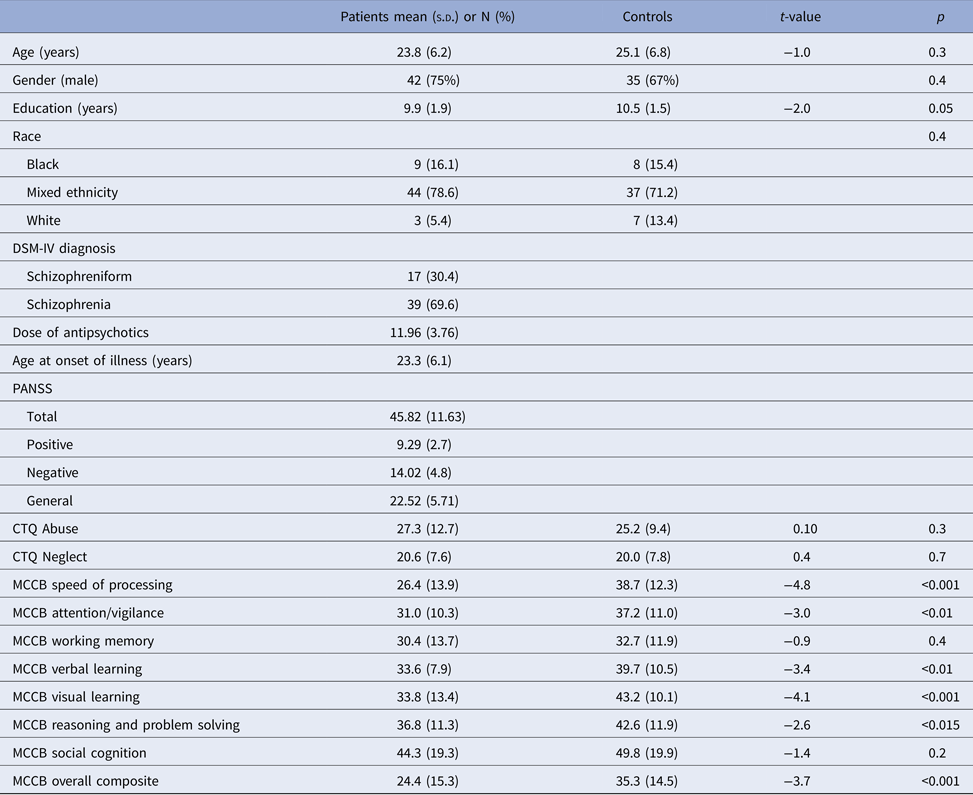
Demographic information, CTQ abuse and neglect scores, and MCCB domain and composite scores for patients and controls are provided in Table 1. CTQ abuse and neglect scores were similar for patients and controls. Controls performed significantly better on the MCCB for all of the domains except working memory and social cognition.
Comparison of demographic details, CTQ abuse and neglect scores and endpoint MCCB scores for the patients (N = 56) and controls (N = 52)

MCCB, MATRICS cognitive consensus battery; s.d., standard deviation; DSM-IV, diagnostic and statistical manual of mental diseases, fourth edition; CTQ, childhood trauma Questionnaire; PANSS, positive and negative syndrome scale.
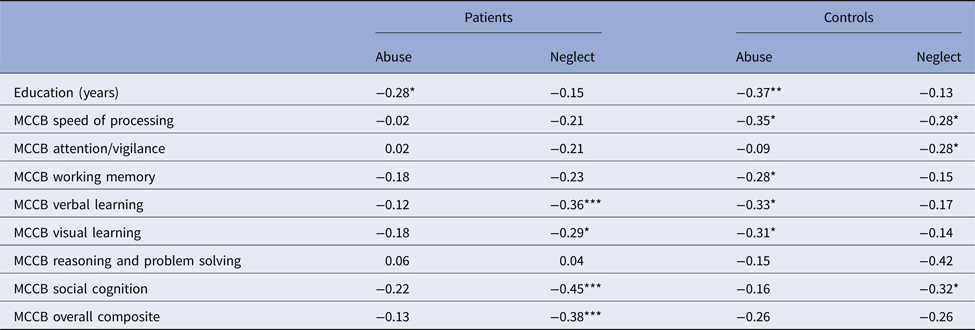
Abuse and neglect scores were significantly correlated with each other (p = 0.006), but with a small effect size (r = 0.27). The correlations between CTQ abuse and neglect scores and MCCB domains and a composite score for patients and controls are provided in Table 2. In patients, neglect correlated with poorer verbal learning, visual learning, social cognition and overall composite scores. In controls, there was a significant correlation between childhood neglect and poor social cognition, the speed of processing, and attention and vigilance. There were no significant correlations between childhood abuse and any of the cognitive domains for the patients. In controls, abuse correlated significantly with speed of processing, working memory, verbal learning and visual learning. CDSS scores were not significantly correlated with abuse (r = 0.06, p = 0.7) or neglect (r = −0.01, p = 0.9) in patients.
Correlations between childhood abuse and neglect and MCCB cognitive domain and composite scores for patients and controls

*p < 0.05; **p < 0.01; ***p < 0.001.
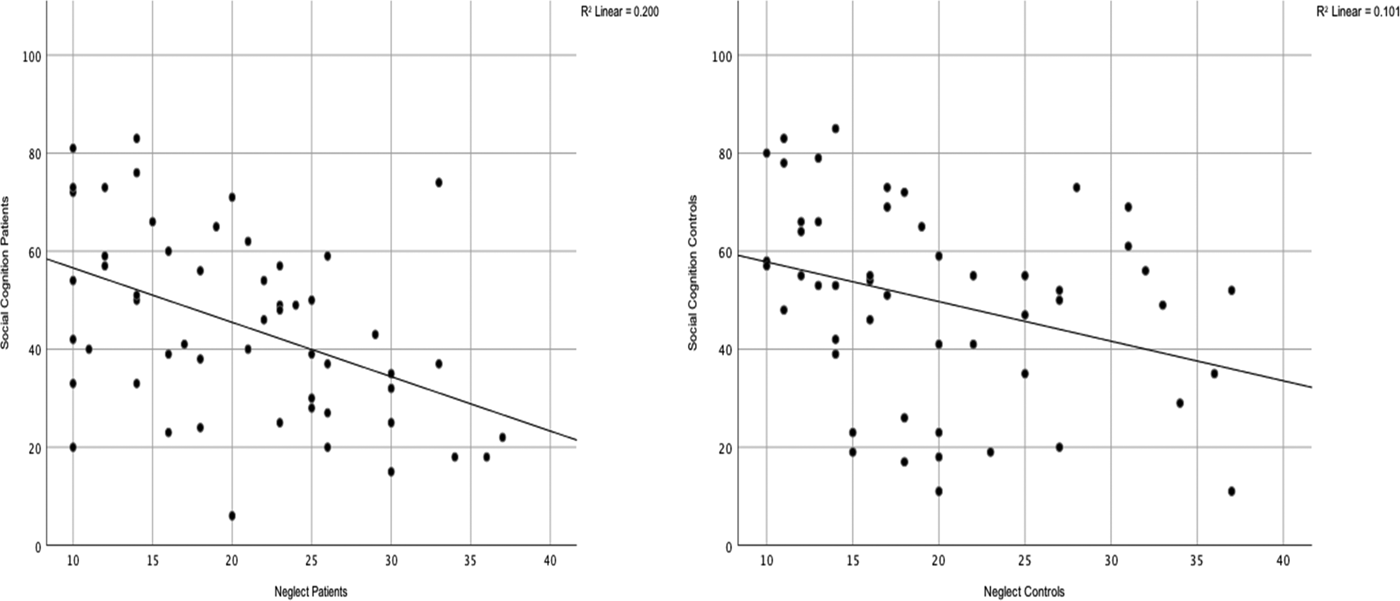
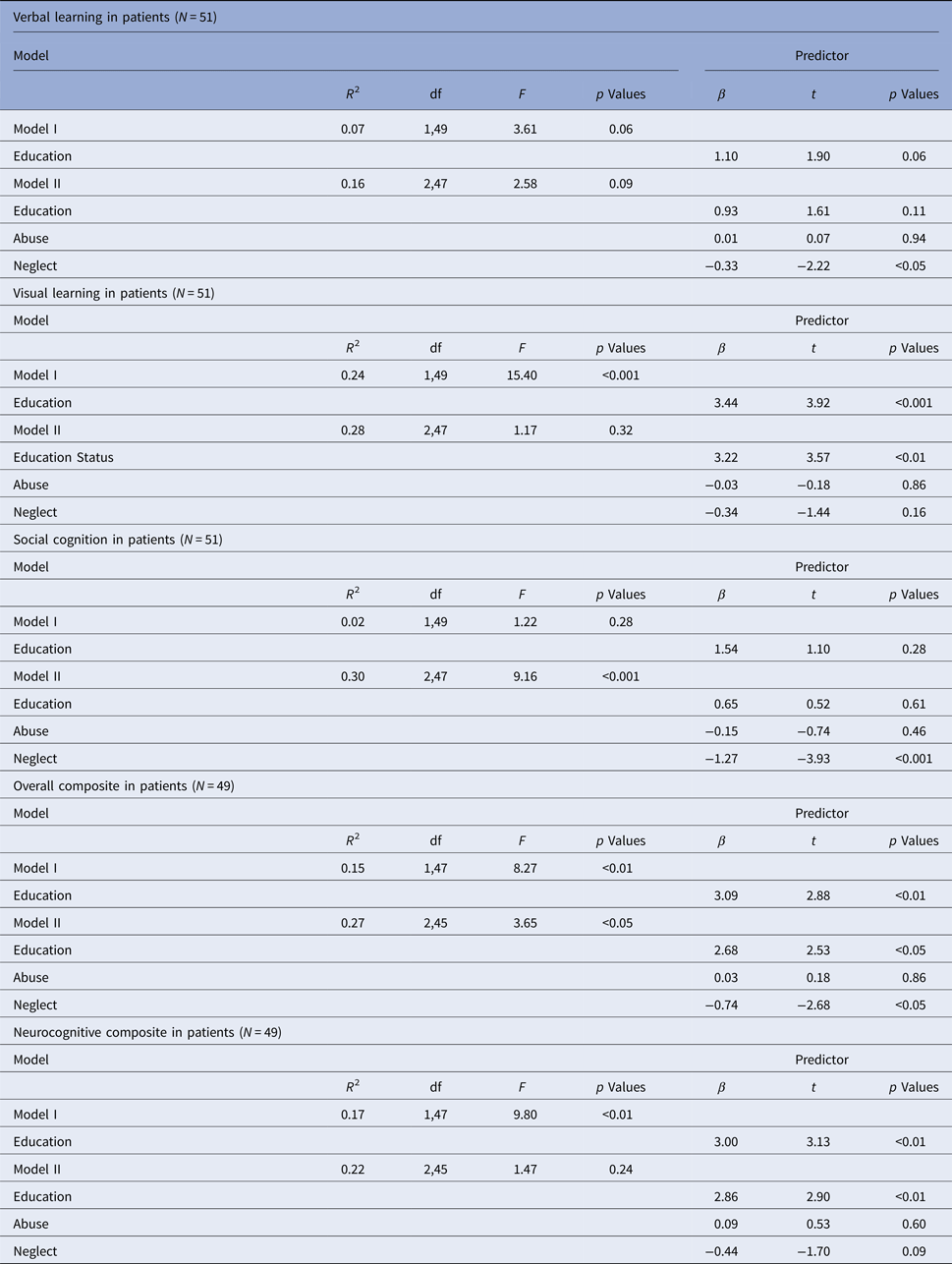
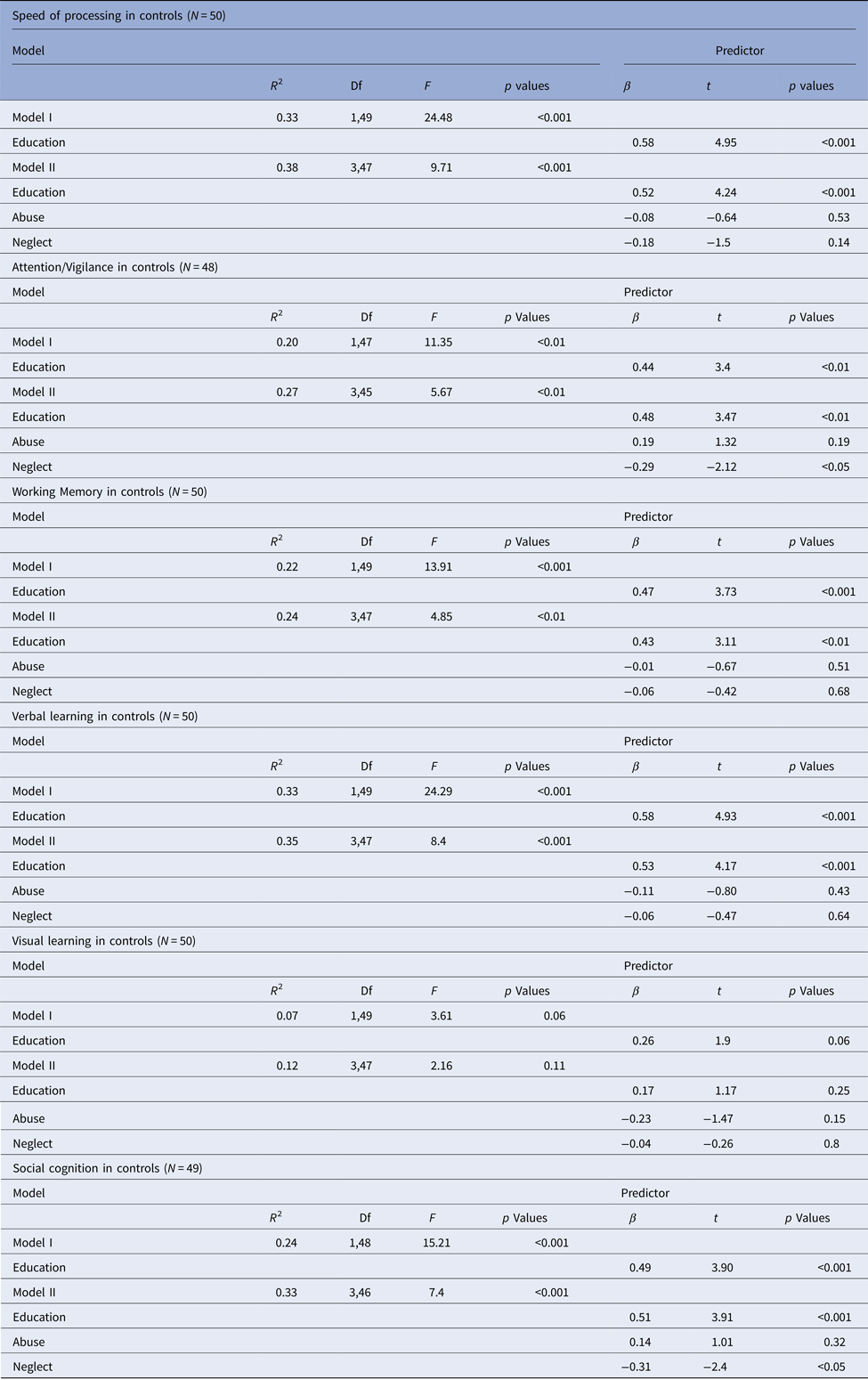
In the hierarchical regression model, we entered an educational level block first, and thereafter we entered abuse and neglect as a second block (see Tables 3–4). We found that for patients, neglect was a significant predictor of the variance in verbal learning, social cognition, and MCCB composite score. In controls, neglect was a significant predictor of social cognition and attention/vigilance. Scatterplots of social cognition and neglect in patients and controls are presented below (see Fig. 1) and scatterplots of the other findings are included in the supplementary material. Abuse was not a significant predictor of cognitive functioning in patients or controls. The inclusion of the outlier did not change the main findings regarding an association between neglect and social cognition although neglect no longer significantly predicted attention/vigilance in the control group. Finally, in a post-hoc analysis to further assess whether any associations between trauma scores and cognition were illness-specific, we performed a regression analysis including all participants as a single group and tested for trauma × group (patient/control) interactions across the eight models. We found no significant increase in the R-square in any of the models.
Scatterplots of social cognition and neglect in controls and patients.

Discussion
The main findings of this study were that exposure to childhood neglect predicted impairments in the cognitive domains of verbal learning, composite cognitive score and notably, social cognition. However, the association between neglect and social cognition was not illness specific, insofar as it was observed in both patients and controls. After controlling for educational level, apart from neglect predicting attention/vigilance performance in controls, none of the other associations remained significant. Specifically, childhood abuse was not a significant predictor of cognitive impairments in either patients or controls.
Our findings are consistent with the proposal that childhood neglect is associated with a ‘cognitive pathway ’ to psychosis characterised by cognitive impairments and negative symptoms, and childhood abuse is linked to an ‘affective pathway’ to psychosis, characterized by a more favourable outcome and independent of cognitive impairments (Myin-Germeys & van Os, Reference Myin-Germeys and van Os2007; van Dam et al. Reference van Dam, van Nierop, Viechtbauer, Velthorst, van Winkel and Bruggeman2015). Furthermore, our finding of a similar association between neglect and social cognition in the control group is consistent with a study in a general population sample indicating a strong association between childhood neglect and cognitive functioning and academic achievements that persisted from childhood through adulthood, whereas childhood abuse was mostly unrelated to cognitive abilities (Geoffroy et al. Reference Geoffroy, Pinto, Li and Power2016). A relationship between childhood neglect and social cognition specifically is suggested by previous studies (Shipman et al. Reference Shipman, Edwards, Brown, Swisher and Jennings2005) suggesting that childhood neglect negatively affects the normal development of emotion regulation in children. In the absence of caregivers who model appropriate emotion regulation strategies children are less likely to fully develop their own skills in this area (Diamond & Aspinwall, Reference Diamond and Aspinwall2003).
The observed association between childhood neglect and social cognition does not imply causality. While it is tempting to propose that our findings are explained on the basis of exposure to adversity during childhood causing lasting deficits in brain function (Sapolsky, Reference Sapolsky1996), it is also plausible that individuals with pre-existing brain deficits are more likely to experience childhood abuse and neglect. Indeed, children with disabilities are at greater risk of being victims of violence (Jones et al. Reference Jones, Bellis, Wood, Hughes, McCoy and Eckley2012). Furthermore, a recent analysis of data drawn from a large sample of individuals from two longitudinal birth-cohort studies has relevance. It was found that, while individuals reporting a history of violence victimisation had pervasive cognitive impairments, they were largely explained by deficits that predated childhood victimisation and by confounding genetic and environmental risk factors (Danese et al. Reference Danese, Moffitt, Arseneault, Bleiberg, Dinardo and Gandelman2017). Our results are consistent with those of Garcia et al. (Reference Garcia, Montalvo, Creus, Cabezas, Sole and Algora2016), who also reported a relationship between childhood neglect and social cognition. As in our study, they used the MCCB to assess cognitive performance. As these authors point out, other studies did not assess social cognition. This is an important omission, given that people with schizophrenia consistently exhibit impairments in social cognition (Healey et al. Reference Healey, Bartholomeusz and Penn2016).
There are several limitations to our study. First, the relatively small sample could have resulted in the study being underpowered to detect smaller effects, or alternatively have resulted in a spurious type II error. Second, childhood adversity exposure was assessed using retrospective self-report, introducing a risk of bias. However, self-reported childhood adversity exposure in individuals with the psychotic disorder has been reported to be consistent over time and unaffected by their current clinical status (Fisher et al. Reference Fisher, Craig, Fearon, Morgan, Dazzan and Lappin2011). Furthermore, the CTQ does not assess repeated trauma nor does it capture the age at which trauma occurs. Third, while our study identified childhood neglect specifically to be associated with poor social cognition, the potential confounding effect of other adversities was not considered. Fourth, we did not consider the age of onset of trauma, nor the duration of trauma exposure. These are factors that have been shown to influence clinical manifestations in schizophrenia (Alameda et al. Reference Alameda, Ferrari, Baumann, Gholam-Rezaee, Do and Conus2015; Schenkel et al. Reference Schenkel, Spaulding, DiLillo and Silverstein2005). Fifth, our study only looked at one aspect of social cognition, namely emotion regulation and therefore inference cannot be made about other social cognition subdomains. Sixth, the average level of education in our sample is relatively low. Also, MCCB scores for both patients and controls were considerably lower than US norms. This limits the generalization of our findings. Lastly, the study used cross-sectional data, thereby precluding any causal inferences.
In conclusion, this study suggests a relationship between cognitive impairment and childhood neglect, but not childhood abuse. Particularly, childhood neglect was related to poor social cognition, but this was found in both patients and controls. Future research should include larger samples of both patients and controls, to better explore illness- and non-illness specific effects of childhood trauma on cognition. Studies should also focus on interactions with other genetic and environmental risk factors, in order to clarify whether risk and resilience factors combine differentially in pathways to illness.
Predictors of cognition in patients

Predictors of cognition in controls

Supplementary material
The supplementary material for this article can be found at https://doi.org/10.1017/S0033291717003671
Acknowledgements
This study was funded by New Partnership for Africa's Development (NEPAD) grant, through the Department of Science and Technology of South Africa, the Medical Research Council of South Africa ‘SHARED ROOTS’ Flagship Project Grant no.MRC-RFA-IFSP-01-2013/SHARED ROOTS’ and an unrestricted grant from Lundbeck International.