Introduction
Syncope is defined as a transient loss of consciousness due to cerebral hypoperfusion with inability to maintain postural tone, followed by spontaneous recovery.Reference Long, Serrano, Cabanas and Bellolio 1 , Reference Huff, Decker and Quinn 2 It accounts for up to 0.6% of all hospital admissions in the United States and one percent of all emergency department (ED) visits.Reference Moya, Sutton and Ammirati 3 - Reference Quinn, Stiell, McDermott, Sellers, Kohn and Wells 6 Approximately 40%-50% of patients with syncope evaluated in the ED are admitted to the hospital, accounting for more than US $10 billion in expenditures from 2000-2005, with a median hospitalization cost of US $8,579.Reference Schladenhaufen, Feilinger, Pollack, Benenson and Kusmiesz 7
Syncope accounts for up to three percent of Emergency Medical Service (EMS) transports to EDs.Reference Alshekhlee, Shen, Mackall and Chelimsky 8 Emergency Medical Service systems perform a critical role in the identification, treatment, and transport of time-critical and intervention-dependent emergency medical conditions.Reference Burt, McCaig and Valverde 9 Emergency Medical Service personnel provide the first line of care for patients with syncope, perform critical actions such as initial assessment and treatment (vital signs, intravenous fluids, cardiac monitoring, and stabilization), as well as gather key details of the history of present illness from the patient, scene, and eyewitnesses.Reference Wang, Weaver, Shapiro and Yealy 10
There is limited prior research that characterizes patients evaluated in the ED with syncope who received initial care from EMS personnel. This study sought to describe the diagnostic and clinical interventions for syncope patients in the out-of-hospital setting.
Methods
Study Design and Population
This was a retrospective record review, approved by the Mayo Clinic Institutional Review Board (Rochester, Minnesota USA), of consecutive patients who presented with syncope, or near-syncope, by EMS to an academic ED with 73,000 annual ED visits. This analysis used data from a prospective, observational cohort study of all ED patients over 18 years of age with syncope or near syncope, evaluated from June 15, 2009 through June 30, 2011. The investigators reviewed the medical records of all the patients included in the parent study and identified those transported by EMS.
Literature Search
An expert reference librarian designed and conducted a literature search with input from the primary authors using OVID MEDLINE (Medline Industries, Inc.; Mundelein, Illinois USA) and PubMed (National Center for Biotechnology Information; Bethesda, Maryland USA) to evaluate the current literature and to ensure feasibility of this study. No studies were found regarding transport by EMS, characterization of patients transported by EMS, or interventions performed by EMS personnel. One study evaluated the prevalence of significant arrhythmias in EMS syncope patients screened with prehospital electrocardiogram (EKG) and tele-medicine support, and a letter to the editor described an analysis of EMS initial evaluation of patients with syncope and its impact in their final disposition and management.Reference Vanek 11 , Reference Brunetti, De Gennaro, Dellegrottaglie, Antonelli, Amoruso and Di Biase 12
Data Collection and Processing
Data abstraction was performed by a research associate, supervised by the senior author, who then performed all chart reviews for eligibility screening and variable abstraction. The research associate was a medical student who was trained on a practice set of 10 charts and was blinded to the final outcomes. Standardized abstraction forms were used for cohort identification (following inclusion/exclusion criteria) and chart abstraction. Variables were defined explicitly and data were extracted from a standardized ambulance patient care report scanned into each patient’s electronic clinical record in the ED. The following variables were extracted: data on mode of transport, patient characteristics and comorbidities, type of syncopal episode, vital signs, physical examination findings, and treatments performed by EMS; they were collected and stored in an electronic database (REDCap; Research Electronic Data Capture; Vanderbilt University, Nashville, Tennessee USA). Study data were collected and managed using REDCap electronic data capture tools hosted at the institution. REDCap is a secure, web-based application designed to support data capture for research studies. Ambiguous results were arbitrated by discussion with the principal investigator. Research associate performance was monitored biweekly by the senior author.
Data Analysis
Descriptive statistics were performed and all continuous variables were reported as averages and all categorical variables as percent frequencies. Data were entered into a Microsoft Excel spreadsheet, Version 2010 (Microsoft Corporation; Redmond, Washington USA) and statistical analyses were conducted using JMP software version 9.0 (S.A.S. Institute; Cary, North Carolina USA).
Results
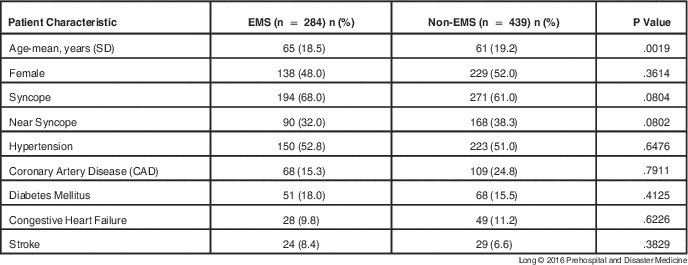
The cohort comprised a total of 723 patients. Two hundred eighty-four (39.3%) arrived by ambulance and 439 (60.7%) arrived via other means. Two hundred thirty-three patients who arrived by EMS (82.3%) were transported by the institutional medical transport service. The most common chief complaint in patients transported by EMS was fainting in 142 patients (50.0%) and dizziness in 127 (44.7%). Syncope was listed as the chief complaint in 32 (11.3%) patients. Table 1 shows patient characteristics and comorbidities.
Patient Characteristics and Comorbidities

Abbreviation: EMS, Emergency Medical Services.
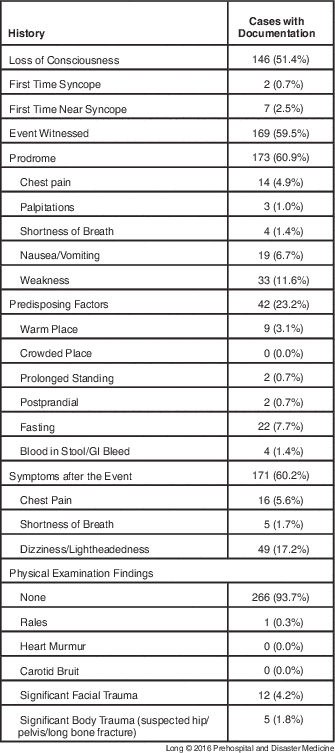
Data from the history and physical examination performed by EMS providers are shown in Table 2. Loss of consciousness was documented in 51.4% of patients, and in 59.5% of cases, the event was witnessed. There were 60.9% of patients who reported prodromal symptoms, the most common of which was weakness (11.0%). The most common predisposing factor was fasting (7.7%).
History and Physical Examination Findings Documented by Emergency Medical Service Providers

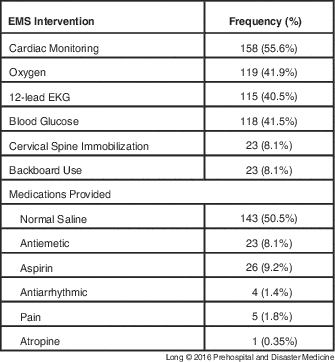
The most common intervention was cardiac monitoring in 158 (55.6%) of the 284 patients transported by EMS, followed by the administration of normal saline in 143 (50.5%), supplemental oxygen (41.9%), blood glucose check (41.5%), and EKG (40.5%; Table 3). One patient had a glucose level lower than 60 and received glucose during transport.
Emergency Medical Service Interventions Provided to Syncope Patients before Emergency Department Arrival

Abbreviation: EKG, electrocardiogram; EMS, Emergency Medical Services.
Of the patients with EKG performed, one-third of EMS providers had a computerized system to interpret the EKG available. The automated system read one EKG as a possible myocardial infarction; this was a patient with an accelerated junctional rhythm and ST abnormality.
Discussion
Emergency Medical Service personnel play a critical role in the initial management of patients with life-threatening injuries and illnesses. They also provide first-line care for patients with syncope, performing critical actions and gaining valuable clinical information which may aid in the ED workup and disposition.Reference Brunetti, De Gennaro, Dellegrottaglie, Antonelli, Amoruso and Di Biase 12 This is the first study to characterize the subset of syncope patients transported to the ED and the role of EMS providers in their care.
In this study, EMS transported more than one-third of all the patients with syncope or near-syncope evaluated in the ED. The results indicate that documentation of key elements of the history of present illness (presence of witnesses, prodrome, predisposing factors, and post-event symptoms) and the physical examination (rales, heart murmur, and trauma) were not recorded in 50.7% of EMS records. This information is valuable for the physician, as a detailed history and physical examination combined with focused diagnostic testing can aid in narrowing the differential diagnosis in syncope patients and can assist providers in identifying patients in whom in-patient admission is necessary for further evaluation and treatment.Reference Schladenhaufen, Feilinger, Pollack, Benenson and Kusmiesz 7 , Reference Brunetti, De Gennaro, Dellegrottaglie, Antonelli, Amoruso and Di Biase 12 , Reference Somani, Baranchuk, Guzman and Morillo 13 Information EMS obtains during the initial evaluation potentially could enhance the management and diagnosis of these patients.Reference Vanek 11 , Reference Brunetti, De Gennaro, Dellegrottaglie, Antonelli, Amoruso and Di Biase 12
In this cohort, EMS interventions provided to patients with syncope or near-syncope were extremely variable. The use of cardiac monitoring was documented in 55.6% of EMS patients, and glucose measurement was documented in 41.5% of the records. These are key interventions that could assist in the recognition and management of life-threatening conditions and, in some cases, potentially reduce hospital admissions and costs.Reference Brunetti, De Gennaro, Dellegrottaglie, Antonelli, Amoruso and Di Biase 12 Figgis et al found that EMS providers underuse oxygen, aspirin, sublingual glyceryl tri-nitrate, and EKG monitoring in the management of chest pain, and that further provision of training and equipment is necessary to enable paramedics to more accurately assess and treat patients with acute coronary syndromes.Reference Huff, Decker and Quinn 14 The use of 12-lead EKG by EMS was reported in 40.5% of cases. An abnormal EKG is one of the clinical variables that is present in all of the syncope clinical decision rules and risk scores.Reference Somani, Baranchuk, Guzman and Morillo 13 - Reference Grossman, Fischer and Lipsitz 26
In many cases, prehospital providers are the first responders to a patient with syncope or near-syncope, which furnishes an optimum opportunity for assessing patients. This assessment of a patient with syncope could play a vital role in care as a patient may be asymptomatic upon arrival to an ED. Emergency Medical Service care normally entails reporting patient characteristics and the care provided to the transport facility, and this report influences the assessment and care provided by ED staff. Not only does this report to the transport facility and assessment and management provided to the patient during transport by ambulance crews affect the following ED care, but it may influence the transport destination based on the perceived mechanism of syncope. Further research should investigate how EMS interventions influence patient’s care and outcome. The results highlight the need for more studies to better understand the role of EMS in the care of syncope.
Limitations
This study had several limitations that deserve particular attention. Hospital admission, discharge diagnosis, and adverse cardiovascular outcomes were not assessed. It is possible that by collecting data from EMS records, instead of recording the report given to the ED staff, biases were introduced. The study attempted to minimized biases by following published chart abstraction strategies.Reference Sun, Derose and Liang 27 It is possible that by including near-syncope patients, selection bias could have occurred. This effect was minimized by applying a clear definition and using methods to increase inclusion rates. It is also possible some eligible patients may have been missed during the screening process.
Conclusion
Emergency Medical Service personnel transported more than one-third of patients presenting to the ED with syncope in this study. Documentation and completion of the syncopal event history, physical exam performed by EMS personnel, and initial interventions by EMS are extremely variable. These results highlight the need for further EMS training/education for the care of syncope patients and more research to better understand these findings.