Introduction
In the study of modern China, the period 1945–1949 remains neglected. It is typically seen as a liminal period, four short years of a decaying regime, sliding off the mainland and out of the mind of historians; a pause between the Sino-Japanese War and the re-commencement of history with the establishment of the People's Republic in 1949. Most studies of this time have concentrated on the iniquities of the late Kuomintang regime: the ‘seeds of destruction’ sown during the war with Japan and before that flowered into corruption, inflation, despair, defeat.Footnote 2
If we want to learn more about the civil war period in its own right, the Chinese Maritime Customs Service might seem an odd place to begin. After all, the institution has been more commonly associated with nineteenth and early twentieth-century informal imperialism than with the era of the atomic bomb and the Cold War.Footnote 3 The contention of this paper, however, is that not only was the Customs in 1945 set to play a key role in the reconstruction of China, but also that it was undergoing a painful transition from an organisation aloof from Chinese politics to one with its fortunes strapped to those of the Kuomintang. This change of direction prompted confrontation between the Service's new leadership (headed by its first American Inspector General, or ‘Inspector General’, Lester Little) and a foreign old guard who resented the undermining of values they saw as having kept the Customs afloat in the turbulent waters of China's recent history.
These differences were best articulated, and most deeply felt, during the investigation of Chinese and foreign staff from neutral countries who had stayed at their posts and cooperated with the Japanese after the seizure of Customs offices in occupied China that followed Pearl Harbour. Such an investigation had no precedent in the near-century of the Customs’ existence. It contradicted the organisation's historical doctrine: of self-preservation and cooperation with de facto powers with a view to serving its own understanding of long-term Chinese interests. It was, therefore, indicative of a shift in loyalty. No longer were employees to be loyal to the Customs firstly, and thence to an ethereal notion of China, but instead to the Customs as a branch of Kuomintang China.
The record of this in-house collaboration trial offers important new perspectives on the final years of the Kuomintang on mainland China. It demonstrates the extent to which the Kuomintang had tightened its control over an historically wayward but fiscally vital entity. It shows how the turmoil of the war with Japan and the Kuomintang's emergence as a victorious member of the community of allied powers had led the Customs’ leadership to defer to the Kuomintang as China's unquestionably legitimate government. Given the organisation's traditional condescension towards China's governments (especially the Republican ones), and its long-held status for many critics as a ‘debt-collecting agency for the benefit of foreign money-lenders,’ these were major changes.Footnote 4
This episode also provides a reminder that those who live through historical events often do not find them so easily to compartmentalise as those who write about them. The evidence of many foreign employees who cooperated with the Japanese and were subsequently investigated shows that, far from perceiving the Sino-Japanese conflict as an era-defining moment, they saw the war as being merely another Asian squabble of the sort the Customs had ridden out time and again, albeit one that was particularly bloody and disruptive. They anticipated that peace would allow them to see out the remainder of their careers in China—largely business as usual. There was an element of wilful self-deception about such statements; but those who were investigated shared with the investigators an assumption that in 1945 the Customs had an important role to play in the rebuilding of China, and were oblivious to the potency of the Communist revolution to overturn their plans.
The first part of this paper summarises the position of the Customs in 1945, before then offering a condensed narrative of the investigation and its context. The final sections examine, in turn, those who were themselves investigated and their justifications, and then those who sponsored the investigation and their objectives.
What was the Customs in 1945?
The Customs in 1945 was not merely an institution that ran import/export; neither was it a tool through which imperialist foreigners could spirit China's wealth off to the West, as it has sometimes been characterised.Footnote 5
As a Customs service, it was undeniably curious, and not just because it had been imposed on China by foreign powers in the nineteenth century and run by an exclusively foreign-staffed (mainly British) administrative branch for most of its history. It was also the only state institution to survive intact through the collapse of the Qing Empire in 1911, the splintering of the fledgling Republic that followed, and the ‘Nanjing Decade’ of Kuomintang rule from 1927. Such tenacity allowed the Customs to expand into areas vacated by other, collapsing, institutions. It did not merely regulate and tax a portion of government income, but had for decades mapped China's coastline, maintained her lighthouses, and operated an anti-smuggling fleet. Until the war with Japan, the Customs had also used its revenue to manage the servicing of China's foreign debt, including the notorious indemnities hanging on from the Boxer war. Such responsibility had led to the Inspector General being sometimes referred to by Chinese officials as the ‘Super Minister of Finance’—not meant as a compliment.Footnote 6 While by 1945 the Inspector General no longer managed China's debts, one responsibility that would be crucial for China's reconstruction was the sheer volume of income that was obtained through the Customs. It had been the largest single source of revenue for every Chinese government from the late Qing until the Sino-Japanese War: still an estimated 43.7% of income in 1937.Footnote 7 After the war, Chiang Kai-Shek (蔣 介 石) immediately turned to foreign imports to stimulate the devastated economy, removing a host of trade restrictions.Footnote 8 The character and makeup of the Customs would clearly be of utmost importance to post-war Kuomintang China.
That character had already changed remarkably during the first decade of Kuomintang rule from 1927–1937. When it came to the Customs, the Nationalists had adopted a pragmatic approach, seeking to avoid the financial and diplomatic costs of closing the institution down. Instead, they undertook reforms that amounted to the elimination of some of the worst symbols of foreign interference, such as the tradition by which the Inspector General sought the approval of the foreign diplomatic corps before paying Customs revenue to the government.Footnote 9 Most crucial of all was a cessation on the hiring of new foreign employees, and the accelerated promotion of Chinese to the administrative ranks (known as the ‘Indoor Service’).Footnote 10 One presumably unintended consequence of this was that, by 1945, all foreign employees had served at least 17 years, which translated to disproportionately senior positions for the group as a whole and, in some cases, entrenched scepticism about the abilities of their Chinese colleagues.Footnote 11 But all realised in 1945 that this was the last generation of foreign employees; the questions were, what role would they play, for how long, and in what sort of Customs Service?
Inspector General Little and others, in both the government and the Customs leadership, saw the Service as operating in a further stage of development after the war. It was as much a change of mind-set as of formal reform. Little wrote time and again of his belief that China needed her experienced foreign Customs employees as she recovered from the conflict: the Service could not be purged of foreigners overnight.Footnote 12 But he went further than any of his British predecessors in seeing the Customs as part of the state apparatus, and its employees, foreign and Chinese, as subject to the same moral claims—such as the need to have lined up against the wartime enemy—as those of any other government department.
The Customs during the war with Japan
When conflict erupted between China and Japan in the summer of 1937, the Customs declined to join in. Determined to secure the long-term integrity of the Service, Inspector General Frederick Maze succeeded in keeping operations and offices going across China, even as Japanese forces established control over much of the country, including its most important trading cities.Footnote 13 Part Western, part Chinese, the ambiguous status of the Customs and the potential for international outcry made it too much trouble for the Japanese to seize. This situation lasted until Pearl Harbour, after which the Japanese took over Customs establishments within their orbit. They ejected non-Chinese employees from countries with which Japan was fighting (British, Americans) and promoted one of their nationals, Kishimoto Hirokichi, to Inspector General in the place of Frederick Maze.Footnote 14 Foreign staff of neutral countries (including French, Portuguese, Swedish, and Russian) were asked to remain at their posts, as were the Chinese. Most did. From 1941 until the end of the war in 1945 the Customs was thus split in two. In Chungking, a hastily-assembled Inspectorate ran so much of the Customs as remained in unoccupied China. From Shanghai, a Japanese-dominated (but still internationally staffed) Inspectorate ran Customs operations in what had traditionally been China's wealthiest, busiest ports. For all that Chungking awarded its Shanghai rival the comforting epithet of the ‘Bogus Service,’ both claimed legitimacy for the duration of the war.Footnote 15
Reuniting the Customs: The Staff Investigation Committee
With peace came reunification. The Customs had a new leadership: Little had become Inspector General in Chungking in 1943, while the Kwan-wu Shu (關 務 署), the Customs’ supervisory body in government, saw the return of Chang Fu-Yun (張 運) as Director General (DG) in September 1945.Footnote 16 Chang's previous stint had seen him oversee the Kuomintang's reforms of the Customs in 1929.Footnote 17 These were appointments appropriate to a new reforming era. In particular, the arrival of an American as Inspector General indicated an implied snub to British interests in China, recognition of the closer ties between China and the United States that had grown during the war, and a fresh start after the moribund final years of British leadership that had followed the establishment of the Chungking Inspectorate in 1941.Footnote 18
While the Chungking Ministry of Finance began to give thought to the future of staff in the Bogus Customs as early as 1943, the issue sharpened in the minds of senior officials when the Swedish ambassador asked in the late summer of 1945 what treatment his compatriots with the Kishimoto Service could expect.Footnote 19
Inspector General Little's solution, approved by Chang, was as follows. All foreign staff, and all senior Chinese staff, who had stayed with the Bogus Customs were regarded retrospectively as having been dismissed on 8th December 1941, the day after the Pearl Harbour attacks.Footnote 20 They were, however, encouraged to apply for reinstatement and explain why they had stayed. These applications were subject to the approval of the Staff Investigation Committee, established 30th October 1945, and made up of one American and two Chinese Commissioners. In more difficult cases, employees would need to present themselves for interview by the committee. If approved, staff could rejoin the Customs, albeit with the 1941–1945 period of their careers effectively deleted—these years would not count towards calculations of pay, pensions, or seniority, while any promotions awarded by the Bogus Customs were also expunged.Footnote 21 For these staff, the clock was wound back to 1941. If the application was not approved, the individual would be excluded from reinstatement.
One advantage of this seemingly convoluted method was that the Customs could claim, when necessary, that all employees of the Bogus Service had been dismissed (as British Members of Parliament were briefed, and as was eventually repeated in the House of Commons in January 1946—without mentioning that most of these employees had subsequently been rehired).Footnote 22 It also exempted the Customs from ever having to give its ‘Bogus’ cousin the lick of respectability that counting those years towards pension rights would have done—a saving of pride as well as pennies. Finally, Little may have thought it would prove easier to refuse re-employment to compromised ex-colleagues than to eject paid-up members of staff after investigation—a job in the Customs had traditionally been seen as a job for life.
There was a simple formula by which the Staff Investigation Committee judged applications. If applicants could prove that they had been coerced by the Japanese into staying at their posts, then they would be eligible for reinstatement. Conversely, anyone who was found to have voluntarily stayed, no matter the reason, would be refused consideration. Career record, length of service, and other such factors were ignored. The assumption was that service in the Bogus Customs was an aberration that could only have been justified by the threat of violence. The burden of proof lay upon those who were investigated.Footnote 23
There had been 129 foreign employees of neutral countries in China at the date of Pearl Harbour, most of whom applied for reinstatement.Footnote 24 Their cases were examined alongside those of the seventeen Chinese staff whose seniority qualified them for investigation.Footnote 25
Two issues emerged to complicate this deft formula. The first was that the neutrals probably thought that they had been ordered to stay by Little's predecessor. As far as he and the rest of the senior Customs leadership were concerned, the Inspector General at the time of Pearl Harbour, Frederick Maze, had told neutral employees that those who stayed to work with the Japanese would be at risk of future recrimination from the Kuomintang.Footnote 26 Because Maze had never told them, Little and his colleagues did not realise that this oral warning to staff in Shanghai would soon be contradicted. Maze wrote to every neutral employee in occupied China, not just those in Shanghai, stating that cooperation with the Japanese was understandable, given the importance of preserving the Customs (‘its properties, spirit, and ethos’) across all of China for the long-term: ‘if necessary, I would defend the actions of employees who continue their work without interruption.’Footnote 27 The letter was born of pressure placed by the Japanese on Maze in Shanghai—though by the time the Inspector General emerged in Chungking after repatriation, he had managed to ‘forget’ about the entire episode.Footnote 28 For the neutrals, however, this was insurance against accusations of betrayal. The Staff Investigation Committee would come to read copies of Maze's letter time and again when applications for reinstatement, framed as protests, came pouring in from across the country.
The second complication was that many employees went on the offensive, writing to the Staff Investigation Committee to reject the proposition that their actions in cooperating with the Japanese were in any way wrong. Even without Maze's advice, they argued, their duty was first to the Customs, a duty that had best been served by seeing the war out in the Bogus Service: protecting property, shielding Chinese staff from persecution and, most fundamentally, preserving the ethos of the Service for the future.Footnote 29 This was more than just self-justifying rhetoric, as it reflected an organisational ethos (combining paternalism and self-preservation) developed over decades which was sharpened under Maze's command during the war. They rejected Little's proposition that their loyalty should have been with China's government; theirs was a higher loyalty, owed first to the Customs, and through it to China.
In its judgement, the Staff Investigation Committee made no reference to these complaints, and thus avoided the controversy that might have resulted from an airing of Maze's behaviour or the self-justifying rhetoric of those investigated.Footnote 30 Even where employees insisted that their decision to stay had been made freely, the committee ruled in most cases that they were victims of Japanese coercion. It could do this because it took a generous interpretation of the investigation's terms, finding that Japanese authority had been so pervasive that, in fact, all employees could be assumed to have been coerced.Footnote 31 We do not know whether such an interpretation had been a goal of Little's when he set the investigation's criteria, but he certainly never complained about the result—he wanted to rebuild the Service, not dismantle it.
The Staff Investigation Committee reported its findings to Little on 23rd November 1945. Approval was needed by Little, then Chang Fu-Yun, then Minister of Finance, O.K. Yui (俞 鴻 鈞)—a process that emphasised the chain of command from the Customs to the government.Footnote 32 Somewhere along the line ‘clemency’ (meaning pension rights) was extended to the widow of a Norwegian who had informed the Japanese of Maze's initial advice to neutrals to leave the Bogus Service. In the final draft, only four were refused re-employment: two foreigners, and two Chinese.Footnote 33 Of the foreigners, Y.H.J. Cloarec, a Frenchman who had for a time served as Chief Secretary of the Bogus Customs, was effectively Kishimoto's second in command. The record of his interrogations suggests he was really punished not for the positions he had held, but for the high profile he had maintained in occupied Shanghai, and his obnoxious behaviour towards Gaullist compatriots.Footnote 34 F. Guttirez was a British citizen who, after the Japanese takeover, had changed her nationality to Portuguese to avoid dismissal.Footnote 35 All others who applied for reinstatement, got it.Footnote 36 Thanks to the layers of bureaucracy required before the decision could be passed, investigated employees only began to take up their posts in February 1946, after months of uncertainty.Footnote 37
The investigated—‘The Service first’
Those employees who fell under the gaze of the investigation did not feel as generous about it as their Inspector General did. Their reaction to the Staff Investigation Committee, illustrated by letters of complaint to Little, shows just how much of a change the investigation represented—and thus, just how different an organisation Little and the rest of the Customs’ leadership anticipated would emerge post-war.
Most of the 129 neutral employees who had been in China at the date of Pearl Harbour seem both to have served the Bogus Customs and then have applied for reinstatement.Footnote 38 The term ‘neutral,’ however, requires some clarification. The group contained Swedes and Portuguese, but also French, Danes and Norwegians, for whom neutral status had been awarded only by the occupation of their countries by Japan's new ally in December 1941, Nazi Germany. When Cloarec drew attention to Vichy France's neutrality (‘my country, right or wrong’), the committee proved less than sympathetic.Footnote 39 For the most part, however, the Staff Investigation Committee avoided discussion of moral and legal technicalities by making clear that the investigation was not to pry into the assumed loyalties of individuals to their own states, but into their explicit failure to remain loyal to the state by which they were employed—China, which was to say, the Chiang Kai-shek's Nationalist government. As ‘neutrals,’ the Japanese had allowed them to stay, but the term itself was not meant to hold any interest for the Staff Investigation Committee.
It is worth noting that life for foreigners in the Bogus Customs was by no means as easy as their colleagues in Kuomintang-controlled China doubtless suspected, nor was their contribution to Japan's war effort that great. The Customs’ greatest help to Japan probably came in its period of official cooperation from 1937–1941: Shanghai's International Settlement led the way, booming as a hub of neutrality surrounded by profitable war while the Customs kept trade efficient and regulated from its base on the Bund.Footnote 40 After Pearl Harbour, the significance of the Customs in occupied China dwindled along with Shanghai's economy. Industry unravelled as the impact of naval blockades was felt, while daily life grew ever more stringent in what had been the city of neon lights.Footnote 41 By July 1945 the Chungking Customs was able to note, in a report on its estranged twin, that, outside of Shanghai, the Bogus Customs was ‘barely self-supporting.’Footnote 42 After a promising beginning (the Kishimoto Service stuck with many old procedures, even continuing to write official communications in English for some time) economic decline helped to sour the atmosphere: many neutrals later complained of isolation at work, eviction from accommodation, and dismissal soon after the bombing of Pearl Harbour.Footnote 43
The difficulties neutral employees experienced in occupied China doubtless tempted many to anticipate a warm welcome back into the reunited Service under Inspector General Little. They would no doubt have been encouraged in this by the example of other institutions of treaty-port life, such as the Shanghai Municipal Police, that had cooperated with the Japanese.Footnote 44 Of most fundamental importance, however, was that the Customs brimmed with a long-held ethos of detachment from China's political upheavals.
Foreigners in treaty-port China had long cultivated a sense of distance and superiority to China's political troubles. In the case of the Customs, this sentiment had been elevated into a guiding principle, repeated by employees alternately as ‘the Service first’ and ‘Customs integrity.’Footnote 45 The idea was that while the Customs served Chinese interests, aloofness from Chinese politics was the only way to guarantee the security and unity of the Customs across China during turbulent times. In other words, the ends justified the means. Though the origins of this mentality can undoubtedly be found in the aloof status that the Customs occupied under the Qing (for example, paying China's debts direct to foreign creditors from 1895 onwards) it only really articulated itself after the collapse of the imperial government in 1911.Footnote 46 Then, the Customs had found itself a unified institution scattered across a country imploding into warring fiefdoms. Under such circumstances, the only way to avoid extinction was to rise above local events. The Inspector General of the day first covered the Service's own costs then, in consultation with the Peking diplomatic community, chose which Chinese faction mustered enough legitimacy to deserve revenue; gunboats—provided by foreign powers interested in maintaining smooth trade—were sometimes deployed to deter those who disagreed with the choice.Footnote 47 Much of this came to an end in 1928, when the Kuomintang brought a semblance of unified government to China, and reforms to the Customs. But even after that, the principle of ‘Customs integrity’ pervaded the policies of the organisation, as we have seen in the case of Inspector General Maze's approach to China's conflict with Japan.
As the Customs ceased recruiting foreigners in 1928, all overseas employees in Inspector General Little's Customs had served at least 17 years, many joining at the peak of the organisation's autonomy in the 1910s and early 1920s. Moreover, the Service had long made it a point of pride that its foreign recruits should, for the most part, come straight from school, without university experience—it sought practical, quick-learning young men, unburdened by academic abstractions, for whom China and the Customs would be the limit of their higher education.Footnote 48
Small wonder, then, that those investigated by the Staff Investigation Committee clung with such tenacity to the ideals of the organisation that they had joined. Their position was best articulated by K.E. Jordan, a Dane, who served as Commissioner at Xiamen during the war. Jordan had been an early supporter of Inspector General Maze's policy of pragmatism towards the Sino-Japanese conflict. Sent to report on negotiations between Custom's staff and Japanese troops at Tianjin in January 1938, he wrote to Maze, ‘it would be disastrous in the circumstances to be 100% “loyal” to the old government: it is more than ever necessary to emphasise the Service's freedom from politics.’Footnote 49 This was a philosophy which kept Jordan in Xiamen until his dismissal by the Japanese in March 1945. After the war, he denounced the Staff Investigation Committee as hypocritical and at odds with Customs procedure. ‘I never looked upon the Japanese occupation as but a temporary phase in the war,’ he noted, ‘nor on the bogus regime as other than a temporary phase in the Service structure.’Footnote 50 Despite his insistence that cooperation with the Japanese had been both voluntary and justified, the Staff Investigation Committee held that Jordan had in fact been coerced into serving the Bogus Customs, and reinstated him. From retirement in Denmark, Jordan continued to harangue Little: ‘I shall never, everything considered, be able to feel otherwise than that I completely wasted my life in serving China, and futilely squandered the idealism which prompted my work. I cannot but profoundly regret that I ever joined the Chinese Maritime Customs’Footnote 51.
Jordan was far from alone in his belief that working with the Bogus Customs had been the right thing to do. One Swede justified his choice with reference to what he had understood to be the ideals of an organisation that he had served for 32 years: ‘from the very beginning I was imbued with the spirit of loyalty and the motto, ‘the Service first’.’Footnote 52 In Tianjin in December 1941, neutral staff had been advised to stay on by the deposed British commissioner, again in the interests of Service integrity (‘were I again called . . . I would certainly repeat what I said. I told the Staff that the best way to keep things together was to stick together and to try as far as possible to carry out the old traditions’).Footnote 53 These sentiments were typical of the response that Little received as the investigation got under way.
Such declarations were doubtless self-serving: people whose careers are on the line will provide every defence that seems plausible. But it should be remembered that all these men had to do was prove that they had been forced by the Japanese to stay. Instead they consistently chose to base their defences on the December 1941 advice received from Inspector General Maze (which had said that serving the Japanese would help preserve the organisation), and their own understanding of the principles of the Customs Service. In short, their response to the charge of collaboration was to attack the premise of the question and to justify cooperation with China's enemy.
The decision of so many neutral employees to cooperate with the Japanese, and the vehemence of the protests with which they met the post-war investigation into their behaviour, pays testament to the tenacity of the Customs’ organisational egotism. All this also demonstrates the gulf between the visions for the Customs’ future held by Little and many of his foreign employees. As one of the investigated, C. Basto, noted, ‘it is a terrible disappointment to have gone through four years of war, every day awaiting the return of the Service to its original form and when that day arrives to find that all our fondest hopes have been misunderstood.’Footnote 54 The Customs emerged from the war a very different organisation, in a very different China, to those that foreign employees remembered.
Who was behind the investigation, and why?
Inspector General Little took responsibility for the Staff Investigation Committee: he fielded the initial queries from the Swedish embassy that sparked the investigation, devised its form, appointed and instructed the committee and corresponded with dozens of those who were investigated.Footnote 55 Beyond Little was a consensus within the Customs’ leadership that the investigations were necessary. The Inspector General's recommendations were first passed to Chang, and then sent to the Minister of Finance for confirmation.Footnote 56 As for the rest of the Customs’ senior leadership, dissenting voices were notably absent. Deputy Inspector General Ting Kuei-Tang (丁 貴 堂), for example, advised Little on appropriate procedure, and also intervened on behalf of two of his colleagues whom he thought should be treated kindly, but offered no criticism of the Staff Investigation Committee per se.Footnote 57 It was evidently an investigation that the Customs’ leadership thought necessary. What remains unclear is exactly why Customs thought it was neccesary.
Despite the apparent consensus, and the precision with which the Staff Investigation Committee has been documented, there are few precise explanations of why the Customs took a step so out of keeping with its established practice. Inspector General Little's correspondence indicated that he simply felt something had to be done, and that this was so obvious as to require no further explanation.Footnote 58 Several motivations can be identified however. Together, they suggest an organisation looking both to the immediate future (seeking to solve practical problems as quickly as possible), and indicate a break from its past ethos as answerable only to itself. These motivations imply that by 1945 the Customs saw itself as operating according to a new vision, responsible to China's government as never before.
Underpinning all other considerations was the Customs’ weakened status with regard to the Kuomintang. Previously, it had covered its own expenses from trade receipts before turning over the balance, but the Kuomintang had stripped away this financial autonomy during the Service's sojourn in Chungking, forcing it to bank revenue with the Treasury and live off government funds like any other branch of the bureaucracy.Footnote 59 The debilitating effect this had on living standards and morale during a period of immense inflation can scarcely be overestimated, and one of Little's principal responsibilities would prove to be the sourcing of adequate resources.Footnote 60 Moreover, the Customs no longer took responsibility for China's loan repayments, which deprived foreign powers of any motivation to contemplate serious financial aid.Footnote 61 Finally, there existed constant pressure from within and from without the Kuomintang to either shut down the Customs or purge its foreign contingent, making Little aware that his role depended on the grace and favour of the Ministry of Finance and China's senior government figures.Footnote 62 The loyalty that Little perceived the Customs as owing the Kuomintang had a very practical basis.
These constraints provided the canvas for such a work as the ‘Staff Investigation Committee’, but with no real reason to pick up the brush. First among the motivations for such an investigation was that Little and his colleagues probably anticipated trouble once the two halves of the wartime Service were reunited. Life in Chungking and the rest of unoccupied China had been difficult for those based beyond Japanese lines on 10th December 1941 and for the handful who had made it across after that date (‘as a result of the war, morale and honesty sank to a dangerous level,’ Little reminisced in 1947).Footnote 63 Joining them in the reunited Customs would be many of the British and Americans interned by the Japanese. It does not take much to imagine that these two groups of staff would have harboured considerable resentment against those who stayed with the Bogus Customs in what must have seemed the comparative splendour of old treaty ports like Shanghai and Tianjin. Certainly, the atmosphere of the post-war Customs was soured by recrimination. Several French employees appeared as witnesses to the Staff Investigation Committee to denounce their former colleague Cloarec (they called him, ‘rabid anti-Free French’).Footnote 64 The threat of unpleasantness certainly troubled Little in December 1945: he wrote to Ting of his fears of ‘cleavage’ between the two groups of staff and suggested that those who had been in Chungking during the war might now be rewarded with jobs in Shanghai at the expense of hangers-on from the Bogus Service.Footnote 65 It seems likely that Little saw the Staff Investigation Committee as a necessary step to smoothing the process of reunification.
A second reason was the necessity to keep step with other purges and trials taking place throughout China, including in Shanghai, the nerve-centre of the Customs. Sitting in Chungking in the summer of 1945, Little would have been justified in anticipating, post-war, a popular demand for some sort of retribution to be paid towards those who cooperated with China's occupiers. Collaboration proved a particularly live issue in Shanghai where, in a bid by the Kuomintang to keep order on the streets and the Communists off them, Japanese troops were allowed to remain at their posts until Chiang's forces reached the city long after the war's end—a situation fiercely criticised in the city's newspapers.Footnote 66 Winter 1945 brought accusations against former officials of the Vichy-affiliated wartime French Concession. The controversy was particularly fraught as the new French government was refusing to recognise Vichy's abolition of the Concession in 1943. French and Chinese authorities raced each other to claim legitimacy by arresting apparent collaborators. In January 1946, thousands of Chinese students gathered outside the consulate-general building, calling for the handover of ‘French traitors.’Footnote 67 With all this happening just streets away, it would have been surprising if the Staff Investigation Committee had not been influenced by the turmoil. Indeed, one of the key players in the Concession's drama, De Gaulle's personal representative to the city, Roderick Égal, appeared as a witness during the Staff Investigation Committee's investigation, helping to seal the fate of Cloarec, the one Frenchman who was refused reinstatement to the Service.Footnote 68 If Little did anticipate anger against those who cooperated with Japan, he would have been right.
Contrasting with these outbursts was a general complacency among the Kuomintang leadership about the issue of collaboration. Chiang Kai-shek saw his priority as preparing for the coming confrontation with the Communist Party of China. Accordingly, he drew on the ranks of the collaborative Wang Ching-wei (王 精 衛) regime to secure cities far from the territory he occupied in the aftermath of Japan's surrender and, ultimately, to strengthen his government and military.Footnote 69 This provided much fodder for Communist propaganda. China eventually saw collaboration trials in summer 1946, but these were not on the scale nor thoroughness of, say, the Nuremburg trials, and were undermined by highly publicised amnesties to senior officials of Wang's government.Footnote 70
To which China was Little responding: the one hungry for revenge against the occupiers’ friends, or the one more concerned with reconstruction and the nation's coming internal confrontation? The evidence suggests that he had both in mind. On the one hand, Little supervised the most thorough investigation of collaboration undertaken by any branch of the Kuomintang, dismissing (if temporarily) everyone who had worked with the Bogus Service. On the other hand, a desire to demonstrate that justice had been done was competing with the more prosaic necessity of rebuilding the Service.
The investigation was just one more on the list of tasks facing Little as he contemplated post-war reconstruction, along with the re-opening of old offices, repairing of lighthouses, the sourcing of shipping and arms for the depleted anti-smuggling fleet, the securing of adequate funds, and the rehiring of experienced staff.Footnote 71 The eve of civil war, with a country to re-build, was not a time for peering into the hearts of those who had remained in occupied territories. Accordingly, Little made no objection to the Staff Investigation Committee's generous interpretation of ‘coercion’ and its consequent conclusion that all but four employees had worked for the Japanese against their own will—a finding that, as we have seen, contradicted some employees’ own statements. His practical approach was consistent with a recognition made by the Ministry of Finance as early as 1943 that reconstruction would necessitate the absorption of employees of the ‘Bogus’ rival Customs (‘victims of circumstance’) into the post-war Service.Footnote 72 So, while there were strong practical arguments for the purging of suspected collaborators, these were weighed alongside the requirements of an organisation that needed men on the ground.
A further consideration was a product of both practical politics and ideological issues. Such cooperation with China's enemy by senior foreign employees inevitably called into question the loyalty of the Customs’ overseas contingent. What had the Nationalist revolution and subsequent years of war been about, if not ridding China of meddling foreigners? The Staff Investigation Committee provided an opportunity for Little to demonstrate that the Customs played by the same rules as the rest of the government. In the process, he signalled a new direction for the Service.
For many Chinese nationalists, the Customs had always been a relic of imperialism. During the war with Japan and afterwards, there was no absence of voices amongst the Kuomintang calling for the end of the organisation. Before Little left the United States of America for China in 1943, he told American officials that he feared a purging of the foreign contingent;Footnote 73 the war saw many powers of the Customs, such as the policing of smuggling, gobbled up by other government departments;Footnote 74 soon after the war's end, Chang Fu-Yun's memoirs record that T.V. Soong intervened to veto another mooted plan to abolish the position of Inspector General and send the foreigners home.Footnote 75 Opposition to the foreign presence extended to Chinese within the Customs itself, and was experienced at all levels. In October 1945, while Little was trying to secure assurances about the future of the foreign contingent from government figures such as T.V. Soong and the Minister of Finance, H.H. Kung, his deputy, Ting Kuei-tang, was busy lobbying the same people for the abolition of the foreign inspectorate. Ting wrote to Chang Fu-Yun (in English, which persisted as the Service's working language for top-level correspondence) the ‘Most [foreigners] are still of the old die-hard type and consider themselves indispensable elements of the Customs. . . . The Chinese staff is now perfectly capable of carrying the Customs administrative work without any assistance’.Footnote 76 For some, the financial perks enjoyed by foreign colleagues were what grated; for others, it was the seniority of foreign employees.Footnote 77 Whatever the specifics of the accusations that dogged the final years of the organisation, the overall sentiment for many Chinese was that the foreign inspectorate of the Customs was the last of the great anachronisms of a century of Western presence in China.
While Inspector General Little came to the job conscious of these feelings (though perhaps not of their virulence) he maintained until the end that not enough Chinese staff were ready to make the step up to run the organisation unaided; while more sympathetic to the demands of Chinese nationalism than some of his colleagues, he insisted that ‘integrity and efficiency’ demanded a continued foreign presence.Footnote 78 The foreign contingent was not just disproportionately experienced, it also enjoyed the benefit of living allowances paid in sterling, which provided some tonic against corruption while the value of Chinese wages continued to disintegrate in the face of inflation.Footnote 79 So, Little fought to recall the most experienced foreigners from war service, and to keep the ones he had in China. In June 1946, he initiated a gruelling public struggle by appointing a British colleague as Commissioner in Shanghai, a particularly high profile post.Footnote 80 In October of that year, the earliest date after reunification for which we have figures, there were 252 foreigners on the books—down from over 1,000 before 1937, but still a visible and disproportionately highly-ranked group.Footnote 81
The foreign presence provided enough of a sensitive issue of its own without accusations of collaboration to further complicate matters. The entire project of rebuilding the Customs was left vulnerable by the legacy of the war. Half of the organisation had been run Japanese-run from December 1941. Of those who worked there, many of the foreign staff seemed inclined to believe that this had been a principled sort of cooperation and largely justifiable. Lurking in the background was the memory of a policy of appeasement by Frederick Maze that began in 1931 which grew increasingly marked during the first four years of China's war with Japan. Maze had reacted to the Japanese annexation of Manchuria in 1931 by trying, and failing, to negotiate agreement with the new Manchukuo authorities: he saw this as a regional rebellion incidental to his wider goal of keeping the Customs unified across China.Footnote 82 Then, in 1937, Maze snubbed the conflict that grew to World War Two by keeping his organisation running in Japanese-controlled China.Footnote 83 The Customs became hostage to Japanese political will, despite nominal loyalty to Chiang Kai-shek's retreating administration. ‘Compromises’ included the promotion of Japanese staff, cooperation with ‘puppet’ administrations, the payment of revenues to a Japanese bank, and assistance in creating controls on exports—from July 1941, all exports were to go to Japan.Footnote 84 The American advisor to the Kuomintang, Arthur Young, later noted, ‘for holding things together Maze deserves credit. In this, however, he was aided by Japan's willingness to have the service of an effective revenue-collecting organ.’Footnote 85 One Italian employee was less sympathetic: ‘we were saving money which was going into the hands of the Japanese with which to bomb and shoot our people.’Footnote 86 In February 1938, weeks after the Nanjing Massacre, Maze travelled to Tokyo to meet Japanese and British officials who wanted to find a way to resolve the Customs’ curious status.Footnote 87 Every member of Little's Customs had taken part in these first four years of official cooperation with Japan, regardless of which side of the frontline they had ended up on after December 1941. The Customs’ loyalty could scarcely have seemed more compromised.
In the Staff Investigation Committee, Little had found a way of repairing some of that damage. In contrast to those dubious war years, and the organisation's purposefully ambiguous status dating back to its foundation under the Qing, the unequivocal premise of the Staff Investigation Committee was that Customs’ employees owed their loyalty to China's internationally recognised, legitimate Kuomintang government. Voluntary cooperation with the Kuomintang's enemy was, prima facie, enough to merit dismissal. That made the loyalty of those who passed the test seem somewhat more sound. Moreover, by casting such light on events after Pearl Harbour, Little left obscured the potentially more damaging legacy of years of appeasement under Frederick Maze. When the Inspector General told one of those who was investigated that the Staff Investigation Committee was answering a ‘question of principle with political implications,’ he may have had in mind the knotty issue of the Customs’ status in China.Footnote 88
The final explanation for the creation of the Staff Investigation Committee lies in the changes experienced by China itself during its eight years of war with Japan. In 1938, the gin bars of the East had hummed with disapproval over the Kuomintang's refusal to adhere to the Customs agreement clinched by Inspector General Maze in Tokyo, a deal which would have seen Chiang's government pay indemnities to Japan even while the war continued. Maze's decision to carry on in occupied China was championed abroad as a victory for good sense and free trade.Footnote 89 By 1945, things had changed. China sat on the United Nations Security Council and was hailed as a member of the ‘Big Four’. Thanks to the Japanese attack on Pearl Harbour, China's conflict had graduated from just another Asian squabble to part of the world's victorious crusade against fascism. Governments, like that of Wang Ching-wei, who had found accommodation with the aggressors, were now universally denounced as ‘puppets’. Many foreigners who knew the Kuomintang from the inside, like Inspector General Little, felt reservations about the regime. But the world had bled in its defeat of Japan. The global order was radically altered and cooperation with the Japanese could no longer be viewed as complacently as it had been by the Chinese Customs’ foreign supporters in 1937.
All these changes seemed to Little so obvious as to require no further explanation. He later described the mantra of ‘Customs integrity,’ repeated so often by the investigated employees of the old Bogus Customs, as an ‘obsession.’Footnote 90 During the investigation, Little offered scant sympathy to those who fell back on that term and its accomplice, ‘the Service first.’ He accused one Danish employee of having been ‘extremely unrealistic and even naive’, for clinging to such a rationale, ‘as though nothing affecting the Customs or your own position had occurred between 1941 and 1945, and as though the whole war had been merely an unfortunate interruption in your Service career.’Footnote 91 The implication was clear: China was no longer the same, its Customs Service was no longer the same, and the sooner that her foreign servants realised that, the better for all concerned.
The Staff Investigation Committee reflected the vision of the Customs’ leadership for the organisation's post-war future. Naturally, this was intimately related to their understanding of China's future. Far from seeing the Customs as anachronistic to a country shorn of extraterritoriality and other quasi-colonial perks, Little, Chang and others anticipated a key position for the Customs in rebuilding the nation's economy and bureaucracy after eight years of conflict. The Staff Investigation Committee was a necessary step to achieving that goal: it was a means with which to reconcile reunited employees, to meet the expectations of those indignant about collaboration with the enemy, and to demonstrate the loyal credentials of China's foreign Customs servants. Most of all, it was to Little a natural response to the position assumed by the Kuomintang in 1945: the government of a nation among equals. To him, this investigation into the wartime behaviour of staff was necessary, natural, and a hint that the Service might yet become the genuine ‘cosmopolitan league working for the welfare and advancement of the Chinese people’ that it had long aspired to be.Footnote 92
Epilogue
Did Little ever succeed in creating a Customs Service readjusted to China's post-war condition? He certainly made some headway. The Inspector General obtained qualified support from senior Kuomintang figures for the recall of foreign employees, dozens of whom returned to China after war service.Footnote 93 In October 1945, the Inspector General noted the implicit vote of confidence represented by the number of Chinese employees who, having left during the war with Japan, were now applying for reinstatement.Footnote 94 Under Little's tenure the Customs returned to Taiwan and Manchuria for the first time since 1895 and 1931 respectively. Through the US State Department, Little obtained ships and arms for the anti-smuggling fleet, while the British Admiralty provided training for Chinese cadets.Footnote 95
But for all the progress that Customs made, Little could not protect the organisation from the impact of the unravelling of the Kuomintang during the civil war. The moment that the fortunes of the Customs became more closely associated with the government of the day than ever before was also the moment at which that government fell apart.
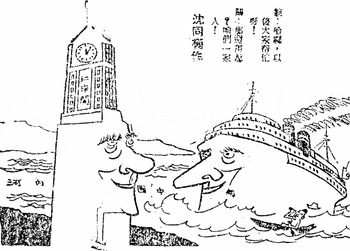
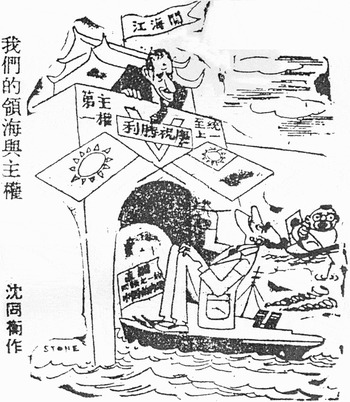
Without the financial autonomy that his predecessors had possessed, Little spent much of his tenure attempting to stretch an ever-dwindling budget. Inflation accentuated divisions between Chinese and foreign staff, with the latter's apparent integrity subsidised by the sterling allowance. ‘Our treatment is 100 times worse than that of our foreign colleagues,’ complained Chinese employees in 1948; expatriates noted ‘deplorable deterioration in discipline, efficiency and honesty among the Chinese staff.’Footnote 96 This helped to undermine Little's efforts to show that the Customs had moved on from its treaty-port past. In June 1946, the Shanghai newspaper, Wenhuibao, carried a series of articles denouncing ‘foreign domination’ and ‘blatant control by foreigners’ in the Customs (see Figures 1, 2). and noted: ‘Eight years of war against the Japanese, but not so easy to be one of the ‘Big Four’.Footnote 97
Ship: ‘Hello! In time to come, we're going to have to help one another!’ Customs: ‘Doesn't that go without saying? We're family!’ (Source: Wenhuibao, June 8th 1946). Both the Customs and foreign trade (in the form of the ship) are represented as stereotypical foreigners, big-nosed and with bushy eye-brows. The message is that foreigners can naturally be expected to collude against China, that the Customs will be less than diligent in policing foreign trade. The immediate context for this was the appointment by Inspector General Little of a British national to the post of Commissioner at Shanghai in June 1946. This newspaper led the way in decrying what it perceived as continued imperialist impulses in the Customs, and complicity between the Service's leadership and foreign business during a period of growing financial inequality. Note the setting in ‘China's internal waterways’ and the Chinese craft about to capsize.

‘Our Territorial Waters and Sovereignty’ (Source: Wenhuibao, June 11th 1946). The gate is under the flag of the Jiangsu Provincial Customs (i.e.: Shanghai Customs). The caption over the ‘V for Victory’ sign reads, ‘Celebrate Victory’. Two signs flanking it read, ‘Unity is supreme; sovereignty utmost’. This is indicative of the cynical atmosphere pervasive in Shanghai by mid-1946. The hopes of the nation after victory, reflected in the flags and bunting, are cheapened by the sight of foreigners once again exploiting China. The foreign vessel appears to be passing through the gates of the Customs without inspection; the hirsute Westerner on board grins and salutes the Customs with his pipe.

Inevitably, the political and military crisis caught up with the Customs, though it was not until October 1948 that Inspector General Little conceded that the organisation's days seemed numbered.Footnote 98 In February 1949, the Inspectorate moved to Guangdong, and from there to Taipei.Footnote 99 An embarrassment for the remnants of Little's vision for a new sort of Customs Service came with the denouement of the civil war. In Taiwan, the Inspector General succeeded after months of negotiations to obtain pensions for the remaining foreign contingent, with the condition that all departing employees sign a waiver stating that they would not serve the People's Republic of China.Footnote 100 Given that the prevailing sentiment of Little's tenure had been to identify the Customs with the Kuomintang—indeed, Little's correspondence seems remarkably absent of reflections on the possibility of a Communist victory—this seemed a straightforward enough request. But several British employees at first refused to sign, and wrote instead to the Beijing government to sound out opportunities on the mainland.Footnote 101 One of them actually landed a job, for a while.Footnote 102 Little's shock (‘it leaves a bad taste in my mouth’), compared with the actions of those employees, provides the strongest evidence of the different understandings of the position of China's foreign Customs servants that had existed in 1945 and had persisted, beneath the surface, until 1949.Footnote 103 On the one hand, a vision of a Customs Service integrated within the Kuomintang state; on the other, the mantra of ‘the Customs first,’ that saw the collapse of the Kuomintang as incidental to a career in China.
Conclusion
As the Chinese Maritime Customs Service was wound up in 1949, these final years of the organisation represent a road not taken. Any historian of such a road must sooner or later face the question: what is the point? Inspector General Little's reforms and the Staff Investigation Committee made no difference to the political landscape (or even to Customs’ administrations) of either Chinese government after 1949, bar lurking institutional memory and the personal penalties that seem to have been paid by Chinese staff who stayed on the mainland.Footnote 104 History does not necessarily need to be justified by reference to a contemporary inheritance, but usually the historian can rely on the events he is describing having made at least some impression on events in later years. In 1949, China—or at least its political institutions—went in an entirely different direction to that which it had taken before. Chronicling events that took place immediately before that shift can seem like mere anecdotage.
However, there are three reasons why the history of the Customs in this period, and in particular the Staff Investigation Committee, deserve our attention.
In the first part, one cannot hope to understand the history of the Customs as a whole without appreciating what it became in its final years. Whether one sees the earlier history of the Customs as one of imperialist exploitation or high-minded public service on behalf of China's people, the post-1945 Customs was very different. Tariffs were set by the government, not in negotiation with foreign powers. Inspector General Little no longer funnelled tax receipts to China's foreign creditors before turning the remainder over to the government, and no longer ran his own budget; instead, income was banked with the Treasury, and running costs drawn from the public purse. This American Inspector General, moreover, tied his organisation more closely than ever to the Republican Chinese state; the Customs shed much of its rhetoric of independence and higher purpose. It was, then, in many ways a weaker institution than before, looking very much like other revenue-collecting government departments in states across the world. But it remained a large and important service, perhaps still the most reliable source of income for the Republic, and with a large number of foreign ‘old-timers’ who intended to see their careers out in China. After 1945, the Customs underwent a new stage of reform, predicated on the assumption that the organisation would last and prosper. For all the teething problems Little experienced, prosper is probably what it would have done, had the Kuomintang not lost the civil war.
Secondly, the changes initiated by the Customs in these years offer an important perspective on the Kuomintang's dealings with foreign powers and, more precisely, the legacy of imperialism. A casual conversation on mainland China will today often elicit the comment that, despite later mistakes made by that government, Mao Zedong and the Communist Party liberated China. Today, the importance of class struggle and land reform as constituent parts of that remembered liberation has fallen away as China has adopted the path of rapid commercialisation and urban-led economic growth. The apparent liberation from foreign exploitation, however, remains an important part of Mao's legacy, particularly in the current climate of extreme nationalism among many of China's youth. Conversely, the role of Chiang Kai-shek and the Kuomintang in ending the exigencies of the foreign presence in China is often overlooked. After Japan's defeat, Chiang toured Shanghai and the other eastern seaboard cities having already negotiated, in 1943, an end to extraterritoriality in China. From 1945, the concession era was truly over (squabbles over Shanghai's erstwhile French Concession aside). Now added to this achievement is the reform of an institution that has often been demonised as among the worst of the agents of imperialism: the Customs. The Kuomintang had already imposed one reform programme in the late 1920s. As mentioned above the most objectionable elements of the Service's role in China that remained were then eliminated in the 1940s—under Inspector General Little, and under Kuomintang pressure. Admittedly, the continued presence of high-ranking foreigners at the top of the Customs’ hierarchy remained a source of deep dissatisfaction for many Chinese throughout this period. Also, a programme of slow reform and amicable relations with the West could not have been more different from the path of isolationism undertaken by Mao after 1949. But the history of the final years of the Customs provides more evidence for a conclusion with a very contemporary resonance: that Chiang Kai-shek, not Mao Zedong, should be seen as the true liberator of China from foreign exploitation.
Finally, the history of the Staff Investigation Committee furthers our understanding both of life in occupied China during the Sino-Japanese War 1937–1945, and the expectations afterwards of foreigners who remained in, or returned to, the country. It tallies with research elsewhere which has proposed that, for many or most who lived through the war, cooperation with the occupier was the norm.Footnote 105 Moreover, it shows how foreign Customs’ employees justified their behaviour, not merely in terms of self-protection and necessity, but as consistent with their understanding of the Customs’ position in China. Ultimately, the Second World War extinguished their immunity from Chinese politics at the very moment that, by cooperating with Japan, they had most fervently asserted it. Their ideals may have suited the ‘old’ China, but they did not understand this new one. For the social or political historian, further research may uncover a similar disconnection operating among other foreign communities of China in this period.Footnote 106
Glossary of Chinese terms*

*Contemporaneous English usage, and simplified
Chinese, in brackets where appropriate.