Introduction
Cannabis is the most widely consumed illicit drug in the world (UNODC, 2008) and its prolonged use is associated with various adverse effects including anxiety, paranoia, depression, tiredness, lack of motivation and low energy (Reilly et al. Reference Reilly, Didcott, Swift and Hall1998). Recurrent cannabis use is reported to have negative psychosocial consequences, including poor work and school performance (Lynskey & Hall, Reference Lynskey and Hall2000; Hall, Reference Hall2009), and physical impairments such as decreased infection resistance, respiratory system problems and adverse reproductive effects (Hall & Solowij, Reference Hall and Solowij1998; Tashkin et al. Reference Tashkin, Baldwin, Sarafian, Dubinett and Roth2002; Hall, Reference Hall2009). Cannabis use is addictive and cessation attempts often result in withdrawal symptoms, such as anger, aggression, anxiety, decreased appetite, irritability, restlessness and sleep difficulty (Budney et al. Reference Budney, Vandrey, Hughes, Thostenson and Bursac2008; Preuss et al. Reference Preuss, Watzke, Zimmermann, Wong and Schmidt2010). In turn, these withdrawal symptoms make successful long-term cessation difficult (Coffey et al. Reference Coffey, Carlin, Degenhardt, Lynskey, Danci and Patton2002; Budney & Hughes, Reference Budney and Hughes2006; Budney et al. Reference Budney, Vandrey, Hughes, Thostenson and Bursac2008). Although the cannabis withdrawal syndrome is not recognized in DSM-IV (APA, 2000), recent research has found consistent evidence for the existence of a reliable and valid withdrawal syndrome (Budney et al. Reference Budney, Hughes, Moore and Vandrey2004; Crowley, Reference Crowley2006; Agrawal et al. Reference Agrawal, Pergadia and Lynskey2008; Hasin et al. Reference Hasin, Keyes, Alderson, Wang, Aharonovich and Grant2008; Vandrey et al. Reference Vandrey, Budney, Hughes and Liguori2008; Preuss et al. Reference Preuss, Watzke, Zimmermann, Wong and Schmidt2010). For instance, Hasin et al. (Reference Hasin, Keyes, Alderson, Wang, Aharonovich and Grant2008) found that 57.7% of frequent cannabis users in a US population cohort reported one or more symptoms of cannabis withdrawal. The most prevalent symptoms were feeling weak/tired, hypersomnia, yawning, psychomotor retardation, anxiety and depressed mood.
Numerous factor- and item-response analyses also indicate a high factor loading for cannabis withdrawal on the underlying liability to cannabis use disorder (CUD) (Lachenbucher et al. Reference Lachenbucher, Labouvie, Martin, Sanjuan, Bavly, Kirisci and Chung2004; Lynskey & Agrawal, Reference Lynskey and Agrawal2007; Compton et al. 2008; Gillespie et al. Reference Gillespie, Kendler and Neale2011); as such, it is now well recognized that cannabis withdrawal is, phenotypically, an integral aspect of CUD (abuse/dependence). These factor analytic findings, together with clinical observations, resulted in the recommended inclusion of the cannabis withdrawal syndrome in the fifth edition of the Diagnostic and Statistical Manual of Mental Disorders (DSM-5, see www.dsm5.org). Accordingly, the proposed DSM-5 definition of cannabis withdrawal includes (A) cessation of prolonged (or less frequent but chronic) pattern of use; (B) emergence of three (or more) of seven withdrawal symptoms within a week of cessation; (C) impairment or distress attributable to criterion B; and (D) the symptoms are not attributable to other medical or psychiatric conditions (www.dsm5.org/ProposedRevision/Pages/proposedrevision.aspx?rid=430).
Despite growing agreement that cannabis withdrawal contributes to the liability to CUD, little is known of its etiology, particularly from a genetic perspective. With regard to cannabis abuse and dependence, several lines of research suggest a genetic influence. A meta-analysis of twin studies by Verweij et al. (Reference Verweij, Zietsch, Lynskey, Medland, Neale, Martin, Boomsma and Vink2010) estimated a heritability (h2) of 51% in males and 59% in females for problematic cannabis use. Recently, Gillespie et al. (Reference Gillespie, Kendler and Neale2011) found that a general latent factor representing CUD, including withdrawal criteria, was also substantially heritable (h2 = 54% for males and 53% for females). However, only a few studies have specifically examined the heritability of cannabis withdrawal symptomatology. Agrawal et al. (Reference Agrawal, Pergadia and Lynskey2008) demonstrated a strong association between cannabis withdrawal symptoms and parental drug and alcohol problems, after controlling for the intensity of cannabis use in the past 12 months. This finding suggests that cannabis withdrawal symptoms are partly influenced by familial (possibly including genetic) factors not overlapping with heritability of use and heavy use of cannabis. Using a family-based sample, Ehlers et al. (Reference Ehlers, Gizer, Vieten, Gilder, Stouffer, Lau and Wilhelmsen2010) found a heritability of 26% for experiencing cannabis withdrawal symptoms; however, their sample was ascertained for alcoholism, making the results less generalizable. They took a genomic variance components approach to compute heritability, which can be less robust than the classical twin design, and their measure of cannabis withdrawal did not include all DSM-5 symptoms.
In addition to examining genetic variation in cannabis withdrawal, it is also of interest to investigate the extent to which this genetic variation is shared with that of cannabis abuse/dependence. A high overlap in the genetic variation in both variables would indicate common underlying biological mechanisms and would provide further support for the inclusion of withdrawal as a criterion for cannabis abuse/dependence in DSM-5.
With regard to cigarette smoking, Pergadia et al. (Reference Pergadia, Heath, Martin and Madden2006) found that approximately 45% of the variance in nicotine withdrawal was due to genetic influences, with genetic effects specific to smoking withdrawal and also shared with smoking progression and quantity smoked. No twin study to date has specifically examined whether genetic factors underlying cannabis withdrawal are specific to or shared with the genetic factors influencing cannabis abuse and dependence.
Using data from a large, community-based Australian twin sample, the present study aimed to (1) estimate the prevalence of the upcoming DSM-5 cannabis withdrawal (criterion B) in lifetime cannabis users; (2) estimate the magnitude of genetic and environmental sources of variance in cannabis withdrawal; and (3) determine the extent to which the genetic and environmental variation in cannabis withdrawal overlaps with that of DSM-IV-defined abuse/dependence.
Method
Participants
The Australian Twin Registry (ATR) includes a total of 4131 twin pairs born between 1972 and 1979. The ATR approached 7850 twin individuals, of whom 3876 (49%) consented to participate, 1971 declined and the remainder gave passive refusals. Attempts to recruit these individuals to participate in the present study were made using a two-tiered process, as required by the ATR's ethics committee. First, the ATR contacted twins (by mail and subsequently by telephone) and asked if they were willing to have their names and contact details forwarded to the Queensland Institute of Medical Research (QIMR) for potential participation in an interview-based study of substance use and mental health. Second, contact details of those consenting were forwarded to the QIMR, who recontacted potential subjects to explain the purposes of the study and enrol them in the study. Further details regarding the recruitment procedure and study characteristics can be found in Lynskey et al. (Reference Lynskey, Agrawal, Henders, Nelson, Madden and Martin2012).
Twins were interviewed between 2006 and 2009; a total of 3326 twin individuals completed the full interview. Of these, 2276 (69% of 3302; 24 missing) reported lifetime (ever) cannabis use. The final breakdown of the sample, including gender and zygosity, is presented in Table 1. The mean age of the final sample was 31.9 (s.d. = 2.5) years, range 27–37 years.
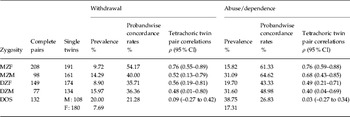
Prevalence, twin pair probandwise concordance rates and tetrachoric twin pair correlations for cannabis withdrawal and abuse/dependence in 2276 cannabis users

MZF, Monozygotic females; MZM, monozygotic males; DZF, dizygotic females; DZM, dizygotic males; DOS, dizygotic opposite sex; CI, confidence interval.
Measures
The computer-assisted telephone interview was based on a modified Australian version of the Semi-Structured Assessment for the Genetics of Alcoholism (SSAGA-OZ; Bucholz et al. Reference Bucholz, Cloninger, Dinwiddie, Hesselbrock, Nurnberger, Reich, Schmidt and Schuckit1994; Heath et al. Reference Heath, Bucholz, Madden, Dinwiddie, Slutske, Bierut, Statham, Dunne, Whitfield and Martin1997). The revised version of the SSAGA obtained more diagnostic information on cannabis and other illicit drug abuse and dependence, and questions assessing CUD were supplemented with detailed questions, based on those described by Budney et al. (Reference Budney, Hughes, Moore and Vandrey2004), to assess potential symptoms of withdrawal.
Cannabis withdrawal
The cannabis withdrawal items used in this study are in accordance with the proposed symptoms included in criterion B of the upcoming DSM-5 cannabis withdrawal syndrome (see www.dsm5.org/ProposedRevision/Pages/SubstanceUseandAddictiveDisorders.aspx). All symptoms are shown in Table 2. Questions assessing withdrawal were asked of those who reported a lifetime history of using cannabis 11 or more times and monthly use (when using the most) and had attempted cessation. For each item, participants were asked to indicate on a four-point scale, ranging from ‘not at all’, ‘mildly’, ‘moderately’ to ‘severely’, how much they experienced that specific symptom after cutting down or going without using marijuana. An item was scored positive if it was experienced at least mildly. In accordance with the DSM-5 guideline, to meet criterion B of cannabis withdrawal participants were required to endorse three symptoms or more. All other lifetime users, including those who had used cannabis less than 11 times, did not use monthly, did not attempt to quit or endorsed one or two symptoms, were coded negatively.
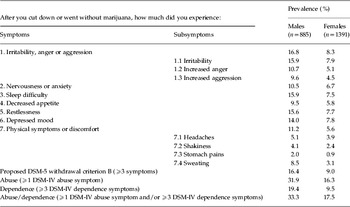
Prevalence of proposed DSM-5 withdrawal symptoms, and abuse/dependence in 2276 lifetime cannabis users
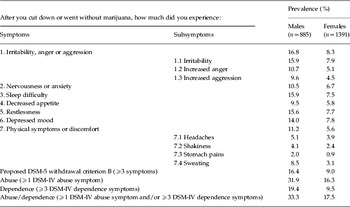
Symptoms 1 and 7 are subdivided into multiple subsymptoms, in which one of these subsymptoms was sufficient to be diagnosed as having that particular criterion.
Cannabis abuse/dependence
We used the DSM-IV abuse and dependence symptoms to obtain a measure of cannabis abuse/dependence. Questions to assess abuse/dependence were also only asked of those using cannabis 11 or more times and at least monthly during the heaviest period of use. For cannabis abuse the criteria were: (1) recurrent use resulting in a failure to fulfill major obligations at work, school or home, (2) recurrent use in situations that are physically hazardous, (3) continued use despite significant social or interpersonal problems caused by the substance use, and (4) continued use despite legal problems. The criteria for cannabis dependence were: (1) an increase in use to achieve an effect (tolerance), (2) using more frequently or for longer periods than intended, (3) persistent desire or unsuccessful efforts to cut down or control substance use, (4) a great deal of time is spent in activities necessary to obtain the substance, use the substance, or recover from its effects, (5) important social, occupational or recreational activities are given up or reduced because of substance use, and (6) the substance use is continued despite knowledge of having a persistent physical or psychological problem that is likely to have been caused or exacerbated by the substance. Each item could be answered with yes or no, and participants were considered to have cannabis abuse/dependence if they endorsed at least one of four DSM-IV abuse criteria or at least three of six DSM-IV dependence criteria (not including withdrawal, and regardless of whether the criteria clustered in a 12-month period or not; APA, 2000).
Statistical analyses
Prevalences, sex differences and probandwise concordance rates of cannabis withdrawal and DSM-IV abuse/dependence were calculated in SAS version 9.1 (SAS Institute Inc., USA). Tetrachoric twin pair correlations and corresponding confidence intervals (CIs) were estimated using the statistical software package Mx with a maximum likelihood estimation procedure (Neale et al. 1999).
Next, we used the classical twin model to partition the total variance in cannabis withdrawal into additive genetic (A), common (or shared) environmental (C) and residual/non-shared environmental (E) variance. ‘A’ denotes the variance resulting from the sum of allelic effects across all segregating genes. ‘C’ refers to environmental influences shared by family members and may include shared home environment, parental style and uterine environment. ‘E’ includes environmental factors not shared by twin pairs (e.g. idiosyncratic experiences), stochastic biological effects and also measurement error. These variance components can be estimated using twin data because identical (monozygotic, MZ) twins share all their genes whereas non-identical (dizygotic, DZ) twins share on average half their segregating genes. A, C and E influences predict different patterns of MZ and DZ twin pair correlations, and structural equation modeling is used to determine the combination of influences that best matches the observed data.
Note that non-additive genetic variance (D; including dominant genetic effects and epistasis) can be modeled in place of C, but based on the pattern of twin pair correlations (the DZ twin pair correlations for cannabis withdrawal were greater than half the MZ twin pair correlations), we modeled A, C and E.
Using the cross-twin cross-trait correlations, we also partitioned the covariance between cannabis withdrawal and abuse/dependence into its additive genetic, shared environmental and non-shared environmental sources in the same way as we did for the variance in cannabis withdrawal. We calculated the genetic correlation, a measure of the overlap in the genetic variation underlying cannabis withdrawal and abuse/dependence. Furthermore, we partitioned genetic and environmental influences on cannabis withdrawal into those that were shared with abuse/dependence and those that were unique for cannabis withdrawal.
Structural equation modeling of twin data was performed in the flexible matrix algebra program Mx (Neale et al. Reference Neale, Boker, Xie and Maes2006), which uses maximum likelihood modeling procedures to determine the combination of A, C and E that best explains the observed data. We fitted univariate and bivariate models (for more information about this model, see Rijswijk & Sham, Reference Rijsdijk and Sham2002) to the raw dichotomous data, where it is assumed that a normally distributed continuum of liability underlies the dichotomous observed categories. Age and sex effects were accounted for in the model by including them as covariates to adjust the thresholds.
The goodness of fit of a model to the observed data is summarized by a statistic distributed as χ2. By testing the change in model fit (Δχ2) against the change in degrees of freedom (Δdf), we can test whether constraining parameters to zero or constraining them to be equal significantly worsens the model fit. In this way we can test hypotheses regarding those parameters. Further details of the classical twin design can be found elsewhere (Neale & Cardon, Reference Neale and Cardon1992; Posthuma et al. Reference Posthuma, Beem, de Geus, van Baal, von Hjelmborg, Lachine and Boomsma2003).
For ease of interpretation, the models were transformed from Cholesky forms into ‘correlated factors’ models as suggested by Loehlin (Reference Loehlin1996).
Results
Prevalence of lifetime cannabis use, withdrawal and abuse/dependence
Of the entire sample, 68.9% (n = 2276) reported lifetime cannabis use, with a significantly higher prevalence for males (76.5%) than females (64.9%) [odds ratio (OR) 1.76, 95% CI 1.50–2.07]. This prevalence is comparable to the prevalence obtained from a large household survey in Australia, which showed that 55% of Australians aged between 20 and 39 years have used cannabis during their lives. The slightly higher estimate obtained in our sample may be the result of the somewhat younger age group.
Of all lifetime users, 21.9% reporting a lifetime history of using cannabis at least 100 times, 14.2% reported using cannabis every day when using it the most, and 20% reported cannabis use in the past 12 months prior to the interview. Male and female prevalences of cannabis withdrawal, the individual withdrawal symptoms and DSM-IV abuse/dependence are presented in Table 2. Of all lifetime cannabis users, 23.6% (n = 538) reported cannabis abuse or dependence, and 11.9% (n = 270) met the criteria for cannabis withdrawal. Evidently, cannabis withdrawal was more common in those who endorsed more abuse/dependence symptoms. Of all individuals reporting cannabis abuse/dependence, 48.0% also experienced cannabis withdrawal, whereas 95.6% of participants with cannabis withdrawal also reported abuse/dependence. Of those reporting cannabis withdrawal (criterion B), 42.6% reported social impairment attributable to it and 38.2% reported using cannabis or a related medication or drug for withdrawal relief.
Of all lifetime users, significantly more males (16.4%) than females (9.0%) reported cannabis withdrawal (OR 1.99, 95% CI 1.54–2.56) and met DSM-IV criteria for cannabis abuse/dependence (males 33.3%, females 17.5%; OR 2.36, 95% CI 1.94–2.88).
Genetic analyses
Preliminary analyses
For each zygosity group, Table 1 summarizes the prevalence, probandwise concordance rates and tetrachoric twin pair correlations for withdrawal and abuse/dependence in lifetime cannabis users. Before modeling the variance components, we tested the effects of age, sex and zygosity on the prevalences (thresholds) of cannabis withdrawal and abuse/dependence (α = 0.05). We found a significant age effect on the prevalence of withdrawal (Δχ21 = 11.26, p < 0001), indicating that younger participants were more likely to report cannabis withdrawal than older participants. No such age effect was found for abuse/dependence (Δχ21 = 2.36, p = 0.12).
Furthermore, as mentioned earlier, we found a significant sex effect on the prevalence of cannabis withdrawal (Δχ21 = 29.39, p < 0.001), and also abuse/dependence (Δχ21 = 67.62, p < 0.001), such that males exhibited more withdrawal and abuse/dependence symptoms than females. The effects of sex and age were accounted for in subsequent modeling.
For both sexes, MZ and DZ twins did not differ significantly with respect to the prevalence of withdrawal or cannabis abuse/dependence. We also found no sex differences between male and female MZ or male and female same-sex DZ twin pair correlations for both variables, suggesting genetic and environmental effects of similar magnitude in males and females. However, the twin pair correlation for DZ opposite-sex (DOS) twin pairs for abuse/dependence was significantly lower than that for the same-sex DZ pairs (Δχ21 = 4.94, p = 0.03), suggesting that there may be qualitative sex differences in sources of familial aggregation in abuse/dependence. In a univariate twin model, however, we were unable to detect significant sex differences in the source of genetic or shared environmental influences, so we do not deal with this further.
Table 1 shows that, for both sexes, the probandwise concordance rate and tetrachoric twin pair correlations for withdrawal and cannabis abuse/dependence were higher in MZ versus DZ twins, suggesting a role for genetic influences on both phenotypes. However, the twin pair correlations were only significantly higher for MZ females than DZ same-sex females for abuse/dependence (Δχ21 = 4.13, p = 0.04), and for withdrawal for females and, for both variables, for males, the differences in twin pair correlations did not reach significance (all p > 0.10).
Genetic and environmental influences on cannabis withdrawal
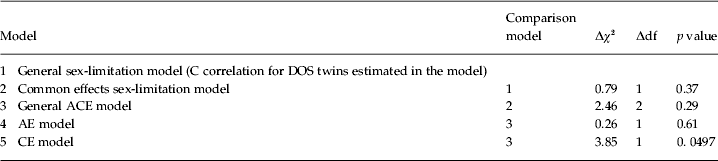
The results of the univariate ACE models for cannabis withdrawal are presented in Table 3. Given that the DOS twin pair correlation is lower (although not significantly) than the DZ same-sex correlations, we first fitted a general sex-limitation model, which allows for qualitative and quantitative differences in the sources of variation in cannabis withdrawal between sexes (see Neale & Cardon, Reference Neale and Cardon1992). To model qualitative differences in genetic influences between males and females, the genetic correlation for DOS twins was freely estimated in the model instead of being fixed at 0.5 as it is for same-sex DZ twin pairs. In the same way, to model qualitative differences in shared environmental influences between sexes, the C correlation for DOS twins was freely estimated in the model instead of being fixed at 1.0. Under this latter model, which fitted slightly better than the genetic sex-limited model [difference in Akaike's Information Criterion (AIC) = 0.30], the A, C and E estimates respectively were 9, 44 and 47% for males and 38, 36 and 26% for females. However, fixing the genetic or shared environmental correlation at 0.5 or 1 respectively (common effects sex-limitation model) did not lead to a significant deterioration of model fit, indicating no evidence for qualitative sex differences. Subsequently, we equated the A, C and E estimates between the sexes (general ACE model), and the results show no significant deterioration of model fit, indicating there were no significant magnitude differences in effects of A, C and E on variance in cannabis withdrawal between males and females. Based on the general ACE model, estimates of the influence of A, C and E on cannabis withdrawal are 55% (95% CI 0.1–81), 12% (95% CI 0–57) and 33% (95% CI 19–51) respectively, where the A influences were just significant (p < 0.05) but the C influences were not significantly different from zero (p = 0.61).
Goodness-of-fit statistics for univariate models of cannabis withdrawal
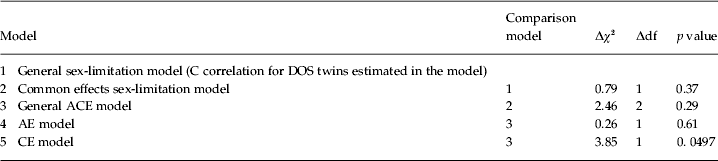
DOS, Dizygotic opposite sex; A, additive genetic influences; C, shared environmental influences; E, non-shared environmental influences; df, degrees of freedom.
Phenotypic and genetic correlation between cannabis withdrawal and abuse/dependence
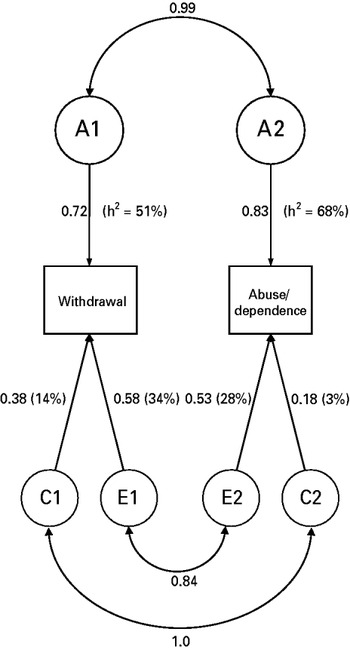
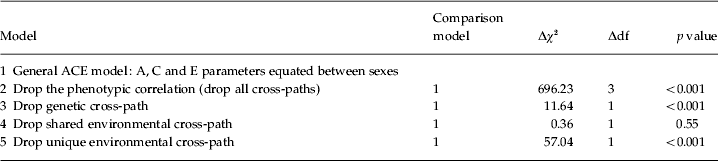
We tested a series of bivariate models to partition the covariation between cannabis abuse/dependence and cannabis withdrawal into that due to A, C and E. Table 4 summarizes the model-fitting steps. Based on the results from the univariate models where we did not find evidence for sex limitation, we fitted a general ACE model (model 1) with the A, C and E parameters equated between sexes. In this model, the phenotypic correlation between withdrawal and abuse/dependence was estimated to be very high (r = 0.92, p < 0.001). Accordingly, the genetic correlation between the traits was also very high and significant (r = 0.99, p < 0.001), and so was the unshared environmental correlation (r = 0.84, p < 0.001). The shared environmental correlation was not significant (r = 1.0, p = 0.55), because of the weak influence of the shared environment on both traits. Figure 1 shows the parameter estimates in the bivariate model (transformed into a correlated factors model; Loehlin, Reference Loehlin1996), including the proportions of variance in withdrawal and abuse/dependence accounted for by genetic effects (heritability; h 2) and shared and unshared environmental influences, along with the genetic, shared environmental and unshared environmental correlations between the two traits.
Correlated factor model. Graphical presentation of the parameter estimates and proportions of variance in cannabis withdrawal and abuse/dependence accounted for by additive genetic (A), common (or shared) environmental (C) and residual/non-shared environmental (E) influences. The double-headed arrows represent the genetic, shared and unshared environmental correlations.

Goodness-of-fit statistics for bivariate models of cannabis withdrawal and abuse/dependence
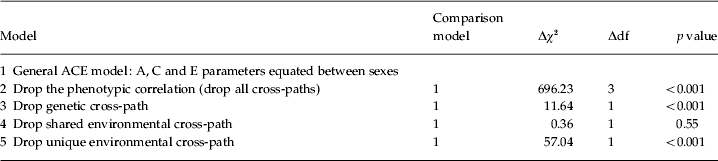
A, Additive genetic influences; C, shared environmental influences; E, non-shared environmental influences; df, degrees of freedom.
The results of the model show that individual differences in both cannabis withdrawal and abuse/dependence are substantially attributable to additive genetic factors (51% for withdrawal and 68% for abuse/dependence), and the remaining variance was mainly due to unshared environmental factors. The variance in both variables overlaps considerably because of very high genetic and environmental correlations between both variables. Of the total phenotypic variance between withdrawal and abuse/dependence, 64% is due to overlapping genetic, 8% to shared environmental and 28% to unshared environmental influences.
Discussion
To our knowledge, this study is the first to use a genetically informative sample to look at the proposed inclusion of cannabis withdrawal in the upcoming DSM-5. We have demonstrated that the proposed DSM-5 withdrawal criterion B is commonly experienced by lifetime cannabis users, and that withdrawal is moderately heritable. Furthermore, we have found a very high correlation between cannabis withdrawal and abuse/dependence due to near-complete sharing of genetic influences and, to a lesser extent, unshared environmental influences on the two traits. This finding underscores the general cohesiveness of cannabis withdrawal with existing DSM-IV and upcoming DSM-5 definitions of CUD and shows that a general genetic vulnerability to CUD criteria, including withdrawal, may exist. By providing evidence for the shared genetic background with CUD according to DSM-IV, our findings add to the wealth of psychometric literature that recommends the addition of cannabis withdrawal to the definition of DSM-5 CUD.
There has been an ongoing debate as to whether the cannabis withdrawal syndrome exists, which is one of the reasons that cannabis withdrawal was not part of the diagnostic criteria for cannabis dependence in DSM-IV. We show that, of all lifetime cannabis users studied, 11.9% experienced three or more symptoms of cannabis withdrawal, and therefore met criterion B of DSM-5 cannabis withdrawal. Irritability, sleep difficulty, restlessness, depressed mood and nervousness were the most common withdrawal symptoms (see Table 2), consistent with findings from previous studies investigating cannabis withdrawal (Budney & Hughes, Reference Budney and Hughes2006; Vandrey et al. Reference Vandrey, Budney, Hughes and Liguori2008; Ehlers et al. Reference Ehlers, Gizer, Vieten, Gilder, Stouffer, Lau and Wilhelmsen2010; Preuss et al. Reference Preuss, Watzke, Zimmermann, Wong and Schmidt2010; Gillespie et al. Reference Gillespie, Kendler and Neale2011). Males were more likely to have exhibited cannabis withdrawal and abuse/dependence than females. Our study and previous research findings (e.g. Budney et al. Reference Budney, Hughes, Moore and Vandrey2004; Agrawal et al. Reference Agrawal, Pergadia and Lynskey2008; Hasin et al. Reference Hasin, Keyes, Alderson, Wang, Aharonovich and Grant2008) support the existence of cannabis withdrawal (symptoms) in cannabis users, providing support for its addition to DSM-5.
Our findings demonstrate that additive genetic factors explained approximately half the variance in DSM-5 cannabis withdrawal and the remaining variance was mainly due to unshared environmental factors. The shared environmental influences on cannabis withdrawal were not significant, partly because of a lack of power. The estimate for genetic variance was slightly higher for abuse/dependence whereas the estimate for environmental influences was somewhat lower. Our estimates are in accordance with the results from a meta-analysis of twin studies by Verweij et al. (Reference Verweij, Zietsch, Lynskey, Medland, Neale, Martin, Boomsma and Vink2010), which showed that A, C and E estimates of problematic cannabis use are respectively 51, 20 and 29% for males and 59, 15 and 26% for females. Large variation across studies in A, C and E estimates of cannabis abuse and dependence exists (Verweij et al. Reference Verweij, Zietsch, Lynskey, Medland, Neale, Martin, Boomsma and Vink2010) because of the different (aged) populations from which research samples are gathered and the different measures used. A low or absent shared environmental influence, as estimated in the present study, has also been found in several previous studies (Kendler & Prescott, Reference Kendler and Prescott1998; van der Bree et al. Reference van den Bree, Johnson, Neale and Pickens1998; Kendler et al. Reference Kendler, Aggen, Tambs and Reichborn-Kjennerud2006; Agrawal et al. Reference Agrawal, Lynskey, Bucholz, Martin, Madden and Heath2007). Furthermore, multistage modeling has reported that the influence of shared environmental influences on the symptoms of cannabis abuse was indirect and mediated entirely by cannabis initiation (Gillespie et al. Reference Gillespie, Neale and Kendler2009).
We found a very high correlation (r = 0.92) between cannabis withdrawal and DSM-IV abuse/dependence; approximately 96% of participants who met criteria for cannabis withdrawal also exhibited DSM-IV abuse/dependence. This is in line with extensive research findings supporting a single CUD latent factor that includes symptoms of withdrawal, indicating withdrawal to be part of the CUD construct (Lachenbucher et al. Reference Lachenbucher, Labouvie, Martin, Sanjuan, Bavly, Kirisci and Chung2004; Lynskey & Agrawal, Reference Lynskey and Agrawal2007; Compton et al. 2008; Gillespie et al. Reference Gillespie, Kendler and Neale2011). Our finding that a substantial majority of those endorsing cannabis withdrawal already met criteria for cannabis abuse/dependence supports the observation that withdrawal is common among individuals with a CUD. Therefore, it is unlikely that its addition to the repertoire of diagnostic criteria will substantially elevate rates of CUD diagnoses.
The near-complete overlap between the genetic variation in withdrawal and that in abuse/dependence supports a common biological basis for the various CUD criteria. This finding should also be reassuring for those genetically informed studies that do not assess cannabis withdrawal. Our analyses indicate that an overwhelming majority of the genetic influences on cannabis withdrawal are shared with those influencing current DSM-IV assessments of cannabis abuse/dependence.
There are a few important methodological limitations to be considered for this study. First, there are some shortcomings in relation to the data used for this study. We were unable to estimate the heritability of the proposed DSM-5 definition of CUD. This was because the twin study had completed data collection before the DSM-5 proposal was announced and, consequently, we did not collect data on the craving criterion. Furthermore, withdrawal was measured using the proposed symptoms for cannabis withdrawal criterion B of DSM-5 but, because of the sample size, heavy or prolonged use (criterion A) and impairment (criterion C) were not used. For cannabis abuse/dependence, we did not require that the criteria cluster within the same 12-month period; however, only 19 individuals did not satisfy the clustering requirement. This potentially makes our findings less applicable for clinicians; for example, prevalence rates of the full diagnosis of withdrawal may be lower in other populations. However, this would not have biased the variance component estimates in any particular direction. Additionally, our measurements of cannabis withdrawal, abuse and dependence symptoms were limited by the potential for bias and inaccuracy in retrospective self-reports. Finally, the sample was predominantly Caucasian with age range 27–37 years, which may limit the generalizability of the results.
Most importantly, our study has a lack of statistical power. Although the sample size is fairly large, both variables had to be analyzed as ordinal data, thus limiting the range of potential genetic analyses. Neale et al. (Reference Neale, Eaves and Kendler1994) showed that a threshold trait requires at least three times the sample size needed for the same power using an equivalent continuous trait. In addition, as this is a general population sample, rates of cannabis withdrawal and abuse/dependence were relatively low, further limiting our statistical power.
This lack of power may have precluded the detection of qualitative or quantitative sex differences in the variance components for withdrawal and abuse/dependence. Hence, although the very low DOS twin pair correlations for both variables point to possible differences in the sources of variance between sexes, the sample was not adequately powered to detect sex limitation in the source of genetic or shared environmental influences. By equating the same-sex DZ twins with the OS twins, we may have inflated the heritability estimates and underestimated the role of shared environment. Furthermore, for males but not for females, the same-sex twin pair correlations indicate a substantial influence of C factors on individual differences in withdrawal, but our sample size did not enable us to differentiate between male and female ACE parameters, resulting in a lower C and a larger A estimate for withdrawal than expected based on the same-sex twin pair correlations.
Despite these limitations, this study yielded several important findings supporting the proposed changes in DSM-5 to include withdrawal criteria in CUD criteria. We found that cannabis withdrawal symptoms exist and are reported by cannabis users. There is also a high correlation between cannabis withdrawal and abuse/dependence. Individual differences in withdrawal symptoms are partly due to genetic influences, which are the same as those influencing abuse/dependence.
Acknowledgments
This research was funded by a National Institute on Drug Abuse (NIDA) grant (DA18267 to M.T.L.) and facilitated through access to the ATR, a national resource supported by an Enabling Grant (ID 628911) from the National Health and Medical Research Council. Further support came from grants DA18660 (M.T.L.), DA23668 and K02DA32573 (A.A) and from the Netherlands Organization for Health Research and Development (ZonMW 31160212 to N.O.N. and H.E.C.). We thank Anjali Henders, Dixie Statham, Richard Parker, Soad Hancock, Judith Moir, Sally Rodda, Pieta-Maree Shertock, Heather Park, Jill Wood, Pam Barton, Fran Husband and Adele Somerville for data collection and data management.
Declaration of Interest
A.A. receives funding from ABMRF/The Foundation for Alcohol Research.