Introduction
Gastrointestinal nematodes cause health problems and economic losses. The parasite Haemonchus contortus is a nematode of small ruminants, with high prevalence and pathogenicity (Arosemena et al., Reference Arosemena, Bevilaqua, Melo and Girao1999). Its haematophagous behaviour causes severe clinical symptoms, such as anaemia, and it has become the most pathogenic parasite of its host animals (Urquhart et al., Reference Urquhart, Armour, Duncan, Dunn and Jennings1990). The increasing prevalence of helminths presenting multi-drug resistance has increased the need to better understand parasite resistance mechanisms and life cycles. Thus, in vitro and in vivo laboratory experiments have been conducted (Grando et al., Reference Grando, de Sá and Baldissera2015, Reference Grando, Baldissera and Gressler2016).
Many studies have been conducted using gerbils (Meriones unguiculatus), and this experimental model has demonstrated much promise regarding reversion of resistance (Molento & Prichard, Reference Molento and Prichard1999), anthelmintic evaluations (Kates & Thompson, Reference Kates and Thompson1967) and investigations of new anti-parasitic compounds (Ribeiro et al., Reference Ribeiro, Macedo, dos Santos, de Oliveira, Camurça-Vasconcelos, de Paula and Bevilaqua2013). Gerbils are susceptible to infections caused by several nematodes, including Strongyloides stercoralis (Nolan et al., Reference Nolan, Megyeri, Bhopale and Schad1993), Strongyloides venezuelensis, Nippostrongylus brasiliensis (Horii et al., Reference Horii, Khan and Nawa1993), Trichostrongylus colubriformis (Conder et al., Reference Conder, Johnson, Guimond, Cox and Lee1991; Ziam et al., Reference Ziam, Pandeya, Darwichea, Lossonb and Kumara1999), H. contortus (Conder et al., Reference Conder, Jen, Marbury, Johnson, Guimond, Thomas and Lee1990) and Ostertagia circumcincta (Teladorsagia circumcincta) (Court et al., Reference Court, Lees, Coop, Angus and Beesley1988).
Use of new experimental models and methodologies with high reliability and repeatability is important for comparing scientific results quickly and easily. Moreover, use of alternative protocols that cause less discomfort to animals has been recommended in order to improve animal welfare. Currently, some aspects of optimal protocols for infection of gerbils by H. contortus remain unclear, such as doubts regarding the use of sheathed or exsheathed larvae and the employment of corticosteroids to induce animal immunosuppression. This study therefore aimed to compare the infectivity of sheathed and exsheathed larvae of H. contortus in gerbils that were either immunocompetent or had undergone immunosuppression through various immunosuppression protocols.
Materials and methods
Isolation of Haemonchus contortus
A multi-drug resistant H. contortus isolate (Almeida et al., Reference Almeida, Garcia, Torgerson and Amarante2010) was used to infect a sheep. This animal was fed with hay and received water ad libitum. Initially, the sheep was treated with the anthelmintic monepantel (Zolvix®). Five days later, faecal examination was performed using the zinc sulphate centrifugation-flotation technique and no parasite was detected. Later, the animal was infected orally with 1.0 × 10⁴ third-stage larvae at three different times: first, a dose of 4.0 × 10³ larvae, and then another two doses of 3.0 × 10³ larvae, at three-day intervals. The larvae that were used to infect the gerbils were recovered by means of coproculture, in accordance with the method described by Roberts & O'Sullivan (Reference Roberts and O'Sullivan1950), as modified by Ueno & Gonçalves (Reference Ueno and Gonçalves1998). The larvae for infecting the animals were previously stored at room temperature for seven days.
In vivo experiment number 1
Twenty-eight male and female five-week-old outbred gerbils (M. unguiculatus), of average body weight 37 g, which were visually in a healthy and parasite-free condition, were obtained from the Animal Care Center of the Federal University of Santa Maria (UFSM), Brazil. The gerbils were kept in polypropylene boxes under controlled temperature and humidity (22°C ± 2°C; 40% relative humidity, RH) under a 12/12 h dark/light cycle and were fed with commercial feed and water ad libitum. After a week of adaptation, the animals were divided randomly according to body weight into seven groups (A to G) of four individuals each. They were infected orally on day 0, except for group G (uninfected), which received a placebo solution (0.9% NaCl). The gerbils were subjected to a 24-hour fasting period to enhance the chances of larval infection. The groups were composed as follows:
Immunosuppression protocols
Protocol 1. Immunosuppression applied to gerbils on days −2, −1, 0, 1 and 2 using 0.1 ml (0.2 mg) of dexamethasone (Azium®, Schering Plus; 2 mg/ml), intramuscularly (IM).
Protocol 2. Immunosuppression applied to gerbils on days −2, −1, 0, 2, 4, 6, 8 and 10 using 0.1 ml (0.2 mg) of dexamethasone (Azium®, Schering Plus; 2 mg/ml), IM.
Protocol 3. Immunosuppression applied to gerbils on days −2, −1, 0, 1 and 2 using 0.1 ml (4 mg) of methylprednisolone acetate (Depo-Medrol®, Pfizer; 40 mg/ml), IM.
Method for obtaining exsheathed larvae
Infective larvae were exsheathed in 0.9% sodium hypochlorite (NaClO), by adding 14 μl of NaClO per ml of water. When 90% of the larvae had become exsheathed, they were washed with distilled water, followed by centrifugation for 3 minutes at 2000 rpm. This procedure was repeated three times. Later, the larvae were placed on a mesh (25 μm) and those with high motility were selected.
Groups formed
Group A. Immunocompetent gerbils infected with 2 × 10³ sheathed larvae.
Group B. Immunosuppressed gerbils (protocol 1) infected with 2 × 10³ sheathed larvae.
Group C. Immunosuppressed gerbils (protocol 1) infected with 6 × 10³ sheathed larvae.
Group D. Immunosuppressed gerbils (protocol 2) infected with 2 × 10³ sheathed larvae.
Group E. Immunosuppressed gerbils (protocol 3) infected with 2 × 10³ sheathed larvae.
Group F. Immunosuppressed gerbils (protocol 1) infected with 2 × 10³ exsheathed larvae.
Group G. Immunocompetent gerbils that remained uninfected.
Parasite recovery and sampling
Ten days post infection (PI), the animals were anaesthetized with isoflurane and whole blood was collected for haematological and biochemical analyses. The stomach was removed, washed externally with 10 ml of warm distilled water (37°C), opened longitudinally in a Petri dish and incubated with 20 ml of 0.9% NaCl at 37°C in a chamber at 37°C for 5 h, following the method of Conder et al. (Reference Conder, Jen, Marbury, Johnson, Guimond, Thomas and Lee1990). After this period, the stomachs were washed with 0.9% NaCl and the larvae were placed in Falcon tubes with 50 ml of 4% buffered formaldehyde. The parasites were counted using an inverted optical microscope (40×).
Haematological analysis
Haematological parameters were assessed in whole blood that had been collected in tubes containing EDTA, using an automatic counter (Coulter T890®; Coulter Electronics, Inc., Hialeach, FL, USA). Total leukocytes (WBC), total erythrocytes (RBC), haematocrit (HCT), haemoglobin concentration (HGBC), mean corpuscular volume (MCV), mean corpuscular haemoglobin concentration (MCHC) and platelets (PLT) were determined. Blood smears were fixed in methanol and were stained with Instant-Prov (NewProv®) stain for differential WBC counts; in these, at least 200 WBCs were counted.
Biochemical analysis
Blood was collected, and the serum was separated by means of centrifugation (3000 rpm for 15 minutes) and stored at −20°C for biochemical analysis. Serum levels of albumin and total protein (TP) were analysed using Labtest kits (Labtest Diagnostica SA, Vista Alegre, MG, Brazil) through an automatic analyser (CELM SBA 200®; CELM, Barueri, SP, Brazil). Globulin values were obtained by subtracting the albumin from the total protein. All tests were carried out in duplicate.
In vivo experiment number 2
A second experiment was performed using two groups: group A, infected with 2 × 10³ sheathed larvae, and group B, infected with 2 × 10³ exsheathed larvae. Eight six-week-old male gerbils, of body weight 44.5 g, were divided into two groups of four individuals each. The animals were infected orally on day 0. Ten days later, the stomachs were removed for larval recovery.
In vivo experiment number 3
The correlation between the establishment of third-stage larvae of H. contortus 15 days PI and body weight was investigated. Seven five-week-old gerbils, males and females, of body weight 35 g, were subjected to immunosuppression using three doses of Depo-Medrol® (Pfizer) (2–4 mg IM, according to body weight) on days −2, −1 and 7 PI. The gerbils were subjected to fasting for 24 hours (18 h prior to infection and 6 h PI), to enhance the chances of infection by 2 × 10³ sheathed larvae on day 0. The animals were sacrificed on day 15 PI in an isoflurane chamber and their stomachs were removed and washed. The larval content of their stomachs was saved as described in the section Parasite recovery and sampling, with minor modifications.
Data analysis
For in vivo experiment 1, data were compared using two-way analysis of variance (ANOVA) followed by Tukey's multiple comparison post-hoc test. For experiment 2, the Mann–Whitney test was used to compare means. In experiment 3, Pearson's correlation coefficient was used to determine the strength of the correlations among the variables: number of larvae recovered and body weight of the gerbils. All analyses were performed with the significance level taken to be P < 0.05.
Results
In vivo experiment number 1
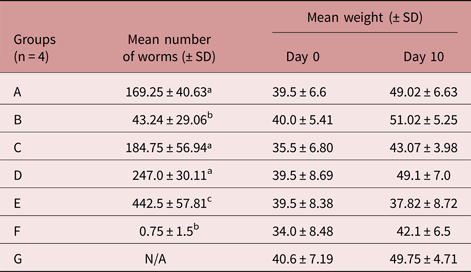
The number of parasites recovered during the necropsy, and the body weight of the gerbils on days 0 and 10 are shown in table 1. A higher number of parasites was found in group A than in group B. Groups B and F had significantly fewer parasites than groups A, C and D. The highest number of parasites was recovered in group E (using the immunosuppressive drug Depo-Medrol® and sheathed larvae), and the lowest number of parasites was found in group F (using exsheathed larvae and immunosuppressed animals). All the gerbils had higher body weight 10 days PI except those in group E, which were treated with methylprednisolone. This drug possibly reduced the mean body weight.
Mean (± SD) numbers of Haemonchus contortus larvae recovered from the stomachs of gerbils on day 10 post infection (PI), and mean (± SD) body weights pre-infection (day 0) and 10 days PI. Groups: A, infected with 2 × 10³ larvae; B, infected with 2 × 10³ larvae and immunosuppressed (protocol 1); C, infected with 6 × 10³ larvae and immunosuppressed (protocol 1); D, infected with 2 × 10³ larvae and immunosuppressed (protocol 2); E, infected with 2 × 10³ larvae and immunosuppressed (protocol 3); F, infected with 2 × 10³ larvae (exsheathed) and immunosuppressed (protocol 1); G, uninfected. N/A, not applicable.

Different letters indicate significantly different mean values (P < 0.05).
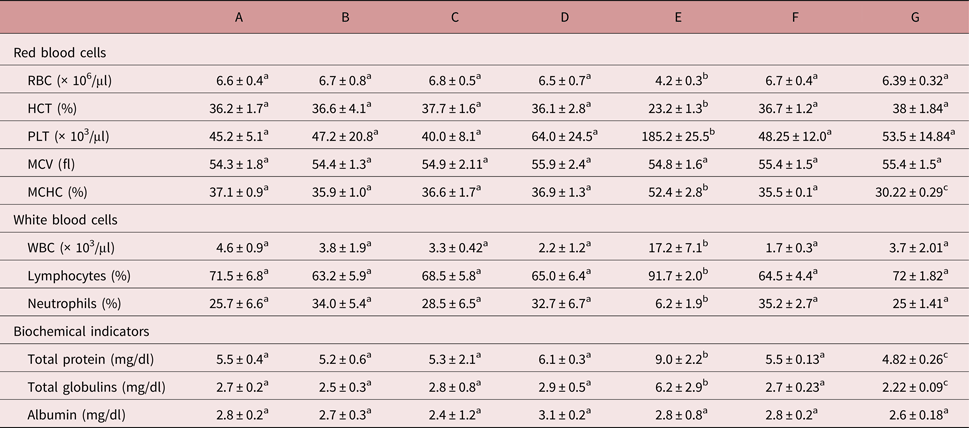
Table 2 shows the mean red and white blood cell counts and biochemical parameters of gerbils infected by H. contortus and the control group (uninfected). For group E, significant alterations to RBC, HCT, PLT, MCHC, WBC, lymphocyte and neutrophil counts can be observed. There were also significant differences in TP and total globulins in all groups, compared with the uninfected control group (group G), with the highest alterations in group E (treated with methylprednisolone). Other parameters of the red blood series (HGBC) and white blood series (rod neutrophils, eosinophils and monocytes) were also measured (data not shown).
Mean (± SD) red and white blood cell counts and biochemical indicators of gerbils with or without infection by H. contortus on day 10 PI. Groups: A, infected with 2 × 10³ larvae; B, infected with 2 × 10³ larvae and immunosuppressed (protocol 1); C, infected with 6 × 10³ larvae and immunosuppressed (protocol 1); D, infected with 2 × 10³ larvae and immunosuppressed (protocol 2); E, infected with 2 × 10³ larvae and immunosuppressed (protocol 3); F, infected with 2 × 10³ larvae (exsheathed) and immunosuppressed (protocol 1); G, uninfected.

Each treatment was compared with the control. The letters compare means in the columns, and different letters indicate significantly different mean values (P < 0.05).
In vivo experiment number 2
More worms were recovered from gerbils infected by sheathed larvae (189.33 ± 126.26) than from those infected by exsheathed larvae (7 ± 2.64). However, due to high variability this result was not statistically significant.
In vivo experiment number 3
In the third experiment, the mean number of larvae recovered 15 days PI was approximately 225. There was a weak correlation (R = 0.36) between the number of larvae recovered and the body weight of the gerbil. However, no significant differences were found (P = 0.05) (fig. 1).
Relationship between the number of larvae recovered and the host body weight (g).

Discussion
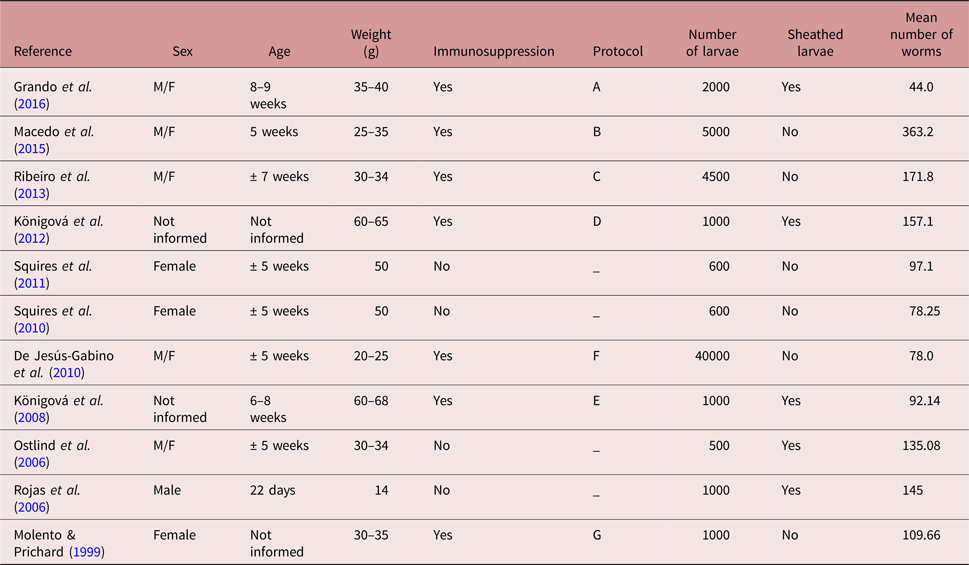
Over the last two decades, a large number of scientific studies on nematodes have been conducted using M. unguiculatus as the experimental model. Many protocols for infecting gerbils with H. contortus can be found in the literature, and some of them are compiled in table 3. The high number of worms recovered in the present study shows that infection became established in immunocompetent animals, as also demonstrated by Ostlind et al. (Reference Ostlind, Cifelli, Mickle, Smith, Ewanciw, Rafalko, Felcetto and Misura2006), Rojas et al. (Reference Rojas, López, Tejada, Vázquez, Shimada, Sánchez and Ibarra2006) and Squires et al. (Reference Squires, Ferreira, Lindsay and Zajac2010, Reference Squires, Foster, Lindsay, Caudell and Zajac2011). For unknown reasons, we found significantly more parasites in immunocompetent gerbils (group A) than in those subjected to immunosuppression using dexamethasone (group B). However, using the same H. contortus isolate as in the present study, Grando et al. (Reference Grando, Baldissera and Gressler2016) recovered an average of 44.0 worms from gerbils 12 days PI while using the same protocol as used for group B in our study.
Protocols used to infect gerbils with H. contortus over the last two decades.

Protocols for immunosuppression: A, Dexamethasone (Azium®, Coopers Animal Health), 0.2 mg per animal, 3 days before and 2 days after infection; B, Hydrocortisone (Azium®, Schering-Plough Labs), 0.2 mg per animal, 2 days before infection; C, Dexamethasone (Azium®, Coopers Animal Health) 0.2 mg per animal, 3 days before infection; D, Hydrocortisone, 6 mg per animal, 7 days before infection and every day after infection; E, Hydrocortisone, 6 mg/kg, 7 days before infection and every other day after infection; F, Hydrocortisone (Azium®, Shering-Plough Labs), 100 μl per animal, 2 days before infection; G, Hydrocortisone 0.02% in the feed, 5 days before infection and during maintenance of the infection.
We found that the main glucocorticoids (GC) used in gerbils to improve H. contortus infection were dexamethasone and hydrocortisone (table 3). Machado et al. (Reference Machado, Gomes, Oliveira, Fiuza and Detmann2006) evaluated gerbils infected by H. contortus and Trichostrongylus colubriformis using 4 mg of methylprednisolone per animal (Depo-Medrol®; Pharmacia) every 21 days. The gerbils were sacrificed 58 days PI for recovery of adult worms, which encouraged us to compare the activity of methylprednisolone and dexamethasone. According to Machado et al. (Reference Machado, Gomes, Oliveira, Fiuza and Detmann2006), methylprednisolone reduced the bio-nutritional efficiency of the gerbils, such that treated animals showed significantly lower performance than untreated animals. This finding corroborates the reduction in mean body weight observed in the animals treated with methylprednisolone in our study.
Larval exsheathment is a critical part of the process of experimental infection (Macedo et al., Reference Macedo, Oliveira, Ribeiro, Santos, Silva, Filho, Camurça-Vasconcelos and Bevilaqua2015). However, only a few studies have investigated the establishment of H. contortus infection in gerbils by means of larvae exsheathed using sodium hypochlorite (Conder et al., Reference Conder, Jen, Marbury, Johnson, Guimond, Thomas and Lee1990; De Jesús-Gabino et al., Reference De Jesús-Gabino, Mendoza de Gives, Salinas-Sánchez, López-Arellano, Liébano-Hernández, Hernández-Velázquez and Valladares-Cisneros2010; Squires et al., Reference Squires, Ferreira, Lindsay and Zajac2010; Reference Squires, Foster, Lindsay, Caudell and Zajac2011; Ribeiro et al., Reference Ribeiro, Macedo, dos Santos, de Oliveira, Camurça-Vasconcelos, de Paula and Bevilaqua2013; Macedo et al., Reference Macedo, Oliveira, Ribeiro, Santos, Silva, Filho, Camurça-Vasconcelos and Bevilaqua2015). Conder and Johnson (Reference Conder and Johnson1996) reported that none of the in vitro exsheathing media, including sodium hypochlorite, was optimal for parasites, and that they appeared to reduce larval viability. However, among the exsheathment media used, the best infection rate was achieved using carbon dioxide for exsheathment. To standardize a larval migration inhibition test, Demeler et al. (Reference Demeler, Kuttler and von Samson-Himmelstjerna2010) used exsheathed Cooperia oncophora larvae and found significantly fewer viable larvae, and migration rates as low as 50%, compared with the use of sheathed larvae. We observed that exsheathed larvae of H. contortus showed lower motility. Even though we selected the ones with highest motility to infect the gerbils, it was not possible to have a satisfactory rate of parasite recovery in both experiments. The use of exsheathed larvae resulted in decreased establishment of worms in experiment 2, thus supporting the results of the first experiment.
In relation to the immune response, GC caused lymphopenia, affecting T lymphocytes through inhibiting the Th1 response and, especially, the Th2 recruits and activating cells responsible for IgE production (Larini, Reference Larini2008). Furthermore, GC induces neutrophilia and eosinopenia and reduces the number of macrophages (Pereira et al., Reference Pereira, Bolzani, Stefani and Charlín2007). Because of the inhibitory effect of GC, it facilitates dissemination and establishment of infectious agents, including parasites such as H. contortus. In our study, infected gerbils that had undergone immunosuppression using methylprednisolone showed higher numbers of leukocytes, despite also showing lymphocytosis and neutropenia. Concerning the haematological and biochemical parameters, strong thrombophilia was observed even with increased total globulins, due to increased synthesis of hepatic proteins as an adverse effect of GC administration (Freitas & Souza, Reference Freitas and Souza2007).
It is known that the effect of corticosteroids on mucosal mast cells, mast cell proteinases and eosinophils, and on the antibody response, is capable of influencing B cell and T-helper cell responses (Ziam et al. Reference Ziam, Pandeya, Darwichea, Lossonb and Kumara1999). According to Amorim et al. (Reference Amorim, Silva and Taketomi2010), gerbils infected by Giardia duodenalis showed specific IgA faecal antibodies and serum levels of IgG1 and IgM, 7 days PI. However, the antibody levels decreased as soon as immunosuppression induced by methylprednisolone acetate was started (Amorim, Reference Amorim2008).
In addition to IgE, other immunoglobulins may perform important functions towards protecting the host against larvae (Tizard, Reference Tizard2014), thereby hampering larval establishment in gerbils. Therefore, one explanation for the higher number of larvae recovered from methylprednisolone-immunosuppressed gerbils is that this occurred through reduction of the humoral response due to increased plasma levels after GC administration, as a result of high doses of methylprednisolone administered over a short period of time (Pereira et al., Reference Pereira, Bolzani, Stefani and Charlín2007).
Our study provided additional evidence that weaned gerbils at an age of approximately five weeks appear to be an acceptable alternative for use as an experimental model, as they showed body development, which contributes towards immunosuppression and/or infection. The decision regarding which methodology should be used may be influenced by other factors, such as the parameters that will be analysed in the research and the influence of GC on them. We highlight that in the first and second experiments it was possible to recover a satisfactory number of worms using sheathed larvae and immunocompetent animals. Use of methylprednisolone increased the number of parasites recovered, compared with untreated gerbils or those receiving dexamethasone. Infected gerbils that had been subjected to immunosuppression using methylprednisolone showed alterations to haematological and biochemical parameters, along with poor performance. A considerable larval burden was recovered from the immunosuppressed gerbils 15 days PI, and body weight did not influence establishment of larval infection.
Acknowledgments
The authors would like to thank Dr Alessandro F. T. do Amarante of the Parasitology Department, Instituto de Biociências, Universidade Estadual Paulista Júlio de Mesquita Filho (UNESP), Botucatu, SP, Brazil, for providing the H. contortus isolate; and Dr José Henrique das Neves for his technical support.
Financial support
This work was financially supported by the National Council for Scientific and Technological Development (CNPq), under procedural number 141542/2014-4, and the Coordination Office for Improvement of Higher-Education Personnel (CAPES), under procedural number 1742789.
Conflict of interest
None.
Ethical standards
This study was approved by the Ethics Committee for Animal Research (CARE) of the Federal University of Santa Maria (UFSM), under protocol numbers 3768260515/2015 and 3787160917/2017.