

How do parties distribute particularistic goods to bolster their electoral support? One strain of literature focuses on district-level allocation strategies. Because parties seek to maximize their legislative seat share in cross-district models, a host of authors argue that parties will allocate goods to swing districts where just a few votes can yield a seat (e.g., Ward and John Reference Ward and John1999; Cox 2009). Parties may simultaneously target districts controlled by co-partisans, which facilitates within-district targeting and minimizes “leakage” by political foes (e.g., Levitt and Snyder 1995; Solé-Ollé and Sorribas-Navarro Reference Solé-Ollé and Sorribas-Navarro2008; Arulampalam et al. 2009).
A related but theoretically distinct strain of literature examines how parties allocate benefits to individuals in exchange for their votes. Despite a growing and nuanced literature, there are two principal, longstanding views. One holds that if a political party has a particular advantage at swaying a set of voters, then it will target these core voters (e.g., Cox and McCubbins Reference Cox and McCubbins1986; Dixit and Londregan Reference Dixit and Londregan1996). On the other hand, if some voters are already predisposed to one party and cannot credibly threaten to vote against it, parties may consider it a waste to target these groups and instead target swing voters (e.g., Stokes Reference Stokes2005).
Early empirical studies of distributive politics theories employed regional- or district-level data. While this is entirely suitable for district-level distributive theories, analyses of the allocation of benefits across rather than within electoral districts are only loosely related to the theoretical accounts of distributive politics that generate predictions about the distribution of benefits to individuals within districts.
Stokes’ (Reference Stokes2005) seminal contribution on vote-buying in Argentina provided the first analysis of the provision of benefits to individuals using survey data. Many authors subsequently followed suit (e.g., Gonzalez-Ocantos et al. 2012; Stokes et al. Reference Stokes, Dunning, Nazareno and Brusco2013; Lawson and Greene Reference Lawson and Greene2014; Carlin and Moseley Reference Carlin and Moseley2015). The use of individual survey data is clearly an improvement over aggregate data. But it too has downsides: self-reported party sympathies may not perfectly reflect voting behavior, it is difficult to crisply determine whether party sympathies lead to individual targeting or if targeting itself changes a voter’s view toward a party, and respondents may misreport their true receipt of benefits due to social desirability bias (see, e.g., Gonzalez-Ocantos et al. 2012). These obstacles are increasingly well-known, and some (particularly the last) can be mitigated.
This article, however, demonstrates that rather than focusing solely on individual-level data, scholars can most effectively test individual-level theories of distributive politics by combining both individual and macro-level data. This holds at least two advantages. First, comparing and contrasting findings from data at different levels of analysis—or integrating them in multilevel models—can enable researchers to paint a more complete picture of distributive targeting. For instance, scholars may learn that a party not only targets core voters, but that it does so systematically in party stronghold locales (e.g., neighborhoods) situated in swing districts but not in party strongholds in core districts. Second, when distributive benefits can be impacted or redirected by subnational politicians, as is common with many distributive programs, only sampling respondents to determine voter targeting strategies can generate inferences that are an artifact of competing targeting attempts at different levels of government instead of initial targeting strategies. Analysts can uncover this by leveraging more aggregated or macro data.
These two advantages have gone largely unrecognized because no studies of distributive politics have explicitly leveraged both individual and aggregate data, and compared findings between different levels of analysis. This is not without reason: surveying a sufficiently large sample of respondents across a wide range of districts is expensive. But designing surveys to acquire at least some sampling variation—and a sufficiently large number of respondents—across relevant aggregate political units could substantially improve inferential gains and advance the study of distributive politics without being cost-prohibitive.
This article demonstrates the importance of a tight fit between theory and methods in distributive politics. Furthermore, I demonstrate the inferential gains to obtaining data at differing levels of analysis in order to piece together a more complete picture of distributive targeting. In doing so, I argue that researchers can most effectively test and refine theories of distributive politics by formulating clear hypotheses, choosing the appropriate unit of analysis, and comparing and contrasting empirical findings from both micro- and macro-level data.
FIT BETWEEN THEORY AND METHODS IN DISTRIBUTIVE POLITICS
Cross-district studies of distributive politics focus on which districts politicians will allocate goods to. A related but theoretically distinct strain of research explicitly generates predictions about benefit allocation within districts (e.g., Cox and McCubbins Reference Cox and McCubbins1986; Lindbeck and Weibull Reference Lindbeck and Weibull1987; Stokes et al. Reference Stokes, Dunning, Nazareno and Brusco2013; Zaragaza 2016). These theories generally predict that parties will target either core voters (Cox and McCubbins Reference Cox and McCubbins1986; Dixit and Londregan Reference Dixit and Londregan1996) or swing voters (Stokes Reference Stokes2005). Of course, individual-level theories can implicitly generate predictions about the spatial allocation of benefits. For example, parties with resource constraints may allocate benefits to constituencies with a greater density of target core or swing voters (e.g., Calvo and Murillo 2004).
Many previous empirical studies cited as supporting core voter or swing voter theories of individual-level distributive targeting, however, have in fact leveraged cross-district data (e.g., Levitt and Snyder 1995; Schady 2000; Ansolabehere and Snyder 2006). By contrast, testing theories of distributive politics at the individual level enables a greater understanding of benefit allocation within districts.
Why is this the case? A district-level or any other aggregate-level empirical analysis of distributive politics can misclassify a core voter strategy as a swing voter strategy and vice versa. Consider a simple scenario in which the incumbent governing party (Party A) targets its core voters in a district with benefits. Suppose that this district has ten Party A core voters and ten opposition Party B voters. Whereas the governing party targets its core supporters in this district, an empirical analysis aggregated at the district level would surmise that Party A was engaged in swing voter targeting if districts are measured politically according to close voting win margins. The same mistaken conclusion would be drawn if instead the district had five Party A core voters, five Party B core voters, and ten ideologically swing voters, and if the researcher measures swing districts according to their distribution of political preferences or ideologies rather than vote returns.
Mistaken empirical conclusions can also occur where incumbent support is heterogeneous across districts. Furthermore, the individual targeting of swing voters can similarly be misclassified as core targeting when using aggregate data.
While aggregate-level analyses can easily misclassify individual-level voter targeting when the individual is not the unit of analysis, researchers should not simply gather individual-level data while ignoring macro-level data. This is critical, because subnational politicians can often mediate distributive relations between voters and national-level politicians. Due to federal structures, difficulties in implementing a national-level program across geographically dispersed locales, and gains in the precision of targeting due to local knowledge, distributive government programs targeted at individuals are often designed at the national level but strongly influenced by subnational political actors. If a subnational politician shares a partisan affiliation with the executive, they may aid in targeting benefits consistent with the central governing party’s interests. But if the subnational politician is an opposition party member, they may disrupt the center’s intended delivery of benefits. The distributive outcome in this case depends on competing allocation attempts at different levels of government.
This dynamic can also operate with broker-driven clientelism and machine politics. Subnational politicians can set rules and regulations (e.g., for party rallies) that impinge on the ability of brokers to target voters (Szwarcberg Reference Szwarcberg2012), or become personally involved in distributing benefits (Weitz-Shapiro Reference Weitz-Shapiro2014).
Consider a district in which incumbent governing party Party A attempts to target its core voters in a district with ten Party A core voters, five opposition Party B voters, and five swing voters. If the district is controlled by Party A, an individual-level empirical analysis would pick up Party A targeting. But if the district is controlled by Party B, the Party B politician may be able to block benefits from reaching Party A voters and instead attempt to redirect them toward Party B supporters. If the national-level Party A politicians can similarly block Party B’s allocation attempts, the result might be allocation to the five swing voters, whether due to imperfect targeting “leakage” or because these are the only voters that politicians can effectively target. The sole use of individual-level data in this case of Party B local control would lead an analyst to erroneously infer that Party A was purposely targeting swing voters. Leveraging individual data alongside data on district-level control would instead correctly indicate that the same program yields different distributive patterns to individuals depending on local political control.
Marshaling both individual-level and macro-level data has an additional advantage: it paints a fuller picture of distributive targeting. For instance, scholars may learn from macro-level data how the spatial distribution of voters impacts vote targeting, whereas individual-level data indicates which voters receive benefits.
RESEARCH DESIGN
I illustrate the inferential issues above in a two-part analysis. Both parts focus on a distributive land grant program in Venezuela. This program is only the latest in a long history of using land reform for distributive politics in Venezuela (see Albertus Reference Albertus2013). Land grants under this initiative are non-programmatic, targeted to individuals, and controlled by central incumbents with the plausible threat of withdrawal of support. The first part of the analysis examines land grant allocation at the individual level. The second examines land distribution at the municipal level, and then compares the inferences drawn from aggregate analyses to those from individual-level analyses. This has the advantage of engaging the two principal methods of analysis in the distributive politics literature. Nonetheless, the results are similar when combining these data through multilevel models, likely due to the unique density of data even across the lowest-level groups, which are voting centers (see the Online Appendix for results).Footnote 1 Survey data of distributive programs are typically much sparser and would therefore benefit more from multilevel analysis.
The key institution charged with administering the land reform is the National Land Institute (INTi), which registers and regulates public and private property, and also manages the distribution of land. Land grant distribution through INTi took place after a recall referendum drive in late 2003 in which voters could sign a petition to recall Chávez from office or a counter-petition to recall opposition politicians. Signatory information was compiled in a database (Maisanta) and publicly leaked. I use Maisanta to match land applicant information to voter lists to examine how petition signing influences land grants.
Dependent Variable: Land Grant Beneficiary
The analyses focus on land applicants, examining whether an individual receives a land grant conditional on applying.Footnote 2 Of the 12 million registered voters in 2004, over 115,000 applied for at least one of INTi’s grants (resulting in 145,000 applications) from April 2007 to February 2009, when Chávez won a referendum for a constitutional amendment removing presidential term limits. This is the period for which data are available. Among applicants, 22,548 were not registered voters in 2004 and do not appear in Maisanta. Of all land applicants, 5 percent became beneficiaries during this period.
Key Independent Variables: Individual Partisanship and Governor Partisanship
The first key explanatory variable is support or opposition to former President Chávez. For the individual-level analyses and some of the aggregate analyses, following Albertus (Reference Albertus2015), I measure support for Chávez using Maisanta data on whether or not an individual signed the third presidential recall petition (Opposition), signed a counter-petition to recall opposition politicians (Loyalist), or signed neither petition (Swing). This database includes information on all registered voters in March 2004.Footnote 3 The availability of such data is unique in that it represents revealed political preferences rather than stated preferences typically employed from surveys, and that it comes from the same database used to actually target Chávez opponents (see, e.g., Hawkins and Hansen 2006). About 26 percent of individuals in Maisanta signed the petition to recall Chávez, and roughly 11 percent signed the counter-petition to recall opposition politicians.
Several conditions highlighted in the literature as favorable to core targeting hold in Venezuela, strongly suggesting that Chávez’s PSUV party sought to direct land grants to loyalists. A highly polarized electorate with few swing voters such as that in Venezuela (Penfold 2007) should encourage core targeting (Cox 2009). This logic holds even stronger when voter mobilization is an attractive strategy (Nichter Reference Nichter2008; Cox 2009), a condition that binds in Venezuela due to a highly variable turnout rate.
Governor partisanship
Venezuela’s land reform is an example of a distributive program in which political intermediaries—in this case, governors—play a key role. All final decisions on land distribution since 2007 have been made in INTi’s central offices in Caracas, which are dominated by Chávez’s PSUV. INTi’s regional offices, located in state capitals, nonetheless serve important functions. Individuals apply for grants through regional offices, which forward applications to Caracas. State governors interact with these regional offices to either facilitate or inhibit the land distribution process (Albertus Reference Albertus2015). To facilitate grants, governors meet directly with land applicants in an effort to claim credit over reform progress, preside at granting ceremonies, and arrange meetings between potential applicants and high-level government actors from institutions that collaborate with INTi in financially aiding reform beneficiaries. To inhibit grants, governors can publicly denounce the reform as depressing agricultural production and instigating violence, withhold local cadastral information, and use state police to deter land invasions and shield private property from distribution.
Importantly, however, INTi’s regional offices are headed by bureaucrats appointed by INTi’s president, who is named by the national executive. It is consequently easier for pro-Chávez politicians to help their supporters. Opposition politicians, while facing considerable obstacles in aiding their supporters, do nonetheless retain considerable capacity to inhibit grants to pro-Chávez individuals in their jurisdictions.Footnote 4
Given the structural incentives politicians have to target core voters in Venezuela given a highly polarized electorate and variable turnout, this discussion implies several testable hypotheses. Pro-Chávez individuals should be more likely than opposition or undeclared individuals to receive benefits in states with pro-Chávez governors; the same individuals should be less likely to receive benefits than undeclared individuals when in opposition-held states. Simultaneously, opposition individuals should be less likely to receive benefits than undeclared individuals when their land applications are forwarded from opposition states.
The analyses therefore include interactions between individuals’ political preferences and the political affiliation of individuals’ state governor. Governor partisan affiliation is coded according to whether they were members of Chávez’s PSUV party or opposition party members. Because land grants were awarded in a wave shortly before the 2009 referendum, I code political affiliation from the 2008 elections.
Controls
The analyses also include several controls that may affect receiving a grant. The first control is whether an individual is enrolled in one of several other government social programs—Misión Ribas, Vuelvan Caras, or other programs. By tapping income, or experience interacting with government, an individual enrolled in other programs may be more likely to receive a grant. The second control variable is the log of the rural population, which captures potential demand for land reform. A third control is the poverty rate, since poverty could drive both political preferences and the probability of receiving land. Rural population and poverty are measured at the municipal level with data from the National Statistics Institute.
Another set of controls in several individual-level models captures the type of land grant application. There are four grant types: adjudications, cartas agrarias, declarations of permanence, and simple property registrations. Individuals apply for specific grant types depending on their de facto and de jure landholding status. A final control included in individual-level models is the time at which an applicant delivered their application to INTi. Earlier applicants are more likely to have had their claim investigated and processed.
A full set of descriptive statistics is in the Online Appendix. Further details on controls are discussed in Albertus (Reference Albertus2015).
INDIVIDUAL-LEVEL ANALYSIS
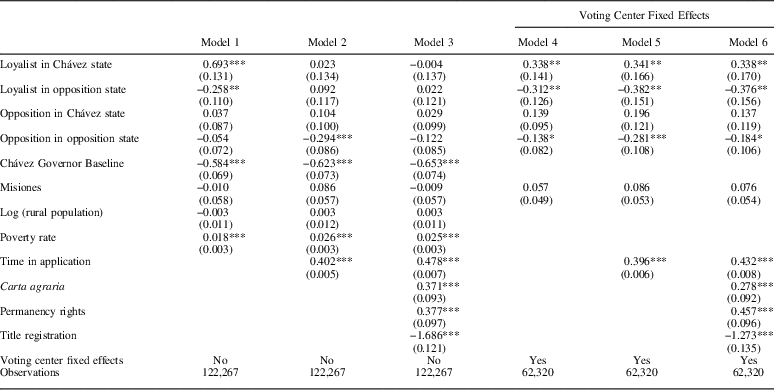
Table 1 presents a set of logit models that include interactions between an individual’s political preferences and the partisan affiliation of the incumbent governor, along with covariates. Columns 1–3 are pooled models. Model 2 adds a variable for when an application was submitted. This helps to account for potential right-censoring in the data. Model 3 adds variables for the type of grant an individual applied for.
Individual-Level Logit Analyses of Land Grants

Note: Standard errors clustered by voting center.
*p<0.10, **p<0.05, ***p<0.01 (two-tailed).
The omitted baseline category of comparison for the political variables in Models 1–3 are petition non-signers in opposition states. Individuals who signed the recall petition against Chávez and who reside in states with opposition governors are less likely to receive a land grant conditional on applying. The same is true of petition non-signers in states with pro-Chávez governors. In contrast, Model 1 indicates that pro-Chávez petition signers in states with pro-Chávez governors are more likely to receive land, though this effect does not remain statistically significant in Models 2–3. Pro-Chávez signers in states with opposition governors are less likely to receive benefits in Model 1. Furthermore, individuals who applied to the program earlier were more likely to become beneficiaries.
Accounting for Voting Center-Level Heterogeneity
Of course, analysts cannot always obtain individual-level data for all potential covariates that are correlated with both political preferences and the likelihood of receiving distributive benefits. However, some of these covariates can often be captured using aggregate-level data on voter groups or their distributional heterogeneity across space. Pairing aggregate data with individual-level data can reduce omitted variable bias and generate a sharper image of individual-level targeting.
In this case, there is geographical variation in political preferences, and individuals that receive benefits may also support Chávez for unobserved reasons. Models 4–6 therefore leverage information on voters’ geographic location. These models compare individuals within voting centers (centros) using conditional (fixed effects) logit models to control for local unobserved heterogeneity that could affect both of these factors. Income is one example. Fortunately, unobserved individual factors such as income are fairly homogenous within voting centers. The extremely small size of voting centers largely accounts for their “homogenous socioeconomic composition” (Lander and López Maya 2005, 47). There were nearly 8600 voting centers for the 2004 recall referendum, yielding an average of 1400 voters per voting center. This makes it possible to more cleanly identify the role of political preferences in land applications and grants.Footnote 5
The baseline categories of comparison in Models 4–6 are petition non-signers within a given voting center, where the governor’s partisan affiliation corresponds to the state where the voting center is located. The variable “Chávez Governor Baseline” is consequently no longer estimated; neither is rural population or poverty rate. Furthermore, individuals in voting centers that lack variance in the dependent variable are dropped.
Individuals living in states with pro-Chávez governors who signed the petition to recall opposition officials were more likely to receive land than petition non-signers by a substantial estimated 40 percent according to Models 4–6. In contrast, pro-Chávez individuals residing in states with opposition governors were significantly less likely to be granted land than petition non-signers in those states by an estimated 32 percent. Similarly, Chávez opponents in states with opposition governors were an average estimated 18 percent less likely to receive land than petition non-signers in those states.
Table 1 demonstrates the importance of employing information on political linkages between state and national officials for land distribution. The structure of the land reform program enables pro-Chávez governors to help their supporters and deny benefits to the opposition. While it is difficult for opposition governors to aid their own supporters, they can disrupt grant-making to pro-Chávez individuals in their states. Higher rates of grants to undeclared swing voters in opposition states are thus an artifact of center-/state-level competing allocation attempts.
INFERENCES USING AGGREGATE DATA
How are the inferences drawn from the individual-level analyses of grants different from those that would be drawn from aggregate municipal-level data? This section demonstrates two answers to this question. First, the sole use of aggregate data to the exclusion of individual-level data can yield ambiguous or misleading inferences about voter targeting. Second, leveraging both individual-level and macro-level data can paint a fuller picture of distributive targeting efforts than individual-level data alone. Aggregate-level analyses of distributive programs should therefore be seen as complementary to individual-level analyses.
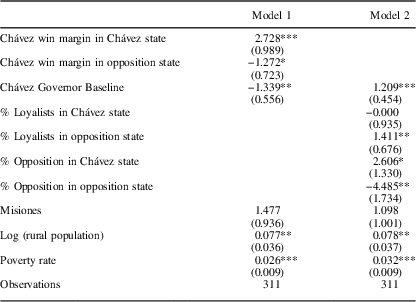
Table 2 presents a set of tobit models that estimate municipal-level land distribution. There are 334 municipalities and a capital district. The tobit models account for left-censoring given that some municipalities had no beneficiaries. The dependent variable is the number of grant beneficiaries per 1000 registered voters. This variable ranges from 0 to 11.49 beneficiaries per 1000 voters with a mean of 0.79. Several control variables that track those in Table 1 and employ the same data sources are included: the rate of misiones participation, log rural population size, and the poverty rate.
Tobit Analyses of Aggregate Land Grants by Municipality

Note: Robust standard errors in parentheses.
*p<0.10, **p<0.05, ***p<0.01 (two-tailed).
The key independent variables measure swing presence and core Chávez support using standard indicators. The first is Chávez’s win margin for the 2004 recall vote. This variable has a mean of 0.51 and standard deviation of 0.15. Because Chávez won the recall vote in nearly every municipality (with three exceptions), a separate Chávez vote share measure of core support is almost perfectly colinear with win margin. Win margin alone therefore taps both core voter presence via the strength of Chávez’s vote share (when win margin is large) and swing voter presence (when the measure takes small values). The second set of key independent variables is the percentage of strong Chávez supporters, opponents, and petition non-signers (swing), calculated from Maisanta.
The Table 2 models account for governor influence by interacting the key municipal-level political variables with the political affiliation of the governor in which a municipality resides. Win margin in Model 1 is positively linked to land grants in states with pro-Chávez governors but negatively linked to grants in opposition-held states. This suggests core targeting in municipalities in states with pro-Chávez governors and swing targeting in opposition-held states. The former finding is consistent with Table 1. Yet given the Table 1 results, the latter finding reflects the effect of both pro- and anti-Chávez individuals being denied benefits relative to petition non-signers in swing and opposition municipalities.
Given that the baseline comparison category for the political variables in Model 1 are municipalities with zero win margin in states with opposition governors, the negative constituent term of Chávez Governor Baseline indicates that for municipalities with zero win margin (i.e., swing), grants will be higher with an opposition governor. While this could be consistent with Table 1, it is again so not because the center is targeting swing groups in opposition states, as one might conclude only on the basis of this finding, but instead because targeting strategies by the center and opposition state governors conflict in these municipalities, and yield benefits to undeclared individuals.
Model 2 uses the percentage of strong Chávez supporters and opponents as the key political variables. The omitted baseline category of comparison are municipalities of petition non-signers in opposition-governed states. The positive coefficient for the percentage of municipal-level pro-Chávez individuals in opposition-held states and the negative coefficient for municipal-level opposition petition signers in opposition-held states suggest that pro-Chávez individuals are being targeted with benefits in opposition states and opposition individuals are being denied benefits. While the latter finding is consistent with Table 1, the former finding is not. The positive coefficient for pro-Chávez loyalists in opposition states therefore must be picking up higher rates of benefits to petition non-signers in municipalities where there are more pro-Chávez individuals. And given the Model 1 finding that municipal-level Chávez win margin is negatively linked to benefits in opposition states, it must be especially polarized municipalities where benefits flow to petition non-signers.
The coefficient on Chávez Governor Baseline in Model 2 is positive and statistically significant, indicating that in a municipality comprised solely of petition non-signers in a pro-Chávez governed state, individuals are more likely to receive benefits than if the governor opposed Chávez. Furthermore, the percentage of loyalists in municipalities in pro-Chávez states is statistically insignificant, and the percentage of opposition individuals in pro-Chávez states is positive, statistically significant, and larger than the Chávez Governor Baseline coefficient.
Taken alone at face value, these findings could suggest that opposition individuals and petition non-signers receive more benefits than pro-Chávez individuals in these municipalities. Given the Table 1 findings, however, it must instead be that pro-Chávez individuals in pro-Chávez governed states are more likely to receive benefits in municipalities with somewhat greater concentrations of opposition individuals and petition non-signers (again, pointing toward targeting in areas of political polarization).
DISCUSSION
What do the findings imply for the study of distributive politics? Most fundamentally, they demonstrate that comparing and contrasting findings from data at different levels of analysis enables researchers to paint a more complete picture of distributive targeting than examining data at a single level of analysis. Conclusions about voter targeting drawn solely from aggregate data depend on the spatial distribution of voters, within-region attempts at targeting, and the aggregate-level measurement of voter makeup. Leveraging individual data can mitigate these issues while shedding light on overall targeting patterns.
On the other hand, solely sampling individual respondents across districts to determine voter targeting strategies could generate inferences that are an artifact of competing targeting attempts at different levels of government instead of top-down targeting strategies. This underscores the attentiveness required to the specific channels through which distributive benefits flow. Again, coupling macro-level data with individual data is key.
These issues call for sampling a sufficient number of respondents across districts of various national–local partisan alignments (e.g., via stratified sampling techniques) to investigate whether such alignments impact voter targeting or whether targeting is merely the outcome of party strategies. This could yield a large number of respondents across a fairly small number of subnational groups. Alternatively, researchers could draw smaller samples from some subnational units/groups to improve group coverage, and then analyze the results using multilevel models that borrow strength from larger-sample groups. Regardless, these approaches need not be cost-prohibitive, but they do require careful attention to the pathways through which distributive benefits flow and the impact of brokers and politicians along these pathways.
Even when these challenges can be overcome, coupling aggregate with individual data has advantages. For instance, an aggregate analysis can illuminate how the partisan spatial distribution of voters impacts distributive targeting to individuals in particular areas.
Acknowledgments
The author thanks Olivier Delahaye, Román Duque, Jim Fearon, Steve Haber, Alisha Holland, Karen Jusko, Terry Karl, David Laitin, Carlos Machado, Rafael Quevedo, Jonathan Rodden, and Dan Slater for their helpful comments on earlier versions of the project. He also thanks Francisco Monaldi for inviting him as a visiting scholar at the Instituto de Estudios Superiores de Administración (IESA) in Caracas for field work, as well as officials from the Instituto Nacional de Tierras.