


A behavioral genetic design that complements the more prevalent twin designs discussed in this special issue is the adoption design. Like twin studies, adoption studies provide estimates of genetic and environmental influences, but the adoption design may include both parent–offspring and sibling comparisons. In the adoption study we can contrast the resemblance between parents and children who share only environmental resemblance (rearing parents with adoptees) as well as the resemblance between parents who share only genetic background (birth parents with adoptees) and compare these to control parents and children who share both (Plomin et al., Reference Plomin, DeFries, McClearn and McGuffin2008). If the design includes multiple offspring in the rearing families, sibling analyses comparing related and unrelated siblings are also possible.
The adoption design has a long history, and an interesting present. The first systematic studies from early in the previous century (e.g., Theis, Reference Theis1924) were retrospective, did not include environmental measures, and did not control for selective placement. One of the first longitudinal studies (Skodak & Skeels, Reference Skodak and Skeels1945) avoided the first problem, but also did not include environmental measures, and was undertaken at a time when deliberate selective placement was still prevalent. The Texas Adoption Project (Horn et al., Reference Horn, Loehlin and Willerman1979) controlled for selective placement, but was not prospective and focused on cognition. More contemporary projects are often transnational (Lee et al., Reference Lee, Grotevant, Hellerstedt and Gunnar2006) with little access to information regarding birth parents, or are subject to the modern practice of open adoption (Leve et al., Reference Leve, Neiderhiser, Ge, Scaramella, Conger, Reid and Reiss2007), which, while possibly being advantageous in many ways, neither eliminates selective placement nor allows for a cleavage of environmental and genetic effects.
While the adoption design provides the cleanest possible separation of the combined inherited biological and family environmental influences that affect a child growing up in a particular family, the combined study of pairs of twins and pairs of related and unrelated siblings provides additional information concerning factors acting throughout the developmental process, allowing a separation of parental influences from other shared environmental influences. At the Institute for Behavioral Genetics (IBG), we are able to combine data from the Colorado Adoption Project (CAP) with parallel data from the Longitudinal Twin Study (LTS; Rhea et al., Reference Rhea, Gross, Haberstick and Corley2006 and elsewhere in this special issue).
In this report we will describe the CAP design – recruitment strategies, sample characteristics, and attrition as well as provide information on the range of domains investigated. We also summarize illustrative papers demonstrating the range of the utility of its data sets. Although the CAP is primarily noted for its major contributions to our understanding of behavioral genetics, it is also a valuable longitudinal study of development independent of those contributions. It has served both those purposes and as part of a representative community sample for studies focused on subjects recruited due to substance problems and other psychopathology. And it can also be used as a tool for understanding the processes and outcomes of adoption in general.
Sample
Parent Recruitment
The CAP, now in its fourth decade, is a prospective and longitudinal adoption design. Plomin and DeFries (Reference Plomin and DeFries1983, Reference Plomin and DeFries1985) initiated the CAP in 1975 with the help of two Denver social services agencies. One social worker employed at both Denver Catholic and Lutheran Social Services met with birth parents planning on placing their children for adoption to invite their participation in the project. These parents completed the core CAP measures (discussed below) and allowed access to the medical and family history information collected by the agencies from all clients. About 20% of the birth fathers participated. The infants who were placed for adoption did not leave the hospitals with their birth parents, but rather were placed for brief stays in foster homes and then with their adopting parents at an average age of 29 days, with a range of 2 to 172 days.
Information about the project was a small part of the orientation for prospective adoptive parents, but they were not invited to participate until the legal requirements for the adoption were complete. About 25% of the birth mothers who agreed to participate decided postpartum not to place their children for adoption. This tendency was more pronounced if the birth father had also participated. Further attrition from the birth parent sample occurred as about 11% of the adopting parents were not contacted, usually due to out-of-state placements or moving shortly after placement. An additional 25% of the adopting parents chose not to participate.
In the final months of enrollment, recruitment was supplemented by a few families from other religious agencies, and ultimately the project was capped at 245 adopting families. Although the birth mother was the initial subject for each dyad, the birth child is considered the proband because, as is shown in Figure 1, it is the adopting parents’ later enrollment that creates the condition for the family's participation.
From contact to enrollment.

A one-to-one matched control group of non-adoptive parents rearing their biological children was ascertained through area hospitals. Information letters with postage-paid reply cards were mailed to the parents of recent newborns. Those who returned the reply card were contacted by phone and completed a short demographic interview to enable matching on the basis of proband gender, parents’ ages, and father education and occupation (at the time, mothers in the adopting families were prohibited from out-of-home employment). The final parent sample comprised 286 birth mothers (41 sibling placements), 60 birth fathers (10 sibling placements), 242 adoptive mothers, 237 adoptive fathers, 243 control mothers, and 244 control fathers.
Sibling Recruitment
Because the project was envisioned as a longitudinal study, younger but not older siblings were enrolled and followed using measures identical to those of the first enrolled children. Recognizing that multiple siblings would be rare in adoptive families, only the first younger siblings in both types of families were included. However, in five adoptive families, following placement of a second adopted child, data from another younger sibling who was biological to the parents were regarded as sufficiently informative to be included as well. In addition, 42 of the adopted younger siblings were probands in a separate birth parent dyad or triad because one or both of their birth parents independently enrolled in the study.
Older siblings were invited to enroll and complete the adult assessment as soon as they reached age 16 (a few half-siblings met this criterion at the time their parents enrolled or soon thereafter), and siblings close in age to the primary subjects intermittently participated as pilot subjects during measures development, but resources were not available to fully include them in the first decades of the study. However, in the 1990s, two studies were begun that included the full participation of almost all siblings in all families, both older siblings and additional younger siblings. Thus, from late adolescence onward, the size of the sibling sample was greatly expanded.
Characteristics
The project succeed in matching adoptive and control families on socio-economic status (SES) variables, and later analyses indicated that even the birth parent sample was also similar, based on the probands’ grandparents, who were more established educationally and financially than the young parents at the time of assessment (Plomin & DeFries, Reference Plomin and DeFries1985; Rhea et al., in press). In addition, the CAP families are representative for the SES measures; although means are higher than those for the United States as a whole, they are comparable to those of the state and the time from which they were drawn and variances are similar to the US norms (Plomin & DeFries, Reference Plomin and DeFries1985; Rhea et al., in press).
Colorado demographics during the 1970s and 1980s and self-selection among those families working with the social service agencies resulted in a sample that is predominantly non-Hispanic white: 95% of the adopting parents and 90% of the birth parents reported that their race/ethnicity was in this category, and nearly all the remainder identified as Hispanic.
The adoption agencies, except for a few limited variables, intentionally did not engage in selective placement, subsequently verified by analyses (Plomin & DeFries, Reference Plomin and DeFries1985; Rhea et al., in press). There has been little contact between birth parents and children, and rare and limited contact in very late adolescence or adulthood.
Assessment: Classic CAP (Birth to Age 16)
Sequence
All parents were first tested at the time of their enrollment. For most birth parents this was during the final trimester of the pregnancy, but a few were enrolled postpartum. Most adoptive and control parents were tested in the year preceding their child's first birthday. Testing sessions took place individually or in groups by category. Subsequent rearing parent assessments coincided with the child assessments and included questionnaires about the child and family at each age, along with intermittent evaluations of the parents themselves.
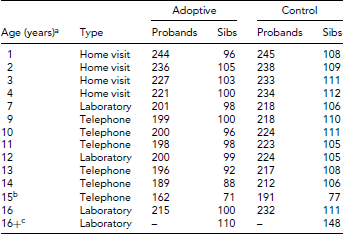
Most children were first tested in their homes as 1-year olds, but a few missed the first assessment and were enrolled at age 2. Table 1 depicts the type of testing (e.g., home visit, laboratory session, or telephone interview) administered at each age, along with the number of subjects by type who contributed data.
Assessment Schedule and Number of Participants Through Age 16 Data Collection
Notes
aSome sessions (e.g., 7–15) were associated with school grade years rather than age.
bSome subjects were not assessed due to proximity to age 16 session.
cAdditional older and additional younger siblings who were at least age 16 but may have been older at the time of data collection.
When the children were about age 7, the schedule switched from birth year contact to school year contact. This shift was due partly to the practicality of testing a large number of subjects during the summer after each school year, but also due to the anticipated importance of school on various indices of development. For each of the laboratory sessions, participants who had moved out of state or who had difficulty traveling to Boulder were seen at home. Throughout this and other reports, the school year assessments are labeled by the average age of most subjects during their completion; for example, age 7 for first grade.
At age 16 we returned to a birth year-based schedule, due to some of the tests selected for this age requiring 16 as a minimum age. For some subjects the post-ninth grade and age 16 tests would have been administered within three months, so the ninth grade test was skipped for approximately 15% of the sample. As stated above, age 16 is also the first age at which both older and younger subjects not previously enrolled were systematically included, resulting in a significantly larger number of subjects at this age. It should be noted that especially in the case of older siblings, the session-labeled age 16 might have been administered at an older age if the individual had passed age 16 before being enrolled.
Attrition that occurred in the early years of the study was due partly to the fact that during the recruitment phase less effort was made to locate families whose contact information was not current. In addition, some adoptive families expressed discomfort with focusing their children's attention on their adoption status. At age 16, the first time subjects were old enough to be administered the tests their parents had completed earlier, special efforts were undertaken to locate and re-enroll subjects who had not been located or whose families had chosen not to participate at earlier ages. These re-enrollment efforts resulted in an increase to nearly 90% and 95% respectively for adopting and control families at the ‘age 16’ session.
Domains
The first assessment for all parents was a three-hour battery of psychological measures, many of which were based on an earlier large-scale study of parents and children, the Hawaii Family Study of Cognition (DeFries et al., Reference DeFries, Vandenberg, McLearn, Kuse, Wilson, Ashton and Johnson1974). This paper-and-pencil assessment included a two-hour cognitive abilities battery, which was designed to evaluate both general and specific cognitive abilities. In addition, parents completed a questionnaire assessment, which included measures of temperament (self and co-parent), handedness, speech pathology, health, and interests and talents. Later rearing parental data collection included a standard cognitive test, the Wechsler Adult Intelligence Scale – Revised (WAIS-R) (Wechsler, Reference Wechsler1981) collected during the seven-year (or in some cases 12-year) session, along with questionnaire assessments.
As shown in Table 2, most of the assessments through age 16 for the children were designed to provide age-appropriate equivalents of the measures their parents completed at enrollment. Some of the domains (e.g., cognitive abilities) were assessed directly, and others were initially assessed from questionnaires completed by parents and teachers or from tester ratings. From age 7 through 15, the children were also interviewed directly using age-appropriate instruments for many of the scales, such as temperament, health, and interests and activities.
Major Assessment Domains Through Age 16

Quantitative behavioral genetic studies ‘provide the best available evidence for the importance of the environment . . .’ (Plomin et al., Reference Plomin, DeFries, Knopik and Neiderhiser2013). This is especially true of adoption studies, which provide direct evidence of environmental influence from analyses of adoptive-parent/adopted child and adoptive sibling data. Consequently, measures of the environment have also been an important element of the CAP and have been assessed at home visits through direct observation, through interviews with parents (Caldwell & Bradley, Reference Caldwell and Bradley1978), and through questionnaires completed both by parents and children, including parenting (Dibble & Cohen, Reference Dibble and Cohen1974) and home atmosphere (Moos & Moos, Reference Moos and Moos1981).
For the phone interviews collected during middle childhood and adolescence, a novel telephone administration of cognitive assessment was developed which enabled investigators to collect useful data cost effectively and with greater ease for participating families (Cardon et al., Reference Cardon, Corley, DeFries, Plomin and Fulker1992; Kent & Plomin, Reference Kent and Plomin1987). The age 16 in-person session was the three-hour test battery previously administered to all parents along with the WAIS-R (Wechsler, Reference Wechsler1981). The CAP had then reached a milestone, with these late adolescent children completing the same test battery their parents had completed 16 years earlier.
Assessment: Current CAP (Age 17 to the Present)
Sequence
The age 16 assessment, which can be thought of as the transition to adulthood, marks a dividing point in the CAP. As stated above, almost all siblings, not just those who were followed longitudinally from infancy, were invited to participate at age 16 and older. However, because many were much older than the primary CAP subjects, the age of assessment does not necessarily match to those of the probands and other siblings. For example, usually the first administration of our measures of substance use and psychopathology (labeled substance in Table 3) using DSM instruments (Cottler et al., Reference Cottler, Robins and Helzer1989; Robins et al., Reference Robins, Cottler, Bucholz, Compton, North and Rourke1999; Shaffer et al., Reference Shaffer, Fisher, Dulcan and Schwab-Stone2000) to the primary subjects was at age 17, but to their older siblings occurred as late as age 40. A series of interviews labeled life patterns (described below) was administered to all subjects, beginning in the first year of this portion of the project rather than at a particular age, resulting in a wide range for these measures as well. Notably, romantic partners were included thrice in this series (though not all subjects identified partners who were willing to participate).
Type and Number of Assessments During Adulthood

Data collection is ongoing for categories in bold. See the text for Life patterns 1 to 8 and Partners 1 to 3.
As is shown in Table 3, most of the sessions subsequent to the first ‘adult’ evaluations have been conducted via telephone and all of them at varying ages for each of the subject types. The sample sizes are also quite variable across this span. Conclusions regarding attrition can not be drawn from this table for several reasons: (1) For some assessments (e.g., substance), the additional siblings may have been invited to participate only one time; (2) for some assessments (e.g., life patterns), funding for data collection was not continuous across the available age ranges; and (3) for some assessments data collection is ongoing.
Domains
Just as the assessment schedule no longer followed the strict age-based model of the earlier years, some of the domains investigated are less closely tied to the foundation measures. As shown in Table 4, we continued to include the foundation measures (at decade intervals), but added instruments focused on life transitions. Many of these interview items were based on Elder's (Reference Elder, Damon and Learner1998) methods to assess both education and achievement milestones and the status of many types of relationships, such as adult–parent–child, adult siblings, romantic and family formation, and friendships. The life patterns assessment varies in detail across these ages to enable collection of a wide range of data across the span. At some of these assessments, subjects were asked to identify a significant romantic partner or co-parent who would be willing to answer similar questions about his or her relationship with the CAP subject and his or her family.
Major Assessment Domains Age 17 and Older

Notes
aWechsler (Reference Wechsler1997).
bCattell et al. (Reference Cattell, Eber and Tatsuoka1970), Buss & Plomin (Reference Buss and Plomin1975), Eysenck & Eysenck (Reference Eysenck and Eysenck1975).
cLife patterns 4 and 7 reflect current changes only.
dToward CAP subject's parents, siblings, and friends.
Illustrative Past Findings
The CAP is a multifaceted study. The uses of its data extend from parent–offspring analyses of IQ to investigations of adoption outcomes in adolescence. An example of the parent–offspring data analyses is the longitudinal investigation of Plomin et al. (Reference Plomin, Fulker, Corley and DeFries1997). They estimated the changing contributions of genetic and environmental factors to general and specific cognitive abilities from childhood through late adolescence and found that for adoptive parents and their adopted child, correlations remained close to zero at all time points, whereas the correlation between both biological parents and their adopted away offspring and control parents rearing biological offspring increased from this span from about 0.1 at age 3 to nearly 0.4 at age 16.
Studies which combine the CAP and LTS sibling samples take advantage of the different ways in which each can be used to estimate genetic and shared environmental variance. For example, shared environmental variance is directly estimated in adoption studies through the comparison of unrelated siblings in adoptive families, whereas twin studies estimate this variance indirectly. Bishop et al. (Reference Bishop, Cherny, Corley, Plomin, DeFries and Hewitt2003) used both of these samples in structural equation models (Eaves et al., Reference Eaves, Long and Heath1986) assessing the etiology of developmental change and continuity in general cognitive ability from infancy to middle adolescence. Cognitive data through age 12 from the CAP sample and through age 10 from the twin sample were analyzed. In general, heritability contributed to both continuity and change in cognitive ability from infancy through adolescence, while shared environmental influence contributed to continuity, and non-shared environmental influences contributed to change.
The utility of the CAP's longitudinal design is highlighted in McClelland et al. (in press), which reported that the likelihood of achieving a bachelor's degree by age 25 was predicted by parental evaluation of the child's attention span persistence at age 4. Specifically, those rated as SD = 1 above the mean on attention-span persistence were almost 50% more likely to graduate within this time frame.
The CAP is also commonly used as part of a combined sample, which includes individuals who are genetically informative as sibling pairs or as individuals as they have been genotyped at a variety of loci. In Corley et al. (Reference Corley, Zeiger, Crowley, Ehringer, Hewitt, Hopfer and Krauter2008), subjects in the CAP were included in a candidate gene study as part of the control sample matched by sex, ethnicity, and birth year to the same number of clinical probands who were ascertained following treatment for drug dependence and conduct problems. Analyses suggested that polymorphisms in two receptor genes (OPRM1 and CHRNA2) were associated with case/control status.
While primarily used to elucidate the genetic and environmental etiology of a variety of phenotypes, the CAP is also ideal for investigating adoption outcomes. For example, Nilsson et al. (Reference Nilsson, Rhee, Corley, Rhea, Wadsworth and DeFries2011) assessed whether adopted individuals are at greater risk for problem behaviors; specifically the prevalence of conduct disorder (CD) symptoms and severity of conduct problems. Prior studies identifying such a link have been criticized for potential selection bias in relying upon clinically ascertained samples (Smith, Reference Smith2001), and it has been shown that later adoption placement is associated with higher rates for problem behaviors (Sharma et al., Reference Sharma, McGue and Benson1998). In contrast, as described above, the CAP is a community-based sample and placements occurred during infancy. In this study, CD symptoms and conduct problems were slightly elevated among adopted individuals as a whole, but this difference was not statistically significant. Further analysis suggests that adoption satisfaction may be a protective factor against problem behaviors.
Conclusions
Adoption studies provide the most direct estimates of quantitative genetic and environmental influences, and genetic–environmental correlation and interaction are estimated with relative ease (Rhea et al., in press). Such analyses are made even more valuable by the addition of longitudinal assessments of the child's development. The CAP design in particular is unique (and not replicable due to secular changes since its initiation) in that it is a prospective adoption design that includes birth parents and placement of adopted children in infancy; it is longitudinal, with assessments currently spanning four decades; it is multivariate, covering many, if not most, salient areas of child development; it is isomorphic in that at several ages, offspring are administered measures that their parents completed at enrollment; it includes a matched non-adoptive control sample, which is valuable not only in estimation of genetic and environmental influences but also as a comparison sample to assess representativeness; and finally, it is successful in retaining its sample – nearly 90% continue their participation into early adulthood.
The impact of the adoption design is augmented when combined with the twin design, as is the case for the CAP and LTS, parallel adoption and twin studies. Although both adoption and twin designs can and frequently do stand alone, together the strengths of each reinforce the other and the weaknesses are minimized. For example, if adoption studies yield biased results because they lack the full range of rearing environments and genetic backgrounds (Stoolmiller, Reference Stoolmiller1999), or if twin studies yield biased results due to special twin effects, using a combined sample, such as the CAP and LTS, these problems can be tested and statistically resolved.
This invaluable resource is made available to researchers all over the world. The CAP data from adopted and non-adopted probands at 1 through 12 years of age, siblings at ages 1 through 7, and parents, including test scores, questionnaire/inventory data, and video tapes, have been placed in the NIH-supported archive of the Henry A. Murray Research Center of Harvard University, and plans have been made to add the remainder of the data through age 16, offering an unparalleled research opportunity to understand the genetic and environmental determinants of behavioral development.
The CAP began as a study of genetic and environmental influences on behavioral development in children. Thirty-seven years later we have begun follow-up assessment of CAP participants in their thirties. The oldest CAP probands are nearing age 40, approaching mid-life. With continued assessment in each decade, we have the unique opportunity to understand better the nature of cumulative and dynamic mechanisms contributing to individual differences in not only child development but in adult development as well. With its genetically informative data reaching from infancy into adulthood with in-depth measurement of a wide range of behavioral domains and numerous aspects of the environment, it is our goal to establish the CAP as the first prospective adoption study of lifespan development.
Acknowledgments
The CAP would not have been possible without the original insight of Robert Plomin and John DeFries, the support of Denver Catholic and Lutheran Social services, the generosity of the families who have continued participating for so many years, and the extraordinary efforts of the data collection team. It has been funded across the years by a CRCW grant from the University of Colorado; National Institutes of Health grants HD010333, HD18426, MH43899, HD036773, DA05131, and DA011015; and the Spencer and William T. Grant Foundations.



