


1. INTRODUCTION
The interaction of intense laser pulses with plasma is relevant to many nonlinear phenomena, including laser fusion schemes (Tabak et al., Reference Tabak, Hammer, Glinsky, Kruer, Wilks, Woodworth, Campbell, Perry and Mason1994; Lindl, Reference Lindl1995), charged particle accelerators (Tajima & Dawson, Reference Tajima and Dawson1979; Clayton et al., Reference Clayton, Marsh, Dyson, Everett, Lal, Leemans, Williams and Joshi1993), and coherent harmonic radiation sources (Giulietti et al., Reference Giulietti, Banfi, Deha, Giulietti, Lucchesi, Nocera and Ze Zun1988; Liu et al., Reference Liu, Umstadter, Esarey and Ting1993; Foldes et al., Reference Foldes, Kocsis, Racz, Szatmari and Veres2003). The excitation of coherent radiation at harmonics of the fundamental frequency of the laser is of much practical importance due to its potential to provide a source of coherent high-frequency radiation extending upto the X-ray regime (Solem et al., Reference Solem, Luk, Boyer and Rhodes1989; Amendt et al., Reference Amendt, Eder and Wilks1991). These applications provide motivation for studying physics of intense laser fields interacting with plasma. It has been seen theoretically that odd harmonics of the laser frequency can be generated by the interaction of linearly polarized laser beams with homogeneous plasma (Mori et al., Reference Mori, Decker and Leemans1993). However, even harmonics can be obtained by propagation of linearly polarized laser pulses through inhomogeneous plasma (Abdelli et al., Reference Abdelli, Khalfaoui, Kerdja and Ghobrini1992; Esarey et al., Reference Esarey, Ting, Sprangle, Umstadter and Liu1993) and also in plasma embedded in external fields (Ferrante et al., Reference Ferrante, Zarcone and Uryupin2004; Jha et al., Reference Jha, Mishra, Raj and Upadhyay2007). In addition, even harmonics can also be generated by the interaction of p-polarized laser beams with homogeneous plasma (Jha & Agrawal, Reference Jha and Agrawal2014).
A number of innovative concepts involving enhancement in efficiency of the generated harmonic radiation have been a subject attracting attention in recent years. For practical applications of harmonic radiation, its conversion efficiency needs to be enhanced. Theoretical and experimental observations have shown conversion efficiency enhancement by applying various phase-matching schemes (Milchberg et al., Reference Milchberg, Clark, Durfee, Antonsen and Mora1996; Cohen et al., Reference Cohen, Popmintchev, Gaudiosi, Murnane and Kapteyn2007). In the presence of a modulated transverse magnetic field, phase-matched harmonic radiation generation was predicted by Rax & Fisch (Reference Rax and Fisch1992). Chen et al. (Reference Chen, Maksimchuk, Esarey and Umstadter2000) have experimentally observed phase-matched relativistic third-harmonic generation in the forward direction by varying the temporal delay and energy of the laser pulse. Recently, an analytical study of phase-matched second-harmonic generation by interaction of linearly polarized laser pulses with plasma in presence of a transverse, spatially distributed static electric field has been reported (Verma et al., Reference Verma, Agrawal and Jha2015).
Significant research activities have been carried out in the last few decades in the area of interaction of bi-color laser beams with plasma. A recent demonstration of the enhancement of amplitude of high harmonics using two-color laser beams of frequencies ω and its second-harmonic 2ω in plasma plumes has been reported (Ganeev et al., Reference Ganeev, Singhal, Naik, Kulagin, Redkin, Chakera, Tayyab, Khan and Gupta2009). Generation of even and odd harmonics has also been observed by propagation of two color, normally incident linearly polarized laser beams in underdense plasma (Jha et al., Reference Jha, Verma and Saroch2013). Similarly, two-color pump laser beams propagating in helium gas jet have been used for odd and even harmonic efficiency enhancement (Mauritsson et al., Reference Mauritsson, Johnsson, Gustafsson, Huillier, Schafer and Garrade2006). Enhancement of ion yield and harmonic radiation has been experimentally observed for two-color laser beams of frequencies ω and 3ω propagating in argon and neon gases (Watanabe et al., Reference Watanabe, Kondo, Nabekawa, Sagisaka and Kobayashi1994).
To meet the challenge of high-power, short wavelength coherent radiation generation, it is important to investigate the conditions under which harmonic generation efficiency can be maximized. The present study is motivated by the possibility of attaining enhanced harmonic generation based on the concept of oblique incidence of two-color laser beams on a vacuum–underdense plasma interface. A detailed analytical study of generation of intense phase-matched third-harmonic radiation via interaction of two-color obliquely incident p-polarized laser beams with plasma having a spatially varying density, in the mildly relativistic regime has been presented. Propagation of laser beams in spatially varying plasma instead of homogeneous plasma allows the harmonic radiation to be phase-matched, leading to further increase in the amplitude of generated harmonics. The study proceeds by considering the plasma to be cold, so that thermal motion of electrons can be neglected as compared with the relativistic quiver motion driven by the intense laser field. The organization of the paper is as follows: in Section 2, the configuration of the obliquely incident, two-color p-polarized laser beams is defined and the equations governing the propagation of the electric fields oscillating at different harmonic frequencies in rippled plasma have been set up. In Section 3, the amplitude of third-harmonic radiation, in the presence of rippled plasma, under phase-matched condition has been evaluated and compared with that obtained in a homogeneous plasma. Summary and conclusions are presented in Section 4.
2. FORMULATION
Consider two intense, p-polarized laser beams having fundamental frequencies ω and mω obliquely incident on a vacuum–plasma interface, at the same angle of incidence θ with respect to the z-axis. The plane of incidence is assumed to be the y−z plane, z < 0 being vacuum and z > 0, a rippled density plasma. The vacuum electric fields representing the two p-polarized laser beams oscillating at the fundamental and their harmonic frequencies are given by
 $$\eqalign{& \vec E_0 = \displaystyle{1 \over 2}\sum\limits_j {\left( {\hat y\cos {\rm \theta} - \hat z\sin {\rm \theta}} \right)} E_{0j} \cr & \qquad \times \exp \left[ {i\left( {k_{\,jy} y + k_{\,jzo} z - j{\rm \omega} t} \right)} \right] + {\rm c}{\rm. c}.} $$
and
 $$\eqalign{& \vec E^{\prime}_0 = \displaystyle{1 \over 2}\sum\limits_l {\left( {\hat y\cos {\rm \theta} - \hat z\sin {\rm \theta}} \right)} E^{\prime}_{0l} \cr & \qquad \times \exp \left[ {i\left( {k_{ly} y + k_{lzo} z - l{\rm \omega} t} \right)} \right] + {\rm c}{\rm. c}.,} $$
where l = mj and the frequency multiplication factor m ≥ 2. k
(j,l)y
= {(j, l)ωsinθ}/c and k
(j,l)zo
= {(j, l)ωcosθ}/c are the propagation constants along the
 $\hat y$
and
 $\hat z$
-directions, respectively. The subscripts j and l correspond to the parameters associated with the first and second p-polarized laser beams. E
0j
and E′0l
represent the amplitudes of the fundamental and the harmonic frequencies of the two laser beams. Also, the amplitudes of the harmonic frequencies j ≥ 2 present in each of the two laser beams are at least an order of magnitude smaller than the amplitude of their respective fundamental frequency. The beams refract inside the inhomogeneous plasma, having density n
0 [= n
00 + n
dexp(ik
0
z), n
00 and n
dexp(ik
0
z) are respectively the ambient and rippled plasma densities, k
0 being the ripple wave number], at an angle
 ${\rm \alpha} _{\left( {\,j,l} \right)} = \tan ^{ - 1} \left( {\sin {\rm \theta} /\sqrt {{\rm \varepsilon} _{\left( {\,j,l} \right)} - \sin ^2 {\rm \theta}}} \right)$
, where
 ${\rm \varepsilon} _{\left( {\,j,l} \right)} = 1 - {\rm \omega} _{\rm p}^2 /\{ (\,j^2, l^2 ){\rm \omega} ^2 \} $
and ωp = (4πe
2
n
00/m
e)1/2 are respectively the dielectric constant and plasma frequency. Hence, the electric fields transmitted inside the plasma are evaluated to be
 $$\eqalign{& \vec E = \displaystyle{1 \over 2}\sum\limits_j {\left[ {\hat y\left( {{{\sqrt {{\rm \varepsilon} _j - \sin ^2 {\rm \theta}}} / {\sqrt {{\rm \varepsilon} _j}}}} \right) - \hat z\left( {{{\sin {\rm \theta}} / {\sqrt {{\rm \varepsilon} _j}}}} \right)} \right]} E_j \cr & \quad \times \exp \left[ {i\left( {k_{\,jy} y + k_{\,jz} z - j{\rm \omega} t} \right)} \right] + {\rm c}{\rm. c}{\rm.}} $$
and
 $$\eqalign{& \vec E^{\prime} = \displaystyle{1 \over 2}\sum\limits_l {\left[ {\hat y\left( {{{\sqrt {{\rm \varepsilon} _l - \sin ^2 {\rm \theta}}} / {\sqrt {{\rm \varepsilon} _l}}}} \right) - \hat z\left( {{{\sin {\rm \theta}} / {\sqrt {{\rm \varepsilon} _l}}}} \right)} \right]} E^{\prime}_l \cr & \quad \times \exp \left[ {i\left( {k_{ly} y + k_{lz} z - l{\rm \omega} t} \right)} \right] + {\rm c}{\rm. c}{\rm.,}} $$
where
 $k_{(\,j,l)z} = \{ (\,j^2, l^2 ){\rm \omega} ^2 {\rm \varepsilon} _{(\,j,l)} /c^2 - k_{(\,j,l)y}^2 \} $
is the propagation constant of the two laser beams inside the plasma, along the
 $\hat z$
-direction, while k
(j,l)y
remains unchanged.
 $\left\{ {E_{\,j,} E'_l} \right\} = \left[ {{{\left( {2\cos {\rm \theta} \sqrt {{\rm \varepsilon} _{(\,j,l)}}} \right)} \bigg{/} {\left( {{\rm \varepsilon} _{(\,j,l)} \cos {\rm \theta} + \sqrt {{\rm \varepsilon} _{(\,j,l)} - \sin ^2 {\rm \theta}}} \right)}}} \right]\left\{ {E_{0j,} E'_{0l}} \right\}$
are the electric field amplitudes of the two p-polarized laser beams transmitted into the plasma (Griffiths, Reference Griffiths2008).
The wave equation governing the propagation of the laser beam through plasma is given by
 $$\left( {\nabla ^2 - \displaystyle{1 \over {c^2}} \displaystyle{{\partial ^2} \over {\partial t^2}}} \right)\vec E_{\rm t} = \displaystyle{{4{\rm \pi}} \over {c^2}} \displaystyle{{\partial \vec J} \over {\partial t}},$$
where
 $\vec E_{\rm t} ( = \vec E + \vec E')$
represents the total radiation electric field and
 $\vec J( = - n_{\rm e} e\vec v$
, n
e and
 $\vec v$
are the plasma electron density, and velocity, respectively) is the plasma current density. The equations governing the relativistic interaction between the electromagnetic field and plasma electrons are the Lorentz force, continuity and Poisson's equations, respectively, given by
 $$\displaystyle{{\partial ({\rm \gamma} \vec v)} \over {\partial t}} = - \displaystyle{{e\vec E} \over {m_{\rm e}}} - \displaystyle{e \over {m_{\rm e} c}}(\vec v \times \vec B) - (\vec v.\vec \nabla )({\rm \gamma} \vec v),$$
 $$\displaystyle{{\partial n_{\rm e}} \over {\partial t}} + \vec \nabla. (n_{\rm e} \vec v) = 0,$$
and
 $$\vec \nabla. \vec E_{\rm s} = - 4{\rm \pi} e(n_0 - n_{\rm e} ),$$
where the relativistic factor γ = (1 − v
2/c
2)−1/2 and
 $\vec E( = \vec E_{\rm t}$
 $+ \vec E_{\rm s} )$
represents the sum of the electric field of the radiation
 $(\vec E_{\rm t} )$
and space charge field
 $(\vec E_{\rm s} )$
.
Considering the mildly relativistic regime, all quantities can be expanded in terms of the normalized electric field by using the perturbative technique. With the help of Eqs. (3), (4) and (6), plasma electron
velocities along the
 $\hat y$
and
 $\hat z$
-directions, upto the second order of the radiation field, are, respectively, obtained as
 $$\eqalign{v_y \, & = \displaystyle{c \over 2}\left[ { - \sum\limits_{\,j = 1}^2 {i\left\{ {a_{\,jy} \exp \left( {i{\rm \delta} _j} \right) + a_{ly}^{\prime} \exp \left( {i{\rm \delta}_l^{\prime}} \right)} \right\}}} \right. \cr & \quad - \displaystyle{{\sin {\rm \theta}} \over 4}\left\{ {a_1^2 \exp \left( {2i{\rm \delta}} \right) + a_{\rm m}^{\prime 2} \exp \left( {2i{\rm \delta} ^{\prime}} \right)} \right\} \cr & \quad\left. { + \displaystyle{{{\rm \beta} \sin {\rm \theta} a_1 a_{\rm m}^{\prime}} \over {2\sqrt {{\rm \varepsilon} _1} \sqrt {{\rm \varepsilon} _{\rm m}}}} \left\{ {\exp \left( {i{\rm \varphi} _ +} \right) - \exp \left( {i{\rm \varphi} _ -} \right)} \right\}} \right] + {\rm c}{\rm. c}.}$$
and
 $$\eqalign{v_z \, & = \displaystyle{c \over 2}\left[ - \sum\limits_{\,j = 1}^2 i\left\{ a_{\,jz} \exp (i{\rm \delta} _j ) + a_{lz}^{\prime} \exp (i{\rm \delta}_l^{\prime} ) \right\} \right. - \displaystyle{1 \over 4} \cr &\quad \left\{ {\sqrt {{\rm \varepsilon} _1 - \sin ^2 {\rm \theta}} a_1^2 \exp (2i{\rm \delta} ) + \sqrt {{\rm \varepsilon} _{\rm m} - \sin ^2 {\rm \theta}} a_{\rm m}^{\prime 2} \exp (2i{\rm \delta} ^{\prime})} \right\} \cr & \quad+ \displaystyle{{{\rm \beta} a_1 a_{\rm m}^{\prime}} \over {2\sqrt {{\rm \varepsilon} _1} \sqrt {{\rm \varepsilon} _{\rm m}}}} \left\{ {\displaystyle{{m\sqrt {{\rm \varepsilon} _{\rm m} - \sin ^2 {\rm \theta}} + \sqrt {{\rm \varepsilon} _1 - \sin ^2 {\rm \theta}}} \over {m + 1}}} \right.\exp (i{\rm \varphi} _ + ) \cr & \quad\left. {\left. { - \displaystyle{{m\sqrt {{\rm \varepsilon} _{\rm m} - \sin ^2 {\rm \theta}} - \sqrt {{\rm \varepsilon} _1 - \sin ^2 {\rm \theta}}} \over {m - 1}}\exp (i{\rm \varphi} _ - )} \right\}} \right] + {\rm c}{\rm. c}., } $$
where δ = k
1y
y + k
1z
z − ωt, δ′ = k
my
y + k
mz
z − mωt, δ
j
= k
jy
y + k
jz
z − jωt, δ′
l
= k
ly
y + k
lz
z − lωt, φ± = (k
my
± k
1y
)y + (k
mz
± k
1z
)z − (m ± 1)ωt, and
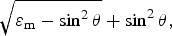
 ${\rm \beta} = \sqrt {{\rm \varepsilon} _1 - \sin ^2 {\rm \theta}}$
 $\sqrt {{\rm \varepsilon} _{\rm m} - \sin ^2 {\rm \theta}} + \sin ^2 {\rm \theta}, $
while a
j(y,z) = eE
j(y,z)/jm
e
ωc and a′
l(y,z) = eE′
l(y,z)/lm
e
ωc are the respective normalized amplitudes of the transmitted electric field of the two laser beams. Equations (9a) and (9b) show that for various values of m, the plasma electron velocities oscillate at even as well as odd harmonics of the laser frequency ω. This suggests the possibility of generation of odd and even harmonics in plasma by two-color laser beams. The first term on the right-hand side of each of these equations represents the quiver velocity of plasma electrons in presence of the two-color laser system, while the last two terms arise due to
 $\vec v \times \vec B$
force exerted on the plasma electrons, giving rise to transverse plasma electron velocities oscillating at combination frequencies. If we consider m = 2, plasma electron velocities oscillate at 3ω, leading to the generation possibility of third-harmonic radiation.
Further, the last term on the right-hand side of each of these equations contain cross-terms arising due to simultaneous propagation of the two-color obliquely incident p-polarized laser beams in the plasma. This term reduces to zero if either (i) single-beam propagation is considered or (ii) the beams are normally incident on the vacuum–plasma interface. Therefore the occurrence of this term is expected to enhance the harmonic conversion efficiency as compared with that obtained by normal incidence of two-color laser beams as well as that generated by a single p-polarized obliquely incident laser beam propagating in the plasma.
The first-order perturbative expansion of Eqs. (6)–(8) may be combined with the density ripple n
0, to give the first-order plasma electron density
 $(n_{\rm e}^{(1)} )$
normalized by n
00 as
 $$n = \displaystyle{{icn_{d0} k_0 \sin {\rm \theta}} \over {2{\rm \omega}}} \left[ {\displaystyle{{a_1} \over {{\rm \varepsilon} _1^{{3 / 2}}}} \exp (i{\rm \zeta} ) + \displaystyle{{a_{\rm m}^{\prime}} \over {m{\rm \varepsilon} _{\rm m}^{{3 / 2}}}} \exp (i{\rm \zeta} ^{\prime})} \right] + {\rm c}{\rm. c}.,$$
where ζ = k
1y
y + (k
1z
+ k
0)z − ωt, ζ′ = k
my
y + (k
mz
+ k
0)z − mωt, and n
d0 = n
d/n
00. It may be noted that the plasma electron density oscillation at the fundamental and harmonic frequencies arises due to oblique incidence of the laser beams inside the rippled density plasma and vanishes for normal incidence. The perturbed plasma electron velocities [Eqs. (9a) and (9b)] and density [Eq. (10)] can be used to obtain the perturbed current densities along the
 $\hat y$
and
 $\hat z$
-directions, respectively, as
 $$\eqalign{J_y = & \displaystyle{{n_{00} ec} \over 2}\left[ {\sum\limits_{\,j = 1}^2 {i\left\{ {\left( {a_{\,jy} \exp \left( {i{\rm \delta} _j} \right) + a_{ly}^{\prime} \exp \left( {i{\rm \delta}_l^{\prime}} \right)} \right)} \right.}} \right. \cr & \left. { +\; n_{d0} \left( {a_{\,jy} \exp \left( {i{\rm \zeta} _j} \right) + a_{ly}^{\prime} \exp \left( {i{\rm \zeta} _l^{\prime}} \right)} \right)} \right\} \cr & + \displaystyle{{\sin {\rm \theta}} \over 4}\left\{ {a_1^2 \exp \left( {2i{\rm \delta}} \right) + a_m^{\prime 2} \exp \left( {2i{\rm \delta} ^{\prime}} \right)} \right. \cr & \left. { - \displaystyle{{2{\rm \beta}} \over {\sqrt {{\rm \varepsilon} _1} \sqrt {{\rm \varepsilon} _{\rm m}}}} a_1 a_{\rm m}^{\prime} \left( {\exp \left( {i{\rm \varphi} _ +} \right) - \exp \left( {i{\rm \varphi} _ -} \right)} \right)} \right\} \cr & + \displaystyle{{n_{{\rm d}0} \sin {\rm \theta}} \over 4}\left\{ {a_1^2 \exp \left( {i{\rm \xi}} \right) + a_{\rm m}^{\prime 2} \exp \left( {i{\rm \xi} ^{\prime}} \right)} \right. \cr & - \left. {\displaystyle{{2{\rm \beta}} \over {\sqrt {{\rm \varepsilon} _1} \sqrt {{\rm \varepsilon} _{\rm m}}}} a_1 a_{\rm m}^{\prime} \left( {\exp \left( {i{\rm \Phi} _ +} \right) - \exp \left( {i{\rm \Phi} _ -} \right)} \right)} \right\} \cr & - \displaystyle{{cn_{{\rm d}0} k_0 \sin {\rm \theta}} \over {2{\rm \omega}}} \left\{ {\displaystyle{{\sqrt {{\rm \varepsilon} _1 - \sin ^2 {\rm \theta}}} \over {{\rm \varepsilon} _1^2}}} \right.a_1^2 \exp \left( {i{\rm \xi}} \right) \cr & + \displaystyle{{\sqrt {{\rm \varepsilon} _{\rm m} - \sin ^2 {\rm \theta}}} \over {m{\rm \varepsilon} _m^2}} a_{\rm m}^{\prime 2} \exp \left( {i{\rm \xi} ^{\prime}} \right) \cr & + a_1 a_{\rm m}^{\prime} \left( {\displaystyle{{\sqrt {{\rm \varepsilon} _1 - \sin ^2 {\rm \theta}}} \over {m\sqrt {{\rm \varepsilon} _1} {\rm \varepsilon} _{\rm m}^{{3 / 2}}}} + \displaystyle{{\sqrt {{\rm \varepsilon} _{\rm m} - \sin ^2 {\rm \theta}}} \over {{\rm \varepsilon} _1^{{3 / 2}} \sqrt {{\rm \varepsilon} _{\rm m}}}}} \right) \cr & \left. {\left. {\left( {\exp \left( {i{\rm \Phi} _ +} \right) - \exp \left( {i{\rm \Phi} _ -} \right)} \right){\rm}} \right\}} \right] + {\rm c}{\rm. c}.}$$
and
 $$\eqalign{J_z = & \displaystyle{{n_{00} ec} \over 2}\left[ {\sum\limits_{\,j = 1}^2 {i\left\{ {\left( {a_{\,jz} \exp (i{\rm \delta} _j ) + a_{lz}^{\prime} \exp (i{\rm \delta} ^{\prime}_l )} \right)} \right.}} \right. \cr & \left. { +\; n_{{\rm d}0} (a_{zy} \exp (i{\rm \zeta} _j ) + a_{{\rm l}z}^{\prime} \exp (i{\rm \zeta} ^{\prime}_l ))} \right\} \cr & + \displaystyle{1 \over 4}\left\{ {\sqrt {{\rm \varepsilon} _1 - \sin ^2 {\rm \theta}} a_1^2 \exp (2i{\rm \delta} )} \right. \cr &+ \left. {\sqrt {{\rm \varepsilon} _{\rm m} - \sin ^2 {\rm \theta}} a_{\rm m}^{\prime 2} \exp (2i{\rm \delta} ^{\prime})} \right\} \cr &- \displaystyle{{\rm \beta} \over {2\sqrt {{\rm \varepsilon} _1} \sqrt {{\rm \varepsilon} _{\rm m}}}} a_1 a_{\rm m}^{\prime} \left\{ {\displaystyle{{m\sqrt {{\rm \varepsilon} _{\rm m} - \sin ^2 {\rm \theta}} + \sqrt {{\rm \varepsilon} _1 - \sin ^2 {\rm \theta}}} \over {m + 1}}} \right. \cr & \quad \left. {\exp (i{\rm \varphi} _ + ) - \displaystyle{{m\sqrt {{\rm \varepsilon} _{\rm m} - \sin ^2 {\rm \theta}} - \sqrt {{\rm \varepsilon} _1 - \sin ^2 {\rm \theta}}} \over {m - 1}}\exp (i{\rm \varphi} _ - )} \right\} \cr &+ \displaystyle{{n_{{\rm d}0}} \over 4}\left\{ {\sqrt {{\rm \varepsilon} _1 - \sin ^2 {\rm \theta}} a_1^2 \exp (i{\rm \xi} ) + \sqrt {{\rm \varepsilon} _m - \sin ^2 {\rm \theta}} a_{\rm m}^{\prime 2} \exp (i{\rm \xi} ^{\prime})} \right\} \cr &- \displaystyle{{n_{{\rm d}0} {\rm \beta}} \over {2\sqrt {{\rm \varepsilon} _1} \sqrt {{\rm \varepsilon} _{\rm m}}}} a_1 a_{\rm m}^{\prime} \left\{ {\displaystyle{{m\sqrt {{\rm \varepsilon} _{\rm m} - \sin ^2 {\rm \theta}} + \sqrt {{\rm \varepsilon} _1 - \sin ^2 {\rm \theta}}} \over {m + 1}}} \right. \cr & \quad \left. {\exp (i{\rm \Phi} _ + ) - \displaystyle{{m\sqrt {{\rm \varepsilon} _{\rm m} - \sin ^2 {\rm \theta}} - \sqrt {{\rm \varepsilon} _1 - \sin ^2 {\rm \theta}}} \over {m - 1}}\exp (i{\rm \Phi} _ - )} \right\} \cr &+ \displaystyle{{cn_{{\rm d0}} k_0 \sin ^2 {\rm \theta}} \over {2{\rm \omega}}} \left\{ {\displaystyle{{a_1^2} \over {{\rm \varepsilon} _1^2}} \exp \left( {i{\rm \xi}} \right) + \displaystyle{{a_{\rm m}^{\prime 2}} \over {m{\rm \varepsilon} _{\rm m}^2}} \exp (i{\rm \xi} ^{\prime}) }\right. \cr & + \left. {\left. {a_1 a_m^{\prime} \left( {\displaystyle{{{\rm \varepsilon} _1 + m{\rm \varepsilon} _{\rm m}} \over {m{\rm \varepsilon} _1^{{3 / 2}} {\rm \varepsilon} _{\rm m}^{{3 / 2}}}}} \right)(\exp (i{\rm \Phi} _ + ) - \exp (i{\rm \Phi} _ - ))} \right\}} \right] + {\rm c}{\rm. c}.,} $$
where ξ = 2k 1y y + (2k 1z + k 0)z − 2ωt, ξ′ = 2k my y + (2k mz + k 0)z − 2mωt, and Φ± = (k my ± k 1y )y + (k mz + k 0 ± k 1z )z − (m ± 1)ωt. While deriving Eqs. (11a) and (11b), the lowest (second) order nonlinear terms have been retained. The harmonic oscillations arise due to nonlinear relativistic effect as well as coupling of the first-order density perturbation with the quiver velocity of plasma electrons. These current densities will drive the harmonic fields of the laser beams.
3. THIRD-HARMONIC RADIATION GENERATION
In order to study the generation of third-harmonic frequency, we consider m = 2. The current density driving the electric field along
 $\hat y$
and
 $\hat z$
-directions are respectively substituted from Eqs. (11a) and (11b) in the source term of wave equation (5) and the third-harmonic terms are equated. Assuming that the distance over which ∂a
3(y,z) (z)/∂z changes appreciably is large compared with the wavelength (∂2
a
3(y,z) (z)/∂z
2 < k
3(y,z)∂a
3(y,z) (z)/∂z) and neglecting pump depletion effects, the evolution of the third-harmonic amplitude along the
 $\hat y$
and
 $\hat z$
-directions are respectively governed by
 $$\eqalign{ \displaystyle{\partial a_{3y} (z)} \over {\partial z} &= \displaystyle{{{\rm \omega} _{\rm p}^2 \sin {\rm \theta}} \over {4c^2 \sqrt {{\rm \varepsilon} _1} \sqrt {{\rm \varepsilon} _2} k_{3z}}} a_1 a_2^{\prime} \left[ {{\rm \beta} \exp (i{\rm \Delta} k.z) }\right.\cr & \left.\quad + n_{{\rm d}0} \left\{ {{\rm \beta} + (ck_0 {\rm \Omega} /2{\rm \omega} )} \right\}\exp (i{\rm \Delta} k^{\prime}.z) \right]}$$
and
 $$\eqalign{ \displaystyle{{\partial a_{3z} (z)} \over {\partial z}} =& \displaystyle{{{\rm \omega} _{\rm p}^2} \over {4c^2 \sqrt {{\rm \varepsilon} _1} \sqrt {{\rm \varepsilon} _2} k_{3z}}} \cr & a_1 a_2^{\prime} \left[ {{\rm \chi} {\rm \beta} \exp (i{\rm \Delta} k.z) + n_{{\rm d}0} \{ {\rm \chi} {\rm \beta} - (ck_0 /{\rm \omega} )} \right. \cr & \left. {\left. {\sin ^2 {\rm \theta} (1/{\rm \varepsilon} _1 + 1/2{\rm \varepsilon} 2)} \right\}\exp (i{\rm \Delta} k^{\prime}.z)} \right],}$$
where
 ${\rm \Omega} = \left\{ {\left( {{{\sqrt {{\rm \varepsilon} _1 - \sin ^2 {\rm \theta}}} / {{\rm \varepsilon} _2}}} \right) + \left( {{{2\sqrt {{\rm \varepsilon} _2 - \sin ^2 {\rm \theta}}} / {{\rm \varepsilon} _1}}} \right)} \right\}$
and
 ${\rm \chi} = \displaystyle{1 \over 3}\left( {\sqrt {{\rm \varepsilon} _1 - \sin ^2 {\rm \theta}} + 2\sqrt {{\rm \varepsilon} _2 - \sin ^2 {\rm \theta}}} \right)$
. The first term on the right-hand side of each of Eqs. (12a) and (12b) arising due to mixing of the two-color beams in uniform density, depicts a phase-mismatch Δk = k
2z
+ k
1z
− k
3z
between the generated third-harmonic and the fundamental frequency of the laser radiation, while the second term is a contribution of the rippled density. This term, depicting a phase-difference Δk′ = (k
2z
+ k
1z
− k
3z
) + k
0 between the generated third-harmonic and the fundamental frequency, points toward the possibility of achieving phase-matching condition. Integrating Eqs. (12a) and (12b) with the assumption that the fundamental amplitudes [a
1(y,z) and a′2(y,z)] of each of the two lasers do not evolve significantly with z, the amplitudes of the third harmonic, respectively, along the
 $\hat y$
and
 $\hat z$
-directions, are given as
 $$\eqalign{ a_{3y} (z) =& \displaystyle{{{\rm \omega} _{\rm p}^2 \sin {\rm \theta}} \over {2c^2 \sqrt {{\rm \varepsilon} _1} \sqrt {{\rm \varepsilon} _2} k_{3z}}} a_1 a_2^{\prime} \left[ {\displaystyle{{\rm \beta} \over {{\rm \Delta} k}}\exp \left( {\displaystyle{{i{\rm \Delta} k.z} \over 2}} \right)\sin \left( {\displaystyle{{{\rm \Delta} k.z} \over 2}} \right)} \right. \cr & \left. { + \displaystyle{{n_{{\rm d0}}} \over {{\rm \Delta} k^{\prime}}}\left\{ {{\rm \beta} + \left( {\displaystyle{{ck_0 {\rm \Omega}} \over {2{\rm \omega}}}} \right)} \right\}\exp \left( {\displaystyle{{i{\rm \Delta} k^{\prime}.z} \over 2}} \right)\sin \left( {\displaystyle{{{\rm \Delta} k^{\prime}.z} \over 2}} \right)} \right]}$$
and
 $$\eqalign{a_{3z} (z) &= \displaystyle{{{\rm \omega} _{\rm p}^2} \over {2c^2 \sqrt {{\rm \varepsilon} _1} \sqrt {{\rm \varepsilon} _2} k_{3z}}} a_1 a_2^{\prime} \left[ {\displaystyle{{{\rm \chi} {\rm \beta}} \over {{\rm \Delta} k}}\exp \left( {\displaystyle{{i{\rm \Delta} k.z} \over 2}} \right)\sin \left( {\displaystyle{{{\rm \Delta} k.z} \over 2}} \right)} \right. \cr &+ \displaystyle{{n_{d0}} \over {{\rm \Delta} k^{\prime}}}\left\{ {\rm \chi} {\rm \beta} - (ck_0 /{\rm \omega} )\sin ^2 {\rm \theta} (1/{\rm \varepsilon} _1 + 1/2{\rm \varepsilon} _2 ) \right\} \cr &\left. {\exp \left( {\displaystyle{{i{\rm \Delta} k^{\prime}.z} \over 2}} \right)\sin \left( {\displaystyle{{{\rm \Delta} k^{\prime}.z} \over 2}} \right)} \right].}$$
Equations (13a) and (13b) show that the amplitude of the third-harmonic radiation is a superposition of two oscillations having different amplitudes and wave numbers. Since the electric fields of the transmitted third-harmonic radiation are obtained along the
 $\hat y$
and
 $\hat z$
-directions, it may be concluded that the harmonic radiation is also p-polarized. The modulus of the resultant amplitude
 $\left( { = \sqrt {a_{3y}^2 (z) + a_{3z}^2 (z)}} \right)$
of the third harmonic normalized by the sum of fundamental amplitudes in vacuum (a
01 + 2a′02) is given by
 $$\eqalign{\left \vert {a_3 (z)} \right \vert &= \displaystyle{{3{\rm \omega} _{\rm p}^{\rm 2} a_1 a_2^{\prime}} \over {2c^2 \sqrt {{\rm \varepsilon} _1} \sqrt {{\rm \varepsilon} _2} k_{3z} \left( {a_{01} + 2a_{02}^{\prime}} \right)}}\cr & \quad \times \left[\displaystyle{{n_{{\rm d}0}^2} \over {{\rm \Delta} k^{\prime 2}}} \left\{{\sin ^2 {\rm \theta}} ({\rm \beta} + (ck_0 {\rm \Omega} /2{\rm \omega} ))^2 + ({\rm \chi} {\rm \beta} - (ck_0 /{\rm \omega} )\right.\right.\cr & \left.\left. \quad{\sin ^2 {\theta} (1/{\rm \varepsilon} _1 + 1/2{\rm \varepsilon} _2 ))^2}\right\} \right.\cr & \left.\quad \sin ^2 \left( {\displaystyle{{{\rm \Delta} k^{\prime}.z} \over 2}} \right) + \displaystyle{{2{\rm \beta} n_{{\rm d}0}} \over {{\rm \Delta} k.{\rm \Delta} k^{\prime}}}\left\{{\rm \beta} (\sin ^2 {\rm \theta} + {\rm \chi} ^2 )\right.\right.\cr & \left.\quad +\displaystyle{{ck_0 \sin {\rm \theta}} \over {2{\rm \omega}}} \left( {{\rm \Omega} - \displaystyle{{{\rm \chi} \sin {\rm \theta} ({\rm \varepsilon} _1 + 2{\rm \varepsilon} _2 )} \over {{\rm \varepsilon} _1 {\rm \varepsilon} _2}}} \right)\sin \left( {\displaystyle{{{\rm \Delta} k.z} \over 2}} \right)\sin \left( {\displaystyle{{{\rm \Delta} k^{\prime}.z} \over 2}} \right)\right.\cr & \left.\quad {\cos \left( {\displaystyle{{\left( {{\rm \Delta} k - {\rm \Delta} k^{\prime}} \right).z} \over 2}} \right) + \displaystyle{{{\rm \beta} ^2} \over {{\rm \Delta} k^2}} ({\rm \chi} ^2 + \sin ^2 {\rm \theta} )\sin ^2 \left( {\displaystyle{{{\rm \Delta} k.z} \over 2}} \right)} \right]^{{1 / 2}}.}$$
Considering the amplitude of the ripple density to be zero (n d0 = 0), Eq. (14) reduces to the normalized third-harmonic amplitude for homogeneous plasma (without density ripple), given by
 $$\eqalign{ \left \vert {\hat a_{3_0} (z)} \right \vert &= \displaystyle{{3{\rm \omega} _{\rm p}^2 a_1 a_2^{\prime} {\rm \beta}} \over {2c^2 \sqrt {{\rm \varepsilon} _1} \sqrt {{\rm \varepsilon} _2} k_{3z} {\rm \Delta} k(a_{01} + 2a_{02}^{\prime} )}} \cr & \quad ({\rm \chi} ^2 + \sin ^2 {\rm \theta} )^{{1 / 2}} \sin \left( {\displaystyle{{{\rm \Delta} k.z} \over 2}} \right){\rm.}} $$
The third-harmonic amplitude is seen to oscillate with propagation distance and is always phase-mismatched. In presence of the density ripple, however, phase matching can be achieved by considering Δk′ = 0 in Eq. (14). Applying this condition leads to
 $$\eqalign{& k_0 = k_{3z} - k_{2z} - k_{1z} = ({\rm \omega} /c) \cr & \quad \left( {3\sqrt {{\rm \varepsilon} _3 - \sin ^2 {\rm \theta}} - 2\sqrt {{\rm \varepsilon} _2 - \sin ^2 {\rm \theta}} - \sqrt {{\rm \varepsilon} _1 - \sin ^2 {\rm \theta}}} \right).} $$
It may be noted that this phase-matching condition can be obtained only in presence of the density ripple. Phase-matching condition can be satisfied by choosing an appropriate value of the ripple wave number for a given value of the normalized plasma frequency and angle of incidence. Figure 1 shows a plot between the periodic ripple wave number (k 0) and normalized plasma frequency (ωp/ω) for different angles of incidence of the laser beams. It is seen that for a given value of normalized plasma frequency, if the angle of incidence of the laser beams is increased, the periodic ripple wave number must also be increased, in order to achieve phase-matching condition.
Variation of density ripple wave number (k 0) with normalized plasma frequency (ωp/ω), for ω = 1.88 × 10¹⁵ radHz for different values of angle of incidence of laser beams.

Applying the phase-matching condition, Eq. (14) reduces to
 $$\eqalign{ \left \vert {\hat a_3 (z)} \right \vert = & {3{\rm \omega} _{\rm p}^2 a_1 a_2^{\prime} \over {2c^2 \sqrt {{\rm \varepsilon} _1} \sqrt {{\rm \varepsilon} _2} k_{3z} (a_{01} + 2a_{02}^{\prime} )}} \cr & \left[{{n_{{\rm d}0}^2 z^2} \over 4} \left\{\sin ^2 {\rm \theta} ({\rm \beta} + (ck_0 {\rm \Omega} /2{\rm \omega} ))^2 \right. \right. \cr & \left. \left. + \;{({\rm \chi} {\rm \beta} - (ck_0 /{\rm \omega} )\sin ^2 {\rm \theta} (1/{\rm \varepsilon} _1 + 1/2{\rm \varepsilon} _2 ))^2}\right\}\right. \cr & \left. + \displaystyle{{{\rm \beta} n_{{\rm d}0} z} \over {2k_0}} \left\{{{\rm \beta} (\sin ^2 {\rm \theta} + {\rm \chi} ^2 ) + \displaystyle{{ck_0 \sin {\rm \theta}} \over {2{\rm \omega}}}} \right. \right. \cr & \left. \left. {\left( {{\rm \Omega} - \displaystyle{{{\rm \chi} \sin {\rm \theta} ({\rm \varepsilon} _1 + 2{\rm \varepsilon} _2 )} \over {{\rm \varepsilon} _1 {\rm \varepsilon} _2}}} \right)} \right\} \sin (k_{0.} z) \right. \cr & \left. + \displaystyle{{{\rm \beta} ^2} \over {k_0^2}} ({\rm \chi} ^2 + \sin ^2 {\rm \theta} )\sin ^2 \left( {\displaystyle{{k_0. z} \over 2}} \right) \right] ^{1 / 2}.}$$
The modulus of the normalized third-harmonic amplitude is seen to be a superposition of the phase-matched term, increasing almost linearly with the propagation distance and two oscillatory phase-mismatched contributions. The harmonic conversion efficiency (η) is defined as
 $${\rm \eta} = \hat a_j^2. $$
Substituting Eqs. (15) and (17) into Eq. (18) leads to the third-harmonic conversion efficiency respectively under phase-mismatched and phase-matched conditions. In order to study the significance of introducing the density ripple for purpose of achieving phase-matching conditions, Figures 2 and 3 have been respectively plotted for homogeneous and rippled density (under phase-matched condition) plasmas. Figure 2 shows the variation of the modulus of the normalized third-harmonic amplitude [Eq. (15)] with normalized propagation distance (z/λ) for different angles of incidence (without density ripple), for the parameters λ = 1.0μm, ωp/ω = 0.1, a 01 = 0.3, and a′02 = 0.15. The harmonic amplitude is seen to oscillate with normalized propagation distance, while it shows a gradual increase and then enhances rapidly with increase in angle of incidence. The conversion amplitude increases upto a coherence (detuning) length and reduces again due to phase-mismatch between the third-harmonic and the fundamental frequencies. It is important to note that the third-harmonic amplitude using two-color obliquely incident p-polarized laser beams in uniform plasma density is one order of magnitude higher than that obtained for normal incidence of two-color laser beams for the same laser and plasma parameters (Jha et al., Reference Jha, Verma and Saroch2013). Figure 3 shows the variation of the modulus of the resultant normalized third-harmonic amplitude [Eq.(17)] with normalized propagation distance (z/λ), for different angles of incidence under phase-matched condition obtained using an appropriate value of ripple wave number (k 0) for rippled plasma having normalized amplitude of the ripple density n d0 = 0.1 (n d = 1.1 × 1018 cm−3). All other laser and plasma parameters are the same as those used for plotting Figure 2. It is seen that the harmonic amplitude increases linearly with propagation distance as well as the angle of incidence. The propagation distance has been considered well within the Rayleigh length. Further, the third-harmonic amplitude obtained in Figure. 3 is an order of magnitude higher than that obtained in Figure 2, due to phase-matched propagation achieved on account of the presence of rippled density. The intensity of third-harmonic radiation at saturation for rippled (homogeneous) plasmas is found to be 7.89 × 10¹⁴ W/cm2 (7.30 × 10¹² W/cm2) and is proportional to pump intensity (2.46 × 10¹⁷ W/cm2) with a power of 2.94 (2.98), in the mildly relativistic regime. Chen et al. (Reference Chen, Maksimchuk, Esarey and Umstadter2000) have experimentally observed the same scale of intensity dependence for pump intensity of the same order as considered in our case, even though the configurations are different.
Variation of normalized third-harmonic amplitude with normalized propagation distance (z/λ) for different values of angle of incidence, in homogeneous plasma, for ωp/ω = 0.1, a 01 = 0.3, a′02 = 0.15, and ω = 1.88 × 10¹⁵ radHz.

Variation of normalized third-harmonic amplitude with normalized propagation distance (z/λ) for different values of incident angles, in rippled density plasma, for ωp/ω = 0.1, a 01 = 0.3, a′02 = 0.15, n d = 1.1 × 1018 cm−3, and ω = 1.88 × 10¹⁵ radHz.

The variation of the conversion efficiency (η) with the normalized propagation distance (z/λ) has been plotted in Figure 4, for the same parameters as in Figure 3 for a typical angle of incidence θ = 70°. The solid curve represents the efficiency of third-harmonic generation under phase-matched condition (rippled plasmas), while the dotted curve shows the efficiency variation for phase-mismatched condition (homogeneous plasmas). The third-harmonic conversion efficiency increases quadratically with the laser propagation distance through plasma in the presence of rippled density. However, in a uniform plasma, the efficiency is seen to oscillate with normalized propagation distance. Since the harmonic radiation is driven by the fundamental laser frequency, its generation is possible upto a given value of θ(=θmax), beyond which the propagation constant k 1 of the fundamental becomes imaginary. Therefore ε1 = sin2 θmax (θmax = cos−1 (ωp/ω)) determines the cut-off value of θ beyond which the transmitted fundamental and hence the enhanced harmonic radiation will not propagate. If larger values of the frequency multiplication factor m are considered, then generation of higher harmonics would be possible. This is evident from the fact that the maximum frequency at which the current density [Eqs. (11a) and (11b)] oscillates is (m + 1).
Variation of third-harmonic conversion efficiency with normalized propagation distance (z/λ). (i) Under phase- matched conditions (solid curve) in rippled plasmas (n d = 1.1 × 1018 cm−3) having k 0 = 1084 cm−1 and (ii) in homogeneous plasma (dotted curve) for ωp/ω = 0.1, a 01 = 0.3, a′02 = 0.15, θ = 70°, and ω = 1.88 × 10¹⁵ radHz.

4. SUMMARY AND DISCUSSION
Generation of phase-matched third-harmonic radiation by the interaction of two-color obliquely incident, p-polarized laser beams with plasma having density ripple, has been analyzed, in the mildly relativistic regime. A plasma with a density ripple could be a suitable medium for efficient generation of the harmonics of electromagnetic radiation. The ripple provides the uncompensated momentum between a harmonic photon and fundamental photons, which consequently leads to resonant enhancement of harmonic power. The frequency of the second laser beam is considered to be a second or higher multiple of the first. Perturbative technique has been used to obtain the nonlinear plasma electron current density. The current density is substituted into the source term of the wave equation and third-harmonic terms are equated to obtain the evolution of the third-harmonic amplitude.
The two-color obliquely incident, p-polarized laser beams of frequencies ω and 2ω induce quiver motion of plasma electrons and exert a
 $\vec v \times \vec B$
force on plasma electrons at combination of frequencies, giving rise to transverse plasma electron velocity oscillating at 3ω, leading to the generation of third-harmonic current density. The generation of third-harmonic radiation appears in the second order of the radiation field, which enhances the harmonic amplitude approximately by one order of magnitude in comparison with that obtained by normal incidence of two-color laser beams in homogeneous plasma. It is seen that the periodicity of spatially varying plasma density allows the third-harmonic radiation to be phase-matched with the fundamental radiation frequency due to which, the energy conversion from the fundamental to the third-harmonic radiation becomes more efficient. The amplitude as well as efficiency of third-harmonic radiation oscillates with propagation distance for homogeneous plasma, while the amplitude (efficiency) increases linearly (quadratically) in rippled density plasma. A comparison of the normalized third-harmonic amplitude (efficiency) for the two cases shows that the harmonic amplitude (efficiency) in the latter case can be increased by several orders of magnitude by choosing suitable wave number of the density ripple. The normalized amplitude of the third-harmonic radiation increases as the angle of incidence is increased, upto an angle θmax [for which the propagation constant (k
1) of the fundamental frequency is real]. The current analytical study also focuses on the possibility of generation of higher order harmonics by considering higher integer values of the frequency multiplication factor m.
ACKNOWLEDGEMENTS
Authors E. A. and N. K. V. are grateful to the University Grants Commission, Government of India, for providing financial support under the Basic Science Research Scheme.



