

Introduction
Human cutaneous leishmaniasis (CL) is a vector-borne skin infection caused by the protozoan parasite of the genus Leishmania (Kinetoplastida: Trypanosmatidae). In Sri Lanka, the first locally acquired CL incidence was reported in 1992 (Athukorale et al., Reference Athukorale, Seneviratne, Ihalamulla and Premaratne1992). Thereafter, several sporadic CL cases have been recorded, mainly in the north and north-central parts (Siriwardena et al., Reference Siriwardena, Udagedara and Karunaweera2003) and to a lesser extent in the southern region of the island (Naotunne et al., Reference Naotunne, Rajakulendran, Abewickreme, Kulasiri, Perera, Premaratne, Attygalle and Mendis1990; Seneviratne et al., Reference Seneviratne, Siriwardena, Ratnatunga and Wijesundera1995). Karunaweera et al. (Reference Karunaweera, Pratlong, Siriwardena, Ihalamulla and Dedet2003) identified the causative pathogen of CL as the Leishmania donovani zymodeme MON-37. During 2001–2005, the number of CL cases increased in Sri Lanka and since 2004 a significant jump has been reported from the southern province (Rajapaksa et al., Reference Rajapaksa, Ihalamulla, Udagedera and Karunaweera2007). Out of the three districts in the southern province, i.e. Matara, Galle and Hambanthota, Matara and Hambanthota districts have been identified as the foci for CL. In Matara district, the majority of the CL incidences were concentrated in the Dickwella Divisional Secretariat Division (DSD), which is an administrative unit below the district level having a median population of approximately 50,000 and an average area of 208 km2. According to the Ministry of Health, 590 CL cases have been reported from Matara district during 2006–2009 of which 55% were recorded in Dickwella DSD.
Sandflies (Diptera: Psychodidae) are incriminated as vectors of Leishmania parasites (Perfiliew, Reference Perfiliew1968) and are mostly prevalent in the tropical and sub-tropical countries of the world (Desjeux, Reference Desjeux1996; Choi and Lerner, Reference Choi and Lerner2001). However, to date, few studies have focused on the sandfly fauna in Sri Lanka (Theodor, Reference Theodor1938; Lewis and Killick-Kendrick, Reference Lewis and Killick-Kendrick1973; Karunaweera et al., Reference Karunaweera, Abeysinghe, Porter and Dotson2009; Ozbel et al., Reference Ozbel, Sanjoba, Alten, Asada, Depaquit, Matsumoto, Demir, Siyambalagoda, Rajapakse and Matsumoto2011). Among the sandfly species recorded in Sri Lanka, to date, Phlebotomus argentipes Annandale and Bruetti has been reported as the only proven vector of Leishmania parasites causing CL (Lane et al., Reference Lane, Pile and Amerasinghe1990). Although Dickwella DSD is an endemic focus for CL, sandfly species that could act as potential vectors there are yet to be identified. Hence, in the present study, prevalence, species composition and population dynamics of sandfly species found in Dickwella DSD were investigated.
Materials and methods
Study area
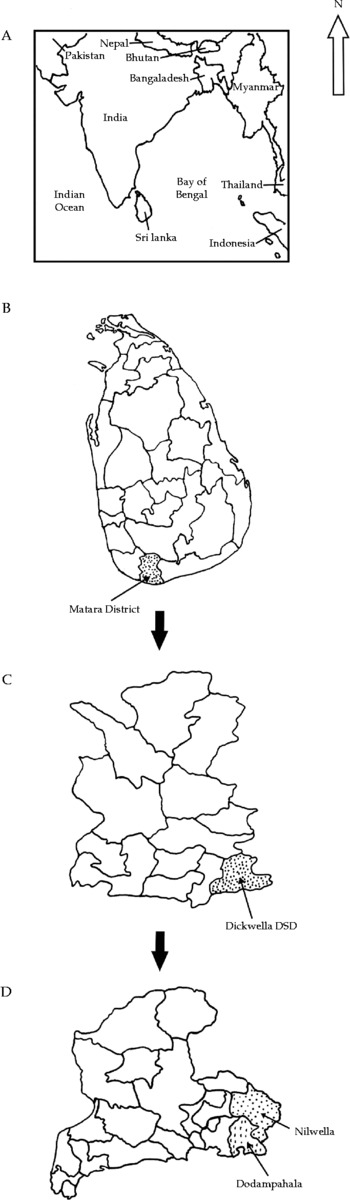
Dickwella DSD lies at 5°47′N latitude and 80°41′E longitude. Based on the climatological conditions, primarily the rainfall, this area is included within the intermediate zone, i.e. between the wet and dry zones of Sri Lanka. The rainfall, reaching an annual average of 1000–1500 mm, occurs primarily during April to June and September to November. The mean daily temperature ranges between 25 and 32°C. Two Medical Officer of Health (MOH) areas, namely Dodampahala (population 1948 as of 2009; area 1.1 km2) and Nilwella (population 1258 as of 2009; area 4.3 km2) (Fig. 1D), were selected for sandfly collection because the majority of the patients who received treatment from Matara General Hospital for CL during the 3 years prior to this investigation came from these two MOH areas. Three sampling stations (station 1 – in Dodampahala MOH area; stations 2 and 3 – in Nilwella MOH area) were chosen, representing three different ecological characteristics within these MOH areas. Station 1 constituted a shallow stagnant water body (approximately 100 m2) that is used for immersing coconut husks for long periods in the traditional coir industry, dense vegetation (i.e. teak, jackfruit, coconut and mango) and a terrain with soils that are rich in organic matter. The second station was located at a slightly higher elevation (i.e. 15 m above sea level) compared with the other two locations, which were at sea level. A coir mill has been established at this location and hence large heaps of coir were visible. Vegetation was rarely seen and extensive soil erosion was evident at this station. The third station was selected in the vicinity of the coast where the terrain was sandy and coconut was the prominent tree species. At all localities, the animal fauna was primarily composed of dogs, domestic cats and rodents.
A, location of Sri Lanka in Asia. B, map of Sri Lanka showing Matara district (shaded). C, map of Matara district showing Dickwella DSD (shaded). D, map of Dickwella DSD showing two MOH areas, i.e. Dodampahala and Nilwella (shaded)

Sandfly collection
Indoor and outdoor sandfly collections were made during March to August 2009, i.e. over a period of 27 weeks. In indoor sampling, resting sandflies were captured from lavatories at all the sampling stations using Castro aspirators (Pessoa and Barretto, Reference Pessoa and Barretto1948). Selection of the lavatories was based on the findings of the preliminary investigation, i.e. the lavatories that were located separately from the human dwellings and which were made of bricks and cement contained sandflies. At least ten such lavatories (i.e. 13 from station 1 and ten from stations 2 and 3) were selected at random from each sampling station. The sandflies were captured from 09.00 to 12.00 h, at weekly intervals (i.e. 27 sampling occasions). In outdoor sampling, initially four types of traps – CDC light trap, sticky trap with castor oil, mouse-baited trap and a cattle-baited trap (Alexander, Reference Alexander2000) – were tested to determine the most efficient trap type. The first three traps proved to be unsatisfactory. Hence, the cattle-baited trap was selected to capture actively foraging adult sandflies. The trap was set up at biweekly intervals (i.e. 13 sampling occasions) at the first two sampling stations (station 1 – in Dodampahala MOH area; station 2 – in Nilwella MOH area) between 18.00 and 05.00 h. Due to logistical reasons, it was not possible to set up a cattle-baited trap at station 3. The rainfall and temperature data in Dickwella DSD were collected from the Agricultural Department, Matara, Sri Lanka.
Identification of sandflies
The catch was brought to the laboratory and preserved in 70% alcohol. Subsequently, the number of flies was counted and their sex determined. Thereafter, the specimens were cleared in 5% KOH for 24 h followed by washing in tap water and the flies were then dissected under a stereomicroscope. Finally, the flies were mounted in Hoyer's medium. Species identification was performed using taxonomic keys proposed by Kalra and Bang (Reference Kalra and Bang1988).
Statistical analysis
Analysis of variance (ANOVA) was performed for comparison of the data on total sandfly density in lavatories and cattle-baited traps, and sex-related counts with respect to different sampling stations using the generalized linear models procedure in SAS (SAS, 1999). When the ANOVA yielded significant F values, means were compared using Tukey's honest significance test (SAS, 1999). The lavatories that did not contain sandflies were excluded from the analysis. In addition, fly numbers pertaining to a particular sex at a given sampling station were compared using Student's t test (SAS, 1999). Prior to the analysis, data were subjected to Shapiro–Wilk's test for normality, and Brown and Forsythe's test for homogeneity of variance. A significance level of 0.05 was used in all analyses.
Results
Sandfly species
Sandfly fauna captured from all the sampling stations of Dickwella DSD comprised of a single species namely Sergentomyia zeylanica irrespective of the capture method.
Indoor sandfly populations
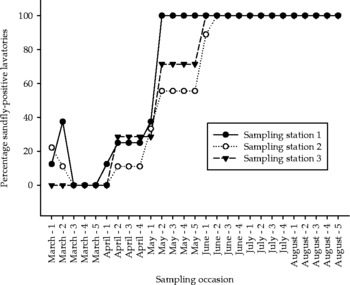
Out of the 81 sampling occasions conducted during the 27-week study period, resting sandflies were captured on 68 occasions irrespective of the sampling station. As a whole, 76% of the lavatories (i.e. 25 out of 33) sampled contained S. zeylanica at least during one sampling occasion. Sixty-one, 90 and 70% of lavatories were shown to be positive for this species at sampling stations 1, 2 and 3, respectively. The percentage of fly-positive lavatories varied with respect to the sampling station as well as over time (Fig. 2). During the first 10 weeks, fly-positive lavatories remained low at all sampling stations. However, with the onset of the eleventh week, i.e. the second week of May, a marked rise was detected and at the sampling station 1, 100% of the lavatories contained flies at this stage. In the case of the other two stations, the maximum level was attained 1 month later. It was also observed that after reaching the plateau, the percentage of positive lavatories remained constant until the end of the study. During the initial 6 weeks, no sandflies were encountered from sampling station 3 (Fig. 2).
Percentage of sandfly-positive lavatories at three different sampling stations in Dickwella DSD during the 27-week investigation period

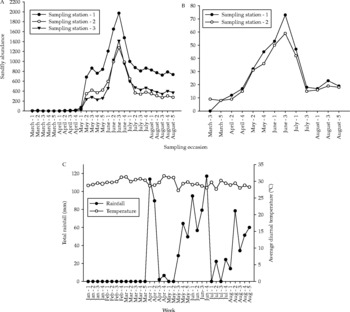
Altogether, 34,481 individual sandflies were captured, of which 49, 25 and 26% came from sampling stations 1, 2 and 3, respectively. Mean ( ± SE) catches differed significantly (F = 43.28; df = 2, 21; P < 0.0001) among the sampling stations. The highest fly density (2119.62 ± 102.01) per lavatory was recorded from lavatories sampled at station 1, which was significantly higher compared with stations 2 and 3. The lowest density (966 ± 91.40) was detected at station 2, which was significantly lower than that of station 3 (1261.43 ± 78.14). Meanwhile, sandfly density differed over time but varied in more or less an identical manner in all the three study locations (Fig. 3). During March to April, zero to low fly density was observed. Thereafter, the numbers started to increase and a small peak was evident in the third week of May. In the third week of June, a clear peak was detected after which a steep fall in fly catch was observed, followed by a slight increase during the fourth weeks of June and August (Fig. 3).
A, total sandfly abundance in lavatories over a period of 27 weeks at three sampling stations in Dickwella DSD; B, total sandfly abundance in cattle-baited traps over a period of 13 weeks at two sampling stations in Dickwella DSD and C, total rainfall and average diurnal temperature in Dickwella DSD.

The sex ratio of the sandflies caught was found to be male-biased, i.e. 1:2 (females:males) (station 1: t = − 9.18, df = 14, P < 0.0001; station 2: t = − 4.67, df = 16, P < 0.0003; station 3: t = − 6.66, df = 12, P < 0.0001). Both sexes were highest at station 1 and were significantly higher (males: F = 44.30, df = 2, 21, P < 0.0001; females: F = 40.25, df = 2, 21, P < 0.0001) compared with stations 2 and 3.
Outdoor sandfly populations
Out of the 26 cattle-baited traps deployed at the two study stations during a 13-week time period, 25 were positive for S. zeylanica. At station 1, this sandfly species was not captured during the first sampling occasion. A total of 691 sandflies were collected from which 53% originated from sampling station 1. However, no significant differences (t = 0.383; df = 24; P < 0.7048) were detected in mean number of sandflies captured/sampling occasion between the two locations (station 1: 28 ± 5.78; station 2: 25.15 ± 4.67). The sex ratio of the captured sandflies was male-biased, i.e. 1:2 (females:males), and no significant differences were detected between the sexes (male: t = 0.774, df = 23, P>0.4471; female: t = 0.492, df = 23, P>0.6272), between the two sampling stations. Fluctuation of fly catches during the study period is shown in Fig. 3. A gradual increase in fly density was observed from March to June with a peak during the third week of June, followed by a marked decline of the numbers. A slight increase in the density occurred in the third week of August (Fig. 3).
Discussion
Among other reasons, the spread of CL depends on the prevalence and the distribution of the sandfly vectors. This paper presents the first report on vector information in Dickwella DSD of southern Sri Lanka, a notable hotspot for CL on the island. Our findings are hence highly important for designing preventive measures and epidemiological forecasting models, as they clearly indicate that the only sandfly species occurring in this area is S. zeylanica. Consequently, this species is most likely the suspected vector of Leishmania parasites responsible for CL incidences in the area. In Sri Lanka, S. zeylanica was first reported in the Colombo district of western province (Theodor, Reference Theodor1938). Later, Karunaweera et al. (Reference Karunaweera, Abeysinghe, Porter and Dotson2009) encountered three S. zeylanica females and 13 males from a single location at a single sampling station in the ‘Mamandala’ region of the dry zone of Sri Lanka, which is also a focus area for CL. Sergentomyia zeylanica has been reported from India and west Pakistan too (Quate, Reference Quate1962; Lewis, Reference Lewis1967). In their study in Sri Lanka, Ozbel et al. (Reference Ozbel, Sanjoba, Alten, Asada, Depaquit, Matsumoto, Demir, Siyambalagoda, Rajapakse and Matsumoto2011) reported at least eight Sergentomyia species but not S. zeylanica; however, the authors reported that the identification of these Sergentomyia species is yet to be completed. Previous studies conducted in Sri Lanka recorded P. argentipes from different parts of the island (Lane et al., Reference Lane, Pile and Amerasinghe1990; Karunaweera et al., Reference Karunaweera, Abeysinghe, Porter and Dotson2009; Ozbel et al., Reference Ozbel, Sanjoba, Alten, Asada, Depaquit, Matsumoto, Demir, Siyambalagoda, Rajapakse and Matsumoto2011). Surprisingly, we did not encounter P. argentipes during our 27-week study period. Phlebotomus argentipes prefers cattle to humans (Singh et al., Reference Singh, Lal and Saxena2008) and hence it is widely associated with cattle sheds (Lane et al., Reference Lane, Pile and Amerasinghe1990). In Dickwella DSD, cattle sheds are rarely found and this might be one reason for the absence of this species. Moreover, climatic factors (Lane et al., Reference Lane, Pile and Amerasinghe1990; Guernaoui et al., Reference Guernaoui, Boumezzough, Pesson and Pichon2005; Chelbi et al., Reference Chelbi, Kaabi, Béjaoui, Derbali and Zhioua2009), characteristics of habitats (Chaniotis et al., Reference Chaniotis, James, Correa, Tesh and Johnson1971) and the type of capture method (Toprak and Özer, Reference Toprak and Özer2007) are important factors determining the species composition of sandflies among different CL foci.
We found lavatories to be excellent resting sites for S. zeylanica, thus favouring human–vector contact and leading to spread of CL. The lavatories that did not contain sandflies had newly constructed cement walls. Sandflies have very limited flight capacity (Chaniotis and Correa, Reference Chaniotis and Correa1974; Morrison, Reference Morrison1993). As such, it can be speculated that the breeding grounds of S. zeylanica extend around the close vicinity of these lavatories. The variations in fly density can be explained by the habitat characteristics of the different sampling stations. In the first sampling station where the highest fly catches were observed, all year round high humidity prevails due to the presence of an adjacent stagnant water body. Dense vegetation makes the soil rich with organic matter, creating an excellent breeding ground for S. zeylanica as well as providing shelter for its animal hosts, such as rodents (Chaniotis et al., Reference Chaniotis, James, Correa, Tesh and Johnson1971; Guernaoui and Boumezzough, Reference Guernaoui and Boumezzough2009). The lower fly density at stations 2 and 3 could primarily be associated with a lack of vegetation. Moreover, at station 3, the sandy soil might negatively affect the breeding of sandflies.
Rainfall pattern had the strongest influence on the number of S. zeylanica collected in the current study, corroborating the earlier findings of Chaniotis et al. (Reference Chaniotis, James, Correa, Tesh and Johnson1971) (Fig. 3). The slight temperature variations might not influence the population fluctuations of S. zeylanica directly. The low prevalence of sandflies from March to April may be related to the prolonged dry weather prevailing from January to the end of March; subsequent heavy rains occurred from the fifth week of March to the third week of April. Eggs, larvae and pupae of sandflies are killed by exposure to dry conditions, and heavy rains inundate the breeding grounds (Sherlock and Sherlock, Reference Sherlock and Sherlock1959; Johnson and Hertig, Reference Johnson and Hertig1961; Chaniotis, Reference Chaniotis1967). Sandflies require 20–40 days to complete their life cycle in the tropics (C. Apiwathnasorn, Mahidol University, Thailand, personal communication). The first small peak density in the second week of May could most probably be related to the completion of the life cycle, with reduced rains occurring from end of April, while the strong peak density in the second week of June as well as the 100% fly-positive lavatories might be attributed to the completion of the second cycle. The steep fall in fly numbers during the third week of June could have been the result of the continuous heavy rains.
The male-skewed sex ratio of S. zeylanica might be due to the aggregation of males for mating with females, genetic control and sex-related mortality (Chaniotis et al., Reference Chaniotis, James, Correa, Tesh and Johnson1971). Moreover, several earlier studies reported male preponderance in phlebotomine sandflies (Chaniotis et al., Reference Chaniotis, James, Correa, Tesh and Johnson1971; Lane et al., Reference Lane, Pile and Amerasinghe1990; Karunaweera et al., Reference Karunaweera, Abeysinghe, Porter and Dotson2009).
Conclusion
Sergentomyia zeylanica is the suspected primary vector of CL in the Dickwella DSD of Sri Lanka. Lavatories were identified as one of the most important targets for the management of adult S. zeylanica. More importantly, outbreaks of CL are expected 1 month after moderate rains. Trials are underway to prove the vector potential of S. zeylanica and explore its breeding grounds.
Acknowledgements
The authors thank Mr Pubudu Methsiri, public health officer, Dodampahala for immense technical support extended to this research.