We have of late been encouraged to think of Britain's imperial past in terms of “webs” and “networks.” Scholars of contemporary globalization, seeking precedent for current perceived trends, have used these labels to describe how different parts of the British Empire were linked together during the nineteenth and twentieth centuries. They argue that the mass media played a particularly significant role in sustaining such patterns of interconnection and, as a result, in forging transnational identities. According to this interpretation, new communications technologies such as telegraphs and submarine telegraph cables allowed news and opinion to be disseminated more rapidly and more freely. Subsequently, this interpretation maintains, radio and television came to act as an even more powerful media of transnational communication, encouraging people to think of themselves as members of global communities. Historians of the British Empire have recently also begun to write about webs and networks and to discuss the role of the mass media in creating imperial communities. In particular, historians of the early nineteenth century have shown how groups of white settlers used newspapers to communicate information and opinion to audiences in Britain and other parts of the empire. Some of these historians argue that, in the process, settlers rehearsed claims to membership in a global British community and discussed ideas about the nature of “Britishness.” As will be discussed below, in deploying a “networked conception” scholars of globalization and historians have generally emphasized the development of patterns of informal, integrative, competing, and constantly shifting interconnection.
How accurate is this picture of the role of the mass media in building and sustaining imperial networks and promoting transnational identities? Can a networked conception provide us with a helpful way of thinking about the nature of the British Empire more generally? This essay argues that, in some cases, throughout the nineteenth and twentieth centuries, sets of connections were formed among different parts of the British Empire that certainly possessed some of the characteristics of webs or networks as they have been identified by proponents of a networked conception: informal, open, multiple, competing, and dynamic. However, it would be misleading to claim that imperial connections always took such forms or even that a networked conception necessarily helps describe the majority of imperial connections. Crucially, in certain circumstances, connections could become more systematic in nature: scholars argue that systems differ from networks in that they are dominated by a restricted number of powerful organizations, whose interests together dictate more formal, entrenched, and limited patterns of interconnection. In order to understand this, we need to look not only at connections between individuals—and at the dialogues and discourses that such links sustained—but also at the commercial and state institutions that often acted to mediate communication between different parts of the world.
As Frederick Cooper has recently argued, scholars who emphasize the significance of global networks have often neglected to explore or acknowledge the limitations of those structures. According to Cooper, “The world has long been—and still is—a space where economic and political relations are very uneven; it is filled with lumps, places where power coalesces surrounded by those where it does not, places where social relations become dense amid others that are diffuse. Structures and networks penetrate certain places and do certain things with great intensity, but their effects tail off elsewhere.”Footnote 1 The discourses that were sustained by imperial connections were seldom entirely independent of these uneven underlying structures: the origins of inequalities and hierarchies cannot be explained purely in terms of cultural representations of difference.Footnote 2 Similarly, it is wrong to privilege the transformative effects of technological change: we must pay attention to the economic, social, and political factors that influenced how new means of communication were actually used. As Cooper hints, in writing about imperial connections we thus need to think about inequalities of power in institutional terms. Patterns of long-distance mass communication in the nineteenth- and twentieth-century British Empire were influenced by particular institutions and marked by an unevenness and a tendency toward systematization that shaped the nature and the extent of connections between different parts of the world and the context in which transnational identities may have operated.
In the British Empire, as elsewhere, newspapers often courted the loyalty of readers, listeners, or viewers by playing consciously on ideas about community. Newspapers would frame the desired audience as a collective body and then would present themselves as servants of that group's interests. Sometimes the appeal was distinctly local, but very often ideas about national identity were expressed. Thus, while, for example, in the 1850s the Manchester Courier sold itself as a self-appointed champion of “provincial aggrandizement,” The Times claimed to represent “the voice of the English nation.”Footnote 3 Later, public broadcasting authorities were similarly keen to stress their national, or even nationalist, credentials. In the wake of the Second World War, the Canadian Broadcasting Corporation (CBC) thus positioned itself in its publicity material as “something that is Canadian, that meets Canadian needs.”Footnote 4 Similarly, in the 1970s, the general manager of the Australian Broadcasting Commission (ABC) argued that his organization had created “a truly national mass audience: its contribution to the development of a sense of national unity in Australia is worth emphasising.”Footnote 5
We might see such conscious claims as echoes of a more profound underlying connection between the mass media and national identity. Famously, Benedict Anderson has argued that newspapers helped associate particular “print languages” with perceived national identities. According to Anderson, this trend was bound up with the commercial drives characteristic of “print capitalism,” which led newspaper enterprises (like book publishing houses) to develop large, discrete, national markets. Readers in these markets consumed newspapers and in the process took part in an “extraordinary mass ceremony,” involving “almost precisely simultaneous consumption … each communicant is well aware that the ceremony he [sic] performs is being replicated simultaneously by thousands (or millions) of others of whose existence he is confident, yet of whose identity he has not the slightest notion.”Footnote 6 According to Anderson, participation in this simultaneous but impersonal ritual allowed readers to imagine themselves as part of a national community, composed of those who shared their language and consumed the same newspapers, even if they never met the vast majority of their fellow members. Anderson argued that this effect operated even in colonial settings, where indigenous peoples and white settlers often used the print language of the imperial power. In such cases a sense of exclusion from equal participation in the empire's structures of rule meant that, for an educated vanguard at least, newspapers (and later radio and television) helped bring into focus a separate national identity.
While Anderson's ideas have enjoyed wide currency, more recently scholars have become interested in analyzing the mass media in a transnational context, as an agent of globalization rather than as a catalyst of nationalism. The sociologist John B. Thompson has thus argued that during the nineteenth century, the press became a powerful agent of transnational communication and encouraged increasingly global senses of community. Like Anderson, Thompson believes that the mass media has been central to the construction of identities in the modern period, particularly because of its increasingly market-oriented nature. However, unlike Anderson, Thompson argues that the quest for larger markets encouraged media concerns to look beyond the borders of the nation. This was facilitated by the introduction of electrical means of information transmission: telegraphs, undersea telegraph cables, and, later, radio and television broadcasting. Thompson claims that from the mid-nineteenth century onward, international news agencies used the new technologies to establish worldwide “networks of communication and information flow.”Footnote 7 According to Thompson, audiences actively exploited the resulting opportunities to forge imagined links with distant others and thus to perceive themselves as members of global communities.Footnote 8 In a colonial context, the mass media may thus have generated a sense of inclusion in a wider imperial community, rather than having stimulated nationalism in the way suggested by Anderson.Footnote 9
David Held, Anthony McGrew, David Goldblatt, and Jonathan Perraton have reiterated such arguments about the role of new communications technologies in nurturing transnational networks and identities. Held and his coauthors present such technologies as part of the “infrastructural support” that allowed the development of more wide-ranging and more densely connected “webs” and “networks of social activity and power.”Footnote 10 As an example of “the globalization of culture and communications” that they believe was the result, they outline the development of the communications infrastructure of the nineteenth-century British Empire, paying particular attention to telegraphs and undersea cables.Footnote 11 Similarly, Edward Herman and Robert McChesney have argued that nineteenth-century European empires provided a framework for the development of a global telegraph and cable infrastructure, international news agencies, and radio broadcasting, all of which they claim laid the foundations for the global reach of modern mass media organizations.Footnote 12 In their most popularized form, such arguments have given rise to the notion that telegraphy created a “Victorian Internet,” characterized by rapid and widespread global communication.Footnote 13
Scholars of globalization seeking precedent for contemporary phenomena often look to the heyday of Victorian overseas expansion. Similarly, some historians have begun to present the British Empire as the crucible in which the “first global economy” was forged: British overseas expansion unleashed transnational forces, created connections between remote parts of the world, and modified preexisting economic, political, social, and cultural structures.Footnote 14 Given this context, it is perhaps not a coincidence that the same emphasis on webs and networks that characterizes much of the literature on globalization has also emerged in some important recent works on the history of the British Empire.
Tony Ballantyne has, for example, argued that, rather than focus on Britain or on individual sites of colonization, historians should think of empire as a “series of historically contingent networks,” “bundles of relationships,” or “webs” that “connected disparate locations into circuits of exchange and debate” as part of a broader process of “imperial globalization.” Ballantyne argues that these webs not only linked Britain with its colonies but also forged connections among various sites of colonization, allowing “cultural traffic” from diverse points of origin to mingle.Footnote 15 These claims are derived from Ballantyne's own detailed analysis of how ideas about Aryanism and race that developed in India, New Zealand, Britain, and elsewhere in the empire came to interact during the eighteenth and nineteenth centuries. However, for Ballantyne, the concept of networks or webs of communication is also of broader applicability in the writing of imperial history. Such terms evoke the multilayered and integrative structure and the shifting and dynamic nature that he claims were typical of imperial connections. Ballantyne argues that information circulated around the British Empire through numerous channels, including those provided by the newspaper press: “the circulation of the printed word wove states together in important ways,” with newspapers helping to form “transnational networks” that “ensured the rapid circulation of a shared body of news and energized intellectual debate within the British empire.” For Ballantyne, “such networks were powerful agents of globalization.”Footnote 16
A networked conception of empire, a global perspective, and an interest in the role of the press similarly inform Alan Lester's recent thought-provoking analysis of connections among different groups in Britain and the British settler colonies during the early nineteenth century. Initially focusing on the Cape Colony in southern Africa, Lester argued that British settler identities were formed not only during conflicts with Dutch settlers and indigenous Africans but also through battles with British humanitarians who sought to combat what they perceived as injustices or atrocities committed by settlers against indigenous peoples. In the course of these political struggles, both settlers and humanitarians tried to represent colonial affairs to audiences in Britain in terms that would support their own particular positions. Moreover, both groups sought to assemble a portfolio of cases, drawn from different colonies, and to place them together in a broader, pan-imperial context. The result was the development of competing networks through which (in an age before telegraphy) ideas and information were communicated around the empire, carried over land and aboard ship by messengers, letters, and newspapers. According to Lester, these networks in turn played a key role in shaping thinking about race, Britishness, and identity. Through their partial representations of colonial conflicts, settlers influenced how their counterparts in other sites of colonization and how people in Britain itself thought about what it meant to be part of a global British community.Footnote 17
Lester has subsequently explored this theme further by looking at three “nodes within an imperial network”—the Cape Colony, New South Wales, and New Zealand—and at the competing settler and humanitarian discourses that connected these “nodes” with each other and with Britain.Footnote 18 In particular, drawing on but also reformulating Anderson's ideas, Lester focuses on newspapers as a crucial means by which settlers imagined and articulated a sense of community with fellow Britons around the world. For Lester, newspapers “helped to bind settlers located in different colonial sites into a broader collective imagination based on the idea of a trans-global British settler identity. … Only through a definition of Britishness as a globalizing phenomenon, rather than a metropolitan monopoly, could settlers at any one site of colonization assert their continued claim to material and moral support from the metropolitan centre.”Footnote 19 Lester thus seeks to show how in the early nineteenth century Britishness was developing into a global identity, not just in its geographical reach but also in terms of how the self-representations of British populations in different parts of the world began to influence each other and to create a broader, shared sense of community. Like Ballantyne, Lester argues that the networked conception on which these specific arguments are based can be applied more widely by those interested in the history of the British Empire. He emphasizes that “concepts such as networks, webs and circuits … [allow the] histories of Britain and its colonies to be conceived as more fluidly and reciprocally interrelated” and are “very fruitful if one wants to consider metropole and colony, or colony and colony, within the same analytical frame, and without necessarily privileging either one.”Footnote 20
Thinking about the British Empire in terms of webs and networks is clearly useful, perhaps particularly so when we look at the late eighteenth and early nineteenth centuries. Using a networked conception of empire, Ballantyne and Lester both deploy substantial amounts of new evidence to support convincing arguments about specific connections. It is not the purpose of this essay to challenge the applicability of a networked conception of empire to the particular cases that they discuss.Footnote 21 However, we do need to question the wider claim that a networked conception offers a superior way of thinking about the history of the British Empire more generally. For in terms of the mass media at least, it is not clear that imperial connections are adequately described in terms of webs or networks, particularly after the middle of the nineteenth century. In this regard, we also need to be wary of work on globalization that emphasizes the role of the mass media in creating liberating networks of communication and forging global identities. Such accounts may not have been given due consideration to the various factors that acted to restrict the ways in which new communications technologies were employed in the late nineteenth and early twentieth centuries.
In many ways, early nineteenth-century imperial networks were a product of how the newspaper trade was structured at the time in Britain and in the colonies. Most press enterprises were small in scale, and many different titles, each with a relatively limited circulation, competed with each other for business. Diversity and fragmentation were the order of the day. This is not to say that the newspaper press that had emerged during the eighteenth century was unsophisticated. Most press enterprises operated on a commercial basis, for profit, and in London at least some had expanded to become complex, impersonal organizations. Despite continuing attempts by the state to regulate and influence the press, in Britain and in many of Britain's colonies, newspapers had gradually helped create a “modern” cultural and political framework and what seemed to be a reasonably participatory “public sphere.”Footnote 22 Papers pursued personal or partisan political programs and expressed editorial opinions with vigor. As Jean Chalaby argues, the people who wrote for the press at this time might more accurately be labeled “publicists” than “journalists.”Footnote 23 These people defended their outspoken critiques of the state and of private interests with the claim that freedom of expression was an essential aspect of “British liberty.”Footnote 24 Indeed, the establishment of a similarly “free” press in different parts of the empire of settlement came to be presented as a reflection of the very British nature of such colonies: one writer later noted that “as the German demands his national beverages wherever he settles, so the Briton insists on his newspaper.”Footnote 25
In such circumstances, newspapers in Britain and around the empire could quite conveniently be turned to serve the purposes of particular imperial networks and to promote the “British” viewpoints of different settler groups. News flowed around the world slowly and unevenly during the early nineteenth century, hampered by the haphazard and unreliable nature of the overland and maritime mail routes that carried reports around the empire. Nevertheless, as early as the mid-eighteenth century, the press had become a medium for communication between Britain and the American colonies. By reprinting extracts from colonial papers, British editors “brought detailed descriptions of American representative proceedings, and the letters of prominent American political and literary figures, into the pages of the London periodical press.”Footnote 26 During the early nineteenth century, newspapers continued to be supplied with overseas news in this way, as reports flowed around the empire in the form of handwritten letters and printed copies of newspapers. Editors eagerly gutted these sources for news, plagiarizing copy from overseas papers.
Although such reports took a long time to reach Britain from individual colonies (and, subsequently, even longer to circulate around the empire), all papers in the same locale were largely dependent on news arriving through the same (often infrequent) mails. This made it difficult and often expensive for any one paper to secure a significant advantage over the others, in terms of the timeliness of reports, even if editors frequently did wish so to compete. It cost The Times over £10,000 a year to maintain an “Extraordinary Express” service from India that involved hiring special agents, couriers, channel steamers, and trains.Footnote 27 In the provinces of the United Kingdom, editors often had to wait for London newspapers to reprint overseas news that had reached the capital by mail, and after the metropolitan papers had arrived in provincial cities and towns, they would in turn be ransacked by local pressmen for news worth republishing one more time. However, particularly in regions with major seaports, such as Plymouth, provincial papers could (as Stephen Manning has shown) enjoy a substantial degree of autonomy in selecting from and publishing news arriving by ship.Footnote 28
Editors in the colonies knew that their news and opinions were being reprinted by British papers in London and the provinces. They welcomed this, for it gave them the opportunity to reach British audiences directly. In their papers, colonial editors printed carefully constructed synopses of local news and opinion, so as to highlight key points that they wished to communicate to metropolitan audiences. These summaries were published on the day that the mails left for England and, on arrival, were subsequently reprinted by papers around the United Kingdom. They could also be taken up by papers in other colonies, although often only after a considerable delay, having traveled along circuitous routes and via London, even then the news hub of the empire.Footnote 29 As Peter Putnis has shown, during the 1840s a “steamship press” developed in London to reciprocate the flow of printed news arriving from the colonies. Titles such as Home News and European Mail published summaries of world news to coincide with the departure of the mails to the colonies.Footnote 30
By their very nature, such complex channels of communication can be hard for the historian to reconstruct without detailed study of a range of newspapers, and sometimes they doubtless remained obscure even to contemporaries. One newspaper would pirate an item from an overseas journal, and others would then reprint the reprint. In the process, details such as the nature of the original source would be lost. Nevertheless, the effects of this type of mass communication could be striking, especially when settler communities were in general agreement about a particular issue. This was demonstrated by British coverage of the Xhosa cattle killings and the subsequent famine among the Xhosa that occurred on the borders of the Cape Colony in 1856–57. Reliant on settler papers arriving by ship for almost all of their news from southern Africa, British papers in London and the provinces provided a remarkably one-sided account of the famine. They displayed the same absence of humanitarian sympathy as the settler papers at the Cape, picked up settler arguments that the famine was purely the fault of the Xhosa themselves, and expected the starving Africans who left their land in search of relief to provide labor for the colony. Settler arguments thus came to inform metropolitan perspectives on events at the periphery; there was an easy fit, as contemporary thinking both at the center and on the margins was informed by broader, shared ideas about providence and political economy.Footnote 31 Similarly, coverage of the Indian Mutiny of 1857–58 in newspapers around the British Empire (and in the United States too) drew largely on the accounts provided by English-language newspapers in India. This may help explain why papers around the English-speaking world tended to explain the event through a “racialised narrative of native atrocity.”Footnote 32
The relatively unstructured, informal channels through which news flowed around the British Empire during the first half of the nineteenth century meant that, during this period, the press could often help sustain a variety of loosely constituted, shifting, and competing imperial networks. Such an apparatus for the transmission of news around the empire could almost be described as democratic, if it were not for the fact that, as Lester has pointed out, it carried highly charged discourses that reinforced class-, gender-, and race-based hierarchies. Moreover, sometimes the channels through which news flowed around the British Empire could work to silence competing voices and instead promote a marked degree of homogeneity, as coverage of events at the Cape or in India during the 1850s demonstrated. By this time, changes already occurring in the way that the British press was supplied with news from overseas rendered this tendency toward systematization more pronounced. News was now arriving in Britain from the colonies carried some of the way by telegraphs and undersea telegraph cables. These technologies were introduced as part of a wider process of transformation, an industrialization of the press that was made possible by advances in methods of production, distribution, and communication. These concurrent changes had profound consequences for how newspaper concerns operated and how they related to their broader social and political milieus. Improved printing techniques allowed ever larger print runs. Better transport links meant that newspapers could cater to growing urban and suburban markets, where literacy was increasingly the norm. As the scale of production grew, commercial preoccupations became more pronounced, and newspapers generally subordinated political considerations to the need to generate revenue by attracting advertisers. While pressmen remained political, they increasingly concerned themselves with broad issues rather than the personal interests of editors or proprietors. “Publicists” became professional “journalists,” and many proprietors became even more concerned than before with commercial matters rather than with advancing political careers.Footnote 33
Scholars of globalization such as Thompson and Held and his coauthors, who focus upon the liberating role of new communications technologies in creating more wide-ranging and more densely connected global networks, have paid insufficient attention to this wider set of transformations. The industrialization of the press meant that the introduction of telegraphs and cables did not simply reinforce existing imperial networks; rather, it reshaped and, to some extent, restricted them. Telegraphs and undersea telegraph cables certainly altered how papers were supplied with overseas news. However, the speed, capacity, and geographic reach of the new technologies were all more limited than the idea of a Victorian Internet would suggest. Moreover, telegraphs and cables were introduced in the context of the ongoing industrialization of the newspaper business, a process occurring all around the empire. With greater industrial concentration came significant agglomerations of commercial influence (akin to the “lumps” described by Frederick Cooper), which at times acted to obstruct communication.
Submarine cables were laid by large private companies, which subsequently charged users punishing transmission rates in order to recoup heavy fixed capital costs and pay generous dividends to shareholders. Such pricing policies were often made possible by the fact that certain companies enjoyed monopolies on direct, electric communication links with particular areas. For example, the Eastern and Eastern Extension Telegraph companies (an interlocking group of enterprises) held a monopoly on telegraphic communication between Britain and Australia until 1902. The high cable charges set by such companies acted to modify and in many ways to limit the impact of nineteenth-century technological innovation in communications. While information could be transmitted at faster speeds than ever before, the expense of using the new cable system constrained the amount of news that could travel through it. Telegraph cables thus tended to service the needs of the global business community more effectively than those of a wider public. Thoughtful contemporaries, such as the journalist and critic R. A. Scott-James, were aware of the resultant failure of new communications technologies to live up to their early promise. “The geographical obstacle of distance no longer checks the distribution of news; but the machinery and railways which have diminished the friction have brought in the element of capital, and imposed a new condition upon the diffusion of ideas. … At all times vested interests crop up seeking to monopolise the free air of knowledge, and the power to deal in knowledge, stifling the national instinct towards inter-communication of ideas—towards national self-consciousness.”Footnote 34
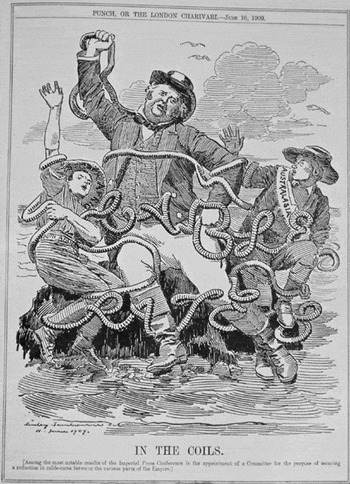
In Britain, some newspaper editors railed at the prohibitive press rates levied by the cable companies. Thus, the first Imperial Press Conference, held in Britain in 1909 and attended by newspaper editors and proprietors from around the empire, was used by some British papers as an opportunity to push for lower press cable rates. Punch portrayed the empire as trapped “In the Coils” of the cable companies (see fig. 1), and the Manchester Guardian similarly lamented the restrictive effects of high cable rates: “To suppose that an Australian or South African citizen will ever have materials for the quick and thorough understanding of a great European dispute so long as cables are a shilling a word, is as foolish as Sancho Panza's example of folly—fishing for mushrooms at the bottom of the sea.”Footnote 35
Limitations imposed on the use of telegraphic communication by the pricing policies of the cable companies meant that, by the late nineteenth century, it had to some extent become more difficult than before for newspapers to satisfy reader demand for up-to-date news. Papers could only afford small quantities of cable news, which not only were insufficient in themselves to provide in-depth coverage of overseas affairs but also rendered obsolete the more detailed reports sent by mail. When a combined British and Egyptian military force sought to reimpose imperial authority over the Sudan in 1896–98, for example, many British newspapers dispatched their own war correspondents to supplement cable news summaries with more detailed accounts that were sent home by post. However, as they discovered after the battle of Omdurman, the mailed reports often reached Britain more than three weeks after the initial news of the battle had arrived by cable. By that point, public interest had tailed off, and fewer people were interested in the detailed mailed accounts, which had been secured by war correspondents at great expense and personal risk.Footnote 36 As Richard Jebb of the London Morning Post later noted, “It is an incident of modern civilisation that people will not read the letters in their newspapers, however excellent those letters may be, with the same avidity as the cabled intelligence—they must have everything red-hot!”Footnote 37
Such considerations were beginning to influence how newspapers secured their news from overseas and, in turn, to reshape webs and networks of imperial communication.
—“In the Coils,” Punch, June 1909, vol. 136–37. Image reproduced courtesy of the Bodleian Library, University of Oxford, shelfmark N.2706 d. 10, page 425.

Newspapers in Britain and around the empire certainly continued to publish mailed reports, which remained an economical way for even the smallest of papers to gather material of their own (especially letters of a nontopical nature) and to flesh out the sparse accounts transmitted by telegraph. However, cable news changed the context in which such reports were read, arguably rendering news and opinion that arrived by mail a less effective means for the construction and maintenance of imperial networks. An elite audience around the empire, composed of limited numbers of politically well-informed and interested readers, certainly remained interested in detailed mailed reports. Even during his time as prime minister, the Australian politician Alfred Deakin was happy to write regular anonymous articles for a comparatively small British audience, the “more serious readers” of the London Morning Post.Footnote 38 As the editor of the Post noted, these “serious students of Australian questions” were “not very many in numbers.”Footnote 39 Weekly, monthly, and quarterly periodicals also continued to offer a means by which serious political commentators around the empire could develop networks of communication and mobilize allies against rival networks of thinkers. Concerns about obsolescence were less acute in such cases.Footnote 40 However, those seeking to use cable news to forge networks of communication with larger audiences, connections capable of sustaining broadly based “imagined communities,” were faced with a more difficult task.
Cable news could not be used as a simple substitute for mailed reports in the construction of imperial connections. It had characteristics of its own that shaped the nature of communication and that modified existing links between press enterprises in the constituent parts of the British Empire. The introduction of cable news helped create patterns of interconnection that were quite different in nature from the unstructured, diverse, competing, and somewhat chaotic imperial webs and networks identified by Ballantyne and Lester. Since individual papers could seldom on their own afford large budgets for expensive cable news, the solution was to share the costs of a common supply of news among many papers. Entrepreneurs were quick to recognize the significance of this new need, and international news agencies, springing up to organize the collection of news and to sell reports to multiple subscribers, rapidly developed to become what were among the first transnational corporations.Footnote 41 In Britain and in many parts of the British Empire, Reuters Telegram Company won the lion's share of this market, in large part due to successive cartel agreements with the other international news agencies, which divided the globe up into separate spheres of influence. Only in Canada did Reuters find itself obliged to defer entirely to another agency, the New York Associated Press.Footnote 42
The dominance enjoyed by Reuters in its protected empire markets was far from complete in the late nineteenth century, as many of the larger newspapers around the British Empire sought to exercise control over news supplies themselves. However, this tension in fact did little to free up the flow of news. The larger papers in the colonies recognized that if they could retain control over supplies of cable news themselves, then they would be able to cement their own market dominance. Potential competitors could be denied access to shared services of international news and would find it impossible to bear the cost of an independent service. In Australia and New Zealand, Reuters was thus obliged to work through the intermediary of a newspaper cartel, dominated by the large Australian dailies and managed by the Melbourne Argus.Footnote 43 In Canada (where by the early twentieth century Reuters was seeking to establish a presence) and South Africa, the larger newspapers sought to develop similar combinations, in order to gain control over supplies of cable news and to use them as a means to restrict competition. Around the empire, a few of the larger papers, such as The Times and Daily Mail in London, the Star in Montreal, and the Cape Argus in southern Africa, were able to secure their own independent services of cable news. However, this was exceptional. In general, a small number of news agencies and newspaper cartels came to exercise overwhelming control over the British Empire's services of cable news. Relations among these organizations were seldom entirely amicable and, indeed, were often marked by antagonism. Nevertheless, generally they were able to work together at least to prevent the emergence of further competition. At the 1909 Imperial Press Conference, neither Reuters nor the representatives of the Australian press combination responded with enthusiasm to the British newspapers’ demands for lower press cable rates.Footnote 44
Thinking about imperial connections in terms of webs or networks may offer a useful way of describing how the press operated to communicate news around the British Empire during the early nineteenth century. At that time, press connections were often diverse, dynamic, multiple, and above all only loosely structured. However, even during this period connections were uneven, and a tendency toward homogeneity could sometimes be observed. This pattern became more marked from the mid-nineteenth century onward, as technological and commercial changes modified earlier patterns of interconnection and privileged particular links at the expense of others, reducing diversity and introducing more rigid structures of communication. Institutional agglomerations of power—lumps—were crucial in this regard.
Lester has questioned whether “systems” language should be applied to imperial connections, arguing that it tends to obscure the dynamic, contingent, and constantly shifting nature of these links.Footnote 45 This is an important and useful argument, and one that encourages us to examine the nature of particular imperial connections in more detail. However, in terms of the mass media at least, it seems more applicable to the early nineteenth century than to later periods. More generally, the argument underestimates the potential for some sets of connections to lose their dynamism and diversity and to become institutionalized and entrenched. It is important to think about the circumstances in which, at certain times, some imperial connections became more systematic in nature. Thus, while Zoë Laidlaw has also argued for the wider applicability of a networked conception to the history of the British Empire, she has emphasized the need to analyze more thoroughly the varied nature of connections within networks and to consider how at times loose networks could give way to more rigid structures. Her own work shows how informal, personalized networks of colonial governance maintained during the early nineteenth century were reshaped during the 1830s by a new emphasis on “impersonal bureaucracy and system.”Footnote 46
In writing about the media and contemporary globalization, Herman and McChesney have described a “global media system.” They apply this label to a situation in which a small number of powerful organizations exert a disproportionate influence over media flows, and in which the outlines of a more systematic framework of connections are thus discernible.Footnote 47 Similarly, the structure of connections between press enterprises in the British Empire in the late nineteenth and early twentieth centuries might be better conceived of as an “imperial press system” than as a network. In this period, a limited number of news agencies and cartels dominated by large newspaper concerns enjoyed significant influence over media markets. These organizations worked to establish a set of fixed commercial relationships designed to manage the flow of news around the empire and thus restrict competition. Through a number of separate agreements, smaller newspapers were drawn into dependence on the services provided by the agencies and cartels and had little alternative but to rely on them for their news.
The development of this imperial press system profoundly influenced how news flowed around the British Empire, setting down an institutionalized commercial structure that in turn reconditioned and to a significant extent restricted existing imperial connections. Systematization was never complete, and some more loosely defined networks continued to wax and wane alongside more formalized connections. News and comment were still exchanged between some newspapers in Britain and the settler colonies on an individual basis. During the South African War of 1899–1902, for example, The Times took much of its news from the Cape Argus, the Daily Mail developed links with the Cape Times, and the Manchester Guardian exploited connections with the South African News.Footnote 48 However, more generally, flows of news and opinion were managed increasingly by press agencies and newspaper combinations in a more systematic fashion. Older patterns of informal exchange between individual newspapers had weakened. Thus British papers took the bulk of their South African war news from Reuters, and in New Zealand, for example, the United Press Association (UPA) provided the papers with both cable news and supplementary reports derived from mailed copies of South African papers such as the Cape Argus and the Cape Times. It was the UPA that managed connections with the British and South African press, not individual New Zealand newspapers.Footnote 49
The UPA's cable news came from the Australian Argus cartel, which in turn compiled material provided mainly by Reuters and other British news agencies. These organizations supplied, among other items, reports from British war correspondents in South Africa, many of which were also being sent from London to Canadian newspapers by the New York Associated Press. Thus common supplies of news continued to flow around the empire, but under the auspices of a small number of large news agencies and newspaper combines. Newspapers could still edit the reports provided by these organizations, but this was often merely a cosmetic procedure, barely concealing the underlying tendency to uniformity. This strengthening element of homogeneity was already apparent in Britain during the Anglo-Zulu War of 1879, as increasing numbers of metropolitan and provincial papers came to rely on syndicated news.Footnote 50 Subsequently, the South African War demonstrated that an imperial press system could encourage uniformity on an imperial scale. In describing the relief of Ladysmith during the South African War, subscribers in Australia and New Zealand all drew on the same reports, provided by Winston Churchill of the London Morning Post and Bennett Burleigh of the London Daily Telegraph. Imperial connections were no longer managed by individual newspapers to suit their particular interests but, rather, by large intermediary organizations, which could have quite different agendas that often reflected their own commercial requirements.
The emergence of an imperial press system helped to reinforce London's position as the news hub of the British Empire and further displaced some parts of the empire from the attention of the British public, perpetuating an enduring pattern: coverage of events in tropical Africa, and in Britain's Asian territories apart from India, remained sporadic and limited in scope.Footnote 51 More disturbing to contemporary eyes were the limits that the imperial press system placed on communication among white, English-speaking communities within the empire. Enthusiasts for closer imperial unity among Britain and the settler dominions were often the most prominent critics of the cable companies, news agencies, and newspaper cartels, arguing that while such organizations might present themselves as serving the needs of the empire, they were in fact acting to restrict imperial communication. Reuters consciously styled itself a servant of the empire; it cultivated close links with officials around the empire and, in many ways, acted to support wider British imperial interests.Footnote 52 Nevertheless, Reuters was also a commercial concern and seldom put imperial interests before its own business agenda. In particular it had little desire to see any proliferation of channels through which news could flow around the empire. Newspaper cartels in Australia and New Zealand suppressed competition with similar vigor and, like Reuters, were able to shelter behind the telegraph companies’ prohibitive charges for transmitting information by cable, which made it difficult for potential competitors to establish rival news services.
In the wake of the South African War, some 150 MPs joined the Imperial Telegraph Committee of the British House of Commons, an unofficial group that argued for state regulation and control of cable routes and for the construction of new government-owned lines in order to strengthen “the cohesive forces of the Empire.”Footnote 53 In 1902, with the opening of a state-owned Pacific cable linking Canada and Australia, Sir Sandford Fleming, the Scottish-born chief engineer of the Canadian Pacific Railway, celebrated victory in his long-running campaign to end the Eastern and Eastern Extension companies’ cable monopoly between Britain and Australasia.Footnote 54 With the support of the Morning Post's imperial relations expert Richard Jebb and the governor-general of Canada, the Fourth Earl Grey, Fleming went on to launch a campaign for wider state control of cables and for the establishment of government-run services of cable news that would reach newspapers around the empire.Footnote 55
While Fleming's initiative was scuppered by the unwillingness of the British government to interfere with the workings of private enterprise, the efforts of British press interests to increase the flow of news from the colonies met with a greater measure of success. In the wake of an orchestrated demonstration of opinion at the 1909 Imperial Press Conference (and despite the obstructive tactics deployed at the conference by representatives of Reuters and the Australian newspaper combination), the Eastern and Eastern Extension companies offered to send “official” news between Britain and the colonies at a reduced rate.Footnote 56 However, while this led to an increased volume of news circulating around the empire, it did predictably little to shake the dominance of the existing news agencies or to increase the number of channels through which news flowed. Instead, it led to the establishment of an expanded Reuters “Imperial News Service” to South Africa and the dependent empire, subsidized by the British government.Footnote 57
More innovative was the Australian government's support for the establishment of a new Independent Cable Association, which aimed to provide Australian country papers with a new source of cable news.Footnote 58 With competition came an increase in the overall supply of news: between June 1910 and June 1911, the total amount of press cable traffic between Britain and Australasia increased by two-thirds.Footnote 59 However, the new Australian association was exceptional; in general, news continued to flow through a limited number of channels, restricted by the interests of the large news agencies and newspaper combines that managed to retain their positions of dominance. Another failure was the attempt in the early 1920s by Lord Northcliffe, Britain's preeminent press baron, and Keith Murdoch, soon to be the founder of his own media empire, to use the network of correspondents established by The Times as the basis for a service of cable news for the empire that would rival Reuters.Footnote 60
Thus, during the late nineteenth and early twentieth centuries, as the press was reshaped by new technologies and commercial imperatives and as an imperial press system developed, the nature of mass communication among the constituent parts of the empire changed. This was not, however, the unqualified, liberating revolution that scholars of globalization have tended to depict. Rather, because of the industrial concentration introduced by contemporaneous changes in the nature of the press, new communications technologies to some extent acted to constrain older, diverse, and competing imperial networks. This reflected the broader tendency of commercial change to impose limits on the press as a means of mass communication, paradoxically at the very same time that new technologies seemed to promise progress. It has been argued that in Britain during the later nineteenth century, the increasingly commercial and industrial nature of the press acted to restrict access to, and the scope of discussion within, the public sphere.Footnote 61 As the press historian Alan Lee put it, “The logic of the press as an industry favoured the process of centralisation, which in turn precluded the classical, exchange model of the communication of ideas.”Footnote 62 In much the same way, if the press had during the early nineteenth century helped shape networks of communication that together approximated an “imperial public sphere,” then subsequent commercial and technological changes worked to limit participation and narrow the range of discussion in that arena as well.
James Curran has recently argued that scholars of globalization, who present the media as contributing to a largely benevolent process by which a more cosmopolitan, interconnected world was ushered into existence, have based their arguments on a somewhat naive approach to media history that fails to give sufficient weight to institutional factors.Footnote 63 Historical work on imperial networks has been much more sensitive to overarching inequalities of power, and indeed both Ballantyne and Lester are keen to point out how such networks were used to help sustain pervasive, hierarchical, and oppressive structures of imperial and settler dominance. Nevertheless, it could be argued that the concept of imperial networks is seldom sufficiently informed by an understanding of how specific, institutionalized inequalities of power—Cooper's lumps—shaped connections between different parts of the empire, at times rendering such links less fluid and reciprocal. This blind spot perhaps reflects the broader tendency in some recent historical writing about the British Empire to see power largely as a function of cultural representation rather than exploring how cultural expressions of inequality and hierarchy also reflect underlying economic and political structures.Footnote 64
The importance of institutional factors in influencing the nature of mass communication within the British Empire is confirmed by a brief glance at subsequent developments in the sphere of broadcasting. Radio in the British Empire was less comprehensively influenced by commercial impulses than was the press, but it nevertheless tended to be similarly dominated by large organizations. These institutions often sought to shape imperial connections to suit their own interests and agendas.
From an early stage, radio in Britain became associated with the idea of public broadcasting. It was to be managed according to what contemporaries called the principle of “remote state control,” through an authority independent of the government of the day and yet responsible to Parliament and working to provide a “public service.” This framework was consolidated during the lifetime of the British Broadcasting Company, established in 1922, and became most closely linked with its successor, the British Broadcasting Corporation (BBC), established in 1926.Footnote 65
Until 1954, the BBC enjoyed a monopoly of domestic broadcasting that gave it a strong base from which to project its influence overseas. The British broadcasting model was seldom adopted in other parts of the empire in its entirety: privately owned commercial stations enjoyed a considerable share of the audience in many colonies and dominions, and the British principle of remote state control was not always fully implemented. Nevertheless, particularly in Canada, Australia, New Zealand, South Africa, and India, the British model provided an important inspiration for the establishment of public broadcasting authorities in the years before the Second World War.Footnote 66 Indeed, visiting many parts of the empire in order to make the case for public broadcasting, BBC officials helped encourage the spread of the model.Footnote 67
While cooperation between public and private broadcasters around the empire did occur, mass communication among the component parts of the British Empire by radio tended to become the domain of the public broadcasting authorities, which generally distrusted and disliked private commercial broadcasting as it emerged in theory and in practice. As a result, connections forged between broadcasters in the empire were relatively fixed in nature. Public broadcasting organizations tended to turn first to similarly minded public authorities when seeking cooperation with broadcasters in other parts of the empire. In the early stages of the Second World War, for example, the BBC assembled in London a team of broadcasting personnel to help coordinate its overseas transmissions and to render its programs more acceptable to listeners in the dominions and the colonies. To find men (and they were all men) to do the job, the BBC enlisted the help of its public broadcasting counterparts overseas. The CBC, the ABC, and All India Radio all nominated officers to work in London.Footnote 68 When the first Commonwealth Broadcasting Conference was convened by the BBC in London in 1945, invitations were issued only to representatives of public broadcasting authorities.
As had earlier been the case with the press, systematized imperial connections forged between public radio broadcasters clearly privileged certain institutions and certain parts of the empire. New technologies did not bring total victory over the tyranny of distance. Just as submarine telegraph cables had tended to confirm London's status as the news hub for the empire, so radio generally acted to establish the BBC as the empire's coordinating center for broadcasting. Thus, for example, while the king's 1939 Empire Day message was broadcast from a studio in Winnipeg, the CBC lacked long-range transmitters, so the program had to be routed through BBC shortwave facilities in London in order to reach the rest of the empire.Footnote 69 Bilateral connections between Britain and each of the colonies and dominions continued to carry more traffic than did multilateral connections among media organizations in different sites of colonization.
Moreover, like the imperial press system, connections between broadcasting organizations seldom worked to privilege the interests of Africans, Asians, and creoles in remote parts of the empire. When the BBC established an Empire Service of broadcasts in 1932, it explicitly aimed at reaching the “white population under the British flag.”Footnote 70 By the 1950s, senior BBC officials had cause to lament their earlier failure to devote attention and resources to encouraging the emergence of strong public broadcasting authorities in the African and Asian colonies. As American-inspired models of private commercial broadcasting spread, the BBC's director-general wrote to the chairman of the ABC of the danger to the idea of public broadcasting that lay in “the growth of commercial stations in Africa & Asia where there is no other sufficient source of revenue. These stations will be very third rate, & 90% American. The growth of organisations eager to establish such stations at no cost to the country concerned reminds me of the days when we sold rum to the natives!”Footnote 71 While such a comment indicates the candid nature of the relationship between broadcasters in Britain and the settler dominions, it also illustrates the practical and perceived limits of connections between the BBC and media organizations in Africa and Asia.
All this is not to suggest that we should stop talking about imperial networks and start thinking in terms of imperial systems instead. Rather, the argument is that attempts to generalize in sweeping terms about the nature of imperial connections or to impose simplistic ideas about communication and globalization can be unhelpful if pushed too far. We should lobby neither for a networked conception of empire, nor for a systems-based model. Instead, we need to examine how the nature and extent of imperial connections changed over time and in different contexts, in response to institutionalized inequalities of power as well as to the vagaries of contacts and dialogues between particular individuals. In the nineteenth and twentieth centuries, as now, such links had their limits, and we need to think in terms of “lumps” as well as “flows” and about how particular inhabitants of or areas in the British Empire were less privileged in terms of the connections that they enjoyed with others.
In the early nineteenth century, newspapers probably often did help sustain sets of imperial connections that were grouped into multiple, fluid, and competing networks. However, tendencies toward homogeneity also existed, and during the later nineteenth century connections tended to become more systematic and entrenched, replacing older, looser networks with newer, more formal structures. This tendency toward systematization was never complete, and, as already noted above, sometimes, in certain circumstances, the press was still able to sustain imperial connections that possessed the qualities of networks or webs. For example, in 1911, during debate in Britain and Canada over a proposed reciprocal trade agreement between Canada and the United States, individual British newspaper editors were able to forge alliances with counterparts in Canada to support their own arguments about the implications of the proposed treaty. Reduced cable rates and the relative ease of transatlantic communication combined with a situation in which certain groups in Britain and Canada were interested in establishing new connections with each other. The result was a political controversy waged through the press, across the internal boundaries of the empire.Footnote 72
Indeed, while contemporaries were aware that new communications technologies had not had quite the liberating effects that had been expected, many still hoped that subsequent changes would lift constraints and that continuing technological progress and an intensifying sense of global British identity would together help forge stronger and more diverse connections. In 1909, the Manchester Guardian thought that, in an age of expensive telegraph cables, there was as much chance of achieving satisfactory communication between different parts of the empire as of fishing up mushrooms from the bottom of the sea.Footnote 73 Nevertheless, in 1924, with the advent of wireless telegraphy, one pressman believed that the time could still come when “there will be inter-quotation, if the word be permissible, among the newspapers of the various Dominions. We shall find the Canadian Press, for example, quoting the views of the great South African and Australasian papers on questions of common Empire interest.”Footnote 74 Nevertheless, while the press still sustained some patterns of imperial interconnection that approximated networks or webs, the countervailing tendency toward systematization and the limits of communication both remained clear.
One of the great strengths of work on imperial networks, both by scholars of globalization and by historians, has been an insistence on the need to examine global as well as national identities. This has involved challenging the somewhat simplistic ideas advanced by Benedict Anderson and others and questioning how far the media operated to stimulate exclusively national senses of belonging. It has also acted as a corrective to earlier histories of the media in countries such as New Zealand, Australia, and Canada, where historians previously adopted an almost entirely national perspective, arguing that the desire to establish national markets inevitably led newspapers to stimulate a national consciousness.Footnote 75 Thinking about imperial connections encourages us to consider the other, transnational senses of community that the media could help encourage. However, we still need to consider how institutionalized inequalities of power influenced this pattern.
During the first half of the twentieth century, some relatively informal and unstructured networks of imperial communication continued to provide a framework in which ideas about global, British identities could be expressed. For example, in debates over the operation of censorship during the Second World War, New Zealand newspapers drew on loose connections with the press in Britain and Australia and sought to use ideas about Britishness to challenge restrictions on freedom of expression imposed by the Dominion government. In order to demonstrate the legitimacy of their claims about the need to reduce the scope of censorship, they monitored regulations and newspaper responses in Australia and Britain and argued that New Zealand's censorship regime should be brought into line with the looser controls imposed in these “other British countries.”Footnote 76 In particular, they drew on shared ideas about the history of a “free press” and what was perceived as a British press tradition in which government intervention was strictly limited. The Wellington Evening Post thus claimed that “freedom of expression has for centuries been the right and privilege of British peoples,” an argument also developed by the Nelson Evening Mail: “In British countries one of the most salutary influences for generations has come from the right of free speech, free assembly and the untrammelled right of the Press to inform accurately and criticise temperately.”Footnote 77 New Zealand newspapers stressed that New Zealand was British and that government intervention in the affairs of the press should thus be minimal.
More formal, systematic imperial connections could offer similar opportunities for expressing ideas about global British identities. The wartime broadcasting work of the Welsh-born Canadian Leonard Brockington (a barrister, renowned orator, and former chairman of the CBC) provides a good example. In 1943, on behalf of the British Ministry of Information, Brockington toured Australia and New Zealand, where he broadcast to listeners about the imperial war effort in other parts of the world.Footnote 78 Brockington subsequently worked with the BBC and the CBC to reach British and Canadian audiences and tell them about wartime life and loyalty in Australia and New Zealand.Footnote 79 Brockington's travels and radio appearances created links among various sites of colonization, and his experiences around the empire certainly influenced the terms in which he spoke about British identity. In a broadcast heard in Britain, Canada, Australia, and New Zealand, Brockington discussed his own mixed English and Welsh heritage and argued that wartime cooperation between diverse groups in Britain was mirrored in other parts of the Commonwealth. “I have stood among Canadians of Norman blood and speech patiently guarding the southern shores of England; I have heard General Smuts salute an Empire that once tried to destroy him, an Empire, which for the sake of humanity, [he] helped so violently to save, so wisely to guide. I have sat in the houses of the Maori listening to the reading of letters from Maori soldiers, telling their mothers wistfully of the English countryside, and of their pride in equal British brotherhood.”Footnote 80 Broadcasting could be used to express and disseminate ideas about a global British identity, constructed in terms that seemed to include French Canadians, Afrikaners, and even some indigenous peoples.
Nevertheless, the systematization of imperial connections did have some influence over how identity was deployed and discussed by media organizations. In this regard, thinking purely in terms of discourses constructed according to autonomous political or ideological imperatives and disseminated through loosely structured networks again neglects the importance of institutional and commercial factors. In particular, the emergence of an imperial press system influenced how different press enterprises sought to use ideas about identity. The picture is thus more complex than either Anderson’s or Thompson's arguments would, for example, suggest, and it would be wrong to replace the belief that the media inevitably fostered national identities with the claim that it instead was bound to encourage global ones.
By the early twentieth century, ideas and rhetoric about local, national, imperial, and other identities were being used by newspapers to respond to perceived threats to their commercial interests, particularly in clashes between news agencies and newspaper combinations. In protecting their interests, these commercial enterprises played on a range of themes. Sometimes national identity was emphasized. In response to attempts by Reuters to develop business in the Canadian market, the founder of the existing Canadian press combination, the Canadian Associated Press, used his newspaper to stress that members of the organization were doing “good, patriotic work when they build up a press service which specializes in a Canadian rather than a continental direction.”Footnote 81 Similarly, when the larger South African newspaper chains rebelled against Reuters and established their own South African Amalgamated Press Agency (SAAPA), they initially claimed that they were motivated by and desired to serve national sentiment. One paper argued that “as South Africa moves towards nationhood it is necessary that the work of supplying overseas news [is taken on by] a news agency owned and operated by our newspapers themselves.”Footnote 82
This might lead us to question Thompson's argument that commercial interests led newspapers to stress a sense of transnational community; however, at other times, commercial interests could indeed encourage identification with empire. For example, following the failure of its initial attempts to dislodge Reuters by playing the national card, SAAPA sought to tie its fortunes to the idea of a wider reorganization of the British Empire's press cable news services.Footnote 83 Similarly, in Australia, country newspapers wishing to break the dominance of the combination headed by the Melbourne Argus argued that a proliferation of press cable services would serve the broader interests of the empire.Footnote 84 These examples, in turn, undermine Anderson's somewhat simplistic arguments about print capitalism, colonial exclusion from a sense of imperial belonging, and the promotion of national identities.
Such evidence demonstrates that the commercialized mass media in the British Empire could sometimes link its fortunes with global identities but, at other times, seek to tap a national sense of community. We are left with a picture dominated by contingency rather than inevitability. How should we interpret this? Should we see the confused and often contradictory ways that newspapers used national and imperial ideas in the commercially motivated cases outlined above as indicative of the pliant and mutable nature of identities and of the fickle way in which the media operated to build up or knock down different identities at different times? Or should we see the attempts of commercial enterprises to cloak themselves in particular identities as mere surface froth, in themselves bearing little relation to the loyalties of individuals and only indicative of the fact that newspaper managers and editors were aware of and sought to profit from the existence of deeply felt and genuine senses of community?
Such questions require us to consider delicate issues of audience response and reception, which are difficult to address with any degree of precision or certainty given the limited evidence relating to contemporary mass opinion that is available to us. Nevertheless, we can make some educated guesses. In the late nineteenth and early twentieth centuries, the changing industrial structure of the mass media and the commercial concerns of different media enterprises both seem to have influenced how issues of national and imperial identity were discussed by the press. This may in turn have shaped in some way the senses of community that were felt by audiences. Recent research on the early nineteenth-century book trade has discerned a similar connection between the commercial interests of publishing companies and the ideas that they made available to readers and has hinted at the possible impact of this pattern on the relationship between reading and contemporary “mentalities.”Footnote 85
Crucially, while we may not be able to write with much confidence about how contemporaries responded to the arguments about identity with which they were confronted in the media, we might (perhaps somewhat perversely) wish to draw attention to the ideas to which they were not exposed. During the late nineteenth and early twentieth centuries, many contemporaries seemed to be concerned by the limited number of channels through which news and opinion flowed around the British Empire, and by the way that this systematization of press connections had restricted audience exposure to different and opposing viewpoints. This concern resonates with the arguments of modern scholars of mass opinion, who argue that more important than what the media actually covers is what it ignores or avoids and what is thus concealed from public view.Footnote 86 Thinking about limitations and silences may thus provide a valuable way to complicate otherwise simplistic arguments about the media and the formation of national and global identities.
The networked conception advocated by Ballantyne, Lester, and others offers a useful tool that can be added to the store of organizing ideas already available to historians of empire. It helps us think in a more thorough way about the nature of the connections that once bound together the constituent parts of the British Empire. During certain periods, it is possible to discern the informal, diverse, and fluid pattern of links that Ballantyne and Lester explicitly seek to evoke by using the terms “webs” and “networks.” The early nineteenth century provides a number of particularly good examples of how such sets of connections operated, and similar networks certainly also coalesced at other times. Moreover, a networked conception, as used by scholars of globalization as well as by imperial historians, does help us escape the narrowly national focus of earlier hypotheses about, and historical studies of, the mass media.
Nevertheless, we still need to exercise care when deploying arguments about the existence of imperial webs and networks. For it is not clear that all sets of imperial connections operated in the loosely structured way that a networked conception suggests. At certain times, a tendency toward systematization was noticeable. In the case of the press, industrialization unleashed powerful commercial impulses that tended to limit the liberating effects of new communications technologies and to reshape and restrict earlier patterns of interconnection. With the advent of radio, the spread of the British model of public broadcasting similarly tended to create entrenched and enduring linkages and channels of communication. The idea of networks can fail to give sufficient weight to institutional factors and institutionalized inequalities and hierarchies and to exaggerate the transformative influence of new communications technologies. Because of technical and commercial limitations, telegraphs and cables did not create a Victorian Internet.
Usefully, a networked conception highlights the fact that imperial connections were not simply radial, connecting different parts of the periphery with the imperial core, like spokes on a bicycle wheel. They also linked different sites of colonization.Footnote 87 This is an important point, and one that is borne out in the case of the mass media by numerous examples. Nevertheless, we also need to take into account the fact that, while a whole range of links connected different parts of the empire with each other, the relative strengths of the impulses flowing through those connections were not necessarily the same. Crucially, impulses traveling along connections between Britain and each of the colonies tended to be far stronger than those traveling along connections among different sites of colonization. In terms of the mass media, London always remained the empire's news hub. Moreover, certain parts of the empire enjoyed less developed connections with the center and with each other than did other, more privileged locations. The settler dominions were thus generally more closely linked to Britain than were colonies in Africa and Asia, with the possible exception of India. The systematization of imperial connections compounded such institutionalized imbalances.
Systematization also influenced the way that the media worked to promote different identities. It did this in a complicated manner. An emphasis on global, transnational identities is useful, but it cannot simply replace an earlier obsession with the nation. In the British Empire during the nineteenth and twentieth centuries, local, national, and imperial identities coexisted and competed, in patterns that changed over time according to complex rhythms. The mass media reflected and influenced this relationship in a similarly subtle and contingent fashion.