Introduction
Direct agricultural marketing in the United States, particularly farmers' markets, has emerged as an alternative to the highly industrialized and consolidated grower–processor–retailer food marketing system. Nationally, the resurgence of direct marketing is linked to the passage of the Farmer-to-Consumer Direct Marketing Act of 1976; subsequently, numerous states enacted regulations to support direct agricultural marketing programs. Thirty-three years later, there are more than 4685 farmers' markets operating across the nation1. Other forms of direct marketing—including Community Supported Agriculture (CSA) programs, roadside stands, ‘pick-your-own’ operations and sales through the Internet or mail order—have also grown in popularity. Between 2002 and 2007, farmers' revenues from direct marketing rose by 49%, from $812 million to $1.211 billion2.
Numerous programs supporting sustainable agriculture and/or small farms, such as USDA-AMS, National Sustainable Agriculture Information Service (ATTRA) and various university small farm programs advocate the use of direct marketing. These organizations advise smaller producers that direct marketing can enable them to market volumes that might otherwise be too small for conventional marketing outlets and to earn higher profits by bypassing food system intermediaries and capturing a greater share of the consumer dollar.
However, there is a dearth of information available regarding the costs producers incur when they engage in direct marketing and the profitability of direct marketing. While producers can charge higher prices when marketing direct to consumers, they could also have higher marketing costs than when selling wholesale. Recent articles in the popular press indicate that some producers are reconsidering their participation in farmers' markets. Several high profile producers of the well-known Ferry Plaza Farmers' market in San Francisco opted to quit or reduce their participation in the market, stating that it was no longer profitable and/or that it was too time-consumingReference Ness3. The executive director of a large Southern California farmers' market association commented that farmers spend an inordinate amount of their time away from their farms to travel to and sell at farmers' marketsReference Parsons4. These concerns are similar to those expressed by Thilmany and WatsonReference Thilmany and Watson5, who concluded that while farmers' markets are expected to grow in popularity, producers' need to balance their marketing activities with the requirements of their production efforts made it difficult for some markets to attract producers.
Thus, the objective of our study was to compare the relative marketing costs and profitability of different types of direct marketing programs relative to the conventional produce wholesale market channel. After a brief review of the literature regarding direct marketing, we describe how we measured the marketing costs producers incur when they engage in direct marketing and present the findings for our three case studies. We then examine the impact of the marketing costs on profitability in different marketing channels. We conclude with an assessment of the cross-channel synergies and prospects for such alternative systems.
Background
Although there are numerous guidebooks concerning starting and operating direct marketing programs and articles regarding consumer interest in farmers' markets and other forms of direct marketing, research regarding the costs and profitability of direct marketing is very limited. Research by Stephenson and LevReference Stephenson and Lev6 supports the use of direct marketing to earn higher prices; they determined that development of more localized food systems utilizing direct marketing in two contrasting Oregon communities could enhance the viability of small farmers.
Brown et al.Reference Brown, Miller, Boone, Boone, Gartin and McConnell7 determined that farmers' markets provide an essential market outlet for many small farms in West Virginia. Park and LohrReference Park and Lohr8 used data from the 2001 nationwide Organic Farm Research Foundation's survey to analyze the effect of diversity in marketing outlets by organic producers on gross organic farm incomes, rather than profitability. They concluded that producers who sell through all three channels (direct to consumers, direct to retailers and/or restaurants and wholesale) or a single channel (any single channel—not necessarily just direct to consumers) tend to have higher gross organic farm income than those who sell through two channels. In their data set, 36.3% sold through two channels and 15.5% of the producers sold through all three channels.
Kambara and ShelleyReference Kambara and Shelley9 addressed the extent to which direct marketing improves the viability of existing operations in California. Twenty-eight percent of the producers they surveyed indicated that they started direct marketing in order to capture higher profit margins, and 63% identified direct marketing as the more profitable channel. Researchers at Rutgers University assessed growers' satisfaction with their returns at farmers' markets; they concluded that the prospects for direct marketing will depend on farmers' ability to sell sufficient volumes at favorable prices. Additionally, they noted that although the majority of the farmers participating at farmers' markets were satisfied with their profit margins, ‘…Harvesting, packing, loading, and transporting the products to farmers' market locations are all labor-intensive activities and require a reliable labor supply.’ (Govindasamy et al.Reference Govindasamy, Italia, Zurbriggen and Hossain10, p. 85).
Direct marketing also requires producers to be more involved in the promotion of their products; for example, most CSA programs included a newsletter with each delivery, and most farmers invest in signage and other display materials when they sell at farmers' markets. Producers need to account for the effort and expense involved with such activities when they shift from the conventional wholesale market to direct marketing. Our methodology for measuring marketing costs is described below.
Measuring Marketing Costs
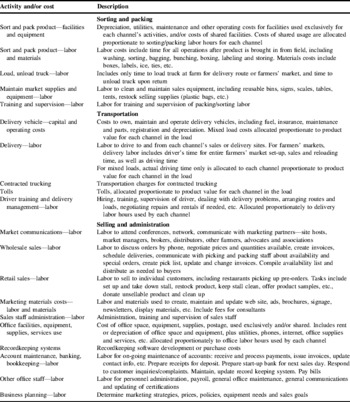
To compare the marketing costs and profitability of different marketing channels, we began by identifying the relevant marketing activities and measuring the costs associated with these activities. First, we compiled a detailed list of post-harvest activities involved in getting product from the field to consumers by reviewing direct marketing handbooks and using our personal experiences. We subsequently grouped these activities into three categories—packing and storage, transportation, and selling and administration (see Table 1); these activities are described in the next section when we compare the extent of the activities between marketing channels. We included the full amount of uncollectible accounts under administration. The marketing activities utilized labor, capital assets, and purchased goods and services. We noted that an individual activity could serve more than one marketing channel simultaneously. We chose to ignore all costs involved in crop production by assuming that these costs were independent of the choice of marketing channel.
Marketing-related activities and costs.

We selected a case-study approach because of the level of detail and effort that would be required to obtain the data for our analysis. Our case studies included three established producers in Northern California who have been actively marketing their produce through all three channels; we classified these operations as small-, medium- and large-sized farms. These operations are similar in the following ways:
• all are certified organic by California Certified Organic Farmers (CCOF);
• all are owned and operated by farmers who have been farming organically in Northern California for at least 12 years;
• they are located within a 50 mile driving distance from each other;
• all have highly diversified cropping patterns, growing a wide variety of vegetables year-round, as well as some fruits;
• all market their products through at least the three marketing channels analyzed in this study:
∘ regular, year-round farmers' market sales,
∘ Community Supported Agriculture type subscription delivery programs (all have year-round weekly deliveries of boxes of seasonal vegetables and fruits to retail subscribers who pick up the boxes at drop sites in their neighborhoods), and
∘ wholesale sales to produce resellers, including direct delivery to distributors, stores and restaurants.
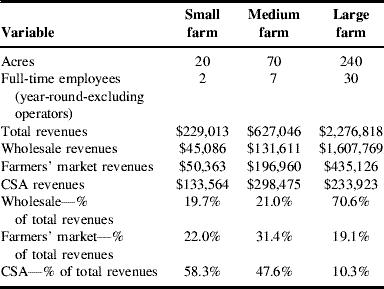
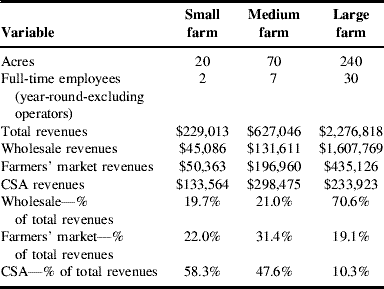
These operations vary significantly in size, as measured by both acreage and sales revenues (Table 2). They have the same relative rankings for all of the parameters in Table 2, except for CSA revenues; the medium farm has the highest CSA revenues, which comprise almost half (47.6%) of its total sales. CSA revenues represent 58.3% of the small farm's total revenues, but only 10.3% of the large farm's revenues. Direct marketing was a significant revenue source for both the small and medium farm, generating four-fifths of their total revenues.
The large farm's predominant marketing channel is the traditional wholesale market (70.6% of its total revenues), which has been its primary growth channel during the past 5 years. Unlike the small and medium farms, the large farm markets year-round in the wholesale market. While all three farms utilize seasonal workers to help in planting and harvest activities, they also rely heavily on the continuity provided by their full-time year-round employees. Only the large size farm provides full health insurance coverage for its year-round employees.
We conducted a series of interviews with the producers and their key employees to obtain background information about their operations, reviewed their financial statements and collected additional information about their marketing practices. We asked the producers to trace the flow of product after harvest to each type of market. Next, we asked each producer to describe the chronological sequence of events involved after they harvested their crops until the produce was sold. Since the case-study operations market year-round, the sequence was examined separately for each day of the week for the seasons (winter and summer) and for each marketing channel. We elicited estimates of the staffing and hours of labor involved for each marketing activity in each marketing channel type. For each activity, we determined what purchased goods and services (such as gas, packaging materials and utilities) and capital assets were utilized. The capital assets included a diverse collection of buildings and equipment, such as packing sheds, office buildings, coolers, ice makers, produce washers, packing lines, forklifts, holding bins, labeling machinery, scales, delivery trucks, software and office equipment.
Each producer also provided a detailed set of their financial records for 2005. We obtained the following information for the capital assets: original cost, year put into service and total years of expected use. Using these values and the straight-line method, we calculated depreciation expenses for each asset during 2005, rather than using depreciation expenses reported in tax returns. Our approach is consistent with the cost of production methodology utilized in the University of California Cooperative Extension's Cost and Returns Studies (for example, see Fake et al.Reference Fake, Klonsky and DeMoura11). We also followed the university's practice of including the opportunity costs of capital (using short-term rate of 7.50% for operating capital and long-term rate of 6.01% for capital costs, including depreciation, for 2005). Consistent with the university's cost study methodology, we valued operator labor at the same rates paid to hired labor for the same activity, rather than applying a higher rate that would reflect the opportunity cost of their managerial effort.
LeRoux et al.Reference LeRoux, Schmit, Roth and Street12 also utilized a case-study approach in their analysis of marketing channel options for small farms in Central New York; however, they limited their measurement of marketing expenses to labor and mileage. Their four case-study farms were all small scale; two of the four were organic producers. They supplemented the case studies by surveying 14 growers regarding their perceptions of marketing channel risks.
Costs of Marketing Activities
There is significant pre-harvest selling activity in both the wholesale and CSA markets. Sorting, packing and storage activities vary across marketing channels. Product sold through the wholesale channel using distributors has to meet specific pack and grade standards; also, this channel requires less ripe fruit since it will be subject to additional handling and time delays. There are no packing standards for produce sold in farmers' markets or to CSAs.
Transportation requirements vary; sometimes, wholesale and/or CSA market deliveries are combined with trips to farmers' markets and CSA deliveries are combined on a regular delivery route. Farmers' markets involve significant sales effort, since direct contact is involved with individual customers. Administrative activities are similar across the channels, although a higher share of administrative time is needed to maintain the numerous individual CSA accounts than the fewer, but larger, wholesale accounts.
The data presented in this section are not meant to be representative of the marketing costs of typical diversified fruit and vegetable farms of specific sales size categories in Northern California. Rather, these data are used to explain the potential for differences and similarities in marketing costs across marketing channels and operations of different sizes.
Depreciation expenses related to marketing activities were low; they ranged from 1.9% of total marketing expenses for the small farm to 5.4% for the large farm. Most of the depreciation related to equipment, rather than buildings. Thus, there was limited substitution of capital for labor for marketing activities as farm size increases.
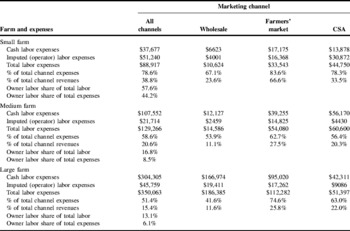
Not surprisingly, labor was the highest marketing expense item for all three farms (Table 3). Although labor expenses as a proportion of total expenses decreased with farm size, they nevertheless represented slightly over half (51.4%) of the large farm's total marketing expenses. The small farm had the largest share of labor provided by the owner; this was expected since the number of employees increased with farm size.
For all three farms, the proportion of labor expenses to total marketing expenses was highest for farmers' markets and lowest for the wholesale market. Most labor expenses for marketing at farmers' markets are incurred before selling begins at the market; thus, adverse weather conditions or a competing event can be very costly for farmers' market producers. The medium farm's labor expense ratios did not vary as widely as they did for the other two farms.
The labor/revenue ratio is a significant indicator of the returns in each marketing channel. It was the highest in the farmers' market channel for all three farms, despite the fact that the proportion of total sales derived from farmers' markets ranged from 19% for the large farm to 30% for the medium farm. Thus, a dollar of labor expense consistently generated the least amount of revenue in this channel. Most noticeably, the small farm's labor expenses comprised two-thirds of its farmers' markets revenues. Further investigation indicated that the small farm's labor hours for packing and storage activities related to farmers' markets exceeded those of the medium farm (although the medium farm's revenues in this channel were almost quadruple those of the small farm). The medium and large farms' labor/revenue ratios in farmers' markets leave significant margins to cover production costs and other expenses. The large farm's highly productive farmers' market program generated almost $4 in sales per dollar of labor expense.
As illustrated in Figure 1, expenses by marketing activity relative to revenues vary significantly by marketing channel for the farms, reflecting differences in the way product is packed, distributed and sold in each channel. In this paragraph, we discuss all marketing expenses ‘as a proportion of total revenues in the marketing channel’—without repeating this phrase. In the wholesale channel, packing and storage costs are the highest expense category for all three farms. Selling and administration costs represent the highest expense category in both direct marketing channels for the small and medium farms. The small farm's high marketing costs in the farmers' market channel are very apparent. Since they are high for all three activities, this suggests that the small farm needs to seek ways to increase its sales at farmers' markets, such as by adjusting its pricing, choice of markets and/or merchandising practices. Also, its packing costs in the wholesale and farmers' market channels are high compared to the other two farms. For the medium farm, transportation costs were highest in the farmers' market channel; this is not surprising since this operation sold at multiple farmers' markets. The large farm's marketing expenses are more evenly distributed and tend to be lower than those for the other two farms; this could be an indication that the large farm has stronger managerial expertise. Its highest expense category—packing and storage costs in the wholesale channel—is attributable to packing materials. Unlike the other two farms, the large farm sells in the wholesale marketing channel year-round (partially to maintain a continuous relationship with its customers); it packs the lower value winter crops and higher value summer crops in the same boxes for this market.
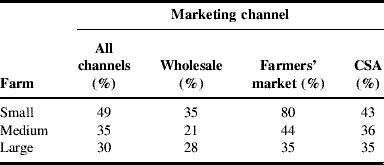
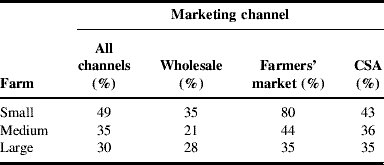
We define ‘marketing cost rate’ as total marketing costs divided by total channel revenues; it is displayed by marketing channel for each farm in Table 4. There is substantial variation across marketing channels and across the farms. Given the relatively higher selling and administration costs in the farmers' market channel, it is not surprising that the marketing cost rate was highest in this channel for both the small and medium farms and tied with the CSA channel as the highest for the large farm. For each farm, the marketing cost rate was lowest in the wholesale channel. These marketing cost rates are applied in the next section to assess the overall profitability of the different marketing channels.
We examined the data in Table 4 for evidence of economies of size in marketing costs. The large farm had the lowest overall marketing cost rate (30%), as well as for the farmers' market and CSA channels (both 35%). The medium farm had the lowest marketing cost rate in the wholesale channel (21%), although the large farm's wholesale revenues were more than 12 times higher. For the farmers' market channel, the large farm's higher sales volumes combined with its lower transportation costs and selling and administration costs, are possible indicators of economies of size; expenses for these categories are not affected much by sales volumes. The medium farm had the highest revenues for the CSA channel and its marketing cost rate in this channel was just one percentage point higher than that for the large farm. Relative to the other two marketing channels, the marketing cost rates for the CSA channel were remarkably similar, ranging from 35% for the large farm to 43% for the small farm. Variation in revenues across the farms was also the lowest for this channel; the medium farm's revenues were 123% higher than those of the small farm. Thus, there was no consistent evidence of economies of size in marketing costs across the marketing channels. Opportunities to achieve such economies were limited because there were few fixed costs involved with the marketing activities of these case-study farms. Economies of size are more likely to be observed in their production activities.
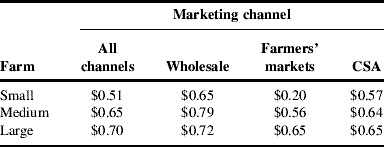
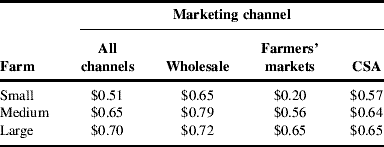
Although the marketing cost rates summarize the results of our extensive data collection efforts, we found it even more meaningful to calculate net returns to marketing by channel by subtracting the marketing cost rates displayed in Table 4 from 1 (Table 5). These values represent the amount each farm netted to cover its production and overhead costs from each dollar of sales in a marketing channel after marketing expenses. For each farm, the net return to marketing was highest in the wholesale channel, ranging from $0.65 for the small farm to $0.79 for the large farm. A noticeable difference was that while the medium and large farms had $0.56 and $0.65, respectively, of each sales dollar from farmers' markets to cover their production and overhead costs, the small farm netted only $0.20 from every dollar of sales at farmers' markets after marketing expenses.
Profitability
While the net return rates discussed above are insightful, they are not the final indicator of the profitability of a marketing channel. Profit is defined as gross revenues minus costs. We did not collect data related to production costs for the three farms. However, recall that we considered crop production costs to be independent of the choice of marketing channel. When we discussed pricing with the operators of our case-study farms, they used prices in the wholesale channel as the reference point for their pricing in their direct marketing channels. Thus, we measure production costs (including overhead expenses not related to marketing) in terms of per dollar of sales in the wholesale market (represented as C). Let Bi be the average price mark-up rate in marketing channel i relative to the wholesale channel; thus, the production cost per dollar of revenue through channel i is (C/Bi) and Bi is 1 for the wholesale channel. The marketing cost rates we reported in Table 4 are stated in terms of per dollar of sales; the marketing cost rate for channel i is Mi. Thus, profit per dollar of revenue in marketing channel i, πi, can be stated as:

With these values known, a producer can determine which marketing channel is most profitable.
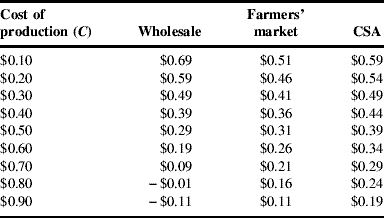
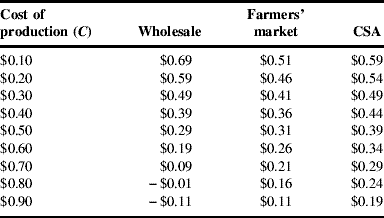
The marginal effect of a change in the production cost (C) on profit in the different marketing channels is derived by differentiating Equation 1 with respect to C; it is −1/Bi. A simple sensitivity analysis is displayed in Table 6 for the medium farm, to demonstrate these results. The mark-up rate of 2.0 was used for both the farmers' market and CSA channels to reflect the medium farm's actual pricing practices, along with the marketing cost rates displayed for the medium farm in Table 4. While each $0.10 increase in C has a full $0.10 impact on profits in the wholesale channel, the impact in the farmers' market and CSA channels is only $0.05. The results in Table 6 demonstrate that changes in production costs affect the relative profitability of the marketing channels. Since the marketing costs were measured for a given set of prices, these prices cannot be changed. While the wholesale channel is the most profitable when production costs are low, the CSA channel becomes the most profitable when C reaches $0.40. The CSA channel is always more profitable than the farmers' market channel since there was an $0.08 spread in the medium farm's marketing cost rates between these channels while its mark-up rates were identical in these channels.
From this rather simplistic analysis, we could conclude that producers need to simply measure their marketing costs, calculate their profitability in each marketing channel and then market exclusively in the highest profit channel. However, there are factors in addition to production and marketing costs and mark-up rates needing to be considered when making marketing channels choices; they are discussed below.
Other Considerations in Selecting Marketing Channels
The producers of our case-study farms mentioned two important factors related to produce marketing that were not considered in these profit calculations—‘sort-outs’ and unpaid product. ‘Sort-outs’ relate to the fact that produce sold through the wholesale channel must meet USDA pack and grade standards while the produce that is too ripe and/or irregularly shaped or is otherwise ‘cosmetically challenged’ can still be sold through direct marketing channels. The large farm (which had 70% of its sales through the wholesale channel) estimated that approximately one-third of the produce harvested for its wholesale customers was ‘sorted-out’ and that about two-thirds of the sorted-out volume is subsequently sold through direct marketing channels. The production cost, C, includes the cost of producing the sorted-out volume. If some or all of the sorted-out product from the wholesale channel is sold in a direct marketing channel, then our profit calculations in Table 6 double-count the production costs for the sorted-out product. Given the large farm's 33% sort-out rate and its 67% diversion rate, the cost of production is overstated by 33%; alternatively, we could have modeled the sold sorted-out product as a by-product. Thus, profit rates are actually higher than indicated in Table 6if the sorted-out product is sold through other channels.
Conversely, incorporating unpaid product decreases profitability. Unpaid product is product that is shipped into a particular marketing channel but does not generate revenue. The operators of the case-study identified four primary sources of unpaid product:
• deliveries rejected by wholesale customers;
• product used for sampling, customer bonuses and rounding-down weights at farmers' markets;
• product not sold at farmers' markets because of lack of demand (such as bad weather) or use of a marketing strategy of keeping the display tables full until the end of the market day and then donating this product at the end of the market day; and
• free boxes of product provided as compensation to hosts for CSA deliveries.
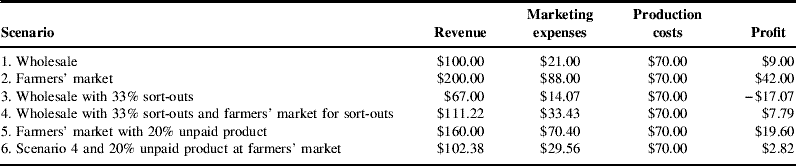
Six simple scenarios demonstrate how sort-outs and unpaid product can impact profits across channels. Assume that a producer harvests 100 pounds of tomatoes from a plot and the production and overhead costs (C) totaled $70. The tomatoes can be sold in the wholesale channel for $1.00 per pound or at the farmers' market for $2.00 per pound. The medium farm's marketing cost rates are included in all scenarios (21% of revenues in the wholesale channel and 44% of gross revenues for farmers' markets). The farm sells all of the tomatoes in the wholesale market in Scenario 1 and at the farmers' market in Scenario 2. Scenario 3 is identical to Scenario 1 except that the farm has a 33% sort-out rate in the wholesale market. Scenario 4 builds on Scenario 3; two-thirds of the product sorted out from the wholesale market is sold at the farmers' markets. In Scenario 5, the tomatoes are sold only at the farmers' market, with 20% of the volume unpaid due to sampling, rounding down of sales weights and end-of-market day donations. Scenario 6 is the same as Scenario 4, but it also includes 20% unpaid volume at the farmers' market. The sorted-out product could also be marketed through the CSA channel, or a combination of the farmers' market and CSA channels.
Marketing expenses by activity and marketing channel by farm.

Characteristics of participating farms.
Marketing-related labor expenses by farm and marketing channel.

Marketing costs as % of sales revenues by farm and channel.
Net return per dollar of sales by farm and channel.
Profit per dollar of revenue by cost of production and marketing channel, medium farm.Footnote 1
1 When BFM and BCSA=2.0 and marketing cost rates as displayed in Table 4.
Scenarios 1 and 2 are the simplest scenarios; Scenario 2 has the highest profit (Table 7). Scenarios 3 through 6 reflect the effects of sort-outs and unpaid product, with profit lowest in Scenario 3 due to the absence of marketing of the sorted-out product from the wholesale market. Marketing the sorted-out product through the farmers' market allows the farm to reverse the financial outcome from a loss of $17.07 (Scenario 3) to a profit of $7.79 (Scenario 4); however, factoring in a 20% unpaid product rate for the farmers' market volume reduces the profit by two-thirds to $2.82 (Scenario 6). Comparing Scenarios 2 and 5 demonstrates the impact of unpaid product at farmers' markets—a 53% decrease in profit.
Profit from 100 pounds of tomatoes in alternative scenarios.
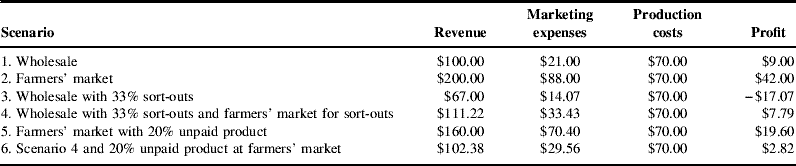
Clearly, using other values for the cost of production and sort-out and unpaid product rates would alter these results. But the primary message of these scenarios remains the same: marketing expenses, sort-outs and unpaid product can have a significant impact on a producer's profit. These factors need to be considered by producers when making marketing decisions and producers must monitor these factors closely. As producers gain experience in direct marketing, they may seek out ways to reduce their marketing costs, such as by choosing to not sell at distant farmers' markets with relatively low sales volumes. The ‘naive’ expectation of selling 100 pounds of tomatoes at a farmers' market for $130 in profit ($200 less $70 of production and overhead expenses) drops dramatically to $19.60 in profit when faced with the realities of costs for marketing and unpaid product. Additionally, marketing jointly in the wholesale and farmers' marketing channels (and perhaps even adding the CSA channel or a farm stand) can generate higher profits than farmers' markets alone.
Conclusions
Using a case-study approach, we developed a structure to measure and compare the relative marketing costs and profitability of different marketing channels that smaller producers often participate in. We classified various marketing-related activities into three categories: packing and storage, transportation, and selling and administration. By measuring the costs for labor, purchased goods and services, and capital assets associated with these marketing-related activities, we determined that there are significant variations in marketing costs across marketing channels. For each of our three case-study farms, the marketing cost rate was lowest in the wholesale channel and highest in the farmers' market channel. Significant labor costs for the selling activity and transportation expenses can offset the higher prices and minimal packaging costs associated with farmers' markets.
LeRoux et al.Reference LeRoux, Schmit, Roth and Street12 also compared ratios of marketing labor to revenue across channels. They determined that farmers' markets and staffed u-pick channels had the highest labor/revenue ratios, with the wholesale channel's ratio as average and the CSA channel's as the lowest. Our higher labor/revenue ratios in the CSA channels are likely to be attributable to the greater amount of customer service that our case-study growers provided to their CSA customers. LeRoux et al. determined that, as a group, CSAs generated a 87% net return per dollar of sales, compared to 67% for farmers' markets and 58% for wholesale. The wholesale channel generated the highest net returns in our case studies (between 65 and 72% per dollar of sales), while the CSA returns ranged between 57 and 65% and farmers' markets had the lowest returns (between 20 and 65%). Our generally lower net return rates are attributable to the fact that we included a wider range of marketing costs, such as depreciation and packaging materials; as previously noted, labor costs for our large farm represented just half (51.4%) of the operation's total marketing expenses. Furthermore, our case-study farms had higher transportation costs for their CSAs because they had multiple pick-up points, unlike the New York case-study farms. We also expect that, due to their proximity to the San Francisco Bay Area where there is high interest in locally grown foods, our case-study operations earned higher wholesale prices than their counterparts in central New York.
Our simplistic sensitivity analysis of the medium farm's profit rate for varying costs of production indicated that profitability was highest in the CSA channel and lowest in the wholesale channel, except when the cost of production was very low. Production costs were not incorporated into the LeRoux et al. analysis. We were unsuccessful in identifying other studies to compare with for our profitability analysis. The University of California's Cost and Returns studies calculate returns for a specific crop, rather than determining whole-farm profitability across different market channels; they are based on a hypothetical operation representing a composite of several farms. USDA's Census of Agriculture reports the number of farms by net cash farm income categories (losses, as well as gains) within the major crop/ranch classifications; however, these data are not tabulated by gross revenue levels or rates of return. USDA included questions related to the distribution of sales across the different channels in one of its 2008 ARMS surveys; however, there has been no public release of these data. Furthermore, the survey could not be used to calculate returns across different marketing channels because no data were collected regarding marketing costs.
The purpose of our sensitivity analysis was to demonstrate how profits can be significantly affected by sort-outs and unpaid product, as well as by marketing costs. The point of examining the different scenarios was not to develop absolute estimates of profitability; rather, we sought to examine how incorporating the particular conditions present in specific marketing channels impacted the channels' relative profitability.
The fact that marketing costs in the CSA channel were lower than those in the farmers' market channel for all three of our case-study farms (as well in the LeRoux et al. analysis) warrants further exploration. CSAs are appealing to producers because, once established, they often generate steady cash flow year-round with substantially less sales effort than selling at farmers' markets. Also, as noted by LeRoux et al., the CSA model is a lower risk method of marketing than farmers' markets, where a market day's sales potential can be adversely affected by adverse weather conditions, holidays and other factors beyond the producer's control.
The challenge is to find ways to expand CSA sales. Recent studies by Perez et al.Reference Perez, Allen and Brown13 and OberholtzerReference Oberholtzer14 indicate that there are two major attributes of CSA programs constraining their growth—product quantity and product choice. Some producers have developed hybrid forms of CSAs; for example, some CSAs offer different sizes of boxes and/or every other week deliveries to appeal to smaller households. To diversify their product selection, some producers exchange products with other local producers. The Pike Place Market Basket CSA contracted with approximately three dozen farms to offer boxes with a diverse product mix for its nearly 800 membersReference Strochlic and Shelley15; the affiliated farmers had lower administrative and transportation costs than if they operated their own CSA.
The farmers' market channel is attractive to new pro-ducers because it has relatively few barriers to entryReference Dmitri, Lohr, Canavari and Olson16 as well as offering the potential to earn ‘full retail. Farmers can enter this channel with minimal investment in packaging and other marketing materials; however, popular markets often have waiting lists for stalls. Farmers' markets can also provide significant networking benefits for new producers. Specifically, Feenstra and LewisReference Feenstra and Lewis17 determined that farmers' markets are a venue for developing entrepreneurial skills, providing producers with a venue for exchanging production and pricing information and networking among themselves. Additionally, farmers' markets can enable producers to develop relationships to enter new marketing channels; farmers can use their presence at a farmers' market to develop future CSA, restaurant and small wholesale customers. The manager of a large farmers' market association recently commented ‘… many of the bigger and more successful growers in farmers' markets are no longer retail stalls, but showcases at a food show … for restaurateurs and specialty buyers’Reference Parsons4. Farmers' markets can also give producers a revenue stream while they are expanding their farming operations, such as developing the broader product line they need for a successful CSA program and/or increasing their production volumes to be large enough to sell to wholesale customers.
Direct marketing channels can provide several other benefits to producers. Market diversification is a classic risk-spreading tool in all industries, including agriculture. Direct marketing increases the number of marketing options available to farmers. For example, when prices in the wholesale market for heirloom tomatoes are low due to excess supplies, producers can still receive ‘full retail’ prices for their tomatoes at farmers' markets. Another benefit of direct marketing is that the industrialized US food distribution system, including the consolidated chain structures within the grocery and food service segments, is designed to handle high volumes of uniform product at low cost, and most shelf-stable processed foods are well suited for such markets. However, the requirement of a high volume of uniform product effectively eliminated the market for produce varieties with relatively short shelf lives and/or those prone to irregular shapes. Direct marketing channels can give farmers' markets power by enabling them to differentiate their produce from that marketed through the traditional produce distribution system. Farmers can market heirloom varieties of produce that cannot withstand a lengthy marketing period; consumers are attracted to these flavorful varietiesReference Gillespie, Hilchey, Hinrichs, Feenstra, Hinrichs and Lyson18. Additionally, many consumers purchase directly from producers because they want information about the practices used to produce the food they consume and they are able to discuss such matters with producers at farmers' markets and other direct marketing venues. Related to this, farmers are able to retain their identity as the producer when they market directly.
The producers in our case studies all commented about the flexibility they have by selling in three marketing channels; such diversification reduces their marketing risk. In addition to having a market for ‘cosmetically challenged’ produce in direct marketing channels, they can market produce that is in excess supply in the wholesale market through farmers' markets and CSAs. Conversely, they can also use the direct marketing channels to sell crops at the beginning and end of the harvest season that are often too small in volume to be handled efficiently through the wholesale channel.
Direct marketing complements, rather than displaces, the traditional wholesale produce distribution system in the United States. Packers, distributors, grocery chains and other downstream entities involved in the traditional US food distribution system incur costs as they provide services, such as sorting, storage, transportation, promotion and selling, to move produce from growers to consumers. Our research demonstrates that the price premiums that farmers earn by direct marketing rather than wholesaling are not pure profit; the higher prices are compensation for the costs they incur when direct marketing their produce. Smaller farmers can build financially viable operations using direct marketing channels to obtain access to markets, grow their farming operations, reduce their marketing risk, and gain market power by providing consumers products with attributes that are not readily available in the industrialized produce distribution system. However, to achieve this success, they must manage their marketing costs as well as their production costs.
Acknowledgements
This research was partially funded by the University of California's Sustainable Agriculture Research and Education Program and the University of California's Small Farm Program.