INTRODUCTION
Chief among the demands that a democratic system requires is the recognition of other citizens’ beliefs and practices including the opportunity to engage in the marketplace of ideas. Thus, a citizenry's level of support for democratic normsFootnote 1 is important. Many studies explain variation in democratic norm commitment through certain psychological traits. In particular, the degree to which people are closed-minded (dogmatic), insecure (low self-esteem), and distrusting of others undermines support for democratic values and processes (Sullivan et al. Reference Sullivan, Marcus, Feldman and Piereson1981; Gibson Reference Gibson2002; Eisenstein Reference Eisenstein2006; Eisenstein and Clark Reference Eisenstein and Clark2014). Likewise, research also suggests that religion (belief, belonging, and behavior) impedes democratic norms commitment — a contention that has support from scholars in several disciplines (from psychologists of religion see, Hunsberger Reference Hunsberger1995; Schwartz and Huismans Reference Schwartz and Huismans1995; from sociologists see, Bellah Reference Bellah, Glock and Bellah1976; Lipset Reference Lipset1981; from political science see, McClosky and Brill Reference McClosky and Brill1983; Sullivan, Piereson, and Marcus Reference Sullivan, Piereson and Marcus1982).
Although the general effects of psychological security as well as religion on support for democratic norms are well known, surprisingly little rigorous empirical study has been devoted to examining the separate and potentially distinctive effects of the various components (dogmatism, self-esteem, and trust) that comprise the psychological security index.Footnote 2 Thus, it is not known whether the separate component parts exert comparable influence or whether the psychological security index conceals important differences in the independent effects of dogmatism, self-esteem, and social trust on democratic norms.Footnote 3 Likewise, previous studies focusing on the religion-psychological security-democratic norm support connection have failed to consider the potentially diverse influences of the multi-dimensionality of religion on dogmatism, self-esteem, and trust.
There are valid reasons to doubt that religious belief, belonging, and behavior exert similar effects of degree and kind on the personality traits widely used as an indicator of psychological security. As such, it remains unclear if the religion relationship is the same across all sub-components or if the effect of belief, belonging, and behavior is conditioned by the particular religious experience and the specific psychological trait. This is particularly true as it relates to expectations regarding religious tradition and its influence on trust and self-esteem. Past studies report countermanding relationships. For example, while evangelical Protestants typically have lower levels of trust and self-esteem (Daniels and von der Ruhr Reference Daniels and von der Ruhr2008; Sullivan, Piereson, and Marcus Reference Sullivan, Piereson and Marcus1982; Branden Reference Branden1983; Ellis Reference Ellis1962), they also have higher levels of religious commitment, which typically leads to both increased trust and self-esteem (Keonig, McCullough, and Larson Reference Keonig, McCullough and Larson2001; Daniels and von der Ruhr Reference Daniels and von der Ruhr2008). Thus, “unpacking” all three components of psychological security alongside all three dimensions of religion (belief, belonging, and behavior), is expected to reveal theoretically important connections in accounting for disparities in the endorsement of abstract democratic values.
In view of the importance assigned to the psychological security index in studies on democratic values, we consider the lack of attention paid to these separate components, and the unique influences of the religious dimensions on the security indicators, a major deficiency in the literature. In this article, which builds on an earlier study attempting to solve the puzzle of religious differences in political tolerance (Eisenstein and Clark Reference Eisenstein and Clark2014), we seek to provide new insight into which component in the psychological security index best predicts support for democratic norms, and how the multi-dimensionality of religion factors into this relationship. Our findings suggest that anti-democratic values are a product of one's psychological attributes and is almost entirely unrelated to one's religion. In fact, no matter the influence of religious belief, belonging, or behavior on dogmatism, self-esteem, and trust, it is the mediating link of psychological security to democratic norm support that is most important. Further, our findings challenge the theoretical underpinnings of the psychological security index as we find little evidence that its components, particularly trust, are appropriate proxy measures for authoritarianism (as suggested by Sullivan et al. Reference Sullivan, Marcus, Feldman and Piereson1981; Sullivan, Piereson, and Marcus Reference Sullivan, Piereson and Marcus1982).
PREVIOUS RESEARCH
Psychological Security and Democratic Norms
The extant literature on democratic values suggests that the psychological security index is one of the most important predictors of democratic norm support (Sniderman Reference Sniderman1975; Herson and Hofstetter Reference Herson and Hofstetter1975; Sullivan et al. Reference Sullivan, Marcus, Feldman and Piereson1981; Sullivan, Piereson, and Marcus Reference Sullivan, Piereson and Marcus1982; Gibson and Tedin Reference Gibson and Tedin1988; Davis Reference Davis1995; Marcus et al. Reference Marcus, Sullivan, Theiss-Morse and Wood1995; Peffley, Knigge, and Hurwitz Reference Peffley, Knigge and Hurwitz2001; Gibson Reference Gibson2002; Reference Gibson2006; Eisenstein Reference Eisenstein2006). Thus, many studies maintain that certain personality traits — the degree to which people are closed-minded, insecure, and distrusting of others — undermines support for democratic rights and processes (Sullivan et al. Reference Sullivan, Marcus, Feldman and Piereson1981; Gibson Reference Gibson2002; Eisenstein Reference Eisenstein2006). This relationship holds up cross-nationally (Sullivan et al. Reference Sullivan, Shamir, Walsh and Roberts1985), and in regimes known for political instability and questionable democratic practices (Gibson Reference Gibson2002; Hinckley Reference Hinckley2010).
The three most common characteristics used in the psychological security index are domatism, self-esteem, and social trust (Sullivan et al. Reference Sullivan, Marcus, Feldman and Piereson1981, 107). Dogmatism is conceived of as a rigidity of mind or thought, regardless of ideological content. Dogmatic thinkers are motivated to protect existing belief structures by rigidly framing political contests as battles between those who are easily categorized as morally “good” or “bad” and thereby make out-groups seem especially dangerous or unworthy of democratic rights (Hinckley Reference Hinckley2010).Footnote 4 As such, it is highly unlikely those individuals will value the free marketplace of ideas and that they will be less likely to learn and support democratic ideals (Sniderman Reference Sniderman1975; Sullivan et al. Reference Sullivan, Marcus, Feldman and Piereson1981; Sullivan, Piereson, and Marcus Reference Sullivan, Piereson and Marcus1982; McClosky and Brill Reference McClosky and Brill1983).
Self-esteem refers to our self-attitudes of worthiness, good, or bad (Sniderman Reference Sniderman1975). Sniderman (Reference Sniderman1975) connects self-esteem to democratic values through the process of social learning. Social learning theory, developed by Zellman (Reference Zellman1975), maintains a lack of self-esteem hinders an individual's motivation for social learning and thereby diminishes the ability for abstract thought and consequently, lowers support for democratic norms. “[D]emocratic values for a variety of reasons are not easy to learn … whatever affects an individuals capacity for social learning also affects his chances of learning” (Sniderman Reference Sniderman1975, 207). Therefore, people with low self-esteem are more likely to reject the norms of democratic politics because their negative self-attitudes have impeded the learning of these values (see, Sullivan, Piereson, and Marcus Reference Sullivan, Piereson and Marcus1982, 156–160). Indeed, research has confirmed the connection between self-esteem and variations in support for democratic values (Sullivan et al. Reference Sullivan, Marcus, Feldman and Piereson1981; McClosky and Brill Reference McClosky and Brill1983).
Social or interpersonal trust is demonstrated in the degree to which an individual trusts (or distrusts) other people in general. The role of trust regarding democratic values derives from the relationship of authoritarianism to a lack of recognition for democratic norms — such as generalized support for civil rights/liberties as well as support for political tolerance. This is an important point: social trust, a component of the psychological security index, intended to perform as an “indirect measure tapping into a central aspect of the authoritarian syndrome … Since an important characteristic of the authoritarian personality is distrust of other people, their motives, and their impulses” (Sullivan, Piereson, and Marcus Reference Sullivan, Piereson and Marcus1982, 153). Following this reasoning, it is expected that social trust will exhibit a similar negative relationship as authoritarianism to support for democratic norms. Much research supports authoritarianism as detrimental to political tolerance and support for democratic values (see for example, Altemeyer Reference Altemeyer1996; Canetti-Nisim Reference Canetti-Nisim2004). The trust-democratic norm linkage is supported by past research, including but not limited to Sullivan et al. (Reference Sullivan, Marcus, Feldman and Piereson1981), Sullivan, Piereson, and Marcus (Reference Sullivan, Piereson and Marcus1982), McClosky and Brill (Reference McClosky and Brill1983), Newton (Reference Newton1997), and Mizstal (Reference Mizstal2001). Indeed, studies have found that those low in social trust tend to be less supportive of democratic values. That is, as a consequence of their greater mistrust of people, these individuals interact with others less seldom which impedes their ability to learn the dominant social norms of the society (Sullivan and Transue Reference Sullivan and Transue1999).
In sum, the existing evidence indicates that those who are psychologically insecure are less supportive of democratic norms. That individual-level variation in democratic norm support (and political tolerance) is largely attributable to psychological factors is well established in the literature. However, much of this research employs a psychological security scale constructed using dogmatism, self-esteem, and trust responses and thus, limits our ability to “unpack” the independent influence of these personality traits on democratic norms. Combining various components into a single psychological security index assumes that each component exerts the same (or similar) degree of influence on democratic norm support, but in point of fact there is theoretical and empirical evidence to expect otherwise.
The Influence of Religion
Beliefs and Behavior
Equally important, is the distinct religion-psychological security linkage to democratic norm support. That is, an essential element of the relationship is the relative impact of religion (belief, belonging, and behavior)Footnote 5 on the psychological security index and the mediating influence of that index on democratic norm support. By and large, studies show that religious belief and/or behavior is negatively related to psychological security (Sullivan et al. Reference Sullivan, Marcus, Feldman and Piereson1981; Sullivan, Piereson, and Marcus Reference Sullivan, Piereson and Marcus1982; Eisenstein Reference Eisenstein2006). It is believed that certain religious beliefs and practices tend to occasion a dogmatic cognitive style (Jelen and Wilcox Reference Jelen and Wilcox1991, 35) that is incompatible with freedom of expression and alternative lifestyles, which is consistent with other research suggesting that it is the authoritarian element that fosters the inverse association between religious belief and/or behavior and democratic values (Laythe et al. Reference Laythe, Finkel, Bringle and Kirkpatrick2002; Canetti-Nisim Reference Canetti-Nisim2004; Canetti-Nisim and Beit-Hallahmi Reference Canetti-Nisim and Beit-Hallahmi2007).
In particular, higher levels of doctrinal orthodoxy and religious commitment reinforce “dogmatic” tendencies and thereby reduce support for democratic values such as democratic norm support. According to Rokeach (Reference Rokeach1960, 44), the lack of open-mindedness or “dogmatic personality” among those with high levels of religiosity (belief and/or behavior) often comes from a certainty in some ultimate authority, that predisposes them to an unwillingness to extend civil liberties to any group (Lone Reference Lone2001). In a similar vein, Jelen and Wilcox (Reference Jelen and Wilcox1991, 37) found that their measure of religious dogmatism is most strongly predicted by doctrinal orthodoxy and religious decision-making, followed by public religious observance. Denominational affiliation also revealed a strong direct path to religious dogmatism so that evangelical respondents exhibited significantly higher levels of dogmatism, even after controls for doctrinal orthodoxy and deference to religious authority in decision-making (Jelen and Wilcox Reference Jelen and Wilcox1991). Arguably, religious orthodoxy fosters a belief that one's chosen religion is the only true religion and that its teachings represent absolute truth and is itself a source of lack of support for democratic rights and processes (Wilcox and Jelen Reference Wilcox and Jelen1990; Green et al. Reference Green, Guth, Kellstedt and Smidt1994). In general, individuals whose conceptual boundaries are defined largely by their strict or “authoritative” readings of the Bible provide a mechanism for organizing and simplifying information about the world (Hoffmann and Bartkowski Reference Hoffmann and Bartkowski2008). Such a belief leaves little room for consideration of views that conflict with religious doctrine.
The link between religion to self-esteem and trust, respectively, is less clear with the precise nature of these relationships as yet undetermined. While some research suggests strong religious beliefs and active religious behavior lead to greater self-esteem (Keonig, McCullough, and Larson Reference Keonig, McCullough and Larson2001; Ellison Reference Ellison1993) and increased life satisfaction (Ellison, Gay, and Glass Reference Ellison, Gay and Glass1989), the role of religious tradition is more suspect in its influence on self-esteem (a point we return to below). Likewise, the religion-trust link remains contested in the extant literature. Uslaner (Reference Uslaner2002), Putnam (Reference Putnam2000), and Putnam and Campbell (Reference Putnam and Campbell2010) show that individuals who are considered religious have a higher level of trust and civic participation than those who do not. Daniels and von der Ruhr (Reference Daniels and von der Ruhr2008) claim that trusting others is positively influenced by church attendance. That church attendance encourages social trust is confirmed by Putnam and Campbell (Reference Putnam and Campbell2010). However, their results also reveal that religious beliefs are an obstacle for shaping trust in others, i.e., increased doctrinal orthodoxy leads to decreased trust. “That is, comparing two people who attend church equally often, the one with more fundamentalist views is less trusting (Putnam and Campbell Reference Putnam and Campbell2010, 468).” Likewise, other research suggests that religion oftentimes results in “particularized” trust wherein you trust those within your religious worldview but not those outside of it (Uslaner Reference Uslaner2000; Yamigishi and Yamigishi Reference Yamagishi and Yamagishi1994); and religion “consumes” trust but does not “produce” trust (Uslaner Reference Uslaner2000).
Thus, there is ample evidence to expect an interaction — potentially in countervailing directions — between religious beliefs and behavior orientations and variances in personality characteristics supporting several working hypotheses for explaining differences in democratic norm support. Therefore, we can hypothesize that doctrinal beliefs encourage dogmatic tendencies and it is the ridigity in thought that interferes with the endorsement of democratic values (H1a). Similarly, increased doctrinal orthodoxy leads to decreased trust in others facilitating the rejection of civil liberties and rights (H1b). However, it is also possible that a positive self-esteem influenced by doctrinal beliefs promotes democratic norm support (H1c). At the same time, we can expect greater religious commitment, as measured by frequency of religious service attendance and prayer, to promote social trust (H2a) and self-esteem (H2b) and it is the positive influence of these personality traits that drive support for democratic attitudes. However, other evidence is more clearly supportive of higher levels of religious commitment such as church attendance and prayer frequency supporting dogmatic thinking and it is the lack of openness for contradictory or conflicting beliefs that impedes the development of democratic values and support for civil liberties (H2c).
Belonging
Not surprisingly, different religious traditions demonstrate differing levels of support for democratic norms. Generally speaking, evangelical Protestants tend to have less support for democratic values than mainline Protestants and Catholics (McClosky and Brill Reference McClosky and Brill1983; Beatty and Walter Reference Beatty and Walter1984; Wilcox and Jelen Reference Wilcox and Jelen1990; Jelen and Wilcox Reference Jelen and Wilcox1991),Footnote 6 which is typically explained by their higher levels of dogmatism, which in turn is explained by their more stringent doctrinal orthodoxy and/or higher levels of religious commitment. However, as noted above, there is conflicting evidence in the relationship between religious tradition to trust and self-esteem. Some research suggests evangelical Protestants are less trusting than their mainline or Catholic counterparts (Daniels and von der Ruhr Reference Daniels and von der Ruhr2008). This is consistent with earlier work (Sullivan, Piereson, and Marcus Reference Sullivan, Piereson and Marcus1982) concluding respondents belonging to traditionally conservative religions have lower self-esteem. Yet, other research suggests that hierarchical religion, such as Catholicism, is what impedes trust (Putnam Reference Putnam1993). Still, earlier research suggests merely claiming a religious affiliation has a positive influence on trust (Rotter Reference Rotter1967). As it relates to the religion-self-esteem relationship, there is evidence to suggest that evangelical Protestants demonstrate lower self-esteem than mainline Protestants because the more religiously conservative evangelical traditions, with a focus on sin, foster self-doubt (Branden Reference Branden1983; Ellis Reference Ellis1962). In contrast, black Protestants exhibit more self-esteem because their “religious institutions may provide an important source of positive self-regard among black Americans (Ellison Reference Ellison1993, 1026).” However, a review of research on the religious tradition and self-esteem linkage suggests considerable debate remains — “at the simple empirical level, no consistent pattern of relationship between religion and self-esteem emerges (Hood Reference Hood and Schumaker1992, 111).”
By and large, these findings support the claim that psychological security operates as a mediater between religious affiliation and democratic values. In terms of a denominational effect, we can hypothesize that evangelical Protestants, as a function of their heightened fundamentalist religious attachment and resulting dogmatic tendencies, will be more prone to reject democratic values (H3). In contrast to the scholarship investigating the link between religious preference and dogmatism, there is a relative shortage of studies examining the relationship of religious denomination to self-esteem and/or trust. The absence of theoretical insights and empirical evidence, coupled with the conflicting results in previous investigations, brings on many questions about the exact nature of the denominational relationship to social trust or self-esteem as a source of variation in support for civil liberties and rights. Still, in consideration of the observed denominational differences uncovered in past research, it is expected that fundamentalist religious convictions — captured by an evangelical Protestant orientation — are associated with low social trust (H4) and low self-esteem (H5) that inhibits support for democratic values.
DATA, MEASUREMENTS, AND DESIGN
In order to conduct this research, we utilize two different national datasets. The first is James Gibson's (Reference Gibson1987) Freedom and Tolerance survey merged with the General Social Survey (GSS) conducted in the same year. The Freedom and Tolerance survey was a re-interview of the 1987 GSS respondents.Footnote 7 The second is the 2006 United States Citizenship, Involvement, Democracy (CID) survey.Footnote 8 The use of the Freedom and Tolerance survey, merged with the 1987 GSS, enables the use of a national sample that brings together the necessary measures of support for norms of democracy, psychological security, and the religious dimensions of belief (e.g., doctrinal orthodoxy), behavior (e.g., level of religious commitment) and a sophisticated coding scheme as it relates to belonging (e.g., the coding scheme for religious affiliation outlined in Steensland et al. (Reference Steensland, Park, Regnerus, Robinson, Wilcox and Woodberry2000) with the appropriate adjustments advocated by Stetzer and Burge (Reference Stetzer and Burge2015)). While a dataset from 1987 may be less than ideal, it is one of the few available datasets based on a national sample that allows us to bring together all pertinent religion, democratic norms, and psychological security variables.Footnote 9
The 2006 CID is also a national sample that contains measures for support for norms of democracy, two of the three components associated with psychological security (trust and dogmatism, excluding self-esteem), and measures for religious belief, behavior, and belonging. The use of the 2006 CID national survey provides a reasonable basis of comparison of the interested relationships in the intervening decades. Moreover, the findings provide a basis of comparison to existing seminal studies such as Sullivan, Piereson, and Marcus (Reference Sullivan, Piereson and Marcus1982), and McClosky and Brill (Reference McClosky and Brill1983) that address the role of support for democratic norms in a political landscape not so different from the post-September 11, 2001 context. That is to say, in an era when Americans’ fear was high and as a consequence, support for democratic norms suffered. Importantly, it is the work of Sullivan et al. (Reference Sullivan, Marcus, Feldman and Piereson1981) and Sullivan, Piereson, and Marcus (Reference Sullivan, Piereson and Marcus1982) that established the standard measurement of psychological security and its value as a primary determinant of democratic values. In this way, the 1987 survey is an ideal dataset (collected not long after the Sullivan et al. publications) to re-evaluate the import of the psychological security index. And, the 2006 dataset offers a more contemporary base of comparison.
MeasurementsFootnote 10
Norms of Democracy
When measuring support for abstract liberal-democratic principles or norms of democracy, the questions used fall under two rubrics: measures tapping general support (e.g., free speech and legal rights) and measures tapping procedural support (e.g., majority vote, release on bail, the right to not be forced to testify against oneself). Both the 1987 and 2006 data utilizes five items to measure support for norms of democracy, which consist of questions about both general and procedural support of individual-level rights. All items have been coded so that 1 corresponds to low support and 5 corresponds to high support.
Psychological Security
Psychological security is measured by three distinct traits: dogmatism, self-esteem, and trust (Sullivan, Piereson and Marcus Reference Sullivan, Piereson and Marcus1982; Davis Reference Davis1995; Marcus et al. Reference Marcus, Sullivan, Theiss-Morse and Wood1995; Peffley, Knigge, and Hurwitz Reference Peffley, Knigge and Hurwitz2001). For the 1987 dataset, six items are used to measure dogmatism; self-esteem is measured by five items; and trust is measured by three items. For the 2006 dataset, dogmatism is measured by five items; trust is measured by three items; and self-esteem is not measured. All responses are coded so that 1 corresponds to low dogmatism/self-esteem/trust and 5 corresponds to high dogmatism/self-esteem/trust.
Religion is a multi-dimensional variable and each dimension must be measured separately. Religious commitment (behavior), in the 1987 dataset, is measured by frequency of attendance (at a religious institution), frequency of personal prayer, and religious salience (Kellstedt et al. Reference Kellstedt, Green, Guth, Smidt, Green, Guth, Smidt and Kellstedt1996; Layman and Green Reference Layman and Green1998). In the 2006 dataset, it is measured by frequency of attendance (at a religious institution) and religious salience. Responses are coded so that lower numbers indicate less religious commitment. Doctrinal orthodoxy (belief), in the 1987 dataset, is measured by biblical literalism,Footnote 11 which is coded so that 1 corresponds to low doctrinal orthodoxy and 3 corresponds to high doctrinal orthodoxy. In the 2006 dataset, it is measured by asking if the respondent is born-again.Footnote 12 Religious tradition (belonging) has (minimally) six religious traditions: evangelical Protestant, mainline Protestant, black Protestant, Roman Catholic, Jewish, and Seculars (or the non-religious). Religious tradition is categorized using the Steensland et al. (Reference Steensland, Park, Regnerus, Robinson, Wilcox and Woodberry2000) coding scheme including the Stetzer and Burge (Reference Stetzer and Burge2015) corrections. Due to data constraints, however, we look at four religious traditions: evangelical Protestant, mainline Protestant, black Protestant, and Catholic. Data limitations prevents the inclusion of Jewish respondents and individuals who identify “other” or express no religious tradition.Footnote 13
The Model
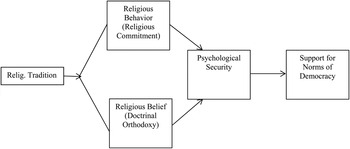
The theoretical model in Figure 1 summarizes the expected relationships between religion, the psychological security index, and democratic norm support while controlling for religious tradition.Footnote 14 A number of individual-level factors that appear to enhance or impede democratic norm support including education, age, income, political conservatism, and threat perception have been included in the model as controls (not shown, available upon request) (e.g., Sullivan, Piereson, and Marcus Reference Sullivan, Piereson and Marcus1982). We estimate the model using structural equation modeling, which relies on maximum likelihood estimation. Structural equation modeling allows for a series of regression equations, in a model with causal ordering, to be tested simultaneously. We are particularly interested in the unique relationships between the various dimensions of religion and the separate components of the psychological security index and ultimately, the outcome these connections have on democratic norm support.
Religion-psychological security-norms of democracy connections. Note: A number of individual-level controls including education, age, income, political conservatism, and threat perception have been included in the models. In the interest of space, full model results are not shown (available upon request).

RESULTS
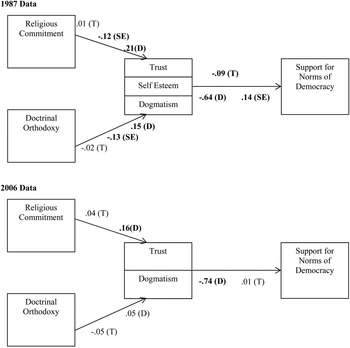
The results shown in Figure 2 depict the religion-psychological security-democratic norms relationship for all respondents regardless of denominational preferences. All path coefficients in bold indicate significance at 0.05 or better and all estimates reported are the standardized coefficients. For the 1987 results, doctrinal orthodoxy exerts a moderate influence on two of the psychological security traits. In particular, a literal view of scripture is associated with dogmatic tendencies (0.15) and less self-esteem (−0.13). The influence of doctrinal orthodoxy on trust fails to emerge (−0.02). Likewise, religious commitment has no influence on trust (0.01). However, greater religious commitment promotes dogmatism (0.21) and lowers self-esteem (−0.12). The findings also show that dogmatism is the most important dimension of the psychological security index, not only as a mediating variable but also on its own. Dogmatism decreases support for norms of democracy by a staggering −0.64. Self-esteem increases support for democratic norms (0.14) while the trust relationship is counter to expectations so that more trusting individuals are less supportive of democratic norms (−0.09). Consistent with these results, the 2006 data also suggests that religious commitment and doctrinal orthodoxy have no influence on trust (0.04 and −0.05, respectively). Again, we find an important connection between religious commitment to dogmatism (0.16), although the influence of doctrinal orthodoxy on dogmatism fails to appear. Finally, the substantial influence of dogmatism on democratic norm support is confirmed (−0.74).Footnote 15 In short, as hypothesized, the doctrinal orthodoxy — dogmatism link (H1a) is supported whereas the doctrinal orthodoxy to trust (H1b) and self-esteem hypotheses (H1c) produce outcomes counter to hypothesized relationships. In addition, religious commitment demonstrates the hypothesized relationship to dogmatism (H2c) but the results do not support the expected relationships between religious commitment to social trust or self-esteem (H2a and H2b).
Religion-psychological security-norms of democracy results.

Furthermore, while the results are not visually depicted in Figure 2, we also tested for direct effects between religion and support for norms of democracy (see Appendix C). The direct positive and significant relationship between religious commitment and norm support indicates that greater religious practice encourages democratic values (0.09, p = 0.06). In contrast, the link between doctrinal orthodoxy and democratic norms is negative reflecting a common verdict concerning the undesirable consequences of religious beliefs in the extant literature (−0.10, p = 0.02). In 2006, religious commitment again proved to be a positive influence on democratic norm support (0.10) but differences in doctrinal orthodoxy (0.03) was inconsequential. These findings make clear that religious beliefs and commitment have differing effects on support for democratic norms and corroborate the Bloom and Arikan (Reference Bloom and Arikan2012) finding that commitment reinforces norm support whereas religious belief undermines it. Overall, the results provide compelling evidence that the influence of religion on support for democratic norms is largely the result of the mediating influence of the psychological security index.
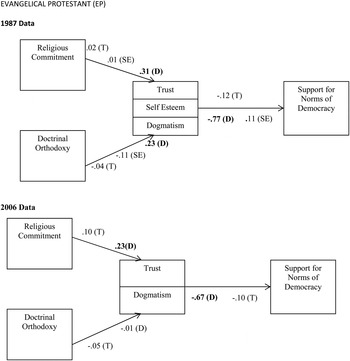
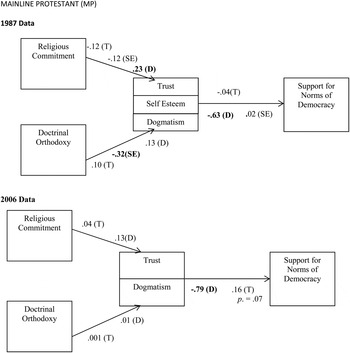
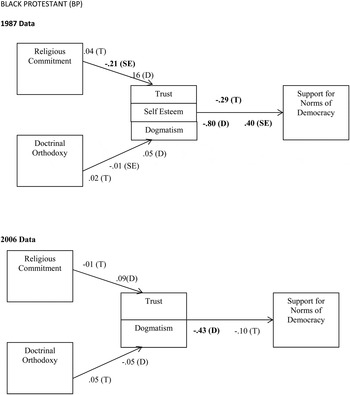
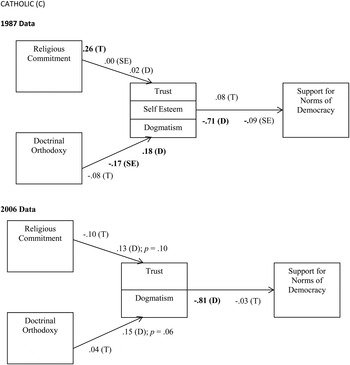
We now turn to the models that consider if the religion-psychological security-democratic norm support relationships vary with denominational preference. We specifically examine: evangelical Protestant (EP), mainline Protestant (MP), black Protestant (BP), and Catholic (C).Footnote 16 Reviewing the 1987 data, the link between doctrinal orthodoxy and dogmatism is evident for solely two of the four religious traditions. That is to say, while strict doctrinal orthodoxy encourages dogmatism regardless of denomination, the results reveal a statistically significant relationship among evangelical Protestants (0.23; confirming the hypothesized relationship in H3) and Catholics (0.18). Additionally, the relationship between doctrinal orthodoxy and self-esteem is also evident in just two of the four religious traditions. Mainline Protestants (−0.32) and Catholics (−0.17) had moderate to substantial results while, in contrast, for black Protestants (−0.01) and evangelicals (−0.11) the parameter estimates, while in the expected direction, are statistically insignificant. Once again, doctrinal orthodoxy had no substantive or statistical influence on trust across the various religious traditions. Considering the 2006 data, the link between doctrinal orthodoxy and dogmatism manifested only for Catholics (0.15; p = 0.06); among the other three religious traditions, the results are both statistically and substantively insignificant. Similarly, there was no influence of doctrinal orthodoxy on trust in others across any of the religious traditions.
The connection between religious commitment and psychological security sheds additional light on the nature of these relationships. While the results for all respondents (Figure 2) demonstrated that religious commitment and religious belief each directly shape the separate components of dogmatism and self-esteem (but not trust), the patterns in Figures 3A, 3B, 3C, 3D indicate that being active in one's religious tradition has differing effects on the separate components comprising the psychological security index. Different religious traditions exhibit a notable link between commitment and dogmatism — indicating that dogmatic tendencies are largely the product of the greater religious intensity among, predominantly evangelical Protestants (0.31 in 1987; 0.23 in 2006 — consistent with hypothesized expectations, H3), mainline Protestants (0.23 in 1987) and to a lesser extent Catholics (0.13, p = 0.10 in 2006).
Results by religious tradition.

Results by religious tradition.

Results by religious tradition.

Results by religious tradition.

In contrast, the sole statistically significant parameter estimate for the religious commitment-self-esteem link is black Protestants (−0.21, 1987). And, the singular statistically significant influence of religious commitment on trust is for Catholics (0.26, 1987). The religious commitment-trust link fails to manifest in any of the models in 2006. This positive relationship is interesting because the direction is unexpected in that it indicates, for Catholics, religious commitment increases trust in others. The evidence highlights an important “conditional” link — dependent upon denominational preference — between religion and the separate dimensions of the psychological security index. Consistent with earlier results, the psychological security index in general, and dogmatism in particular, mediates the relationship between religion and support for democratic norms. A dogmatic personality proves to be, by far, the most dominant influence accounting for differences in democratic norm support across the religious traditions in both 1987 (−0.77 EP; −0.63 MP; −0.80 BP; −0.71 C) and more recent times (in 2006: −0.67 EP; −0.79 MP; −0.43 BP; −0.81C). With the exception of black Protestants (1987) and mainline Protestants (2006), the psychological security traits of trust and self-esteem lack a significant linkage to democratic norms (results inconsistent with H4 and H5). More importantly, the influence of trust is inconsistent so that among black Protestants trust decreases norm support but enhances it for mainline Protestants.
As with the results based on all adults, we included a path to test for a direct relationship for both religious commitment and doctrinal orthodoxy to democratic norms across the religious traditions. Reviewing 1987 results contained in Appendix C, we find regardless of religious denomination, none of the coefficients obtained statistical significance. In addition, all but one of the coefficients suggested a negligible influence with an absolute value not exceeding 0.13; the sole suggestive relationship is for evangelical Protestants wherein doctrinal orthodoxy moderately decreased norm support (−0.20, p = 0.09). The 2006 data results present a slightly different picture. For evangelical Protestants and Catholics, religious commitment strengthens democratic norm support (0.23 and 0.17, respectively). In contrast, the directional effect of doctrinal orthodoxy varies that is contingent upon denominational preference. Strict doctrinal religious beliefs decrease norm support for evangelical Protestants (−0.15) but increase it for Catholics (0.13, p = 0.06). Taken together, these findings provide a compelling case for concluding that the relationship between religion and support for democratic values is almost entirely indirect, and importantly, when there is a direct relationship between religion and democratic norm support, it is contingent on the “conditional” link of denominational preference. These findings also demonstrate that norm commitment is largely weakened by the influence of a dogmatic personality. At the same time, the results reveal that while the effect of dogmatism on democratic norms support remains relatively unchanged regardless of religious tradition, important denominational differences manifest in the link between religious commitment and doctrinal orthodoxy to the separate components comprising the psychological security index employed in the extant research. Overall, the results underscore the importance of employing an approach that incorporates the three distinct, yet interrelated dimensions of belief, belonging, and behavior (e.g., “the Three B's” of religion). Perhaps more importantly, the results call into question the conventional usage of combining the different attributes into a single psychological security index.
DISCUSSION AND CONCLUSIONS
In light of these findings, scholars need to re-consider the practice of combining the three separate components of dogmatism, self-esteem, and trust into a single measurement structure as an acceptable indicator of psychological security. Sullivan et al. (Reference Sullivan, Marcus, Feldman and Piereson1981) and Sullivan, Marcus, and Piereson (Reference Sullivan, Piereson and Marcus1982) argue specifically that dogmatism and trust are proxy measures of authoritarianism. Our results call into question the interchangeability of these indicators. If dogmatism and social trust are to be accepted as comparable measures of authoritarianism, then it would be reasonable to expect analogous effects of these separate measures on democratic norm support. Our results simply do not support this conclusion.
Furthermore, a number of studies have demonstrated a strong negative relationship between religion and authoritarianism (Adorno et al. Reference Adorno, Frenkel-Brunswik, Levinson and Sanford1950; Laythe et al. Reference Laythe, Finkel, Bringle and Kirkpatrick2002; Canetti-Nism Reference Canetti-Nisim2004; Canetti-Nisim and Beit Hallahmi Reference Canetti-Nisim and Beit-Hallahmi2007). However, our results fail to substantiate a robust relationship between religion and either self-esteem or trust. Likewise, if trust is a suitable substitute measure of authoritarianism, then the relationship between religion and trust should mirror the relationship between religion and authoritarianism found in previous studies. Our results fail to do this. Overall, our analyses show that as a mediating influence for the effects of religion, the separate indicators of trust and self-esteem are not reliable predictors of support for democratic norms and may, as a result of the offsetting influence of self-esteem, underestimate the negative effect of dogmatism. These results calls into question the conventional usage of trust and self-esteem as components of the psychological security index.
Our results do illustrate the importance of dogmatism as a driver of psychological security, and this is consistent with other research (Gibson Reference Gibson2002). However, considering the prominent role assigned to dogmatism in understanding the influence of religion on various democratic beliefs and practices, we argue that the conceptualizaion of dogmatism as a proxy for measuring authoritarianism should also be subjected to increased empirical scrutiny. To date, there has been no empirical confirmation that dogmatism is a valid indicator of an authoritarian personality and dogmatism has been conceptualized differently in the existing literature. For example, research within the religion-tolerance literature suggests dogmatism is a political / attitudinal variable (Green et al. Reference Green, Guth, Kellstedt and Smidt1994; Wilcox and Jelen Reference Wilcox and Jelen1990). Empirical verification of the correct conceptualization (i.e., political attitude vs. psychological attribute) has important implications for current debates about causal ordering. The schism as to whether religion precedes or is a derivation of personality exists, in part, because the use of dogmatism is muddled in democratic values studies. Eisenstein (Reference Eisenstein2015) highlights, specifically, the problematic placement of dogmatism alongside various personality variables in the link between psychological determinants and democratic values, which supports Djupe (Reference Djupe2015, 7) when he states that ‘[t]he battle over the understanding of dogmatism is pitched …” debating whether or not it is a hard-wired psychological trait or a (temporary) attitude. A goal of future research should consist of employing a modeling strategy that addresses the causal inference problem by clarifying if dogmatism is “hard-wired” in personality or an acquired political attitude.
In addition, the results show that whether analyzing the data for all respondents or controlling separately for religious denomination, several patterns emerge. To begin, the direct relationship between religious commitment and doctrinal orthodoxy to democratic norms, in general, failed to materialize. First, for all respondents (1987 data), doctrinal orthodoxy does negatively influence support for democratic norms, but while the coefficient was statistically significant, the influence was negligible and hardly explains why some citizens are more and others less supportive of democratic norms. In contrast, religious commitment positively influences norm support but again, the influence is marginal and therefore, not likely a key source of differences in norm support (−0.09, p = 0.06). Second, the 2006 results for all respondents and Catholics suggests that any direct relationship between religion (belief and behavior) and norm support is positive while the results for evangelical Protestants suggest religious commitment positively influences norm support although doctrinal orthodoxy impedes it. Importantly, these results are important because it demonstrates that in most cases, the religion-democratic norm support linkage is not direct. Moreover, when religion is directly linked to norm support, it is usually in a positive direction and thus, encourages the development of democratic norms. Equally important, our results demonstrate that while religious beliefs and/or commitment influence dogmatic tendencies, it does not follow that one's beliefs or commitment level impact support for democratic norms. Rather, the mediating link is what matters.
The results for all respondents demonstrate that religious commitment influences dogmatism and self-esteem, but not trust. However, the religious commitment-psychological security relationship is contingent upon religious tradition. A similar conditional relationship exists between doctrinal orthodoxy to trust, self-esteem, or dogmatism. In sum, both religious commitment and doctrinal orthodoxy exert an influence on psychological security, most often by influencing dogmatic tendencies, and, to a lesser extent, self-esteem. The lone connection between religion and trust manifests in the model for Catholics, but only in 1987.
In addition to the mediational results presented, our findings by religious tradition have important implications for current understandings of the role of religion in the development of democratic values. In particular, the findings make clear that doctrinal, commitment, and denominational dimensions of religion can have a distinct, even opposing, impact on personality traits — traits that are commonly combined into a single measure of psychological security in the democratic norm and political tolerance literature. As such, we argue that understanding the impact of religion on democratic norms requires employing a measurement strategy of psychological security that allows for the separate and unique effects of belief, belonging, and behavior. For example, the relationships for black Protestants is particularly interesting. Among black Protestants, aside from the rather notable effect of religious commitment to self-esteem, the religion-psychological security connection is weakest for these religious adherents. Yet, the direct impact of the separate security dimensions of dogmatism, self-esteem, and trust on democratic norm support is rather significant; a finding that is not replicated among the other traditions.Footnote 17 Put differently, while psychological traits are stronger predictors of norm support than religion (belief or commitment or tradition), the mediating influence of dogmatism, self-esteem, and trust is particularly strong among black Protestants. These results may reflect the role of the church in the African-American community versus (what we might call) the European community. That is, the black church has been a central extra-familial institution touching all aspects of life in the African American community — and, particularly as it relates to politics and the political realm. Black churches once constituted the entire civil society for the black community and as a consequence, faith is intertwined with the political and social aspects of life. The centrality of black churches is unique to the African American community, a pattern that is not found among the other religious traditions (Lincoln and Mamiya Reference Lincoln and Mamiya1990). Nevertheless, the results do leave us with several unanswered questions for future research: Why do the components of psychological security have greater influence on norm support for black Protestants than adherents of the other religious traditions? Why are higher levels of trust associated with less — not more, as expected — support for democratic norms? Why is the direct influence of dogmatism on support for democratic norms, despite considerable variations in the effects of religious commitment and belief on the psychological security elements, practically the same across the models?
In sum, these findings do not fully support a negative association between religiosity and democratic values; rather, in and of itself, religiosity has a negligible impact on the endorsement of democratic values. The compelling evidence is that individuals are likely to adopt anti-democratic attitudes, not because their religion makes them so, but because psychyological attributes — in particular, dogmatism — are the primary drivers of intolerance or the rejection of democratic values. To this point, regardless of variations in the link between religious belief and behavior to psychological security, these differences fade so that the effect of dogmatism on democratic norm support is considerable but essentially indistinguishable. And, these findings uphold regardless of religious tradition. So, any psychological security differences as a consequence of the various religious dimensions (e.g., belief, behavior, or belonging) disappear in estimating norm support. In contrast to the prevailing scholarly tendency to attribute negative social outcomes to religion, these results reveal that religion cannot be considered the sole, nor even a primary, factor impeding beliefs in democratic values or freedom. Rather, it would appear that anti-democratic values are a by-product of one's psychological attributes and is almost entirely unrelated to one's religion. The mediating link is key.
APPENDIX A: PSYCHOLOGICAL SECURITY
Dogmatism (1987 and 2006 data)
-
1) Of all the different philosophies that exist in the world there is probably only one that is correct.
-
2) To compromise with our political opponents is dangerous because it usually leads to the betrayal of our side.
-
3) A group which tolerates too many differences of opinion among its own members cannot exist for long.
-
4) In the long run the best way to live is to pick friends and associates whose tastes and beliefs are the same as one's own.
-
5) There are two kinds of people in this world: those who are for the truth and those who are against it.
-
6) Most of the ideas that get printed nowadays aren't worth the paper they are printed on. (NOTE: Question #6 is not part of the 2006 data.)
Self-esteem (1987 data only; no measures for self-esteem in 2006)
-
1) I never try to do more than I can for fear of failure.
-
2) I think that in some ways I am really an unworthy person.
-
3) When I look back on it, I guess I really haven't gotten as much out of life as I had once hoped.
-
4) I often feel I have done something wrong or evil.
-
5) People today have forgotten how to feel properly ashamed of themselves.
Trust (1987 and 2006 data)
-
1) Generally speaking, would you say that most people can be trusted or that you can't be too careful in dealing with people?
-
2) Would you say that most of the time people try to be helpful, or that they are mostly just looking out for themselves?
-
3) Do you think most people would try to take advantage of you if they got a chance, or would they try to be fair?
Norms of Democracy (1987 data)
-
1) If someone is suspected of treason or other serious crimes, he should not be entitled to be released on bail.
-
2) When the country is in great danger we may have to force people to testify against themselves in court even if it violates their rights.
-
3) No matter what a person's political beliefs are, he is entitled to the same legal rights and protections as anyone else.
-
4) Any person who hides behind the laws when he is questioned about his activities doesn't deserve much consideration.
-
5) I believe in free speech for all, no matter what their values might be. Each item has five response categories ranging from agree strongly to disagree strongly.
Norms of Democracy (2006 data)
-
1) Society should not have to put up with those who have political ideas that are extremely different from the majority.
-
2) Free speech is just not worth it if it means that we have to put with danger to society of extremist political views.
-
3) What our country needs is one political party which will rule the country.
-
4) The party that gets the support of the majority ought not to have to share political power with the minority.
-
5) Our country would be better off if we just outlaw all political parties.
Religious Commitment items (1987 data)
Frequency of Attendance is measured by asking: How often do you attend religious services?
-
1. Less than once a year
-
2. Once a year
-
3. Several times a year
-
4. Once a month
-
5. 2–3 times a month
-
6. Nearly every week
-
7. Every week
-
8. More than once a week
Frequency of Personal Prayer is measured by asking: About how often do you pray?
-
1. Less than once a week
-
2. Once a week
-
3. Several Times a week
-
4. Once a day
-
5. Several times a day
Religious Salience is measured by asking: “Would you call yourself a strong [religious preference] or not a very strong [religious preference]? (1987 data)
-
1. No Religion
-
2. Not Very Strong
-
3. Somewhat Strong”
-
4. Strong
Religious Commitment items (2006 data)
Frequency of Attendance is measured by asking: Apart from spcial occasions such as weddings and funerals, about how often do you atten religious services nowadays?
-
1. Never
-
2. Less often (than special holy days)
-
3. Only on special holy days
-
4. At least once a month
-
5. Once a week
-
6. More than once a week
-
7. Every day
Religious Salience is measured by asking: “How religious would you say you are?”
-
0. Not religious at all
-
1. through 9
-
10. Very Religious
Doctrinal Orthodoxy item (1987 data)
The Biblical literalism question asked respondents: Which of these statements comes closest to describing your feelings about the Bible?
-
1. The Bible is an ancient book of fables, legends, history, and moral precepts.
-
2. The Bible is the word of God but not everything in it should be taken literally, word for word.
-
3. The Bible is the actual word of God and is to be taken literally, word for word.
Doctrinal Orthodoxy item (2006 data)
Would you call yourself born again?
-
1. No
-
2. Yes
Variables not shown: political conservatism, threat perception, education, age, and income.
APPENDIX B
Within the traditional religion and politics literature, religion is conceptualized as having three distinct, yet interrelated dimensions: religious belief, religious belonging, and religious behavior (Layman Reference Layman1997; Layman and Green Reference Layman and Green1998; Kellstedt et al. Reference Kellstedt, Green, Guth, Smidt, Green, Guth, Smidt and Kellstedt1996; Kellstedt Reference Kellstedt, Green, Leege and Kellstedt1993). These are measured by doctrinal, sociological, and external behavior variables. Commonly utilized measures are: Church attendance, frequency of prayer, denominational affiliation, religious salience, doctrinal beliefs (doctrinal orthodoxy), religious self-identification, and religious experience (such as a born-again experience). For example, by knowing how often someone attends church, their level of religious salience, frequency of prayer, all measures of external behavior, an individual's religious behavior (or religious commitment) could be gauged. This is how religion and politics scholars have typically measured commitment, which is a measure focused on behavior.
Denominational affiliation and religious traditions are meant to operationalize the concept of belonging.Footnote 18 When analyzing and exploring the relationship of religious belonging to the political landscape, some type of order needs to be placed on the staggering number of religious group memberships in the United States. Denominational affiliation and religious tradition are the most frequently used categories for imposing this necessary order. Denomination refers to a specific organizational affiliation such as Catholic, Baptist, Lutheran, Episcopalian, Methodist, etc. For example, someone who is formally associated with the local Episcopalian church in Muncie Indiana, belongs to a local congregation. However, that local congregation is also part of a larger denomination called the Episcopalian Church, USA.
Religious tradition is distinctly different and broader conceptually from denominational affiliation because it cuts across denomination. Thus, that same individual who is a member of a local Episcopalian congregation, and part of the larger Episcopalian Church, USA denomination can also be categorized with individuals from other denominations into what is called a religious tradition. Denominations categorized within the same religious tradition tend to share common histories, a particular belief set regarding theology, ritual and eschatology, and even distinct racial or ethnic compositions (Steensland et al. Reference Steensland, Park, Regnerus, Robinson, Wilcox and Woodberry2000; Layman and Green Reference Layman and Green1998; Kellstedt and Green Reference Kellstedt, Smidt, Leege and Kellstedt1993).
Finally, the most common way of conceptualizing believing is through doctrinal orthodoxy. However, believing is also conceptualized by (i.e., trying to capture) the relationship between the individual and the divine by asking questions about religious experience(s). The most commonly used question asks whether or not an individual has had a “born-again” experience. Doctrinal orthodoxy, typically measured by questioning individual beliefs regarding the literalism and/or the inerrancy of the Bible, is meant to capture the worldview and basic values of religious individuals (Layman Reference Layman1997; Layman and Green Reference Layman and Green1998; Leege and Kellstedt Reference Leege and Kellstedt1993).Footnote 19
APPENDIX C