I. Introduction
Parenthood has divergent impacts on the employment status of men and women in the UK. There is little difference in the employment rate of men and women aged twenty-five to thirty-four who are childless, whereas, for the same age group, there is a 25 per cent difference in employment rates between fathers and mothers (ONS, 2013). Less than 20 per cent of mothers in the UK work full-time compared with the OECD average of nearly 45 per cent (Resolution Foundation, 2012). Working part-time comes at a cost: one study found that 50 per cent of mothers took lower-skilled part-time work (Resolution Foundation, 2012), which on average negatively impacts the earnings of women for the duration of their working lives (ONS, 2016). If this situation is to change, it is essential that men and women participate more equally in the task of parenting, particularly of young children. An effective parental leave scheme encourages more men to do just that, with the result that women should theoretically enjoy the benefits (both financial and in terms of longer-term career progression) of an earlier return to work. So it seems apposite to examine the current system of paid parental leave in the UK, known as Shared Parental Leave (SPL), to assess whether it can begin to bring about these deep-seated cultural changes in both home and workplace.
This paper will consider the policy arguments justifying the introduction of SPL from the perspective of gender equality and to what extent SPL reflects governmental acceptance of the need for fathers to be more heavily involved in the care of their child or children. It will analyse SPL in detail and assess to what extent it will be successful in encouraging fathers to make use of it when considered alongside the leave policies available in Nordic countries. The paper will then consider the issue of eligibility for SPL in more detail in a section that considers whether SPL might be open to legal challenge by UK fathers seeking to access it, from the perspectives of EU law and the European Convention on Human Rights. Finally, it will consider whether fathers can challenge the level of pay available to them whilst on leave as compared with mothers, many of whom are contractually entitled to pay that is higher than the statutory rate whilst on maternity leave. Can fathers argue that this disparity amounts to discriminatory treatment?
The central issue of this paper is whether SPL is capable of redressing gender inequality both at home and in the workplace by transforming the traditional division of caring roles in the family. There is an increasing diversity in family forms in current times (Hobson and Morgan, Reference Hobson, Morgan and Hobson2002; Dermott, Reference Dermott2008), which is recognised in the UK legislation that introduces SPL. SPL provides leave for social as well as biological parents, which recognises the rights of gay as well as straight couples to adopt children.Footnote 1 Biological parents do not have to be living together to qualify. Partners of biological mothers are widely defined to include anyone with whom the latter has ‘an enduring family relationship’ (apart from a family member).Footnote 2 But SPL also has the potential to address a wider equality agenda. Any increase in the take-up of SPL by fathers can serve to further challenge gendered notions of parenting, which consequently would validate the diverse range of people who provide parenting roles (Mezey and Pillard, Reference Mezey and Pillard2012). In a US context, Rosenblum (Reference Rosenblum2012) argues that ‘mothering’ and ‘fathering’ retain strong heterosexual meaning, so a more gender-neutral interpretation of these roles would allow fathers (as single parents or in gay couples) to be more widely acknowledged as legitimate primary carers. Fathers are diverse in terms of sexuality, socio-economic position, race and age, and references to ‘fathers’ in the paper include social as well as biological fathers.
II. Policy background
The provision of various forms of parental leave has been a feature of European countries for the last forty years and in particular since work–family reconciliation has become a high priority for many governments since the 1990s. This has been driven by various policy objectives such as the need to increase women's involvement in the labour market, to reduce child poverty and to react to the decline of the male breadwinner as the dominant family model in the UK in order to help women combine work with childcare (Lewis, Reference Lewis2010).
A further policy objective is that parental leave has the potential to redress gendered norms around the division of labour in families. Feminists have long argued that the position of women as wives and mothers was a key factor in explaining gender inequality in the workplace (Wortis, Reference Wortis and Wandor1972). In modern times, the general trend has been that, whilst mothers are expected to combine the responsibilities of work and care (of children and/or elderly relatives), fathers have not correspondingly increased their share of childcare and housework (Lewis, Reference Lewis and Hobson2002; Gornick and Meyers, Reference Gornick and Meyers2009). Therefore, encouraging fathers to become full-time carers by taking time away from work has become a priority for policy-makers in many European countries, because that will enable mothers to return to work earlier post childbirth as well as encouraging a more equal division of childcare between fathers and mothers.
Social changes such as the declining rate of marriage, the increase in divorce, co-habitation and births outside marriage forced policy-makers in the UK to reassess the role of fathers in society. In the 1980s, the focus was on fathers who had been divorced or had separated from their spouse or partner but who failed to support their children financially. Under the Labour government elected in 1997, there was a change of emphasis in policy towards fathers, which Collier and Sheldon (Reference Collier and Sheldon2008, p. 209) have described as a move from ‘cash to care’. Policy changes attempted to challenge the traditional model of fatherhood, which argued that fathers were primarily economic providers for the family and women provided the caring role. The importance of fathers being involved in caring for their child was linked to improvements in child welfare and development. Thus, encouraging fathers to remain committed to their parenting role – even if they were separated or divorced – was perceived by policy-makers as beneficial to children, fathers and to society generally (e.g. by reducing unemployment and anti-social behaviour) (Lewis, Reference Lewis and Hobson2002). Another development was government intervention to help parents in reconciling their caring role alongside their work commitments, through policies that increased the availability of pre-school childcare and promoted work–life balance (e.g. flexible working and parental leave). So there is ample justification for the introduction of parental leave and other work–family reconciliation policies, in terms of both pursuing the objective of governments to respond to social change and gender equality in the workplace.
However, in the UK context, there is a clear disparity between the ideal of the ‘involved’ or ‘caring’ father and the policies that have been presented to fathers. Unpaid parental leave was introduced in 1999, allowing fathers the chance to take up to four weeks’ leave per year to look after their children under five.Footnote 3 However, the fact that leave remains unpaid severely limits the number of fathers who would be willing to take it up. Fathers were given the opportunity to take up to two weeks’ paid paternity leave immediately following the birth of their child from April 2003.Footnote 4 This was a step in the right direction in that some remuneration was provided, but the length of leave available does little to challenge the assumption of employers (and society more generally) that mothers are the primary carers beyond the initial two-week period post birth. Additional Paternity Leave (APL) was introduced in 2010, which enabled fathers to take leave but only after their spouse had returned to work and only from twenty weeks post birth.Footnote 5 APL did provide fathers with the opportunity to take a longer period of continuous leave (up to twenty-six weeksFootnote 6 ) with the possibility of payment (fathers were entitled to any maternity pay that had been available to the mother). The main disadvantage was the lack of flexibility as to when the leave could be taken.
Given the low take-up of parental leave and APL by fathers (Moss, Reference Moss2015, p. 337), the success of these policy interventions must be questioned. Whilst the vast majority of fathers do take some time off immediately after childbirth (Moss, Reference Moss2015), only 16 per cent of fathers took more than two weeks leave following their child's birth (DWP, 2011). In addition, the approach of recent governments to parental leave sent out mixed messages. The Blair government extended paid maternity leave to thirty-nine weeks and wanted to extend it to fifty-two weeks (HM Treasury, 2004) – a change that, by encouraging women to take a longer period of maternity leave, perpetuated the norm of childcare as the mother's responsibility rather than challenging it. So, whilst to some extent the UK government has acknowledged the importance of involved fatherhood, the policies it has presented have not challenged maternity leave as the key important period of leave for parents. The introduction of APL has not generally resulted in a greater commitment amongst the vast majority of fathers to take parental leave beyond the first few weeks post birth.
III. How does SPL work? What are its strengths and weaknesses?
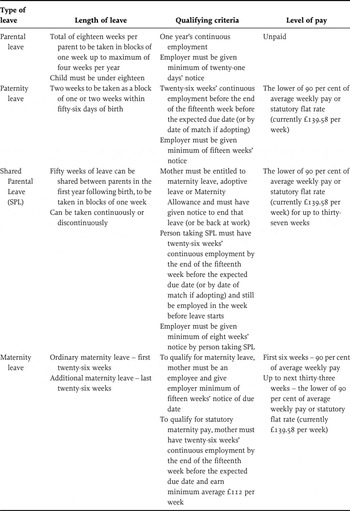
This section of the paper will assess whether SPL has the potential to succeed where previous policies have failed, namely to increase the number of fathers taking leave beyond the first week or two post birth. In this section, the various forms of leave available to parents in the UK will be referred to. Table 1 summarises these entitlements, the qualifying criteria associated with each and the level of pay. SPL was introduced in December 2014 by the Shared Parental Leave Regulations 2014,Footnote 7 which applied to children who were born or placed for adoption on or after 5 April 2015. In order for fathers to take SPL, both they and their spouse or partner must meet several eligibility requirements. First, mothers must be entitled to take maternity leave (or qualify for Maternity Allowance if they are self-employed) and have either returned to work or given notice to their employer that their leave will end.Footnote 8 Fathers taking SPL must give at least eight weeks’ notice of their intention to take leave to their employer and provide specific information along with it.Footnote 9 This must include a declaration by their spouse or partner that they consent to the father taking the period of SPL which has been specified in the notice.Footnote 10 This means that mothers must actively consent to their spouse or partner taking SPL. To put it another way, SPL does not contain a period of leave that is specifically reserved for fathers (often referred to as a quota). Interestingly, the government did propose a four-week period of leave to be reserved for fathers in Consultation on Modern Workplaces (Department for Business Innovation and Skills, 2011), but abandoned it following discussions with stakeholders over concerns about complexity (i.e. it did not want to add yet another type of leave to the list) and cost to employers. Baird and O'Brien (Reference Baird and O'Brien2015) have suggested that stakeholder concern over the government's initial proposal to reduce maternity leave to eighteen weeks in a time of austerity was a factor in the proposal being abandoned. This retreat by the government from a more radical policy that would have undermined the primacy of maternity leave over other forms of leave suggests that the government had not accepted the idea that maternity should be regarded as equal to parental leave and represented a reluctance to fully embrace the involved-fatherhood discourse. The government's retreat highlights the ambivalence that is at the heart of SPL: whilst it argues that parents should share childcare more equally, it remains unwilling to challenge the male breadwinner/female carer model by shortening maternity leave or by failing to make other policy changes, such as increased provision of nursery places, which would challenge the model.
Types of leave available to parents in the UK

The person taking SPL must also meet eligibility criteria (be that the mother, father or other partner of the mother). The most controversial is that they must be an employee with at least twenty-six weeks’ continuous employment by the end of the fifteenth week prior to the due date (or the week in which parents were notified of having been matched with their adopted child) and remain in employment until the week before SPL is taken.Footnote 11 This contrasts with qualification for maternity leave, which does not require any continuous employment. An even more significant issue is that Statutory Shared Parental Pay (which will be considered later in the paper) is not as generous as maternity pay. Women earning over £8,060 per annum (in the 2016/17 tax year – a figure that is well below the average annual salary in the UK) and who have been employed for twenty-six weeks can claim 90 per cent of their average weekly earnings for the first six weeks of maternity leave and the statutory rate thereafter. Parents taking SPL are only paid at the statutory rate (currently 90 per cent of average weekly earnings or £139.58, whichever is the lower), even if leave is taken in the first six weeks. The fact that SPL is not a ‘day one’ right and the lower rate of pay reinforce the idea that mothers are primary carers and fathers are secondary carers. Mothers will continue to take maternity leave rather than SPL because of financial considerations, which in turn will make it more difficult to challenge traditional divisions of labour between fathers and mothers (Golynker, Reference Golynker2015).
One advantage of SPL is that it has the potential to be more flexible than APL. Unlike APL, where leave had to be taken in a single block,Footnote 12 SPL can be taken discontinuously during the year post birth, enabling partners to take leave separately or together. However, employers have the ability to veto discontinuous periods of leave if agreement cannot be reached.Footnote 13 Preliminary research suggests that employees are not generally requesting discontinuous leave (Working Families, 2016), although perhaps they are seeking to avoid conflict by having to negotiate leave with their employers with the possibility of refusal a potential outcome. It would be unfortunate if the flexible nature of SPL was not fully utilised by employees for this reason.
In summary, the introduction of SPL represents continuity in terms of recent social policy towards fathers. In fact, SPL goes further in that it can be triggered at an earlier stage than APL and is more flexible. Yet there appears to be continued reticence within government to fully embrace the involved-fatherhood and/or gender-equality discourse, as illustrated by the government's retreat from its proposal for a period of leave reserved for fathers and the relatively low level of remuneration offered to parents taking advantage of SPL. Early findings show that the government's predictions of a take-up rate of between 2 and 8 per cent of eligible parents were accurate (Working Families, 2016; CIPD, 2016).
IV. Evaluation of SPL in an international context
The success of SPL as a policy will ultimately depend on how many fathers make use of it. In the context of their analysis of leave policies available for fathers in the Nordic countries, Haas and Rostgaard (Reference Haas and Rostgaard2011, p. 182) suggested six criteria that would facilitate a high level of take-up by fathers. They provide a useful measure against which to evaluate SPL. The criteria are: (1) generous eligibility requirements; (2) a generous amount of non-transferable leave available to fathers on an individual basis (referred to below as the father's quota); (3) a lengthy additional period of paid leave available to both partners; (4) a generous level of compensation; (5) flexibility as to how leave is taken; and (6) other incentives to encourage fathers to take leave. This section will concentrate on the second, fourth and fifth factors, as these are the particular weak points in SPL.
Haas and Rostgaard (Reference Haas and Rostgaard2011) identify the father's quota as the most important factor in improving take-up in the Nordic countries. Sweden, Norway and Iceland all introduced quotas and have seen the vast majority of fathers take the periods of leave available. Fathers in these countries have decided that they do not do not want to lose a period of leave that is paid. In my view, it is the quota combined with the generous level of compensation paid by the Nordic countries that has resulted in high levels of take-up. It is doubtful that UK fathers will take leave merely because it is non-transferable: it must be adequately compensated as well. All the Nordic countries calculate their rates of compensation as a percentage of salary (albeit operating with a salary cap so high-earners are less well compensated), which provides a higher level of pay whilst on leave than the current statutory rate in the UK. The UK needs to adopt a similar system of compensation if take-up is to increase.
In terms of flexibility, SPL does not compare favourably to the Nordic countries, where generally there is the option to take leave on a part-time basis and over a longer period than just the first year. The rationale for increasing flexibility is to enable fathers to combine work and childcare and thus increase take-up (Brandth and Kvande, Reference Brandth and Kvande2016, p. 277). However, a Norwegian study of fathers who combined work and care found that they did not achieve truly ‘involved fathering’ because many fathers felt that work commitments took priority over childcare (Brandth and Kvande, Reference Brandth and Kvande2016). SPL does provide for so-called SPLIT days,Footnote 14 where employees can work up to twenty days without bringing SPL to an end. This does provide scope for flexibility, but it is left to employees and employers to decide whether these days can be taken and on the level of remuneration. Whilst a part-time option would seem to appear attractive to employers, it would offer more security to employees if the right to take SPL on a part-time basis was expressly written in to the scheme. UK policy-makers should also consider extending the SPL period beyond the first year. In Norway, for example, fathers taking advantage of the quota (ten weeks’ length at the time of writing) but combining it with part-time work can take leave up until their child's third birthday (Brandth and Kvande, Reference Brandth and Kvande2016, p. 277).
It is worth noting that, even in Nordic countries, it is generally mothers who take parental leave that is available to both parents (as distinct from the fathers’ quota, which would be lost if not taken). So Nordic countries are not a panacea, but they do offer UK policy-makers ideas for increasing the take-up rate for fathers.
V. Is the UK in breach of the Parental Leave and/or Equal Treatment Directive?
This section will consider whether the Shared Parental Leave Regulations 2014 are open to legal challenge by father-carers because they breach EU law. Such is the legacy of leave schemes that have been designed on the presumption that mothers will take the primary caring role following childbirth, that fathers who want to take parental leave can find themselves refused access or, if they are permitted access, they are not entitled to the same rate of pay that a mother would be entitled to, which then makes taking leave financially impossible (examples of such cases are discussed below). The logical conclusion of the involved-fatherhood discourse is that more fathers want to take parental leave, but often legal systems have not caught up with that discourse, which has left fathers with little alternative but to resort to litigation to enforce their rights.
A recent case before the Court of Justice of the European Union (CJEU) could act as a precedent for a legal challenge. Maistrellis Footnote 15 concerned a male judge who was refused parental leave by the Greek authorities. The Greek Civil Service Code only allowed a father to take parental leave if his spouse was either working or had health problems that prevented her from looking after their child. The claimant's application was refused on the basis that his wife did not work. When he claimed discriminatory treatment, the national court asked the CJEU whether the provision of the Civil Service Code was in breach of the Parental Leave and/or the Equal Treatment Directive. The Parental Leave Directive was originally passed in 1996 and updated in 2010. Both incorporate Framework Agreements, agreed by representatives of trade unions and employers’ organisations, that provide the substantive provisions. The court in Maistrellis interpreted the provisions of the original directive. Clause 2 of the Framework Agreement entitles men and women to an individual right of at least three months of parental leave to enable them to care for a child under the age of eight. The same clause adds that, in principle, this should be on a non-transferable basis. In other words, each parent is entitled to three months’ parental leave but they are not able to transfer that leave to the other parent. The directive does not stipulate that leave must be paid.
The CJEU began by focusing on the wording of the Framework Agreement, which was the basis of the Parental Leave Directive. The right to a period of leave of at least three months was a minimum requirement that could not be undermined by Clause 2.3, which allowed some discretion to Member States about how the scheme was to work in practice, such as the notice periods required to be given by employees to employers. The court found that there was nothing in Clause 2.3 that allowed Member States to deny access to one parent based on the employment status of his or her spouse or partner. The CJEU also noted that one of the policy goals of the Parental Leave Directive was to encourage men to take ‘an equal share of family responsibilities’.Footnote 16 This was consistent with Article 33(2) of the Charter of Fundamental Rights of the EU, which says that everyone had the right to take parental leave following the birth of a child. So the wider policy framework supported the interpretation of the Framework Agreement by the CJEU. Therefore, Greek law was in breach of the Directive.
The CJEU then turned to the Equal Treatment Directive. The directive prohibits discrimination on grounds of sex in relation to hiring employees; their conditions of employment, including pay, access to training and promotion; and any action taken to dismiss them. In order to prove direct discrimination, claimants must show that they are in a comparable situation to someone of the other sex. In this regard, the court asserted that ‘the situation of a male employee parent and that of a female employee parent are comparable as regards the bringing up of children’.Footnote 17 This appears to indicate a change in direction from previous cases brought by fathers claiming sex discrimination because they had been refused benefits that had only been available to mothers on maternity leave.
The court in Maistrellis found that mothers who are civil servants were unconditionally entitled to parental leave whereas fathers who were civil servants were entitled to it only if their spouse worked or had ill-health. In other words, the fact of being a parent was not enough to qualify male civil servants for parental leave. The court found this to be direct discrimination against the claimant. Was there any argument that justified such discrimination? The court dismissed the argument that the measure constituted positive actionFootnote 18 by arguing that ‘far from ensuring equality in practice between men and women in working life, [the provision of the Civil Service Code] is liable to perpetuate a traditional distribution of the roles of men and women’.Footnote 19 Neither was the provision justified by reference to the Pregnant Workers Directive, which entitles mothers to a minimum of fourteen weeks’ continuous leave to be taken either side of childbirth,Footnote 20 as the refusal of parental leave to the claimant did not constitute a measure that protected the health and safety of workers who were pregnant or had recently given birth or who were breastfeeding. It seems that the court was differentiating between the early weeks following childbirth, where it was legitimate to discriminate against fathers in order to protect mothers’ health, and measures relating to parental leave, where it was no longer prepared to recognise the special status of mothers. The CJEU did not express a view on the length of maternity leave necessary to protect the health of mothers. The Pregnant Workers Directive stipulates a minimum compulsory maternity leave of two weeks,Footnote 21 but it seems unlikely that fathers would be able to successfully challenge leave that is in any way justifiable to protect maternal health, although the position may be different in relation to leave connected to adoption. In recognising that the position of men and women is the same in terms of ability to care for their children, the CJEU has taken a significant step towards providing fathers with rights that previously only mothers had been entitled to.
This case is relevant for fathers in the UK who do not qualify for SPL because their spouse or partner has not met the eligibility requirements. Fathers would be able to challenge SPL rules as being in breach of EU law. The CJEU has stated quite clearly in the Maistrellis case that Member States cannot restrict the access of one parent to parental leave because of the employment status (or lack of employment status) of the spouse or partner of that person, which is exactly what the SPL scheme does in the UK. The government would no doubt argue that SPL is there to support working parents, but that is irrelevant in terms of assessing its compatibility with the terms of the Parental Leave Directive. It would also argue that the Parental Leave Directive has been implemented, as parents in the UK do have an individual right to take unpaid parental leave (subject to meeting the continuous-employment criterion). However, this paper argues that, as SPL is a parental-leave scheme, this too should meet the criteria in the Parental Leave Directive.
VI. The human rights perspective: Markin v. Russia
Could British fathers who are denied access to parental leave argue that their human rights have been breached? Article 8(1) of the European Convention of Human Rights (ECHR) protects an individual's right to a private and family life. This can only be curtailed by the law of a signatory state if it is in accordance with a legitimate aim (which are listed in Article 8(2)) and proportionate to the aims of that national law. Article 14 ECHR seeks to ensure that rights and freedoms under the ECHR are enjoyed in a non-discriminatory way.
The judgment of the European Court of Human Rights in Markin v. Russia Footnote 22 is significant because much of the reasoning of the court echoes that of the CJEU in Maistrellis. Following a divorce from his wife, the claimant, who was a member of the Russian armed forces, was the sole carer of his children and unsuccessfully applied for three years’ parental leave. Unlike female military personnel, who were entitled to three years’ parental leave, a male member of the Russian armed forces was entitled to three months’ parental leave only if his wife had died or he was bringing up children on his own. Three questions faced the court in this case: did parental leave come within Article 8 ECHR; did the refusal to grant the claimant parental leave constitute a breach; and, even if it did, could it be justified by the Russian government?
The first question, having been considered in other cases, was disposed with quickly. The court argued that ‘parental leave and related allowances promote family life and necessarily affect the way in which it is organised’,Footnote 23 so Article 8 was applicable. Central to the court's reasoning regarding the issue of breach was to recognise that normative attitudes to childcare had changed in the signatory states since the end of the twentieth century:
‘In an absolute majority of European countries the legislation now provided that parental leave might be taken by both mothers and fathers. In the Chamber's opinion, this showed that society had moved towards a more equal sharing between men and women of responsibility for the upbringing of their children and that men's caring role had gained recognition.’Footnote 24
The court also found that the claimant was in an analogous situation to female military personnel as regards the capability to look after his children. It clearly drew the distinction between maternity leave and parental leave:
‘… in contrast to maternity leave which is intended to enable the woman to recover from the childbirth and to breastfeed her baby if she so wishes, parental leave and parental leave allowances relate to the subsequent period and are intended to enable a parent concerned to stay at home to look after an infant personally.’Footnote 25
In this second period, men and women are ‘similarly placed’Footnote 26 to look after children. Therefore, the court found discriminatory treatment.
Could this difference in treatment be justified? The argument relating to the special status of mothers following childbirth had already been rejected as normative values regarding parenting and the increased involvement of fathers had changed. The Russian government argued that this was a measure justified by positive discrimination. This was rejected in much the same terms as the CJEU had used in Maistrellis. Russia argued that refusal of parental leave to fathers was justified to ensure the operational effectiveness of the armed forces. This was rejected because the Russian government had not produced any statistical or other evidence to establish how many servicemen would be eligible to take three years’ leave or might want to even if they were eligible. Whilst a more selective ban on certain military personnel might have been acceptable, such as those on tours of duty abroad, a blanket ban on all servicemen was not proportionate. Therefore, the claimant's rights under Article 8 and 14 ECHR had been breached.
It is not being argued that this case is directly applicable to the UK because the terms on which parental leave were offered to the claimant were clearly discriminatory and very different to the SPL scheme in the UK. However, the judgments in Maistrellis and Markin represent a significant step towards gender equality in terms of parenting in three respects. First, there is recognition that fathers and mothers are now similarly placed to look after children. This is important because, in order to successfully pursue a direct-discrimination claim, fathers have to show that they are in a comparable position to mothers. It also signals an acceptance of the involved-fatherhood discourse by the CJEU and the European Court of Human Rights, so much so that the latter was prepared to depart from an earlier precedent case. The second is that the courts recognise that maternity leave and parental leave can be distinguished without jeopardising maternity rights that legitimately protect women before and after childbirth through the exception to the equal-treatment principle.Footnote 27 This means that a father can legitimately compare himself with the situation of a mother who is providing childcare several weeks following the birth. This is an essential prerequisite for the kind of legal challenge started by the claimant in Shuter (see below). Finally, it appears that courts are no longer willing to accept that positive discrimination is a justification for continuing to prefer maternity over parental leave. In fact, the opposite is true – namely gender stereotypes around the roles of fathers and mothers can be perpetuated by maintaining the primacy of maternity leave. This could help father-carers in the UK in future cases, provided that similar reasoning is adopted by the British courts.
VII. Can fathers challenge the rate of Statutory Shared Parental Pay?
Another aspect to this debate is whether fathers who are entitled to the statutory rate of pay whilst on SPL could make a ‘levelling-up’ claim, namely that they are being discriminated against when compared with women employees who are entitled to an enhanced rate of contractual pay whilst on maternity leave. This has been an issue that has been before the UK courts on a previous occasion, although the claimant was taking APL rather than SPL.Footnote 28 The arguments made by the defendant in response to the indirect-discrimination claim remain relevant for employers who are considering whether to offer an enhanced rate to employees on SPL. During his period of APL, the claimant received pay at the statutory flat rate that his wife would have been entitled to had she been on maternity leave. In contrast, Ford employees who were on maternity leave received 100 per cent of basic pay for up to fifty-two weeks.
The claimant argued both direct and indirect discrimination in claiming the difference in pay. The arguments on direct discrimination concerned the specific provisions of APL and so are not relevant here. Indirect discrimination is defined as a provision, criterion or practice (PCP) that is applied regardless of sex but that puts people of the same sex as the claimant at a disadvantage, and the claimant suffers disadvantage.Footnote 29 In an employment context, the employer can justify discriminatory treatment as a proportionate means of achieving a legitimate aim.Footnote 30 The tribunal accepted that the PCP in this case was Ford's policy of paying mothers their full basic pay during maternity leave and specifically from twenty weeks post birth. The defendant conceded that this would put fathers at a disadvantage and therefore the focus of the judgment is on Ford's justification for its maternity-leave policy. The tribunal found that Ford's justification for the policy, namely to improve the recruitment and retention of women employees, particularly in its professional grades, was legitimate and proportionate. Ford had missed its own target of having women compose 25 per cent of its workforce by some distance, although the tribunal acknowledged that the policy had increased the number of women employees. The judgment provides employers with some reassurance that discrimination claims from fathers claiming the same amount of pay as women on maternity leave can be justified on business grounds provided that employees (whether male or female) taking SPL are paid equally.
However, the tribunal's reasoning on the issue of justification can be questioned. One of the factors that influenced Ford's decision to retain its generous contractual maternity pay whilst deciding to pay employees on APL at the statutory rate was that a more generous APL payment would prompt a higher rate of take-up, which (given the large number of male employees) could disrupt the business, compared to the small proportion of female employees who took maternity leave. Yet the take-up of two weeks’ paternity leave by fathers (for which Ford employees received full pay) was less than half the percentage of women taking maternity leave as a proportion of the workforce. Take-up of maternity leave was around 3–6 per cent of the female workforce between 2001 and 2013, whereas take-up of paternity leave was less than 2 per cent of the male workforce during roughly the same period (according to Ford's own evidence). If only small numbers of fathers were taking up paternity leave even though full pay was offered, Ford should have concluded that it could safely offer APL at full pay as well, without causing undue disruption to the business. Arguably, Ford's decision not to offer parents taking APL any increase on the statutory rate was partly financial and partly due to fear of disruption to its (overwhelmingly male) workforce. Yet there was no firm evidence that this disruption would occur. Ford had not questioned its eligible employees about the possibility of them taking up APL. The tribunal chose not to challenge this flawed reasoning. Few employers will be in a position to argue that a generous maternity-leave scheme was necessary to increase the percentage of female employees. Therefore it can be argued strongly that Shuter was confined to its facts and that it will not be long before contractual maternity-leave payments are challenged as discriminatory against fathers once more.
VIII. Conclusion
Despite the fact that SPL is an improvement on previous parental-leave schemes, it remains flawed as a policy for the following reasons: fathers do not have a period of SPL reserved for them; the employer has a veto on discontinuous periods of leave; it lacks a clear option to combine leave and part-time work and most crucially a relatively low level of remuneration whilst on leave. Therefore, SPL does not offer UK fathers sufficient incentive to take it. Employers do have the option of providing a higher contractual rate of pay to its employees taking SPL. Whilst there is some evidence of this happening, many employers will not be willing or able to offer enhanced pay.Footnote 31 The weaknesses in SPL as a policy reflect the reluctance of the government to challenge the expectation that it is mothers who will take time away from work to be the primary carer (whether or not that is combined with paid work later on).
This paper has demonstrated that SPL needs to be reformed if it is to change this expectation. Considering the high take-up rate by fathers in Nordic countries, the introduction of a period of SPL that is reserved for fathers and a higher level of compensation, calculated on a percentage of basic pay, would seem to be crucial. The government should also remove the employer veto on discontinuous leave and explicitly provide for SPL to be taken on a part-time basis in order to offer employees maximum flexibility.
The second half of the paper shows that the CJEU and European Court of Human Rights have recognised that, whilst a period of maternity leave is legally justified in order to protect the health of mothers (and babies), men and women are equally capable of looking after children whilst on parental leave. This gender-neutral perspective puts fathers in a stronger position to claim benefits previously reserved to mothers. However, it is unclear precisely at what point post birth fathers could claim equality of treatment with mothers. This is an issue that should be clarified, either by the CJEU or through EU legislation.
The legal barriers to fathers being accepted as legitimate primary carers are coming down, which should encourage more fathers to take extended leave. However, there is a divergence between the widespread judicial acceptance of the involved-fatherhood discourse and the reality of fathering practice in the UK. It seems that, whilst many fathers feel that it is now acceptable to take a short period of leave following birth or adoption, the vast majority remain reluctant to take a longer period of leave and become the primary carer (Miller, Reference Miller2011). Policy-makers can make SPL more attractive, but this needs to be accompanied by a broader debate that legitimises and affirms the motivation and ability of fathers to become primary carers.