1. Introduction
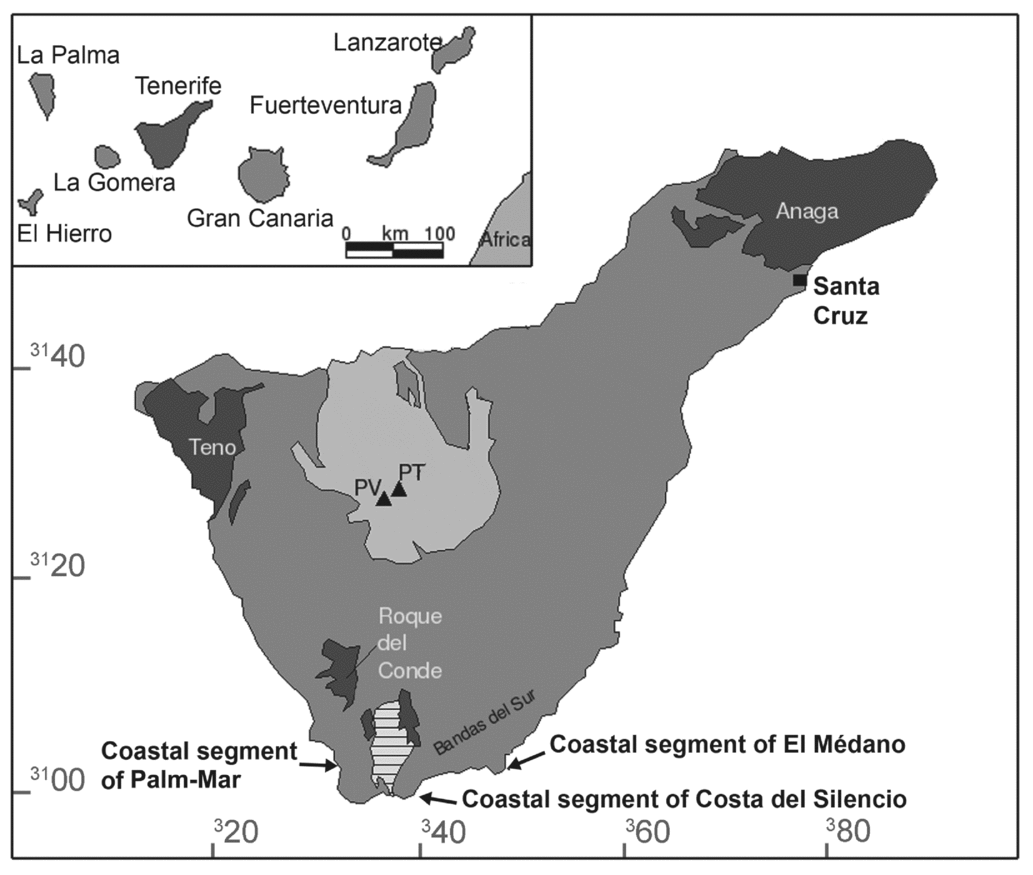
The Canary archipelago represents a chain of volcanic islands in the Central Atlantic near Morocco's west coast (Fig. 1). The origin of the islands has been controversially discussed; a hotspot model is currently favoured (e.g. Carracedo, Reference Carracedo1999; Guillou et al. Reference Guillou, Carracedo, Paris and Pérèz Torrado2004; Paris et al. Reference Paris, Guillou, Carracedo and Perez Torrado2005). For the older central and eastern Canary Islands, stable conditions without significant uplift or subsidence have been assumed (e.g. Carracedo, Reference Carracedo1999). The younger western Canary Islands are still in the shield-building stage associated with intense magma intrusion and concomitant positive vertical movements (Hildenbrand et al. Reference Hildenbrand, Gillot, Soler and Lahitte2003). In numerous publications on the western Canary Islands, fossil beaches have been described in various positions above the present sea-level (for readability we use asl for ‘above present mean sea-level’ hereafter) indicating significant uplift during Quaternary and Holocene times. The largest and topographically highest (Pico de Teide: 3718 m) island of the Canaries, the island of Tenerife, is situated in the centre of the archipelago and is thought to be an example of a ‘rejuvenated stage island’ (Paris et al. Reference Paris, Guillou, Carracedo and Perez Torrado2005), associated with remarkable historic volcanic activity. In the older literature, fossil beaches in the north and northeast of Tenerife Island have been interpreted as the result of Pleistocene sea-level fluctuations (Carracedo, Reference Carracedo1999; Acosta et al. Reference Acosta, Uchupi, Muñoz, Herranz, Palomo and Ballesteros2003). Hence, uplift or considerable subsidence has been considered a minor influence for this volcanic island. Whereas Zazo et al. (Reference Zazo, Goy, Hillaire-Marcel, Gillot, Soler, González, Dabrio and Ghaleb2003a , Reference Zazo, Goy, Hillaire-Marcel, González Delgado, Soler, Gahleb and Dabrio b ) ascertained that a slight subsidence of the southern part of Tenerife has occurred since late Pleistocene time, Kröchert, Maurer & Buchner (Reference Kröchert, Maurer and Buchner2008) reported an asymmetrical uplift of the island complex with no distinct uplift in the northeast but significant uplift rates in the south of Tenerife. A submerged developed tuff cone suggests uplift during the past ~300 ka, while various fossil beaches in the southern part of Tenerife Island indicate minimum uplift rates of 45 m during the last ~42 ka (14C dating of fossil marine shells from uplifted fossil beach deposits yielded an age of 41650±3700 yr; Buchner & Kröchert, Reference Buchner and Kröchert2009). However, no evidence for recent uplift of southern Tenerife has been detected yet. In this study, we present new dating results for uplifted fossil beach deposits on the flank of the Montaña Guaza lava stream near the village of Palm-Mar, achieved by radiocarbon analysis of fossil marine shells.
Geographical position of the Canary Islands (inset) and geographical overview of the island of Tenerife with the study area and further localities in southern Tenerife mentioned in the text.

2. Vertical movements on the Canary Islands – a brief review
On the eastern islands of Lanzarote, Fuerteventura and Gran Canaria, uplifted fossil beaches have been described by Lecointre, Tinkler & Richards (Reference Lecointre, Tinkler and Richards1967), Klug (Reference Klug1968), Meco & Stearns (Reference Meco and Stearns1981) and Zazo et al. (Reference Zazo, Goy, Dabrio, Bardajı´, Hillaire-Marcel, Ghaleb, González-Delgardo and Soler2002, Reference Zazo, Goy, Hillaire-Marcel, Gillot, Soler, González, Dabrio and Ghaleb2003a ). The topographically highest fossil beach deposits at ~100 m asl were discovered by Klug (Reference Klug1968) on Gran Canaria and at ~70 m asl on Lanzarote by Zazo et al. (Reference Zazo, Goy, Dabrio, Bardajı´, Hillaire-Marcel, Ghaleb, González-Delgardo and Soler2002). However, the higher marine terraces on these eastern Canary Islands are of Quaternary age (~1.3 Ma), and the general uplift trend in the past 1 Ma merely totals to ~17 mm ka−1. Recently, the island of Fuerteventura changed to more or less stable conditions and the island of Lanzarote even to a slight subsidence tendency in the order of 7 mm ka−1 that probably began about 300 ka ago (Zazo et al. Reference Zazo, Goy, Dabrio, Bardajı´, Hillaire-Marcel, Ghaleb, González-Delgardo and Soler2002, Reference Zazo, Goy, Hillaire-Marcel, Gillot, Soler, González, Dabrio and Ghaleb2003a ).
In contrast to the central and eastern Canary Islands, the westernmost smaller islands of La Palma and El Hierro are still in the shield-building stage associated with an intense magma intrusion and high effusion rates. On La Palma, submarine series presently exposed at the surface have been described as evidence for significant uplift of this island (Staudigel & Schmincke Reference Staudigel and Schmincke1984; Hildenbrand et al. Reference Hildenbrand, Gillot, Soler and Lahitte2003). No precise uplift rates have been reported for El Hierro (e.g. Meco et al. Reference Meco, Scaillet, Guillou, Lomoschitz, Carracedo, Ballester, Betancort and Cilleros2007); however, the submarine volcanic eruption of 2011/2012 south of El Hierro preceded an island-wide uplift of ~40 mm (González et al. Reference González, Samsonov, Pepe, Tiampo, Tizzani, Casu, Fernández, Camacho and Sansosti2013).
On Tenerife Island, Bravo (Reference Bravo1952) and Palacios, Yanks & Gonzalez (Reference Palacios, Yanks and Gonzalez1996) have both recorded marine deposits on the coast of the Orotava valley (N Tenerife), while Talavera et al. (Reference Talavera, Kardas, Richards and Richards1978), Talavera, Paredes & Martín (Reference Talavera, Paredes and Martín1989) and Zazo et al. (Reference Zazo, Goy, Hillaire-Marcel, González Delgado, Soler, Gahleb and Dabrio2003b ) have done so on the Playa del Tachero (NE Tenerife). Further fossil beaches have been depicted by Zazo et al. (Reference Zazo, Goy, Hillaire-Marcel, Gillot, Soler, González, Dabrio and Ghaleb2003a ) near Igueste de San Andrés (E Tenerife). On a general map of the Canary Islands, Carracedo (Reference Carracedo1999) recorded two locations with pillow lavas on Tenerife. These pillow lavas, as well as the fossil beach deposits in the north and east of Tenerife, are situated at a present altitude probably influenced by Pleistocene sea-level changes; thus, the development of the pillow lavas and the fossil beaches in these parts of Tenerife were ascribed by Carracedo (Reference Carracedo1999) to a Pleistocene sea-level highstand. In contrast to later studies, Carracedo (Reference Carracedo1999) concluded that the Canary Islands have experienced neither uplift nor subsidence since their emergence above sea-level. Conditions on Tenerife have also been considered rather stable, without significant uplift or subsidence by Talavera et al. (Reference Talavera, Kardas, Richards and Richards1978) and Palacios, Yanks & Gonzalez (Reference Palacios, Yanks and Gonzalez1996). Zazo et al. (Reference Zazo, Goy, Hillaire-Marcel, Gillot, Soler, González, Dabrio and Ghaleb2003a , Reference Zazo, Goy, Hillaire-Marcel, González Delgado, Soler, Gahleb and Dabrio b ) even assumed slight subsidence of Tenerife since late Pleistocene time. Likewise, Kröchert, Maurer & Buchner (Reference Kröchert, Maurer and Buchner2008) found that the occurrence of fossil beaches close to the former sea-level in the Anaga Mountains in the northeast of Tenerife indicated stable conditions without remarkable subsidence or uplift in the last ~130 ka. In the north of Tenerife, marine deposits located at up to 18.5 m asl probably point towards an uplift of ~10 m, potentially associated with the ~540–690 ka Orotava flank collapse event. These deposits can be alternatively explained as being related to a eustatic sea-level highstand around ~400 ka (Kröchert, Maurer & Buchner, Reference Kröchert, Maurer and Buchner2008). According to Kröchert, Maurer & Buchner (Reference Kröchert, Maurer and Buchner2008) and Buchner & Kröchert (Reference Buchner and Kröchert2009), the uplift rates in the south of Tenerife (Bandas del Sur) amount to a minimum of 15 m since ~778 ka. However, this is probably a minimum estimate for the effective uplift rate given a minimum uplift of 15 m at the Playa del Silencio since ~300 ka ago (~0.05 mm yr−1) and of 45 m during the last ~42 ka (~1.1 mm yr−1) for the El Médano coastal segment. As a result of the varying regional uplift rates across the island, a tilting via asymmetrical uplift of Tenerife has been suggested (Kröchert, Maurer & Buchner, Reference Kröchert, Maurer and Buchner2008; Buchner & Kröchert, Reference Buchner and Kröchert2009).
Vertical uplift of volcanic islands can generally be caused by major earthquakes, mass loss as a consequence of giant landslides or by ascending magma. According to Pirazzoli et al. (Reference Pirazzoli, Thommeret, Thommeret, Laborel and Montaggioni1982) and Kontogianni, Tsoulos & Stiros (Reference Kontogianni, Tsoulos and Stiros2002), major earthquakes can enforce vertical movements of tectonic blocks resulting in a symmetric or asymmetric uplift of entire islands. Examples of partial uplift of volcanic islands as a result of giant landslides and flank collapses with concomitant mass loss are documented on many of the Canary Islands, for instance by Masson & Watts (Reference Masson and Watts1995), Carracedo (Reference Carracedo1999) and Acosta et al. (Reference Acosta, Uchupi, Muñoz, Herranz, Palomo and Ballesteros2003). Kröchert, Maurer & Buchner (Reference Kröchert, Maurer and Buchner2008) and Buchner & Kröchert (Reference Buchner and Kröchert2009) stated that the uplift in the south of Tenerife could be caused by seismic activity or mass loss due to flank collapse events but uplift due to ascending magma appears more plausible. These authors furthermore stated that the enforced uplift of Costa del Silencio coincides with the beginning of intense volcanic activity ~300 ka ago. The uplift of the area near El Médano since ~42 ka ago may suggest a sustained magma load for Tenerife. Kröchert, Maurer & Buchner (Reference Kröchert, Maurer and Buchner2008) gave a detailed compilation of examples of vertical movements of volcanic islands triggered by ascending magma.
3. Study area
3.a. Montaña Guaza
The phonolitic dome of Montaña Guaza (28°03′00″N, 16°41′32″W) represents a prominent landmark in southern Tenerife, and (together with the Caldera del Rey) it demonstrates the only manifestation of highly evolved magma outside the Las Cañadas caldera in the centre of Tenerife Island (Martí, Mitjavila & Araña, Reference Martí, Mitjavila and Araña1994). Montaña Guaza's tens-of-metres-thick lava flow complex forms a distinct steep cliff line on the coastal segment north of Palm-Mar. According to Carracedo et al. (Reference Carracedo, Rodríguez Badiola, Guillou, Paterne, Scaillet, Pérez Torrado, Paris, Fra-Paleo and Hansen2007), the phonolitic rocks of Montaña Guaza formed 928 ka ago.
3.b. Coastal segment north of Palm-Mar
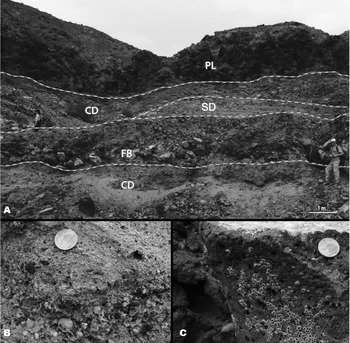
In this coastal segment (28°01′44″N, 16°42′16″W), a small bay with abrasion platforms up to a height of 30–35 m asl formed in the Montaña Guaza lava flow complex. Owing to considerable slope talus deposited along the cliff line of this bay, we were not able to detect any fossil beach deposits at a height between 10 m and 35 m asl. Coastal erosion and construction activity north of the village of Palm-Mar currently offer a view on a band of fossil beach deposits about 150 m in lateral extent and up to ~1.5 m in thickness that is exposed at an elevation of ~7 m to 8.5 m asl (Fig. 2a). The sequence consists of weakly cemented, moderately sorted middle- to coarse-grained sands that indistinctly reveal horizontal cross-bedding. At the northern flank of the bay, the sandy deposits lap on the phonolitic rocks of the Montaña Guaza lava stream and are sandwiched between volcanic talus material and moderately rounded, imbricated beach gravels. In places, the coarse-grained talus material and the sandy deposits are consolidated by carbonate and, thus, can be classified as beach rock (Fig. 2b). The fossil beach deposits frequently contain fossil calcareous algae, broken and intact shells of the marine gastropods Patella sp. and Spirula sp. as well as perfectly preserved barnacles in in situ position on phonolitic blocks (Fig. 2c) within the beach deposits. Owing to the steep palaeomorphology at the flank of the eroded lava stream of Montaña Guaza, the beach was probably very narrow without a distinct subdivision into foreshore and backshore areas.
(a) Outcrop at the coastal segment north of Palm-Mar with beach deposits exposed at an elevation of ~8 m to 9.5 m asl. CD – colluvial deposits; FB – fossil beach deposits; PL – phonolitic lava flow; SD – sandy deposits. (b) Beach rock deposits with shell fragments. (c) Colluvial (phonolitic) rock overgrown by barnacles. Coin for scale is 2 cm diameter.

4. Radiocarbon dating: methods and results
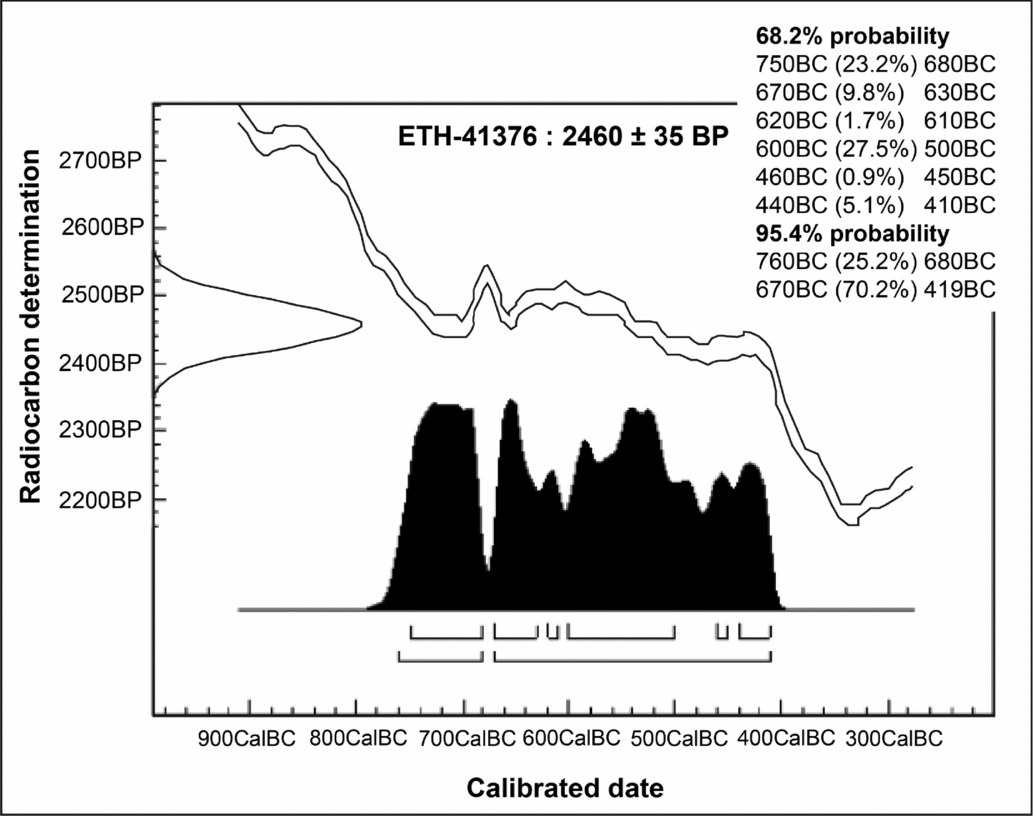
Fresh and unweathered shells of Patella sp. sampled from the fossil beach deposits of the coastal segment north of Palm-Mar (see Section 3.b. and Fig. 1) were selected for 14C dating. To exclude samples affected by alteration–solution and/or recrystallization of the shells, we checked the samples by optical microscopy of polished thin sections and using a CamScan™ SC44 scanning electron microscope (SEM) EDAX™ PV 9723/10 energy dispersive X-ray (EDX) system at the Institut für Planetologie, Universität Stuttgart. The 14C dating analysis was carried out at the Ion Beam Physics – AMS C14 laboratory of the Swiss Federal Institute of Technology (ETH), Zurich, Switzerland. The samples, typically 50 mg in individual weight, were cleaned, etched using HCl, ultrasonically washed in demineralized water, and carbon isotopes subsequently measured with an accelerator mass spectrometer (AMS); for technical details about sample preparation at the AMS laboratory see Hajdas et al. (Reference Hajdas, Bonani, Thut, Leone, Pfenninger and Maden2004). The results were calibrated and corrected by the use of OxCal v.3.10 (Bronk Ramsey, Reference Bronk Ramsey2005) with atmospheric data from Reimer et al. (Reference Reimer, Baillie, Bard, Bayliss, Beck, Blackwell, Bronk Ramsey, Buck, Burr, Edwards, Friedrich, Grootes, Guilderson, Hajdas, Heaton, Hogg, Hughen, Kaiser, Kromer, McCormac, Manning, Reimer, Richards, Southon, Talamo, Turney, van der Plicht and Weyhenmeyer2009). The dating analysis yielded an age of 2460±35 bp; standard deviation is 1σ error for the 68.2% probability and 2σ for the 95.4% probability (see Fig. 3).
Diagram and result for the radiocarbon dating of marine shells in uplifted fossil beach deposits of the Palm-Mar coastal segment analysed in this study. Uncertainties for 68.2% probability are at the 1σ error level, uncertainties for 95.4% probability are at the 2σ error level; calibrated by OxCal v.3.10 and corrected by the atmospheric data from Reimer et al. (Reference Reimer, Baillie, Bard, Bayliss, Beck, Blackwell, Bronk Ramsey, Buck, Burr, Edwards, Friedrich, Grootes, Guilderson, Hajdas, Heaton, Hogg, Hughen, Kaiser, Kromer, McCormac, Manning, Reimer, Richards, Southon, Talamo, Turney, van der Plicht and Weyhenmeyer2009).

5. Discussion
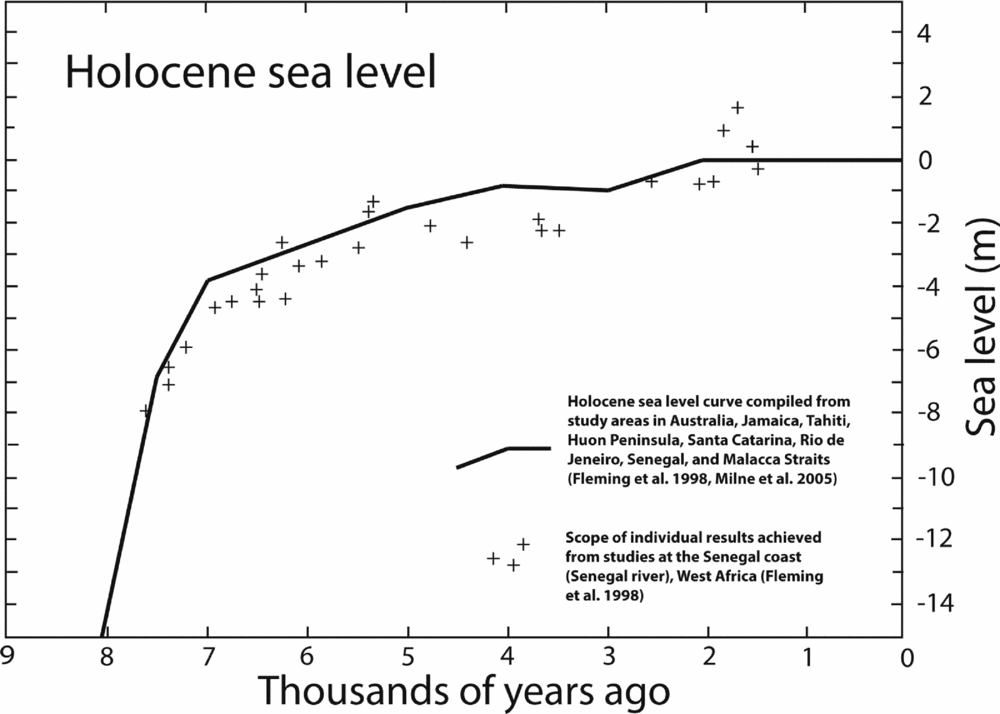
As set out in the brief review in Section 2, differential uplift rates across different domains suggest an overall asymmetrical uplift of Tenerife Island (~10 m in the north v. ~45 m in the south) over the past ~42 ka (Kröchert, Maurer & Buchner, Reference Kröchert, Maurer and Buchner2008; Buchner & Kröchert, Reference Buchner and Kröchert2009). So far, however, it has been unclear whether the uplift of 45 m during the last ~42 ka occurred more or less steadily or as shorter pulses of uplift. Ongoing uplift of southern Tenerife is plausible but still a matter of speculation. Abrasion platforms up to a height of 30–35 m asl formed in the phonolitic lavas of Montaña Guaza since their emplacement 928 ka ago (Carracedo et al. Reference Carracedo, Rodríguez Badiola, Guillou, Paterne, Scaillet, Pérez Torrado, Paris, Fra-Paleo and Hansen2007), possibly related to sea-level highstands (e.g. Hearty & Kaufmann, Reference Hearty and Kaufmann2000). However, uplift of 45 m determined for the adjoining coastal segments of El Médano by Kröchert, Maurer & Buchner (Reference Kröchert, Maurer and Buchner2008) suggests that the coastal erosion in the Montaña Guaza lava stream also occurred during the last ~42 ka. This assumption is supported by the occurrence of marine sand and gravel deposits (~1.5 m in thickness) that are exposed at an elevation of ~7 m to 8.5 m asl on the flank of the eroded phonolitic lava stream of Montaña Guaza. From their sedimentological properties (horizontal cross-bedding, sub-rounded beach gravel showing imbrication), the occurrence of beach rocks and barnacles in in situ position, it is unlikely that these deposits were accumulated during a single catastrophic event (e.g. storm or tsunami deposits) but probably represent fossil beach sediments that were deposited around 2460±35 bp (2σ) as suggested by the newly obtained 14C-dating results. According to Pirazzoli (Reference Pirazzoli1996) and Hearty & Kaufmann (Reference Hearty and Kaufmann2000), the global eustatic sea-level did not rise above the present sea-level during the last ~42 ka. The sea-level curves by Fleming et al. (Reference Fleming, Johnston, Zwartz, Yokoyama, Lambeck and Chappell1998) and Milne, Long & Bassett (Reference Milne, Long and Bassett2005) show that the global eustatic sea-level was slightly lower (−0.5 m) ~2.5 ka ago (Fig. 4). The eustatic sea-level determined for the coast of West Africa (Senegal; Faure & Elouard, Reference Faure and Elouard1967; Faure et al. Reference Faure, Fontes, Hebrard, Monteillet and Pirazzoli1980; Fleming et al. Reference Fleming, Johnston, Zwartz, Yokoyama, Lambeck and Chappell1998) was situated about 0.5 m below the present sea-level ~2.5 ka ago and slightly exceeded the present sea-level by 2 m for a short period of time at about 1.5 ka bp. From this point of view, beach deposits of the Palm-Mar coastal segment at a present height of ~7 m to 8.5 m asl were effectively uplifted by ~7.5 to 9 m.
Holocene sea-level curve for the last 8 ka. The compiled global sea-level did not exceed the present sea-level; individual results for the Senegal coast suggest that the North Atlantic palaeo-sea-level may have exceeded the present sea-level by a maximum of 2 m in the time span between 2 and 1.5 ka ago (after Fleming et al. Reference Fleming, Johnston, Zwartz, Yokoyama, Lambeck and Chappell1998 and Milne, Long & Bassett, Reference Milne, Long and Bassett2005, modified).

Generally, the uplift of a volcanic island can be caused by seismic activity or mass loss due to flank collapse events. According to our results, the uplift of Tenerife is asymmetric and is more pronounced in the southern part of the island, but none of the known Holocene flank collapse events (e.g. Masson & Watts, Reference Masson and Watts1995; Carracedo, Reference Carracedo1999) correlate convincingly, neither by time nor by geographical position, with the uplift processes at the localities investigated in this study. Whereas González de Vallejo et al. (Reference González de Vallejo, Capote, Cabrera, Insua, Acosta, Clift and Acosta2003), González de Vallejo, Tsigé & Cabrera (Reference González de Vallejo, Tsigé and Cabrera2005) and Buchner & Kröchert (Reference Buchner and Kröchert2009) depicted faults with minor offsets (up to 1.2 m) in the area of El Médano, faults with considerable offsets have not been described in the present study areas. Minor offsets mentioned by González de Vallejo et al. (Reference González de Vallejo, Capote, Cabrera, Insua, Acosta, Clift and Acosta2003) and González de Vallejo, Tsigé & Cabrera (Reference González de Vallejo, Tsigé and Cabrera2005) are not sufficient to explain the uplift determined in this study. Major flank collapses are not known in the study area, and constant and persistent positive vertical movement caused by single catastrophic events such as major earthquakes or mass loss as a consequence of giant landslides is implausible. Altogether, this rather suggests permanent intruding magma as the driving force for the uplift of southern Tenerife. Ramalho et al. (Reference Ramalho, Helffrich, Schmidt and Vance2010) referred to the different uplift history and uplift mechanisms of the islands of the Cape Verde archipelago in the central North Atlantic. Some of these islands (e.g. Santiago, São Nicolau), which exhibit positive vertical displacements, have a history of uplift linked with permanent active volcanism. According to Ramalho et al. (Reference Ramalho, Helffrich, Schmidt and Vance2010), asymmetrical uplift can be explained by differential subsurface loading: heterogeneous underplating or intrusions underneath different volcanic edifices can generate uneven upward buoyancy conditions that result in differential uplift. The uplift of the Costa del Silencio segment coincides with the beginning of intense volcanic activity in this area at ~300 ka (cycle 3, according to Martí, Mitjavila & Araña, Reference Martí, Mitjavila and Araña1994; Bryan, Martí & Cas, Reference Bryan, Martí and Cas1998; Kröchert, Maurer & Buchner, Reference Kröchert, Maurer and Buchner2008; Kröchert & Buchner, Reference Kröchert and Buchner2008). The still ongoing uplift of the area between El Médano and Palm-Mar since ~42 ka ago indicates a persistent and possibly ongoing magma delivery for Tenerife (Kröchert, Maurer & Buchner, Reference Kröchert, Maurer and Buchner2008; Kröchert & Buchner, Reference Kröchert and Buchner2008; Buchner & Kröchert, Reference Buchner and Kröchert2009). This volcanic activity might be considered as part of a volcanic cycle (cycle 4) that started ~95 ka ago with the eruption of the widespread San Lorenzo lava field in southern Tenerife.
The uplift rate for southern Tenerife calculated from the local uplift estimates totals to a minimum of ~0.05 mm yr−1 in the past 300 ka in the Costa del Silencio section and to ~1.1 mm yr−1 for the past ~42 ka in the El Médano area. The uplift rate of ~7.5 to 9 m during the past ~2.5 ka (~3.3 mm yr−1) for the beach deposits north of Palm-Mar significantly exceeds this mean uplift rate and supports increasing and ongoing uplift of the southern part of Tenerife Island. In the context of the entire Canary archipelago, the proposed uplift rates for southern Tenerife are remarkably high. The eastern Canary Islands of Gran Canaria, Fuerteventura and Lanzarote are in the post-erosional stage (Carracedo et al. Reference Carracedo, Pérez, Ancochea, Meco, Hernán, Cubas, Casillas, Rodriguez, Ahijado, Gibbons and Moreno2002) and are either in more or less stable conditions (Gran Canaria, Lanzarote) or changed to a slight subsidence tendency (Lanzarote) in the order of 7 mm ka−1 that probably began about 300 ka ago (Zazo et al. Reference Zazo, Goy, Dabrio, Bardajı´, Hillaire-Marcel, Ghaleb, González-Delgardo and Soler2002, Reference Zazo, Goy, Hillaire-Marcel, Gillot, Soler, González, Dabrio and Ghaleb2003a ). The long-lasting and extremely productive 1730–1736 Timanfaya volcanic eruptions on Lanzarote were obviously not preceded by perceivable magma underplating. The estimated subsidence rate for La Gomera (erosional stage; Carracedo et al. Reference Carracedo, Pérez, Ancochea, Meco, Hernán, Cubas, Casillas, Rodriguez, Ahijado, Gibbons and Moreno2002) during the last 120 ka is in the order of 0.25 mm yr−1, which indicates a higher subsidence than that of the neighbouring islands (Izquierdo, Abad & Rodríguez-Vidal, Reference Izquierdo, Abad and Rodríguez-Vidal2013). The western Canary Islands of El Hierro and La Palma are still in the shield-building stage (Carracedo et al. Reference Carracedo, Pérez, Ancochea, Meco, Hernán, Cubas, Casillas, Rodriguez, Ahijado, Gibbons and Moreno2002). Whereas no precise uplift rates are currently known for El Hierro (e.g. Meco et al. Reference Meco, Scaillet, Guillou, Lomoschitz, Carracedo, Ballester, Betancort and Cilleros2007), results for La Palma point towards an uplift rate of about 0.4–0.5 mm yr−1 (Staudigel & Schmincke, Reference Staudigel and Schmincke1984; Hildenbrand et al. Reference Hildenbrand, Gillot, Soler and Lahitte2003), which is about seven times lower than the uplift rates seen on southern Tenerife.
Amelung et al. (Reference Amelung, Jónsson, Zebker and Segall2000) detected widespread uplift rates that range from a few millimetres per year to over 0.9 m yr−1 on the Galápagos Islands (Fernandina and Isabella) induced by the ascent of magma. The volcanoes of these islands count among the most active in the world. Positive vertical movements triggered by magma injection have been described for the Nisyros volcano (SE Aegean Sea) by Stiros et al. (Reference Stiros, Pirazzoli, Fontugne, Arnold and Vougioukalakis2005); uplift rates total to 1.7 mm yr−1 during the last 2–3 ka (Kinvig et al. Reference Kinvig, Winson and Gottsmann2010). The mean uplift rate of 3.3 mm yr−1 for southern Tenerife for the past ~2.5 ka is twice as high compared to the uplift of Nisyros volcano. Our results are not sufficient to predict a future or even an imminent increase in the volcanic activity in southern Tenerife. However, considering magma-triggered island uplift as a potential gauge for forthcoming volcanic eruptions and hazard, we recommend intensifying the already existing volcanic hazard assessment activity (e.g. seismic and airborne radar observation) in this densely populated tourist area of Tenerife Island.
6. Conclusions
-
(1) Stable conditions without remarkable subsidence or uplift existed in the Anaga Mountains in the northeast of Tenerife since 130 ka bp. The uplift rate for southern Tenerife (El Médano and Playa del Silencio coastal segments) amounts to 45 m over the last ~42 ka.
-
(2) In this study, we confirm the remarkably high uplift rates in the south of Tenerife as earlier postulated by Kröchert, Maurer & Buchner (Reference Kröchert, Maurer and Buchner2008) by 14C dating of uplifted fossil beach deposits of the Palm-Mar coastal segment, which yielded a Holocene age of ~2.5 ka. An effective uplift of 7.5 to 9 m within 2.5 ka in the Palm-Mar region totals to a mean uplift rate of ~3.3 mm yr−1 during this time period. This suggests that southern Tenerife has been undergoing significant uplift during the past 42 ka; uplift has intensified in the last couple of thousand years.
-
(3) Asymmetrical uplift of Tenerife is the result of varying regional uplift rates. Uplift in the south could be caused by seismic activity or mass loss due to flank collapse events. However, uplift due to ascending magma is considered a more plausible scenario. The magma-triggered uplift of the Costa del Silencio segment coincides with the beginning of a volcanic cycle (cycle 3) that started at ~300 ka. The uplift of the El Médano and Palm-Mar region since ~42 ka ago indicates an intense magma load and supports the assumption that southern Tenerife is seeing a new volcanic cycle (cycle 4) that probably started with the eruption of the San Lorenzo Lava field ~95 ka ago.
-
(4) We are unable to predict a future or even an imminent increase in volcanic activity in southern Tenerife. However, the uplift rates in southern Tenerife are significantly higher than detected for all other Canary Islands, including La Palma. Uplift rates for Tenerife are in the range of – or even surpass – those typical for active volcanic islands elsewhere on Earth. Intense active magma underplating in southern Tenerife is the most plausible explanation, and therefore caution is advised with respect to future outbreaks of volcanic hazard.
Acknowledgements
We are grateful to the two anonymous reviewers for helpful suggestions and comments. E.B. kindly acknowledges a grant (Project 11050) from the Stifterverband für die Deutsche Wissenschaft.