INTRODUCTION
Methane (CH4) and nitrous oxide (N2O) are two important greenhouse gases (GHG) in the atmosphere that have been receiving increasing attention (Dalal et al. Reference Dalal, Allen, Livesley and Richards2008). This is not only because their concentrations have increased rapidly in the last century owing to human industrial activities and agricultural production, but also because CH4 and N2O molecules have a strong infrared absorption capacity and large warming effects in the atmosphere (Geng et al. Reference Geng, Luo and Yuan2010; Fender et al. Reference Fender, Pfeiffer, Gansert, Leuschner, Daniel and Jungkunst2012). The global warming potential (GWP) of single molecules of CH4 and N2O are 23 times and 298 times that of carbon dioxide (CO2), respectively, for a period of 100 years (IPCC Reference J. T., Y., D. J., M., P. J., X., K. and C. A.2001).
Agricultural ecosystems, accounting for c. 0·14 of the total area of terrestrial ecosystems, are an important source of atmospheric CH4 and N2O (Paustian et al. Reference Paustian, Six, Elliott and Hunt2000). In recent years, inappropriate land use and agricultural management practices such as flood irrigation, deep ploughing and excessive fertilization have been exacerbating the release of soil CH4 and N2O into the atmosphere (Paustian et al. Reference Paustian, Six, Elliott and Hunt2000). Therefore, there is an urgent need for a comprehensive investigation and quantitative study of the current variety of agricultural management practices and their effects on CH4 and N2O emission characteristics.
Recently, in arid and semi-arid regions, new technologies such as plastic film mulching together with drip irrigation have been developed to conserve soil moisture and improve crop production (Ibarra-Jimenez et al. Reference Ibarra-Jimenez, Zermeno-Gonzalez, Munguia-Lopez, Quezada-Martin and De La Rosa-Ibarra2008). This type of cultivation is now widely applied and reached 1 000 000 ha in north-western China in 2009 (He et al. Reference He, Yan, Zhao, Chang, Liu and Liu2009). Generally, mulching practice affects the soil physical condition, nutrient cycling and crop productivity (Li et al. Reference Li, Song, Jjemba and Shi2004; Liu et al. Reference Liu, Li, Yang, Hu and Chen2009), which can have a strong impact on GHG fluxes between the soil and atmosphere. It is essential to evaluate the effect of mulched-drip (MD) irrigation practice on soil GHG fluxes in both arid and semi-arid areas.
Previous studies on GHG fluxes under plastic film mulching cultivation are rare, and there is a lack of qualitative and quantitative information on the GHG flux in arid and semi-arid areas, especially in East Asia, which is one of the largest arid regions in the world. It has been shown previously that plastic film mulching cultivation could reduce CO2 emissions (Li et al. Reference Li, Zhang, Wang, Chen and Tian2012). The main reasons were the impervious barrier effect of the plastic film mulching, which decreased wind disturbance or turbulence at the soil surface and the consumption of local alkaline soil and weathering reactions by carbonate (Li et al. Reference Li, Zhang, Wang, Chen and Tian2012). However, the positive GHG effects of this cultivation practice may be exaggerated if its impacts on CH4 and N2O are not considered, which is essential for understanding agriculture's impact on net GWP (Six et al. Reference Six, Ogle, Breidt, Conant, Mosier and Paustian2004).
The aim of the present study was: (1) to characterize and quantify the effects of MD irrigation on CH4 and N2O fluxes in arid and semi-arid areas of East Asia, and to examine how plastic film mulching affects the flux rates of N2O and CH4 during two cotton (Gossypium hirsutum L.) growing periods; (2) to assess the GWPs of N2O and CH4 emissions with the adoption of plastic film mulching cover.
It was hypothesized that within the plastic film mulching cover, N2O emissions would increase and CH4 uptake would decrease compared with the soil without a natural mulching cover, since soils covered with plastic mulch films generally have higher inorganic N content, higher water content, and lower O2 concentration (Nishimura et al. Reference Nishimura, Komada, Takebe, Yonemura and Kato2012). Taking into account the GWPs of CH4 and N2O in a 100-year time horizon, plastic film mulching practice would decrease the global warming impact.
MATERIALS AND METHODS
Site description
Research was conducted in cotton fields at the Fukang Station of Desert Ecology of the Xinjiang Institute of Ecology and Geography, Chinese Academy of Sciences (87°56′ E, 44°17′ N, 450–460 m a.s.l.). The soils at the site were a clay loam. The field site was reclaimed from the desert 15 years ago and was continually planted with cotton in the annual growing season. The climate was a typical semi-arid continental climate, with an average annual temperature of 9·28 °C and low annual rainfall of c. 160 mm for the last 30 years. Rainfall totalled 98 mm in 2009 and 106 mm in 2010 during the cotton-growing season (April–November). The soil pH and electrical conductivity at 0–20 cm was 8·43 and 2·08 ms/cm, respectively, in April 2009.
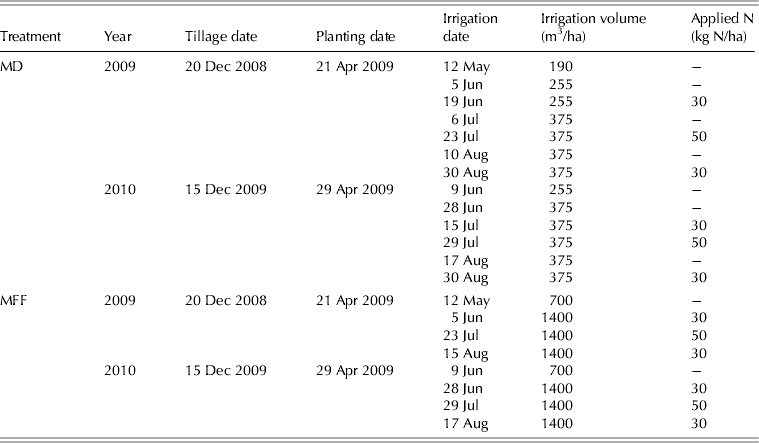
The field experiment comprised two treatments during the cotton growing seasons of 2009 and 2010: (1) the traditional cultivation system of mulch-free flooded irrigation (MFF) and (2) a modern cultivation system that used MD irrigation. In April 2009, each treatment was replicated three times in a randomized complete block making a total of six 15×8 m plots. The cotton (cvar Xinluzao No. 6) was sown on 21 April, 2009 and 28 April 2010. At the MD sites, a high density, airtight transparent polythene film (0·01–0·02 mm thick, 1·25 m wide) was placed over the soil surface before sowing and drip irrigation under the mulching was used. At the MFF sites, flood irrigation with no plastic film was used. For both treatments, the planting density was 266 667 plants/ha, and urea (110 kg N/ha) and superphosphate fertilizer (72 kg P2O5/ha) were applied. In the MD sites, fertilizer was applied with drip irrigation, but in the MFF sites, fertilizer was sprinkled on the soil before flood irrigation. The timing and frequency of irrigation and fertilization followed the local commercial practice. Crop management details for the two cultivation systems are shown in Table 1.
Crop management details for the two cultivation systems in the cotton growing season of 2009 and 2010

MD=mulched-drip irrigation; MFF=mulch-free flooding irrigation.
Field sampling of soil fluxes and environmental factors
The closed chamber method (Jin et al. Reference Jin, Dong, Qi and Domroes2009) was used to determine GHG flux in situ. The chamber (0·5×0·5×0·5 m) was equipped with a small circulation fan and a gas channel, which was a polyvinyl chloride (PVC) tube with a three-way stopcock. A stainless steel frame with a water groove (0·5×0·5×0·05 m) was inserted into the soil and the chamber placed into a groove that was filled with water before each gas sampling to ensure an airtight seal.
Three steel frames were placed between the cotton rows in each replicate. The gases were collected mostly between 09·00 and 11·00 h every other week from May to October 2009 and 2010. After relevant events such as fertilization or irrigation, gas sampling frequencies were increased. A total of 25 gas samplings in 2009 and 23 gas samplings in 2010 were collected during the experimental periods. At each sampling event, c. 70 ml air in the chamber was aspirated through the needle into the polyethylene-coated aluminium gas bags at 30 s intervals for 150 s after capping. The concentrations of CH4 and N2O in the air samples were analysed using a modified gas chromatograph (Agilent 4890D, Agilent Technologies, Inc., Santa Clara, CA, USA) equipped with an electron capture detector and a hydrogen flame ionization detector (Wang & Wang Reference Wang and Wang2003). The total emissions of CH4 and N2O over the growth period were obtained from the integrated weekly fluxes using the following equation:
 $${\rm Total}\;{\rm CH}_4 \;{\rm or}\;{\rm N}_{\rm 2} {\rm O}\;{\rm emission} = \sum\limits_i^n {\displaystyle{{X_i + X_{i + 1}} \over 2}(t_{i + 1} - t_i )}. $$
where X i (g/m2/d) was the first week CH4 or N2O measurement and X i+1 (g/m2/d) was the following week CH4 or N2O measurement at times t i and t i+1, respectively; n was the final week of CH4 or N2O measurement during the sampling periods.
During each gas sampling event, measurements of air temperature at 30 cm and soil temperature at 10 cm in planted and non-planted sites with and without chambers were made for each sample using a SN2202 digital thermo detector (Sinan Instruments Plant of Beijing Normal University, Beijing). Soil water content at 10 cm in each plot was measured used the oven drying method (105 °C for 48 h).
Soil properties
Soil samples from the 0–20 cm surface layer, with a composite of ten subsamples, were taken with a 2 cm diameter stainless steel sample auger at each site. A total of 36 soil samples were collected in May, July and September in 2009 and June, August and October in 2010. Each sample was air-dried and sieved to 2 mm to measure soil organic carbon (SOC), total nitrogen (TN) and mineral N (NH4, NO3−) concentration. The SOC was measured using the dichromate–sulphuric acid (K2CrO7–H2SO4) oxidation method. Total nitrogen was measured using a Kjeldahl nitrogen analyser (Model KDN-2C, Shanghai, China). The mineral N concentrations were determined from 4 g (dry mass) of soil using a KCl extraction procedure (Bai et al. Reference Bai, Wang, Yan, Gao, Xiao, Shao and Ding2012), and analysed by continuous flow analysis (AA3, Bran+Luebbe Co., Germany). Soil bulk density at 0–5 cm was measured using a 100 ml stainless steel ring at each site.
Statistical analysis
The differences in the gas fluxes and the parameters of the soil physical and chemical properties between MD and MFF sites were tested with the Mann–Whitney U-test at a probability level of 0·05 and were performed using SPSS statistical software package (SPSS 11.0).
RESULTS
Soil properties
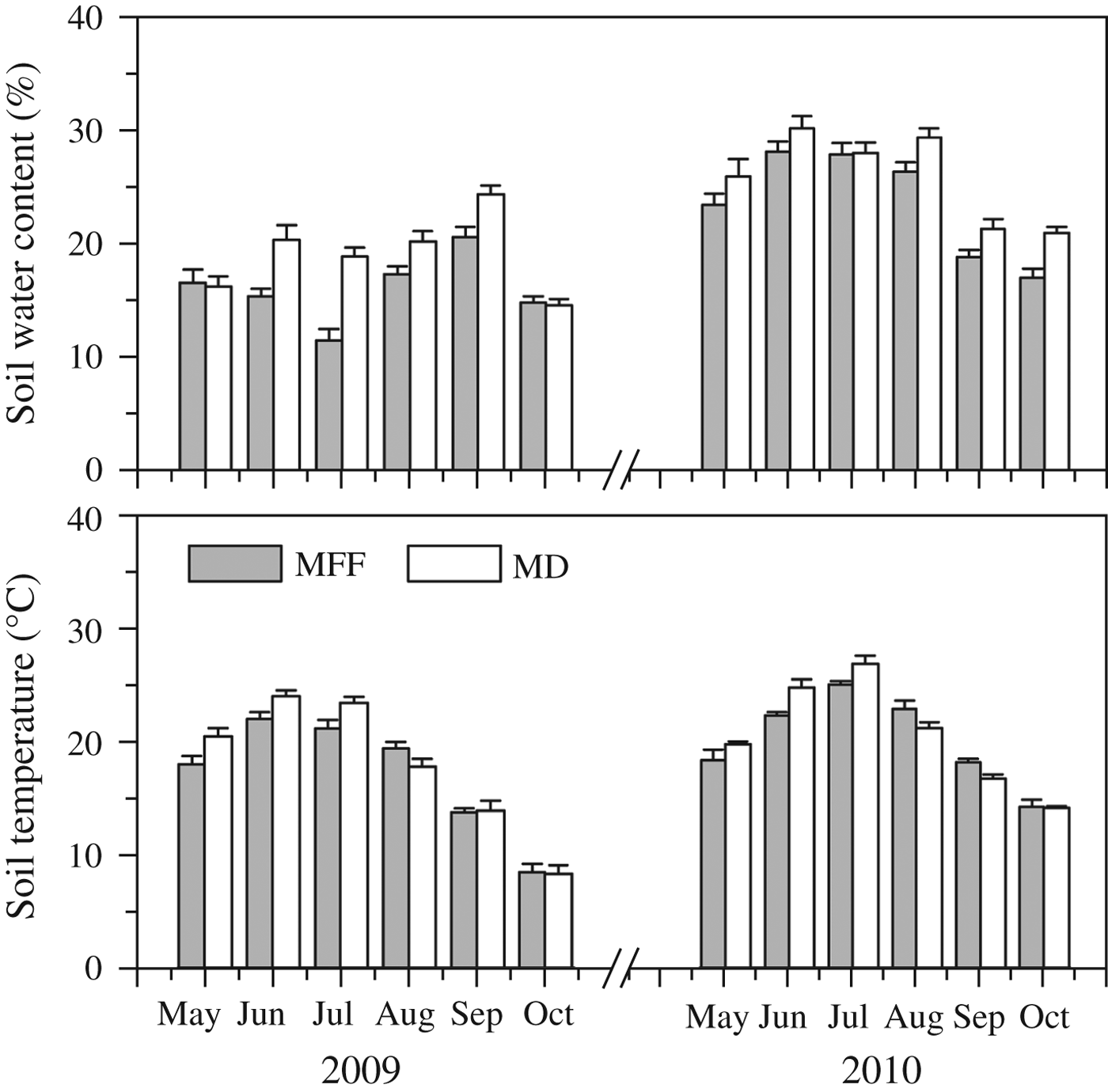
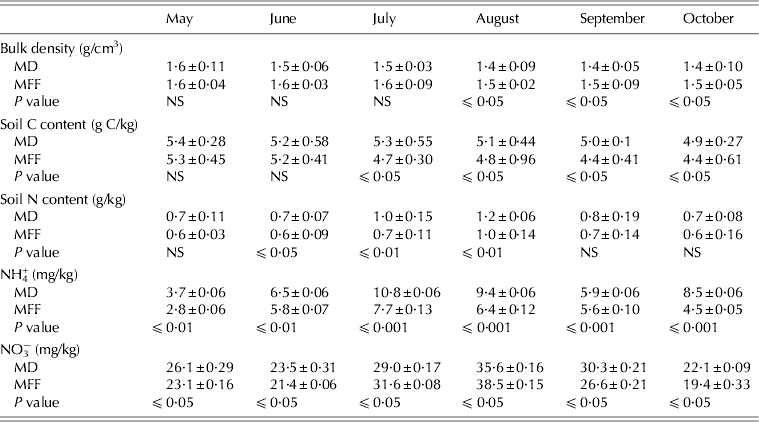
The mean daily soil temperature showed a pronounced seasonality during the growing season (Fig. 1). Soil temperatures at the MFF sites were lower than at the MD sites until August and were higher thereafter, especially in 2010. Soil water contents at the MD sites were higher than at the MFF sites during the whole growing period except for May 2009 because this site was flooded by nearby drains before measurement. Soil bulk density at the MD sites was slightly lower than at the MFF sites and bulk density tended to decrease over time for both sites during the experimental period.
Soil temperature and soil water content during the 2009 and 2010 growing seasons in the mulched-drip irrigation (MD) and mulch-free flooding irrigation (MFF) cotton fields. Values are mean with s.d. of three replicates.
The SOC and TN contents were also consistently higher at the MD sites than at the MFF sites (Table 2). The difference in SOC between the two treatments increased with time. Soil NH4+ content at the MD sites ranged from 3·7 to 10·8 mg/kg and were consistently higher than those at the MFF sites. The NO3− contents in soil were also higher at the MD sites compared with that in the MFF sites except for July 2009 and August 2010.
Soil properties in the mulched-drip irrigation (MD) and mulch-free flooding irrigation (MFF) cotton fields. Values are mean±s.d.
Soil CH4 fluxes
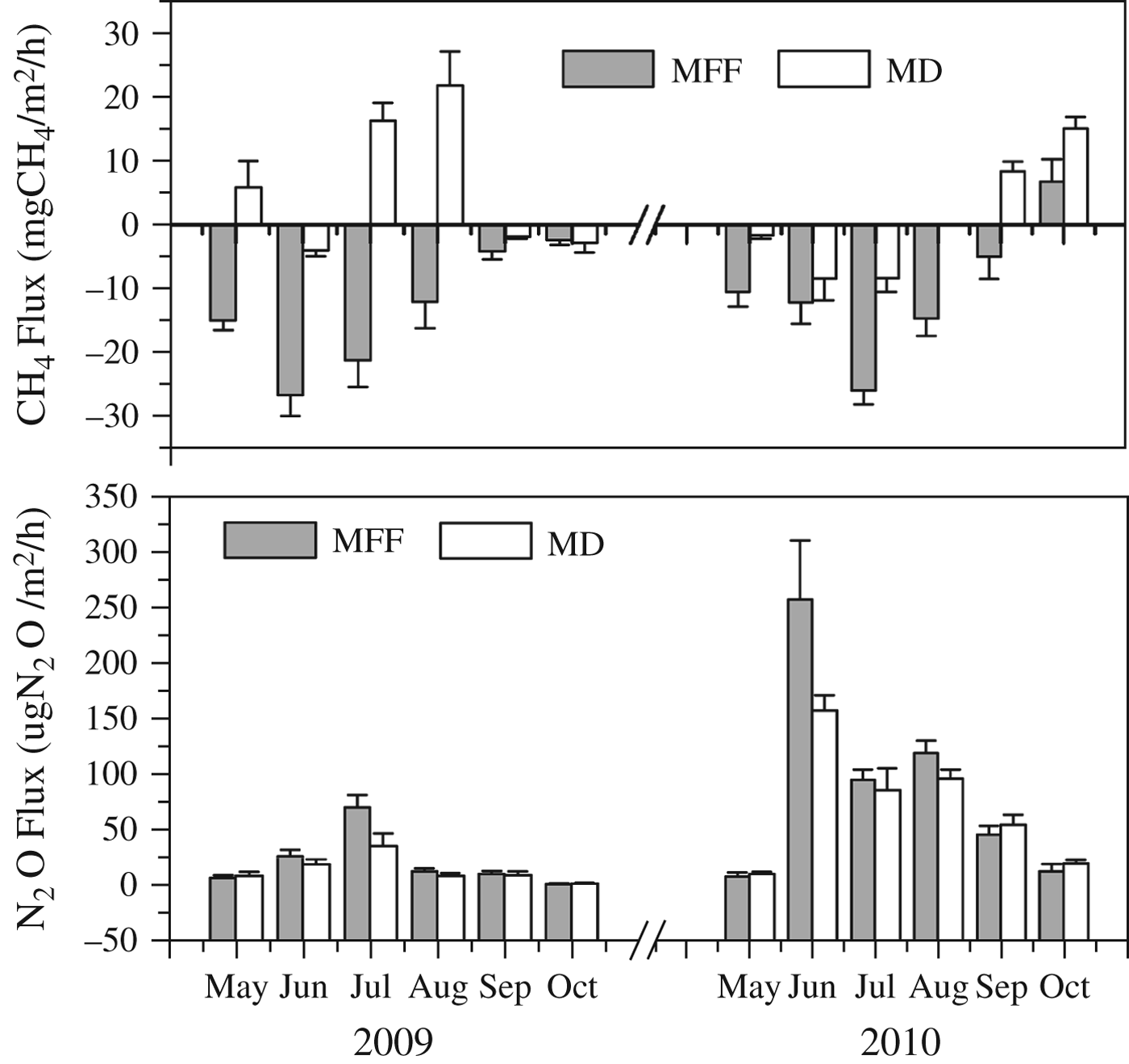
The soil at the MFF sites absorbed CH4 throughout the whole growing season except for October 2010, whereas those at the MD sites both absorbed and emitted CH4 (Fig. 2). The mean CH4 absorption rates at the MFF sites tended to be higher than those at the MD sties. Over the two growing seasons, average annual emissions of CH4 from the MD sites was 0·02 g CH4/m2/season but the MFF sites had a net uptake of 0·05 g CH4/m2/season from the atmosphere (Table 3).
Soil CH4 and N2O during the 2009 and 2010 growing seasons in the mulched-drip irrigation (MD) and mulch-free flooding irrigation (MFF) cotton fields. Values are mean with s.d. of three replicates.
The annual accumulated emissions of greenhouse gases during the 2009 and 2010 growing seasons in the mulched-drip irrigation (MD) and mulch-free flooding irrigation (MFF) cotton fields. Values are mean± s.d.
* The GWP was calculated by using the IPCC factors over a 100-year time horizon for the emissions of CH4 and N2O (IPCC Reference J. T., Y., D. J., M., P. J., X., K. and C. A.2001), using the following equations: GWP(CH4)=F(CH4)×23, since 1 kg CH4-e=23 kg CO2 e; GWP(CH4)=F(N2O)×296, since 1 kg N2O-N=296 kg CO2 e.
Soil nitrous oxide fluxes
The mean N2O emission rates varied greatly, from 1·6 to 256·0 mg N2O/m2/h at the MFF sites and from 1·7 to 157·0 mg N2O/m2/h at the MD sites (Fig. 2). The mean N2O emission rates increased to the highest levels in June 2009 and July 2010 and decreased to the lowest levels in October of both growing seasons. Overall, the MFF sites had a higher N2O emission rate, c. 1·4–1·7 times that of the MD sites (Table 3). Some negative fluxes of N2O were observed at individual chambers in the MD sites in October 2010.
Global warming potential
In order to compare the GWP of CH4 and N2O emissions, they were converted into CO2 emission equivalents using GWP coefficients of 23 for CH4 and 296 for N2O in a 100-year horizon. Relatively, the GWP for CH4 was significantly lower than N2O in both MD and MFF sites (P<0·01), and only accounted for 0·9–1·6% of N2O. The average net GWP for CH4 and N2O in the MD sites was c. 51 g CO2 e/m2/year, while than that for the MFF sites was higher: 71 g CO2 e/m2/year.
DISCUSSION
A number of studies have shown a significant increase in soil temperature under plastic film mulching (Li et al. Reference Li, Song, Jjemba and Shi2004; Ibarra-Jimenez et al. Reference Ibarra-Jimenez, Zermeno-Gonzalez, Munguia-Lopez, Quezada-Martin and De La Rosa-Ibarra2008). In the present study, a similar result was found in the early plant growing period. However, soil temperature at the MD sites was lower or was no different from that at the MFF sites in the late growing period owing to the cover effect of the larger plants in the MD sites. The plastic film also effectively prevents the evaporation of soil moisture, explaining the higher soil moisture content of the MD treatments.
The SOC and TN contents at the MD sites were higher than the MFF sites. These results contrast with several previous reports, which found that mulching practices decreased the SOC and TN content owing to an increase in soil microbial decomposition rate (Li et al. Reference Li, Song, Jjemba and Shi2004). However, Li et al. (Reference Li, Zhang, Wang, Chen and Tian2012) and Gu et al. (Reference Gu, Liang, Huang, Ma, Wang, Yang, Liu, Lv and Lv2012) both reported that mulching practices could help plants grow well and develop a larger root system, especially in the 0–30 cm layer, which could secrete large amounts of exudates or supply more root litter to the soil. In addition, owing to the reduction of oxygen in the MD sites by the film covering, MD practices may further restrict the microbial decomposition rates of the original soil organic matter (Khan & Datta Reference Khan and Datta1991). These factors probably resulted in the higher soil SOC and TN contents in the MD sites, which could compensate for or offset the decomposition of the soil organic matter due to the increase in soil temperature.
Inorganic N pools were dominated by NO3− at both the MD and the MFF sites compared with NH4+ probably owing to the high soil pH of 8·4, and the fact that increased NH4+ and NO3− concentrations in mulched sites have been observed in this and several other studies (e.g. Sharmasarkar et al. Reference Sharmasarkar, Sharmasarkar, Miller, Vance and Zhang2001; Li et al. Reference Li, Song, Jjemba and Shi2004). These findings indicate that mulching practices could increase mineral N in soil owing to the higher soil temperature. Also, it is associated with the lower rate of fertilizer in the MD sites than the MFF sites. In the present experiment, fertilizer in the MD sites was added in drip irrigation under the mulching, which could infiltrate N fertilizer more fully into the soil to reduce the loss from volatilization of ammonia or low solute leaching. In contrast, MFF fertilization added fertilizer as flooding irrigation and Sharmasarkar et al. (Reference Sharmasarkar, Sharmasarkar, Miller, Vance and Zhang2001) reported that flooding fertilizer can result in 42–53% N loss due to NO3 leaching.
Generally, farmland soils can oxidize atmospheric CH4 under dry conditions owing to methanotrophs in soils, which act as sinks for atmospheric CH4 (Dalal et al. Reference Dalal, Allen, Livesley and Richards2008). In the present study, the MFF sites were well-drained and generally absorbed CH4; however, the MD sites tended to absorb less than the MFF sites and sometimes emitted CH4. These results show that MD can decrease CH4 absorption or convert CH4 sinks to sources during the growing season.
Methanotrophs and methanogens are microorganisms that play an important role in the CH4 flux from soil (Angel et al. Reference Angel, Matthies and Conrad2011). The rate of CH4 absorption by methanotrophs or the CH4 production rate by methanogens is limited mainly by the O2 availability in the soil (Dalal et al. Reference Dalal, Allen, Livesley and Richards2008). In the present study, MFF soils were dry, with good soil void condition. Oxygen was well dispersed in the soil and improved the activity of soil methanotrophs, which would increase the absorption of atmospheric CH4 (Geng et al. Reference Geng, Luo and Yuan2010). By contrast, at the MD sites, plastic film mulching covered the soil and lowered the effective diffusivity of O2 availability, probably providing anaerobic conditions for CH4 generation by methanogens. In addition, according to Liu et al. (Reference Liu, Li, Yang, Hu and Chen2010), the higher soil moisture and higher soil temperature in the MD sites could accelerate soil organic matter decomposition and root respiration rates, which will further lead to the formation of a soil anaerobic environment, prompting a large amount of CH4 generation.
Xie et al. (Reference Xie, Zheng, Zhou, Gu, Zhu, Chen, Shi, Wang, Zhao, Liu, Yao and Zhu2010), Jiang et al. (Reference Jiang, Yu, Fang, Cao and Li2010), Win et al. (Reference Win, Nonaka, Toyota, Motobayashi and Hosomi2010) and Fender et al. (Reference Fender, Pfeiffer, Gansert, Leuschner, Daniel and Jungkunst2012), in laboratory measurements and field studies of forest, grassland and farmland soils, indicated that a higher N content, especially NH4+ in the soil has an inhibiting effect on CH4 oxidation. A fertilization experiment in arable land also had a strong inhibitory effect on the oxidation of CH4 (Schellenberg et al. Reference Schellenberg, Alsina, Muhammad, Stockert, Wolff, Sanden, Brown and Smart2012). The main reason is that the increased soil NH4+ can compete with CH4 for the active binding point of the key enzyme in methane oxidation, i.e. methane monooxygenase (Fender et al. Reference Fender, Pfeiffer, Gansert, Leuschner, Daniel and Jungkunst2012). This inhibits the enzymes activity and is irreversible. In the present study, the soils at the MD sites had more NH4+ than those at the MFF sites over the whole growing season. Thus, the relatively high NH4+ content likely had an inhibitory effect on CH4 oxidation at the MD sites.
Farmland soil is one of the most important N2O sources, contributing up to 70–90% of atmospheric emissions globally (Win et al. Reference Win, Nonaka, Toyota, Motobayashi and Hosomi2010; Schellenberg et al. Reference Schellenberg, Alsina, Muhammad, Stockert, Wolff, Sanden, Brown and Smart2012). Different farmland management measures on soil N2O emissions vary greatly (Paustian et al. Reference Paustian, Six, Elliott and Hunt2000). Many studies suggest that differences in soil water and temperature are the major reasons for different soil N2O emissions under different management practices, and surface soil N2O flux was positively correlated with soil temperature and soil water content (Xu et al. Reference Xu, Shen, Li, Dittert and Sattelmacher2004; Okuda et al. Reference Okuda, Noda, Sawamoto, Tsuruta, Hirabayashi, Yonemoto and Yagi2007). In the present experiment, the MD sites had higher soil temperature and moisture contents than the MFF, thus soil N2O emissions in the MD sites should be higher than that of the MFF sites. Nishimura et al. (Reference Nishimura, Komada, Takebe, Yonemura and Kato2012) also found higher N2O emissions from soil covered with plastic mulch film compared with that from non-mulching sites in a horticultural field. However, the actual observation in the present study was the opposite.
Thus, it was concluded that in the MD sites, the key influencing factors were not temperature and soil moisture. Nitrous oxide emission was probably associated with other factors, such as oxygen diffusion status, amounts of readily available carbon and inorganic N in the soil. It is well established that microbial proliferation is enhanced, and thus N2O production generally increases, under conditions of high inorganic N and organic matter contents and low O2 concentration in the soil (Letey et al. Reference Letey, Valoras, Hadas and Focht1980; Yanai et al. Reference Yanai, Hirota, Iwata, Nemoto, Nagata and Koga2011; Nishimura et al. Reference Nishimura, Komada, Takebe, Yonemura and Kato2012). In the present experiment, the mulched soils were under conditions of high inorganic N content and organic carbon. The O2 concentration in the soil was not measured, but previous studies have indicated that O2 concentration in the soil decreases significantly due to the respiration of soil microorganisms and roots under low O2 diffusivity conditions (Khan & Datta Reference Khan and Datta1991; Nishimura et al. Reference Nishimura, Komada, Takebe, Yonemura and Kato2012). However, under these soil conditions at the MD sites, no significant enhancement of N2O production by denitrification occurred and N2O fluxes in June, July and August of 2009 and 2010 at the MD sites were significantly higher than those at the MFF sites. Okuda et al. (Reference Okuda, Noda, Sawamoto, Tsuruta, Hirabayashi, Yonemoto and Yagi2007) also observed no significant difference in the N2O emission factor between mulching and non-mulching treatments. The present results suggest that N2O production processes in the mulched sites may be affected by other factors. Hasegawa et al. (Reference Hasegawa, Shimizu and Hanaki2004) reported that some denitrifying bacteria, such as Thiobacillus denitrificans, could reduce nitrates to N2, taking nitrates as the final electron acceptor of respiration under anaerobic conditions though the following reaction:
 $$5{\rm S} + 6{\rm KNO}_3 + 2{\rm H}_2 {\rm O} \to 3{\rm N}_2 \uparrow + {\rm K}_2 {\rm SO}_4 + 4{\rm KHSO}_4. $$
However, for the above reaction to proceed smoothly, the presence of sulphur oxides in the soil is also necessary (Letey et al. Reference Letey, Valoras, Hadas and Focht1980; Hasegawa et al. Reference Hasegawa, Shimizu and Hanaki2004). Therefore, related literature was reviewed and it was found that the local soils were rich in sulphur oxides.
Based on the above analysis, it was speculated that the possible reason for lower N2O emission at the MD sites than at the MFF sites was that the anaerobic soil environment resulting from the plastic film mulching dramatically increased soil denitrification by anaerobic microorganisms such as T. denitrificans, which then reduced some nitrous compounds further into N2 (Hasegawa et al. Reference Hasegawa, Shimizu and Hanaki2004), thereby reducing the soil N2O emission. However, direct evidence cannot be provided. Future studies on the soil microbial community are expected to elucidate the denitrification process under plastic film mulching cover.
Global warming potential is a simplified index on radiation characteristics, which is used to estimate and evaluate the impact of various GHGs on the climate system (Six et al. Reference Six, Ogle, Breidt, Conant, Mosier and Paustian2004). The GWP value of a given gas is related to the length of its evaluation period (IPCC Reference J. T., Y., D. J., M., P. J., X., K. and C. A.2001). A gas that decomposes quickly in the air is likely to have a great influence on GWP in the early stage of the assessment period, but the later impact will be lower because the gas has been broken down. For example, in the results of the Second Assessment Report of the IPCC, the 20-year GWP of CH4 is 72, but the 100-year GWP is 25 (IPCC Reference J. T., Y., D. J., M., P. J., X., K. and C. A.2001). Therefore, the assessment period must be given when studying the GWP of GHGs.
In the present study, GWP coefficients of 23 for CH4 and 296 for N2O in a 100-year horizon (IPCC Reference J. T., Y., D. J., M., P. J., X., K. and C. A.2001) were used to observe the impact of the MFF and MD cultivation on these two GHGs. When CH4 and N2O emissions were expressed in CO2 equivalents, it appeared that the contribution of CH4 to the greenhouse effect was significantly lower than N2O in these two treatments, although a lower CH4 uptake in the MFF sites was observed. The same result has been obtained in other managed farmland sites (Geng et al. Reference Geng, Luo and Yuan2010). This tends to show that in arid farmland, CH4 emission is unlikely to significantly affect the ecosystem GHG budget.
Considering the changes in the two GHG fluxes together, the cumulative GWP estimates for both MD and MFF treatments were c. 51 and 71 g CO2 e/m2/season during the entire growth period, respectively, which make them weak atmospheric sources. However, compared with MFF cultivation, MD cultivation seems to be a good way to decrease GHG emissions, while cotton productivity in MD cultivation can be kept at a high and stable level (Li et al. Reference Li, Zhang, Wang, Chen and Tian2012).
CONCLUSION
The MD cultivation system enhanced soil temperature and soil water content but did not increase N2O fluxes compared with the MFF cultivation system. The CH4 absorption at the MD sites tended to be less than at the MFF sites, and sometimes the MD sites emitted CH4 via methanogens in the anaerobic conditions under mulching. Considering the changes in these two GHG fluxes together, the contribution of CH4 to the greenhouse effect was significantly lower than N2O in these two treatments during the entire growth period. Consequently, transition from MFF cultivation to MD irrigation cultivation could decrease atmospheric emissions by c. 20 g CO2 e throughout the growing season. Mulched-drip irrigation cultivation system is an effective way to decrease GHG emissions in the short term in cotton systems of arid areas.
The present study was financially supported by the Important Science and Technology Specific Project of Xinjiang Uygur Autonomous Region (grant no. 201130106-2), the Project of the National Natural Science Foundation of China (grant no. 40971148), the Programme for 100 Distinguished Young Scientists of the Chinese Academy of Sciences (grant no. 0972021001) and the China Programme of International Plant Nutrition Institute (IPNI).