Introduction
According to the World Economic Outlook Update by the International Monetary Fund, India is one of the fastest growing economies in the world. However, this rapid macro-economic growth has not yet been translated into a substantial decline in childhood undernutrition in the country (Subramanyam et al., Reference Subramanyam, Kawachi, Berkman and Subramanian2011; Joe et al., Reference Joe, Rajaram and Subramanian2016). Childhood undernutrition is responsible for the majority of childhood morbidities and is one of the leading causes of child mortality in India (Gragnolati et al., Reference Gragnolati, Shekar, Das Gupta, Bredenkamp and Lee2005; UNICEF, 1990, 2007; Black et al., Reference Black, Allen, Bhutta, Caulfield, de Onis and Ezzati2008; World Health Organization, 2010). Stunting, defined as the z-score of height-for-age below minus 2 standard deviation units from the median of a reference population (HAZ), is a strong predictor of adult height and an indicator of restricted linear growth of a child due to chronic undernutrition (Tanner et al., Reference Tanner, Healy, Lockhart, Mackenzie and Whitehouse1956; Onis, Reference Onis2006; WHO Multicentre Growth Reference Study Group, 2006; World Health Organization, 2010). Empirically, taller adults have higher cognitive abilities, fewer physical impairments over the lifetime and higher earnings (Barker & Osmond, Reference Barker and Osmond1986; Barker et al., Reference Barker, Godfrey, Gluckman, Harding, Owens and Robinson1993; Strauss & Thomas, Reference Strauss and Thomas1998; Glewwe & Miguel, Reference Glewwe and Miguel2007; Hoddinott et al., Reference Hoddinott, Behrman, Maluccio, Melgar, Quisumbing and Ramirez-Zea2013; Schott et al., Reference Schott, Crookston, Lundeen, Stein and Behrman2013; Guven & Lee, Reference Guven and Lee2015). Unfortunately, the percentage of childhood stunting has remained alarmingly high in many parts of India (HUNGaMa Survey Report, 2011). Almost 30% of the world’s stunted children are in India – an outlier even among the poorest nations in the world (UNICEF, 2013).
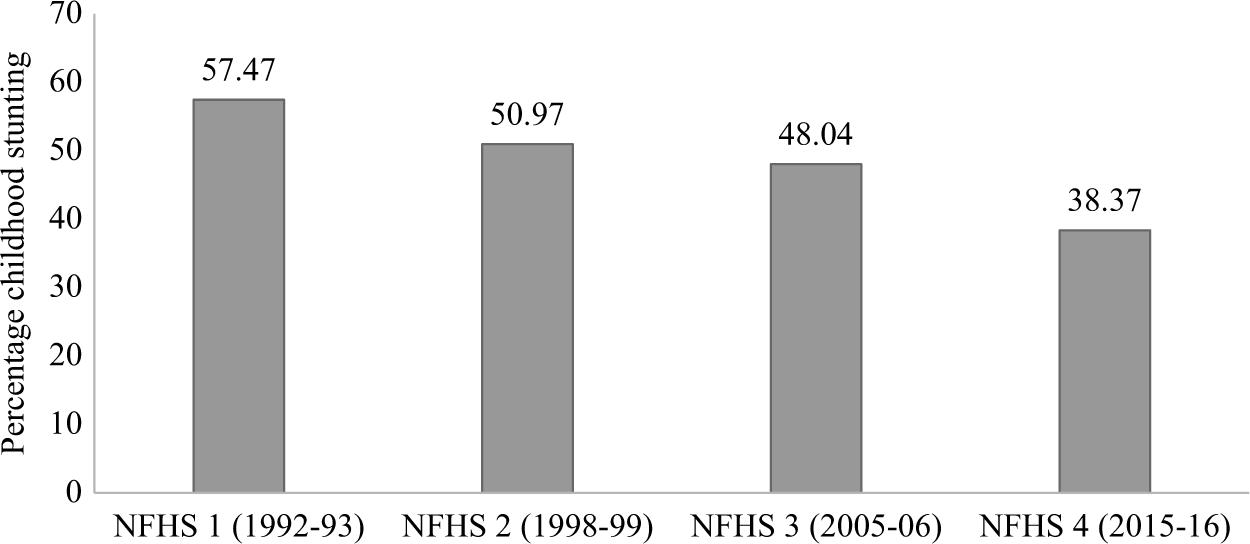
Since the 1990s, India’s childhood stunting levels have declined gradually. However, this decrease has not been on a par with that of other countries with similar economic conditions (Gragnolati et al., Reference Gragnolati, Shekar, Das Gupta, Bredenkamp and Lee2005), decreasing from a level of 57% in 1992–93 to 38% in 2015–16 (Fig. 1). Continuous efforts have been made to combat and eradicate childhood morbidities and undernutrition in India. Some noteworthy initiatives have been the United Nations Children’s Fund (associated with India since 1949), the Integrated Child Development Scheme (ICDS) (1975), the National Plan of Action for Children (signatory to the World Summit on Children, 1990), Mid-Day Meals (1995), Reproductive and Child Health-II (2005), Janani Suraksha Yojana (JSY) (2005), Janani Shishu Suraksha Karyakaram (2011) and Pradhan Mantri Matru Vandana Yojana (PMMVY) (2017). Despite such efforts, the recent (2015–16) Indian National Family and Health Survey (NFHS-4) data recorded one in three children to be stunted.
Percentage of childhood stunting in India, NFHS-1 (1990–93) to NFHS-4 (2015–16).

There is a myriad of literature unravelling the determinants of childhood stunting in India. Some of the major child- and mother-level factors predisposing a child to stunting are: mother’s health, height, education and socioeconomic status, and the age and sex of the child (Smith & Haddad Reference Smith and Haddad2000; Black et al., Reference Black, Allen, Bhutta, Caulfield, de Onis and Ezzati2008, Reference Black, Victora, Walker, Bhutta, Christian and de Onis2013; Subramanian et al., Reference Subramanian, Ackerson, Smith and John2009; Kanjilal et al., Reference Kanjilal, Mazumdar, Mukherjee and Rahman2010; Fenske et al., Reference Fenske, Burns, Hothorn and Rehfuess2013; Fledderjohann et al., Reference Fledderjohann, Agrawal, Vellakkal, Basu, Campbell and Doyle2014; Onis & Branca Reference Onis and Branca2016; Singh et al., Reference Singh, Arokiasamy, Pradhan, Jain and Patel2016;). Morbidities such as diarrhoea and acute respiratory infection reduce immunity and weaken children, making them more vulnerable to infection and disease. This leads to the physical inability to absorb nutrients from food (Scrimshaw & SanGiovanni, Reference Scrimshaw and SanGiovanni1997; Jayachandran & Pande, Reference Jayachandran and Pande2017). However, research on clustering of stunting status in siblings, albeit cardinal in assessing the mechanism of stunting, remains limited in India. This is also called ‘clustering of stunting within the same family’ and is a widely studied phenomenon in child mortality. The argument in mortality research is that the death of a preceding child has a significant ‘scarring effect’ on the survival status of the index child. In other words, there are strong linkages between the death status of siblings resulting in clustering of mortality in a family (Das Gupta, Reference Das Gupta1990; Arulampalam & Bhalotra, Reference Arulampalam and Bhalotra2006, Reference Arulampalam and Bhalotra2008). Malnutrition measures such as underweight status, used in the study of sibling linkage (Singh et al., Reference Singh, Arokiasamy, Pradhan, Jain and Patel2016), are often affected by short-term programme interventions, whereas stunting is a stronger correlate of long-term chronic malnutrition and remains unaffected by short-term interventions. The present study explores the burden of multiple stunted siblings nested under a mother and provides insights on the biological aspect of childhood stunting. It also addresses additional issues of controlling geographical variations by using a multilevel approach.
The nutritional outcomes of siblings are linked by various mechanisms. Three parental concerns that affect the nutritional status of siblings are equity, efficiency and preference (Behrman et al., Reference Behrman, Schott, Mani, Crookston, Dearden and Duc2017; Mussa, Reference Mussa2015). Equity bias is caused by parents wanting their children to be equally well off. Thus, if nutritional requirements are different for different sexes, a gender bias may arise. Efficiency bias arises when parents are willing to invest more in a child because he/she is more efficient. Preference bias comes into play when parents prefer one child over the other. It has been observed that despite having similar calorie intakes, boys are given more fat and milk with their cereal compared to girls (Das Gupta, Reference Gupta1987). Girl children are less likely to be breastfed according to WHO/UNICEF standards than their male counterparts leading to mortality inequalities among male and female children (Fledderjohann et al., Reference Fledderjohann, Agrawal, Vellakkal, Basu, Campbell and Doyle2014). In some cases, sibling nutritional inequality is observed not only by sex, but also by age and birth order (Mussa, Reference Mussa2015). A mother’s experience through her reproductive life is postulated to have a significant impact on her children’s health. This is the ‘learning hypothesis’ as this defines the process by which a mother who has experienced a negative child health outcome such as death in the past may employ her experience to avoid the negative outcome in a later birth (Lee & Mason, Reference Lee and Mason2005; Arulampalam & Bhalotra, Reference Arulampalam and Bhalotra2006).
Inter-generational transmission of poverty is also a leading cause of clustering of childhood undernutrition. Wealthier parents invest more in their children’s health, social and educational needs, thereby increasing their chances of earning more, whereas children born to poor households have a higher chance of living a life of drudgery and ending up having a low standard of living. Thus, children of poorer households remain undernourished and show an increased risk of child mortality due to undernutrition (Martorell & Zongrone, Reference Martorell and Zongrone2012; Behrman et al., Reference Behrman, Schott, Mani, Crookston, Dearden and Duc2017).
This study focused on the clustering of stunting at the sibling level in India and assessed the contribution of the clustered burden on aggregate-level estimates. A randomized simulation technique was designed to assess the amount of load that would be taken away from the burden of childhood stunting if the siblings found to be stunted, clustered under the same mother, could be eliminated. A multinomial model was applied to produce predicted probabilities of childhood stunting by socioeconomic characteristics to indicate the propensity of clustering among various population sub-groups. A multilevel approach was used to estimate the effect of stunting status of a preceding sibling on the stunting status of the index child by taking the preceding child as a lagged variable. This approach gives reliable statistical estimates by controlling for various geographical levels in a diverse country such as India. Empirical evidence of state dependency in childhood stunting, after controlling for various socioeconomic and geographical characteristics, will assist in providing a new dimension to aetiology of childhood stunting and help in revision of old policies and frame new programmes to effectively deal with the issue of the sluggish decline in childhood stunting in India.
Methods
Data
The NFHS is a nationally representative, large-scale survey aimed at producing reliable maternal and child health indicators in India. It is conducted under the stewardship of the Ministry of Health and Family Welfare, India. The International Institute for Population Sciences (IIPS), Mumbai, is the nodal agency for conducting the NFHS. A two-stage stratified sample was collected in NFHS-4 from 29 states and seven union territories. For the very first time, district-level information was available in the data. A detail of the sampling techniques and size can be obtained from the national report of the NFHS 4 (IIPS & ICF, 2017). In NFHS-4, information was collected from 601,509 households with a response rate of 97.6%.
The sample size of the children below 60 months (under 5 years) in NFHS-4 was 259,627. The number of mothers who gave birth to children in the 5-year time period preceding the survey was 190,898. For the purpose of this study, children with missing information for height and age were deleted and the analysis was carried out on 225,002 children from 167,969 mothers. The anthropometric measures of both children between 0 and 59 months of age and mothers aged 15–49 years were collected. Weights were measured using a Seca 874 digital scale. The heights of mothers, and children aged 24–59 months, were measured using a Seca 213 stadiometer. The recumbent length of children below 2 years, or 85 cm, was measured using a Seca 417 infantometer. The preceding child and index child can be easily identified using the birth index and birth order numbers. Several socioeconomic, demographic and biological variables were considered in the study. The data are publicly available and can be downloaded from the Demographic Health Survey (DHS) website (https://dhsprogram.com/data/available-datasets.cfm).
Variables
Outcome variable
The outcome variable of interest was the height-for-age z-score (HAZ) from which the stunting status of children below 5 years of age was estimated. It is important to note how various measures of malnourishment differ from each other and what they actually signify. While wasting and underweight are generally considered to be short-term measures of acute malnourishment, stunting is considered to be a measure that not only encompasses the present lack of nutrition but also capture long-term deficiencies, usually inherited through transgenerational undernutrition (Caulfield et al., Reference Caulfield, Richard, Rivera, Musgrove, Black and Jamison2006; Bhutta et al., Reference Bhutta, Ahmed, Black, Cousens, Dewey and Giugliani2008; World Health Organization, 2010). In this study, the main aim was to assess sibling linkage, which inevitably depicts a genetic linkage. Thus, stunting was conceptualized to be the most suitable measure.
Explanatory variables
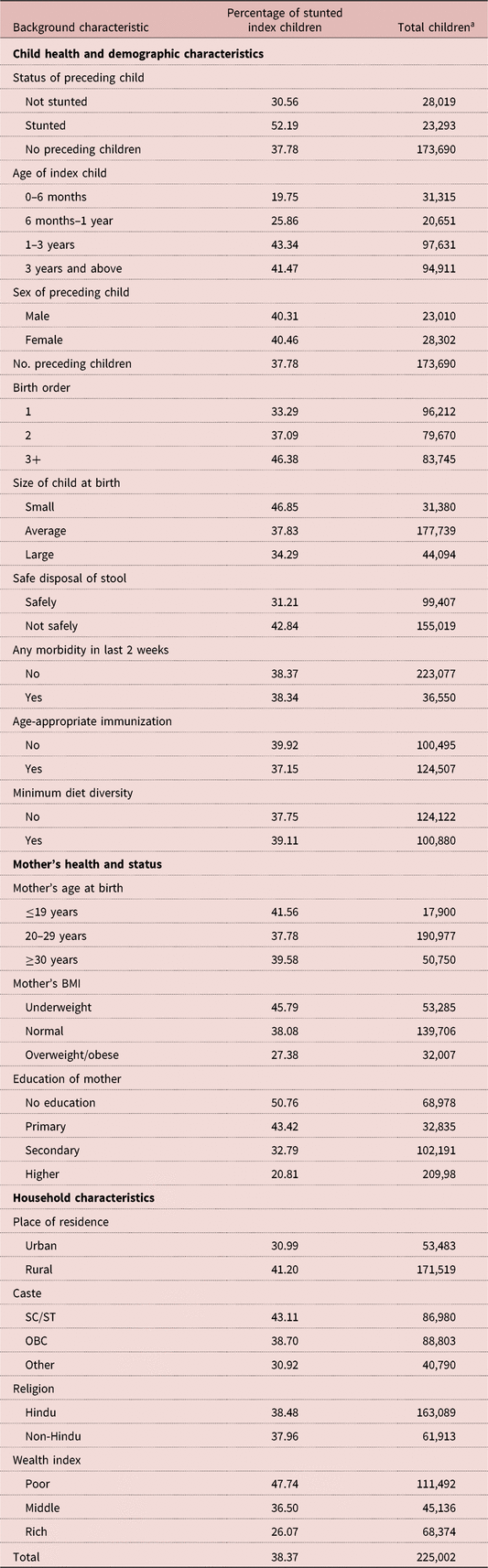
The main explanatory variable was the stunting status of the preceding child, coded as 0 if the HAZ was below minus 2 standard deviations and 1 otherwise. The model was controlled for a set of maternal and child demographic and socioeconomic characteristics, along with nutrition behaviour, and community-level sanitary practices as a proxy for neighbourhood disease environment. The percentages of stunting by the selected background characteristics are provided in Table 1.
Childhood stunting levels by background characteristics of mother and child, NFHS-4 (2015–16)

a Excluding children with no information.
SC/ST: Scheduled Caste/Scheduled Tribe; OBC Other Backward Class.
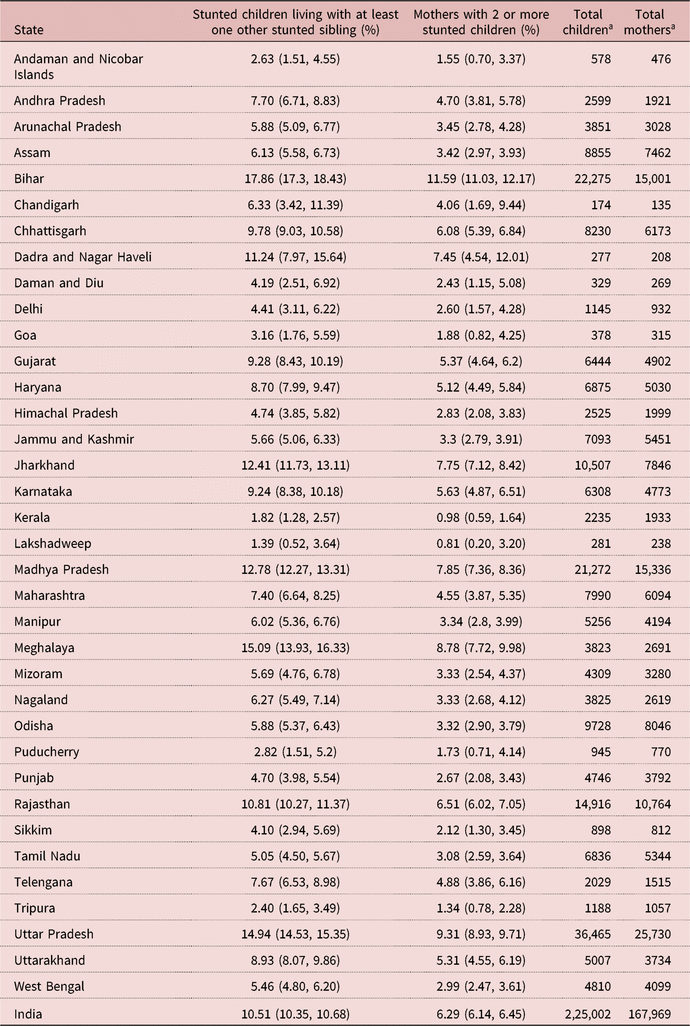
Percentage (95% CI) of sibling clustered childhood stunting in states of India, NFHS-4 (2015–16)

a Excluding children with no information.
Analysis
The sibling-level clustered burden of childhood stunting was estimated by identifying children below 59 months who were themselves stunted and were living with one or multiple stunted siblings. A simple, step-by-step, randomized simulation technique was designed to understand the burden of sibling-level clustering on the aggregate level of childhood stunting for various states and union territories of India. A univariate random sampling distribution was used to rank the children nested within mothers. The ranks were provided randomly. Stunted children with lower rank were simulated to be not stunted to obtain the estimates for aggregate stunting level without the clustered burden.
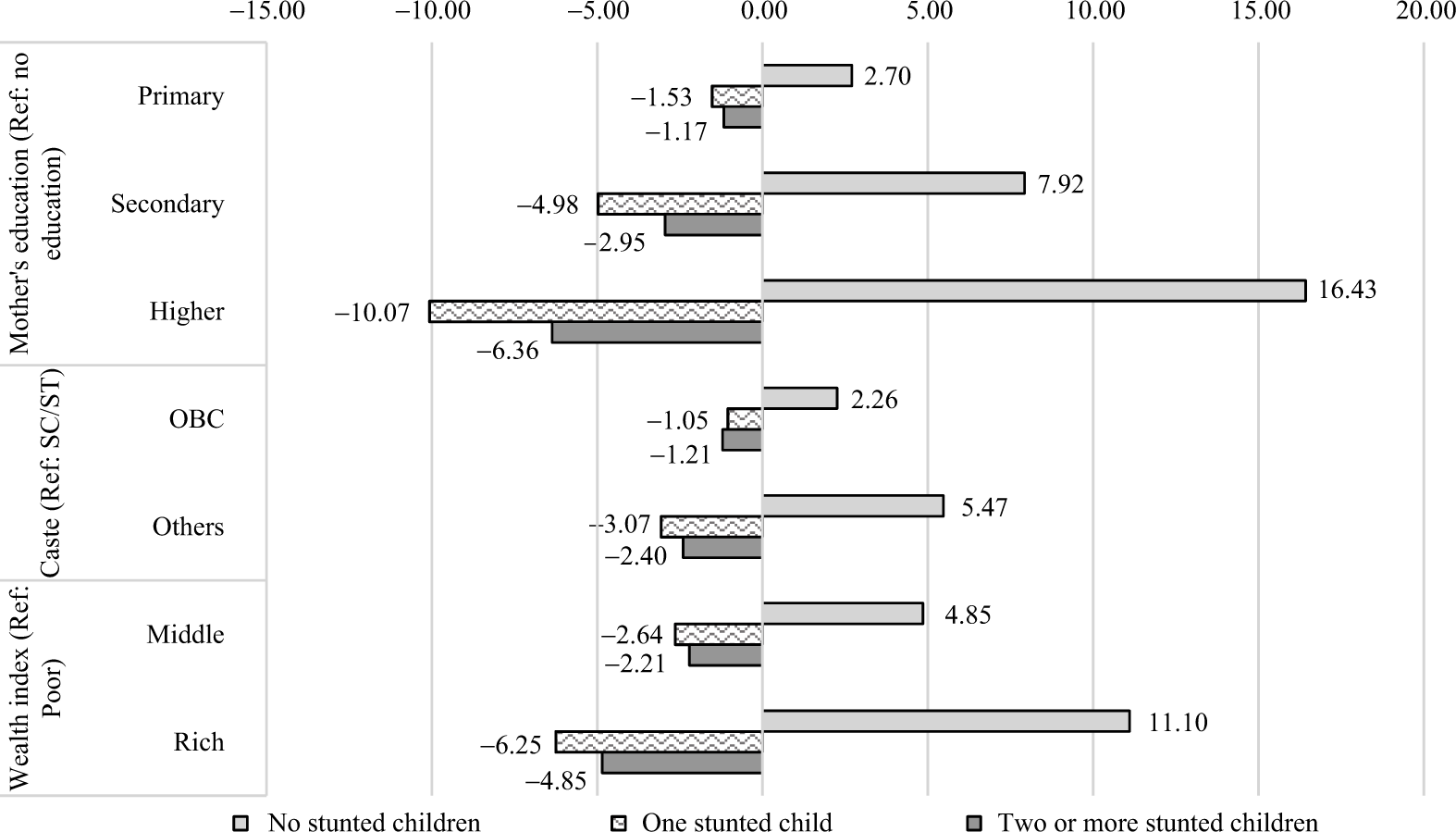
To assess the burden of stunting among various socioeconomic sub-groups, multinomial logit regression was used. Here, the dependent variable was the number of stunted children per mother. Clustering was noted if a mother had two or more stunted children below 5 years of age. The marginal probabilities by three major proxies for socioeconomic status were calculated from the fitted model. The proxies taken were: mother’s education level, social class (caste) and wealth status of the household.
To analyse sibling linkage, a multilevel approach using a binomial response model (multilevel binary response) estimated by the second-order penalized or predictive quasi-likelihood (PQL2) method was applied. For this model, the stunting status of children was coded as a binomial variable. This method is often preferred over the first-order marginal quasi-likelihood method (MQL1) as this may produce results that are biased downwards. Since there was not much difference between the estimates from MQL1 and PQL2, the Markov Chain Monte Carlo (MCMC) method was not used in the analysis. The model was controlled at three levels for some of the selected states: district, primary sampling unit (PSU) and individual child level. The PSU consists of villages in rural areas and wards in urban areas. The PSU and community are used interchangeably in this work. At the national level, the model was additionally controlled for states. The states selected for multilevel analysis were: Bihar, Uttar Pradesh, Madhya Pradesh, Gujarat, Punjab, Odisha and Tamil Nadu. These states fell in different positions in the stunting continuum and provided evidence to check if clustering of childhood stunting was state-specific or family-specific. This will provide insights on the type of programmes and policies that need to be bolstered.
Results
Descriptive statistics of the sample
Table 1 provides estimates of the percentage of stunting among the index children by the control variables used in the study. In cases where the preceding child was stunted, the percentage of stunting of the index child was as high as 52%. There was a rise in the percentage of stunted children after the age of 1 year. A similar percentage of stunting was observed among the index children irrespective of the sex of the preceding child. The percentage of stunting was found to rise with birth order. Around 47% of children of small birth size, and 43% of those whose stool was not safely disposed of, were stunted. Almost 40% of children who did not receive age-appropriate immunization were found to be stunted. Almost 38% of children who did not meet the Minimum Diet Diversity (MDD) level were stunted. The MDD is calculated following NFHS guidelines, which include all children who, irrespective of their breastfeeding status, have consumed items from four or more food groups (IIPS & ICF, 2017). Mothers whose age at child birth was below 19 years had 42% stunted children. Underweight mothers gave birth to 46% of the stunted children. In rural India, 41% of children were stunted compared with 31% in urban areas. The percentage of stunting was higher among Scheduled Caste/Scheduled Tribes (SC/ST) and Other Backward Class (OBC) mothers with no formal education or only primary education and belonging to lower wealth quintiles. The percentage of households that practised open defecation had a positive correlation with low HAZ. This was taken as a continuous variable at the community level.
Level of sibling-linked clustering of childhood stunting
Table 2 provides the clustering estimates of childhood stunting along with 95% confidence intervals in the states and union territories of India. Here, the percentage of children who are themselves stunted and who are living with at least one other stunted sibling and the percentage of mothers with multiple stunted children are presented. Almost 11% of stunted siblings were clustered within 6% of mothers (Table 2). This indicates that out of all children below 5 years of age, 11% were themselves stunted and were living with one or more stunted sibling. The states with a high level of aggregate childhood stunting (Table 3) like Bihar (18%), Meghalaya (15%), Uttar Pradesh (15%), Madhya Pradesh (13%) and Jharkhand (12%) showed the highest percentages of clustered stunted siblings (Table 2). This implies that a heavy burden of stunting was clustered within mothers in these states. Most of the Empowered Action Group (EAG) states remained in the top quintile of heavy sibling-level burden of stunting. Among the union territories, the highest percentage of clustering was observed in Dadra and Nagar Haveli (11%). The sibling-level clustered burden was only 1% in Kerala. This huge variation in the clustering of childhood stunting is an indicator of the inequality between the states of India.
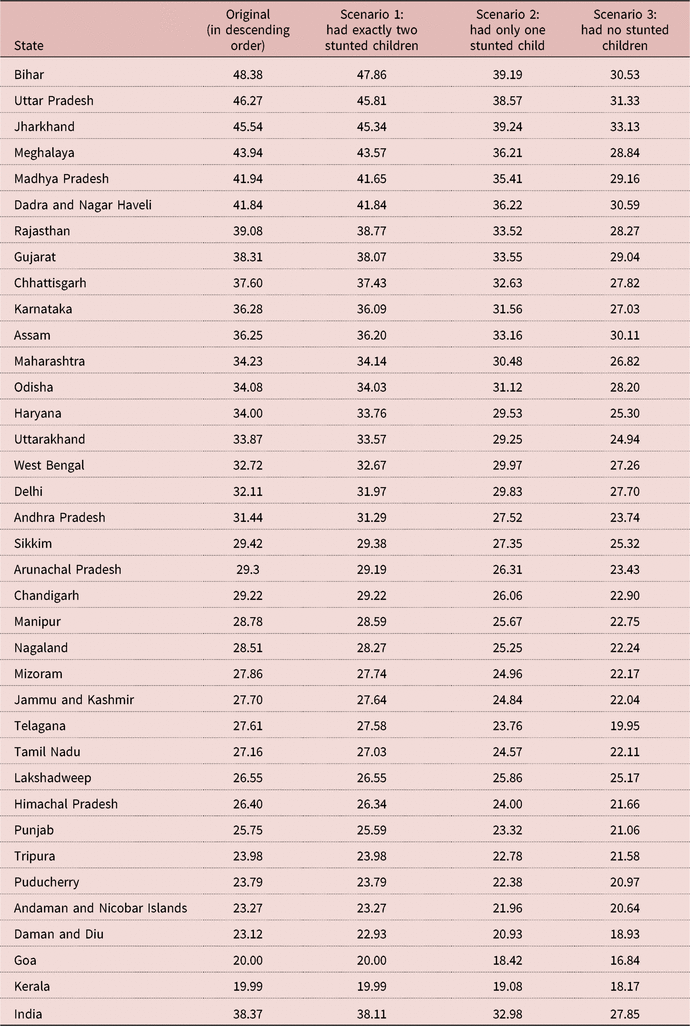
Predicted reduction in aggregate childhood stunting after removal of clustered sibling burden, NFHS-4 (2015–16)

Contribution of clustered stunting at an aggregate level
In the NFHS-4, the highest burdens of stunting were in Bihar, Uttar Pradesh, Jharkhand, Meghalaya, Madhya Pradesh, Dadra and Nagar Haveli (union territory), Rajasthan, Gujarat and Chhattisgarh. The percentages of stunted children in these states were higher than the national level, which was 38%. The estimate of childhood stunting included mothers with multiple stunted children, mothers with one stunted child and mothers with no stunted children born in the 5 years preceding the survey. The ideal case scenario is to achieve mothers with no stunted children. However, to completely eliminate stunting is a ‘one step at a time’ task. In Table 3, three scenarios are simulated. Scenario 1 estimates the aggregate-level childhood stunting if the mothers who had more than two stunted children had exactly two stunted children and no more. Scenario 2 provides aggregate-level stunting estimates if the mothers with multiple stunted children had only one stunted child. Scenario 3 captures the ideal situation where if mothers with multiple stunted children had no stunted children. In most of these states, there could be a noticeable decrease in the percentage of stunting if multiple stunted children could be reduced to one stunted child per mother. In states where the burden of childhood stunting was higher, like Bihar and Uttar Pradesh, a more than 7 percentage point decrease could be obtained if mothers with multiple stunted children could be reduced to have only one stunted child. However, in states like Kerala, where the aggregate-level burden was already low, not much difference can be noticed after removal of sibling-level clustering of stunting. The decrease in child stunting percentage for Bihar was as high as 18 percentage points and that for Uttar Pradesh was 15 percentage points if mothers with multiple stunted children could be assisted to have no stunted children by improving the z-scores of these children. If Scenario 3 could be achieved, an almost 10 percentage point reduction could be made in the stunting percentage at the national level.
Clustering of childhood stunting
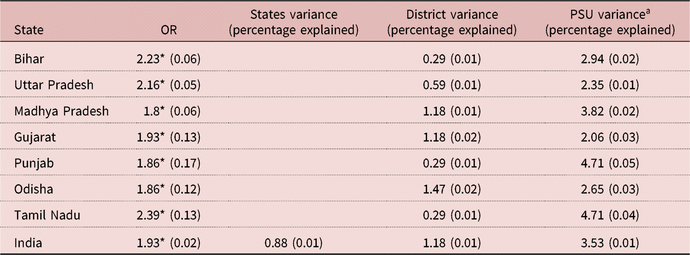
The burden of multiple stunted children was found to be clustered among the lower socioeconomic categories. The probability of having no stunted children was higher for more educated women belonging to the general social class and richer households (Fig. 2). After controlling for the principal co-factors, the results of the multilevel binary response model indicated that the chance of the index child being stunted increased by an odds ratio of 1.93 if the preceding child was stunted (Table 4). The selected states were very diverse in demographic characteristics, geographic attributes, economic transition, policy implementation, community-level participation and social commitment. However, the odds ratio for sibling linkage was above 1 and statistically significant for all selected states. After controlling for district- and PSU-level (village/ward) variation, mother-level heterogeneity was nearly zero. This indicates that, within the PSUs of districts, the behaviour of mothers was homogeneous. Hence, mothers were dropped as a hierarchical level. District level accounted for 0.3–1.5% of the variation for the selected states, whereas PSU level explained 2.1–4.7% of the variation in the model. This emphasized the heterogeneity between the PSUs of the districts of the selected states. In India, state level contributed 3.5% to the variation in the model.
Marginal effect (percentage) of mother’s wealth index, caste and education level on number of stunted children born to mothers, NFHS-4 (2015–16).

Multilevel analysis of clustered burden of childhood stunting in India and selected states, NFHS-4 (2015–16)

Standard errors in parentheses.
The model controlled for child age, preceding child’s sex, birth order, child’s size at birth, childhood morbidity, age-appropriate immunization, child satisfying minimum diet diversity, safe disposal of child’s stool, mother’s age at birth, mother’s education, whether mother received full ANC or not, place of residence, caste, religion, wealth index and percentage of households in the PSU with unimproved sanitation.
a Village/ward level.
* p<0.05.
Discussion
After missing the Millennium Development Goal (MDG) of reducing child malnourishment by half in 2015, India now aims to eradicate childhood malnourishment by 2030 under the Sustainable Development Goals (SDGs) designed in 2016. For India to take a positive step in that direction, a supply-side strategy highlighting the structural causes of childhood stunting needs to be bolstered rather than extolling economic achievements (Joe et al., Reference Joe, Rajaram and Subramanian2016; Subramanian et al., Reference Subramanian, Mejía‐Guevara and Krishna2016). The present study assessed the clustering of multiple stunted children in the same household in India. It first assessed the burden of sibling-level clustering of childhood stunting by randomized simulation. It then further addressed the issue of clustering of childhood stunting within certain lower socioeconomic strata. The study used a multilevel approach to confirm that sibling linkage in childhood stunting is a common phenomenon irrespective of the socioeconomic and demographic profile of the state in India. The importance of the village/ward level in addressing the issue of childhood stunting has been highlighted in the study.
The study showed that aggregate state-level childhood stunting reduced in almost all states in the study decade. However, Bihar and Meghalaya had the highest fertility in 2015–16, and showed very high levels of clustering. Bihar had a total fertility rate of 3.41, whereas Meghalaya’s stood at 3.04. Higher fertility is often linked to son preference, poor health-seeking behaviour, low maternal education and low female autonomy (Arnold et al., Reference Arnold, Choe and Roy1998; Vikram et al., Reference Vikram, Vanneman and Desai2012). Moreover, higher fertility also increases the probability of sibling clustering of stunting as the sample to which the event may occur increases. However, this needs empirical evidence. Most of the poorest performing states belong to the EAG, characterized by higher fertility and large socioeconomic and health inequalities (Pande & Yazbeck, Reference Pande and Yazbeck2003). The Government of India has designed many programmes to ameliorate the situation of child undernutrition. Unfortunately, the gap between the existence of a programme and its actual implementation is one of the major hurdles in addressing child undernutrition in India. Although the ICDS is one of the biggest nutrition supplementation programmes in India, its coverage is appallingly low in the states that emerged as the poorest performers in this study (Lokshin et al., Reference Lokshin, Das Gupta, Gragnolati and Ivaschenko2005). The large economic and social inequality between and within the states of India is a major contributor to rising inequalities in child undernutrition (Subramanian et al., Reference Subramanian, Kawachi and Smith2007). The mixed performance of various public programmes also adds to the disparity in childhood undernutrition scenario (Chalasani, Reference Chalasani2012).
The multinomial model suggested that childhood stunting was clustered within uneducated mothers, and those belonging to scheduled caste/tribes and of lower economic status. This may be due to the fact that prolonged poor socioeconomic status and inter-generational transfer of poverty can act as strong proxies for poor maternal and child health. The result of the vicious cycle of poverty and marginalization is a continuum of poor health. A multilevel approach was used in this study to check for the sibling linkage in childhood stunting in states belonging to different ranks in the stunting continuum. Despite controlling for social and economic factors, the empirical findings of the present study uphold a strong ‘scarring effect’ of childhood stunting. Sibling outcomes are often found to be highly correlated due to shared family background and socioeconomic status (Solon et al., Reference Solon, Corcoran, Gordon and Laren1991). The present study highlights that this remains undisputed, irrespective of the social and political commitment of the states.
After controlling for the various geographical regions in India, within PSUs (villages/wards) the mothers were found to behave homogenously. The learning hypothesis takes into account that a mother who has a child with stunted growth should be able to prohibit the stunting of later children by using her learnings from her experience. In that case, the scarring effect should have been negative or insignificant. However, the results indicate otherwise. Thus, the learning hypothesis of the mother is rejected. Homogeneity at the mother level is often interpreted as similar impact of genetic traits, maternal ability, maternal behaviour, feeding practices and gender preferential behaviour (Das Gupta, Reference Das Gupta1990; Sastry, Reference Sastry1997; Arulampalam & Bhalotra, Reference Arulampalam and Bhalotra2008). Equity, efficiency and preference bias, which result in differential treatment of siblings, are also unobserved maternal traits.
The results of the multilevel model provide evidence for the need for state-specific policies keeping villages/wards as an administrative unit of implementation. In a country as diverse as India, ‘one size fits all’ is a faulty programmatic approach. In a previous study on childhood wasting in India, a community nutrition approach was suggested to assist families with a clustered burden of wasting (Griffiths et al., Reference Griffiths, Matthews and Hinde2002). Nutrition policies such as ICDS, Mother and Child Tracking, JSY and PMMVY need to be strengthened by linking them to village/ward-level data. Mainstream policies urgently need to integrate adarsh gram and ‘aspirational district’ perspectives to achieve a holistic improvement in childhood stunting at the state level (Subramanian et al., Reference Subramanian, Joe and Venkataramanan2018).
States like Tamil Nadu and Odisha have been lauded for their impressive state-customized policies. The Tamil Nadu Integrated Nutrition Programme (TINP) has effectively reduced undernutrition in Tamil Nadu (Heaver, Reference Heaver2002). In Odisha, since the early 2000s there has been a synergy in the various sectors and robust management that has helped execute effective and efficient nutritional policies (Mohmand, Reference Mohmand2012). However, Table 4 shows that the odds of a child being stunted if the preceding sibling is stunted are 1.86 and 2.39 in Odisha and Tamil Nadu, respectively. This emphasizes the need to adopt a mother-level lifecycle approach in nutrition policies and programmes in India. In other words, mothers with repeated stunted births should be prioritized in maternal and child nutrition policies and monitored over a substantial period of their lives.
Despite constant efforts by the Government of India, there are several lacunae in the design and strategy adopted in most nutrition policies. An example can be cited from one of the recent policies formulated by the Central Government – the PMMVY. This maternity benefit programme has many good measures that may help address maternal and child health issues in India. In the guidelines of this policy, the government states that poor in utero nutrition can result in degraded health throughout the lifespan. This policy also takes into account that mothers with poor health have a higher chance of giving birth to undernourished children. The beneficiaries of this policy are pregnant women and lactating mothers not in regular employment with Central or State Government or PSUs, and not enjoying similar benefits from other sources. However, the benefits of this policy cover the first living child only. The beneficiaries can withdraw the entitlement of Rs5000 only once (Ministry of Women and Child Development, 2017). The policy does not account for clustering of stunting. This paper documents that there has been a reduction in childhood stunting in India from 2005–06 to 2015–16. However, it also provides statistical evidence that there exists sibling linkage in stunting status. If the preceding child is stunted, the chances of the index child being stunted increase by the odds of 1.93. This clustered burden of stunting among siblings aged below 5 years is more prominent in certain states. The inclusion of multiple births in any maternal and child health programme, especially in the poorest performing villages and wards, can help in improving the stunting status of children aged 5 years or below.
Acknowledgments
The authors thank the Editorial Board of the Journal of Biosocial Science for considering this work for publication, and the two anonymous reviewers for their insightful comments that helped in improving this paper.
Funding
This research received no specific grant from any funding agency, commercial entity or not-for-profit organization.
Conflicts of Interest
The authors have no conflicts of interest to declare.
Ethical Approval
The study used secondary data publicly accessible from the Demographic Health Survey (DHS) site (https://dhsprogram.com/data/available-datasets.cfm). The Demographic Health Survey follows all standard ethical considerations while collecting data.