INTRODUCTION
Adenoid cystic carcinoma (ACC) accounts for approximately 10% of salivary gland tumours. It is the most common tumour of the minor salivary glands and is the second most common tumour of the major salivary glands after mucoepidermoid tumours.Reference Chen, Bucci, Weinberg, Garcia, Quivey, Schechter, Phillips, Fu and Eisele1 There is a propensity for perineural spread in addition to nodal and haematogenous spread. The tumours often have a slow, protracted natural history.
Surgery is well established as the definitive treatment modality for ACC. Local recurrence occurs commonly following treatment with surgery alone. This is thought to occur because of the infiltrative growth pattern and perineural spread associated with these tumours, hence radiotherapy is given post-operatively. The addition of post-operative radiotherapy has been shown in several retrospective reviews to enhance LC rates.Reference Chen, Bucci, Weinberg, Garcia, Quivey, Schechter, Phillips, Fu and Eisele1–Reference Chunying, Hu and He7 Radiobiological parameters for this tumour have yet to be fully established, and current treatment schedules are based upon clinical experience and small retrospective case series.
Current post-operative schedules used within the United Kingdom deliver at least 60 Gy in 30 fractions as there is evidence that doses less than this lead to inferior outcomes.Reference Chen, Bucci, Weinberg, Garcia, Quivey, Schechter, Phillips, Fu and Eisele1–Reference Simpson, Thawley and Matsuba3 Little data exists regarding the use of accelerated hypofractionated regimes for ACC. In theory, this may offer both practical advantages to a busy radiotherapy department, alongside potential radiobiological advantages. The present study determines outcomes following the use of an accelerated hypofractionated regime in the post-operative setting for patients with ACC.
METHODS
All patients treated with accelerated hypofractionated radiotherapy (AHRT) between 1997 and 2008 were identified and retrospectively analysed. The dose delivered included 50 Gy, 52.5 Gy or 55 Gy given in 20 fractions over 25 days. Anterior and posterior oblique fields were used to deliver the treatment with an anterior matched neck field to treat uninvolved lymph nodes within levels III to V to a dose of 41.25 Gy in 15 fractions where appropriate.
A retrospective review of hospital notes was performed. Data collection included site of the primary tumour and surgical margin status: classified as clear, microscopically involved or macroscopically involved.
Primary outcomes were overall survival (OS) and local control (LC) calculated using the Kaplan–Meier method. The time to progression was defined as the date of starting radiotherapy until the documented date of failure for those who relapsed. Patients were censored at the date of death (if the patient died from other causes without relapse) or last follow-up date. Univariate analysis using Cox proportional hazards models was performed to assess the influence of the following variable on outcomes: involvement of resection margins, age, gender, and site of disease.
RESULTS
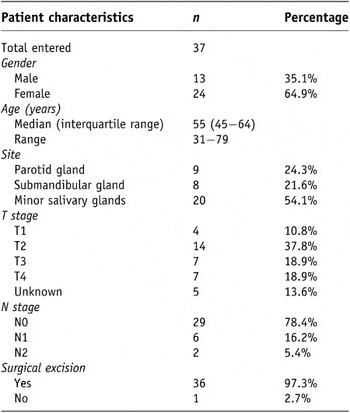
Thirty-seven patients were identified and reviewed. Of these, 13 were male and 24 were female. The median age at diagnosis was 55 (range 31–79) years. Nine patients had parotid ACC, 8 had submandibular ACC and 20 had minor salivary gland ACC. Minor salivary gland tumours included nine tumours within the oral cavity and the remaining 12 were from other sites.
Thirty six of the included patients had undergone surgical resection of their tumours prior to receiving radiotherapy. Histology reports were reviewed, 25 had clear margins, 7 had microscopic involvement of the margins and 4 had macroscopic involvement. Patient and tumour characteristics are given in Table 1.
Patient characteristics

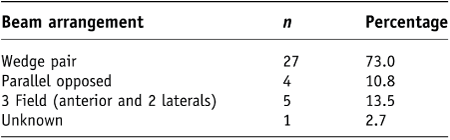
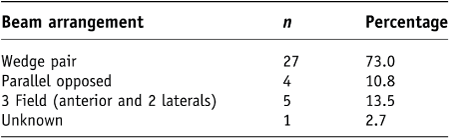
Thirty-one patients were planned conventionally using the simulator. The remaining six patients, who were the most recent to be treated, were planned using computerized tomography. Table 2 shows the beam arrangements used. None of the patients were treated with intensity-modulated radiotherapy.
Radiotherapy technique
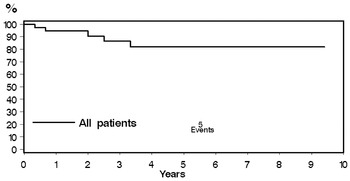
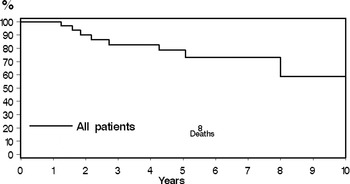
The median follow-up times for all patients was 59 (range 14–126) months. Ten patients had developed recurrence: 5 loco-regional, 4 distant recurrences and 1 both loco-regional and distant recurrence. The median time to progression was 21 (range 4–85) months. The Kaplan–Meier plots for LC and OS for all patients are shown in Figures 1 and 2, respectively. The 5-year LC rate was 81.8% (95% confidence intervals (CIs) 60.9–92.2).
Kaplan–Meier plot of local control.

Kaplan–Meier plot of overall survival rates.

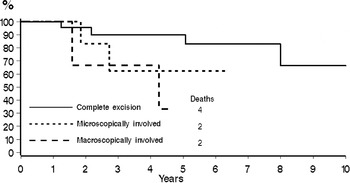
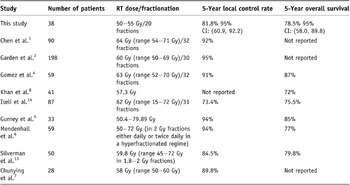
At the time of analysis, eight patients had died. Four of these had initially presented with T4 disease. OS at 5 years was 78.5% (95% CI 58.0–89.8%). No significant differences in the rate of LC or OS were found within the cohort when considering age, gender, T stage or site of disease. Figure 3 illustrates the survival curves when considering involvement of the surgical margin. Involved margins were associated with reduced OS (p = 0.04). Table 3 compares the results presented here to those available in the literature.
Overall survival by involvement of surgical margins.

Comparison of the results from this study with those from the literature

CI, confidence interval; RT, radiotherapy.
DISCUSSION
Radiotherapy is widely accepted as standard treatment in the post-operative setting for ACC. Several studies considering a combined approach of surgery followed by radiotherapy to a dose of at least 60 Gy (in 2 Gy per fraction over 39 days) have shown significantly greater LC than from surgery alone.1,3,7
The reported cohort shows a similar distribution of sites of ACC as compared to published data.Reference Khan, DiGiovanna, Ross, Sasaki, Carter, Son and Haffty8,Reference Terhaard, Lubsen, Van der Tweel, Hilgers, Eijkenboom, Marres, Tjho-Heslinga, de Jong and Roodenburg9 Garden et al. reported survival and disease-free rates for patients with ACC treated using combined surgery and post-operative radiotherapy.Reference Garden, Weber, Morrison, Ang and Peters2 Doses ranged from 50–69 Gy (median, 60 Gy) over 23–58 days (median, 42 days). Outcomes were significantly better in those who received a post-operative radiation dose of 60 Gy or more. The 5-year LC rate, freedom from relapse rate and OS were 95%, 68% and 82%, respectively.
The accelerated hypofractionated regime reported here appears to be associated with similar LC and OS to conventional radiation schedules. At present, the radiobiology of ACC is poorly understood. Both the α/β ratio and significance of accelerated repopulation for ACC remain unknown. AHRT has been used successfully in squamous cell carcinoma of the head and neck cancer largely due to the shortened overall treatment time counteracting accelerated repopulation.Reference Sanghera, McConkey, Ho, Glaholm and Hartley10 In prostate cancer, hypofractionated radiotherapy has also been used successfully but in this disease due to the postulated low α/β ratio.Reference Yeoh, Holloway, Fraser, Botten, Di Matteo, Butters, Weerasinghe and Abeysinghe11,Reference Brenner, Martinez, Edmundson, Mitchell, Thames and Armour12
The small number of patients within this study limits conclusions with respect to variables analysed. However, consistent with other series, involvement of surgical margins was associated with a worse OS. With the exception of increasing T stage, other studies have failed to consistently identify any other significant prognostic factors.4,6,8,13
Other series used post-operative radiation doses ranging from 50 to 79.89 Gy, given in 2 Gy fractions (Table 3). Chen et al. reported 90 patients who received post-operative radiotherapy to a mean dose of 64 Gy, with a median follow-up of 66 months. Compared to our cohort, a greater proportion of patients had T3 (20%) and T4 (26%) disease and involved surgical margins (63%), yet a superior 5-year LC rate of 92% was achieved.Reference Chen, Bucci, Weinberg, Garcia, Quivey, Schechter, Phillips, Fu and Eisele1 Furthermore, the series by Gomez et al. (mean dose 63 Gy) also contained a higher proportion of patients with T3 (14%) and T4 (34%) disease and a 5-year LC of 91% was reported.Reference Gomez, Hoppe, Wolden, Zhung, Patel, Kraus, Shah, Ghossein and Lee4 Both these studies support the use of 2 Gy fractionation over accelerated hypofractionation. However, Iseli et al. reported 87 patients (median dose 62 Gy) and the 5-year LC rate was 73.4%. This cohort included 44.4% T3 or T4 disease.Reference Iseli, Karnell, Graham, Funk, Buatti, Gupta, Robinson and Hoffman14 Mendenhall et al. reported 5-year LC of 94% in a cohort of 59 patients treated with either pre- or post-operative radiotherapy with varying dose-fractionation schedules: pre-operative RT, 50 Gy (range, 45 Gy–61.3 Gy); and post-operative RT, 67.8 Gy (range, 10.5 Gy–76.8 Gy), in either 2 Gy per fraction or a hyperfractionated regime treating twice daily.Reference Mendenhall, Morris, Amdur, Werning, Hinerman and Villaret6 It is difficult to compare this series with ours in view of the heterogeneity of the dose-fractionation schedules.
The possibility that AHRT over 4 weeks is associated with inferior outcome cannot be excluded. To achieve radiobiological equivalence with a 60 Gy in 30-fraction regime, there would need to be a significant degree of accelerated repopulation to realise any benefit from the shortened schedule. Alternatively, in the complete absence of accelerated repopulation, an α/β ratio of 0.5 Gy would be required to give equivalence to 60 Gy in 30 fractions (see Appendix 1 for calculation). It is possible that a combination of moderate accelerated repopulation and a slightly decreased α/β ratio would also render the schedules equivalent. Multicentre prospective randomised trials are unlikely to be performed given the rarity of this disease and its long natural history. Therefore caution should be exercised when using altered fractionation for this disease. Following completion of this study, the local institutional policy for ACC has been revised. In the presence of involved margins, a dose of 65 Gy in 30 fractions over 39 days is administered. In the absence of margin involvement, a dose of 60 Gy in 30 fractions over 39 days is administered.
It is possible that AHRT in the post-operative setting for ACC leads to an inferior outcome and we recommend using 2 Gy fractionation to a minimum dose of 60 Gy.
APPENDIX
To determine α/β of ACC if AHRT is equivalent to conventional fractionation in the absence of accelerated repopulation associated with ACC, the following equation is solved:
BED (biologically effective dose) hypofractionated regime without time correction = BED conventional regime
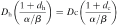
where D h = total dose hypofractionated regime = 50 Gy; d h = dose per fraction hypofractionated regime = 2.5 Gy; α/β = unknown; D c = total dose conventional regime = 60 Gy; d c = 2 Gy
DISCLOSURE
P.S. received honoraria from Schering-Plough and A.H. received honoraria from Merck and meeting expenses from Roche and Sanofi-Aventis. The other authors declared no conflict of interest.