Identifying childhood risk factors is a significant and important step in the creation of effective methods to prevent the development of anxiety in adulthood. The cognitive schema of intolerance of uncertainty (IU), a tendency to react negatively to uncertain situations and events (Dugas, Buhr, & Ladouceur, Reference Dugas, Buhr, Ladouceur, Heimberg, Turk and Mennin2004), is an important component contributing to and maintaining anxiety disorders, particularly generalized anxiety disorder (GAD; Dugas, Gagnon, Ladouceur, & Freeston, Reference Dugas, Gagnon, Ladouceur and Freeston1998; Dugas, Marchand, & Ladouceur, Reference Dugas, Marchand and Ladouceur2005; Freeston, Rhéaume, Letarte, Dugas, & Ladouceur, Reference Freeston, Rhéaume, Letarte, Dugas and Ladouceur1994; Ladouceur, Gosselin, & Dugas, Reference Ladouceur, Gosselin and Dugas2000). Understanding IU's development is important since daily life is full of uncertain situations, and being unable to cope with uncertainty or ambiguity places an individual at great risk for constant worry and anxiety. Early development of IU can negatively impact an individual throughout life (Cassidy, Reference Cassidy, Cicchetti and Toth1995; Dugas et al., Reference Dugas, Buhr, Ladouceur, Heimberg, Turk and Mennin2004). However, IU has principally been documented in adults with GAD (Dugas et al., Reference Dugas, Gagnon, Ladouceur and Freeston1998; Freeston et al., Reference Freeston, Rhéaume, Letarte, Dugas and Ladouceur1994), and very few studies have investigated IU in children (Boulter, Freeston, South, & Rodgers, Reference Boulter, Freeston, South and Rodgers2014; Comer et al., Reference Comer, Roy, Furr, Gotimer, Beidas, Dugas and Kendall2009), with even fewer investigating its development and contributing factors (Cassidy, Lichtenstein-Phelps, Sibrava, Thomas, & Borkovec, Reference Cassidy, Lichtenstein-Phelps, Sibrava, Thomas and Borkovec2009; Tan, Moulding, Nedeljkovic, & Kyrios, Reference Tan, Moulding, Nedeljkovic and Kyrios2010). This leaves a significant empirical gap, compromising both deeper understanding of how IU arises and the development of early interventions. Furthermore, IU has more recently been identified as a transdiagnostic cognitive component related to diverse mental health problems, including depression (Boswell, Thompson-Hollands, Farchione, & Barlow, Reference Boswell, Thompson-Hollands, Farchione and Barlow2013; Gentes & Ruscio, Reference Gentes and Ruscio2011) and has been shown to be a good target for clinical intervention (Dugas & Robichaud, Reference Dugas and Robichaud2007). Thus, understanding IU is relevant to reducing many mental health problems, not just anxiety.
IU has been related to worry throughout multiple developmental stages (adolescence, young adulthood, and adulthood) and has been equally reported in both sexes (Dugas et al., Reference Dugas, Buhr, Ladouceur, Heimberg, Turk and Mennin2004). Individuals with this cognitive filter find uncertain events very distressing, regardless of the probability that these events will happen or not (Dugas et al., Reference Dugas, Gagnon, Ladouceur and Freeston1998), and would rather face a problem with a definite negative outcome than an uncertain one (Dugas et al., Reference Dugas, Buhr, Ladouceur, Heimberg, Turk and Mennin2004). Although patients with other anxiety disorders can also experience IU, Dugas et al. (Reference Dugas, Buhr, Ladouceur, Heimberg, Turk and Mennin2004) suggested that the increased specificity of IU in generalized anxiety may be due to the diffuse nature of the anxiety in patients with GAD. Patients with GAD have a low threshold for IU related to a wide range of subjects and contexts, whereas patients with other anxiety disorders have much more specific worries. It has been suggested that this “generalized cognitive filter” may develop quite early in childhood (Cassidy, Reference Cassidy, Cicchetti and Toth1995; Dugas et al., Reference Dugas, Buhr, Ladouceur, Heimberg, Turk and Mennin2004). Supporting this suggestion, in a study involving 5-year-old children, negative expectations predicted symptoms of overanxious or generalized anxiety disorder a year later, even after controlling for internalizing problems (Warren, Emde, & Sroufe, Reference Warren, Emde and Sroufe2000). Furthermore, when 5- to 9-year-olds were asked to interpret ambiguous scenarios, their cognition related to threat and distress were predictive of anxiety symptoms over a 3-year span (Creswell, Shildrick, & Field, Reference Creswell, Shildrick and Field2011).
Two proposed risk factors for the development of IU are (a) an insecure parent–child attachment and (b) behavioral inhibition (BI), a tendency to react negatively to the unfamiliar. Both have been linked to worry, a lower threshold for tolerating uncertainty and a lack of control over one's environment, concepts all related to increased risk for IU and anxiety disorders (Cassidy, Reference Cassidy, Cicchetti and Toth1995; Hudson & Rapee, Reference Hudson, Rapee, Heimberg, Turk and Mennin2004). Although insecure attachment has long been proposed as a childhood risk factor for GAD (Cassidy, Reference Cassidy, Cicchetti and Toth1995), specifically through its influence on IU (Dugas et al., Reference Dugas, Buhr, Ladouceur, Heimberg, Turk and Mennin2004), few studies have empirically examined attachment's links to GAD (Cassidy et al., Reference Cassidy, Lichtenstein-Phelps, Sibrava, Thomas and Borkovec2009; Tan et al., Reference Tan, Moulding, Nedeljkovic and Kyrios2010) and none have looked at its direct role in the development of IU. BI has also been identified as an important risk factor for anxiety disorders (Hudson & Rapee, Reference Hudson, Rapee, Heimberg, Turk and Mennin2004), but no study has explicitly examined the influence of BI on the development of IU. Very few studies looked at IU as an outcome measure, and most have investigated IU and related risk factors in relation to anxiety and GAD. Identifying the causes of IU would not only have theoretical and etiological implications but also contribute to prevention and treatment for individuals struggling with uncertainty, anxiety, or related mental health problems.
Attachment, Uncertainty, and Risk of Anxiety
Attachment typically forms between the child and a significant adult (generally the parent) during the first year of life (Bowlby, Reference Bowlby1982/1969). Bowlby (Reference Bowlby1973) postulated that attachment plays an important role in the development of anxiety disorders. According to attachment theory, in everyday or new and uncertain situations, the child can use a caregiver or parent as a “secure base” from which to explore the environment. When a child encounters a frightening or threatening situation, he or she can seek the physical proximity and comfort of the caregiver to diminish psychological distress or to avoid physical danger (Ainsworth, Blehar, Waters, & Wall, Reference Ainsworth, Blehar, Waters and Wall1978; Goldberg, Reference Goldberg2000). Through these experiences, the child acquires knowledge not only about the physical environment but also about the self (by learning to regulate distress) and others (by integrating the expected behaviors of others in response to the child's needs). Individual differences observed in child behavior in stressful situations depend, in part, on the child's interpretation of caregiver behavior and on expectations of his caregiver's responses to his needs for comfort and care (Goldberg, Reference Goldberg2000, Reference Goldberg, Singer and Zeskind2001; Goldberg, Blokland, & Myhal, Reference Goldberg, Blokland, Myhal, Larose and Tarabulsy2003; Main, Kaplan, & Cassidy, Reference Main, Kaplan and Cassidy1985). Attachment theorists postulate that a child develops an attachment bond with a significant caregiver based on generalization of this caregiver's daily reactions to child proximity-seeking behaviors (Bowlby, Reference Bowlby1973, Reference Bowlby1988). An internal working model of the relationship with the primary caregiver allows the child to interpret and predict the caregiver's behavior, and regulate his own reactions, thoughts, and feelings toward the attachment figure (Bretherton & Munholland, Reference Bretherton, Munholland, Cassidy and Shaver1999). For infants and preschool children, qualitative differences in the quality of attachment are traditionally inferred from the child's behavior in a separation–reunion procedure (Ainsworth, et al., Reference Ainsworth, Blehar, Waters and Wall1978; Main & Cassidy, Reference Main and Cassidy1988), following the assumption that observed behaviors are indicative of the internal working model activated by this procedure.
Four attachment patterns have been identified in infancy: secure (B), insecure–avoidant (A), insecure–ambivalent (C), and insecure–disorganized attachment (D; Ainsworth et al., Reference Ainsworth, Blehar, Waters and Wall1978; Main & Solomon, Reference Main, Solomon, Greenberg, Cicchetti and Cummings1990). In general, when a caregiver is sensitive and responds adequately in a timely, warm, and predictable manner to a child's needs, the child views the caregiver as accessible, consistent, and sensitive, and learns that the caregiver can be counted on for comfort, to help reduce distress in stressful situations, and to help regulate the child's emotions (Ainsworth et al., Reference Ainsworth, Blehar, Waters and Wall1978; Bowlby, Reference Bowlby1982/1969). This in turn helps the child develop a secure attachment and a sense of competence in his own capacities to self-regulate (Bretherton, Reference Bretherton1990; Cassidy, Reference Cassidy1994; Kopp, Reference Kopp1982, Reference Kopp1989). However, if parental responses are unstable or inconsistent, a child may not learn to adequately regulate distress. Children with insecure–avoidant (A) attachment typically have parents who are less sensitive and seen as more inaccessible and rejecting by the child compared with parents of secure children (Ainsworth et al., Reference Ainsworth, Blehar, Waters and Wall1978; Bretherton, Reference Bretherton1985; Main & Cassidy, Reference Main and Cassidy1988). Children with an insecure–ambivalent (C) attachment tend to have insensitive and inconsistent parents. This inconsistent parenting creates an uncertain environment and leads children to worry about the availability of their parent in time of stress and to view their parent as unpredictable and unreliable (Ainsworth et al., Reference Ainsworth, Blehar, Waters and Wall1978; Bretherton, Reference Bretherton1985; Main & Cassidy, Reference Main and Cassidy1988). Insecurely attached children are more likely to process or interpret ambiguous information or situations as threatening, hostile, or negative than securely attached children (Cassidy, Kirsh, Scolton, & Parke, Reference Cassidy, Kirsh, Scolton and Parke1996; for review, Dykas & Cassidy, Reference Dykas and Cassidy2011).
Secure and insecure attachment patterns are considered to be organized responses to differences in parental behavior. However, an insecure–disorganized (D) attachment, where children display unusual, conflicting, or disoriented behaviors, is characterized by the absence of a coherent strategy to regulate comfort-seeking behavior (Main & Solomon, Reference Main, Solomon, Greenberg, Cicchetti and Cummings1990). When the caregiver is simultaneously a potential source of security and of fear and anxiety to the child (such as in maltreating families or those affected by mental illness), this constant uncertainty about the reactions or availability of the parent can severely affect the quality of the parent–child bond (Main & Hesse, Reference Main, Hesse, Greenberg, Cicchetti and Cummings1990). Main and Cassidy (Reference Main and Cassidy1988) further observed a transition to controlling behavior in disorganized children (D-controlling) involving parent–child role reversal between infancy and age 6. Moss, Cyr, and Dubois-Comtois (Reference Moss, Cyr and Dubois-Comtois2004) verified that two-thirds of preschoolers classified as disorganized assumed control of the parent–child relationship by age 7 in either a punitive or caregiving manner. Unable to tolerate the uncertainty and fear caused by a frightening caregiver, these children try to control their surroundings, including their parent, in order to regulate their own anxiety by assuming the role of the parent (Solomon, George, & De Jong, Reference Solomon, George and De Jong1995). Still, some children stay disorganized continuing to display the D attachment behaviors seen in infancy.
Certain types of attachment, namely, ambivalent and D-controlling, were proposed as risk factors for the development of IU (Cassidy, Reference Cassidy, Cicchetti and Toth1995; Dugas et al., Reference Dugas, Buhr, Ladouceur, Heimberg, Turk and Mennin2004). Enduring anxiety might result from constantly worrying about the availability of one's parent, such as in an ambivalent attachment dyad, or from having to take care of a parent who cannot assist the child in dealing with his own distress, as in a D-controlling dyad (Cassidy, Reference Cassidy, Cicchetti and Toth1995; Dugas et al., Reference Dugas, Buhr, Ladouceur, Heimberg, Turk and Mennin2004). Cassidy et al. (Reference Cassidy, Lichtenstein-Phelps, Sibrava, Thomas and Borkovec2009) found adult GAD patients reported higher instances of “role-reversal/enmeshment” (comparable to D-controlling attachment, where the child takes care of the parent's needs) during childhood, compared to controls. Another retrospective study found links between role-reversal/enmeshment and IU as well as the development of GAD in a nonclinical sample (Tan et al., Reference Tan, Moulding, Nedeljkovic and Kyrios2010). A limitation of these studies is the use of retrospective questionnaires to assess childhood attachment. No studies have used observational separation–reunion based measures in a prospective manner to examine the influence of childhood attachment on the development of IU in adulthood. Warren, Huston, Egeland, and Sroufe (Reference Warren, Huston, Egeland and Sroufe1997) found that, in an at-risk sample (Minnesota Longitudinal Study of Risk and Adaptation), infant ambivalent attachment predicted child and adolescent anxiety disorders (17 years later) after controlling for newborn temperament and maternal anxiety (Warren et al., Reference Warren, Huston, Egeland and Sroufe1997). A cross-sectional study with 7- to 18-year-old children with a primary anxiety diagnosis, found that children with self-reported ambivalent attachment reported higher rates of worry compared with other children (Brown & Whiteside, Reference Brown and Whiteside2008). However, relatively few studies have examined attachment in relation to anxiety disorders, and a recent meta-analysis showed that although insecurity, specifically ambivalent attachment, was most frequently related to anxiety, few studies used observational attachment measures, many only compared security and insecurity and not specific attachment classifications, and outcome measures varied across studies, all contributing to mixed results (Brumariu & Kerns, Reference Brumariu and Kerns2010).
BI, Uncertainty, and Risk of Anxiety
BI, described as fearful reactions or a tendency to withdraw in the face of novel situations, objects, or people, is one of the most widely studied child temperament profiles (Fox, Henderson, Marshall, Nichols, & Ghera Reference Fox, Henderson, Marshall, Nichols and Ghera2005; Kagan, Snidman, Kahn, & Towsley, Reference Kagan, Snidman, Kahn and Towsley2007). BI has also been established as an important risk factor for internalizing problems and anxiety disorders (Biederman, Rosenbaum, Chaloff, & Kagan, Reference Biederman, Rosenbaum, Chaloff, Kagan and March1995; Hudson & Rapee, Reference Hudson, Rapee, Heimberg, Turk and Mennin2004). Biological concepts of physiological reactivity as well as self-regulation are at the core of BI (Goldsmith & Campos, Reference Goldsmith and Campos1990; Kopp, Reference Kopp1982; Rothbart & DerryBerry, Reference Rothbart, Derryberry, Lamb and Brown1981). According to Kagan and colleagues (Kagan, Reznick, & Gibbons, Reference Kagan, Reznick and Gibbons1989; Kagan, Reznick, & Snidman, Reference Kagan, Reznick and Snidman1987, Reference Kagan, Reznick and Snidman1988), the sympathetic nervous system of inhibited children, commonly related to the fight or flight response, has a lower activation threshold than in uninhibited children, particularly to novel, uncertain, or ambiguous stimuli. Therefore, BI children would require less intense stimuli to activate their sympathetic nervous system compared with uninhibited children (Kagan, Reference Kagan, Schmidt and Schulkin1999; Kagan et al., Reference Kagan, Reznick and Snidman1987, Reference Kagan, Reznick and Snidman1988). These differences in activation thresholds are thought to be the primary mechanism linking BI to the development of behavioral problems (Kagan, Reference Kagan, Schmidt and Schulkin1999; Kagan et al., Reference Kagan, Reznick and Snidman1987, Reference Kagan, Reznick and Snidman1988).
A physiological vulnerability from birth to react more rapidly or intensely (i.e., a lower sympathetic activation threshold) means that BI children are at increased risk to react intensely to novel or uncertain situations or stimuli before having developed self-regulation. They would therefore tend to avoid novel situations early in life, curbing habituation to such situations and maintaining these behaviors, hence putting them at risk to develop internalizing problems and anxiety disorders (Lonigan & Phillips, Reference Lonigan, Phillips, Vasey and Dadds2001; Manassis & Bradley, Reference Manassis and Bradley1994). An increased sensitivity to novel, uncertain, or ambiguous situations has been documented in BI children (Kagan & Snidman, Reference Kagan and Snidman2004). In theoretical definitions of BI, IU plays a key role. For example, Zentner and Bates (Reference Zentner and Bates2008, p. 17) stated that “Kagan sees the core feature of inhibition as an intolerance of uncertainty rather than a proneness to fear.” Furthermore, definitions of BI have emphasized reference to the initial tendency to react to unfamiliar events or novelty (Degnan & Fox, Reference Degnan and Fox2007; Garcia-Coll, Kagan, & Reznick, Reference Garcia-Coll, Kagan and Reznick1984) and Reznick, Gibbons, Johnston, and McDonough (Reference Reznick, Gibbons, Johnston, McDonough and Reznick1989, p. 30) defined BI as a “… vulnerability to the uncertainty caused by unfamiliar events that cannot be assimilated easily.” BI children attend more or show greater vigilance to threat or novelty and are less able to disengage from such stimuli than do noninhibited children (for review, see Blackford & Pine, Reference Blackford and Pine2012; Degnan & Fox, Reference Degnan and Fox2007). Research on information processing has proposed attentional bias to threat or to negative stimuli as a cognitive link between temperament and the development of anxiety disorders (for a review, see Vasey & Macleod, Reference Vasey, MacLeod, Vasey and Dadds2001). When asked to perform an ambiguous task (i.e., rating levels of fear in a happy face), adolescents identified as behaviorally inhibited since toddlerhood had abnormally high amygdala activation compared with individuals that were consistently noninhibited (Perez-Edgar et al., Reference Perez-Edgar, Roberson-Nay, Hardin, Poeth, Guyer, Nelson and Ernst2007). Similarly, young adults previously characterized as BI at 2 years of age, exhibited amygdala hyperactivity to novel faces compared to familiar ones (Schwartz, Wright, Shin, Kagan, & Rauch, Reference Schwartz, Wright, Shin, Kagan and Rauch2003). Just as a child who learns that his caregiver is unavailable or inconsistent, a BI child has heightened physiological reactions to the environment and thus acquires a perception of the world as uncertain and threatening, putting the child at risk for later IU. Although numerous studies have linked BI with anxiety disorders (see Hudson & Rapee, Reference Hudson, Rapee, Heimberg, Turk and Mennin2004), no study has specifically examined BI in relation to IU.
Neuroticism and Maternal Anxiety
Many additional factors must be considered when studying cognitive concepts related to anxiety disorders. The personality trait of neuroticism, characterized by vulnerability to psychological distress (Costa & McCrae, Reference Costa and McCrae1992), has been identified as a risk factor for psychopathology in adulthood (see Costa & McCrae, Reference Costa and McCrae1992; Silove, Marnane, Wagner, Manicavasagar, & Rees, Reference Silove, Marnane, Wagner, Manicavasagar and Rees2010). Neuroticism has specifically been associated with worry, tendency to avoid ambiguous situations, anxiety disorders, and specifically GAD (De Bruin, Rassin, & Muris, Reference De Bruin, Rassin and Muris2007; Lommen, Engelhard, & van den Hout, Reference Lommen, Engelhard and van den Hout2010; Vreeke & Muris, Reference Vreeke and Muris2012). Furthermore, neuroticism has been found to be directly related to IU (De Bruin et al., Reference De Bruin, Rassin and Muris2007; Sexton, Norton, Walker, & Norton, Reference Sexton, Norton, Walker and Norton2003). Moreover, maternal anxiety may contribute to the development of child anxiety disorders through both genetics and modeling of anxious behaviors (Gerull & Rapee, Reference Gerull and Rapee2002; Hudson & Rapee, Reference Hudson, Rapee, Heimberg, Turk and Mennin2004) and has been associated with higher levels of child insecure attachment, BI, and anxiety disorders (Hirshfeld, Biederman, Brody, Faraone, & Rosenbaum, Reference Hirshfeld, Biederman, Brody, Faraone and Rosenbaum1997; Manassis, Bradley, Goldberg, Hood, & Swinson, Reference Manassis, Bradley, Goldberg, Hood and Swinson1995). Therefore, both neuroticism and maternal anxiety are important to control for when studying IU.
Objectives
The main objective of the current study was to examine the contribution of BI and attachment at preschool and early school age, when children are between 5 and 7 years old, to the development of IU in adulthood, at approximately 21 years of age. Based on previous empirical work and models of the development of anxiety, we predicted that BI would contribute to the development of IU. In addition, insecure–ambivalent and disorganized–controlling attachment types were predicted to both be associated with IU (Cassidy, Reference Cassidy, Cicchetti and Toth1995; Dugas et al., Reference Dugas, Buhr, Ladouceur, Heimberg, Turk and Mennin2004; Warren et al., Reference Warren, Huston, Egeland and Sroufe1997). We also tested for potential interactions between BI and attachment. Several studies have documented interaction effects between these two variables on later outcomes, including anxiety disorders (Bohlin, Hagekull, & Andersson, Reference Bohlin, Hagekull and Andersson2005; Nachmias, Gunnar, Mangelsdorf, Parritz, & Buss, Reference Nachmias, Gunnar, Mangelsdorf, Parritz and Buss1996; Schieche & Spangler, Reference Schieche and Spangler2005; van Brakel, Muris, Bögels, & Thomassen, Reference van Brakel, Muris, Bögels and Thomassen2006), although results are inconsistent (see Vaughn, Bost, & van IJzendoorn, Reference Vaughn, Bost, van IJzendoorn, Cassidy and Shaver2008). Since studies describing the interactive effects of BI and insecure attachment have reported inconsistent results, we tested this interaction effect on the risk of developing IU without a prior prediction. As both neuroticism and maternal anxiety have been found to be associated with anxiety disorders (and IU), they were included as covariates.
We used an observational behavioral inhibition measure (BIM; Zdebik, Reference Zdebik2013) previously validated with toddlers, with a secondary objective to adapt it here to an older sample of children. Assessment involved validating the BIM against adult measures related to shyness and also testing its divergent validity in relation to attachment. It was predicted that the BIM would not be related to attachment classification but that it would be positively related to measures of adulthood shyness. Finally, we also tested how maternal anxiety would be related to attachment and BI, and predicted that mother's with higher levels of anxious symptoms would have children with higher levels of both BI and insecure attachment. This study will be the first to examine the longitudinal association between child BI and attachment, using observational measures and examining specific attachment subgroups as predictors of IU in adulthood.
Method
Participants
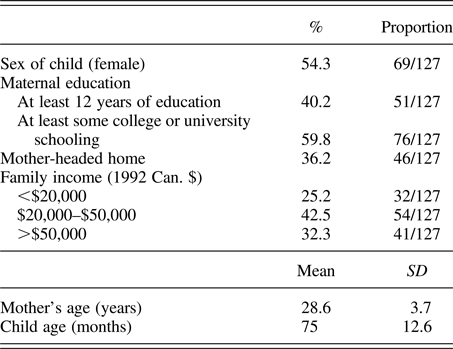
Study participants were 60 French-speaking mother–child dyads taking part in an ongoing longitudinal study examining the influence of the parent–child relationship on developmental adaptation (see Moss & St-Laurent, Reference Moss and St-Laurent2001; Moss et al., Reference Moss, Smolla, Cyr, Dubois-Comtois, Mazzarello and Berthiaume2006). At Time 1 (T1) of the current study, children were aged between 5 and 7 years old. The sample was heterogeneous with respect to income level, maternal education, and family structure (see Table 1 for descriptives). Time 2 (T2) measures were taken 8 years later, when children had a mean age of 13.7 years (SD = 0.64, range = 12.6–15.1 years, N = 79, 47 girls). Approximately 7 years later, at Time 3 (T3), participants were young adults with a mean age of 21.3 years (SD = 0.87, range = 20–23 years, N = 60, 38 young women). Seventy-three percent of participants still lived at home at the time of the study. Thirty-two percent of participants had completed a high school degree, 43% had college-level schooling, and 25% had some university-level training.
Demographic characteristics of sample (n = 127)a

a Demographic characteristics correspond to initial data collection, when children were between 5 and 7 years old.
Sixty participants completed all three time points. Fifty-three percent of participants were lost to attrition from the first time point of the study (see Moss, Rousseau, Parent, St-Laurent, & Saintonge, Reference Moss, Rousseau, Parent, St-Laurent and Saintonge1998). From the adolescent phase (T2), 24% (N = 19) of participants did not complete the young adult phase (T3): 6 refused to participate, 7 never responded to repeated contacts by the project's research assistants, 3 had nonvalid phone numbers, 2 moved away, and 1 accepted to participate but did not attend the laboratory appointment. Analysis of variance and χ2 analyses of sociodemographic variables (age, sex, maternal education, family income, type of family, and maternal anxiety) were conducted to compare participants lost to attrition with those remaining in the study. These analyses revealed no significant differences between T1 and T2 and between T2 and T3. However, the proportion of male participants dropped from T1 to T3, χ2 (1, 127) = 4.51, p = .05, and mothers of children still participating in the study had more years of education at T1 (M = 14.7 years, SD = 2.97) compared to mothers whose children did not participate at T3 (M = 13.2 years, SD = 2.85; t = 3.04, p < .05).
General procedure
Participants were contacted by telephone 2 weeks prior to each phase of the project and were sent questionnaires to complete at home and bring to the laboratory. When children were 5 to 7 years old (T1), mothers and their children were invited to the laboratory to complete an interactive play task, which included a free-play session, and to participate in a separation–reunion procedure. Upon arrival, two research assistants greeted participants and collected the questionnaires. They invited the dyad into the experimental room, where they introduced the interactive task, which consisted of a mock grocery store within which items were to be collected from a given grocery list. The mother and child were given 2 min to explore the task and toys (free play) before the mother was asked to leave the room for about 5 min while the child completed the first task alone. The mother then came back to the room to complete the task with her child (20 min). The task was followed by a 45-min separation during which the mother left the room to fill out questionnaires with an experimenter and the child completed problem-solving tasks with another experimenter. An unstructured 5-min period during which the child was free to play with toys in the room preceded each reunion. Without being given any particular instructions, the mother was then asked to rejoin her child in the experimental room. The reunion lasted 5 min. Following the reunion period, the dyad stayed in the room for a 10-min snack time. A second separation (about 30 min) followed the snack time, structured similarly to the first separation, followed by a 5-min reunion.
The child's behaviors during both reunion periods were used for attachment classification. This procedure, akin to the procedure by Main and Cassidy (Reference Main and Cassidy1988), was used because the children were of preschool and school age and its validity for classifying attachment behavior in children in this age range has been repeatedly demonstrated (Cassidy, Reference Cassidy1988; Cohn, Reference Cohn1990; Groh, Roisman, van IJzendoorn, Bakermans-Kranenburg, & Fearon, Reference Groh, Roisman, van IJzendoorn, Bakermans-Kranenburg and Fearon2012; Moss et al., Reference Moss, Cyr and Dubois-Comtois2004; Solomon et al., Reference Solomon, George and De Jong1995). The child's behaviors during the interactive task free-play were used to code BI. Finally at T1, in addition to a sociodemographic questionnaire, mothers completed a questionnaire measuring the child's vocabulary.
During the adolescent phase of the study (T2), when the children were between 13 and 15 years old, they were invited to fill out questionnaires at the laboratory. None of the children's questionnaires from this phase were used in the current study. Mothers once again filled out sociodemographic questionnaires and also the Symptom Checklist 90—Revised (SCL-90-R; Derogatis, Reference Derogatis1994). At T3, the young adult phase, participants came to the laboratory without their parents. They completed the Revised Neuroticism-Extraversion-Openness Personality Inventory (NEO PI-R; Costa, & McCrae, Reference Costa and McCrae1992) and the Intolerance of Uncertainty-12 Short Form (IUS-12; Carleton, Norton, & Asmundson, Reference Carleton, Norton and Asmundson2007) in addition to filling out sociodemographic information about themselves. Participants were given $20 for their participation in each phase of the study. Informed written consent from all participating families was obtained at each assessment. The study was approved by the Université du Québec à Montréal Research Ethics Committee.
Instruments
Attachment classification and distribution
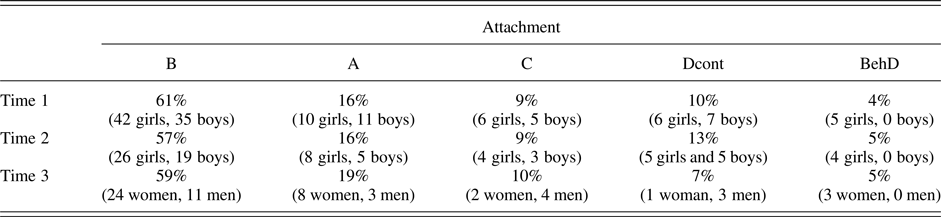
The Preschool Attachment Classification System (Cassidy & Marvin, Reference Cassidy and Marvin1992) for the 5-year-olds and the Main and Cassidy (Reference Main and Cassidy1988) system for the 6- to 7-year-olds, which are conceptually similar, were used to classify the children's reunion behaviors. Both systems use a six-category attachment coding scheme to classify children into three organized (A, B, and C) and three disorganized (controlling–caregiver [Ccare], controlling–punitive [Cpuni], and behaviorally disorganized [BehD]) attachment patterns. Videotaped reunions were coded by the second author and a graduate student. Both were unaware of participant scores on any other measures. Both coders were trained by R. Marvin and achieved reliability with him on a separate sample of tapes. All discrepancies were resolved by reviewing the tapes until consensus was achieved. Reliability for the classifications of the 5-year-old children was calculated separately from that of the 6- and 7-year-old children, which were comparable and both indicated excellent agreement (κ = 0.86 and 0.88, respectively). Overall agreement for the major classifications (A, B, C, and D) was 88% (κ = 0.81), calculated on 30% of the sample. Reliability was also calculated for the disorganized classification subtypes for the 14 D videotapes in the reliability pool. Agreement was as follows: 4/4 (100%) for Ccare, 4/5 (80%) for Cpun, and 4/6 (67%) for BehD (overall agreement for the D subtypes was thus 80%). In the current study, in order to test if disorganized controlling and ambivalent attachment patterns are related to the development of IU, both disorganized controlling (Dcontrol) subtypes were combined for analyses as they are theoretically similar in terms of the children's role reversal and internal working models of their caregiver related to feeling unprotected and vulnerable (Moss et al., Reference Moss, Cyr and Dubois-Comtois2004). The BehD, although small, was left as a distinct category. There were no significant differences in the relative proportions of the various attachment classifications between T1 and T2, T1 and T3, or T2 and T3 (Table 2; χ2 tests; all ps > .05), indicating no differences in attrition rates. As main analyses were multivariate regressions, attachment was coded into dummy variables contrasting each specified attachment group (A, C, Dcontrol, and BehD) to the reference secure group (B; Cohen & Cohen, Reference Cohen and Cohen1983). In order to identify how different attachment groups (A, B, C, Dcontrol, and BehD) may differ on sociodemographic variables, correlations, t tests and χ2 tests were performed with participant age, sex, maternal age, maternal education, and family income. Attachment groups did not differ on any of these sociodemographic variables (all ps > .05).
Attachment classifications at the three time points
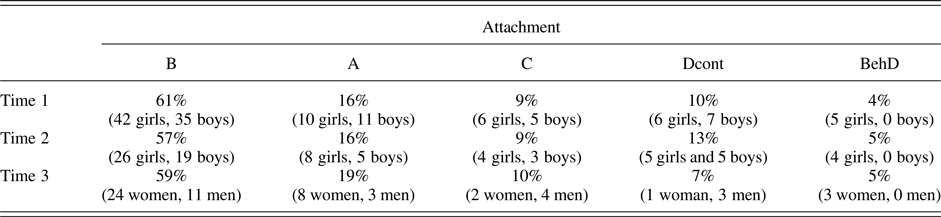
Note: B, secure; A, avoidant; C, ambivalent; Dcont, disorganized controlling; BehD, behaviorally disorganized.
BIM
BI was measured using the BIM, a protocol based on the laboratory studies of Kagan and colleagues (Garcia-Coll et al., Reference Garcia-Coll, Kagan and Reznick1984; Kagan et al., Reference Kagan, Reznick and Gibbons1989) and on the Strange Situation procedure (Ainsworth et al., Reference Ainsworth, Blehar, Waters and Wall1978). The Strange Situation procedure has all the necessary components to evaluate BI in children: an unfamiliar situation, novel objects, opportunity for exploration, and the introduction of an unfamiliar individual (Ainsworth et al., Reference Ainsworth, Blehar, Waters and Wall1978; Garcia-Coll et al., Reference Garcia-Coll, Kagan and Reznick1984). However, Zdebik (Reference Zdebik2013) showed that only the initial free-play session, even prior to the entrance of the stranger, was sufficient to observe inhibited behavior in children, as BI is said to refer to the initial negative or fearful reactions to novelty (Garcia-Coll et al., Reference Garcia-Coll, Kagan and Reznick1984; Degnan & Fox, Reference Degnan and Fox2007). Children's reactions to a novel room and toys even in the presence of their mother were varied enough to discern BI and risk for internalizing symptoms (Zdebik, Reference Zdebik2013). Here, the BIM was adapted and validated for older children.
Behaviors such as spontaneous vocalizations, displays of negative affect or fretting, play, and proximity to the mother (within 1 m, between 1 and 2 m, and beyond 2 m) were coded in terms of frequency and length from the videotaped free-play session of the interactive grocery task at the beginning of the laboratory visit, when children were aged between 5 and 7 years old. The videotaped segment used to code BI did not overlap with the footage used to code attachment. Frequency or duration (in seconds) of the operationalized behaviors were divided by the total length of the duration of the free-play session and standardized. Scores that were not observed for over 20% of the sample were coded as either present or not (0 or 1). Composite scores were computed based on theoretical representation of a behavioral inhibited profile in the literature (Garcia-Coll et al., Reference Garcia-Coll, Kagan and Reznick1984). The BIM score was composed of the sum of reversed spontaneous vocalizations, negative affect, proximity to mother 0 to 1 m, reversed proximity to mother 1 m to 2 m, reversed proximity to mother 2 m and over, and reversed play scores, where higher scores represented higher levels of BI. The BIM was previously validated in a study using principal component analysis, which revealed a score describing inhibited–uninhibited behaviors (Zdebik, Reference Zdebik2013). The BIM has previously been corroborated against validated temperament questionnaires: the Fear and Approach Scales of the revised Infant Behavior Questionnaire (Gartstein & Rothbart, Reference Gartstein and Rothbart2003) and the Shyness and Sociability Scales of the Early Childhood Behavioral Questionnaire (Putnam, Gartstein, & Rothbart, Reference Putnam, Gartstein and Rothbart2006) as well as a temperament questionnaire filled out by research assistants having observed children at home for over 2 hr (Non-caregiver Observational Temperament AQS-based scale; Zdebik, Reference Zdebik2013). The BIM was also comparable to an existing laboratory-based BI protocol (White, McDermott, Degnan, Henderson, & Fox, Reference White, McDermott, Degnan, Henderson and Fox2011) and was also shown to have excellent reliability (Zdebik, Reference Zdebik2013).
In the current sample, the BIM was adapted to an older sample of children, while still using the same behaviors as in the original construction of the protocol. Videotapes were coded for inhibition by the main author, who was blind to attachment classification. A second coder, trained by the main author and blind to inhibition and attachment classification, coded 15% of randomly selected videotapes. Intraclass correlations ranged from .83 to 1.00 (all ps < .001). BI was not significantly related to any of the sociodemographic variables (participant age, sex, maternal age, maternal education, and family income; correlations and t tests; all ps > .05).
Child vocabulary
Because a large part of the BIM is related to vocalization behaviors, differences in vocalization rates could potentially be related to differences in vocabulary knowledge and proficiency. Therefore, children's vocabulary ability was measured at T1, using the French Canadian version of the Peabody Picture Vocabulary Test—Revised, l’Échelle de vocabulaire en images Peabody (EVIP; Dunn, Dunn, & Thériault, Reference Dunn, Dunn and Thériault1993) for children between 2.5 and 18 years of age. The EVIP requires no reading or writing on the child's part, making it well suited for testing shy children. It consists of 5 trial items and 170 test items arranged in increasing degree of difficulty. Each item is composed of four black-and-white drawings presented in a multiple-choice format. The child must choose the image that best corresponds to the stimulus word that is read out by the experimenter. Although the EVIP measures receptive language abilities, it is designed to rapidly assess the child's range of acquired vocabulary and verbal competence as well as the child's academic aptitude.
Maternal anxiety symptoms
Maternal anxiety was measured using the Anxiety Scale of the SCL-90-R (Derogatis, Reference Derogatis1994), a self-report 90-item questionnaire evaluating symptoms of psychopathology. Participants rate, if each symptom has applied to them in the last 7 days from 0 (not at all) to 4 (extremely). The anxiety scale (α = 0.90) refers to symptoms such as tension, nervousness, trembling, feelings of terror and panic, in addition to somatic manifestations. The SCL-90-R demonstrated high internal consistency, and its validity and reliability have been well documented in both research and clinical populations (Derogatis & Lynn, Reference Derogatis, Lynn and Maruish1999). Total anxiety scale score could range from 0 to 40. As participants were from the general population, over 25% of mothers scored zero (scores ranged from 0 to 31 with a median score of 2). Therefore, the score was dichotomized and mothers scoring 10 and above were classified as “anxious” and the remainder as “nonanxious.”
NEO PI-R
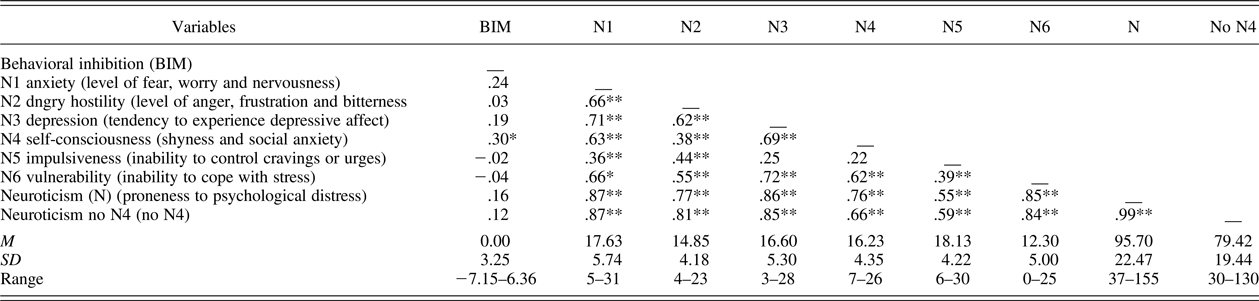
The NEO PI-R (Costa & McCrae, Reference Costa and McCrae1992) is a 240-item measure of adult personality. Participants rate statements pertaining to themselves from 0 (strongly disagree) to 4 (strongly agree). Higher scores indicate a higher level of the trait. Five personality domains are assessed: neuroticism, extraversion, openness, agreeableness, and conscientiousness. Each of the five domains (48 items each) is composed of six subscales (8 items each). Validity and reliability of the NEO PI-R has been widely documented and internal consistency coefficient αs for the domain scales range from 0.86 to 0.92 and from 0.56 to 0.81 for subscales (Costa & McCrae, Reference Costa and McCrae1992). The neuroticism domain (Cronbach α = 0.86), where high scores refer to increased proneness to psychological distress, and its subscales (anxiety, α = 0.83; angry hostility, α = 0.68; depression, α = 0.78; self-consciousness, α = 0.60; impulsiveness α = 0.65; and vulnerability α = 0.80) were used in the present study (see Table 3 for description of subscales).
Correlations and descriptive statistics between the BIM and the neuroticism domain and subscales (N = 57)

Note: BIM, Behavioral Inhibition Measure; N1–N6, neuroticism subscales with description; No N4, total neuroticism score without N4 subscale.
*p < .05. **p < .01.
IUS-12
The IUS-12 (Carleton et al., Reference Carleton, Norton and Asmundson2007) is a 12-item self-report questionnaire and the short form of the original 27-item Intolerance of Uncertainty Scale (Freeston et al., Reference Freeston, Rhéaume, Letarte, Dugas and Ladouceur1994). Participants rate items related to uncertainty, ambiguous situations, and future events, such as “unforeseen events upset me greatly” and “uncertainty keeps me from living a full life,” from 1 (not at all characteristic of me) to 5 (entirely characteristic of me; α = 0.89). Higher scores indicate a higher level of IU. The IUS-12 was shown to be comparable and highly correlated (r = .96, p < .01) to the original long form (Carleton et al., Reference Carleton, Norton and Asmundson2007; Khawaja & Yu, Reference Khawaja and Yu2010). It has good internal consistency, convergence, and discriminant validity (Carleton et al., Reference Carleton, Norton and Asmundson2007; McEvoy & Mahoney, Reference McEvoy and Mahoney2011).
Sociodemographic questionnaire
A family background questionnaire, containing items regarding sociodemographic information, was completed by mothers at T1 and T2. Information relating to family income, parental education and marital status, child sex, and child age was included in the questionnaire. At T3, the young adults completed a sociodemographic questionnaire, documenting income, education, living situation, and relationship status.
Results
Preliminary analyses
Prior to analysis, data were checked for outliers and normality (Tabachnick & Fidell, Reference Tabachnick and Fidell2007). As continuous variables were normally distributed, no transformations were necessary. All main analyses were conducted with the 60 participants remaining in the study at T3. Correlations and t tests were performed with participant age, sex, maternal age, maternal education, family income, siblings (having zero vs. one or more siblings) and adulthood living situation (living with parents versus independently) in order to identify potential sociodemographic covariates related to the dependent variable, that is, IU scores. No significant associations were found with sociodemographic variables and IU (all ps > .05); therefore, they were not included in further analyses.
Power considerations
A power analysis was performed to determine the estimated effect size that could be reasonably detected in our study for a sample of n = 60, a power of 0.80, and α = 0.05. For our final model, including interaction terms, we could detect a large effect size (f 2 = 0.32). For the first steps of our hierarchical model, we would be able to detect a medium to large effect size (f 2 = 0.14–0.26). Hence, although the sample was small, the statistical power was adequate for the analysis.
BI
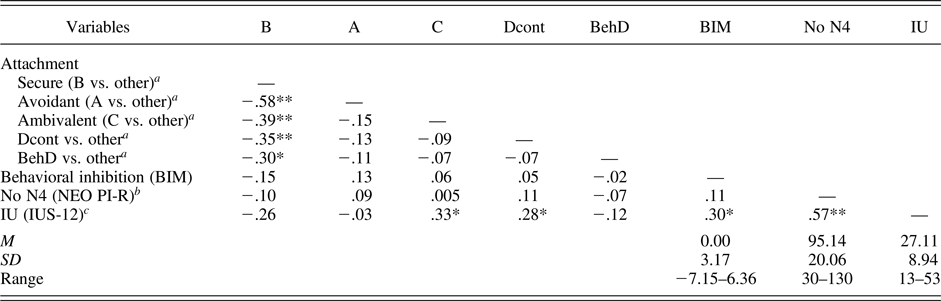
We first addressed the validity of the BIM. No significant correlations between the BIM score and any of the attachment groups were observed (Table 4, all ps > .05). Analysis of variance with attachment treated as a categorical variable (A, B, C, Dcontrol, and BehD) revealed similar results, suggesting that the BIM score measures a separate concept from attachment, consistent with previous research (for a review, see Vaughn et al., Reference Vaughn, Bost, van IJzendoorn, Cassidy and Shaver2008).
Correlations and descriptive statistics between main analyses variables (N = 56)

Note: B, secure; A, avoidant; C, ambivalent; Dcont, disorganized controlling; BehD, behaviorally disorganized; BIM, Behavioral Inhibition Measure; No N4, total neuroticism score without N4 subscale; IU, intolerance of uncertainty; NEO-PI-R, Neuroticism-Extraversion-Openness Inventory Personality Inventory Revised; IUS-12, Intolerance of Uncertainty Short Form.
aAttachment coded as dummy variables.
bTotal neuroticism score without the N4 subscale.
cPartial correlations controlling for neuroticism score without the N4 subscale.
*p < .05. **p < .01.
The BIM was then compared to neuroticism and its subscales. Of particular interest for validation purposes was the N4 self-consciousness subscale that is related to shyness and social anxiety. Correlations revealed no significant relationship between BIM and the main neuroticism domain nor its subscales, except for the N4 subscale (r = .30, p = .026, all other ps > .05). Children with higher BIM scores had significantly higher self-consciousness scores (Table 3).
As a large part of the BIM is related to vocalizations, correlation between the BIM and vocabulary competence were performed to ensure that the vocalization coding was not related to child vocabulary. Children's vocabulary competence was not significantly related to the BIM score (r = –.24, p > .05). Divergent validity of the BIM score with attachment coding and convergent validity with a concept related to shyness and social anxiety validated the use of the BIM score in subsequent analyses.
Maternal anxiety
We then examined the relation of maternal anxiety to both attachment and BI to confirm previous research linking these variables. Insecure children were significantly more likely to have anxious mothers: no secure child had a mother classified as anxious (Fisher p = .011). Furthermore, children classified as disorganized–controlling were significantly more likely to have anxious mothers compared with other children, while this effect approached significance in avoidant children (Dcontrol: Fisher p = .039; A: Fisher p = .052). Anxious mothers had children with significantly higher BI scores than did nonanxious mothers (M = 3.98, SD = 1.95; M = –0.54, SD = 2.95, respectively), t (51) = 3.64, p = .001, d = 1.58.
Preschool BI and attachment as predictors of adult IU
Prior to main analyses, neuroticism and maternal anxiety were also tested as possible covariates of IU. As anticipated, participants with higher neuroticism scores also had significantly higher IU scores (r = .60, p < .001); therefore, neuroticism was controlled for in main analyses. However, participants with anxious mothers (M = 1.40, SD = 0.14) did not differ from those with nonanxious mothers (M = 1.48, SD = 0.16) in IU, t (53) = 1.19, p = .24, d = 0.58. Therefore, maternal anxiety was not included in main analyses.
Given that the N4 self-consciousness subscale of neuroticism was shown to be related to BI, it was removed from the total neuroticism score so that BI and neuroticism could be addressed as separate predictors of IU, avoiding redundancy in the results. Therefore, a neuroticism score without the N4 scale was computed by summing all other neuroticism subscale scores (neuroticism no N4; Table 3). The neuroticism no N4 score was used in the subsequent analyses. Table 4 presents correlation coefficients as well as means and standard deviations for variables included in main analyses and online-only supplementary Figure S.1 presents a scatterplot of the relationship between BI and IU for each of the attachment classifications.
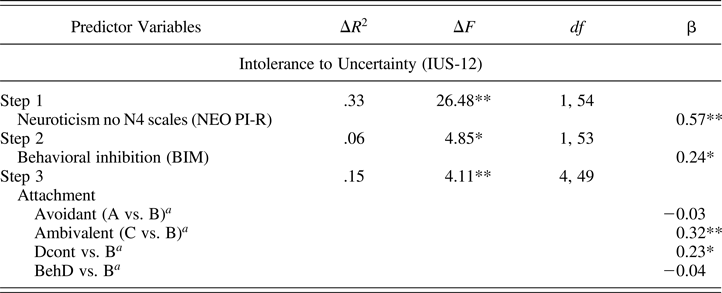
A hierarchical regression was performed to examine the independent and interactive contributions of BI and attachment at preschool age to the development of IU in adulthood (Table 5). In order to ensure that BI and attachment would independently predict IU from other potential risk factors for psychopathology, neuroticism was entered as a first step in the prediction model since it was collected at the same time point as our outcome variable. The regression analysis was therefore performed with neuroticism in Step 1 (control variable = neuroticism no N4), BI in Step 2 and attachment in Step 3. Insecure–ambivalent (C; β = 0.32) and disorganized controlling (Dcontrol; β = 0.23) attachment significantly differ from security (B) in predicting IU (explaining 15.4% of the variance), even after controlling for neuroticism (β = 0.57) and BI (β = 0.24), which independently explained 33.0% and 6.0% of the variance, respectively. When Attachment × BI interaction terms, using a centered transformation of the continuous variable, were added to the model, they failed to reach statistical significance. Furthermore, when the interaction terms were added, the total variance explained of the model dropped from 48.3% to 45.4%, making it a weaker fit. Therefore the better fitted model is one that includes preschool attachment and BI as predictors of IU while controlling for neuroticism.
Hierarchical regression model with preschool attachment and behavioral inhibition as predictors of adult intolerance of uncertainty (N = 56)

Note: IUS-12, Intolerance of Uncertainty Short Form; No N4, total neuroticism score without N4 subscale; NEO-PI-R, Neuroticism-Extraversion-Openness Inventory Personality Inventory Revised; BIM, Behavioral Inhibition Measure; A, avoidant; B, secure; C, ambivalent; Dcont, disorganized controlling; BehD, behaviorally disorganized.
aAttachment coded in dummy variables contrasting each group with the reference group (B).
*p < .05. **p < .01.
Discussion
Insecure attachment and BI in childhood independently predicted IU in adulthood 15 years later, while controlling for neuroticism and maternal anxiety. These results are consistent with theoretical models of the development of IU and anxiety (Cassidy, Reference Cassidy, Cicchetti and Toth1995; Cassidy et al., Reference Cassidy, Lichtenstein-Phelps, Sibrava, Thomas and Borkovec2009; Dugas et al., Reference Dugas, Buhr, Ladouceur, Heimberg, Turk and Mennin2004; Shamir-Essakow, Ungere, & Rapee, Reference Shamir-Essakow, Ungere and Rapee2005; Warren et al., Reference Warren, Huston, Egeland and Sroufe1997). Furthermore, as predicted and consistent with previous studies, maternal anxiety was related to both increased BI and an increased likelihood of insecure attachment in children (Manassis et al., Reference Manassis, Bradley, Goldberg, Hood and Swinson1995). However, maternal anxiety was not significantly correlated with IU. Finally, we successfully validated a new observational BI measure, developed for toddlers, to an older population of children. This study is the first to longitudinally assess the intrinsic and external developmental factors that contribute to the development of an individual's IU.
Insecure attachment, specifically the C and the Dcontrol subtypes, differs from secure attachment in predicting IU over and above neuroticism, maternal anxiety, and child temperament. This finding underscores the importance of early child–caregiver relationships as an influence on intolerance for uncertain and ambiguous situations (Cassidy, Reference Cassidy, Cicchetti and Toth1995; Cassidy et al., Reference Cassidy, Lichtenstein-Phelps, Sibrava, Thomas and Borkovec2009; Dugas et al., Reference Dugas, Buhr, Ladouceur, Heimberg, Turk and Mennin2004). Concordant with our results, Warren et al. (Reference Warren, Huston, Egeland and Sroufe1997) found ambivalent attachment to be a stronger predictor of anxiety disorders in adolescence than maternal anxiety and infant temperament, although they did not include the D attachment classification. Our results are consistent with Warren et al.’s (Reference Warren, Huston, Egeland and Sroufe1997) hypothesis that ambivalent attachment would be related to anxiety disorders due to chronic inconsistent parenting. Consistent with previous results (Tan et al., Reference Tan, Moulding, Nedeljkovic and Kyrios2010), Dcontrol attachment, compared to secure attachment, also predicted IU above and beyond neuroticism, maternal anxiety, and child temperament. Our results suggest that the perceived threat of ambiguity or uncertainty and a lack of control over one's environment may play a crucial role in the development of IU.
A reduced sense of control over one's environment in early age was suggested as a risk for anxiety disorders (Chorpita & Barlow, Reference Chorpita and Barlow1998). Inconsistent parenting could contribute to such a sense of lack of control particularly in the case of children with ambivalent attachment. Disorganized children who experience helpless or hostile parenting or maltreatment would also experience a sense of lack of control. As they grow older, disorganized children would be unable to tolerate this lack of control over their environment, or in this case their parent. Developing a controlling attachment would enable these children to regain some control and reduce uncertainty through role reversal. Out of the two disorganized groups in our study, only the controlling type was related to IU and not the behaviorally disorganized group. Children who develop a Dcontrol attachment may have a lower threshold for tolerating uncertainty than those that remain disorganized at older ages (BehD). Although differences are documented between Dcontrol and BehD attachment (Moss et al., Reference Moss, Cyr and Dubois-Comtois2004), future studies with larger sample sizes should further investigate these discrepancies in relation to IU. Larger samples would also allow examining potential differences between the two types of controlling attachment (O'Connor, Bureau, McCartney, & Lyons-Ruth, Reference O'Connor, Bureau, McCartney and Lyons-Ruth2011).
We found that BI in childhood contributed to a low threshold for tolerating uncertain situations or events, above and beyond neuroticism and maternal anxiety. These results are consistent with Vreeke and Muris (Reference Vreeke and Muris2012), who found higher levels of BI were related to children's anxiety symptoms after controlling for neuroticism, in both a nonclinical and a clinical sample, and that BI was not directly related to the overall neuroticism score. Therefore, our findings raise the possibility that being behaviorally inhibited early in life can have an effect on intolerance of uncertainty in adulthood and this above current psychological vulnerability. BI involves heightened reactions to novelty and uncertainty, and these reactions potentially predispose children to learn or develop a view that the environment can be uncertain and dangerous. In this respect, inhibited children are similar to children who learn that their caregiver is unavailable or inconsistent and perceive uncertainty as a threat. However, BI explained a small percentage of the variance in IU. A possibility is that BI was measured in an unselected sample, contrary to most BI research that examines children at the extremes of inhibition (scoring high or low), which usually yield stronger results (Degnan & Fox, Reference Degnan and Fox2007; Reznick et al., Reference Reznick, Gibbons, Johnston, McDonough and Reznick1989).
BI and attachment did not have interacting effects on IU, consistent with some but not all previous research examining the effects of attachment and BI on anxiety (Muris, van Brakel, Arntz, & Schouten, Reference Muris, van Brakel, Arntz and Schouten2011; Shamir-Essakow et al., Reference Shamir-Essakow, Ungere and Rapee2005; see Vaughn et al., Reference Vaughn, Bost, van IJzendoorn, Cassidy and Shaver2008). Our small sample may have made the detection of an interaction effect difficult. Methodological differences across studies should also be considered. A recent meta-analysis reported that inconsistent results in studies examining attachment and anxiety disorders could be related to methodological issues such as type of attachment measure used, age of participants, type of population (i.e., clinical or nonclinical), and reported outcome measures (Brumariu & Kerns, Reference Brumariu and Kerns2010). However, another meta-analysis examining attachment and internalizing behaviors (including anxiety disorders) reported that such issues had little effect on internalizing outcomes (Groh et al., Reference Groh, Roisman, van IJzendoorn, Bakermans-Kranenburg and Fearon2012), as opposed to externalizing behaviors (Fearon, Bakermans-Kranenburg, van IJzendoorn, Lapsley, & Roisman, Reference Fearon, Bakermans-Kranenburg, van IJzendoorn, Lapsley and Roisman2010). Regarding BI, type of measure (observational vs. parent report), type of population (selected vs. unselected sample), and stability of BI have all been identified as having potential effects on outcomes (Kagan & Snidman, Reference Kagan and Snidman2004; Kagan et al., Reference Kagan, Snidman, Kahn and Towsley2007; Reznick et al., Reference Reznick, Gibbons, Johnston, McDonough and Reznick1989). Therefore, more research must be done on BI and attachment in relation to distinct anxiety disorders in clinical and nonclinical samples, before clearly establishing these effects.
Although the BIM is a new measure of BI, our results suggest that it is a valid and reliable measure. As predicted, anxious mothers’ children had higher levels of BI, supporting previous results (Biederman et al., Reference Biederman, Rosenbaum, Chaloff, Kagan and March1995). Fearful reactions by mothers may help maintain BI in children (Gerull & Rapee, Reference Gerull and Rapee2002). Furthermore, the fact that our BI measure was not associated with the overall neuroticism score, but only the subscale related to shyness, suggests that the BIM measures a concept more closely related to self-consciousness in public, discomfort around others, and uneasiness in awkward social situations rather than overall vulnerability to negative emotions and maladjustment (Costa & McCrae, Reference Costa and McCrae1992). Having already been validated in a younger population of children (Zdebik, Reference Zdebik2013), these results further support the BIM as a promising observational BI measure. Furthermore, as the vocalizations are measured in terms of syllables, this measure can be used with culturally diverse populations as it is not necessary to understand the language of the participants even in older populations of children (Zdebik, Reference Zdebik2013). However, further validation in different at-risk, clinical or culturally diverse samples would be important to establish its generalizability across populations.
Limitations and future studies
Although our results are promising, there are some limitations to address. The young adulthood data (IU and neuroticism) were taken at the same time point and were self-reports, potentially inflating the relationship between these variables due to shared method variance. However, as some childhood measures were related to IU and not neuroticism, and vice versa, shared variance cannot fully account for our findings. Due to attrition, our final sample had fewer males and fewer individuals with lower maternal education than the original sample, and hence increased representation of these groups would increase the generalizability of our results. However, attrition typically diminishes statistical power, yet we detected meaningful associations between variables. Replication in other populations would of course be valuable, and a larger sample would also be beneficial, enabling the study of different anxiety disorders with sufficient statistical power. Furthermore, BI and attachment were measured at the same time point of the study, and video footage from the same laboratory session was used to code both measures, also possibly creating shared method variance. However, distinct parts of the sessions were used for each measure and no relation was found between the two variables, making shared variance also improbable in this case.
In addition, controlling for other maternal characteristics, for example, maternal personality and parenting style, would be important as these have been shown to moderate the relationship between child temperament and later social adjustment (Coplan, Arbeau, & Armer, Reference Coplan, Arbeau and Armer2008). Although maternal anxiety was not associated with IU, it is important to consider that the well-being of both parents can affect a child's vulnerability to certain disorders and should be considered in future studies (Bögels, Stevens, & Majdandžić, Reference Bögels, Stevens and Majdandžić2011). With the increasing evidence of paternal attachment relationship influencing anxious–withdrawn behavior (Vershueren & Marcoen, Reference Verschueren and Marcoen1999) and social competence (Boldt, Kochanska, Yoon, & Nordling, Reference Boldt, Kochanska, Yoon and Nordling2014), future studies would benefit from investigating the father's role in the development of IU. As the role of peers in late childhood and adolescence increases (see Allen, Reference Allen, Cassidy and Shaver2008), investigating how peer influence could moderate the effects of attachment and temperament on the development of IU would also be important. Similarly, romantic partner attachment may impact IU as adolescent relationships develop (see Feeney, Reference Feeney, Cassidy and Shaver2008). Stressful life events and gradual increases in individual responsibilities have been suggested as risks for the development of GAD (Dugas et al., Reference Dugas, Buhr, Ladouceur, Heimberg, Turk and Mennin2004); therefore, important life transitions (living on one's own, parenthood, etc.) are other likely candidates for the development of IU. Hence, a life span approach would benefit the understanding of IU.
A notable line of investigation was suggested by Dugas et al. (Reference Dugas, Buhr, Ladouceur, Heimberg, Turk and Mennin2004). Due to the stable character of IU, it was proposed that it may act as a “cognitive diathesis” increasing an individual's chances of developing anxiety in reaction to increased stress. A next step would be to investigate if individuals experiencing higher levels of IU are at increased risk of developing GAD and if this link is moderated by the amount of stress they have experienced throughout their life. Sroufe, Egeland, and Kreutzer (Reference Sroufe, Egeland and Kreutzer1990) also described the enduring influence of early attachment patterns and how they can resurge under certain circumstances, particularly in stressful situations, throughout an individual's life. It is possible that early integrated experience, shaped by both attachment and temperament, can resurface in times of stress, such as in late adolescence and early adulthood, a period synonymous with increased responsibilities compared to childhood. Finally, identifying underlying mechanisms linking specific aspects of temperament and early attachment in the etiology of interpretation of uncertainty as well as developing prevention strategies and therapies could help examine causal links between BI, attachment, and IU.
Conclusion
Our study is the first to provide empirical support that preschool attachment, particularly ambivalent and disorganized controlling types when compared to secure attachment, as well as BI independently predict IU in adulthood, even after controlling for neuroticism and maternal anxiety. Furthermore, we were able to further validate a new observational BI measure that can be easily integrated into studies with appropriate video footage, adding valuable childhood temperament information and providing substantial advantages over retrospective questionnaires. Finally, our work emphasizes the role of early cognitive processes in the development of later psychopathology. In our study, early cognitive processes related to perceived insecurity and uncertainty on a temperamental and relational level are important in the development of the cognitive schema of IU, hence proposing new opportunities for preventative treatment not only with young children but also with their caregivers.
Supplementary Material
To view the supplementary material for this article, please visit https://doi.org/10.1017/S0954579417001614.