The incidence of congenital heart disease is 4 to 8 per 1000 live births.Reference Hoffman and Kaplan1 Although advances in medical knowledge and technology have, over the past few decades, dramatically improved the survival of children with congenital heart defects, for many lesions life expectancy of patients remains short and quality of life low.Reference Canobbio2–Reference Reybrouck, Rogers and Weymans4 Residual cardiovascular defects are responsible for some of these hardships. Survivors of congenital heart disease are also often afflicted with pulmonary, neurological, neurodevelopmental, orthopaedic, and other comorbidities that impair their ability to function.Reference Cooper, Jacobs and Chai5–Reference Imms8 Superimposed upon these physical impairments, patients with congenital heart disease are often subject to overprotection on the part of parents, educators, and healthcare providers predisposing them to physical inactivity and exercise intolerance.Reference Linde9, Reference Casey, Stewart and McCusker10
These factors can have serious implications for congenital heart disease survivors’ long-term health and quality of life. In adults, physical inactivity has been found to be an independent risk factor for atherosclerosis, cardiovascular disease, and diabetes.Reference Thijssen, Maiorana, O'Driscoll, Cable, Hopman and Green11 Indeed, sedentary living is estimated to be responsible for approximately one-third of deaths due to coronary heart disease and type II diabetes, and low cardiopulmonary fitness is a strong independent predictor of all-cause mortality. Among adults, the relative risk for cardiovascular death that is associated with being unfit exceeds that associated with smoking, elevated systolic blood pressure, hypercholesterolaemia, or obesity.Reference Thijssen, Maiorana, O'Driscoll, Cable, Hopman and Green11–Reference Fernandes, McElhinney, Khairy, Graham, Landzberg and Rhodes13 Among patients with congenital heart disease, diminished exercise capacity has been found to be an independent predictor of death/and or hospitalisation for individuals with repaired Tetralogy of Fallot, Transposition of the Great Arteries, Pulmonary Hypertension, and Fontan Physiology.Reference Fernandes, McElhinney, Khairy, Graham, Landzberg and Rhodes13–Reference Rhodes, Ubeda Tikkanen and Jenkins17 To optimally manage patients with complex congenital heart disease, the role of ancillary therapies that may not cure but may potentially improve cardiac function and quality of life – such as cardiac rehabilitation – should be explored.Reference Somarriba, Extein and Miller12
Cardiac rehabilitation programmes have been widely studied in adults with acquired heart disease. Programmes for acute – post-MI or post-surgery – and chronic patients differ with regard to the intensity of endurance training, the level of monitoring employed, and the number/training of the personnel required for supervision; other aspects of the programmes are similar. In addition to improving oxygen consumption and exercise capacity, they have been found to reduce morbidity, mortality, and economic costs, as well as improve quality of life.Reference Lawler, Filion and Eisenberg18–Reference Piepoli, Conraads and Corra21 They also have a salutary effect upon standard cardiovascular risk factors such as lipid profiles, adiposity, and hypertension. The effects of exercise on these conventional cardiovascular risk factors are, however, substantially less compared with those achieved by pharmacological therapies alone, and the mortality benefits associated with exercise and fitness cannot be explained solely by the impact of these dynamics upon the conventional risk factors.Reference Thijssen, Maiorana, O'Driscoll, Cable, Hopman and Green11, Reference Green, O'Driscoll, Joyner and Cable22–Reference Dimmeler and Zeiher24
Unfortunately, only 10% of all potential adult candidates for exercise training/cardiac rehabilitation actually receive this therapy. Among children this percentage is much lower.
One would expect that the benefits associated with exercise training in adults with cardiovascular disease would also be recognised among children with congenital heart disease. However, there have been relatively few clinical studies of paediatric cardiac rehabilitation. These studies vary greatly in design, inclusion criteria, assessment of risk factors, duration of follow-up, attrition, and particularly in outcome measures. Thus, a systematic review of the existing literature is needed to summarise and evaluate the existing data regarding the benefits of cardiac rehabilitation in children, to determine the proper outcome measurements, and to identify the attributes of a successful programme.
Methods
Search strategy: The bibliographical search was performed using the following strategy: heart, cardiac, rehabilitation, exercise, lung, human, infant, child, adolescent.
The databases searched during the study were: MEDLINE/PubMed, EMBASE, Cardiosource Clinical Trials Database, and Cochrane Library. Additional studies were obtained from the bibliography of the studies obtained.
Inclusion criteria: Studies were included if they contained a structured cardiac rehabilitation programme with an exercise training component in cardiac patients up to 18 years of age or if they reviewed these types of studies. Only complete articles published from January, 1981 until November, 2010 were included.
Exclusion criteria: Languages other than English, Spanish, French, or Italian or studies with a rehabilitation component but without an exercise training component were not included.
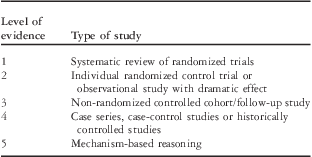
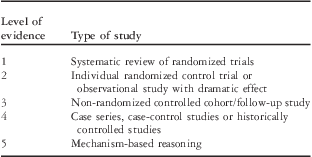
Classification of the evidence: Two independent authors reviewed each paper. Each reviewer classified each study according to the OXFORD classification for evidence-based medicine25 – a classification system based on the type of study (Table 3). When the authors’ classifications differed, the case was discussed and a consensus classification was determined. The quality of the evidence supporting the use of cardiac rehabilitation in children with congenital heart disease was then graded, based upon the entirety of the studies reviewed, as described by the Oxford Center for Evidence-Based Medicine (Table 4).
Results
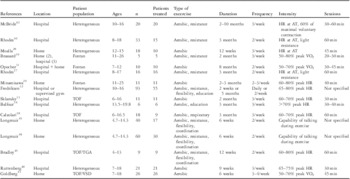
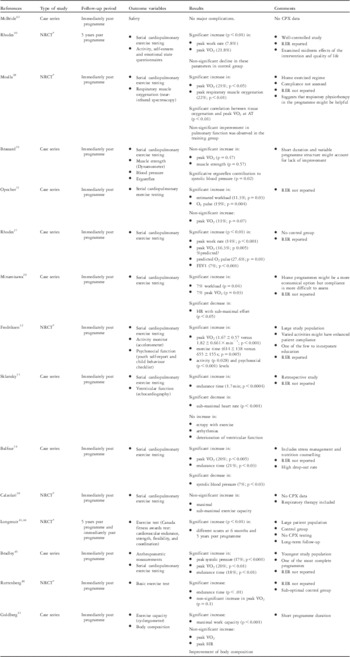
A total of 193 articles were found; however, only 24 met our inclusion criteria. Of these, 21 had a structured rehabilitation programme, but only 18 had an exercise training component. These papers are the focus of this review. Of these articles, two were case reports and were not included in our final analysis.Reference Somarriba, Extein and Miller12, Reference McCall and Humphrey26 The youngest patients included were 4 years old. The number of patients included per study ranged from 1 to 103, and the duration of the programme ranged from 2 weeks to 10 months. No adverse events were reported. The essential features of each study are summarised in Tables 1 and 2.
Description of patient population and rehabilitation programme.

AT = anaerobic threshold; HR = heart rate; TGA = transposition of the great arteries; TOF = tetralogy of Fallot; VSD = ventricular septal defect; VO2 = oxygen consumption
Study description.

AT = anaerobic threshold; CPX = cardiopulmonary testing; FEV1 = forced expiratory volume in the first second; HR = heart rate; NRCT = non-randomized controlled tria; RER = respiratory exchange ratio; VO2 = oxygen consumption
*NRCT – equivalent to a cohort study in the modified CONSORT definition56
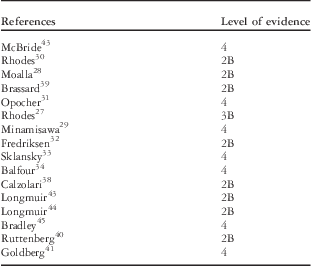
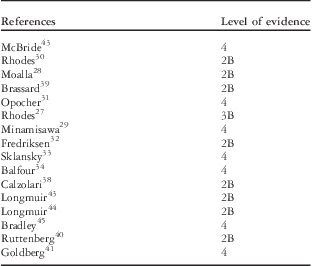
The level of evidence of these studies was scored according to the OXFORD classification system and is presented in Table 3. There were no randomised control trials, and the best studies receive a score of only 3. Overall, the level of evidence supporting the efficacy of cardiac rehabilitation in children with congenital heart disease may be characterised as suggestive but not as definitive (Oxford Center for Evidence-Based Medicine Classification B; Table 4).
Levels of evidence.
Classification of level of evidence.
Discussion
The main goal of this review was to describe and quantify existing data regarding rehabilitation programmes for children with congenital heart disease. Several studies have found evidence supporting the acute benefits of cardiac rehabilitation in these patients.Reference Rhodes, Curran and Camil27–Reference Miller, Horgan and Lipschultz35 Serious adverse events have not been encountered. A limited number of previous reviews have evaluated this subjectReference Brassard, Bedard, Jobin, Rodes-Cabau and Poirier36, Reference Takken, Hulzebos, Blank, Tacken, Helders and Strengers37 and have, in general, concurred with these findings.
However, our review raises a number of important issues that have not been previously addressed. Beneficial results were not uniformly observed and adequate randomisation was not often employed. It must also be acknowledged that the physiologic alterations and residual impairments associated with different congenital heart defects vary greatly, and the response to rehabilitation may differ depending upon the defects present. Ideally, each pathologic variant should be studied individually. However, only seven of the clinical trials studied a homogenous population.Reference Somarriba, Extein and Miller12, Reference McCall and Humphrey26, Reference Minamisawa, Nakazawa, Momma, Imai and Satomi29, Reference Opocher, Varnier and Sanders31, Reference Sklansky, Pivarnik, O'Brian, Morris and Bricker33, Reference Calzolari, Turchetta and Biondi38, Reference Brassard, Poirier and Martin39
The structure of the rehabilitation programmes also varied considerably with regard to the intensity, frequency, and duration of exercise. Most early studies also limited their training programmes to aerobic exercises.Reference Rhodes, Curran and Camil27, Reference Minamisawa, Nakazawa, Momma, Imai and Satomi29, Reference Opocher, Varnier and Sanders31, Reference Sklansky, Pivarnik, O'Brian, Morris and Bricker33, Reference Balfour, Drimmer, Nouri, Pennington, Hemkens and Harvey34, Reference Calzolari, Turchetta and Biondi38, Reference Ruttenberg, Adams, Orsmond, Conlee and Fisher40, Reference Goldberg, Fripp, Lister, Loke, Nicholas and Talner41 In contrast, most current rehabilitation programmes employ a combination of aerobic and resistance training.Reference Somarriba, Extein and Miller12, Reference McCall and Humphrey26, Reference Moalla, Maingourd, Gauthier, Cahalin, Tabka and Ahmaidi28, Reference Fredriksen, Kahrs and Blaasvaer32, Reference Brassard, Poirier and Martin39, Reference McBride, Binder and Paridon42–Reference Bradley, Galioto, Vaccaro, Hansen and Vaccaro45 Owing to the fact that a strong relationship exists between muscle strength and exercise tolerance,Reference Somarriba, Extein and Miller12, Reference Brassard, Bedard, Jobin, Rodes-Cabau and Poirier36 suboptimal training regimen may account for the ambiguous results that emerged from some of the paediatric rehabilitation programmes.
However, even the current rehabilitation programmes do not take into account the fact that congenital heart disease may also be associated with congenital or acquired abnormalities in other organ systems, which may be appropriately addressed in rehabilitation therapy. These organ systems include:
Pulmonary: Coexisting pulmonary pathology is common among patients with congenital heart disease including restrictive lung disease, obstructive lung disease, diaphragmatic paralysis, recurrent pulmonary infections, etc. Although pulmonary dysfunction is usually not the main factor limiting exercise capacity,Reference Nanas, Nanas and Kassiotis46 it could contribute to exercise limitation during a maintained submaximal effort. Respiratory physiotherapy may therefore improve the congenital heart disease patient's cardiorespiratory response to exercise, just as it does in patients with chronic heart failure.Reference Cooper, Jacobs and Chai5, Reference Moalla, Maingourd, Gauthier, Cahalin, Tabka and Ahmaidi28, Reference Nanas, Nanas and Kassiotis46–Reference Fitzgerald and Sherwood48
Neurologic: The neurologic deficits encountered among patients with congenital heart disease may range from major syndromes such as hemiparesis, cerebral palsy, or epilepsy to more subtle symptoms such as neurodevelopmental delays, learning disabilities, or attention deficit disorders.Reference Bird, Jeffries and Licht6–Reference Imms8 These disabilities may be appropriate targets for rehabilitation therapy and/or may influence the structure of an individual's rehabilitation programme.
Musculoskeletal: Musculoskeletal abnormalities are among the most common extracardiac anomalies associated with congenital heart disease. These patients may have scoliosis and other thoracic deformities, connective tissue disorders, hypotonia, etc.Reference Greenwood, Rosenthal, Parisi, Fyler and Nadas49, Reference Jaiyesimi and Antia50 all of which may be relevant to one or more aspects of a patient's rehabilitation programme.
Few of the paediatric cardiac rehabilitation programmes reviewed here incorporated features designed to address these issues and most did not include recommended components of adult rehabilitation programmes,Reference Leon, Franklin and Costa20 such as nutritional counselling, aggressive risk factor management, psychosocial and vocational counselling, physical activity counselling, education, and psychological intervention. Indeed, educational intervention, one of the main pillars in adult cardiac rehabilitation, was employed in only four of the trials.Reference Somarriba, Extein and Miller12, Reference Fredriksen, Kahrs and Blaasvaer32, Reference Balfour, Drimmer, Nouri, Pennington, Hemkens and Harvey34, Reference Bradley, Galioto, Vaccaro, Hansen and Vaccaro45 Similarly, psychological assessment/counselling was never included. Owing to the fact that behavioural issues are not uncommon among children with congenital heart disease and their caretakersReference Bird, Jeffries and Licht6–Reference Imms8, these omissions may have significant negative consequences and decrease the success rate of a cardiac rehabilitation intervention.
Mid/long-term follow-up data have been provided by only two studies (LongmuirReference Longmuir, Tremblay and Goode43 and RhodesReference Rhodes, Curran and Camil30). Significant improvements, persisting beyond the immediate post-programme period, were observed. These studies suggest that rehabilitation programmes can have persistent beneficial effects in children with congenital heart disease. However, it is difficult to draw firm conclusions from these two, small studies. Certainly, to reliably achieve long-standing lifestyle changes – a necessity for these patients with a chronic disease, and one of the major goals of cardiac rehabilitation – a multi-level intervention that targets the children, their lifestyles, and their caretakers seems desirable. To sustain acute improvements, reinforcement with long-term follow-up programmes should be pursued. These approaches have been productively incorporated into exercise programmes for children with obesity.Reference Collins, Okely and Morgan51, Reference Woolford, Sallinen, Clark and Freed52 The outcomes of obesity programmes that incorporate these multidimensional features have been found to be superior to those of programmes with more limited resources.Reference Collins, Okely and Morgan51 Better results may also accrue to children with congenital heart disease if their rehabilitation programmes were to be enhanced with these capabilities.
The technology used to assess the impact of cardiac rehabilitation also varied considerably from study to study. Serial cardiopulmonary exercise testing – one of the most valuable tools for objectively and quantitatively assessing the impact of cardiac rehabilitation – was used in a fraction of the studies. The respiratory exchange ratio – probably the best objective measure of effort expenditure in this population – often was not reported or used to establish that the observed changes were due to the effects of the rehabilitation programme rather than the variations in effort expenditure. It is therefore difficult to reliably interpret the peak exercise data of these studies.
Apart from the peak oxygen consumption, there is no consensus regarding the other outcome measures that should be used to assess the effects of cardiac rehabilitation. Potential candidates include muscle strength,Reference Somarriba, Extein and Miller12 body composition, quality of life questionnaires, etc. In order to fully assess the effects and benefits of a cardiac rehabilitation programme, variables that reliably measure the impact of the programme upon the different areas affected by congenital heart disease must be identified and studied.
From the articles reviewed for this study, and the literature regarding exercise programmes for patients with obesity and other chronic paediatric diseases, such as cystic fibrosisReference Williams, Benden, Stevens and Radtke53 and renal transplantation,Reference Clapp, Bevington and Smith54, Reference Tangeraas, Midtvedt and Cvancarova55 there appears to be a consensus that rehabilitation programmes should have a duration of at least 12 weeks and a frequency of two to three times a week, with sessions lasting at least 40 minutes. We believe that the programmes should include aerobic, resistance, and flexibility training, as well as education and psychological intervention. The intensity of aerobic exercise should be at a heart rate approximately equivalent to that associated with the anaerobic threshold. This consideration is particularly relevant to children with congenital heart disease, as chronotropic impairment is commonly encountered in this population.
A final point that emerges from this analysis is that rehabilitation programmes for children with congenital heart disease are underutilised and their potential value underappreciated. A number of factors may account for this state of affairs, including systematic deficiencies, for example, a limited number of specialised facilities/personnel; economic limitations, for example, a lack of insurance coverage for the programmes; provider unawareness, for example, healthcare providers underestimate the value and/or availability of rehabilitation programmes; and patient-related factors, for example, logistic problems, expense, parental anxiety. Resolution of these issues will require changes at various levels of healthcare policies, protocols and increasing awareness of these programmes among healthcare dispensers and families.
Conclusion
We are now confronted with a growing patient population of survivors of congenital heart disease. These individuals continue to suffer from disabilities that affect their present and future quality of life. Multidisciplinary interventions, such as cardiac rehabilitation, which could greatly benefit many of these patients, are underappreciated and almost invariably overlooked as a first-line approach to secondary intervention.
Benefits have been observed in many studies of cardiac rehabilitation in children with congenital heart disease, and no adverse events have been reported. Although challenging at various levels, randomised controlled studies on larger homogeneous population are needed to prove the efficacy of these interventions, stratify risk in these patients, and develop optimal protocols. Long-term effects and outcomes should be determined.
The chosen outcome variables have also been incomplete. Ideally, they should assess the effects of the programme on multiple areas including impairment of body structures or functions, limitation of activities, and restriction of participation. Serial cardiopulmonary exercise testing is best suited for measuring exercise capacity and prescribing exercise intensity. Other modalities should be developed to quantitatively assess other areas of impairment.
The optimal structure of a paediatric cardiac rehabilitation programme also remains unclear. A combination of aerobic and resistance exercise is probably ideal. Including complementary therapies such as respiratory physiotherapy, education and psychological interventions might improve the outcome of these programmes; however, this issue has not been thoroughly studied. Comorbidities and environmental impediments that often confront patients with congenital heart disease have, historically, not been addressed by rehabilitation programmes. The role of parents in the rehabilitation programmes has also been overlooked. These are areas that deserve greater attention. We believe that a cardiac rehabilitation programme should be based on multidisciplinary interventions that apply a holistic approach to the patient and treat the ensemble of problems that they confront.
Acknowledgement
Grant: Research Fellowship Grant Fundación Alfonso Martin Escudero for Dr Ana Ubeda