INTRODUCTION
Rocky shores mussels frequently occur as multilayered beds of considerable structural complexity (Guiñez & Castilla, Reference Guiñez and Castilla1999; Commito & Rusignuolo, Reference Commito and Rusignuolo2000). In southern South America, the intertidal mussel beds are dominated by species of small size, mostly of the Brachidontes genus, however larger mussels (i.e. Mytilus sp.) are also present, but in low densities along the rocky shores (Penchaszadeh, Reference Penchaszadeh1973; López Gappa et al., Reference López Gappa, Tablado and Magaldi1990; Adami et al., Reference Adami, Tablado and López Gappa2004, Reference Adami, Tablado and Sodor2008). The distribution pattern of Brachidontes intertidal mussel beds along the south-western Atlantic includes Brachidontes solisianus d'Orbigny, 1846 and B. darwinianus d'Orbigny, 1846 in south Brazil and Uruguay (Klappenbach, Reference Klappenbach1965; Rios, Reference Rios1994; Scarabino et al., Reference Scarabino, Zaffaroni, Clavijo, Carranza, Nin, Menafra, Rodríguez-Gallego, Scarabino and Conde2006), B. rodriguezii from Uruguay to north Argentinean Patagonia (Castellanos, Reference Castellanos1967; Scarabino et al., Reference Scarabino, Zaffaroni, Clavijo, Carranza, Nin, Menafra, Rodríguez-Gallego, Scarabino and Conde2006) and B. purpuratus Lamarck, 1819 on the Patagonian shore, extending towards the Pacific ocean along the Chilean coast to Ecuador (Bernard, Reference Bernard1983; Prado & Castilla, Reference Prado and Castilla2006). The latter species was frequently placed by several authors under the genus Perumytilus Olsson, 1961 (Aguirre et al., Reference Aguirre, Perez and Negro Sirch2006).
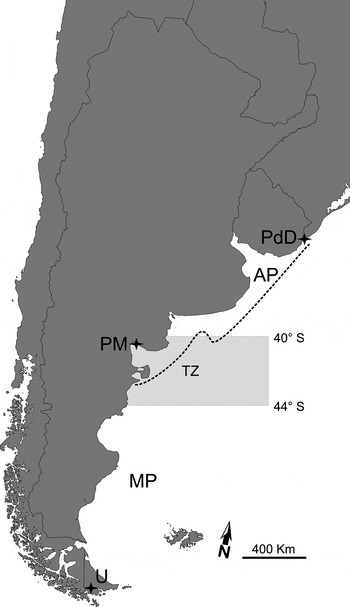
Biogeographically, the B. rodriguezii distribution range is included in the Argentine province (warm-temperate), from the south of Brazil to the north of Patagonia, while B. purpuratus distribution is included in the Magellanic province (cold-temperate) from Las Grutas (40°50′S San Matías Gulf), to the Beagle Channel in the south-western Atlantic (Scarabino, Reference Scarabino1977; Rios, Reference Rios1994; Scarabino et al., Reference Scarabino, Zaffaroni, Clavijo, Carranza, Nin, Menafra, Rodríguez-Gallego, Scarabino and Conde2006; Adami et al., Reference Adami, Schwindt, Verón, Tablado and Orensanz2007). The transition zone between these two biogeographical provinces has been shortly characterized and is located in the sector of the north Patagonian gulfs between 40°S and 44°S latitude (Balech & Ehrlich, Reference Balech and Ehrlich2008).
At present, the taxonomic status of these species is under discussion, and there are no simple tools to distinguish between them. Brachidontes rodriguezii and B. purpuratus shells have several particular features that allow to distinguish between them: the umbo is terminal and numerous strong and forked ridges run from the umbo out to the hind edge of the shell such as a fan in B. purpuratus while in B. rodriguezii ridges are fine and run parallel from the sub-terminal and rounded umbo (Penchaszadeh et al., Reference Penchaszadeh, Pastorino, Brogger and Boltovskoy2008). However, in certain intertidals the shells are very worn away and their differentiation based on these characteristics becomes virtually impossible. Phenotypic diversity provides valuable clues to the differentiation of species and subspecies, reflecting the historical processes that create taxonomic distinctions as well as plastic responses to the environment (Cardini & Elton, Reference Cardini and Elton2011). The possibility to discriminate between them is of great interest for ecological and biodiversity studies.
The conventional morphometric approach is less likely to be successful in cases where diversity of shapes is not large, and hence, the morphometric trends are apt to be rather subtle, as is the case of mussel shells. In this particular case, elliptical Fourier analysis (EFA) (Kuhl & Giardina, Reference Kuhl and Giardina1982) is more appropriate, since it allows researchers to capture the entire outline shape in a systematic manner and with a desired degree of precision (Rohlf & Archie, Reference Rohlf and Archie1984). Previous studies have shown that EFA is effective in the analysis of bivalves shell shape variation when applied to distinguish similar species of bivalves (Rufino et al., Reference Rufino, Gaspar, Pereira and Vasconcelos2006; Costa et al., Reference Costa, Menesatti, Aguzzi, D'Andrea, Antonucci, Rimatori, Pallottino and Mattoccia2010), between fossil and modern specimens (Gordillo et al., Reference Gordillo, Márquez, Cárdenas and Zubimendi2011), and to analyse geographical variation in shape (Ferson et al., Reference Ferson, Rohlf and Koehn1985; Innes & Bates, Reference Innes and Bates1999; Palmer et al., Reference Palmer, Pons and Linde2004; Krapivka et al., Reference Krapivka, Toro, Alcapán, Astorga, Presa, Pérez and Guiñez2007; Costa et al., Reference Costa, Aguzzi, Menesatti, Antonucci, Rimatori and Mattoccia2008; Márquez et al., Reference Márquez, Robledo, Escati Peñalosa and Van der Molen2010; Gordillo et al., Reference Gordillo, Márquez, Cárdenas and Zubimendi2011; Márquez & Van der Molen, Reference Márquez and Van der Molen2011; Rufino et al., Reference Rufino, Vasconcelos, Pereira, Fernández-Tajes, Darriba, Méndez and Gaspar2012). Furthermore this method lets researchers analyse complex outlines without losing information about shells' form (Rohlf & Archie, Reference Rohlf and Archie1984).
The implementation of geometric morphometric tools to easily obtain the shell outlines and to reconstruct the shell contours of the analysed data will enable us to determine the main shell shape variation shown by these two species. In the present study we analyse the shell morphological pattern in the dominant mussel beds species, B. rodriguezii and B. purpuratus, along their Atlantic distribution range, including the transition zone, where both species coexist. The aim of this study is to discriminate shell-shape patterns between B. rodriguezii and B. purpuratus populations that could be a determinant factor to differentiate them when they coexist in the same rocky shore, since the environmental conditions are the same for both species, and to visually describe the differences to evaluate if it is possible to generate a key for an easy differentiation.
MATERIALS AND METHODS
Brachidontes rodriguezii and B. purpuratus samples were collected from the two extremes of their distribution ranges in the south-western Atlantic, Punta del Diablo (34°02′S 53°32′W) and Ushuaia (54°49′S 68°11′W) respectively. In addition a third sample collection site was included in the transition zone: Punta Mejillón (41°01′S 64°08′W) in north Patagonia, which comprises the southern distribution location of B. rodriguezii and the northern extreme distribution range for B. purpuratus (Figure 1).
Map of the south-western Atlantic Ocean showing the sample collection sites. The broken lines separate the biogeographical provinces along the Atlantic coast: AP, Argentinean Province and MP, Magellanic Province. The grey clear box shows the transition zone (TZ). Codes of sample collection sites: PdD, Punta del Diablo; PM, Punta Mejillón; U, Usuahia.

A total of 200 adult individuals were collected from mussel beds: 50 individuals from each sample site. The sample size-ranges were as follows: B. rodriguezii from Punta del Diablo: 127–226 mm; B. rodriguezii from Punta Mejillón: 157–228 mm; B. purpuratus from Punta Mejillón: 118–234 mm; and B. purpuratus from Ushuaia: 279–344 mm. Soft parts were removed and images of the inner side of the left valves were obtained using a digital camera. Shell area (cm2) was estimated using SHAPE-ChainCoder software (Iwata & Ukai, Reference Iwata and Ukai2002) and it was used as a proxy for shell size.
To analyse the morphological variation between B. rodriguezii and B. purpuratus, we applied EFA using the software package Shape v1.26 (Iwata & Ukai, Reference Iwata and Ukai2002). An EFA method consists of decomposing a curve into a sum of harmonically related ellipses (Lestrel, Reference Lestrel1997). The closed contours are obtained as chain-coded data from the digital images of the outlines (Freeman, Reference Freeman1974). The coefficients of the Fourier series (elliptic Fourier descriptors, (EFDs)), which are normalized to avoid variation related to the size, rotation and starting point of the contour traces, are then calculated from the chain-coded data using the procedure proposed by Kuhl & Giardina (Reference Kuhl and Giardina1982). From a preliminary analysis, we concluded that 10 harmonics were sufficient to characterize mussels' shell shape in detail. By this procedure, the shape of each shell was approximated to 37 coefficients of normalized EFDs (four coefficients for each harmonic, excluding the first three that became constant after the normalizations).
Principal component analysis (PCA) of the variance–covariance matrix (Rohlf & Archie, Reference Rohlf and Archie1984; Crampton, Reference Crampton1995) was used to summarize shape variation based on the EFDs for each shell. To assess and control putative allometric effects, we computed a linear multiple regression (principal component regression method: De Maesschalck et al., Reference De Maesschalck, Estienne, Verdú-André, Candolfi, Centner, Despagne, Jouan-Rimbaud, Walczak, Massart, De Jong, De Noord, Puel and Vandeginste1999; Costa et al., Reference Costa, Aguzzi, Menesatti, Antonucci, Rimatori and Mattoccia2008; Márquez & Van der Molen, Reference Márquez and Van der Molen2011), where PCs were used as independent variables and shell area as dependent variable.
A discriminant analysis based on the shape (EFDs) of the two extreme populations (B. purpuratus from Ushuaia and B. rodriguezii from Punta del Diablo) was performed. Using 50% of the total sample (100 individuals from the two extreme populations B. purpuratus from Ushuaia and B. rodriguezii from Punta del Diablo) the discriminant function was formed. Then, this discriminant function previously defined was used to assign the individuals from the transition zone (Punta Mejillón) of both species, without group information, to one or other species. The average shell shape for each species was reconstructed from the normalized coefficients mean values of the EFDs using the inverse Fourier transformations (Iwata & Ukai, Reference Iwata and Ukai2002).
Provided with the drawings of the shapes from the two species, previously achieved, seven collaborators classified the transition zone shells into two groups to determine if inter-specific differences in shell shape were distinguishable by visual observation. Next we calculated the percentage of individuals correctly assigned to each species. The proportion of correctly assigned individuals by visual observation was then compared with those correctly assigned by the discriminant function.
RESULTS
Only the first three PCs (summarizing the 89% of the EFA total variance) were used in the analyses. Negligible regressions were found between size (shell area) and shell shape for PC1 and PC2 (R2 < 0.003), however the regression was significant for PC3 (R2 = 0.51). But given that the third axis explained only 8% of the total shape variance, only 8% of the shell shape variation is explained in 51% by size. Considering this, all the subsequent analyses were performed without allometric corrections.
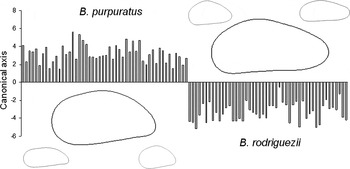
The discriminant function successfully distinguished between the two species from the extreme locations (B. rodriguezii from Punta del Diablo and B. purpuratus from Ushuaia). There are a series of characters that allow their unequivocal separation: in B. rodriguezii valves of adult individuals are elongated and the position of the umbo is sub-terminal, while in B. purpuratus valves are globular and the position of the umbo is terminal (Figure 2). The proportion of correctly assigned individuals from the transition zone using the discriminant function obtained from the two extreme populations was slightly different for each species. While B. rodriguezii shells were 100% correctly assigned, B. purpuratus shells were correctly assigned in 78.2%.
Discriminant analysis between the extreme populations of two species of the Brachidontes genus. Outline diagrams show the mean (middle), –2 standard deviation (SD) (left) and +2SD (right) shell shape of each of them.

Regarding the classification by the direct observation method, the proportion of correctly assigned shells varied between 34 and 94%, with an average of 66%.
DISCUSSION
Brachidontes genus includes species which often vary intra- and inter-specifically in response to environmental conditions as a result of ecophenotypic plasticity (e.g. Nalesso & Duarte, Reference Nalesso and Duarte1992; Tanaka & Magalhães, Reference Tanaka and Magalhães1999). The most accepted hypothesis is that there is a morphological sequence of ecomorphs which respond to different environmental controls such as latitude, depth, substrate type and water energy (Aguirre et al., Reference Aguirre, Perez and Negro Sirch2006). Some biodiversity and palaeobiogeographical studies illustrate that the differentiation between Brachidontes species from the transition zone is difficult (Aguirre et al., Reference Aguirre, Perez and Negro Sirch2006; Cuevas et al., Reference Cuevas, Martin and Bastida2006), since most morphological differences are only identifiable by experienced taxonomists. Therefore, we analysed the inter-specific shell shape variations, with special emphasis on individuals from the transition zone. The strength of this study is that the analysis was based on individuals that inhabit the same patch in the middle intertidal rocky shore, and so the shape variation that could be caused by local ecological conditions is almost completely reduced.
The Brachidontes mussel inhabits intertidal rocky shores where they form complex multilayered matrices or beds. These mussels have been defined as ecosystem bio-engineers and many taxa are associated with them on the rocky intertidals (Pérez et al., Reference Pérez, Guíñez, Llavona, Toro, Astorga and Presa2008), and thus they are important for the regional biodiversity. Quantifying biodiversity is a crucial aspect of conservation, and molecular analyses have become the primary source for identification of biological diversity. However numerous studies have highlighted the risk of underestimating diversity by focusing on a single point of comparison (Cardini & Elton, Reference Cardini and Elton2011). In a phylogenetic reconstruction, Trovant et al. (Reference Trovant, Ruzzante, Basso, Orensanz, Bigatti and Van der Molen2011) explain that B. rodriguezii and B. purpuratus from the south-western Atlantic, which distribution overlaps between 40° and 44°S show different biogeographical and phylogenetic affinities. In the present study we clearly distinguish both Brachidontes species inhabiting the transition zone by means of morphometric tools, showing that both phenotypic and genotypic studies are in agreement. Given this, the study of morphological differences provides important complementary perspectives on biodiversity (Cardini & Elton, Reference Cardini and Elton2011).
The EFA provided better results on the classification of individuals pertaining to different species from the transition zone than the results from direct observations. The principal advantage of EFA on visual observations is that EFA is not a subjective method. So, the analysis of shell shape variation through EFA decomposition provides an objective tool to discriminate between B. purpuratus and B. rodriguezii, allowing simple and complete visualizations of specimens' means (Ferson et al., Reference Ferson, Rohlf and Koehn1985; Costa et al., Reference Costa, Menesatti, Aguzzi, D'Andrea, Antonucci, Rimatori, Pallottino and Mattoccia2010). Furthermore, these mussels form dense multilayered beds and the time needed for manual classification is elevated, though using the automated procedures described in this work reduces the processing speed and also diminishes the chance of human error. Because only the experienced taxonomists can correctly classify individuals of both species based on their internal and external morphology, our results suggest that the use of the discriminant function from the EFA method could be easily used by non-taxonomist specialist observers to differentiate between species of Brachidontes genus of the transitions zone in future ecological and biodiversity research.
In the future, the implementation of this tool would enable development of simple user-friendly software that facilitates the determination of species or populations with less assignment error. Finally, the methodology presented here brings some promising insights concerning the inter-specific mussel identification: this new approach yielded the clearest results in the study of species identification improving, in this way, biodiversity studies.
ACKNOWLEDGEMENTS
We thank Dr Guido Pastorino for his help in the individuals' determination and to the volunteers who participated in the visual shell classification. We are also grateful to Dra Laura (Lali) Fazola for her collaboration in the Ushuaia's sample collection. This research received no specific grant from any funding agency, commercial or not-for-profit sectors.