Introduction
Dementia affects more than 36 million people worldwide with projections indicating a figure of over 115 million by 2050 (Prince and Jackson, Reference Prince and Jackson2009). The dementias, of which Alzheimer's disease (AD), vascular dementia (VaD), Lewy body disease and frontotemporal dementia (FTD) are the most common causes, are accompanied by caregiver (González-Salvador et al., Reference González-Salvador1999) and societal burden (Australian Institute of Health and Welfare (AIHW), 2006). Planning to meet these needs requires data on likely trajectories of people affected by dementia and of variables associated with rates of decline.
Variables reported to be associated with more rapid decline include younger age of onset (Musicco et al., Reference Musicco2009), fewer years of education (Musicco et al., Reference Musicco2009), type of dementia (Rascovsky et al., Reference Rascovsky2005), behavioral and psychological symptoms of dementia (BPSD) (Lawlor, Reference Lawlor2002) and extra-pyramidal features (Richards et al., Reference Richards, Touchon, Ledesert and Ritchie2002). Some of these variables, such as BPSD, increase caregiver and economic burden as evidenced by increased use of resources.
Naturalistic studies of progression provide information on rates of decline, of variables associated with rate of decline and on use of resources. This paper describes the Prospective Research In MEmory clinics (PRIME) study, an ongoing non-prescriptive, longitudinal study that monitors the treatment outcomes of nearly 1000 patients with mild cognitive impairment (MCI) (Winblad et al., Reference Winblad2004) or dementia at nine centers in Australia. The purpose of PRIME is to provide a cohort of patients that can be examined for hypothesis generation and for identifying and measuring the complex relationships among different predictor and outcome variables over a three-year period.
This paper presents data from baseline and six-month follow-up of 970 patients. Our aims were: (i) to describe the natural history of patients attending memory clinics; (ii) to compare rates of change by diagnostic groups; and (iii) to examine predictors of decline over six months.
Methods
Design
Patients with MCI or dementia undergoing specialist assessment or continued treatment, along with their caregivers, were assessed at nine participating memory clinics in Australia using pre-specified instruments. Clinics were spread across four of the eight states/territories of Australia and covered both regional and capital centers. Patients were to be followed up at 3, 6, 12, 24 and 36 months by a research nurse and, where indicated, by their specialist clinician. There was no requirement for patients to be prescribed any particular medication. Ethics approval was obtained from institutional ethics committees associated with individual referring centers (National Institute of Health clinical trials registry number: NCT00297271).
Participants
Patients were eligible for inclusion if they: had been diagnosed with dementia by a clinician using the DSM-IV (Diagnostic and Statistical Manual of Mental Disorders; American Psychiatric Association, 2000) criteria or MCI using the Petersen criteria (Winblad et al., Reference Winblad2004); were living in the community with <40 hours/week nursing care; had a caregiver willing to provide consent for required components of the study; were fluent in English; and, could provide written informed consent directly, or through a legal guardian/proxy.
The requirement that patients were living in the community with <40 hours/week nursing care was implemented to ensure we excluded patients deemed equivalent to those with nursing home care. Patients were excluded if they were acutely ill or had any concomitant life-threatening illness considered likely to interfere with the patient's ability to complete the study (as these patients are seen in emergency or other parts of the health care system), were diagnosed with MCI and prescribed a cholinesterase inhibitor (ChEI) or memantine (due to prescribing regulations), or were concurrently participating in a clinical trial of an investigational drug (phase I, II or III). However, patients who commenced participation in a clinical trial after enrolment in PRIME were eligible to continue PRIME follow-up.
The cohort was divided into diagnostic groups (defined at baseline by expert clinicians using the following criteria): AD (as per DSM-IV, with early onset defined as onset before 65 years of age), AD (as per DSM-IV, with late onset defined as onset after 65 years of age), FTD, MCI, VaD, mixed (AD and VaD), and “other” dementia. The AD (early onset), AD (late onset) and mixed (AD and VaD) groups comprised the AD group.
Instruments
Demographic data, weight, duration of symptoms, cognition, function, behavior and medication use were collected at baseline and (except for stable demographics) at six months. In addition, caregiver burden and economic resources and costs were measured.
Cognition was assessed using the Mini-Mental State Examination (MMSE) (Folstein et al., Reference Folstein, Folstein and McHugh1975), the Alzheimer's Disease Assessment Scale-Cognitive subscale (ADAS-Cog) (Rosen et al., Reference Rosen, Mohs and Davis1984), and the Clock Drawing Test (Sunderland et al., Reference Sunderland1989) using the ten-point clock test drawing scoring system. Dementia severity was rated at baseline on the Clinical Dementia Rating (CDR) scale which was scored using the Morris algorithm (Morris, Reference Morris1993). Behavior was assessed using the Neuropsychiatric Inventory (NPI) (Cummings et al., Reference Cummings1994; Cummings, Reference Cummings1997), and function using the Functional Autonomy Measurement System (SMAF) (Hebert et al., Reference Hebert, Carrier and Bilodeau1988). Caregiver burden was assessed by the research nurse or caregiver completing the Zarit Burden Interview (Bédard et al., Reference Bédard2001). All instruments were recommended but not required to be completed at baseline and every subsequent visit.
Consistent with Australian government prescribing rules that require demonstrable improvement in order to obtain continued ChEI subsidization, the ADAS-Cog was recommended for patients with a diagnosis of AD and an MMSE score of ≥25 at the time of the initial visit. (Subsidized medication requires an improvement within six months of commencing ChEIs of at least 2 points on MMSE, or for those scoring above 24/30 at baseline, at least 4 points on the ADAS-Cog.)
Patient resource use was defined as access to one or more of the following services: family doctor, specialist, day surgery, alternative/complementary medicine, psychiatric nurse or visit by home care nurse, counselor/psychologist, laboratory tests, day care, support group, home help or meals on wheels. Caregiver resource use was defined as access to a caregiver support group, counseling, psychologist or social worker.
Statistical analyses
As the study was exploratory no a priori sample size was calculated. Data were examined for the entire cohort and each treatment group. Testing was performed using a two-sided significance level of 0.05.
Analysis of covariance was used to estimate the mean change from baseline in MMSE by diagnosis group among all patients (excluding MCI) after controlling for the following patient characteristics as covariates: age, age at onset, sex, occupation, education, living arrangements, driving status, baseline MMSE, CDR and NPI scores, baseline ChEI and psychotropic medication use. The possibility of an interaction between diagnostic groups and ChEI use (i.e. permitting a differential effect of ChEI use in different diagnosis groups) was to be included in the final model if found to have a p‑value < 0.20. Post-hoc analysis including MCI patients was conducted.
Missing data were not imputed. No adjustments were made for multiplicity. Results are presented as means and standard deviation (SD), counts and percentages, or p-values and 95% confidence intervals (CIs) unless otherwise stated.
Results
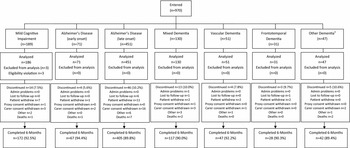
Of the 970 patients enrolled, data from 967 were analyzed; three patients with a diagnosis of MCI were excluded due to eligibility violations. Patient flow is presented in Figure 1. The most common diagnosis at baseline was AD (late onset) (46.5%), followed by MCI (19.5%). The “other” dementia group included 15 patients with dementia with Lewy bodies (DLB) and three further patients with a possible diagnosis of DLB. Of the 967 patients analyzed, 76 (7.9%) discontinued from the study before the six-month visit and an additional 13 (1.3%) patients died before six months. Patients who discontinued were similar on mean baseline characteristics to those who completed the six months with regards to sex and diagnosis, but were older and had worse baseline assessment scores compared with those who continued: baseline age (discontinuers 80 years (SD 6.5); completers 77 years (SD 7.5); p = 0.002), CDR score (discontinuers, 1.0 (SD 0.7); completers, 0.8 (SD 0.6); p = 0.006), MMSE score (discontinuers, 21.0 (SD 6.2); completers, 22.7 (SD 5.2); p = 0.003) and SMAF score (discontinuers, ‒20.6 (SD 12.9); completers, ‒15.6 (SD 11.0); p < 0.001).
Patient flow. aIncludes 15 patients with dementia with Lewy bodies disease (DLB) and 3 further patients with a possible diagnosis of DLB.

Baseline and change over six months
Patient characteristics
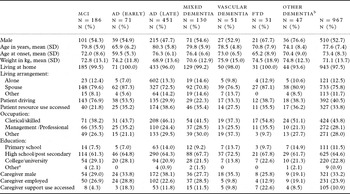
At baseline, the majority of patients in this study: were living at home; living with a spouse; had at least high school/post-secondary education; and did not access patient support resources. There was a higher proportion of males in all diagnostic groups, and higher rates of behavioral disturbance in patients with FTD (as determined by NPI baseline score), but no marked differences between diagnostic groups on any other baseline characteristic (Table 1 and 2). Dementia severity at baseline was mild on average (mean CDR score of 0.8). Overall, 280 (34%, n = 820) patients scored moderate or severe (below 21) on baseline MMSE score.
Baseline characteristics

aIncludes none and other. bIncludes 15 patients with dementia with Lewy bodies (DLB) and a further 3 patients with a possible diagnosis of DLB.
AD = Alzheimer's disease; FTD = frontotemporal dementia; MCI = mild cognitive impairment; SD = standard deviation.
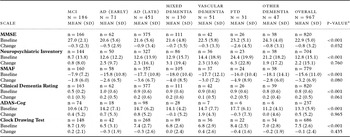
Baseline assessment scores and change at six months – completers only

aGroups compared by ANOVA. Results are for all patients who provided both baseline and month 6 scores (i.e. completers).
AD = Alzheimer's disease; SD = standard deviation; FTD, = frontotemporal dementia; MCI = mild cognitive impairment; MMSE = Mini-Mental State Examination; SMAF = Functional Autonomy Measurement System; ADAS-Cog = Alzheimer's Disease Assessment Scale – cognitive subscale.
At six months 15 patients had their baseline diagnosis changed. Ten patients who had MCI progressed to dementia: nine to AD and one to mixed dementia. One patient with VaD was rediagnosed at six months as having mixed dementia; one patient with mixed dementia was rediagnosed as “other”; three patients with AD (late onset) were rediagnosed, two as “other” and one as FTD. Rates of change over the six-month period, as measured by the MMSE (‒0.3 to ‒0.9), SMAF (‒1.8 to ‒4.0), and NPI (0.8 to 3.1) were generally similar for the different types of dementia, except for patients with FTD who had more marked changes (Table 2). Changes in ADAS-Cog, Clock Drawing Test and CDR were similarly small across all diagnostic groups.
Medication Use
Around a third of patients were on concomitant psychotropic medications at baseline (35.2%) and nearly two-thirds were on ChEIs (61.6%). There were significant differences in the use of psychotropic medications and ChEI use between diagnostic groups at baseline and at six months (see Figures S1 and S2 published as supplementary material online attached to the electronic version of this paper at http://www.journals.cambridge.org/ipg).
Concomitant psychotropic use remained relatively stable over the six months at about 34% for most diagnostic groups apart from the VaD group, which had a decrease in use from 43.1% at baseline to 34.0% at six months, and the FTD group, which had an increase in use from 67.7% to 78.6%. Memantine was prescribed at baseline and six months for patients in the AD, VaD and mixed dementia groups only; no patient with MCI was prescribed memantine at six months. Overall memantine use increased slightly from 4.6% at baseline to 5.3% at six months; this increase was accounted for by prescribing within the late AD group only.
At baseline ChEIs were prescribed for 61.6% of patients overall and 79.1% of patients with any form of AD. A high rate of use was observed in patients diagnosed with FTD (51.6%) (see Figure S3 published as supplementary material online attached to the electronic version of this paper at http://www.journals.cambridge.org/ipg). Study entry precluded enrolment of patients with MCI on ChEIs – the one (0.5%) patient who was on a ChEI at baseline was excluded as a protocol violation. There was no significant difference between males and females who continued ChEI use at baseline: 46.5% and 45.5% respectively; and, who started ChEI use at baseline: 13.9% and 17.5% respectively. Although overall ChEI use slightly decreased over the course of the 6‑months to 58.3%, an increase in use was observed in the (baseline) MCI and ‘other’ groups reflecting diagnosis reassignment.
Resource use
More patients with dementia used at least one resource at baseline (36.7%) and at six months (36.9%) compared with patients with MCI (baseline 21.5%, six months 15.7%). A significant difference was observed between diagnostic groups on resource use at baseline (p = 0.005) and six months (p < 0.001).
Predictors of decline
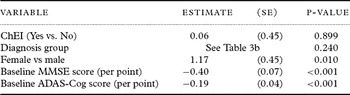
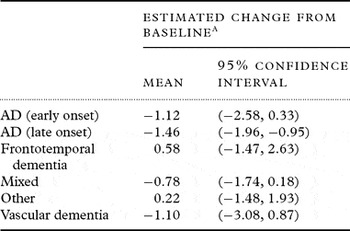
We examined the following predictors of decline using change in measures of cognition (MMSE) from baseline to six months for all patients with dementia (excluding MCI): ChEI use, age, age at onset, sex, institutionalization status at baseline, occupation, education level, living arrangement, diagnosis, driving status, psychotropic use at baseline, ADAS-Cog, CDR, MMSE and NPI scores at baseline. In a preliminary analysis, the interaction between diagnostic group and ChEI use was not significant (p = 0.304, results not shown); the interaction was excluded from the final model. Three covariates were found to be significantly associated with change in MMSE: sex (p = 0.010), baseline MMSE (p<0.001) and baseline ADAS-Cog scores (p<0.001, see Table 3a). Each additional point (worse) in ADAS-Cog score at baseline was associated with a 0.19 decrease (worse outcome) in MMSE at six months. Conversely, each additional point (better) in MMSE score at baseline was associated with a 0.4 point decrease (worse outcome) in MMSE at six months. Changes in MMSE scores were 1.17 points worse for males than for females. The estimated mean changes in MMSE for each diagnostic group (adjusting for all covariates) are shown in Table 3b. These estimated means were not significantly different (p = 0.240).
Change in MMSE from baseline to six months (ANCOVA without interaction): all dementia diagnostic groups excluding MCI

Other covariates were not significant (p > 0.10, data not shown): age, age at onset, occupation, education, living arrangements, driving status, psychotropic medication use, CDR score, and NPI score. Interaction between ChEI use and diagnosis group was excluded after being found not to be significant in a preliminary analysis (p = 0.304).
MMSE = Mini−Mental State Examination; ADAS-Cog = Alzheimer's Disease Assessment Scale – cognitive subscale; ANCOVA = analysis of covariance; SE = standard error; MCI = mild cognitive impairment; ChEI = cholinesterase inhibitor.
Estimated change in MMSE from baseline to six months, after controlling for other baseline covariates in ANCOVA model

aEstimated changes correspond to holding all covariates at their observed mean values (numerical covariates) or with their observed relative frequencies (categorical covariates).
MMSE = Mini-Mental State Examination; ANCOVA = analysis of covariance; AD = Alzheimer's disease.
No other baseline characteristic incorporated in the model (ChEI use, age, age at onset, AD vs VaD, FTD vs VaD, mixed vs VaD, “other” vs VaD, living arrangement, psychotropic use at baseline, CDR and NPI score at baseline) was associated with a significant change in MMSE score at six months (all p > 0.10, data not shown). When we repeated the analysis including patients with MCI, results were essentially similar except that age was now a predictor and being male no longer predicted greater decrease in MMSE at six months.
In a post-hoc analysis, the 111 patients who were taking antipsychotics at baseline had a lower mean MMSE than the 856 who were not (means and SDs respectively 19.84 ± 6.23 and 22.94 ± 5.07) and had a greater decline over six months (‒2.09 ± 4.05 and ‒0.60 ± 3.06; p < 0.001). These differences were slightly more apparent when MCI patients were excluded and more marked in the ten FTD patients taking antipsychotics compared to the 21 not taking antipsychotics (mean difference and SD over six months ‒5.80 ± 5.05 and ‒0.56 ± 2.61; p = 0.002)
Discussion
In this non-prescriptive naturalistic cohort study of patients attending Memory Disorders Clinics in Australia, we found patients had an overall slight worsening on all assessment scales over the six-month period. Mean baseline scores deteriorated by 0.8 on MMSE, 3.2 on SMAF and increased by 2.2 on NPI, 0.2 on CDR and 0.5 on ADAS-Cog. These changes are less than previously reported (Wilkinson et al., Reference Wilkinson, Francis, Schwam and Payne-Parrish2004; Musicco et al., Reference Musicco2009; Roselli et al., Reference Roselli2009) possibly reflecting this naturalistic setting. There was no apparent trend suggesting that one diagnostic group with dementia was more severely affected than another. However, patients with FTD had a greater decline cognitively as judged by the MMSE and tended to decline more functionally as judged by the SMAF. Patients with MCI scored more favorably on all assessments relative to other diagnostic groups.
We observed inconsistency between the proportion of females recruited into this study and the gender prevalence of the disease in Australia; 64% of patients in 2003 were female (AIHW, 2006), whereas females totaled 47% of this study population. This may be explained by the requirement to have carer consent as males are more likely to have a spouse carer than are females. It may also reflect the fact that women are more likely than men to seek assessment for medical illness and it is spouses rather than the people with dementia themselves who are more likely to instigate referral. A further inconsistency concerned the proportion of patients with DLB in this study (grouped with “other” for the purpose of analyses). Autopsy studies have shown DLB to be a more common form of dementia (15–20%) than we found (McKeith, Reference McKeith2002), which may represent a lack of differentiation of DLB from AD or Parkinson's disease by clinicians. However, overall, the proportion of patients in each diagnostic group was comparable, with the exception of higher prevalence of AD in this study, to that observed in a recent survey of memory clinics throughout Australia (Woodward and Woodward, Reference Woodward and Woodward2009) suggesting a diagnostically representative sample.
FTD differs from other forms of dementia, particularly on age of onset, yet it may be under- diagnosed since the clinical and cognitive symptoms often overlap with other forms of dementia (Woodward et al., Reference Woodward2010). Patients with FTD in this study were generally younger, younger at onset, more severely neuropsychiatrically impaired (as measured by the NPI score) and more likely to be using psychotropics compared with patients with other forms of dementia. Over the six months, patients with FTD had a greater decline in MMSE, NPI and SMAF score compared with other diagnostic groups. This finding is consistent with recent studies that showed this subset of patients have a more accelerated decline in overall MMSE score over a nine-month (Chow et al., Reference Chow, Hynan and Liptonde2006) and 12-month period compared with patients with AD (Rascovsky et al., Reference Rascovsky2005).
Change over six months in the use of ChEIs was examined as these agents are recommended as pharmacological intervention for cognitive and other symptoms of AD (AIHW, 2006). Some 20% of patients with any form of AD in this study were not on a ChEI at baseline, increasing to 27% at six months. This is very similar to that reported from the Canadian Outcomes Study in Dementia (COSID) (Sambrook et al., Reference Sambrook2004) where just under 17% of patients with AD were not on a ChEI at baseline, rising to 27% at six months. As ChEIs are considered first-line pharmacotherapy for mild to moderate AD (Burns et al., Reference Burns2006), the lack of use in this patient subset may be due to a mixture of reasons including intolerance, recent discontinuation or contra-indications. The uptake of ChEIs in Australia for the improvement of cognitive function increased by 39% from 2002 (226,456 prescriptions) to 2005 (315,020 prescriptions) and is predicted to continue (AIHW, 2006). In the year 2008/2009, over 386,000 prescriptions were subsidized by the Australia government for three ChEI treatments and memantine for the treatment of AD (AIHW, 2010). Some patients with moderately severe AD may have been prescribed memantine instead of a ChEI as this treatment was approved for reimbursement as monotherapy in a small group of patients (MMSE 10–14) in Australia in July 2008, i.e. during the conduct of this study (National Prescribing Service, 2008). We were surprised by the high use of ChEIs in over 50% of patients with diagnosed FTD despite this being outside prescribing regulations. This may have reflected diagnostic uncertainty or a “last try” therapeutic approach.
Although ChEI use decreased slightly over the six-month period for most diagnostic groups, an increase in use was observed for patients with MCI or “other” dementia. ChEI use in the MCI group was prohibited by our protocol at baseline, but its use increased at six months to 10.5% (18 patients). Of the 18 MCI patients prescribed a ChEI, the diagnoses for eight MCI patients had been changed to AD. Reasons for prescribing ChEIs for the remaining ten patients whose MCI diagnosis at six months was unchanged were unclear. MCI is only a risk factor for dementia and there is insufficient published pharmacological evidence to support the use of these agents in delaying progression to dementia (Winblad et al., Reference Winblad2004).
Diagnoses of dementia remained stable over six months with only 5 of 781 patients (0.64%) having their diagnosis changed. Despite the mild nature of dementia, a third of patients overall and two-thirds of patients with FTD were taking psychotropics and just over a third overall were accessing some sort of assistance, both of which remained relatively stable over the six-month period. One exception was the increased use of psychotropics at six months in the FTD group.
We examined multiple prognostic factors to predict decline over the six-month period and found the following predictors to be associated with cognitive decline: higher baseline MMSE and ADAS-Cog scores and male sex. It seems inconsistent with reported data that a 1-point (better) increase in baseline MMSE score was found to be associated with a 0.4 decrease (worsening) at six months. Baseline MMSE has been shown to have no impact on disease progression (Musicco et al., Reference Musicco2009). Moreover, six months is a relatively short time-frame to determine these predictors of disease progression, and we may find with longer follow-up the effects of previously reported predictors will become apparent. Also, a floor effect cannot be ruled out as an influencing factor since the worst patients (those at the low end of the MMSE score) had less room to decline over the six-month period. The converse finding with ADAS-Cog scores probably reflects differences in samples examined and highlight the need to regard these findings with caution. We confirmed a previously noted association between antipsychotic use and greater cognitive decline in patients with dementia (McShane et al., Reference McShane, Keene and Gedling1997) but our data do not allow us to discern whether this is causal.
Being female was associated with a significantly greater MMSE improvement at six months (improved score of 1.17). However, previous study results have noted no apparent sex difference (Musicco et al., Reference Musicco2009; Wilson et al., Reference Wilson2010). While sample bias may be one explanation, we found no difference between the proportions of females and males continuing on ChEIs at baseline assessment. Longer-term findings may be more revealing.
There are inherent limitations to any observational study. A convenience sample of patients was used in this study and no data were gathered on all patients in the memory clinics to see if they were representative of the general population attending memory clinics throughout Australia. However, patients were recruited from four of the eight states/territories in Australia, which provides a large geographical representation of the identified specialized memory clinics available in Australia (Woodward and Woodward, Reference Woodward and Woodward2009). Potential sampling bias is also a concern; we had more males, which is unusual in dementia studies, a high proportion of AD and FTD patients were on a ChEI at baseline, and the majority were living with a spouse. These factors may have influenced physicians to enroll patients whom they felt were more likely to participate in the study. That said, previous studies have reported similar patient baseline characteristics (Sambrook et al., Reference Sambrook2004; Musicco et al., Reference Musicco2009). Furthermore, we found patients who discontinued before six months were older and had a more severe condition (as judged by baseline score) compared to those who continued, which may have affected our findings. To mitigate potential analysis confounders we adjusted for a number of baseline factors when looking at change from baseline in MMSE score.
Identifying factors to predict decline in dementia and MCI is becoming increasingly important as the population ages. Recognizing these factors and the differences in rate of change between diagnostic groups will allow clinicians greater insight and ability to manage both patients and caregivers. The monitoring of the PRIME database will continue and subsequent changes over a longer period will be examined to provide generalizable data from this Australian cohort study.
Conflict of interest declaration
David Ames is former Editor-in-Chief of International Psychogeriatrics. All authors have received remuneration for services on advisory boards, and/or support to attend conferences, honoraria for consultancies or lectures, and/or for research projects from Janssen-Cilag and other companies marketing or developing treatments for dementia.
This study was supported by Janssen-Cilag Pty Ltd Australia. Statistical analysis was performed by Syreon Corporation and funded by Janssen-Cilag.
Description of authors' roles
All authors contributed to the conception and design of this study, provided interpretation of data, revised the paper for important intellectual content, and gave their approval of the final version. The sponsor gave approval of the study design and final version of the paper.
Acknowledgments
We thank all the Australian investigators, study nurses, staff and hospitals who comprise the PRIME study group: Prince of Wales Hospital (Marika Donkin, Kim Burns, Katrin Seeher); The Queen Elizabeth Hospital (Shelley Casey, Trish Steventon); St George's Hospital (Maree Mastwyk, Alissa Westphal, Nicola Lautenschlager, Olga Yastrubetskaya, Marilyn Kemp, Edmond Chiu and Jennifer Ames); Austin Health Repatriation Hospital (Irene Tan, Henry Zeimer, Leonie Johnston); Hornsby Ku-Ring-Gai Hospital (Sue Kurrle, Roseanne Hogarth, Judith Allan); Fremantle Hospital (Roger Clarnette, Janice Guy, Denae Clark); The Prince Charles Hospital (Chris Davis, Mary Wyatt, Katrina Brosnan, Margaret Morton); Rankin Park Hospital (John Ward, Jeanette Gatgens); Geelong Private Hospital (Alastair Mander, Bernadine Charles).
Our thanks also to Andrea Malcolm, Medical Communications, Janssen-Cilag Pty Ltd who provided medical writing assistance during the preparation of this paper, and to Nadia Lesnikova, Syreon Corporation who conducted statistical analyses.