Introduction
Delusional disorder (DD) was originally described in the 19th century by Kraepelin (Reference Kraepelin1915) as a distinct illness with well-systematized delusions that were not bizarre, which he termed paranoia. Winokur (Reference Winokur1977) further defined the characteristics of DD as prominent non-bizarre delusions in the absence of any accompanying hallucinations. The term ‘delusional disorder’ has since been introduced into diagnostic classification systems including DSM-III-R and DSM-IV, and under the term persistent delusional disorder in ICD-10. Recently, DSM-V removed the requirement of non-bizarre delusions in its definition of DD, instead adding a delusion bizarre-type specifier to provide continuity with DSM-IV. Previous research, which mainly focused on examining the profile of DD, found those with DD were more likely to be female and married, have little occupational impairment, and high co-morbidity (Munro & Mok, Reference Munro and Mok1995; Yamada et al. Reference Yamada, Nakajima and Noguchi1998; Grover et al. Reference Grover, Biswas and Avasthi2007). However, only a few systematic studies have examined if DD has a distinct aetiology separate from other psychoses and affective disorders (Kendler, Reference Kendler1982; Marneros et al. Reference Marneros, Pillmann and Wustmann2012). The lack of studies could be due to low DD prevalence, and features of the disorder such as high functioning and lack of insight might limit the ascertainment of an adequate sample size (Ibanez-Casas & Cervilla, Reference Ibanez-Casas and Cervilla2012). The well-known review of 17 studies by Kendler (Reference Kendler1982) suggested DD was distinct from paranoid psychosis as it was associated with an older age of onset, shorter hospitalization, being native-born and socially disadvantaged, as well as being female and married as mentioned above. However, these studies were conducted before the introduction of standardized diagnostic criteria. Later studies that used DSM-III (Fabrega et al. Reference Fabrega, Ahn and Mezzich1992) and ICD-10 classifications (Jager et al. Reference Jager, Bottlender, Strauss and Moller2003) reported similar findings for the characteristics of DD, except they found there was better social functioning. These findings suggest the possibility that DD could be differentiated from schizophrenia (SZ).
In the three decades following Kendler's review, there has only been one large recent comparative longitudinal follow-up study on a cohort of 43 DD patients and 42 paranoid SZ patients. This study concluded each disorder was an independent and separate entity that exhibited significantly dissimilar symptoms, course, and outcome (Marneros et al. Reference Marneros, Pillmann and Wustmann2012). In addition to demographic differences, they found DD was less likely to be influenced by genetics but more likely to be influenced by environmental factors. At the 12.9-year follow-up, DD patients had better social and functional outcomes than the SZ patients (Marneros et al. Reference Marneros, Pillmann and Wustmann2012). Although the two patient groups were recruited from the same hospital during the same period, the paranoid SZ cohort was recruited from another study that looked at acute and transient psychotic disorders, which could have introduced bias into the sample in regards to a higher proportion of females and a slightly later onset of the disorder. Furthermore, the studies by Marneros et al (Reference Marneros, Pillmann and Wustmann2012) and Jager et al (Reference Jager, Bottlender, Strauss and Moller2003) recruited only inpatient participants, which may not have been representative samples. Kendler (Reference Kendler1982) questioned whether the accuracy of the hospital admission data represented the true occurrence of DD in the population. Age matching is important because age is a prognostic factor in SZ (Malla et al. Reference Malla, Norman, Schmitz, Manchanda, Béchard-Evans, Takhar and Haricharan2006; Crumlish et al. Reference Crumlish, Whitty, Clarke, Browne, Kamali, Gervin, McTique, Kinsella, Waddington, Larkin and O'Callaghan2009). Studies that do not properly match for age may introduce bias, for example, older DD patients had better functioning than the younger SZ patients. In addition, most previous research on DD was limited to sociodemographics, functioning, and clinical parameters, ignoring neurocognitive aspects. Two studies that looked at neurocognitive functioning did not find any significant differences between age-matched DD and SZ patients, but one study only included males and both had small sample sizes (Evans et al. Reference Evans, Paulsen, Harris, Heaton and Jeste1996; Lapcin et al. Reference Lapcin, Guler, Ceylan, Maner, Ger and Satmis2008a , Reference Lapcin, Guler, Maner, Ceylan, Keskinkilic, Satmis and Ergen b ). Therefore, more studies are needed to determine if DD is distinct from SZ or whether a broader concept of SZ spectrum disorders is warranted.
This study aimed to compare sociodemographics, family history, illness presentation, symptoms, functioning, and neurocognitive variables among a consecutive cohort of 71 pairs of age-matched DD and SZ patients. The participants were consecutively recruited from a population-based territory-wide study of early psychosis in Hong Kong, which targeted adult inpatients and outpatients with first-episode psychosis. The diagnosis was performed using the diagnostic criteria of DSM-IV for more accurate prognostic information.
Method
Participants
Participants were consecutively recruited between June 2009 and August 2011 from a population-based territory-wide study of early psychosis in Hong Kong targeting first-episode patients [the Jockey Club Early Psychosis (JCEP) Project; Hui et al. Reference Hui, Chang, Chan, Lee, Tam, Lai, Wong, Tang, Li, Leung, McGhee, Sham and Chen2014]. Participants were drawn from adult-onset psychosis patients aged ⩾26 years, which meant adolescent-onset SZ cases were precluded from the study. Patients identified by their case medical officers at outpatient psychiatric units were screened for study eligibility. The original consecutive cohort included 157 SZ patients and 72 DD patients. Concurrent with the literature, DD had a significantly older age of onset (39.6 years) than the SZ (35.4 years). To compare between the two groups, participants were age-matched, which gave us a final sample size of 71 DD patients (mean age 41.8 years) and 71 SZ patients (mean age 40.8 years).
Inclusion criteria were age between 26 and 55 years, Cantonese-speaking Chinese, and diagnosed with first-episode SZ or DD according to DSM-IV criteria (APA, 1994). Exclusion criteria were organic brain conditions, substance-induced psychosis, a known history of intellectual disability, or at serious risk of suicide/violence. Written informed consent was obtained from all patients. The study was approved by the Institutional Review Boards at each study site. The study was conducted in accordance with Good Clinical Practice and the Declaration of Helsinki.
Assessments
The data were systematically collected through a face-to-face interview with each patient by trained research assistants. Basic demographic information including age, gender, years of education, body mass index, place of birth, smoking status, marital status, living situation, and employment status were recorded. Diagnosis was assessed according to DSM-IV criteria (APA, 1994). Diagnosis of SZ or DD for each subject was confirmed at 6 months following the first episode by two experienced psychiatrists based on a best-estimate consensus (Leckman et al. Reference Leckman, Sholomskas, Thompson, Belanger and Weissman1982) using all available information, including the validated Chinese version of the Structured Clinical Interview for DSM-IV (So et al. Reference So, Kam, Leung, Chung, Liu and Fong2003), medical records, history from informants, and case workers of JCEP.
The items concerning premorbid functioning during childhood, adolescence, and adulthood were evaluated using the Premorbid Adjustment scale (PAS; Cannon-Spoor et al. Reference Cannon-Spoor, Potkin and Wyatt1982). The score in each PAS subscale was expressed as the sum of the obtained scores divided by sum of the maximum scores of the rated items that were applicable to the participant. The overall PAS score was the average of all subscale scores (ranging from 0 to 1; higher numbers represented poorer levels of functioning). Premorbid schizoid and schizotypal traits, including affect, suspiciousness, antisocial behaviour, asocial behaviour, and other abnormalities, were assessed by the Assessment of Premorbid Schizoid and Schizotypal Traits (PSST; Foerster et al. Reference Foerster, Lewis, Owen and Murray1991). The number of stressful life events in the prior 6 months was recorded by the List of Threatening Experiences, a 12-item questionnaire (Brugha et al. Reference Brugha, Bebbington, Tennant and Hurry1985).
Duration of untreated psychosis (DUP) was defined as the interval between onset of positive psychotic symptoms and first contact with any psychiatric service. This was assessed using the Interview for the Retrospective Assessment of the Onset of Schizophrenia (IRAOS; Häfner et al. Reference Häfner, Riecher-Rössler, Hambrecht, Maurer, Meissner, Schmidtke, Fatkenheuer, Loffler and an der Heiden1992), which is a standardized, semi-structured interview conducted on patients and their close relatives within 4 months following the first episode. A review of the case notes was also conducted as collateral information to minimize recall bias. The onset of psychosis referred to the presence of one or more psychotic symptoms of delusion, hallucination, disorganization of speech or behaviour. Mode of onset of the psychotic disorder was classified into three groups: acute (⩽1 month), sub-acute (⩽3 months), or insidious (>3 months). The presence or absence of a family history of SZ (including definite and probable SZ in either first- or second-degree relatives) and family history of other mental illnesses (including mood disorders, non-affective and affective psychoses) were recorded.
Patients’ help-seeking behaviour since onset of psychotic symptoms was assessed by a research assistant using a retrospective semi-structured pathways-to-care in psychosis (Hui et al. Reference Hui, Tang, Wong, Chang, Chan, Lee and Chen2013) questionnaire. The help sought included formal support [e.g. general practitioner (GP), social worker, counsellor], informal support (e.g. family members, friends, priest), and the last psychiatric consultation leading to an effective treatment. The research assistants were trained by a psychiatrist who had participated in a cross-national study on the International Pilot Study of the Onset of Psychosis (IPSOS) in 2005, which used the same scale. The overall waiting time (days) was the time between onset of psychotic symptoms and the first help-seeking action. The overall help-seeking duration (days) was the time from the first help-seeking action to receiving effective psychiatric treatment. The total number of help-seeking actions during the overall help-seeking period was recorded. The help-seeking delay (days) was the time between the appearance of psychotic symptoms and first contact with any health-related service. The system delay (days) was the time from the first contact with any health-related service to receiving effective psychiatric treatment.
Clinical characteristics of the age of onset, mode of onset, psychiatric hospitalization at entry, overall co-morbidity, and existing medical illness were evaluated. Positive and negative symptoms were assessed using the Positive and Negative Syndrome Scale (PANSS; Kay et al. Reference Kay, Fiszbein and Opler1987), the Scale for the Assessment of Positive Symptoms (SAPS; Andreasen, Reference Andreasen1984), and the Scale for the Assessment of Negative Symptoms (SANS; Andreasen, Reference Andreasen1983). Insight was assessed using item G12 of the PANSS.
Functioning level was assessed using the Social Occupational Functioning Assessment Scale (SOFAS) and the Role Functioning Scale (RFS; Goldman et al. Reference Goldman, Skodol and Lave1992; Goodman et al. Reference Goodman, Sewell, Cooley and Leavitt1993). SOFAS assessed the overall social and occupational functioning of an individual on a continuum (from 100 = excellent to 1 = grossly impaired). RFS assessed the role functioning of an individual on a 7-point scale in four specific aspects: work productivity, independent living and self-care, immediate social network relationship, and extended social network relationship.
Neurocognitive functioning was assessed using a comprehensive battery of neurocognitive tests. Verbal and performance intelligence was measured using an adapted version of the Wechsler Adult Intelligence Scale – Revised (WAIS-R; Wechsler, Reference Wechsler1981, Reference Wechsler1987) for Cantonese-speaking participants (Hong Kong Psychological Society, 1989). Verbal intelligence was measured using the Information, Arithmetic, and Digit Span (forward and backward) subtests, and performance intelligence was measured using the Digit Symbol subtest. Short-term (immediate recall) and long-term (30-min delayed recall) verbal memory was measured using the Logical Memory test. Semantic memory was measured with the Verbal Fluency test, in which participants were asked to name as many items as possible in an animal category in 1 min. Short-term visual memory was assessed using the Visual Patterns test.
Statistical analysis
All statistical analyses were performed using IBM SPSS version 20.0 (IBM Corp., USA). Differences in the basic demographic, clinical, functional and neurocognitive characteristics were determined using independent t test for parametric continuous variables, χ2 test for categorical variables, and Mann–Whitney U test for non-parametric continuous variables. The level of statistical significance for all analyses was set at p < 0.05. To handle the problem of multiple testing, the false discovery rate (FDR) at a threshold of q < 0.05 was computed for the significant results.
Results
A total of 71 DD patients (mean age 41.8 years) age-matched with 71 SZ patients (mean age 40.8 years) were recruited into the study. Based on DSM-IV criteria, persecutory delusions (78%) were the most frequently occurring delusions in the DD population, followed by delusional jealousy (13%), somatic delusions (5%), mixed delusions (3%), and unspecified (1%).
Basic demographic and socioeconomic variables
No differences in gender distribution, years of education, immigration from mainland China, and family history of SZ were found between DD and SZ patients (Table 1). Although no differences were found in the monthly household and personal income, more DD patients lived in public rental housing compared to private permanent housing. In addition, more DD patients were married. These findings were also significant at an FDR threshold of q < 0.05 (3.7% for marital status and type of housing).
Basic demographic and socioeconomic variables

N, Number; s.d., standard deviation; n.s., not significant; DD, delusional disorder; SZ, schizophrenia; HK$, Hong Kong dollar (HK$1=US$7.8).
a Public housing refers to public rental housing, subsidized sale flat, temporary housing and others.
Premorbid, onset pattern and help-seeking behaviour
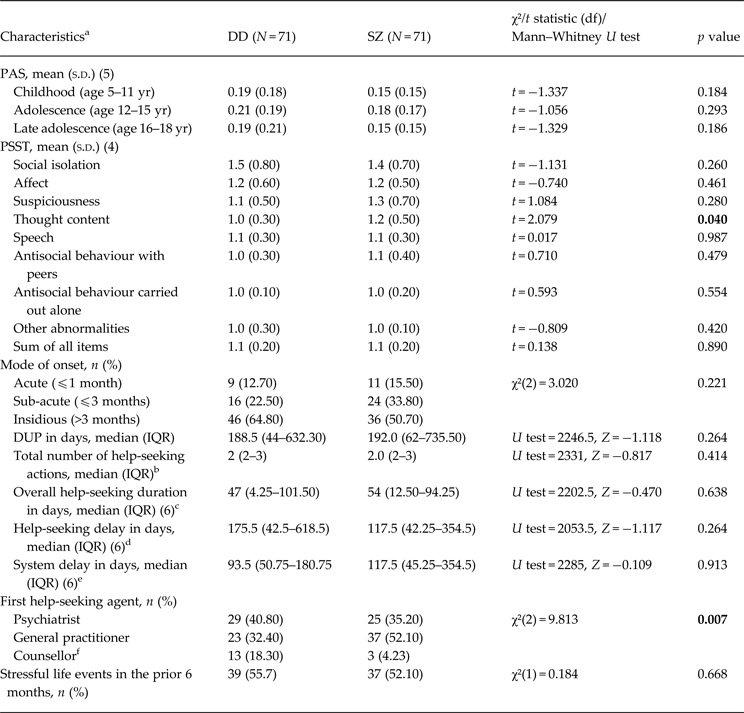
Compared to SZ patients, DD patients had significantly less premorbid schizoid and schizotypal traits, particularly relating to thought content and beliefs. However, no differences were observed in premorbid functioning at childhood, adolescence, and late adolescence (Table 2). In the first help-seeking action, we found that fewer DD patients had approached a GP and more of them had approached counsellors. Furthermore, compared with first help seeking with either GP or mental health worker (including psychiatrist, clinical psychologist, counsellor, priest) between the two diagnostic groups, there was significantly more SZ patients having an initial contact with a GP [57% v. 35%; χ2(1) = 6.067, p = 0.014].
Premorbid and help-seeking characteristics

N, Number; s.d., standard deviation; IQR, interquartile range; n.s., not significant; DD, delusional disorder; SZ, schizophrenia; PAS, Premorbid Adjustment Scale; PSST, Assessment of Premorbid Schizoid and Schizotypal Traits; DUP, duration of untreated psychosis.
a Number of missing observations in parentheses.
b The total number of help-seeking actions during the overall help-seeking period.
c Overall help-seeking duration (days) was the time from the first help-seeking action to receiving effective psychiatric treatment.
d Help-seeking delay (days) was the time between the appearance of psychotic symptoms and first contact with any health-related service.
e System delay (days) was the time from the first contact with any health-related service to receiving effective psychiatric treatment.
f Counsellor refers to clinical psychologist, counsellor or religious priest.
There were no differences in DUP between the two groups, with both taking a median of 6 months to approach psychiatric services after psychotic symptoms first appeared. There were also no differences regarding the mode of illness onset or the presence of precipitating stressful life events in the 6 months preceding onset (Table 2).
Clinical characteristics
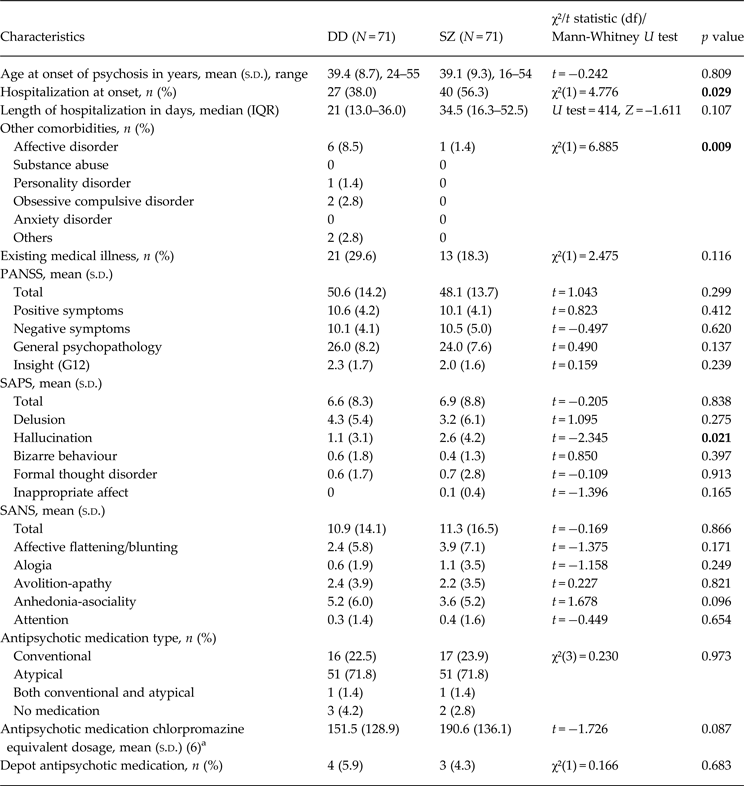
DD patients were 1.5 times less likely to be hospitalized at presentation compared to SZ patients, although durations of the hospitalization were comparable between the two groups (Table 3). DD patients also had more co-morbidity, particularly affective disorder. There were no differences in any of the psychopathology ratings, although DD patients had lower SAPS hallucination subscores as expected. There were no differences regarding the type, dosage, route and compliance of antipsychotic medication between the two groups.
Clinical characteristics

N, Number; s.d., standard deviation; IQR, interquartile range; n.s., not significant; DD delusional disorder; SZ, schizophrenia; PANSS, Positive and Negative Syndrome Scale; SAPS, Scale for Assessment of Positive Symptoms; SANS, Scale for Assessment of Negative Symptoms.
a Number of missing observations in parentheses.
Functional and neurocognitive characteristics
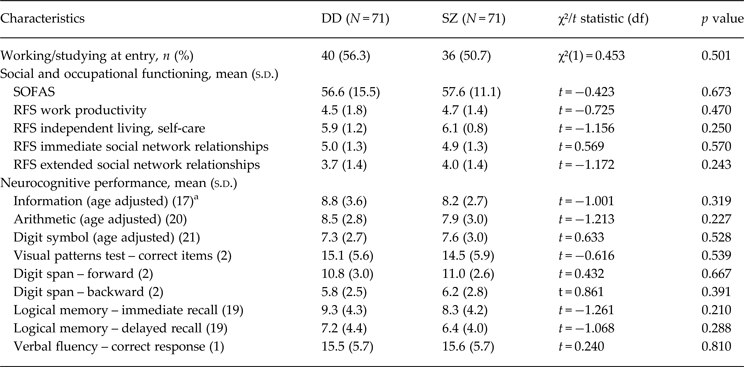
There were no differences in the occupational status, social and occupational functioning, and neurocognitive performance level between DD and SZ patients (Table 4).
Functioning and neurocognitive performance

N, Number; s.d., standard deviation; n.s., not significant; DD, delusional disorder; SZ, schizophrenia; SOFAS, Social Occupational Functioning Assessment Scale; RFS, Role Functioning Scale.
a Number of missing observations in parentheses.
Discussion
To date, this is the largest cross-sectional study comparing 71 age-matched pairs of DD and SZ patients diagnosed using DSM-IV diagnostic criteria. Our data suggest that DD patients had less premorbid schizoid and schizotypal traits compared to SZ patients. However, at first episode, no significant preclinical, symptomatic, treatment, functioning, or neurocognitive markers were found between the two groups. In line with the NIMH Research Domain Criteria (RDoC) initiative in using psychiatric taxonomies to describe psychopathology on a spectrum rather than traditional diagnostic categories (Insel et al. Reference Insel, Cuthbert, Garvey, Heinssen, Pine, Quinn, Sanislow and Wang2010), the findings from our study provide an updated perspective on the conceptualization of the clinical differences between DD and SZ, as well as expanding the descriptive accounts of the two disorders to include a neurocognitive dimension.
The study was designed to have several distinctive strengths that were particularly relevant for the current exploration. First, our DD patient sample were outpatients, which was a more representative sample than the inpatient samples used in previous studies (Jager et al. Reference Jager, Bottlender, Strauss and Moller2003; Marneros et al. Reference Marneros, Pillmann and Wustmann2012) who were often clinically more severe. Second, the DD and SZ cohorts were age-matched, which reduces the confounding effects of age on the psychoses outcome (Malla et al. Reference Malla, Norman, Schmitz, Manchanda, Béchard-Evans, Takhar and Haricharan2006; Crumlish et al. Reference Crumlish, Whitty, Clarke, Browne, Kamali, Gervin, McTique, Kinsella, Waddington, Larkin and O'Callaghan2009). Third, larger DD samples are needed for a more rigorous study, but the rarity and features of the disorder makes ascertaining a sufficient sample size difficult (Marneros et al. Reference Marneros, Pillmann and Wustmann2012). The large cohort in our study were consecutively recruited from first-episode patients from outpatient psychiatric clinics in Hong Kong, which had sufficient power to detect differences between DD and SZ. We also used modern definitions and diagnostic criteria from DSM-IV, and we included pathways-to-care and neurocognition parameters in our comprehensive measurements, as well as basic demographics, symptoms and functioning. Fourth, the diagnosis of first-episode psychosis is susceptible to change over time (Opjordsmoen, Reference Opjordsmoen2014). The current diagnoses of DD and SZ were made by two psychiatrists based on all available sources of information during the first 6 months of the illness to ensure diagnostic accuracy.
Premorbid functioning
Compared to DD patients, we found that SZ patients had significantly more schizoid and schizotypal traits during the premorbid period, particularly thought content and ideas. In other words, DD patients had less long-standing premorbid personality trait dysfunctions in the years prior to onset. Compatible with previous findings (Kendler, Reference Kendler1982; Fabrega et al. Reference Fabrega, Ahn and Mezzich1992; Jager et al. Reference Jager, Bottlender, Strauss and Moller2003), we found twice as many DD patients were married compared to age-matched SZ patients, suggesting DD patients had less deterioration of social, intimate, and established relationships before illness onset. Past studies found that DD patients had higher socioeconomic status (Fabrega et al. Reference Fabrega, Ahn and Mezzich1992), but our findings and those of Jager et al. (Reference Jager, Bottlender, Strauss and Moller2003) showed no differences between DD and SZ patients regarding their financial situations. Contrary to Kendler's review (Reference Kendler1982) that found DD patients were more socially disadvantaged than SZ patients, we observed more DD patients were living in public rental housing, which could be because more DD patients were married and lived away from their parents compared to their SZ counterparts.
DUP and help seeking
Although there were differences during the premorbid period between the two disorders, as the illness developed, there were no apparent differences in the DUP, mode of onset, and help-seeking actions between both groups. Compared with SZ, it was believed that DD patients would have a longer delay to treatment because of the more understandable nature of delusion, which would lead to difficulty in seeking mental health services (Ibanez-Casas & Cervilla, Reference Ibanez-Casas and Cervilla2012). The absence of a difference in DUP between the two groups could be due to improved early detection and intervention in Hong Kong since 2001. These intervention programmes aim to increase the public awareness of psychoses and allow easier access to local mental health services through self-referral and direct service contact. Similarly, no differences were observed in the total number of help-seeking actions or the median duration of the help-seeking delay before receiving effective psychiatric treatment. This could be related to a great variability in each of these parameters across the two groups, suggesting there may not be a uniform pattern of pathways to care for either disorder.
Although DD patients were less likely to approach a GP during their first help-seeking action, they were more likely to seek help from a social worker. The number of SZ patients whose first help-seeking contact was with a GP was nearly double that of DD patients, which suggests GPs could more easily identify SZ patients as needing treatment than DD patients who would by definition have intact personality and social functioning.
Symptomatology and treatment
As expected, DD patients had fewer hallucination compared to SZ patients (Marneros et al. Reference Marneros, Pillmann and Wustmann2012). However, there were no significant differences in negative symptoms between the two groups. Other studies showed DD patients had less severe anxiety and negative symptoms such as flat affect and alogia (Jager et al. Reference Jager, Bottlender, Strauss and Moller2003; Marneros et al. Reference Marneros, Pillmann and Wustmann2012), but these studies included only inpatients who might have more severe symptoms, particularly in the SZ cohort leading to more prominent differences between groups, which might explain the inconsistency between our findings.
In agreement with the study by Marneros et al (Reference Marneros, Pillmann and Wustmann2012), we found a significantly lower rate of hospital admissions in the DD sample. However, the period of the hospital stay during the first episode was similar in our two groups. By contrast, other studies found the hospital stay was longer in SZ patients (Marneros et al. Reference Marneros, Pillmann and Wustmann2012). We did not explore the reasons for hospital admissions, but it was suggested in the study by Marneros et al. (2012) that most DD patients were admitted due to social reasons. There were no differences in the type, dosage, and route of the prescribed antipsychotic medications between DD and SZ patients.
Functioning and neurocognition
Using a comprehensive set of neurocognitive batteries, we found similar neurocognitive functioning, including executive functions, semantic, short-term, and long-term working memory, in DD and SZ patients during the first episode. By contrast, past studies suggested that DD had better overall functioning during first admission, at discharge (Jager et al. Reference Jager, Bottlender, Strauss and Moller2003), and at the 12-year long-term follow-up (Marneros et al. Reference Marneros, Pillmann and Wustmann2012). However, the participants in these studies were not age-matched, which could introduce bias because older age of onset was suggested to be a good prognostic factor in SZ (Malla et al. Reference Malla, Norman, Schmitz, Manchanda, Béchard-Evans, Takhar and Haricharan2006; Crumlish et al. Reference Crumlish, Whitty, Clarke, Browne, Kamali, Gervin, McTique, Kinsella, Waddington, Larkin and O'Callaghan2009). Although our findings provide new evidence challenging the previous finding that DD patients have better functioning than SZ patients, it should be interpreted in light of our age-matched cohort, which minimized the potential confounding effects of age on functioning but also leads to difficulty in making generalizations about individuals with SZ in the larger population.
To our knowledge, only two previous studies have compared the neurocognitive functioning between DD and SZ patients (Evans et al. Reference Evans, Paulsen, Harris, Heaton and Jeste1996; Lapcin et al. Reference Lapcin, Guler, Ceylan, Maner, Ger and Satmis2008a , Reference Lapcin, Guler, Maner, Ceylan, Keskinkilic, Satmis and Ergen b ). In the study by Evans et al. (Reference Evans, Paulsen, Harris, Heaton and Jeste1996), they matched 14 DD and 50 SZ patients with age and age of onset, but found no significant differences in regards to attention, verbal and motor skills, psychomotricity, memory, abstract thinking, and flexibility. The studies by Lapcin et al. (Reference Lapcin, Guler, Ceylan, Maner, Ger and Satmis2008a , Reference Lapcin, Guler, Maner, Ceylan, Keskinkilic, Satmis and Ergen b ), compared 37 DD patients with 31 paranoid SZ patients, 31 non-paranoid SZ patients, and 34 controls, matched by age and years of education. They found no differences between DD and paranoid SZ patients in regards to verbal and sustained attention, verbal learning, and memory, but they observed significant differences for verbal memory between DD and non-paranoid SZ patients (Lapcin et al. Reference Lapcin, Guler, Maner, Ceylan, Keskinkilic, Satmis and Ergen2008b ). However, the study by Evans et al. (1996) had only 14 DD cases and the study by Lapcin et al. (Reference Lapcin, Guler, Maner, Ceylan, Keskinkilic, Satmis and Ergen2008a, b ) included only male participants, whereas our study had a larger sample size that included both males and females.
Furthermore, our cohort was drawn from adult-onset psychosis patients and contained later onset SZ patients who are thought to have better outcomes and would have better compensation for symptoms prior to treatment. Onset of psychotic symptoms during adolescence has more far-reaching detrimental effects on social and work functioning than later onset psychosis, because adult patients would presumably have established careers and social networks (Jeste et al. Reference Jeste, Harris, Krull, Kuck, McAdams and Heaton1995). Such characteristics among the late-onset SZ sample may be associated with better occupational functioning and neurocognitive performance, which might explain the minimal differences between the groups. Nevertheless, these findings suggest factors independent of diagnosis relating to later onset of these two psychotic disorders may in some way protect against occupational and cognitive functioning.
Lastly, DD has been proposed to be distinct from SZ based on the findings that DD was precipitated more by stress (psychologically), whereas SZ was more trait related and was more associated with having a family history of psychotic disorders (Marneros et al. Reference Marneros, Pillmann and Wustmann2012). However, a similar proportion of stressful life events preceding onset (Marneros et al. Reference Marneros, Pillmann and Wustmann2012), at 6 months prior to onset (Marneros et al. Reference Marneros, Pillmann and Wustmann2012), or prior to hospitalization (Jager et al. Reference Jager, Bottlender, Strauss and Moller2003) have been reported in DD and SZ patients. Concurrently, our data also did not support this theory, and we found neither family history of SZ nor the number of stressful life events 6 months prior to the first episode was significant.
Limitations and implications
Our consecutive sample demonstrated that DD was not uncommon in Hong Kong, but the ratio of DD to SZ in the parent study was approximately 1:2, which was much higher than in Western samples. Our cohort was recruited from adult-onset psychosis patients aged ⩾26 years resulting in more DD (mostly late onset) and fewer SZ (mostly early onset) cases. Furthermore, over 80% of the Hong Kong population live with others, a phenomenon not observed in Western samples. We found over half of all first help-seeking actions were initiated by family members (Hui et al. Reference Hui, Tang, Wong, Chang, Chan, Lee and Chen2013). It was postulated that more individuals with DD would seek help, which could account for the DD:SZ ratio.
Patients at serious risk of suicide/violence were excluded from the study, which may mean more severe SZ cases were excluded resulting in a higher DD:SZ ratio. However, the proportion of patients with a history of serious suicide was small, which would have a minimal influence on the number of SZ cases. Patients at serious risk of suicide or violence would normally be given priority treatment with follow-up care under the local mental health system. They were excluded from the parent study so as not to compromise the patients’ safety and treatment.
The age-matching of SZ patients to DD patients has several pros and cons. As younger age was found to be associated with poor prognosis in SZ, one would expect to see DD patients (who are usually older) would have better occupational and cognitive functioning than SZ patients (who are usually younger) if age was not matched. We further analysed a group of SZ cases not age-matched with the DD sample. Similar to previous studies, we found more DD patients were in full-time work/studies [χ2(1) = 7.023, p = 0.008] than SZ patients, clearly showing the effect of age on outcome. Although potential confounding factors of age on functioning and the neurocognitive variables were controlled, a direct comparison between the age at study entry and age of onset was not possible because DD and SZ patients were age-matched. We may not be able to make generalizations about SZ in the larger population because over half of the original SZ cases were not included and the original sample consisted of only adult-onset psychosis patients. A further analysis on our data found that cognitive functioning was not significantly different in both non-matched and matched DD and SZ groups, which is in line with former reports (Evans et al. Reference Evans, Paulsen, Harris, Heaton and Jeste1996; Lapcin et al. Reference Lapcin, Guler, Ceylan, Maner, Ger and Satmis2008a , Reference Lapcin, Guler, Maner, Ceylan, Keskinkilic, Satmis and Ergen b ). The current attempt of age-matching of the SZ sample to the DD sample is relevant in differentiating the clinical, functioning and cognitive differences between the two disorders.
We did not observe a gender difference in non-matched or matched DD and SZ cohorts, which was contrary to studies that found more females had DD. Again, this could be due to our participants being drawn from adult-onset psychosis. The lack of adolescent cases in our sample may potentially have bias towards fewer SZ cases and fewer males. In addition, there could have been issues with retrospective recall during the help-seeking process, especially in the eight patients who had an overall help-seeking time of over 500 days.
The current cross-sectional study was limited by the lack of longitudinal information. Indeed, we are now at the medium-term follow-up stage of our cohort and outcome data will be analysed to determine whether DD is distinct from SZ and whether DD outcome is better than SZ in the long term. Empirical data from longitudinal studies are crucial to address if DD and SZ are different in course and outcome before concluding the nosological distinction between DD and SZ. Our findings showed premorbid personality traits, marital status, hospitalization index were the only differences that could clearly differentiate DD from SZ. The lack of differences between DD and SZ relating to premorbid, clinical, treatment, functioning and neurocognitive aspects have important clinical implications and provide a new perspective on these two disorders.
Acknowledgements
This work was supported by funding from the Hong Kong Jockey Club Charities Trust (grant number 21009144).
Declaration of Interest
E.H.M.L. has served on the advisory boards for AstraZeneca and Eli Lilly. E.Y.H.C. has served on the advisory board for Otsuka; and has received research funding from AstraZeneca, Janssen-Cilag, Pfizer, Eli Lilly, Sanofi-Aventis and Otsuka, and an educational grant from Janssen-Cilag. The other authors declare no conflict of interest in this study.