Implications
This study supports the view that early handling can increase play and exploration behaviour, both of which have been suggested to be associated with positive emotional states. Thus, it implies that we have the potential to prepare piglets to experience improved welfare. However, using the same handling technique as in this study would not be feasible in practice; therefore, it would be useful to tease apart the aspects of the catching, retraining and tactile stimulation that have the greatest effects. If it is the tactile stimulation, the next step would be to develop less labour-intensive ways to mimic it in practice. Finally, the results suggest that not all piglets may need to be handled for the whole litter to benefit.
Introduction
Play and exploratory behaviour are suggested to be associated with experiencing positive emotional states to motivate animals to perform them, and thus experience the survival benefits (Boissy et al., Reference Boissy, Manteuffel, Jens, Moe, Spruijt, Keeling, Winckler, Forkman, Dimitrov, Langbein, Bakken, Veissier and Aubert2007; Held and Špinka, Reference Held and Špinka2011). It can, therefore, be proposed that any housing or management procedure that results in an increase in the performance of these behaviours is promoting these positive states. Environmental enrichment can improve animal welfare by providing stimulation and opportunities for these behaviours, but animals quickly lose interest in simple objects in their environment if they are not biologically relevant (Newberry, Reference Newberry1995; Van de Perre et al., Reference Van de Perre, Driessen, Van Thielen, Verbeke and Geers2011). It would be useful if we could instead prepare animals at an early age to make the most of the opportunities presented by their environment.
In experiments carried out in rats, it was shown that rats reared in a rich environment with many exploratory objects developed a significantly thicker cerebral cortex than rats reared in a poor environment (Diamond, Reference Diamond2001; see also Levine, Reference Levine2005). The increased thickness was due to a larger number of brain cells and more extensive branching of their dendrites and interconnections to other cells, which is associated with a better brain plasticity. Therefore, it can be proposed that, among other things, animals with increased and more complex dendrite connections in the brain may be more likely to create their own play and exploration opportunities. Dendritic changes (Kolb et al., Reference Kolb, Gribb and Borny2003b) as well as play behaviour (Held and Špinka, Reference Held and Špinka2011) in response to the exposure to different environments have also been shown to vary with sex and age.
Rodents, non-human primates and humans provided with a rich sensory environment at a very early age – for example, by maternal tactile stimulation (TS) – have changes in the functioning of the hypothalamic–pituitary–adrenal (HPA) axis stress regulating system (Levine, Reference Levine2005; Champagne, Reference Champagne2008) and the autonomic nervous system (Field, Reference Field2010). These changes are related to an increase in the glucocorticoid receptor sites and the gene expression for this receptor, which would lead to a higher sensitivity of the circulating glucocorticoids – increasing the negative feedback on the HPA axis – to a decrease in heart rate and blood pressure and to an increase in vagal activity. In this way, it was proposed that alterations in the ‘programming’ of the HPA axis promotes developmental plasticity, which benefit the individual by making it better prepared for a stressful situation. Little is known whether such changes in the HPA axis better prepare animals as well for a situation where there are potential opportunities. Field et al. (Reference Field, Hernandez-Reif and Freedman2004) indicated that TS influences the maturation of the limbic and frontal cortical regions of the brain, which are responsible for communication and affect (emotions). Presumably, these maturation changes could affect positive as well as negative emotional states.
The beneficial effects of the provision of human TS to young animals via the somatic nervous system, which is associated with skeletal muscle voluntary control of body movements, have been reviewed by McMillan (Reference McMillan1999). His conclusions are in line with other studies pointing out the importance of early human TS in animals to improve exploratory skills (sheep: Mateo et al., Reference Mateo, Estep and McCann1991; goats: Boivin and Braastad, Reference Boivin and Braastad1996; dairy cows: Schmied et al., Reference Špinka, Newberry and Bekoff2008; horses: Ligout et al., Reference Ligout, Bouissou and Boivin2008; rabbits: Verwer et al., Reference Verwer, van Amerongen, van den Bos and Hendriksen2009), immune function (sheep: Caroprese et al., Reference Caroprese, Napolitano, Albenzio, Annicchiarico, Musto and Sevi2006) or production (sheep: Napolitano et al., Reference Napolitano, Marino, Musto, Caternolo and Sevi2005). In pigs, it was demonstrated that, as a consequence of receiving individual human handling, pigs touched and interacted with an unfamiliar human significantly sooner and for longer compared with non-handled pigs (Tanida et al., Reference Tanida, Miura, Tanaka and Yoshimoto1995; Tallet et al., Reference Tallet, Sy, Prunier, Nowak, Boissy and Boivin2014; Oliveira et al., Reference Oliveira, Paranhos da Costa, Zupan, Rehn and Keeling2015). These results suggest that handled pigs were less fearful and more explorative. In laboratory animals, Kolb et al. (Reference Kolb, Gibb and Gorny2003a) showed that giving infant rats 45 min of daily TS with a paintbrush for the first 3 weeks of life enhanced their motor and cognitive skills in adulthood. Although TS may not necessarily be experienced as positive by the individual (McMillan, Reference McMillan1999), recent physiological evidences using heart rate and cortisol measurements in pigs (Tallet et al., Reference Tallet, Sy, Prunier, Nowak, Boissy and Boivin2014 and sheep (Coulon et al., Reference Coulon, Nowak, Peyrat, Chandèze, Boissy and Boivin2015) suggest that it can be experienced as such. In rats, the beneficial effects still seem to be present even when the TS is experienced as mildly stressful (Levine, Reference Levine1957).
To date, there is no documentation available on how early TS correlates with the play and exploratory behaviour in pigs. If human TS can indeed increase dendrite connections in the brain, then these behaviours should increase. This argument is strengthened by the evidence shown in primates that behavioural complexity correlates with neocortex size, which can be under the influence of TS (Dunbar, Reference Dunbar2010). More play and exploration should result in more positive emotional states being experienced by the animals, therefore improving their welfare. Thus, the aim of this study was to investigate whether early handling including TS increases play and exploratory behaviour in commercial pigs under standardized test conditions.
Material and methods
Animals, housing and management
The experiment was carried out in 2011 at the Swedish Livestock Research Centre, Lövsta, at the Swedish University of Agricultural Sciences, Sweden. The sows were kept loose in individual farrowing pens (3.84×2.2 m) with partly slatted concrete floors, provided with straw and a creep area (1.35×1.65 m) with a heat lamp. They were fed commercial lactation feed twice daily and farrowing was synchronized.
Sow parity ranged from one to four litters. The experimental animals were 127 cross-bred piglets (Yorkshire×Hampshire) from 13 litters. At birth, the piglets were weighed and they received an ear tattoo for identification. The average litter size was 9.7 piglets. Before 4 days of age, the piglets received an iron injection and their teeth were ground, males were castrated and, when necessary, some piglets were moved between sows to balance for litter size and sex between litters. Food (commercial pelleted dry diets) and water were available ad libitum for the piglets from the age of 21 days. At 5 weeks of age, they were weaned by removing the sows. Pigs’ BW at 5 weeks of age was 10.13±0.19 kg (mean±SE).
Handling treatments
Litters were assigned to one of the following treatments balanced for the day of birth and pen location in the stable –handled litters (H), non-handled litters (NH) and 50/50 litters (50/50). In the handled litters (four litters), all piglets received human TS according to a standardized procedure (see the ‘Handling procedure’ section), whereas in the non-handled litters (four litters) none of the piglets received TS. Each 50/50 litter (five litters) was divided between two treatments. The 50/50 handled (50/50H) were the half of the piglets in the litter that received TS and 50/50 non-handled (50/50NH) were the other half of the piglets in the litter that did not receive TS, but experienced the daily presence of a human in the pen to perform TS on their litter mates. The 50/50 treatments were included in order to control for possible sow effects. All the piglets experienced the same daily routines performed by the farm staff and piglets to be handled were identified by a colour pig marker on their backs.
Handling procedure
Piglets from the H and the 50/50H treatments (66 piglets, 35 males and 31 females) were subjected to 23 sessions of TS from 5 days of age until weaning (35 days of age). The procedure was performed daily, once a day, until the piglets reached 21 days of age, and afterwards every 2nd day until weaning. The procedure was carried out by two female experimenters. Before each handling session, one person entered the pen with a board and calmly removed the sow from the pen to another area in the same stable. The sows in the non-handled litters were also separated from the piglets for the same amount of time (ca. 20 min). In the handled litters, after the sow was removed, the person quietly entered the pen again, caught one piglet and handed it to the other person who stood inside the creep area. The piglet was released on the floor in the creep area while another piglet was caught and moved to the area. When two piglets had been moved, the second person entered the creep area. Both persons sat down on the floor, took one piglet onto their lap and started to stroke it gently for 2 min, from head to back, at a rate of one stroke per second. As the procedure was enforced, the TS should probably be considered as a mild stressor for most of the piglets. During the first minute of stroking, the piglets were not released even if they resisted being stroked (trying to escape/vocalizing). After that, the piglet was released to the floor if it was resisting; otherwise it was kept on the person’s lap. From the age of 21 days onwards, piglets were stroked while standing on the floor and were no longer handled on the person’s lap, due to their increased body size. The order of the selected piglets to be handled was systematically varied through all the sessions.
Play/exploration test
The play/exploration test was performed at 42 days of age, which was 1 week after weaning. In total, 120 pigs participated in the test (H: 42; NH: 40; 50/50: 38). The pigs were tested in pairs (n=60 pairs) from the same treatment group, litter and, if possible, the same sex (although six pairs were of mixed sex). From litters with an odd number, the remaining pigs were not tested. For the purpose of the test, each pair of pigs was brought to a nearby pen in the stable using a trolley. In the new pen, of the same size and type as their home pen, fresh straw and a novel play object (a knotted rope, sold commercially as a dog tug toy) were provided on the floor. The pigs were allowed to move freely in the pen, and their behaviour was video recorded continuously from two angles in order to cover the entire pen area. After 8 min, a door to a corridor behind the pen was opened to allow the pigs access to 2.31 m2 of an unexplored area for 2 min.
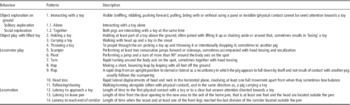
The ethogram for object-directed exploration, object play with a lifted toy and locomotor play, as well as locomotion, is summarized in Table 1. Social play, indicated by ‘nose-to-nose contact’, ‘head knocks’, ‘lever’, ‘mounting’ and ‘non-injurious biting’, was considered for recording, but was discounted from the analysis following pilot analyses as it accounted for <1% of the observations. An 8-min recording session was divided into 5-s sample intervals, and the frequency of a particular behaviour was calculated based on the number of occurrences out of the 96 sample points. Scan sampling every 5 s was used to record whether an individual was interacting or not with the toy on the ground (i.e. object exploration on ground). For object play with a lifted toy and locomotor play, focal behaviour sampling, with one-zero recording within each 5 s, was used. One-zero sampling has been found to be the most practicable recording type for play patterns in mammals, which starts and stops repeatedly and rapidly (Martin and Bateson, Reference Martin and Bateson2007). For measurements of latencies, continuous recording was used to note the time at which each of the specific behavioural events occurred.
Descriptions of the behaviour scored in the play/exploration test in a novel environment

This study was approved by the Uppsala Ethical Committee of Animal Experimentation, Uppsala, Sweden, under protocol C117/11.
Statistical analysis
The statistical analysis was performed using the SAS package, version 9.2 (SAS Institute, 2008). For the purpose of the analysis, the recordings of ‘holding’, ‘throwing’ and ‘carrying’ the toy were merged into a new variable called ‘solitary object play with a lifted toy’. The variable ‘locomotor play’ consisted of the count records of ‘scamper’, ‘pivot’, ‘turn’, ‘hop’, ‘flop’, ‘head toss’ and ‘following’. The behaviour ‘chasing’ was never seen to occur. The latencies to leave the pen and to reach the end of the corridor are for those pigs that actually left the pen or that reached the end of the corridor. The data residuals for each of the tested variables did not follow a normal distribution (UNIVARIATE procedure); therefore, a non-parametric GLIMMIX procedure was utilized for dependent variables taking into account the Poisson distribution. Weight at 5 weeks of age was included as a categorical variable with two levels (1=⩽10.3 kg, 2=>10.3 kg). Each level included 60 pigs. Individual pig nested within the litter was used as a random effect. To adjust for multiple comparisons, we used the studentized maximum modulus method. The significance of effects was tested using the t-test. A significant difference of the tested effects, treatment, sex, weight category and their interactions, was set at P=0.05. We also investigated the behavioural responses within the 50/50 treatment in a separate analysis using the above model. No significant differences were found between the behaviour of pigs from the 50/50H and the 50/50NH treatments. These data are not shown in the manuscript. Results are presented as means and standard deviations, and all reported P-values are two-tailed. The procedure CORR was used to investigate Spearman’s correlation coefficients in order to assess the relationship between the behaviours. Only Bonferroni-corrected statistically significant values are reported (P<0.0025).
Results
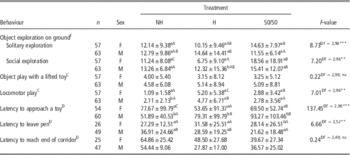
All the pigs performed some form of play behaviour or object-directed exploration. Six pigs, all from H litters, never approached the toy; 12 pigs, similarly distributed between the different treatments, never left the pen to explore the corridor, and three pigs from the 50/50 and NH litters that entered the corridor never reached the end. There were main effects of treatment and sex on all types of play and exploratory behaviour, with the exception of the object play on the ground, which was only affected by the sex of the piglet. There was a treatment×sex interaction for all behaviours, except for object play with a lifted toy and latency to reach the end of the corridor (Table 2); therefore, interpretation of the overall effect of the treatment and the sex separately may be misleading. For this reason, only results from the interaction are presented. No significant differences were seen in the object play with a lifted toy when comparing pigs of different treatments (NH=4.27±5.67, H=4.19±8.51, 50/50=4.32±7.45; F-value=1.60) or sexes (M=4.95±8.01; F=3.49±6.32; F-value=8.43). With regard to the latency to reach the end of the corridor, treatment and sex both independently affected the behaviour. The latency was the longest in pigs from NH litters and the shortest in pigs from 50/50 litters (NH= 59.00±18.18, H=46.79±27.32, 50/50= 37.26±25.04; F-value=43.06; P⩽0.0001). Females reached the end of corridor later than did males (F=50.96±27.56, M=43.26±24.57; F-value=35.00; P⩽0.0001).
Means and standard deviations of time in seconds for behaviours collected in pairs of pigs during 10 min in the play/exploration test by interaction of treatment and sex

n=number of recorded pigs; F=females; M=males; NH=non-handled; H=handled.
F=behaviour recorded as frequency; C=behaviour recorded as counts; D=behaviour recorded as duration.
F-values are also presented.
a,b,cMeans in the same column with a different superscript differ significantly.
A,B,CMeans in the same row with a different superscript differ significantly.
**P<0.01, ***P<0.001.
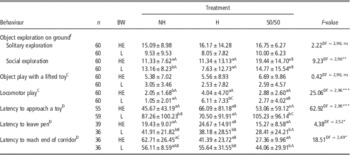
There was a strong effect of BW category. However, as there was also a treatment×weight category interaction for all recorded behaviours except solitary object exploration and object play with a lifted toy, only the results of the interaction are presented (Table 3).
Means and standard deviations of time in seconds for behaviours collected in pairs of pigs during 10 min in the play/exploration test by interaction of treatment and BW

n=number of recorded pigs; F=females; M=males; NH=non-handled; H=handled; BW=BW category; HE=heavy pigs; L=light pigs.
F=behaviour recorded as frequency; C=behaviour recorded as counts; D=behaviour recorded as duration.
F-values are also presented.
a,b,cMeans in the same column with a different superscript differ significantly.
A,B,CMeans in the same row with a different superscript differ significantly.
*P<0.05, **P<0.01, ***P<0.001.
Summarizing these results over all types of play and object exploration, the level of locomotor play was most often significantly higher for H pigs and 50/50 pigs than for NH pigs (Tables 2 and 3). An even more consistent finding was that for both sexes and for both weight categories, pigs of the 50/50 treatment were always significantly more involved in social object exploration than pigs from the NH treatment and often also significantly more often than pigs from the H treatment.
Considering the latency measures, no consistent pattern was found across sex or BW categories for the different treatments (Tables 2 and 3).
The correlation analysis revealed that solitary object exploration on the ground was positively correlated with object play with a lifted toy (r=0.49). Locomotor play was negatively correlated with social object exploration on the ground (r=−0.31) and latency to leave the pen (r=−0.37). There was a strong positive correlation found between latency to leave the pen and latency to reach the end of the corridor (r=0.79).
Discussion
The main finding in this study was that repeated early human handling, with enforced stroking on the back, carried out before weaning affected play behaviour and object-directed exploration, as well as the latency to approach a novel object or a novel environment, 1 week after weaning. These results were not entirely consistent, however, as effects depended on the type of play/exploration and varied according to the BW and the sex of the pig. Possible explanations for this complex relationship include that piglets of different weight and sex may have experienced the handling procedure differently, therefore leading to variation in how the treatment affected their neural development. Another potential explanation is that the evolutionary optimal strategy for how TS affects behavioural responses may vary for piglets of different phenotypes.
Locomotor play, as predicted, was the greatest in the handled pigs (H pigs) of both sexes compared with non-handled pigs (NH pigs). An improvement in motor skills as a result of TS has already been shown in rats (Kolb et al., Reference Kolb, Gibb and Gorny2003a). Possibly, further supporting a beneficial effect on motor skills is that in handled litters females approached the toy quicker than females from other litters. Sex differences in social play behaviour in rats in response to maternal touching have been shown earlier (Edelmann et al., Reference Edelmann, Demers and Auger2013). There are many differences between males and females in their motor skills and this may also be related to differences in how they play (Špinka et al., Reference Schmied, Waiblinger, Scharl, Leisch and Boivin2001). The observed behaviour could also result from a different level of fear or anxiety or different motivations to explore an unfamiliar object or environment.
When the toy was on the ground, social object exploration was the greatest in pigs from the litters where half of the piglets were handled (50/50 litters) compared with NH litters, irrespective of BW or sex. Social object exploration was also often greater in 50/50 litters compared with H litters. This suggests that it was something about handling half of the piglets that had consequences related to social exploration for the whole litter. Possibly the odour from the human handling of half the litter triggered a series of socio-emotional interactions between the piglets that had a similar enhancing effect on their neural development to that following increased attention by the mother to rat pups following human handling (Denenberg and Whimbey, Reference Denenberg and Whimbey1963; McMillan, Reference McMillan1999; Kolb et al., Reference Kolb, Gibb and Gorny2003a). Supporting this is that TS affects the maturation of the parts of the brain responsible for communication and emotion (Field et al., Reference Field, Hernandez-Reif and Freedman2004). One could, therefore, speculate that social support or social facilitation of exploration was greatest in the 50/50 litters. Although most consistently significant for social exploration of the novel object, piglets from the 50/50 litters of both weight categories were often also the category of piglets that were quickest to leave the pen and reach the end of the novel corridor.
Apart from the TS, BW played a role on how much play, exploration and locomotion was performed. Although no difference in BW was found between the pigs of different treatments (Oliveira et al., Reference Oliveira, Paranhos da Costa, Zupan, Rehn and Keeling2015), at 5 weeks of age heavier pigs were quicker to approach the novel toy and to leave the pen. Whether this is a result of a lower level of fear or anxiety or a higher motivation to explore an unfamiliar object or environment is not clear.
There were many BW and treatment interactions, which in combination with the earlier discussed treatment and sex differences emphasize the importance of individual characteristics when investigating the effect of earlier handling. A large variation was noted in how much the piglets resisted the handling (unpublished data), which would in turn have effects on how they experienced subsequent handlings.
Regardless of the level of stress our piglets may have experienced, it is a general consensus that it is the arousal and not necessarily the valence that stimulates the positive behavioural development, which was also evident in this study. It remains to be investigated whether this effect would be seen later during their development as well, although in rats this positive effect of TS on the behaviour was found both in juvenile (Edelmann et al., Reference Edelmann, Demers and Auger2013) and adult animals (Kolb et al., Reference Kolb, Gibb and Gorny2003a). If, as put forward by Duncan (Reference Duncan1993), welfare is all about the feelings experienced by animals, then pigs from litters where all or half of the piglets were handled before weaning may be experiencing, or at least have the potential to experience, more positive emotional states after weaning, and thus have a better welfare compared with other pigs housed under the same environmental conditions.
Acknowledgements
The project was funded by the Centre of Excellence in Animal Welfare Science, a Swedish Research Council Formas collaborative research platform. The CAPES (Coordination for Enhancement of Higher Education Personnel) provided Daiana de Oliveira financial help to be engaged in this project. The authors thank the staff at Lövsta for their cooperation. Prof. Mateus Paranhos da Costa was involved in the earlier discussions about this study.