Introduction
A number of studies suggest that hyperkinetic disorder is more common in people with intellectual disability (ID) than the general population (Seager & O’Brien, Reference Seager and O’Brien2003; Emerson & Hatton, Reference Emerson and Hatton2007; Neece et al. Reference Neece, Baker, Blacher and Crnic2011; Neece et al. Reference Neece, Baker and Lee2013). Hyperkinetic disorder can present as an extra barrier to learning and functional skill acquisition in this already vulnerable group because of its impact on attention and ability to engage with others.
Background to hyperkinetic disorder
Hyperkinetic disorder, as classified in the ICD-10, is a neurodevelopmental disorder, often diagnosed in childhood (World Health Organisation, 1992). Its main features are impaired attention and over-activity, which occur in more than one environment, are of early onset (under 6 years of age) and of long duration. The associated features include social disinhibition and impulsive flouting of social rules (World Health Organisation, 1992; NICE, 2008). It is important to consider whether symptoms in the ID population are related to the disability itself or whether they are part of a separate, hyperkinetic disorder. The American Psychiatric Association describes a similar disorder called attention deficit hyperactivity disorder, but with an age of onset specified as below 12 years (American Psychiatric Association, 2013).
Some studies have suggested that hyperkinetic disorder may be underdiagnosed in the ID population owing to ‘diagnostic overshadowing’ or because of an already present diagnosis of ID (Fuller and Sabatino, Reference Fuller and Sabatino1998; Hendriksen et al. Reference Hendriksen, Peijnenborgh, Aldenkamp and Vles2015). The National Institute for Health and Clinical Excellence (NICE, 2008) recommends a multi-modal approach investigating symptoms and impact in different settings as outlined by a variety of sources. Multi-disciplinary involvement is crucial in terms of evaluating psychiatric comorbidity, communication and sensory issues and adaptive functioning.
The diagnostic validity of hyperkinetic disorder in the presence of ID has historically been a question of debate and has been examined previously (Hastings et al. Reference Hastings, Beck, Daley and Hill2005; Antshel et al. Reference Antshel, Philips, Gordon, Barkley and Farone2006; Neece et al. Reference Neece, Baker and Lee2013). However, the study of Stromme and Diseth (Reference Stromme and Diseth2000) among others supports a higher prevalence of hyperkinetic disorder in the ID population. Additionally, the Neece et al. (Reference Neece, Baker and Lee2013) study shows consistencies in symptoms across a range of IQ levels. Evans and Trollor (Reference Evans and Trollor2016) argue that these bolster the validity of diagnosis and recommend a thorough approach to review potential contributors to symptoms in this population such as other medical or psychiatric diagnoses and autism.
Prevalence in studies
There is a large variability in the reported rates of hyperkinetic disorder in individuals with ID. Prevalence figures in children with ID range from 8.7% to over 40% (Stromme & Diseth, Reference Stromme and Diseth2000; Neece et al. Reference Neece, Baker and Lee2013) and from <2% to 55% of adults (Cooper et al. Reference Cooper, Smiley, Morrison, Williamson and Allan2007). This is comparable to the general population with studies reporting prevalence rates between 1.4% and 9.5% in children and between 1.0% and 4.4% in adults (Polanczyk, Reference Polanczyk, Willcutt, Salum, Keiling and Rhode2014; Chan et al. Reference Chan, Folger and Hammerness2016; Thapar & Cooper, Reference Thapar and Cooper2016). Neece et al. (Reference Neece, Baker and Lee2013) argue that overall studies show a threefold over-representation of hyperkinetic disorder in the ID population compared with the general population. Different sampling strategies and assessment methods, including differing diagnostic criteria, may have contributed to this variation (Polanczyk, Reference Polanczyk, Willcutt, Salum, Keiling and Rhode2014).
Previous studies examining the prevalence of hyperkinetic disorder based on the level of ID have produced mixed results with some reporting increasing rates as the level of disability increases (Hastings et al. Reference Hastings, Beck, Daley and Hill2005; La Malfa et al. Reference La Malfa, Lassi, Bertelli, Pallanti and Albertini2008; Memišević & Sinanović, Reference Memišević and Sinanović2015), whereas others showing no difference (Hardan & Sahl, Reference Hardan and Sahl1997; Dekker & Koot, Reference Dekker and Koot2003) and some others reporting decreasing rates (Johnson et al. Reference Johnson, Lubetsky and Sacco1995). Several reasons for these discrepancies have been posited, including the possible reluctance of clinicians to diagnose hyperkinetic disorder in the individuals with more severe IDs (Buckley et al. Reference Buckley, Dodd, Burke, Guerin, McEvoy and Hillery2006), uncertainty regarding the presentation of symptoms of hyperkinetic disorder particularly as the severity of ID increases, as well as differences in criteria and methodology between studies (Reilly & Holland, Reference Reilly and Holland2011).
This report aims to add further to the prevalence research by examining the point prevalence of hyperkinetic disorder in the population within a community ID psychiatric service. In terms of areas for further prevalence research, one key area is establishing baseline rates for hyperkinetic disorder across different levels of ID, which we also aim to examine in this report.
Methods
Study setting
The community psychiatry service for people with ID in county Galway sits within a voluntary organisation, which like many others in Ireland has service-level agreements with the health service executive. However, unlike many others, it delivers services to people with mild ID. A significant numbers of voluntary sector services in Ireland work with people with moderate, severe and profound ID only. People with mild ID nationally are often seen by psychiatric community mental health teams. In county Galway, however, and for historical reasons, a significant number of people with mild ID receive service provision from voluntary services specialising in working with people with ID. The psychiatry service also provides input to children with ID. This is through a clinic jointly provided with the local developmental paediatrics service.
Essentially, small multi-disciplinary teams (minus psychiatry) across voluntary agencies provide input to people with ID depending on age, geographical area and level of ability. If psychiatry input is required, a referral is sent via the general practitioner. While the psychiatry team members are not part of an MDT as such, service provision can be delivered in a consultative outpatient clinic process or through case conferences and team meetings.
The psychiatry service also receives referrals from Child and Adolescent Mental Health Service (CAMHS) and community mental health teams. The referrals for children are for those attending special schools in the county and accessing multi-disciplinary services attached to those schools.
This ‘cradle to grave’ service is undergoing a process of reconfiguration to be in line with national policy. Its current format, however, allows straightforward prevalence statistics to be calculated in the ID clinical sample accessing services in county Galway as this includes children and adults with ID in the county across all ranges of ID from profound to mild.
The Online Information Service ‘OLIS’ database is a local service database which contains a subsection with clinical and diagnostic information pertinent to the ID psychiatry service in Galway. The number of patients with various diagnoses can be identified alongside their age using this database.
Procedure
OLIS was used to identify the total number of children and adults with ID and those with a comorbid diagnosis of hyperkinetic disorder. The diagnosis of hyperkinetic disorder had been previously established using a multidisciplinary approach with clinical and psychological assessments which always include structured instruments (Conner’s Rating Scales) provided to teachers and parents as well as two separate environmental assessments and observations.
The total number of patients with ID and patients with comorbid hyperkinetic disorder was used to calculate the point prevalence of hyperkinetic disorder in the clinical ID population.
The number of adults and children with hyperkinetic disorder based on the level of ID (mild, moderate, severe and profound) was also examined and used to calculate the point prevalence of hyperkinetic disorder in each ID population.
Statistical analysis was completed using the SPSS version 11 software. Fisher’s test was used to calculate differences in prevalence rates with significance established at p-value <0.05.
Results
The calculated point prevalence of hyperkinetic disorder in children was 32.6% and in adults was 3.1% (Table 1). The difference between the two populations was statistically significant at p<0.005.
Point prevalence of hyperkinetic disorder in the clinical ID population

HK, hyperkinetic disorder; ID, intellectual disability.
The calculated point prevalence of hyperkinetic disorder in children and adults compared with the prevalence in previous studies (Stromme & Diseth, Reference Stromme and Diseth2000; Cooper et al. Reference Cooper, Smiley, Morrison, Williamson and Allan2007; Neece et al. Reference Neece, Baker, Crnic and Blacher2013).
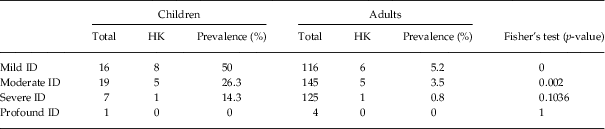
The calculated point prevalence of hyperkinetic disorder in children with mild ID was 50%, in children with moderate ID was 26.3% and in children with severe ID was 14.3%. The calculated point prevalence of hyperkinetic disorder in adults with mild ID was 4.6%, in adults with moderate ID was 3.5% and in adults with severe ID was 0.8%. The differences in prevalence rates between adults and children with mild and moderate ID were significant at p<0.05 (Table 2).
Point prevalence according to level of ID

HK, hyperkinetic disorder; ID, intellectual disability; CI, confidence interval.
The calculated point prevalence of hyperkinetic disorder in adults and children based on the level of ID.
p<0.05=significant.
Discussion
We found that the prevalence of hyperkinetic disorder within the ID service falls within the range reported in other studies (see Table 1), although it was at lower end of the reported rates in adults and at the higher end of the reported rates in children. The overall prevalence of hyperkinetic disorder was higher in children compared with the adults and this result was statistically significant.
When based on the level of ID, the calculated point prevalence of hyperkinetic disorder in our patient population was highest in individuals with mild ID and it decreased as the severity of the ID increased. The prevalence was higher in children across the levels of ID compared with adults, although this result was only statistically significant for the mild and moderate ID populations. Taylor et al. (Reference Taylor, Paton and Kapur2015) report that while some adults continue to have symptoms in adulthood, most do not, and this is reflected in our results with higher prevalence in children when compared with adults.
Hyperkinetic disorder can present with increased comorbidities in an ID population (Ahuja et al. Reference Ahuja, Martin, Langley and Thapar2013) and previous studies also report higher rates in this population than in the general population (Stromme & Diseth, Reference Stromme and Diseth2000; Neece et al. Reference Neece, Baker and Lee2013). There is a large variability in the reported rates of hyperkinetic disorder in this population and this has been attributed to the differences in use of criteria and diagnostic methods (Reilly & Holland, Reference Reilly and Holland2011). Our prevalence rate of 32.6% in children with ID is comparable to a recent annual CAMHS national report published by the Health Service Executive (HSE, 2014) in Ireland, which found that hyperkinetic disorder was the most frequently assigned primary presentation in their patient population at 31.6% of cases.
The previous data available on prevalence of hyperkinetic disorder based on the level of ID is conflicting and our results seem to be in contradiction to some studies in the past that have reported either no change or increasing rates of hyperkinetic symptoms as the level of disability increases (Dekker & Koot, Reference Dekker and Koot2003; La Malfa et al. Reference La Malfa, Lassi, Bertelli, Pallanti and Albertini2008). However, as Reilly and Holland argue, most previous studies on prevalence have examined the presence of symptoms of hyperkinetic disorder in an ID population using diagnostic instruments rather than examining the prevalence of clinical diagnosis of hyperkinetic disorder in the population and that, as it has previously been suggested by Dekker and Koot, the presence of symptoms does not necessarily correlate with impairment (Dekker & Koot, Reference Dekker and Koot2003; Reilly & Holland, Reference Reilly and Holland2011).
Evans and Trollor (Reference Evans and Trollor2016) argue that vulnerability to this disorder is conferred by a number of means, including many biological, environmental and social risk factors in addition to syndromes, which give rise to both. The lower rates in those with severe ID may be secondary to the increased complexity of diagnosis in this population. It is possible that symptoms in more severe ID cases with genetic syndromes are attributed to the genetic condition rather than hyperkinetic disorder (King, Reference King2016). This may also explain higher rates of hyperkinetic disorder in people with ID.
There are strengths and limitations to this study. Our community psychiatry service for individuals with ID is set up to provide a service for both children and adults with all levels of ID. This has created a database which has allowed us to examine the point prevalence of hyperkinetic disorder in the total ID population known to the community service and also examine the prevalence based on the severity of ID in this clinical sample.
The diagnosis of hyperkinetic disorder in our population was a clinical diagnosis, made after a multi-modal assessment was undertaken when an individual presented with impairment in functioning, and the prevalence reported may be more representative of the rates that may be encountered in a general ID psychiatry service.
A limitation of our report is the relatively small sample size in the under 18 population, particularly when separated based on the level of ID, which cautions the generalisation of the results in this population. The small sample size of adults with profound ID also limits our findings for that population. Additionally, the small sample sizes also limit the use of statistical analysis for assessing the significance of differences in prevalence rates, particularly based on the level of ID, as they reduce power and limit any clinical inferences that can be made from the results of statistical tests and future similar studies with larger sample sizes may be able to identify any statistical differences.
Conclusion
We have calculated the point prevalence of comorbid hyperkinetic disorder in individuals within a community ID psychiatry service and it is in keeping with the rates found in previous literature. Our data suggest that the prevalence of hyperkinetic disorder may decrease in a clinical population as the severity of ID increases. However, conflicting data are available regarding the prevalence of hyperkinetic disorder in a learning disability population based on the level of disability and further prevalence research with larger sample sizes should be considered in terms of future research.
Financial support
This research received no specific grant from any funding agency, or from commercial or not-for-profit sectors.
Conflicts of interest
Evan Yacoub and Sonn Patel have no conflicts of interest to disclose.
Ethical standards
The authors assert that all procedures contributing to this work comply with the ethical standards of the relevant national and institutional committee on human experimentations with the Helsinki Declaration of 1975, as revised in 2008. The study protocol was approved by the local ethics committee of the participating institution.