1 Introduction
This paper examines the distribution of vowel-laxness alternations and stress shift in Slovenian, and proposes that stress shift is driven by the markedness of mid lax vowels. We offer an analysis in terms of positional faithfulness that uses a ‘Beckman-Noyer ranking’, which has previously been argued to produce unattested patterns. We start this section with an overview of the Slovenian pattern, and then connect it to the Beckman-Noyer ranking of positional faithfulness.
Slovenian has a nine-vowel system, [i e ɛ a ʌ ə ɔ o u]. The vowels [ɛ ɔ ʌ] can be considered to be marked in Slovenian (Jurgec Reference Jurgec2010, Reference Jurgec2011, Becker & Jurgec Reference Becker, Jurgec, Kehrein, Köhnlein, Boersma and van Oostendorp2017). They surface only under stress, and in masculine nouns are most freely distributed in the nominative singular (see §4.1 on the relevance of the masculine nominative singular for our analysis). Elsewhere in the masculine paradigm, these vowels are eliminated (with some exceptions). The proposed analysis categorises Slovenian masculine nouns with a marked vowel according to the position of the stressed syllable: nouns with non-initial stress, most of which are iambic, e.g. [pɾoˈmɛt] ‘traffic’, and nouns with initial stress, which are divided into trochaic, e.g. [ˈjɛzik] ‘tongue’, and monosyllabic, e.g. [ˈmɛʧ] ‘sword’. Most of the iambic nouns lose their marked vowel outside of the nominative singular, exemplified here and throughout with the genitive singular, e.g. [pɾoˈmeta]. We attribute this pattern to the effect of a context-free markedness constraint against mid lax vowels, and special protection of the nominative singular. When a mid lax vowel is in an initial syllable, however, it is protected by faithfulness to the initial stressed position, which is why monosyllabic stems like [ˈmɛʧ] generally maintain their marked vowel throughout the paradigm, e.g. [ˈmɛʧa]. In trochaic stems such as [ˈjɛzik], the same faithfulness to the initial stressed position triggers stress shift, e.g. [jeˈzika]. Stress moves away from the initial position, and the mid lax vowel is eliminated in the less prominent, unstressed position.
There are lexical exceptions: stress does not shift from initial mid lax vowels in all words, and does shift in some words with other vowels. We examine the distribution of mid vowels in the lexicon using data from a dictionary, and confirm the observations in an experiment with 92 participants. A nonce-word task (Berko Reference Berko1958) with 145 participants reveals a clear generalisation: stress shift is preferred with mid lax vowels, and dispreferred with other vowels.
Positional faithfulness theory (Beckman Reference Beckman1997, Reference Beckman1998) proposes a family of constraints that penalise changes in prominent positions such as the stressed syllable or the root. For example, in the analysis of languages that allow mid lax vowels only in stressed syllables (such as Slovenian), high-ranking positional faithfulness to laxness dominates a context-free markedness constraint against mid lax vowels, i.e. Ident[ATR]/ˈσ ⪢ *MidLax, with low-ranking context-free faithfulness, i.e. *MidLax ⪢ Ident[ATR].
Beckman (Reference Beckman1997) uses faithfulness to the initial syllable to analyse the patterning of mid vowels in Shona, where vowel height is contrastive in initial syllables and predictable in the following syllables. The analysis proposed here combines the stressed and the initial positions by making reference to a stressed initial position; we return to this point in §4.3 below.
A consideration of positional faithfulness in the light of factorial typology brings forth a prediction that has been thought to be troubling: prominence could shift to a different position just when it would have otherwise protected a marked structure. For example, stress could move away from a mid lax vowel, and the vowel would then be reduced in the resulting unstressed position. This prediction of positional faithfulness has been referred to as the Beckman-Noyer problem (McCarthy Reference McCarthy2007; see Beckman Reference Beckman1998: 36, McCarthy Reference McCarthy2010, Jesney Reference Jesney2011), because no language was thought to instantiate this type of ranking. We will argue, however, that this is not in fact a problem: the prediction is correct, and we will show how it is manifested in Slovenian. We therefore suggest the revised term ‘Beckman-Noyer ranking’.
The canonical, unproblematic effect of positional faithfulness is exemplified in (1), which shows a language where mid lax vowels are generally banned due to *MidLax ⪢ Ident[ATR], as in (1a). However, the same mid lax vowels are allowed in stressed syllables thanks to the protection of the positional constraint Ident[ATR]/ˈσ, as in (1b). This commonly attested pattern is observed, in, for example, Italian (Krämer Reference Krämer2009: §4.1.2), English (Hammond Reference Hammond1997) and many other languages that limit mid lax vowels to stressed syllables (Archangeli & Pulleyblank Reference Archangeli and Pulleyblank1994). In (1), vowel laxness has no effect on the position of stress, due to undominated Ident[stress].
-
(1)

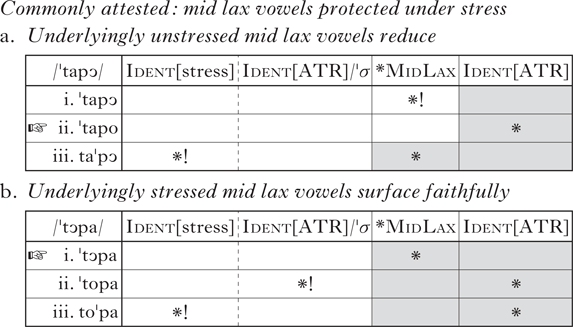
Very different types of languages are predicted, however, if Ident[stress] is ranked below Ident[ATR]/ˈσ. For example, the tableaux in (2) have the same constraints, inputs and candidates as (1), but Ident[stress] is ranked below positional faithfulness. Mid lax vowels are reduced as expected when they are underlyingly unstressed, as seen in (2a). But underlyingly stressed mid lax vowels push stress to an available unmarked vowel, and are reduced in the resulting less prominent position, as in (2b).
-
(2)
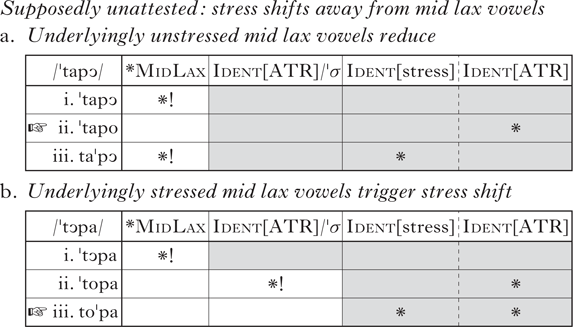
The ranking in (2) is a straightforward prediction of positional faithfulness theory; this ranking closely matches the weighted-constraint analysis that we offer for Slovenian in §4. More generally, what all Beckman-Noyer rankings have in common is positional faithfulness dominating the constraints that determine the location of prosodically strong positions.
For Slovenian, we propose that context-free markedness outranks positional faithfulness, as in (2), but Jesney (Reference Jesney2011) discusses other Beckman-Noyer rankings in which positional faithfulness is ranked above general markedness. The difference between the two varieties of the Beckman-Noyer rankings can be seen when the grammar is given an input with only mid lax vowels; i.e. there is no unmarked vowel to which stress can shift. In Slovenian-type rankings, mid lax vowels cannot surface at all, leading to tensing and faithful stress, e.g. /ˈtɔpɔ/ → [ˈtopo]. With top-ranked positional faithfulness, the underlyingly stressed mid lax vowel surfaces, e.g. /ˈtɔpɔ/ → [ˈtɔpo], and all of the other vowels in the word surface as mid tense.
In the realm of phonotactic learning (Hayes Reference Hayes, Kager, Pater and Zonneveld2004), the Slovenian-like Beckman-Noyer ranking in (2) is not a problem. In phonotactic learning, individual words are learned without any paradigmatic relations, while assuming inputs that are identical to outputs, e.g. [toˈpa] is necessarily paired with the input /toˈpa/. The undominated context-free markedness constraint against the triggers of stress shift ensures that the triggers are absent from underlying representations in this type of learning; the intended system cannot be reconstructed by the learner, and therefore cannot survive more than one generation. The situation in (2) is effectively blocked in the realm of phonotactic learning by the lack of a learning path to it. Jesney (Reference Jesney2011) makes this point in the context of syllabification.
The ranking in (2) is available in Slovenian because there are independent reasons for positing the required ranking and underlying representations: the unsuffixed masculine nominative singular allows mid lax vowels rather freely, and thus supplies nouns with these marked vowels in underlying representations, while in the rest of the nominal paradigm mid lax vowels are eliminated due to context-free *MidLax. For example, the nominative singular [ˈjɛzik] maintains its mid lax vowel because it is a nominative singular (more on this in §4.1), but the mid lax vowel is eliminated thanks to stress shift in the genitive [jeˈzika]. Simply put, a Beckman-Noyer ranking is found in Slovenian, just as predicted by positional faithfulness theory. (See Jesney & Tessier Reference Jesney and Tessier2011 on learning grammars with positional faithfulness constraints.)
The paper continues with a survey of the stress-shift and laxness-alternation patterns in the Slovenian lexicon, based on data from a dictionary and a judgement experiment (§2). The results of a nonce-word study show that stress shift away from mid lax vowels is preferred, and stress shift away from any other vowel is dispreferred (§3). An analysis in terms of positional faithfulness is contrasted with less satisfactory alternatives (§4), after which we conclude (§5).
2 Lexicon study: lax vowels drive stress shift
Slovenian nouns are predominantly mono- or disyllabic. The position of stress is contrastive, e.g. [ˈpasat] ‘to fit-supine’ vs. [paˈsat] ‘Passat (type of car)’, and falls most frequently on the stem-final syllable, although non-stem-final stress is reasonably common.
Two types of paradigms are observed in Slovenian nouns with penultimate stress in the nominative singular, as in (3): uniform paradigms, in which stress is faithful (fixed) throughout the declension, and mobile paradigms, in which stress surfaces on the penultimate vowel of the stem in the nominative singular and on the final vowel in the rest of the paradigm, exemplified here by the genitive singular (Toporišič Reference Toporišič2000, Jurgec Reference Jurgec2007).
-
(3)
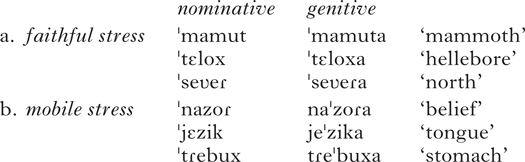
The stress alternation in (3b) is accompanied by an [ɛ ~ e] alternation for ‘tongue’, which follows from a language-wide prohibition on mid lax vowels in pretonic position, as shown in (4), from Jurgec (Reference Jurgec2006, Reference Jurgec2011).
-
(4)
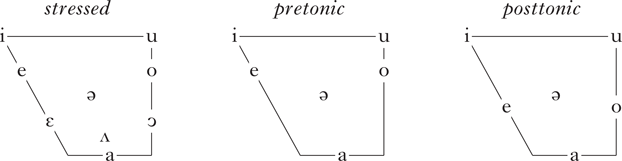
Mid lax vowels are contrastive in stressed position, e.g. [ˈlet] ‘ice’ vs. [ˈlɛt] ‘flight’, but pretonically, only tense mid vowels are possible. As (4) shows, pretonic mid vowels are just as high as stressed mid tense vowels, both in absolute terms and relative to the height of [ə]. In this paper, our focus is on the tonic and pretonic positions, and in these positions the initial [ɛ] of [ˈjɛzik] is different in laxness from the initial [e] of [jeˈzika]. For the sake of completeness, we also show the posttonic vowel system, where mid vowels are lower than [ə]. We transcribe them in this article as tense, following Jurgec (Reference Jurgec2010) and Jurgec & Bjorkman (Reference Jurgec and Bjorkman2018); nothing crucial depends on this choice.
There is a historical source for the relevance of vowel quality to stress mobility. Slovenian inherited the three Common Slavic accentual paradigms: fixed root stress, fixed suffix stress and the mobile paradigm, in which stress alternates between root and suffix (Stang Reference Stang1957, Dybo Reference Dybo1981). In the history of Slovenian, there were multiple processes in which stress retracted in particular environments, based on vowel length and tone, and additionally, certain word-final vowels (‘yers’) were deleted. Many of these processes affected monosyllabic roots only, and are therefore irrelevant to the synchronic root-internal shift we focus on in this paper. The development that is most relevant to the contemporary stress shift is the ‘secondary’ retraction that turned older [jeˈzik ~ jeˈzika] (faithful stress) into modern [ˈjɛzik ~ jeˈzika], and led to the appearance of mid lax vowels in these paradigms (Greenberg Reference Greenberg2000: 143). This retraction was sensitive to vowel length, but with the later disappearance of vowel length, stress retraction is no longer a possible synchronic analysis of Slovenian. For example, there is no longer anything to distinguish mobile [ˈjɛzik] from fixed [ˈtɛlox].
Stem-penultimate stress has three main sources: original Common Slavic stress, loanword adaptation and ‘secondary retraction’. In the first two cases the mid vowels can be tense or lax, whereas in the case of secondary retraction they are lax. This retraction is the source of the mobile stress in [ˈjɛzik ~ jeˈzika], as it affected the unsuffixed nominative singular, but not the suffixed forms of the paradigm. There is thus a diachronic connection between the unsuffixed nominative singular and mobile stress; this pattern is prevalent in masculines, but is also observed sporadically in feminines, neuters and adjectives that have an unsuffixed nominative singular. In verbs, which do not surface unsuffixed, stress never shifts within the root. Overall in the language, fixed stress is by far the most prevalent.
Historically, tone was a relevant factor in stress retraction. But even for those speakers who still have tone in standard Slovenian, tone is not the key to stress shift. While all mobile stress items have low tone, it is attested with faithful items as well, e.g. both faithful [ˈtɛlox] and mobile [ˈjɛzik] have low tone (Becker & Jurgec Reference Becker, Jurgec, Kehrein, Köhnlein, Boersma and van Oostendorp2017). In fact, low tone is very common with penultimate stress even on tense vowels, e.g. both faithful [ˈseʋeɾ] and mobile [ˈtɾebux] have low tone, and thus tone does not distinguish tense from lax vowels. In standard Slovenian, tone is currently optional, and tonal pronunciations are on the wane (Srebot-Rejec Reference Srebot-Rejec1988), but stress shift is mandated regardless of whether speakers have tonal distinctions. In the two experiments in this paper, the items are presented and judged with no tonal distinctions.
Because the vast majority of nouns with penultimate stress in the nominative singular are disyllabic, the nominative has initial stress in almost all of them. The proposed analysis (to be developed fully in §4 below) uses initial syllable faithfulness to derive mobile stress. While the diachronic generalisation is that stress retracted to the penultimate syllable, the proposed synchronic analysis is that it shifts away from the initial syllable.
The proposed analysis will also account for laxness alternations without stress shift; these occur when the mid lax vowel is non-initial and thus not protected by initial syllable faithfulness, as in [uˈspɛx ~ uˈspexa] ‘success’; we return to these in §2.3. These alternations are driven by a context-free markedness constraint against mid lax vowels. A parallel laxness alternation, e.g. [moˈdɾʌs ~ moˈdɾasa] ‘viper’, is driven by a constraint against the low tense vowel [ʌ]; this constraint is undominated outside the nominative singular.
In monosyllabic stems, mid lax vowels generally do not alternate, e.g. [ˈmɛʧ ~ ˈmɛʧa], as expected from the protection of initial syllable faithfulness. For completeness, we mention that there are 55 monosyllabic masculine nouns that historically required stress to shift to a suffix (Toporišič Reference Toporišič2000: 282–286), e.g. [ˈzʋon ~ zʋoˈna] ‘bell’. None has a marked vowel ([ɛ ɔ ʌ]), and nowadays all strongly prefer fixed stress, e.g. [ˈzʋona]. Finally, there are also alternations in the 23 masculine roots that lack a full vowel, e.g. [stəˈbəɾ ~ stəˈbɾa] ‘pillar’; in these, too, fixed initial stress is becoming increasingly common: [ˈstəbəɾ ~ ˈstəbɾa]. These marginal stress patterns are observed in some feminine and neuter nouns, as well as in adjectives. As already noted, fixed stress is by far the most common throughout the language. Again, these alternations have no bearing on the main point of this paper.
The remainder of this section provides evidence for the claim that mobile stress is driven by vowel quality, and in particular, that stress is more likely to shift away from initial mid lax vowels. Data from a dictionary is surveyed in §2.1, and the patterns are confirmed by a questionnaire with native speakers in §2.2. Laxness alternations under fixed stress are surveyed in §2.3, with a summary in §2.4.
2.1 Dictionary study
For this study, a list of 2219 nouns was painstakingly collected from Toporišič's (Reference Toporišič2001) dictionary, which is not publicly available online. The list included all nouns with mobile stress and a random sample of nouns with faithful stress, up to about 300 items for each stressed vowel quality in the nominative singular. The list is available in the online supplementary materials. Nominal stems are mostly short in Slovenian (Jurgec Reference Jurgec2019), and this is true in this dataset as well: monosyllabic 42%, disyllabic 51%, trisyllabic or longer 7%.
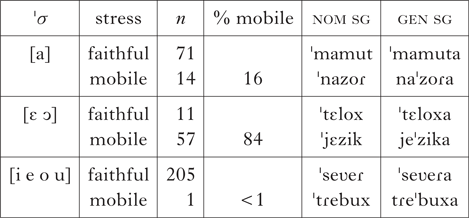
Of this list, there are 359 items (16%) with stress on the penultimate syllable of the stem in the nominative. These are presented in Table I. Stem-final stress in the nominative accounts for 83% of the items, and fewer than 1% have antepenultimate stress in the nominative. Table I shows that among words with stress on the stem's penultimate syllable in the nominative, mobile stress is most common with mid lax vowels, fairly common with [a] and very rare with tense vowels.
Dictionary study: mobile stress is most common with [ɛ ɔ].

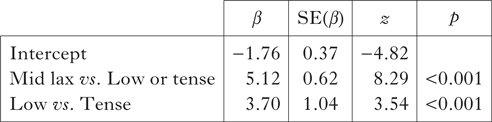
To quantify the effect of vowel height in the lexicon, we fitted a logistic regression model to the nouns with penultimate stress in the nominative, with mobile vs. faithful stress as the dependent variable, using the glm function in R (R Core Team 2016). Vowels were coded as either marked (mid lax) or unmarked (low or tense), and the unmarked vowels were further divided into low or tense, for a total of three vowel-height categories. Following the recommendation of Gelman & Hill (Reference Gelman and Hill2007: §4.2, §5.5), vowel height was centred using Helmert coding. This coding created two binary predictors: marked vs. unmarked, or more descriptively, Mid lax vs. Low or tense, with values of ⅔ for the mid lax vowels [ɛ ɔ] and ―⅓ for the low or tense vowels [i e a o u], and Low vs. Tense, with values of +½ for low [a], ―½ for tense [i e o u] and zero for mid lax vowels. The model, given in Table II, shows that mobile stress is significantly more common with mid lax vowels than with other vowels, and significantly more common with low [a] than with tense vowels. Masculine gender accounts for the majority of the 359 penultimate stress items (78%), and for an even greater majority of the 72 mobile stress items (83%), leading us to make all nonce words in §3 masculine. To quantify the effect of gender in the lexicon, a binary gender predictor (masculine vs. feminine or neuter) was added to the model in Table II. Gender did not make a significant improvement to the model (χ 2(1) = 0.05, p > 0.1), so this predictor was omitted.
Dictionary-data regression model: mobile stress is significantly more common with mid lax vowels.

A reviewer correctly points out that the lexicon we use overrepresents the mobile stress items, since we collected all of them, but have only a sample of the fixed stress items. To measure the effect of this overrepresentation, we simulated lexicons with increasing numbers of fixed stress items. The estimates (β) of the predictors stay exactly the same, with slightly smaller SE and thus slightly larger z-values and slightly smaller p-values. The only difference in the model is in the intercept, whose estimate decreases with the number of fixed stress items. Therefore, the overrepresentation of mobile stress items does not affect the conclusions we draw from the model.
Of the 72 mobile stress items in Table I, 71 are disyllabic; the one exception is the trisyllabic [peˈtɛlin ~ peteˈlina] ‘rooster’. It would be highly accurate, then, to say that mobile stress shifts from a stem-initial syllable to a stem-peninitial syllable, and this is indeed the analysis we propose. We will claim that productive stress shift is only learned from the 56 items in which stress moves away from an initial mid lax vowel, which compete with the eleven items in which it does not (see Table I). No generalisation is learned from the 16 remaining nouns in which stress shifts from vowels that are either not mid lax or not initial: [ˈtɾebux], [peˈtɛlin] and the 14 items with [a]. These are lexicalised or fossilised, and do not contribute to the productive grammar.
To summarise, the proposed analysis categorises Slovenian stems into three groups: stems with initial stress, which may be trochaic or monosyllabic, and stems with non-initial stress, most of which are iambic disyllables.
2.2 Real-word survey
To ensure that the dictionary data reflects current usage among Slovenian speakers, an online survey was carried out. Speakers were auditorily presented with nominative–genitive paradigms, and they were asked to judge their acceptability. The results confirmed those of the dictionary study in §2.1.
2.2.1 Participants
Native speakers of Slovenian were recruited online via social networks and by word of mouth. At the end of the questionnaire, participants reported their age, language background, etc. Data was retained from the 92 participants who completed the survey and who self-reported as being 18 or older, living in Slovenia and speaking Slovenian natively; the rest of the data was discarded. Participants volunteered their time and effort.
Of the 92 participants, 53 self-identified as female and 29 as male; 10 did not say. The average reported age was 30 (range 18–66, median 28). Participants reported their native dialect, which we binned into two categories, ‘central’ (Ljubljana, Gorenjska, Dolenjska; 49 participants) and ‘other’ (Primorska, Štajerska, Koroška, Prekmurje or unreported; 43 participants). The central dialects have vowel systems that are similar to that of standard Slovenian. Speakers of other dialects are aware of a discrepancy between the number and/or quality of their native vowels and the standard vowels, even if they are entirely fluent in the standard dialect.
2.2.2 Materials
A representative sample of 163 mostly familiar high-frequency masculine nouns with penultimate stress in the nominative was chosen from the list in §2.1, according to their stressed vowel: 33 with [a], 49 with mid lax [ɛ ɔ], 54 with mid tense [e o] and 27 with high tense [i u].
The nouns were recorded in a sound booth by a 45-year-old male native speaker of Slovenian, a professional broadcaster; he can be considered a representative speaker of non-tonal standard Slovenian. He had no training in linguistics. The list of nominatives and genitives was unpaired and shuffled, and isolated words were presented to the speaker one at a time, written with the diacritics that standardly mark stress and vowel quality in the written language. The list was recorded three times in different random orders; the best of the three tokens of each word was selected and transformed to mp3 format. Some of the genitives that were presented to the speaker were attested and some unattested; we judge that our speaker was exceptionally good at pronouncing all of the words as intended with equal ease and fluency. The audio stimuli are available for inspection in the online supplementary materials.
2.2.3 Procedure
Participants accessed the experiment online, using Experigen (Becker & Levine Reference Becker and Levine2020), with the device and browser of their choice. To keep the survey acceptably short, the server selected a random sample of 38 items for each participant: 16 with [a], 16 with a mid lax vowel, four with a mid tense vowel and two with a high vowel.
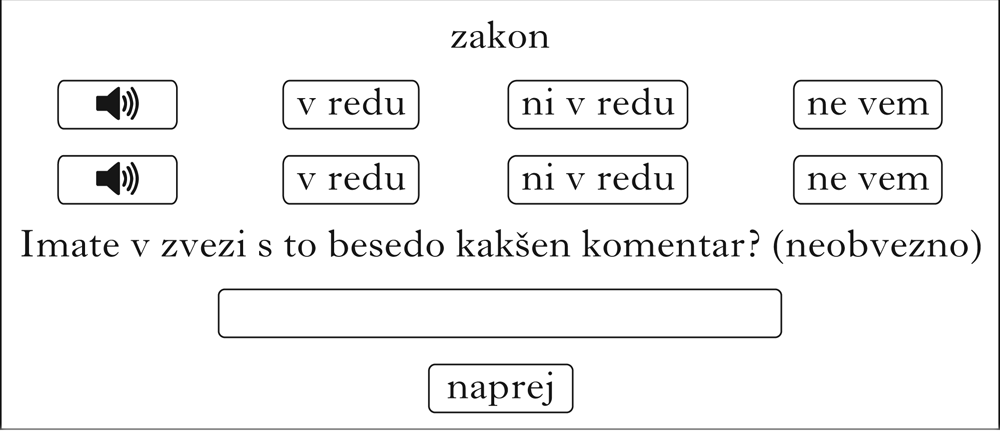
After a short written introduction in standard Slovenian, items were presented on the screen, one at a time, following the format in Fig. 1. The nominative form was presented orthographically at the top of the screen, and a button appeared on the next line. When pressed, two words were presented auditorily: the nominative followed by one of the two possible genitives (faithful or mobile), and then three new buttons appeared, labelled v redu ‘ok’, ni v redu ‘not ok’ and ne vem ‘I don't know’. Once one of the three buttons was pressed, the other paradigm was presented auditorily: the same nominative followed by the other genitive. The order of genitives was randomised and counterbalanced. Once both paradigms were evaluated, the following message appeared: Imate v zvezi s to besedo kakšen komentar? (neobvezno) ‘Do you have any comment on this word? (optional)’, before the participant moved to the next screen.
Sample item (zakon ‘law’) used in the real-word survey.

At the end of the experiment, participants were asked to volunteer demographic information, as explained above.
2.2.4 Results
Participants accepted (i.e. selected ‘ok’) one of the two genitives in 83% of the trials, i.e. 83% of the trials were informative. They accepted both genitives in 13% of the trials and neither genitive in 4% of the trials. To simplify the analysis, we collapse the ‘not ok’ responses and the ‘I don't know’ responses; ‘I don't know’ accounted for fewer than 3% of the responses. The raw results are available in the online supplementary materials.
Figure 2 shows mean differences in the acceptability of the two nominative–genitive paradigms by item. The by-item results are reported in Appendix A. The y-axis shows the preference for mobile stress (the difference between acceptance of the mobile and faithful genitives), with higher values indicating a stronger preference for mobile stress. Overall, mobile stress was preferred for mid lax vowels, and faithful stress for all other vowels, with [a] closer to the tense vowels. These results thoroughly confirm the dictionary study in §2.1. Speakers of central dialects accepted mobile stress with mid lax and low vowels slightly more often than speakers of other dialects, and slightly less often with tense vowels.
Difference in acceptability between mobile and faithful stress in real words (92 participants, 163 nouns). Error bars are 95% confidence intervals.

For the statistical analysis of these results, a mixed-effects logistic regression was fitted to the acceptance of the mobile genitive as the dependent variable, using the glmer function from the lme4 package (Bates et al. Reference Bates, Mächler, Bolker and Walker2015) in R. All of the trials were included, regardless of the acceptance of the faithful genitive. Vowel height was Helmert coded exactly as in §2.1. Speaker dialect was coded as a centred binary predictor, with the value +0.47 for central dialects and ―0.53 for other dialects. Following the method described in Barr et al. (Reference Barr, Levy, Scheepers and Tilly2013), an initial fully crossed model was fitted with the two predictors and their interaction, as well as maximal random slopes for participant and item. Since this model did not converge, random slopes were removed one at a time; all random slopes had to be removed before arriving at a model that converged. This model is shown in Table III.
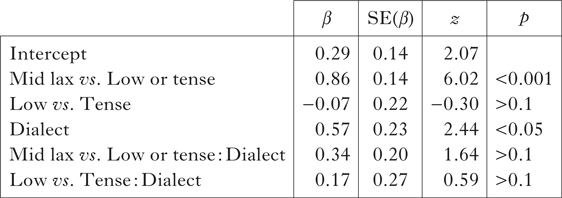
Real-word regression model (92 participants, 163 nouns).

The model confirms that the mobile genitive is significantly more acceptable with mid lax vowels than with other vowels, and with the low vowel [a] more than with the tense vowels.
Dialectal differences were small and insignificant. Speakers of central dialects have a vowel system that is similar to the vowel system of standard Slovenian, and have quality-driven stress shift in their non-standard dialect. Speakers of non-central dialects have different vowel systems, which are either smaller or do not correspond to the standard system; furthermore, some non-central dialects lack stress shift. Despite all of this, the absence of a significant effect suggests that speakers were largely accessing their knowledge of standard Slovenian, the prestigious dialect of the media and education, regardless of their native dialect. For the relatively young participants in the study, this is to be expected, given the increase in fluency in standard Slovenian since the 1950s. Mastery of standard Slovenian is also high among older speakers; in Jurgec (Reference Jurgec2019) even the oldest, most fluent speakers of local dialects without mobile stress appeared to have easy access to the mobile stress patterns of standard Slovenian.
2.3 Laxness alternations under stress
The same tense–lax alternation that accompanies stress shift is also observed in nouns with fixed stem-final stress. In these nouns, exemplified in (5), a mid lax vowel may be either retained faithfully, as in (5a), or tensed, as in (5b). Some nouns display variability, e.g. [ˈʃkɔf ~ ˈʃkɔfa, ˈʃkofa] ‘bishop’. This type of vowel alternation suggests that mid lax vowels are generally tolerated better in the nominative singular, but they are ideally eliminated in the rest of the paradigm, even under stress.
-
(5)
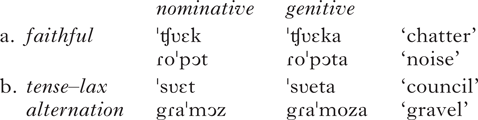
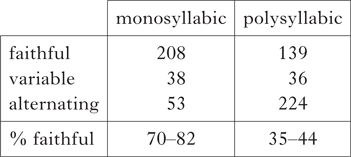
The prevalence of laxness alternations under stress is summarised in Table IV, using the dictionary data from §2.1. The alternation affects the majority of polysyllabic words, but most monosyllables are spared. We attribute this protection of monosyllables to faithfulness to the initial syllable (Beckman Reference Beckman1997, Reference Beckman1998, Casali Reference Casali1998, Barnes Reference Barnes2006, Becker Reference Becker2009, Steriade Reference Steriade, Hanson and Inkelas2009, Becker et al. Reference Becker, Ketrez and Nevins2011, Jesney Reference Jesney2011, Becker et al. Reference Becker, Nevins and Levine2012, Becker & Gouskova Reference Becker and Gouskova2016, Becker et al. Reference Becker, Jurgec, Kehrein, Köhnlein, Boersma and van Oostendorp2017). In monosyllabic stems such as [ˈsʋɛt ~ ˈsʋeta], the [ɛ ~ e] alternation is in the initial syllable, and therefore violates initial syllable faithfulness. In polysyllables such as [uˈspɛx ~ uˈspexa], the same [ɛ ~ e] alternation does not occur in the initial syllable, and initial syllable faithfulness is not violated.
Mid tense-lax alternations under stress; monosyllables tend to be protected.

The nominative singular is also more tolerant of marked vowels when low vowels are considered. Of the two low vowels of Slovenian, [a] and [ʌ], the unmarked lax [a] is freely distributed. Tense [ʌ], however, is strictly limited to the stressed final vowel of unsuffixed masculine nominative singular nouns and adjectives. In the rest of its paradigm, [a] is found without exception, e.g. [ˈbɾʌt ~ ˈbɾata] ‘brother’ (Jurgec Reference Jurgec2011).
To summarise, vowel quality drives two different types of alternations: stress alternations that allow marked vowels to reduce inconspicuously by shifting stress away from an initial syllable, and reduction in situ when stress is not initial. The marked vowels [ɛ ɔ ʌ] are mostly tolerated in the nominative singular, and are mostly eliminated in the rest of the paradigm.
2.4 Summary
Our examination of the lexicon revealed an asymmetry: stress shift is significantly more acceptable when it moves stress away from the mid lax vowels [ɛ ɔ] than from other vowels. The effect was found in the dictionary study (§2.1), and confirmed in the questionnaire with native speakers (§2.2). The argument that stress shift is driven by marked vowels is supported by the observation that when they are non-initial, marked vowels are eliminated even under stress (§2.3).
In existing words, shifting stress away from the low [a] is significantly more common than it is from the tense vowels [i e o u]; we will see in §3 below that this effect is not extended to nonce words.
We attribute the special treatment of mid lax vowels to positional faithfulness to the initial stressed syllable: stress moves away from marked vowels in order that they can be eliminated in a less prominent position, an example of the Beckman-Noyer ranking.
3 Stress shift from mid lax vowels is productive
We follow Zuraw (Reference Zuraw2000) in assuming that irregular lexical processes reflect a probabilistic grammar, and that the effect of such a grammar may be observed in the aggregate treatment of nonce words. For instance, Ernestus & Baayen (Reference Ernestus and Harald Baayen2003) show that Dutch speakers’ productions of nonce words reflect distributional characteristics of the lexicon, with velars in root-final position eliciting relatively more voicing than labials and coronals. Similarly, Becker et al. (Reference Becker, Ketrez and Nevins2011) demonstrate that Turkish speakers’ productions mirror the distribution of laryngeal alternations in the lexicon in terms of size of the nominal stems and place of final stops, with longer words and labials preferring more alternations. In Slovenian, variable palatalisation is blocked by a consonant co-occurrence restriction (Jurgec Reference Jurgec2016), and this generalisation is extended to nonce words (Jurgec & Schertz Reference Jurgec and Schertz2020). However, Becker et al. (Reference Becker, Ketrez and Nevins2011) show that not all trends in the lexicon are productively extended to nonce words, and argue that grammars are biased to only represent trends that reflect cross-linguistically attested asymmetries, or natural trends. The Turkish lexicon displays different rates of laryngeal alternations in stops, depending on the quality of preceding vowels, but these differences were not mirrored in the nonce-word task. Similar preferences for natural over unnatural lexical trends were demonstrated by Hayes et al. (Reference Hayes, Zuraw, Siptár and Londe2009) and Hayes & White (Reference Hayes and White2013). Even phenomena that are regular in the lexicon may be entirely unproductive, as Zhang et al. (Reference Zhang, Lai and Turnbull-Sailor2006) show rather dramatically in the case of a number of tone-sandhi alternations in Taiwanese.
In light of these documented discrepancies between the lexicon and the grammar, we think it is necessary to show that Slovenian stress shift is driven by marked vowel qualities in nonce words.
3.1 Participants
Native speakers of Slovenian were recruited online via social networks and by word of mouth, as in §2.2 above. Data was analysed from the 145 participants who completed the survey and self-identified as being 18 or older, living in Slovenia and speaking Slovenian natively; other data was discarded.
Of these 145 participants, 90 self-identified as female and 36 as male; 19 did not say. The average reported age was 31 (range 18–66, median 29). We categorised 79 participants as speakers of central dialects (Ljubljana, Gorenjska, Dolenjska), and 67 as speakers of other dialects (Primorska, Štajerska, Koroška, Prekmurje or unreported).
3.2 Materials
Nonce-word stimuli consisted of nominative–genitive masculine nominal paradigms, with ten paradigms per stressed vowel, giving a total of 70 paradigms, where each paradigm contained one nominative, one faithful genitive and one mobile genitive, e.g. [ˈbidip ~ ˈbidipa, biˈdipa]. All stems were disyllabic CVCVC.
For mid vowels, identical consonants were used for tense and lax vowels, e.g. tense [ˈʒolup ~ ˈʒolupa, ʒoˈlupa] and lax [ˈʒɔlup ~ ˈʒɔlupa, ʒoˈlupa]. The mobile stress genitive is identical in both paradigms, since the contrast between tense and lax mid vowels is completely neutralised, as mentioned in §2 above. The stimuli (provided in Appendix B) were recorded as in §2.2, using the same speaker and methods.
3.3 Procedure
The experiment was conducted online using Experigen. The server made a random selection of 20 paradigms for each participant: four paradigms with high vowels, twelve with mid vowels (six tense, six lax) and four with the low vowel [a]. Each item had a unique consonantal make-up, so that no participant was asked to judge both tense [ˈʒolup] and lax [ˈʒɔlup], for example.
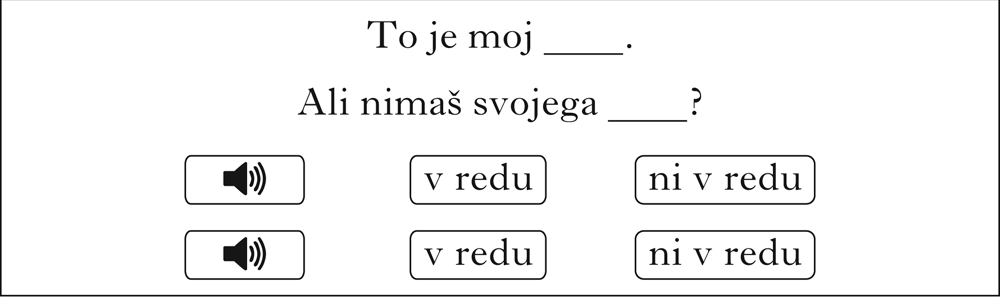
Each trial started with the frame sentence shown in Fig. 3, with blank slots for the nominative and the genitive respectively: To je moj _.‘This is my _.’ Ali nimaš svojega _? ‘Don't you have your own _?’. A button appeared on the next line; when pressed, one nominative–genitive paradigm was played, either faithful or mobile, and then two buttons appeared, v redu ‘ok’ and ni v redu ‘not ok’. Once pressed, a second sound button appeared for the other paradigm, and then two more judgement buttons. The participants were free to listen to the materials as many times as they wanted. Once they had judged both paradigms, the next stimulus was played.
Web interface for the nonce-word survey.

3.4 Results
Participants accepted one of the two genitive forms in 70% of the trials. In the remaining, less informative trials, participants accepted both genitives in 23% of the trials, and neither genitive in the remaining 6%. The results by item are in Appendix B, and the raw results are available in the online supplementary materials.
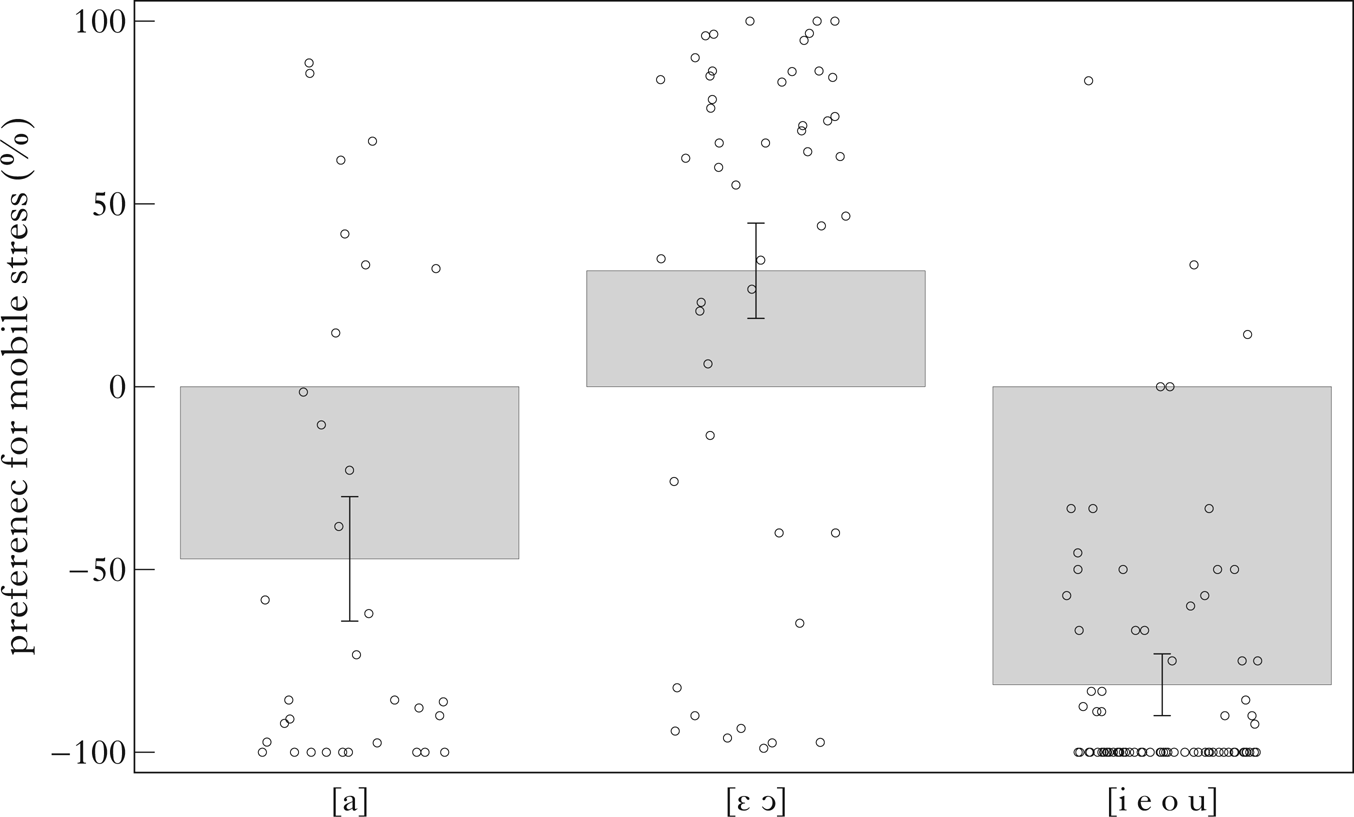
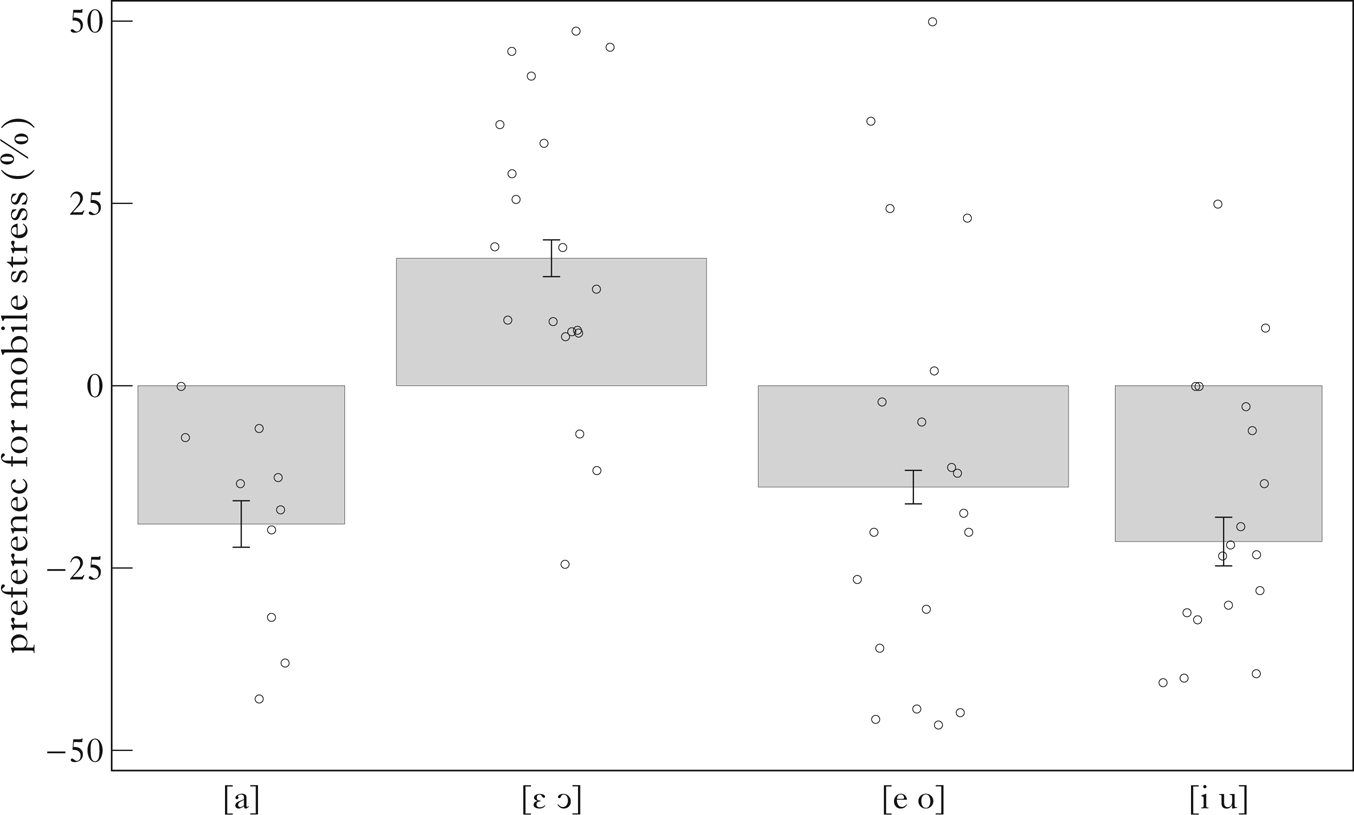
As expected from the lexicon, mobile stress was accepted with mid lax [ɛ ɔ] 17% more often overall than faithful stress, as seen in Fig. 4. With other vowels, faithful stress was preferred over mobile stress, with a difference of 21% for high vowels and 14% for mid tense vowels. With the low vowel [a], the acceptability of faithful stress was not intermediate between the lax and the tense vowels; rather, it patterned with the tense vowels (19% preference for faithful stress). The items in each vowel class are normally distributed around their means; there are no outliers or otherwise notable items.
Preference for mobile stress over faithful stress in nonce items by vowel height (145 participants, 70 nonce nouns). Error bars are 95% confidence intervals.

Speakers of central dialects accepted mobile stress 9% more often than speakers of other dialects (59% vs. 50%), ranging from a difference of 13% with mid lax vowels to 5% with high vowels.
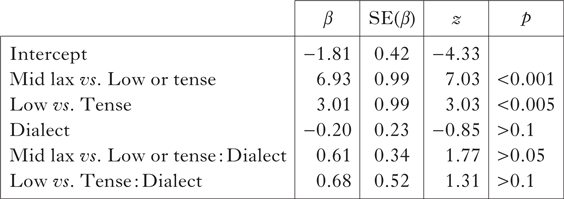
Inferential statistics were performed with a mixed-effects logistic regression model, using acceptance of the mobile stress genitive as the dependent variable, as in §2.2. All of the trials were again included, regardless of the acceptance of the faithful genitive. Vowel height was coded exactly as in §2.1 and §2.2, and dialect was coded as a centred binary variable, with a value of +0.43 for central dialects and ―0.57 for other dialects. Initially, a fully crossed model was fitted with the two predictors and their interaction, as well as maximal random slopes for participant and item. Since this model did not converge, random slopes were removed one at a time, following the method described in Barr et al. (Reference Barr, Levy, Scheepers and Tilly2013), leaving only a random slope for Low vs. Tense by participant. This final model is given in Table V.
Nonce-word regression model (145 participants, 70 nouns).

The model shows that the mobile stress genitive was significantly more acceptable with mid lax vowels than with all other vowels, but no significant difference was seen between the tense vowels and the low vowel [a]. Additionally, the model shows a significant and positive main effect of dialect, but no significant interactions, meaning that speakers of central dialects preferred stress shift overall. However, this preference was not significantly modulated by vowel quality.
Recall that the phonology of central dialects is similar to that of standard Slovenian in terms of the vowel system and the quality-driven stress shift, whereas non-central dialects differ in their vowel system and/or stress distribution. The results show that speakers of non-central dialects have less access to the grammar of standard Slovenian than speakers of central dialects, but this access is still significant.
An examination of the real-word and nonce-word studies shows that stress shift is significantly more acceptable when it moves stress away from mid lax vowels, both in real words and in nonce words. In the lexicon, stress shift away from [a] is significantly more acceptable than stress shift away from tense vowels, but there is an insignificant trend in the opposite direction in the nonce-word study.
To summarise, the nonce-word study confirms that speakers of Slovenian prefer mobile stress with mid lax vowels, and apply this preference productively to novel words, mirroring their treatment of real words. The low vowel [a], however, patterns with the tense vowels, despite the evidence for stress shift away from [a] in the lexicon. We attribute this difference to markedness: mid lax vowels are marked and therefore limited in their distribution, while the low lax [a] is unmarked and freely distributed in the language.
4 A positional faithfulness analysis
In this section, we provide an analysis of the generalisations in §2 and §3: the stressed mid lax vowels [ɛ ɔ] are frequently found in the masculine nominative singular, but in the rest of the paradigm these marked vowels are partially eliminated. When stress is non-initial, it has nowhere to move, and marked vowels are eliminated under stress, e.g. [pɾoˈmɛt ~ pɾoˈmeta]. When stress is initial, the existence of another stem vowel matters: in monosyllabic stems, the alternation is blocked because stress has nowhere to move, but the initial stressed syllable is protected, e.g. [ˈmɛʧ ~ ˈmɛʧa]. In trochaic stems, the same faithfulness to the initial stressed syllable prevents tensing under stress, and stress shifts to an available unmarked vowel, making the elimination of the marked vowel less conspicuous, e.g. [ˈjɛzik ~ jeˈzika]. In the real words of the language, stress shift is also attested with vowels that are not mid lax, especially [a], but this pattern is not extended to nonce words, i.e. it is not present in the grammar.
Positional faithfulness is indispensable for an analysis that captures the dependence of stress shift on vowel quality. The proposed analysis contrasts with alternatives based on positional markedness, which fail to reach the same level of generality.
We discuss the role of the masculine nominative singular in §4.1. Next, we set up a grammar that learns from existing lexical items, and projects generalisation selectively to nonce words. The core of our analysis, which relies on positional faithfulness, is in §4.3. We reject a range of alternatives in §4.4, and summarise in §4.5.
4.1 Strong faithfulness in the masculine nominative singular
In the masculine nominative singular, stress is contrastive, and marked vowels are tolerated, which we attribute to strong faithfulness to underlying stress and vowel qualities. In the rest of the paradigm, weaker faithfulness allows the elimination of mid lax vowels and low tense vowels. For example, the low tense [ʌ] surfaces in the nominative singular [ˈbɾʌt], due to Ident[ATR] ⪢ *LowTense, but the genitive [ˈbɾata] is the result of the opposite ranking. What singles out the masculine nominative singular? Language-internally, as argued by Jurgec & Bjorkman (Reference Jurgec and Bjorkman2018), it is the only part of the paradigm that allows bare roots, or morphologically simple forms. Cross-linguistically, it represents the confluence of unmarked number, unmarked gender and unmarked case; see e.g. McFadden (Reference McFadden and Grohmann2009, Reference McFadden2018) for arguments that the nominative is syntactically unmarked.
Further support for the unique status of the zero-ending masculine nominative singular comes from frequency. While evidence from Slovenian is not available, data from Russian (Slioussar & Samojlova Reference Slioussar and Samojlova2015) is entirely consistent with the proposal: masculine is the most common gender (47%), nominative the most common case (30%), singular the most common number (78%) and zero the most common ending (24%).
Various theoretical frameworks allow the masculine nominative singular to be determined by a different constraint ranking, such as cophonologies (Inkelas et al. Reference Inkelas, Orhan Orgun and Zoll1996, Anttila Reference Anttila2002, Inkelas & Zoll Reference Inkelas and Zoll2007) or indexed constraints (Itô & Mester Reference Ito, Mester, Beckman, Dickey and Urbanczyk1995, Pater Reference Pater2000, Reference Pater and Parker2009a, Reference Paterb, Flack Reference Flack2007, Gouskova Reference Gouskova2007, Becker Reference Becker2009, Jurgec Reference Jurgec2010). Jurgec & Bjorkman (Reference Jurgec and Bjorkman2018) propose that constraints can be specific to unaffixed words, modifying the lexical indexation schema. The current proposal is compatible with any of these possibilities.
The marked vowels [ɛ ɔ ʌ] are further limited to native nouns; they do not appear in established loanwords (Jurgec Reference Jurgec2010). This again suggests the regulation of these vowels along lexical lines.
4.2 Protection of existing items
Leaving the nominative singular behind, we focus on the more interesting grammar of the rest of the paradigm, exemplified throughout by the genitive singular. Our goal is to present a grammar that is learned from real words of the language, and correctly derives all of the real words, but also makes gradient predictions for nonce words, capturing the results of our nonce-word task. Zuraw's (Reference Zuraw2000) UseListed framework was designed to capture such effects: existing words are memorised and protected by a UseListed constraint, and novel words are derived productively by a grammar that is trained on the words of the lexicon (see Moore-Cantwell & Pater Reference Moore-Cantwell and Pater2016 and Zymet Reference Zymet2018 for more recent work on the grammar of irregular lexicons). To account for the gradience in our data, we switch from categorical Optimality Theory to a gradient constraint-based approach. Gradience in Zuraw (Reference Zuraw2000) was modelled by the Gradual Learning Algorithm (Boersma & Hayes Reference Boersma and Hayes2001), which was later shown in Pater (Reference Pater2008) to lack a solid mathematical foundation. We opt for the more established Maximum Entropy framework (MaxEnt; Goldwater & Johnson Reference Goldwater, Johnson, Spenader, Eriksson and Dahl2003, Wilson Reference Wilson2006). For a broader review of gradient constraint-based approaches, see Hayes (Reference Hayes2017).
The grammar has two context-free markedness constraints, *MidLax and *LowTense, and several faithfulness constraints, to be listed below. Crucially, there is no constraint penalising the unmarked vowels [i e a o u], and therefore nothing compels the alternation when stress shifts away from these vowels. Canonically, stress shifts away from an initial mid lax vowel, but there are also 16 lexical items that have stress shift under different conditions: stress shift away from [e] in [ˈtɾebux ~ tɾeˈbuxa] and stress shift away from a non-initial vowel in [peˈtɛlin ~ peteˈlina], and also 14 items with stress shift away from [a], e.g. [ˈnazoɾ ~ naˈzoɾa]. Like all nouns, regardless of their phonology, these 16 nouns are memorised and protected by UseListed, as seen in (6), but they make no contribution to any general productive pattern. Candidates (6a) and (6b) are generated productively from the concatenation of the nominative singular base with the genitive suffix, and compete with the next two candidates, which are derived directly from the memorised genitive [tɾeˈbuxa]. The use of the memorised form is favoured by UseListed, and faithfulness allows it to surface unchanged.
-
(6)
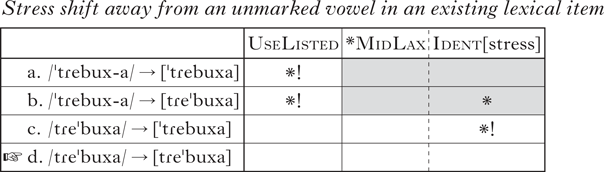
In our analysis, then, [ˈtɾebux], [peˈtɛlin] and the 14 items with [a] are lexicalised, or fossilised. Productive stress shift is only learned from the remaining 56 items in which stress shifts away from an initial mid lax vowel, which compete with eleven items in which it does not (see Table I above). Words with canonical stress shift, e.g. [ˈjɛzik ~ jeˈzika], are also listed, and their genitives are therefore protected by UseListed, but they also provide evidence for stress shift motivated by *MidLax.
Novel items presented to speakers in their nominative singular form lack a memorised genitive, regardless of whether the genitive has faithful or mobile stress, and are therefore all equally penalised by UseListed. This is exemplified by the nonce item [ˈbagem] in (7), whose genitive does not exist and therefore must be derived productively. UseListed penalises all of the candidates equally, and the decision is handed down to the grammar, in this case favouring the fully faithful genitive.
-
(7)

With unmarked vowels such as [a] and [e], stress shift is entirely unmotivated; the shifted candidate is harmonically bounded by the faithful candidate. This grammar is unable to reproduce the difference in the lexicon between [e] (one alternating item) and [a] (14 alternating items). This prediction is borne out in the treatment of nonce words, as seen in Fig. 4 above, where stress shift is equally disfavoured in nonce words with [a] and [e]; indeed, there is a non-significant trend in the opposite direction.
The stress-shifted genitive [baˈgema] is harmonically bounded in (7), which guarantees its absolute ungrammaticality in a categorical grammar. In our MaxEnt grammar, the predicted well-formedness of stress shift from an unmarked vowel is low (6%), and is the same for all five vowels.
4.3 Stress shift eliminates mid lax vowels
Mid lax vowels in forms other than the masculine nominative singular are reduced in two ways: when the stressed mid lax vowel is non-initial, it is tensed in situ in most words. In nouns with initial stress, positional faithfulness blocks the alternation in monosyllables, whereas in trochaic stems, the same protection of the initial stressed position causes stress to move away, to allow tensing in the less prominent unstressed initial position.
We use a family of Ident[ATR] constraints to model these effects: first, general Ident[ATR] penalises all differences in [ATR] between the nominative singular and the rest of the paradigm. Next, the positional constraints Ident[ATR]/σ1 and Ident[ATR]/ˈσ penalise changes in word-initial and stressed positions respectively (Beckman Reference Beckman1997, Reference Beckman1998). Finally, the most specific Ident[ATR]/ˈσ1 penalises changes in stressed initial position, and can be construed either as an atomic constraint or as the conjunction of the previous two (see Tessier Reference Tessier2007: §2.6.3–§2.6.5 on choosing between positional faithfulness constraints, and Shih Reference Shih2017 for further discussion of constraint conjunction in MaxEnt grammars). Stress shift is penalised by the general constraint Ident[stress]. The weights of the constraints were obtained by training the grammar on the lexicon from §2.1 using the MaxEnt Grammar Tool (Hayes & Wilson Reference Hayes and Wilson2008). Following Zuraw (Reference Zuraw2000), the training did not include the constraint UseListed.
We present the application of this grammar in (8)–(10), starting with a mid lax vowel in the less prominent non-initial position, followed by mid lax vowels in the initial stressed position.
Faithfully retaining a mid lax vowel is penalised by *MidLax, as seen in (8a). Tensing in stressed position violates both the general Ident[ATR] and the specific Ident[ATR]/ˈσ. To keep the tableaux manageable, we stipulate that stress shift to suffixes and stress shift to the left are blocked. The prediction in (8) is an expected well-formedness score of 61%, i.e. tensing a non-initial mid lax vowel is fairly acceptable.
-
(8)
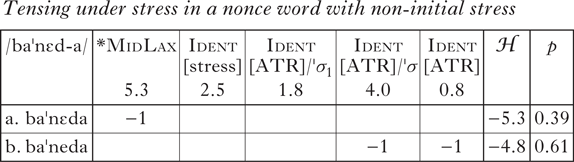
In monosyllabic stems, the stressed syllable is word-initial, and thus tensing it incurs an additional violation of Ident[ATR]/ˈσ1 relative to polysyllabic stems, as seen in (9).
-
(9)
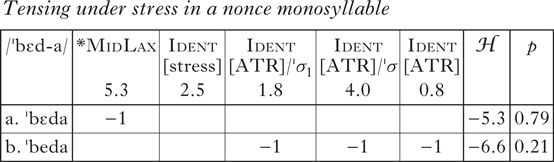
This added violation of Ident[ATR]/ˈσ1 reduces the predicted well-formedness of tensing from 61% in polysyllables to 21% in monosyllables; cf. the difference in the lexicon of 70–82% and 35–44% respectively (see Table IV in §2.3). The numbers do not match perfectly, because the proposed constraints are general, and apply both to tensing under stress and to tensing with stress shift. The same positional faithfulness constraints do double duty, maintaining mid lax vowels in monosyllables while preventing the maintenance of the same vowels in trochees, as seen in (10).
-
(10)

In the genitive of nonce [ˈbɛdiʃ], the fully faithful candidate in (10a) incurs only a violation of *MidLax, just like (9a). Tensing under stress in (10b) incurs violations of positional faithfulness, just like (9b). However, the best candidate, (10d), involves stress shift, allowing the elimination of the marked vowel in an unstressed position. Stress shift is favoured because it avoids penalties from positional faithfulness constraints. There is no violation of faithfulness to the stressed initial position in (10d), because the initial syllable is not stressed in the output, and prominent positions are defined relative to the output in positional faithfulness theory (Beckman Reference Beckman1997, Reference Beckman1998).
Plain initial syllable faithfulness is violated in both (9b) and (10d), which is why Ident[ATR]/σ1 was assigned a weight of zero and left out of all the tableaux.
The grammar presented here exemplifies a straightforward prediction of positional faithfulness: the stressed prominent position moves in order to avoid an unfaithful mapping in the prominent position. The prediction is borne out in Slovenian, as seen in (10) above, showing that the Beckman-Noyer ranking is not problematic.
The tableau in (10) is a version for Slovenian of Jesney's (Reference Jesney2011) tableau (6b), with one difference: in Jesney's account, moving the prominent position incurs a violation of the markedness constraint Trochee, whereas here it incurs a violation of the faithfulness constraint Ident[stress].
Jesney also considers inputs in which all of the underlying vowels are marked, e.g. /ˈbɛdɛʃ/ (her tableau (7)). In our analysis of Slovenian, a hypothetical stem with only mid lax vowels strongly prefers faithful stress, e.g. /ˈbɛdɛʃ-a/ → [ˈbɛdeʃa], because shifting stress to [beˈdɛʃa] adds a violation of Ident[stress], without removing a violation of *MidLax. Recall that shift to a suffix vowel is blocked by fiat. In this type of grammar, stress is optimally moved away from a mid lax vowel, but if there is no eligible unmarked vowel to move to, one mid lax vowel surfaces faithfully and all of the other mid lax vowels reduce to tense.
Given a nominative singular with a peninitial mid vowel such as [ˈbɛdeʃ], a Slovenian speaker could potentially posit an underlying representation such as /ˈbɛdɛʃ/ rather than the more surface-true /ˈbɛdeʃ/, and therefore indirectly allow the quality of the peninitial vowel to influence the position of stress in the genitive. However, in the nonce-word experiment, preference for stress shift was stronger with a peninitial mid vowel, not weaker (14% preference for stress shift with a non-mid peninitial vowel vs. 22% preference for stress shift with a mid peninitial vowel). This result is incompatible with the idea that speakers assume two lax vowels in the underlying representation to any detectable extent.
Jesney (Reference Jesney2011) proposes a method for excluding Slovenian-like patterns in the framework of Harmonic Serialism (McCarthy Reference McCarthy2010, Reference McCarthy, McCarthy and Pater2016). In this theory, prominent positions are defined relative to the input to the previous stage of the derivation, and therefore stress shift in /ˈbɛdiʃ-a/ → [beˈdiʃa] is blocked, because the reduction of the mid lax vowel still takes place in the prominent position. It seems likely, however that Slovenian could be analysed in Harmonic Serialism with a different set of underlying representations and constraints, for example by replacing underlying stress and faithfulness to stress with lexically specific alignment. We leave this task for future work.
4.4 Possible alternatives to positional faithfulness
We have provided an adequate analysis of Slovenian stress shift: stress moves away from a marked vowel to allow it to reduce inconspicuously, and this alternation is governed by the same positional faithfulness constraints that protect marked vowels in monosyllables from being eliminated under stress. Because this analysis relies on a type of constraint interaction that has been considered problematic, we must ask whether there is a workable analysis without positional faithfulness, of course within plausible limits on the admissible types of constraints.
We maintain the assumption that the grammar only shifts stress away from mid lax vowels, and consider an alternative analysis that dispenses with positional faithfulness and instead introduces positional markedness. To motivate stress shift, we use a stress-window constraint that we dub StemFinal (‘stress must be stem-final’) or a similar positional markedness constraint. This constraint must be dominated by the general faithfulness constraint Ident[stress], as shown in (11), to prevent stress shift away from the unmarked [i e a o u].
-
(11)

The problem with this grammar is that without positional faithfulness, *MidLax can only cause tensing, never shifting, as shown in (12). Without positional faithfulness, the intended winner [beˈdiʃa] loses, or, in a stochastic grammar, [beˈdiʃa] would be predicted to be less well-formed than [ˈbediʃa], contrary to fact.
-
(12)

Similarly, a positional markedness constraint that penalises initial mid lax vowels (*InitialMidLax) will not help, for the same reason: it would penalise the fully faithful candidate (12a), but leave tensing in situ, as in (12b), as the winner.
Even less useful would be a positional markedness constraint against mid lax vowels in unstressed syllables, *MidLaxunstressed; this constraint would not be violated at all in (12) or in the tableaux below, and would do no work. We thus reject the possibility of an analysis that eliminates positional faithfulness and retains only markedness and general faithfulness.
A second alternative to positional faithfulness would be a conjunction of positional markedness and general faithfulness, in this case, Ident[ATR] and StemFinal (Smolensky Reference Smolensky1997, Reference Smolensky, Smolensky and Legendre2006, Łubowicz Reference Łubowicz2005), as in (13). The conjoined constraint penalises tensing under non-stem-final stress, correctly allowing [beˈdiʃa] to be the most well-formed, followed by [ˈbɛdiʃa].
-
(13)

This analysis works for nouns with non-stem-final stress, and extends correctly to polysyllables with stem-final stress, as shown in (14). Tensing in situ is predicted by the ranking *MidLax ⪢ Ident[ATR].
-
(14)

Without positional faithfulness, however, nothing blocks tensing in monosyllabic stems, as seen in (15). To block tensing in monosyllables, an additional constraint would have to outrank *MidLax and prevent tensing, while still allowing the tensing in trochees in (13), for example a constraint against lax vowels in initial syllables. Such a constraint has no typological support, since languages that allow lax vowels (or any other marked structure) in all syllables but the initial one are unknown.
-
(15)

The beauty of positional faithfulness lies precisely in its ability to connect the behaviour of monosyllabic stems with the opposite behaviour of trochaic stems; abandoning this family of constraints leads to a loss of generality. We hope to have shown that any alternative to positional faithfulness is rather unappealing, combining lack of generality with unattractive constraints.
To reiterate, the current proposal depends on the types of constraints that the analyst allows: general (context-free) markedness, general faithfulness, positional markedness and positional faithfulness. Positional faithfulness, we argue, is necessary for an analysis that captures the entire range of phenomena in Slovenian.
4.5 Local summary
The proposed analysis consists of several components: the unsuffixed masculine nominative singular is assumed to be the base of the derivation, and to enjoy stronger resistance to markedness pressures. In the rest of the nominal paradigm, a markedness constraint against mid lax vowels allows the grammar to capture the elimination of these vowels, either via stress shift or in situ. The analysis leaves behind those few lexical items in which stress shifts away from other vowels, or away from a non-initial syllable; those items are listed and retrieved from the lexicon correctly, but they do not contribute to the productive grammar.
A positional faithfulness constraint that penalises tensing in the initial stressed position does double duty: it prevents tensing in situ in monosyllabic stems, and drives stress shift, with concomitant tensing in trochaic stems. While there is an alternative analysis that relies on markedness–faithfulness conjunction, it cannot capture the connection between stress shift and tensing in situ.
5 Conclusions
In this article we have surveyed the stress and laxness alternations in the Slovenian nominal system, and have suggested that they instantiate a Beckman-Noyer ranking (formerly the Beckman-Noyer problem; McCarthy Reference McCarthy2007). In this kind of grammar, strong positional faithfulness to laxness, combined with weak faithfulness to stress, allows mid lax vowels to trigger stress shift. In parallel constraint-based theories (Optimality Theory or MaxEnt), the analysis follows without complication from the tenets of positional faithfulness theory. In Harmonic Serialism, the analysis we proposed is blocked, necessitating some further adjustment to the theory.
We examined the Slovenian nominal system, and observed that in the unsuffixed masculine nominative singular stressed mid lax vowels occur rather freely. In suffixed forms, these marked vowels are reduced to tense vowels in most lexical items. When stress is on a non-initial syllable of the stem (which is usually an iambic disyllable), the marked vowels are reduced in situ. In stems with initial stress, tensing under stress is blocked by positional faithfulness, which is why mid lax vowels are maintained in most monosyllables. In trochaic stems, the same positional faithfulness constraint blocks reduction under stress, and stress shifts rightwards, to allow the stem-initial vowel to reduce in a less prominent position.
The strong positions in Beckman's (Reference Beckman1998) original proposal are both phonological and morphological, and the exact inventory of prominent positions is a matter of ongoing research and debate. Beckman's original phonological positions are onsets, initial syllables and stressed syllables (see also Crosswhite Reference Crosswhite2001), with later proposals including final positions (Barnes Reference Barnes2006) and prevocalic and presonorant positions (as opposed to pre-obstruent positions; Rubach Reference Rubach2008). Giavazzi (Reference Giavazzi2010) argues for a somewhat different set of phonetically based strong positions, such as the post-stress position. Morphologically strong positions include the root (McCarthy & Prince Reference McCarthy and Prince1993, Beckman Reference Beckman1998), the noun (Smith Reference Smith2002, Reference Smith, van Oostendorp, Ewen, Hume and Rice2011), the head (Moreton et al. Reference Moreton, Smith, Pertsova, Broad and Prickett2017), and the bare root and uninflected stem (Jurgec & Bjorkman Reference Jurgec and Bjorkman2018). Here, we combine the initial position and the stressed position into one initial stressed position. If this is construed as atomic, research on the typological, phonetic and psycholinguistic support for this position is called for. Alternatively, if faithfulness to initial stressed syllables is the conjunction of initial syllable faithfulness and stressed syllable faithfulness, further research is needed on the predicted effects of conjoined positional faithfulness constraints (see Tessier Reference Tessier2007: §2.6.3–§2.6.5 on managing multiple positional faithfulness constraints).
To some extent, we believe that Beckman-Noyer rankings were thought to be problematic due to the absence of large typological studies of positional phenomena, an absence that persists to this day. For example, the WALS database (Dryer & Haspelmath Reference Dryer and Haspelmath2013) focuses on phonemes and segmental phonotactics, such as the presence of initial [ŋ], but does not track prosodic positions. Similarly, PBase (Mielke Reference Mielke2007) and the OSU metathesis database (Hume et al. Reference Hume, Seyfarth and Zhu2019) catalogue rules or processes, but do not track prominent positions. The small typological study of initial syllable phenomena in Becker et al. (Reference Becker, Nevins and Levine2012) is overdue for expansion.
The effect of Beckman-Noyer rankings is not limited to prominent syllables (stressed and/or initial), but rather extends to all kinds of phonological objects. McCarthy (Reference McCarthy2007) and Jesney (Reference Jesney2011) examine a Beckman-Noyer ranking that revolves around positional faithfulness to onset consonants, predicting a problematic language in which voiced obstruents are devoiced and resyllabified into codas to satisfy onset faithfulness and *VoicedObstruent, e.g. /pata/ → [pa.ta], but /pada/ → [pat.a]. One type of solution to these cases is to re-examine the proposed prominent positions. For example, Rubach (Reference Rubach2008) proposes to replace faithfulness to onsets with faithfulness to syllable-blind presonorant faithfulness. In another syllable-blind proposal, Giavazzi (Reference Giavazzi2010) examines the blocking of alternations in posttonic consonants.
For Slovenian, we propose that a context-free markedness constraint against mid lax vowels is responsible for stress shift. This interaction between vowel quality and stress has been argued to be restricted: according to de Lacy (Reference de Lacy2006, Reference de Lacy and Lacy2007) and Blumenfeld (Reference Blumenfeld2006), only sonority or tone can interact with stress assignment, but segmental features cannot, and specifically, higher-sonority vowels attract stress away from lower-sonority vowels. The sonority hierarchy of de Lacy (Reference de Lacy2006: 68) orders peripheral vowels as follows: [a] > [ɛ ɔ] > [e o] > [i u]. A sonority-based analysis would run into the following problem, then: mid lax vowels repel stress, while the more sonorous [a] and the less sonorous tense vowels have no effect on stress. Stress shift neither increases nor decreases with sonority; it is conditioned by the markedness of mid lax vowels. We conclude that Slovenian stress makes direct reference to particular vowel qualities. In later work, Shih (Reference Shih, Hansson, Farris-Trimble, McMullin and Pulleyblank2016, Reference Shih2018) and Shih & de Lacy (Reference Shih and de Lacy2020) make the stronger claim that even sonority cannot influence stress assignment. A similar claim is also made by Rasin (Reference Rasin2017). The Slovenian generalisation uncovered here directly contradicts these claims, regardless of whether sonority is relevant in Slovenian.
This study of Slovenian contributes to the understanding of the typology of prominent syllables and the development of positional faithfulness theory, yet it also highlights the challenge of collecting similar cases. In Slovenian, the generalisation is muddied by the exceptions that are observed in the lexicon, and it was the nonce-word study that revealed the grammar that speakers project from this lexicon. We hope that further efforts to uncover such hidden generalisations will continue to inform typological studies and linguistic theory.